
Chapter 12 – Responsibility Accounting, Operational Performance Measures, and the Balanced Scorecard
12-1
Chapter 12
Responsibility Accounting, Operational Performance Measures, and the
Balanced Scorecard
Answer Key
True / False Questions
1. Each department, responsible for different processes, should have goals different from the
company as a whole.
2. Responsibility accounting refers to the various concepts and tools used by managers to
measure the performance of people and departments in order to foster goal congruence.
3. A cost center manager does not have the ability to produce revenue.

Chapter 12 – Responsibility Accounting, Operational Performance Measures, and the Balanced Scorecard
12-2
4. A company-owned restaurant in a fast-food chain is considered an investment center.
5. Performance reports help managers use management by exception and effectively control
operations.
6. Performance reports are unique in that they do not incorporate budgets and variance
analysis.

Chapter 12 – Responsibility Accounting, Operational Performance Measures, and the Balanced Scorecard
12-3
7. An allocation base for a cost pool should ideally be a cost object.
8. A collection of costs to be assigned is called a cost pool.
9. Common costs are charged to a company’s operating segments when preparing a segmented
income statement.

Chapter 12 – Responsibility Accounting, Operational Performance Measures, and the Balanced Scorecard
12-4
10. Costs that are traceable to a segment and are completely beyond the influence of the
segment manager can be advantageously divided in segment reports into two distinct
responsibilities – those for segments and those for segment managers.
11. Inventory control is important in achieving the benefits of a just-in-time (JIT) philosophy.
12. The continual search for the most effective method of accomplishing a task by comparing
existing methods and performance levels with those of other organizations, or with other
subunits within the same organization is known as a gain-sharing plan.
Chapter 12 – Responsibility Accounting, Operational Performance Measures, and the Balanced Scorecard
12-5
13. The typical balanced scorecard is best described as containing both financial and
nonfinancial performance measures.
14. A company’s balanced scorecard should focus on the performance measurements that are
most important to its key competitor.
Chapter 12 – Responsibility Accounting, Operational Performance Measures, and the Balanced Scorecard
12-6
Multiple Choice Questions
15. When managers of subunits throughout an organization strive to achieve the goals set by
top management, the result is:
16. The concepts and tools used to measure the performance of people and departments are
known as:

Chapter 12 – Responsibility Accounting, Operational Performance Measures, and the Balanced Scorecard
12-7
17. Which of the following is not an example of a responsibility center?
18. A manufacturer’s raw-material purchasing department would likely be classified as a:
Chapter 12 – Responsibility Accounting, Operational Performance Measures, and the Balanced Scorecard
12-8
19. Halpern Corporation is in the process of overhauling the performance evaluation system
for its San Diego manufacturing division, which produces and sells parts that are popular in
the aerospace industry. Which of the following is least likely to be chosen to evaluate the
overall operations of the San Diego division?
20. A cost center manager:
Chapter 12 – Responsibility Accounting, Operational Performance Measures, and the Balanced Scorecard
12-9
21. The Telemarketing Department of a residential remodeling company would most likely be
evaluated as a:
22. A revenue center manager:
Chapter 12 – Responsibility Accounting, Operational Performance Measures, and the Balanced Scorecard
12–10
23. If the head of a hotel’s food and beverage operation is held accountable for revenues and
costs, the food and beverage operation would be considered a (n):
24. A profit center manager:
Chapter 12 – Responsibility Accounting, Operational Performance Measures, and the Balanced Scorecard
12–11
25. Which of the following would have a low likelihood of being organized as a profit
center?
26. Swift Software operates stores within five regions. Regional managers are held
accountable for marketing, advertising, and sales decisions, and all costs incurred within their
region. In addition, regional managers decide whether new stores will open, where the stores
will be located, and whether the stores will lease or purchase the facilities. Store managers, in
contrast, are accountable for marketing, advertising, sales decisions, and costs incurred within
their stores. Ideally, on the basis of this information, what type of responsibility center should
the software company use to evaluate its regions and stores?
Chapter 12 – Responsibility Accounting, Operational Performance Measures, and the Balanced Scorecard
12–12
27. Decentralized firms can delegate authority by structuring an organization into
responsibility centers. Which of the following organizational segments is most like a totally
independent, standalone business where managers are expected to “make it on their own”?
28. A responsibility center in which the manager is held accountable for the profitable use of
assets and capital is commonly known as a (n):
Chapter 12 – Responsibility Accounting, Operational Performance Measures, and the Balanced Scorecard
12–13
29. An investment center manager:
30. The Asian Division of a multinational manufacturing organization would likely be
classified as a:

Chapter 12 – Responsibility Accounting, Operational Performance Measures, and the Balanced Scorecard
12–14
31. Performance reports help managers:
32. Consider the following statements about performance reports:
I. Performance reports provide feedback to managers and allow them to better control
operations.
II. Many performance reports have budget, actual, and variance data.
III. Performance reports are often structured around a firm’s organizational hierarchy—that is,
data relating to lower-level units (e.g., departments) are combined and flow into higher-level
units (e.g., stores).
Which of the above statements is (are) true?
Chapter 12 – Responsibility Accounting, Operational Performance Measures, and the Balanced Scorecard
12–15
33. Republic Resorts owns numerous hotels on each of the Hawaiian Islands. The company’s
performance reporting system is structured around the firm’s organizational structure, with
information flowing from operating departments at a particular property and later respectively
grouped by individual hotel, island operation (i.e., division), and the company as a whole.
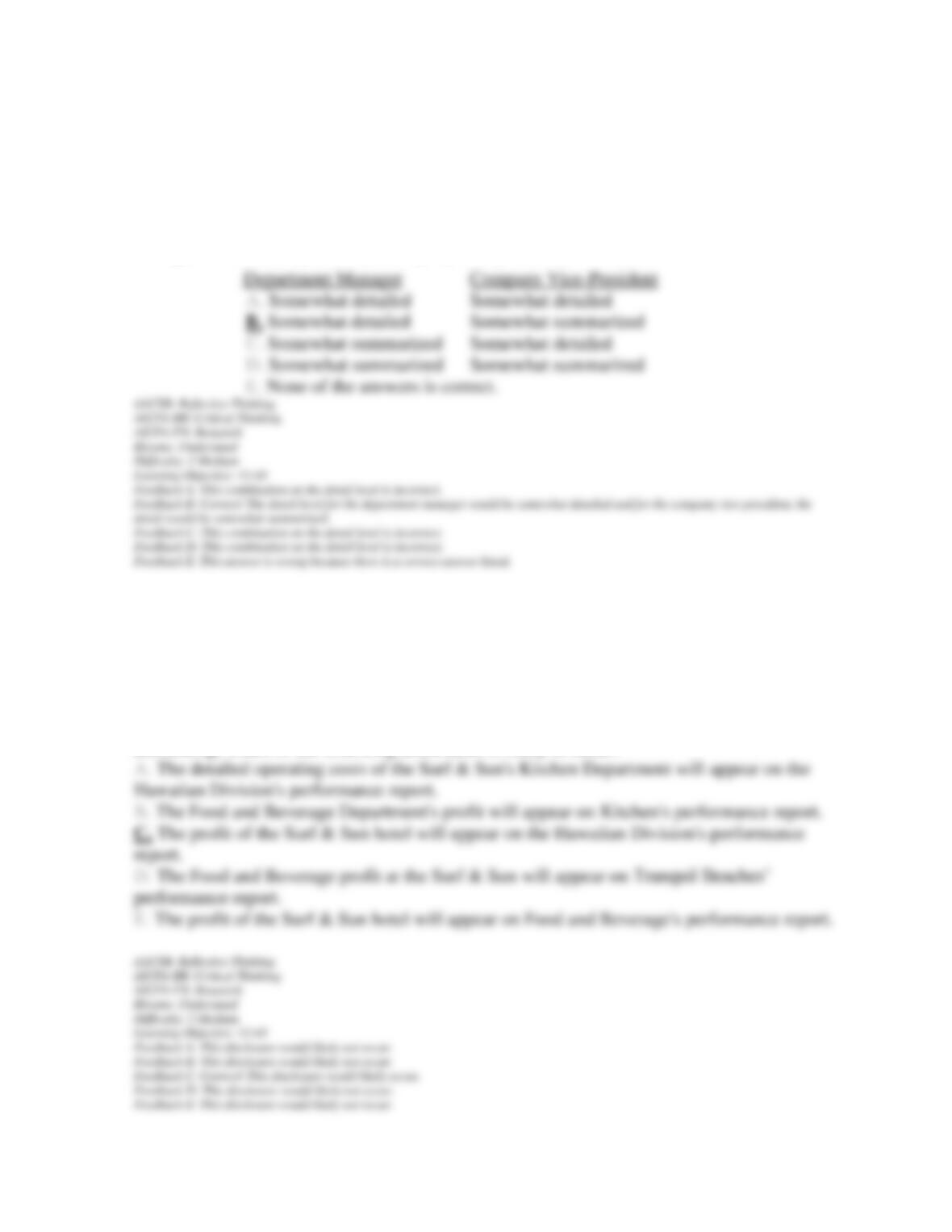
Which of the following best depicts the detail level of the information given to a department
manager versus that reported to a company vice-president?
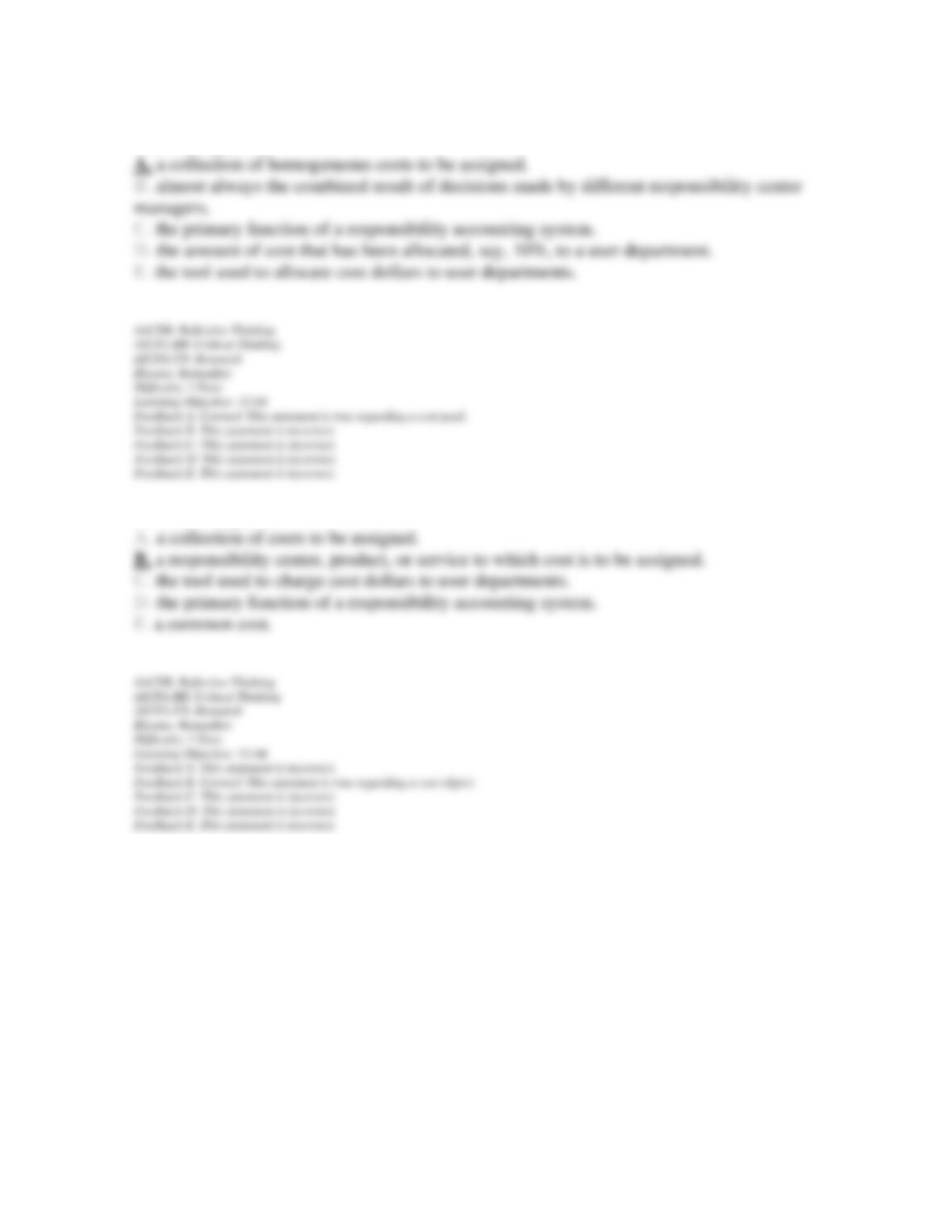
34. Tranquil Beaches owns six hotels in Hawaii, collectively known as the Hawaiian
Division. The various hotels, including the Surf & Sun, have operating departments (such as
Maintenance, Housekeeping, and Food and Beverage) that are evaluated as either cost centers
or profit centers. The Food and Beverage Department, for example, is a profit center, with
activities divided into three segments: Banquets and Catering, Restaurants, and Kitchen. If
Tranquil Beaches uses a performance-reporting system that is based on responsibility
accounting, which of the following disclosures is likely to occur?
Chapter 12 – Responsibility Accounting, Operational Performance Measures, and the Balanced Scorecard
12–16
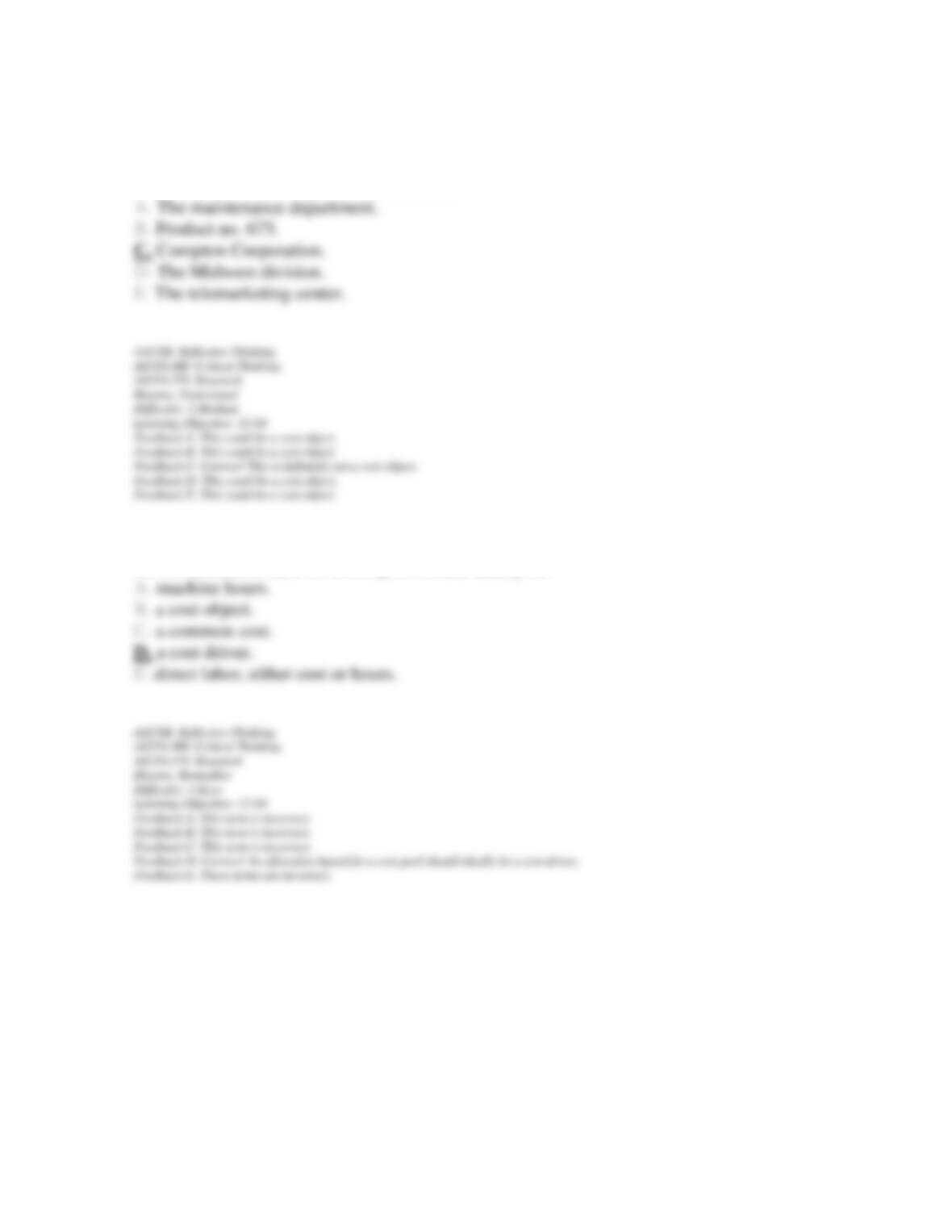
35. A cost pool is:
36. A cost object is:
Chapter 12 – Responsibility Accounting, Operational Performance Measures, and the Balanced Scorecard
12–17
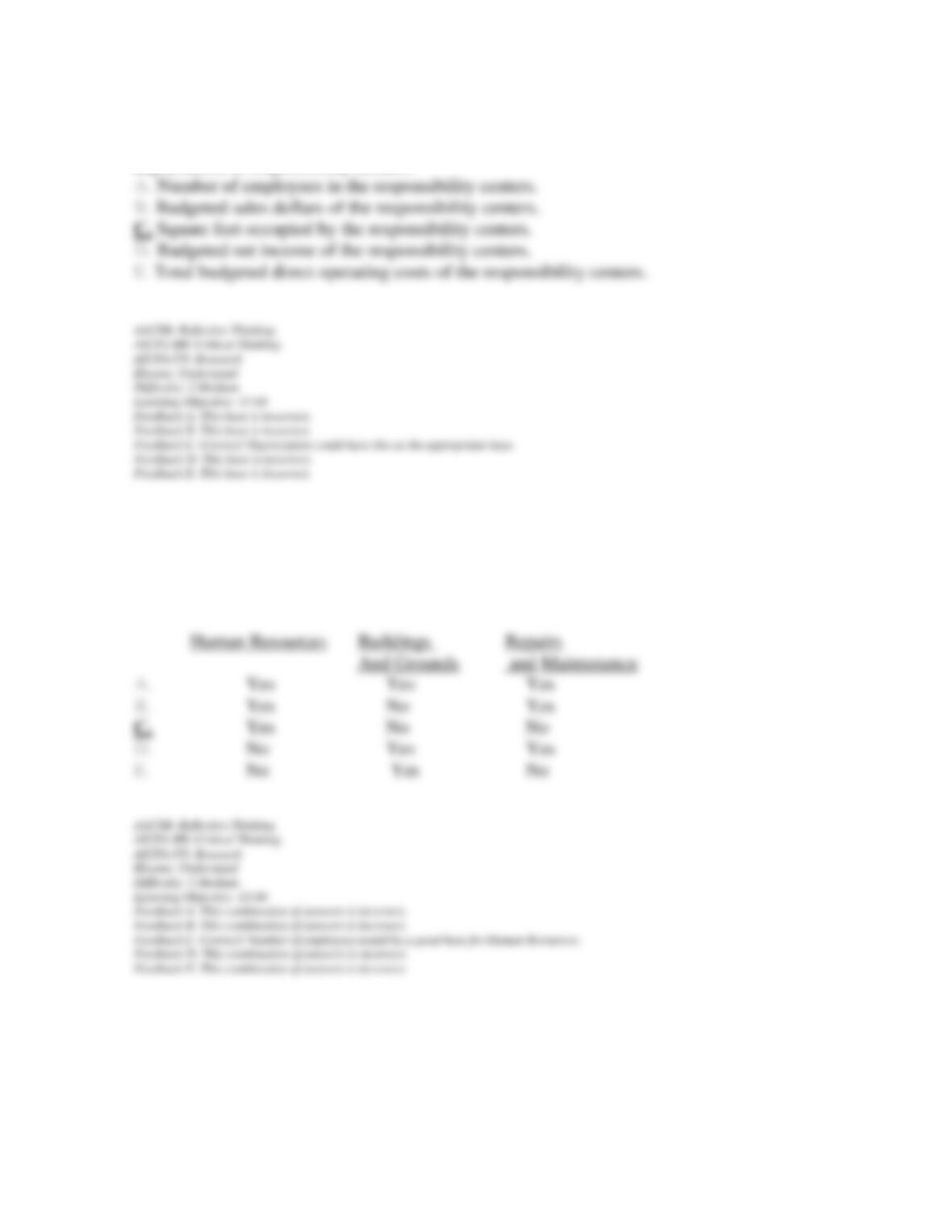
37. Compton Corporation, with operations throughout the country, will soon allocate
corporate overhead to the firm’s various responsibility centers. Which of the following is
definitely not a cost object in this situation?
38. An allocation base for a cost pool should ideally be:
Chapter 12 – Responsibility Accounting, Operational Performance Measures, and the Balanced Scorecard
12–18
39. Which of the following is an appropriate base to distribute the cost of building
depreciation to responsibility centers?
40. Crimson Industries is in the process of evaluating allocation bases so that selected costs
can be charged to responsibility centers. Would the number of employees likely be a good
base for allocating the costs of Human Resources, Building and Grounds, and Repairs and
Maintenance to user centers?
Chapter 12 – Responsibility Accounting, Operational Performance Measures, and the Balanced Scorecard
12–19
41. Cost pools should be charged to responsibility centers by using:
A. budgeted amounts of allocation bases because the cost allocation to one responsibility
center should influence the allocations to others.

Chapter 12 – Responsibility Accounting, Operational Performance Measures, and the Balanced Scorecard
12–20
Use the following information to answer Questions 42 and 43.
Management of Wee Ones (WO), an operator of day-care facilities, wants the company’s
profit to be subdivided by center. The firm’s accountant has provided the following data:
Center
Budgeted
Revenue
Actual
Revenue
Budgeted
Direct
Costs
Actual
Direct
Costs
Downtown
$320,000
$340,200
$300,000
$300,000
Irvine
560,000
534,600
510,000
440,000
H. Beach
720,000
745,200
690,000
740,000
Totals
$1,600,000
$1,620,000
$1,500,000
$1,480,000
WO’s advertising, which is handled by the home office, is not reflected in the preceding
figures and amounted to $60,000.
42. If advertising expense were allocated to centers based on actual center profitability, the
amount of advertising expense allocated to the Irvine center would be closest to: