Accounting, 9e (Horngren)
Chapter 12 Corporations: Paid-in Capital and the Balance Sheet
Learning Objective 12-1
1) The formation of a corporation is generally less complicated than the formation of a partnership.
2) A corporation is a separate legal entity formed under the laws of a particular state.
3) Stockholders of a corporation have unlimited liability for the corporation’s debt.
4) A disadvantage of the corporation is the separation between the owners of the corporation (the stockholders) and
the managers of the corporation, which can sometimes result in a conflict of interests.
5) Which of the following is a TRUE statement about a corporation?
A) The owners of a corporation have co-ownership of the property of the corporation.
B) A corporation is not taxed on the corporation‘s business income.
C) A corporation has a limited life.
D) The owners of a corporation have limited liability for the corporation’s debts.
6) Which of the following characteristics of a corporation limits a stockholder’s loss to the amount of his or her
investment in the stock of the corporation?
A) Transferability of ownership
B) Limited liability
C) Separate legal entity
D) Separation of ownership and management
7) Which of the following statements describes the corporate characteristic termed no mutual agency?
A) The liabilities of the corporation cannot be extended to the personal assets of the shareholder.
B) Shares of stock can be readily bought and sold by investors on the open market.
C) Shareholders are not authorized to sign contracts or make business commitments on behalf of the corporation.
D) Corporations pay income tax on corporate earnings, and shareholders pay personal income tax on corporate
dividends and gains from sale of stock.
8) Which of the following statements describes the corporate characteristic termed limited liability?
A) The liabilities of the corporation cannot be extended to the personal assets of the shareholder.
B) Shares of stock can be readily bought and sold by investors on the open market.
C) Shareholders are not authorized to sign contracts or make business commitments on behalf of the corporation.
D) Corporations pay income tax on corporate earnings, and shareholders pay personal income tax on corporate
dividends and gains from sale of stock.
9) Which of the following statements describes the corporate characteristic termed double taxation?
A) The liabilities of the corporation cannot be extended to the personal assets of the shareholder.
B) Shares of stock can be readily bought and sold by investors on the open market.
C) Shareholders are not authorized to sign contracts or make business commitments on behalf of the corporation.
D) Corporations pay income tax on corporate earnings, and shareholders pay personal income tax on corporate
dividends and gains from sale of stock.
10) Which of the following statements describes the corporate characteristic of easy transfer of corporate
ownership?
A) The liabilities of the corporation cannot be extended to the personal assets of the shareholder.
B) Shares of stock can be readily bought and sold by investors on the open market.
C) Shareholders are not authorized to sign contracts or make business commitments on behalf of the corporation.
D) Corporations pay income tax on corporate earnings, and shareholders pay personal income tax on corporate
dividends and gains from sale of stock.
11) Which of the following corporate characteristics is a disadvantage of the corporate form of business?
A) Limited liability
B) Double taxation
C) No mutual agency
D) Transferability of ownership
12) Which of the following is a disadvantage of the corporate form of business?
A) Separation of ownership and management
B) Continuous life
C) The potential to raise large amounts of capital
D) No mutual agency
13) What authority determines how many shares of stock a corporation may issue?
A) A vote by the board of directors
B) The rules of GAAP
C) Regulations of the Securities and Exchange Commission
D) The government laws in the state where the business is incorporated
14) Which of the following describes the term outstanding stock?
A) The shares of stock that are held by the stockholders
B) The shares of stock that have been sold for the highest price
C) The total amount of stock that has been authorized by state law
D) The total amount of stock that has not been sold yet
15) Which of the following characteristics is an advantage of the corporate form of business?
A) Higher degree of government regulation
B) The potential to raise large amounts of capital
C) Separation of ownership and management
D) Double taxation
1) Different classes and types of stock carry different degrees of risk for the shareholder.
2) Corporations must issue common stock, but may or may not decide to issue preferred stock.
3) All forms and classes of stock carry voting rights.
4) Every corporation issues preferred stock.
5) Paid-in capital is equity that is generated internally by corporate business transactions.
6) Retained earnings is equity that is generated internally by corporate business transactions.
7) All corporations must issue both common and preferred shares of stock.
8) Which of the following represents one of the basic rights of stockholders?
A) Stockholders may sell their stock back to the company if they wish.
B) Stockholders may authorize a business contract on behalf of the corporation.
C) Stockholders may participate in management by voting on corporate matters.
D) Stockholders may determine at what price the company issues stock.
9) Which of the following represents one of the basic rights of stockholders?
A) Stockholders may sell their stock back to the company if they wish.
B) Stockholders may authorize a business contract on behalf of the corporation.
C) Stockholders may determine at what price the company issues stock.
D) Stockholders may receive dividends from corporate earnings.
10) Which of the following represents one of the basic rights of stockholders?
A) Stockholders may sell their stock back to the company if they wish.
B) Stockholders can claim a portion of the corporate assets in the event the company is liquidated.
C) Stockholders may authorize a business contract on behalf of the corporation.
D) Stockholders may determine at what price the company issues stock.
11) Which of the following represents one of the basic rights of stockholders?
A) Stockholders can maintain their proportionate ownership if the corporation issues new stock.
B) Stockholders may sell their stock back to the company if they wish.
C) Stockholders may authorize a business contract on behalf of the corporation.
D) Stockholders may determine at what price the company issues stock.
12) Which of the following describes the par value of stock?
A) Par value is the current selling price of stock.
B) Par value is the highest price for which a share can sell.
C) Par value is the price paid if the corporation purchases its own stock back.
D) Par value is a nominal, or minimal, amount assigned to shares of stock by the corporation.
13) The two basic sources of equity are:
A) common stock and bonds.
B) common stock and preferred stock.
C) paid-in capital and retained earnings.
D) loans from banks and gifts from donors.
14) Paid-in capital consists of:
A) amounts paid by customers.
B) capital raised by issuing bonds.
C) earnings generated by the corporation.
D) amounts received from stockholders.
15) Which of the following describes retained earnings?
A) Internally generated capital that results from profitable business transactions
B) Externally generated capital that is contributed by shareholders
C) Externally generated capital that is raised from banks and other creditors
D) Internally generated capital that results from employees’ contributions
16) Which of the following describes preferred stock?
A) Stock that sells for a very high price
B) Stock that is sold to employees of the company as a performance incentive
C) Stock that is purchased by the corporation for investment purposes
D) Stock which gives shareholders certain preferences and advantages over common stock
17) Which of the following is a TRUE statement about no-par stock?
A) No-par stock has zero value.
B) No-par stock has been purchased by the corporation for investment purposes.
C) No-par stock is a form of common stock that does not carry par value.
D) No-par stock is a form of preferred stock without voting rights.
18) Which of the following types of stock are considered to be LEAST risky for investors?
A) Common stock
B) Par value stock
C) No-par stock
D) Preferred stock
19) Which of the following is an advantage of preferred stock?
A) Preferred shareholders are guaranteed that they will not take a loss on their investment.
B) Preferred shareholders have higher voting rights than common shareholders.
C) Preferred shareholders may sell their shares for a price higher than that of common stock.
D) Preferred shareholders have the first claim on dividend funds.
20) Which of the following is an advantage of preferred stock?
A) Preferred shareholders generally receive a fixed amount of dividends before common stockholders do.
B) Preferred shareholders are guaranteed that they will not take a loss on their investment.
C) Preferred shareholders have higher voting rights than common shareholders.
D) Preferred shareholders may sell their shares for a price higher than that of common stock.
21) Which of the following is an advantage of preferred stock?
A) In the event of liquidation, preferred shareholders are guaranteed to get their investment back in full.
B) In the event of liquidation, preferred shareholders have first claim on remaining corporate assets.
C) In the event of liquidation, preferred shareholders may sell their shares for higher amounts than common stock.
D) In the event of liquidation, preferred shareholders may retain their proportionate share of voting rights.
Learning Objective 12-3
1) When a corporation sells 10,000 shares of $10 par value common stock for $120,000, the Common stock account
is credited for $100,000.
2) Stock sold for amounts in excess of par value results in a gain reported on the income statement.
3) The stock of publicly owned corporations is bought and sold on stock exchanges, such as the New York Stock
Exchange.
4) When a company sells stock for more than the par value, it will record a gain on sale for the amount in excess of
par.
5) Osbourne Company issued 50,000 shares of common stock in exchange for manufacturing equipment. The
equipment was valued at $1,000,000. The stock has par value of $0.01 per share. Osbourne should record a gain on
the sale of stock for the difference between the equipment’s market value and the stock’s current market value.
6) Most preferred stock is sold at a price higher than its par value.
7) If a company’s share prices go up from the original issue price, the company will record income for the amount of
the gain.
8) No gains or losses are ever recorded by a company when they sell or issue shares of their own stock.
9) Which of the following would be included in the entry to record the issuance of 5,000 shares of $10 par value
common stock at $13 per share cash?
A) Cash would be debited for $65,000.
B) Common stock would be debited for $50,000.
C) Common stock would be credited for $65,000.
D) Paid-in capital in excess of par—common would be debited for $5,000.
10) Retained earnings represents:
A) the assets of the corporation less the liabilities.
B) capital contributed by the stockholders of a corporation.
C) the accumulated profits of the corporation less dividends paid out.
D) a liability on the corporate balance sheet.
11) Which of the following occurs when a shareholder invests cash in a corporation in exchange for stock?
A) Both liabilities and stockholders’ equity are increased.
B) Both assets and stockholders’ equity are increased.
C) One asset is increased and another asset is decreased.
D) Both assets and liabilities are increased.
12) The following information is from the balance sheet of Tudor Corporation as of December 31, 2014.
Preferred stock, $100 par
$ 500,000
Paid-in capital in excess of par—preferred
35,000
Common stock, $1 par
190,000
Paid-in capital in excess of par—common
380,000
Retained earnings
131,500
Total stockholders’ equity
$1,236,500
What was the average issue price of the common stock shares?
A) $1.90
B) $1.00
C) $3.00
D) $13.15
13) The following information is from the balance sheet of Tudor Corporation as of December 31, 2014.
Preferred stock, $100 par
$ 500,000
Paid-in capital in excess of par—preferred
35,000
Common stock, $1 par
190,000
Paid-in capital in excess of par—common
380,000
Retained earnings
131,500
Total stockholders’ equity
$1,236,500
What is the average issue price of the preferred stock shares?
A) $107
B) $100
C) $176
D) $5,000
14) The following information is from the balance sheet of Tudor Corporation as of December 31, 2014.
Preferred stock, $100 par
$ 500,000
Paid-in capital in excess of par—preferred
35,000
Common stock, $1 par
190,000
Paid-in capital in excess of par—common
380,000
Retained earnings
131,500
Total stockholders’ equity
$1,236,500
What was the total paid-in capital as of December 31, 2014?
A) $1,236,600
B) $1,105,000
C) $956,000
D) $131,500
15) Bradley Corporation issued 10,000 shares of common stock on January 1, 2013. The stock has par value of
$0.01 per share and was sold for cash at par. The journal entry to record this transaction would:
A) debit Cash $100 and credit Common stock $100.
B) credit Cash $10,000 and debit Common stock $10,000.
C) debit Paid-in capital $9,900,and credit Common stock $9,900.
D) debit Cash $10,000, credit Common stock $100, and credit Paid–in capital $9,900.
16) Bradley Corporation issued 10,000 shares of common stock on January 1, 2013. The stock has par value of
$0.01 per share and was sold at $25 per share. The journal entry for this transaction would:
A) debit Cash $250,000, credit Paid-in capital $100, and credit Common stock $249,900.
B) credit Cash $250,000 and debit Paid-in capital $250,000.
C) credit Cash $250,000, debit Common stock $100, and debit Paid-in capital $249,900.
D) debit Cash $250,000, credit Common stock $100, and credit Paid-in capital $249,900.
17) Chaney Corporation issued 20,000 shares of common stock on January 1, 2014. The stock has par value of
$1.00 per share and was sold at $30 per share. The journal entry for this transaction would:
A) credit Cash $600,000, debit Common stock $20,000, and debit Paid-in capital $580,000.
B) debit Cash $600,000 and credit Paid-in capital $600,000.
C) debit Cash $600,000, credit Common stock $20,000, and credit Paid-in capital $580,000.
D) debit Cash $600,000 and credit Common stock $600,000.
18) Dallkin Corporation issued 5,000 shares of common stock on January 1, 2013. The stock has no par value and
was sold at $18 per share. The journal entry for this transaction would:
A) debit Cash $90,000 and credit Common stock $90,000.
B) debit Cash $90,000 and credit Paid-in capital $600,000.
C) credit Cash $90,000 and debit Common stock $90,000.
D) credit Cash $90,000, debit Paid-in capital $5,000, and debit Common stock $85,000.
19) On December 2, 2014, Ewell Company purchases a piece of land from the original owner. In payment for the
land, Ewell Company issues 8,000 shares of common stock with $1.00 par value. The land has been appraised at a
market value of $400,000. The journal entry to record this transaction would include which of the following items?
A) Debit Common stock $8,000 and debit Paid–in capital $392,000.
B) Credit Common stock $8,000 and credit Paid-in capital $392,000.
C) Credit Common stock $400,000.
D) Debit Cash $400,000.
20) Osbourne Company issued 50,000 shares of common stock in exchange for manufacturing equipment. The
equipment was valued at $1,000,000. The stock has par value of $0.01 per share. The entry to record this
transaction would include which of the following line items?
A) Debit Cash $5,000.
B) Credit Gain on sale of common stock $1,050,000.
C) Credit Paid-in capital $999,500.
D) Credit Common stock $1,000,000.
21) Peterson Company issued 4,000 shares of preferred stock for $240,000. The stock has a par value of $60 per
share. The journal entry to record this transaction would:
A) credit Cash $240,000, debit Common stock $4,000, and debit Paid-in capital $236,000.
B) debit Cash $240,000, credit Common stock $4,000, and credit Paid-in capital $236,000.
C) credit Cash $240,000 and debit Preferred stock $240,000.
D) debit Cash $240,000 and credit Preferred stock $240,000.
22) Lerner Company had the following transactions in 2013, its first year of operations.
• Issued 20,000 shares of common stock. Stock has par value of $1.00 per share and was issued at $14.00
per share.
• Issued 1,000 shares of $100 par value preferred stock. Shares were issued at par.
• Earned net income of $35,000.
• Paid no dividends.
At the end of 2013, what is the total amount of Stockholders’ equity?
A) $415,000
B) $120,000
C) $260,000
D) $380,000
23) Lerner Company had the following transactions in 2013, its first year of operations.
• Issued 20,000 shares of common stock. Stock has par value of $1.00 per share and was issued at $14.00
per share.
• Issued 1,000 shares of $100 par value preferred stock. Shares were issued at par.
• Earned net income of $35,000.
• Paid no dividends.
At the end of 2013, what is the total amount of Paid-in capital?
A) $415,000
B) $120,000
C) $280,000
D) $380,000
24) Moretown Company had the following transactions in 2014, its first year of operations.
• Issued 30,000 shares of common stock. Stock has par value of $1.00 per share and was issued at $18.00
per share.
• Earned net income of $70,000.
• Paid no dividends.
At the end of 2014, what is the total amount of Stockholders’ equity?
A) $30,000
B) $610,000
C) $540,000
D) $70,000
25) Moretown Company had the following transactions in 2014, its first year of operations.
• Issued 30,000 shares of common stock. Stock has par value of $1.00 per share and was issued at $18.00
per share.
• Earned net income of $70,000.
• Paid no dividends.
At the end of 2014, what is the total amount of Paid-in capital?
A) $30,000
B) $610,000
C) $540,000
D) $70,000
26) Notebook Company had the following transactions in 2013, its first year of operations.
• Issued 2,000 shares of common stock. Stock has par value of $1.00 per share and was issued at $50.00
per share.
• Issued 100 shares of $100 par value preferred stock. Shares were issued at par.
• Earned net income of $95,000.
• Paid dividends of $5,000.
At the end of 2013, how much was the total Stockholders’ equity?
A) $200,000
B) $110,000
C) $90,000
D) $100,000
27) Notebook Company had the following transactions in 2013, its first year of operations.
• Issued 2,000 shares of common stock. Stock has par value of $1.00 per share and was issued at $50.00
per share.
• Issued 100 shares of $100 par value preferred stock. Shares were issued at par.
• Earned net income of $95,000.
• Paid dividends of $5,000.
At the end of 2013, how much was the total Paid-in capital?
A) $190,000
B) $110,000
C) $90,000
D) $200,000
28) Overton Company had the following transactions in 2012, its first year of operations.
• Issued 5,000 shares of common stock. Stock has par value of $0.01 per share and was issued at $30.00
per share.
• Earned net income of $200,000.
• Paid dividends of $5.00 per share.
At the end of 2012, how much is the total Stockholders’ equity?
A) $150,000
B) $325,000
C) $175,000
D) $200,000
29) Overton Company had the following transactions in 2012, its first year of operations.
• Issued 5,000 shares of common stock. Stock has par value of $0.01 per share and was issued at $30.00
per share.
• Earned net income of $200,000.
• Paid dividends of $5.00 per share.
At the end of 2012, how much is the total Paid-in capital?
A) $150,000
B) $325,000
C) $175,000
D) $200,000
30) Which of the following is the correct order of accounts in the stockholders’ equity section of the balance sheet?
(Assume preferred stock is issued at par.)
A) Common stock, Preferred stock, Paid-in capital in excess of par, Retained earnings.
B) Common stock, Paid-in capital in excess of par, Preferred stock, Retained earnings
C) Preferred stock, Paid-in capital in excess of par, Common stock, Retained earnings
D) Preferred stock, Common stock, Paid-in capital in excess of par, Retained earnings
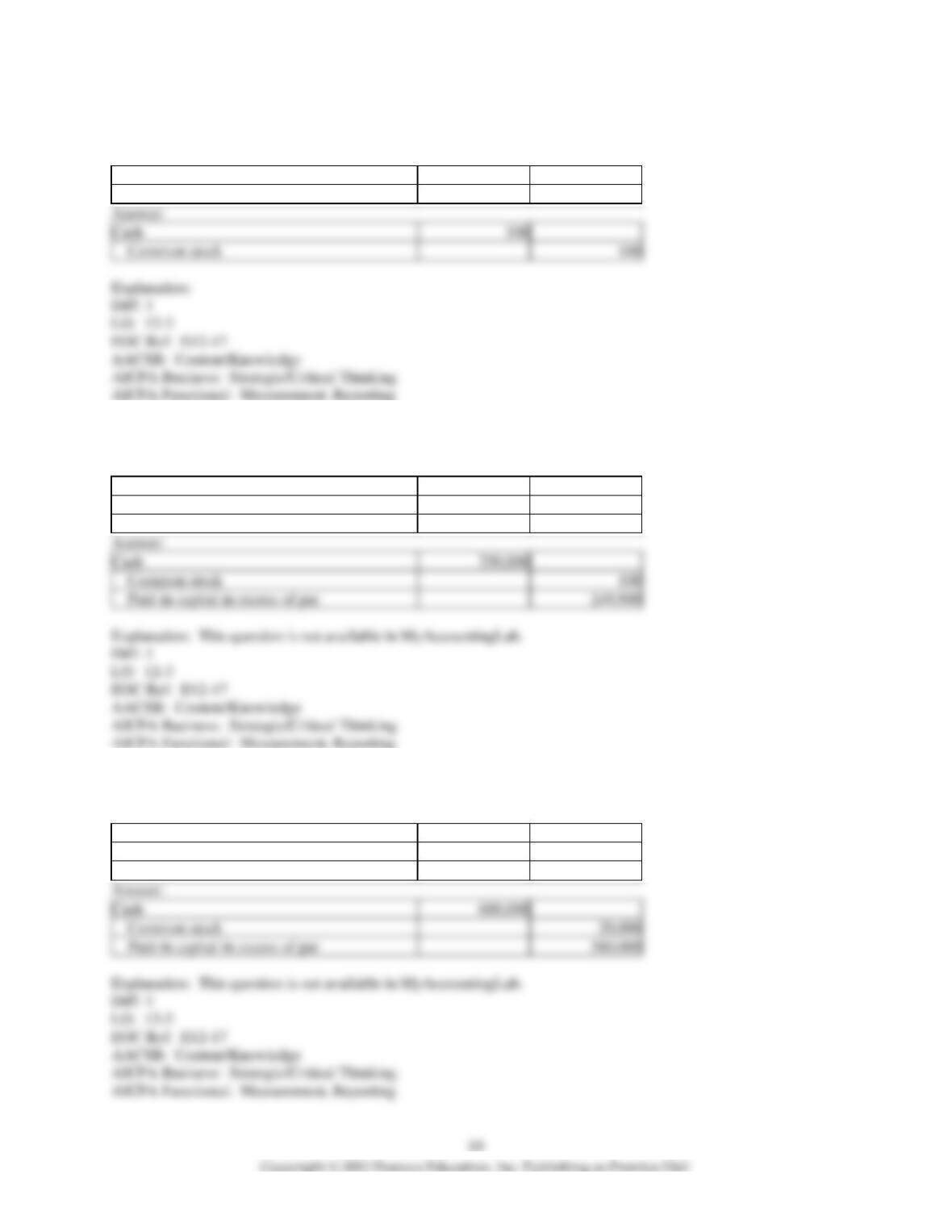
31) Bradley Corporation issued 10,000 shares of common stock on January 1, 2013. The stock has par value of
$0.01 per share and was sold at par. Please provide the journal entry for this transaction.
Cash
32) Bradley Corporation issued 10,000 shares of common stock on January 1, 2013. The stock has par value of
$0.01 per share and was sold at $25 per share. Please provide the journal entry for this transaction.
Cash
33) Chaney Corporation issued 20,000 shares of common stock on January 1, 2014. The stock has par value of
$1.00 per share and was sold at $30 per share. Please provide the journal entry for this transaction.
Cash
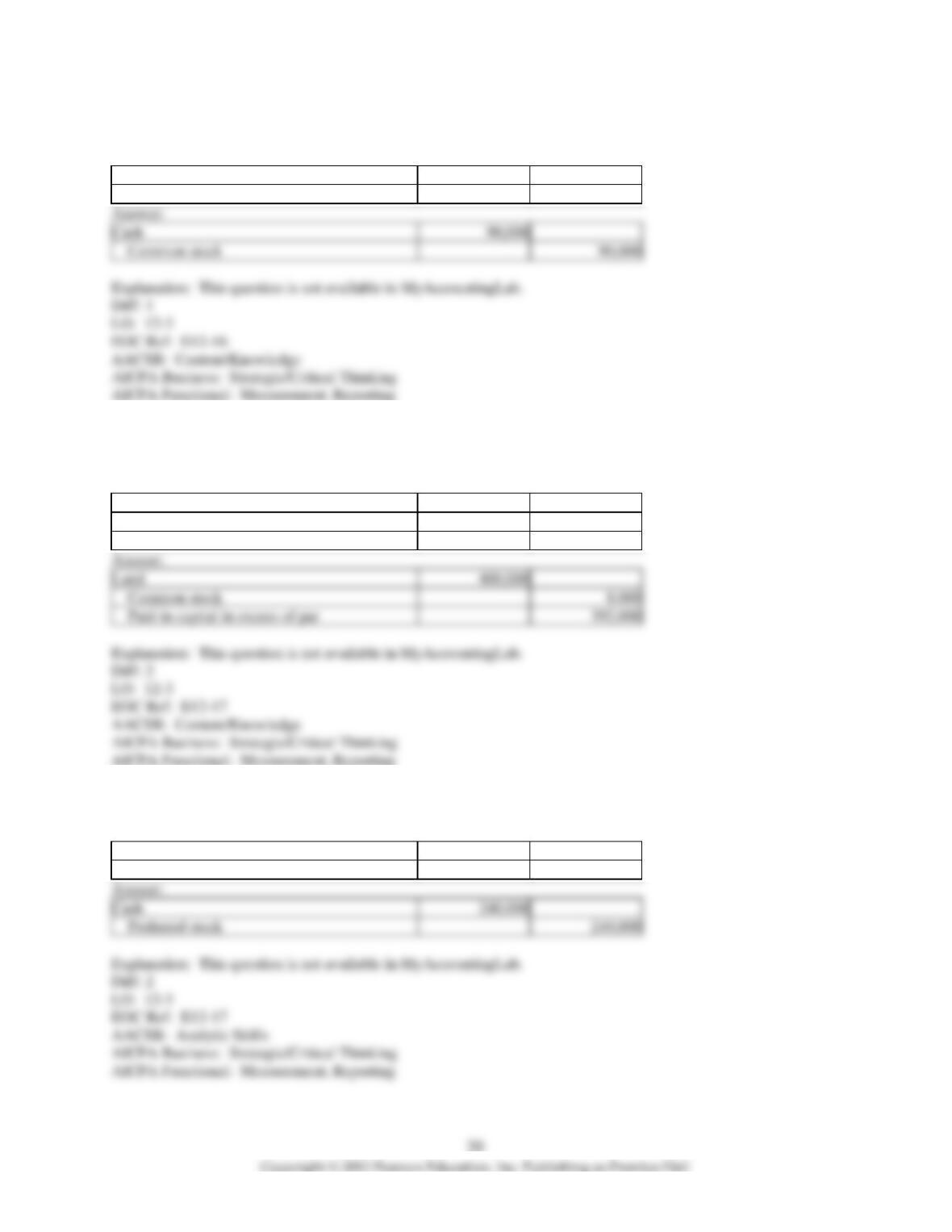
34) Dallkin Corporation issued 5,000 shares of common stock on January 1, 2015. The stock has no par value and
was sold at $18 per share. Please provide the journal entry for this transaction.
Cash
35) On December 2, 2014, Ewell Company purchases a piece of land from the original owner. In payment for the
land, Ewell Company issues 8,000 shares of common stock with $1.00 par value. The land has been appraised at a
market value of $400,000. Please provide the journal entry for this transaction.
Land
36) Peterson Company issued 4,000 shares of preferred stock for $240,000. The stock has a par value of $60 per
share. Please provide the journal entry for this transaction.
Cash