Chapter 12 – Reporting and Interpreting Investments in Other Corporations
1. The extent of influence and control over another company is a critical factor in determining
the proper method of accounting for a long-term investment in the common stock of another
company.
2. Investments in bonds intended to be sold before they reach maturity should be reported
under the market value method.
3. Management must have the intent and ability to hold a bond investment until maturity if it
is to be classified as a held-to-maturity security.
Chapter 12 – Reporting and Interpreting Investments in Other Corporations
4. If a bond is bought at a discount, then interest revenue will be less than the cash payment.
5. If a bond is bought at a premium, the amortized book value of the bond investment will
decrease as the bond matures.
6. Held-to-maturity bond investments have to be reported on the balance sheet at fair value.
Chapter 12 – Reporting and Interpreting Investments in Other Corporations
7. Investments classified other than as held-to-maturity bond investments have to be reported
on the balance sheet at fair value.
8. A realized gain or loss is reported on the income statement when a fair value adjustment is
made.
9. An unrealized holding gain is reported on the income statement when the fair value of an
available-for-sale security exceeds its cost.
Chapter 12 – Reporting and Interpreting Investments in Other Corporations
10. An unrealized holding gain is reported within other comprehensive income when the fair
value of a trading security exceeds its cost.
11. An unrealized holding loss is reported on the income statement when the fair value of a
trading security is less than its cost.
12. A realized gain or loss is reported on the income statement when a trading security is
sold.
Chapter 12 – Reporting and Interpreting Investments in Other Corporations
13. A decline in the fair value of the available-for-sale portfolio reduces assets and net
income.
14. An increase in the fair value of the trading securities portfolio increases both assets and
net income.
15. The sale of a stock from the available-for-sale portfolio creates a gain or loss on the
income statement based on the difference between the stock’s original cost and its selling
price.
Chapter 12 – Reporting and Interpreting Investments in Other Corporations
16. The only income reported on the income statement for a stock from the available-for-sale
portfolio prior to its sale is dividend revenue.
17. The equity method is required to be used when an investor has the ability to exert
significant influence over the investee.
18. Use of the equity method is required for investments between 20 and 50% of a company’s
common stock regardless of the investor’s ability to influence the investee.
Chapter 12 – Reporting and Interpreting Investments in Other Corporations
19. The equity method requires the recognition of investment revenue for dividends received.
20. Ocean Corporation owns 30% of Woods Corp. for which they paid $5.5 million and uses
the equity method to account for the investment. Woods Corp. paid a $100,000 dividend; the
investment in Woods Corp. account will decrease by $30,000, which is Ocean’s proportionate
share of the dividend.
21. An investment accounted for under the equity method would record a reduction in the
investment account for the proportionate share of the investee‘s reported net loss.
Chapter 12 – Reporting and Interpreting Investments in Other Corporations
22. An investment accounted for under the equity method would record an increase in the
investment account and create net income for an amount equal to the proportionate share of
the investee’s reported net income.
23. An investment accounted for under the equity method is always reported on the balance
sheet at fair value.
24. When an investment accounted for under the equity method is sold, the gain or loss
reported on the income statement is the difference between the selling price and its original
cost.
Chapter 12 – Reporting and Interpreting Investments in Other Corporations
25. Any unrealized gains or losses on trading securities would have to be added back to or
deducted from net income on the statement of cash flows under the indirect method of
determining cash flows from operating activities.
26. Madison Inc. acquires 100% of the voting stock of Allison Corp. for $10.0 million.
Allison’s total assets at fair value equaled $12.5 million and Allison had liabilities at fair value
equal to $3.4 million. Madison will report goodwill of $0.9 million.
27. When the acquiring company purchases 100% of the investee’s stock, the investee’s assets
and liabilities will be consolidated with those of the acquiring company at their book values.
Chapter 12 – Reporting and Interpreting Investments in Other Corporations
28. Subsequent to a merger, any revenues and expenses of the subsidiary would be combined
with those of the parent company on the consolidated income statement.
29. Goodwill is reported on a consolidated balance sheet only if it was acquired in the merger
or acquisition.
30. The assets of the subsidiary are depreciated and amortized over their useful lives as a part
of the consolidation process.
Chapter 12 – Reporting and Interpreting Investments in Other Corporations
31. Which of the following is the best description of investments in trading securities?
32. Piano Company owns 55% of the voting common stock shares of Keys Corporation.
Which of the following is true?
Chapter 12 – Reporting and Interpreting Investments in Other Corporations
33. Which of the following is the best description of investments in available-for-sale
securities?
34. Chang Corp. purchased $1,000,000 of bonds at par value on April 1, 2010. The bonds pay
interest at the rate of 10%. Chang intends to hold these bonds to maturity. Which of the
following statements is false?
Chapter 12 – Reporting and Interpreting Investments in Other Corporations
35. Significant influence over the operating and financial policies of another company may be
indicated by
36. Use of the consolidated financial statement method of accounting for a long-term
investment in common stock of another company is required when the ownership of its voting
stock is
Chapter 12 – Reporting and Interpreting Investments in Other Corporations
37. Miller Corp. purchased $1,000,000 of bonds at 105. The bonds pay interest at the rate of
10%. Miller intends to hold these bonds to maturity. Which of the following statements is
false?
38. Miller Corp. purchased $1,000,000 of bonds at 96. The bonds pay interest at the rate of
10%. Miller intends to hold these bonds to maturity. Which of the following statements is
correct?
Chapter 12 – Reporting and Interpreting Investments in Other Corporations
39. Idaho Company purchased 30% of the outstanding preferred stock (nonvoting) of Potato
Corporation as a long-term investment. Which of the following classifications should be used
by Idaho Company in accounting for the investment?
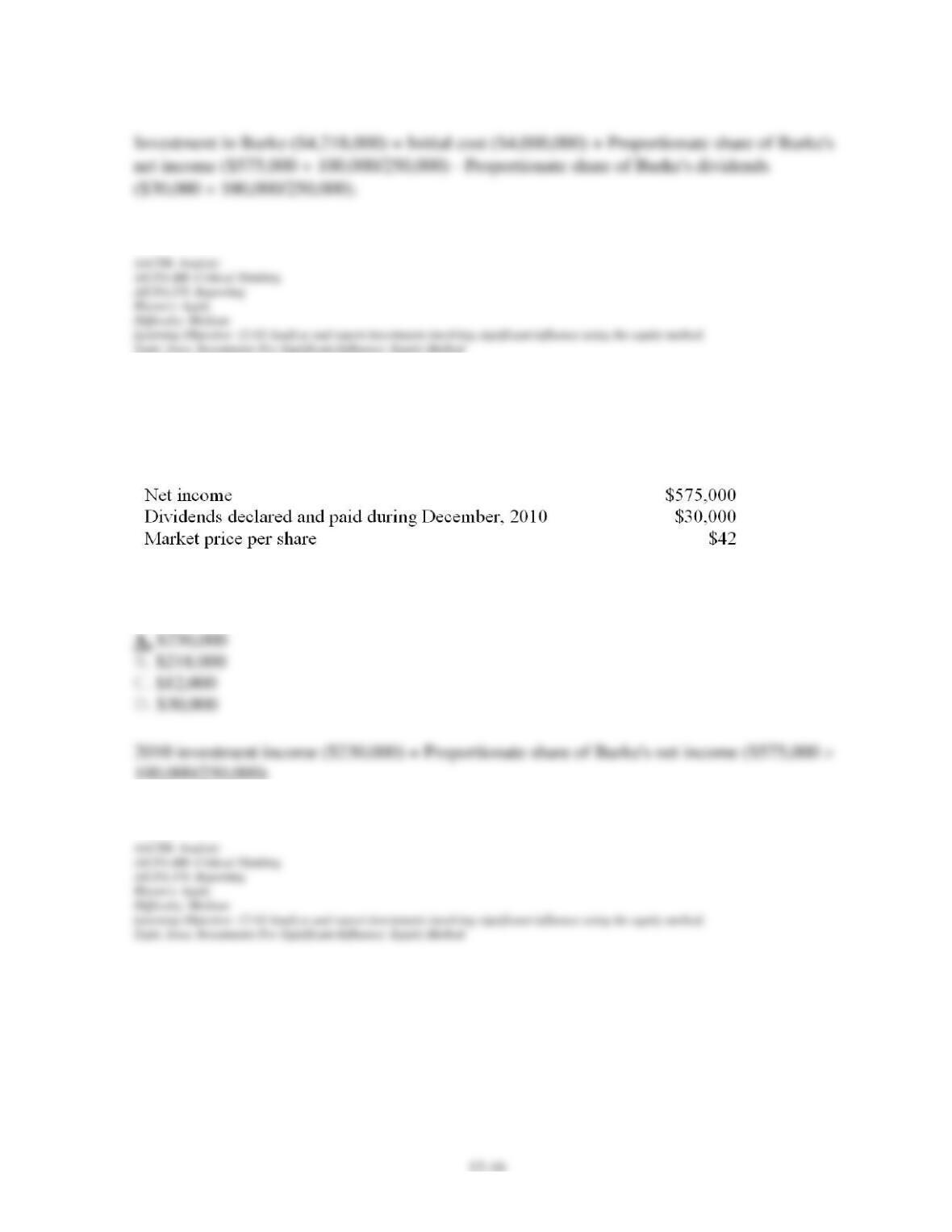
40. Gilman Company purchased 100,000 of the 250,000 shares of common stock of Burke
Corporation on January 1, 2010, at $40 per share as a long-term investment. The records of
Burke Corporation showed the following on December 31, 2010:
At what amount should Gilman Company report the Burke investment on the December 31,
2010 balance sheet?
Chapter 12 – Reporting and Interpreting Investments in Other Corporations
41. Gilman Company purchased 100,000 of the 250,000 shares of common stock of Burke
Corporation on January 1, 2010, at $40 per share as a long-term investment. The records of
Burke Corporation showed the following on December 31, 2010:
How much should Gilman Company report as investment income from the Burke investment
during 2010?
Chapter 12 – Reporting and Interpreting Investments in Other Corporations
42. On January 1, 2010, Entertainment Company acquired 15% of the outstanding voting
stock of Rocker Company as a long-term investment in available-for-sale securities. During
2010, Rocker Company reported net income of $1,500,000 and dividends declared and paid
of $250,000. How much income will be reported during 2010 from the Rocker investment?
43. Which of the following statements is correct?
Chapter 12 – Reporting and Interpreting Investments in Other Corporations
44. Lyrical Company purchased equity securities for $500,000 and classified them as trading
securities on September 15, 2010. On December 31, 2010, the current market value of the
securities was $481,000. How should the investment be reported within the 2010 financial
statements?
45. Libby Company purchased equity securities for $100,000 and classified them as available-
for-sale securities on September 15, 2010. At December 31, 2010, the current market value of
the securities was $105,000. How should the investment be reported in the 2010 financial
statements?
Chapter 12 – Reporting and Interpreting Investments in Other Corporations
46. On January 1, 2010, Short Company purchased as an available-for-sale investment,
20,000 shares (15% of the outstanding voting shares) of Daniel Corporation’s $1 par value
common stock at a cost of $50 per share. During November 2010, Daniel declared and paid a
cash dividend of $2 per share. At December 31, 2010, end of the accounting period, Daniel’s
shares were selling at $48. The 2010 financial statements for Short Company should report
the following amounts:
Chapter 12 – Reporting and Interpreting Investments in Other Corporations
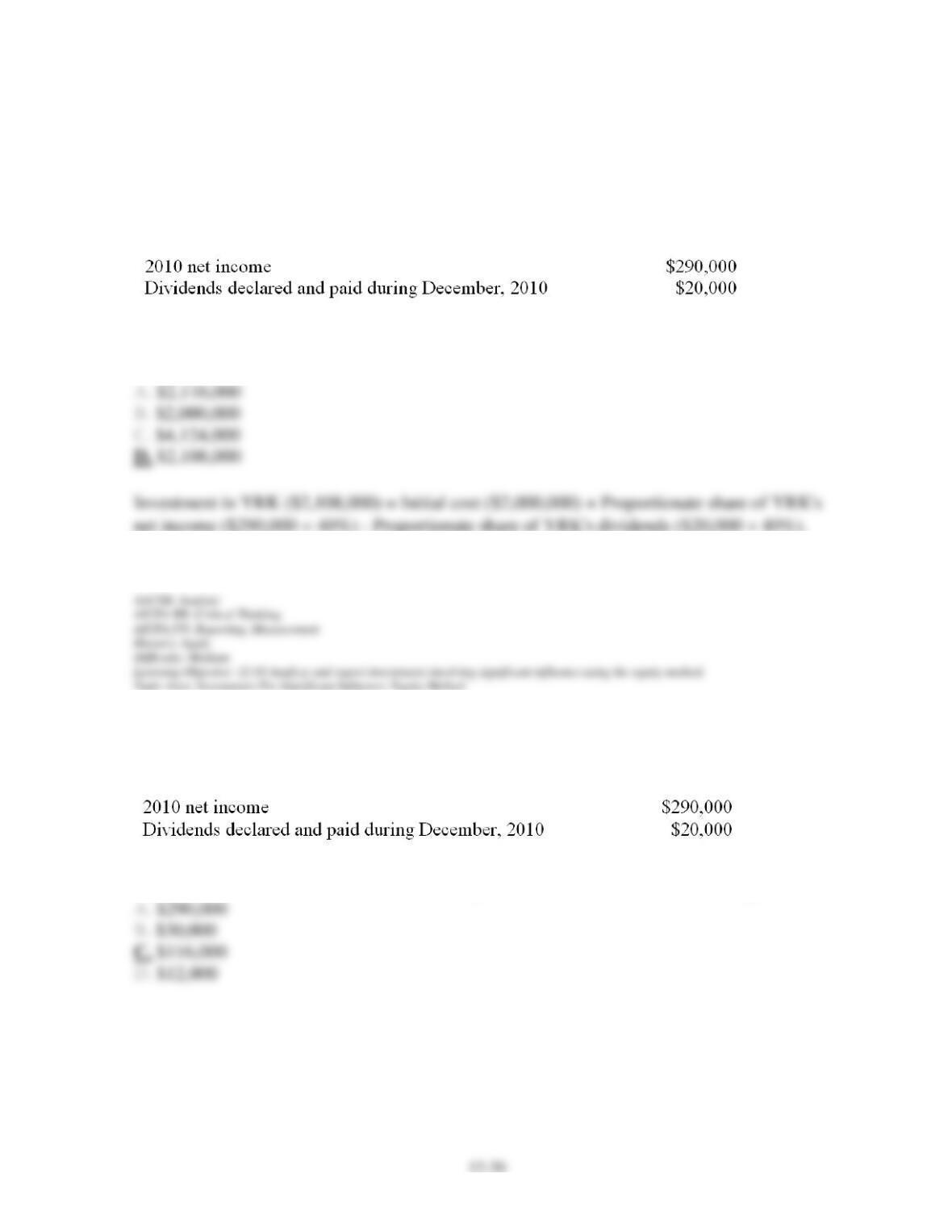
47. JDR Company purchased 40% of the common stock of YRK Corporation on January 1,
2010, for $2,000,000 as a long-term investment. The records of YRK Corporation showed the
following on December 31, 2010:
At what amount should JDR report the YRK investment on the December 31, 2010 balance
sheet?
48. JDR Company purchased 40% of the common stock of YRK Corporation on January 1,
2010, for $2,000,000 as a long-term investment. The records of YRK Corporation showed the
following on December 31, 2010:
How much investment income should JDR report from the YRK investment during 2010?