33
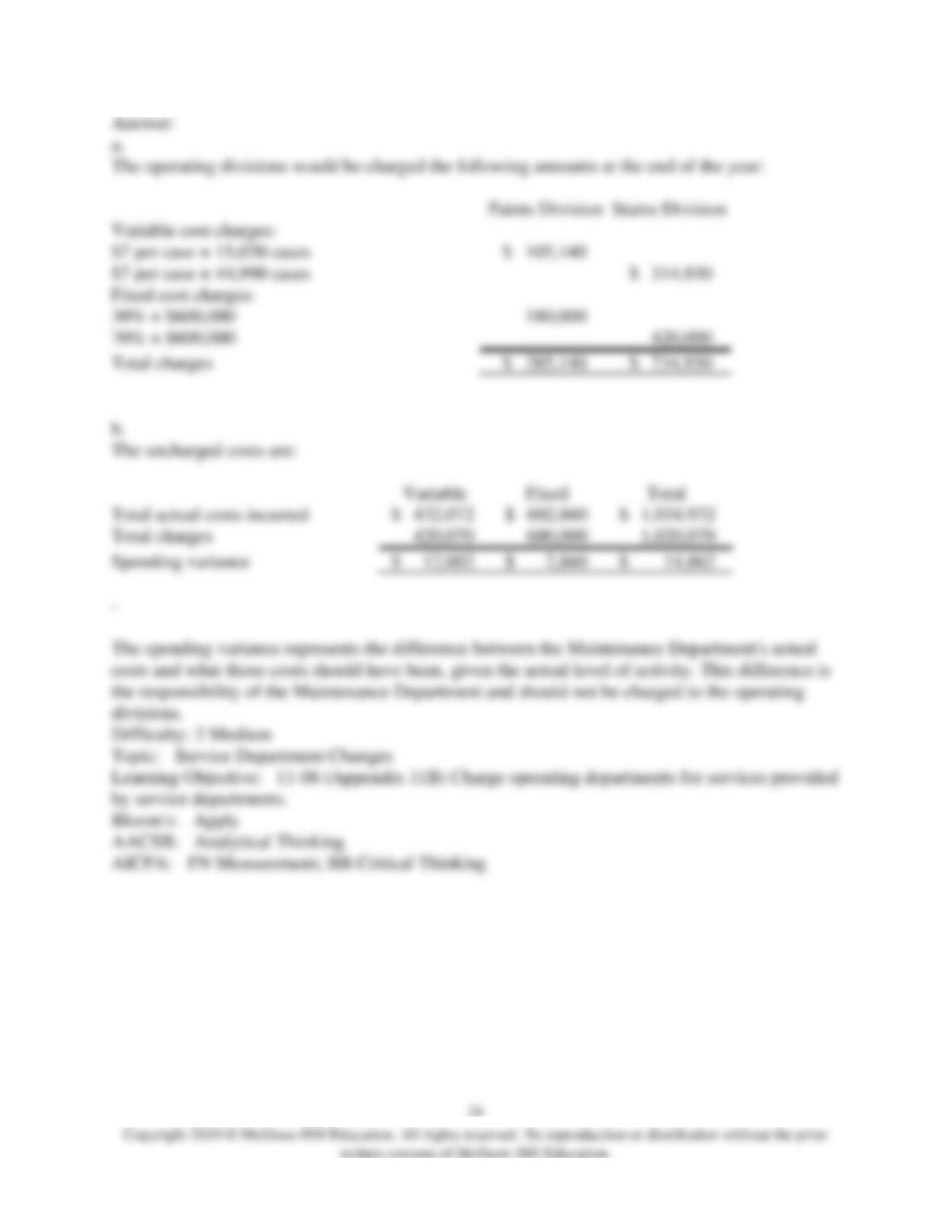
39) Nealon Corporation’s Maintenance Department provides services to the company’s two
operating divisions—the Paints Division and the Stains Division. The variable costs of the
Maintenance Department are budgeted based on the number of cases produced by the operating
departments. The fixed costs of the Maintenance Department are determined based on the
number of cases produced by the operating departments during the peak-period. Data appear
below:
Maintenance Department
Budgeted variable cost
$
7
per case
Budgeted total fixed cost
$
600,000
Actual total variable cost
$
432,072
Actual total fixed cost
$
602,860
Paints Division
Percentage of peak-period capacity required
30
%
Budgeted cases
15,000
Actual cases
15,020
Stains Division
Percentage of peak-period capacity required
70
%
Budgeted cases
45,000
Actual cases
44,990
–
Required:
a. Prepare a report showing how much of the Maintenance Department’s costs should be charged
to each of the operating divisions at the end of the year.
b. How much of the actual Maintenance Department costs should not be charged to the operating
divisions at the end of the year? Who should be held responsible for these uncharged costs?
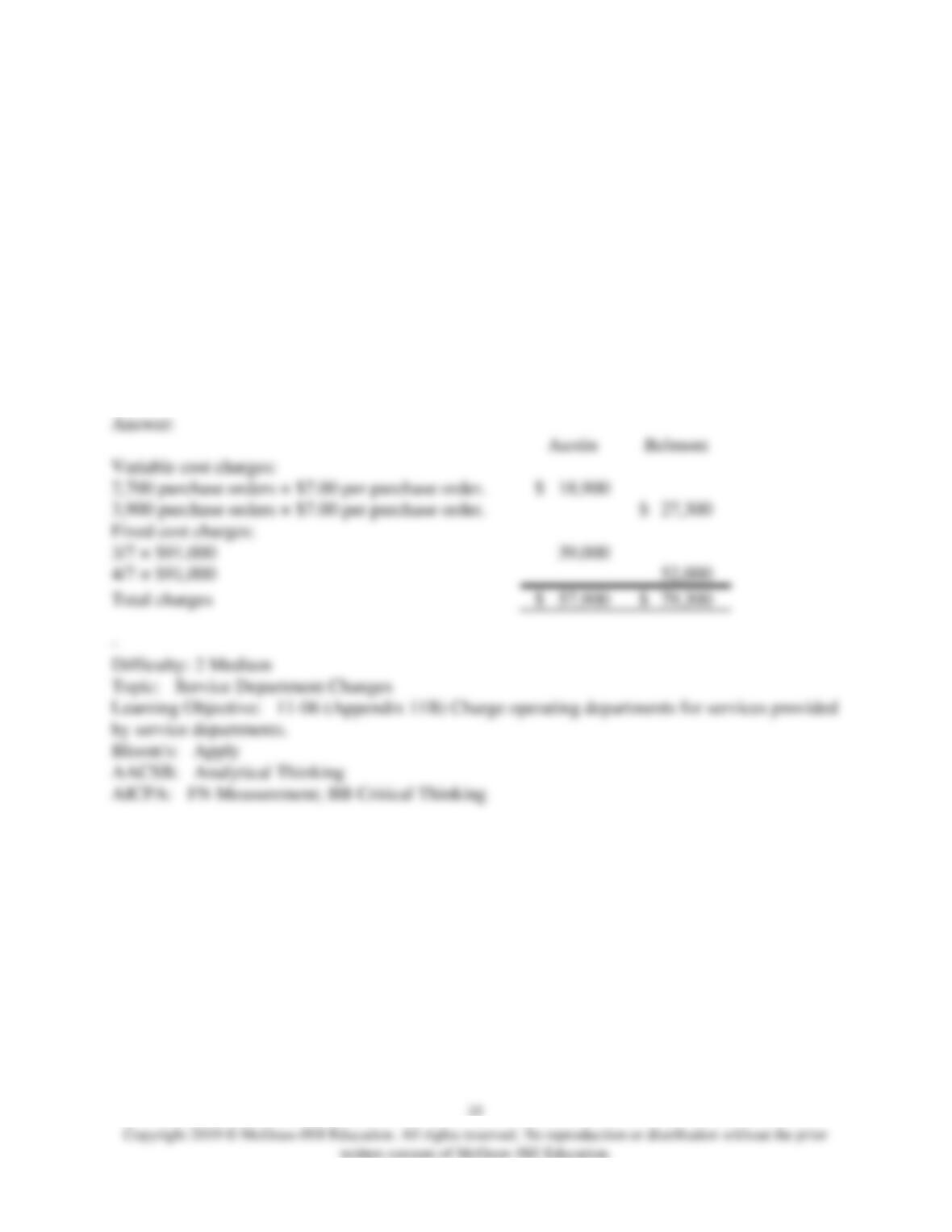
40) Smurnov Company has a purchasing department that provides services to two factories
located in Austin and the other in Belmont. Budgeted costs for the purchasing department consist
of $91,000 per year of fixed costs and $7 per purchase order for variable costs. The level of
budgeted fixed costs is determined by the peak-period requirements. The Austin factory requires
3/7 of the peak-period capacity and the Belmont factory requires 4/7.
During the year, 2,700 purchase orders were processed for the Austin factory and 3,900 purchase
orders for the Belmont factory.
Required:
Compute the amount of purchasing department cost that should be charged to each factory for
the year.

36
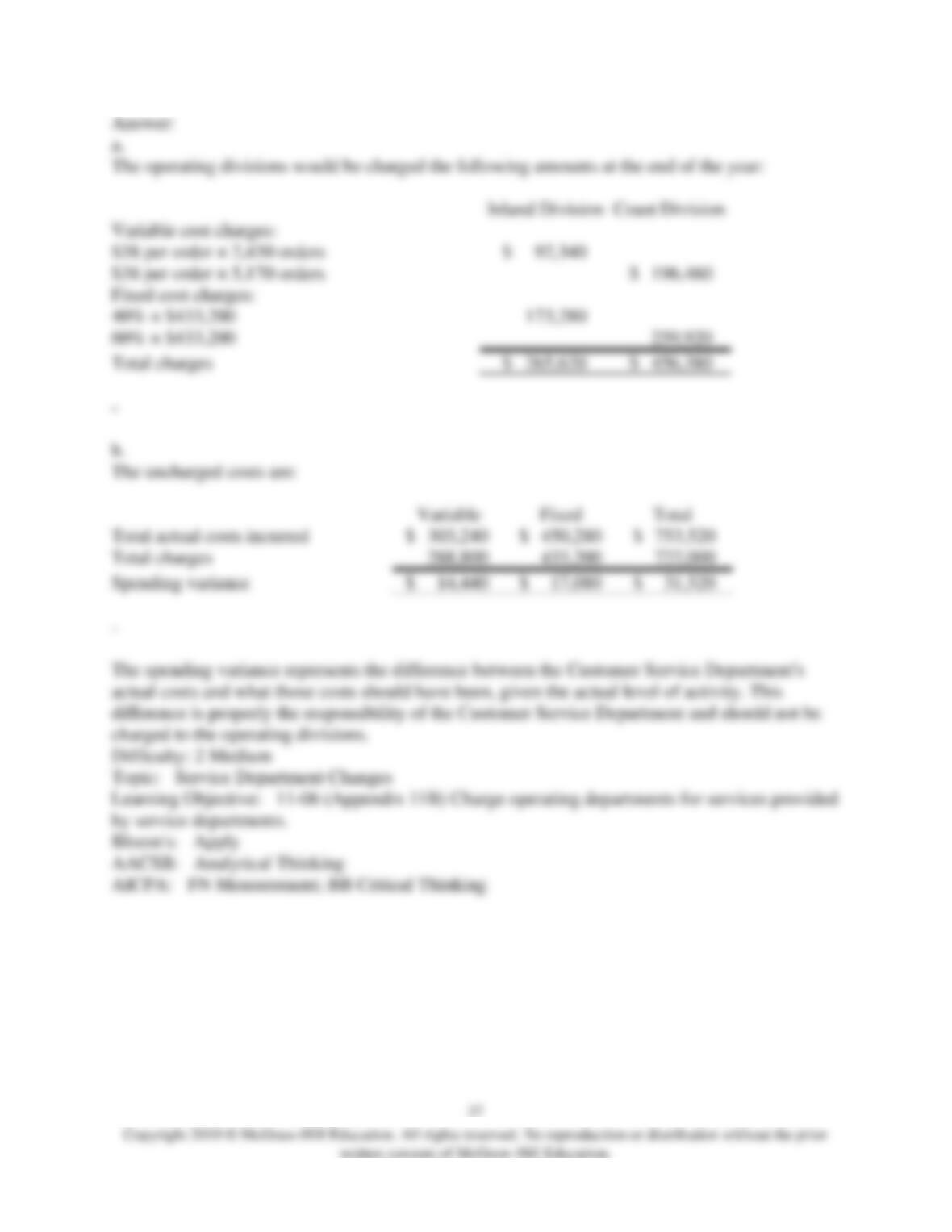
41) Sauseda Corporation has two operating divisions—an Inland Division and a Coast Division.
The company’s Customer Service Department provides services to both divisions. The variable
costs of the Customer Service Department are budgeted at $38 per order. The Customer Service
Department’s fixed costs are budgeted at $433,200 for the year. The fixed costs of the Customer
Service Department are determined based on the peak-period orders.
Percentage of Peak-period
Capacity Required
Budgeted Orders
Inland Division
40
%
2,400
Coast Division
60
%
5,200
–
At the end of the year, actual Customer Service Department variable costs totaled $303,240 and
fixed costs totaled $450,280. The Inland Division had a total of 2,430 orders and the Coast
Division had a total of 5,170 orders for the year.
Required:
a. Prepare a report showing how much of the Customer Service Department’s costs should be
charged to each of the operating divisions at the end of the year.
b. How much of the actual Customer Service Department costs should not be charged to the
operating divisions at the end of the year? Who should be held responsible for these uncharged
costs?

38
42) Cannata Corporation has two operating divisions—a North Division and a South Division.
The company’s Logistics Department services both divisions. The variable costs of the Logistics
Department are budgeted at $32 per shipment. The Logistics Department’s fixed costs are
budgeted at $372,300 for the year. The fixed costs of the Logistics Department are determined
based on peak-period demand.
Percentage of Peak-period
Capacity Required
Budgeted
Shipments
North Division
25
%
1,700
South Division
75
%
5,600
–
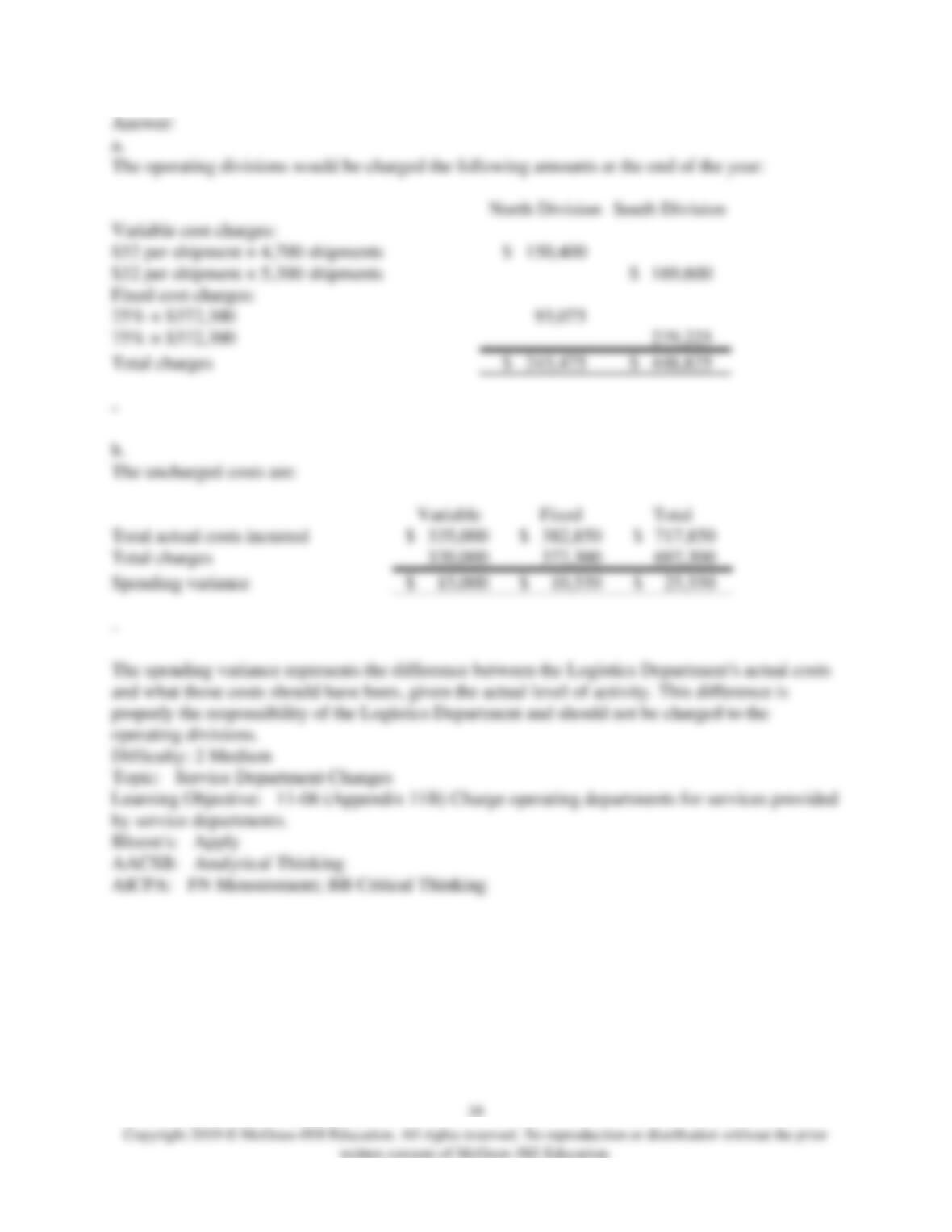
At the end of the year, actual Logistics Department variable costs totaled $335,000 and fixed
costs totaled $382,850. The North Division had a total of 4,700 shipments and the South
Division had a total of 5,300 shipments for the year.
Required:
a. Prepare a report showing how much of the Logistics Department’s costs should be charged to
each of the operating divisions at the end of the year.
b. How much of the actual Logistics Department costs should not be charged to the operating
divisions at the end of the year? Who should be held responsible for these uncharged costs?

40
43) Leslie Company operates a cafeteria for the benefit of its employees. The company
subsidizes the cafeteria heavily by allowing employees to purchase meals at greatly reduced
prices. Budgeted and actual costs in the cafeteria for the year just ended are as follows:
Budgeted
Actual
Variable costs*
$
500,000
$
436,000
Fixed costs
$
340,000
$
352,000
–
*Unrecovered cost after deducting amounts received from employees.
Costs of the cafeteria are charged to producing departments on the basis of the number of
employees in these departments. Fixed costs are charged on the basis of the percentage of peak-
period requirements. Data concerning the company’s producing departments follows:
Machining
Assembly
Total
Budgeted number of employees
300
500
800
Actual number of employees
200
400
600
Percentage of peak-period requirements
40
%
60
%
100
%
–
Required:
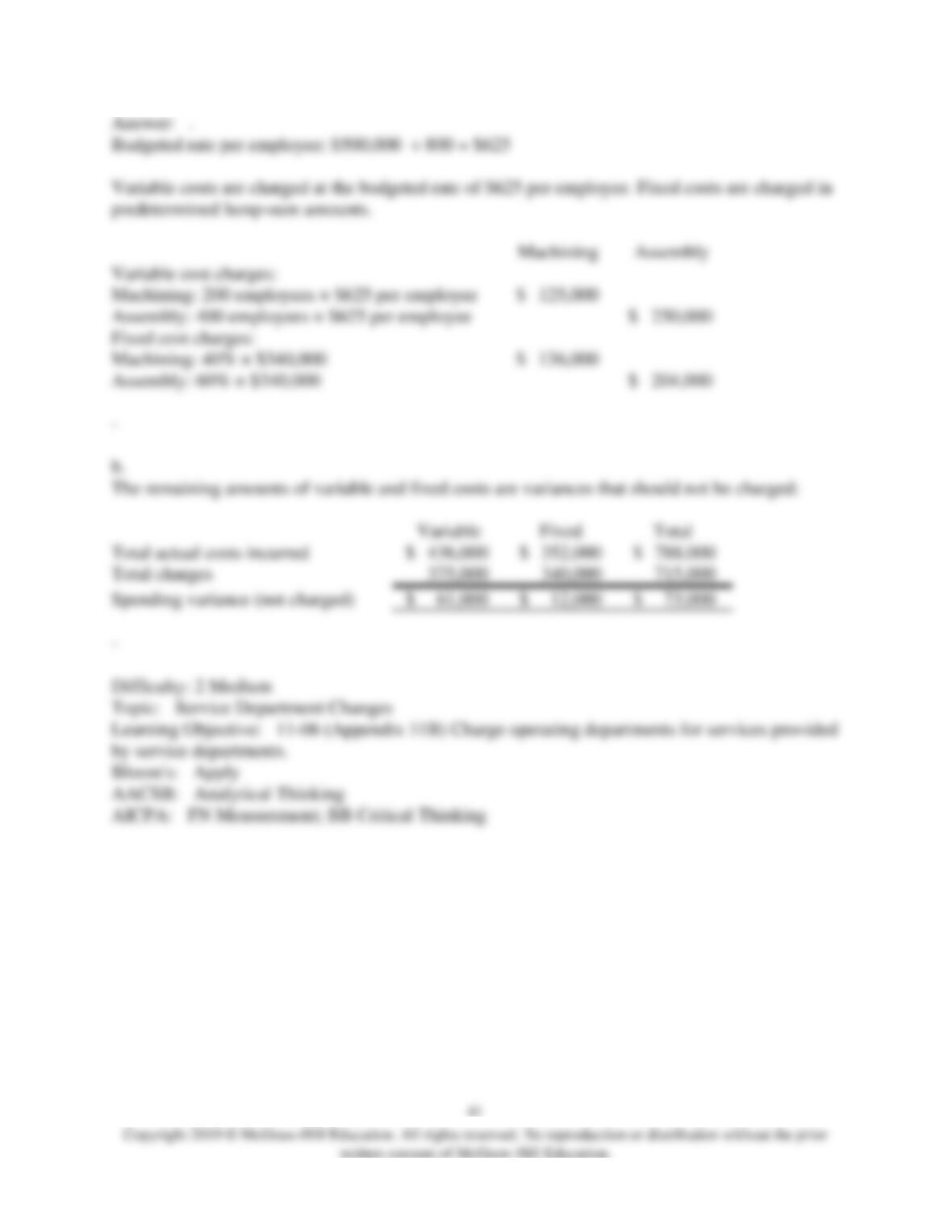
a. Compute the dollar amount of variable and fixed costs that should be charged to each of the
producing departments at the end of the year for purposes of evaluating performance.
b. Identify the amount, if any, of actual costs that should not be charged to the operating
departments.

42
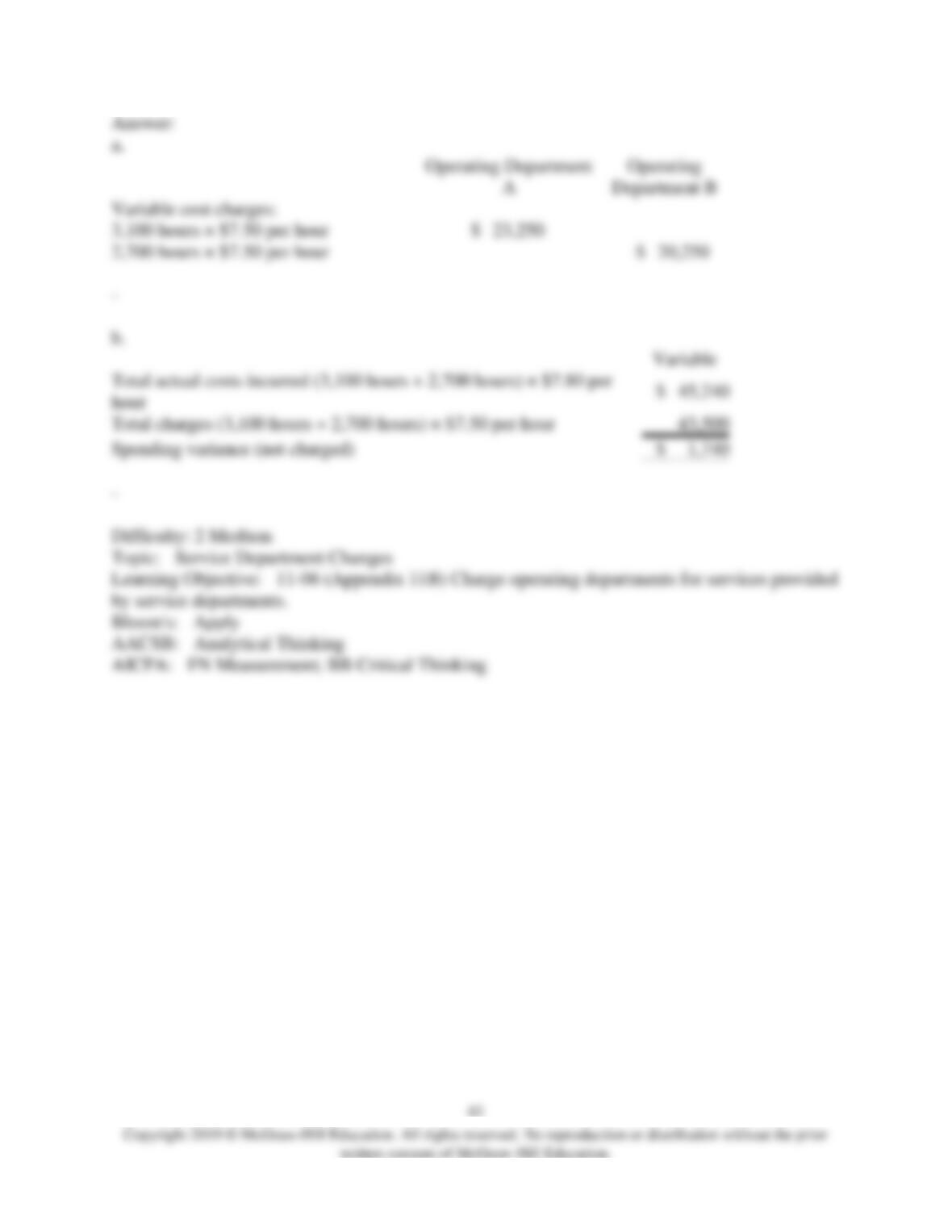
44) Gabritz, Inc. has a maintenance department that provides services to the company’s two
operating departments. The variable costs of the maintenance department are charged on the
basis of the number of maintenance hours logged in each department. Last year, budgeted
variable maintenance costs were $7.50 per maintenance hour and actual variable maintenance
costs were $7.80 per maintenance hour.
The budgeted and actual maintenance hours for each operating department for last year appear
below:
Operating Department
A
Operating
Department B
Budgeted maintenance hours
3,000
2,500
Actual maintenance hours
3,100
2,700
–
Required:
a. Compute the amount of variable maintenance department cost that should have been charged
to each operating department at the end of the year for performance evaluation purposes.
b. Compute the amount of actual variable maintenance department cost that should NOT have
been charged to the operating departments at the end of the year for performance evaluation
purposes.