Managerial Accounting, 16e (Garrison)
Chapter 11A: Transfer Pricing
1) The selling division in a transfer pricing situation should want the transfer price to cover at
least the full cost per unit plus the lost contribution margin per unit on outside sales.
2) From the buying division’s perspective, when a transferred item can be purchased from an
outside supplier, the price charged by the outside supplier represents an upper bound on the
charge that should be made on transfers between the selling and buying divisions.
3) Whenever the selling division must give up outside sales in order to sell internally, it has an
opportunity cost that should be considered in setting the transfer price.
4) The transfer price used for internal transfers between divisions of the same company cannot
affect the divisions’ reported profits.
5) When a dispute arises over a transfer price, top managers should intervene to keep divisional
managers from making a costly mistake, even though the divisions are evaluated as profit
centers.
6) Setting transfer prices at full cost can lead to bad decisions because, among other reasons, full
cost does not take into account opportunity costs.
7) If transfer prices are to be based on cost, then the costs should be actual costs rather than
standard costs.
8) Wengert Products, Inc., has a Motor Division that manufactures and sells a number of
products, including a standard motor. Data concerning that motor appear below:
Capacity in units
40,000
Selling price to outside customers
$
59
Variable cost per unit
$
17
Fixed cost per unit (based on capacity)
$
21
–
The Automotive Division of Wengert Products, Inc needs 8,000 special heavy-duty motors per
year. The Motor Division’s variable cost to manufacture and ship this special motor would be
$20 per unit. Because these special motors would requires more manufacturing resources than
the standard motor, the Motor Division would have to reduce its production and sales of standard
motors to outside customers from 40,000 units per year to 27,200 units per year.
What is the total contribution margin on sales to outside customers that the Motor Division
would give up if it were to make the special motors for the Automotive Division?
A) $336,000
B) $537,600
C) $860,160
D) $755,200

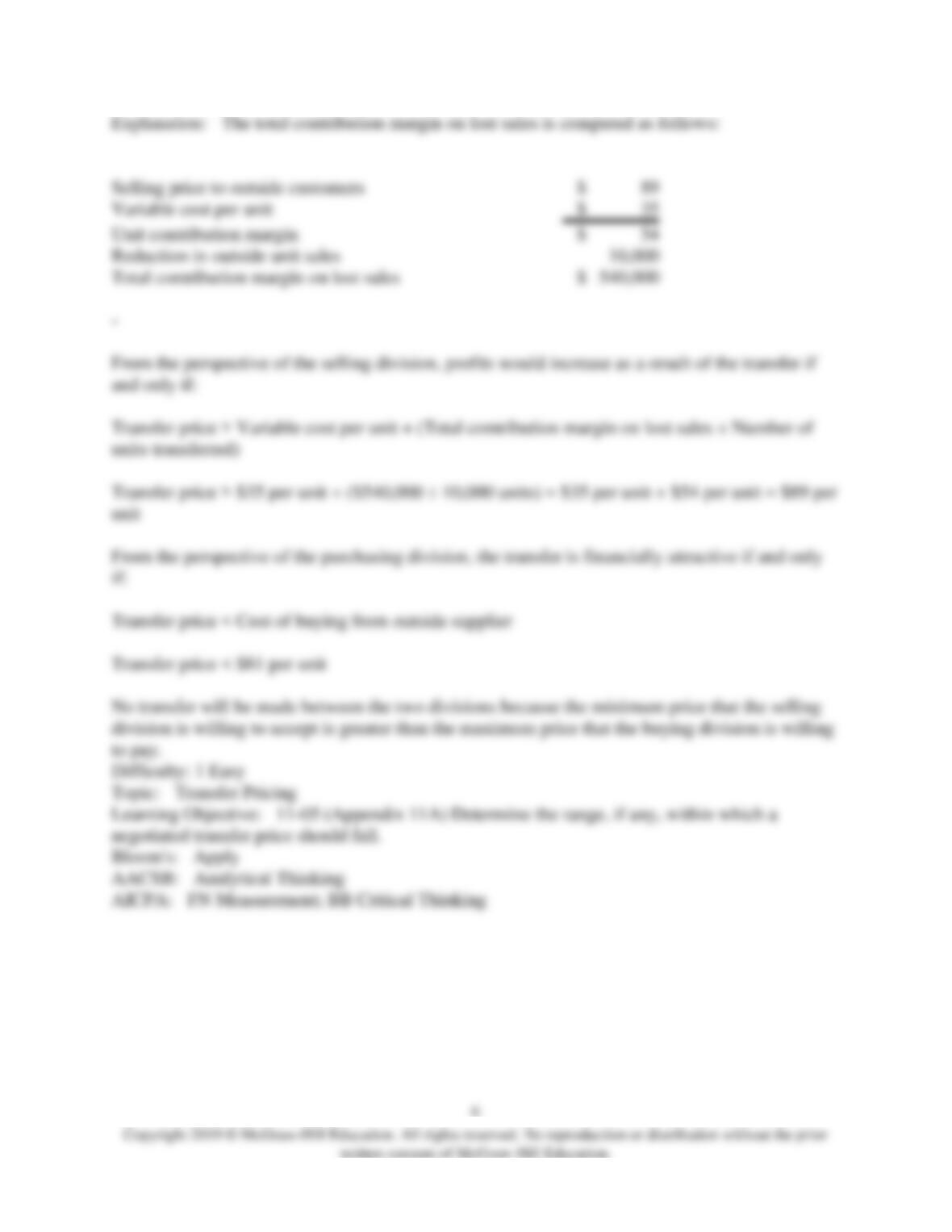
9) Godina Products, Inc., has a Receiver Division that manufactures and sells a number of
products, including a standard receiver that could be used by another division in the company,
the Industrial Products Division, in one of its products. Data concerning that receiver appear
below:
Capacity in units
58,000
Selling price to outside customers
$
89
Variable cost per unit
$
35
Fixed cost per unit (based on capacity)
$
42
–
The Industrial Products Division is currently purchasing 10,000 of these receivers per year from
an overseas supplier at a cost of $81 per receiver.
Assume that the Receiver Division is selling all of the receivers it can produce to outside
customers. Does there exist a transfer price that would make both the Receiver and Industrial
Products Division financially better off than if the Industrial Products Division were to continue
buying its receivers from the outside supplier?
A) Yes, both divisions are always better off regardless of whether the selling division has enough
idle capacity to handle all of the buying division’s needs.
B) Yes, the minimum transfer price that the selling division should be willing to accept is less
than the maximum transfer price that the buying division should be willing to accept.
C) The answer cannot be determined from the information that has been provided.
D) No, the minimum transfer price that the selling division should be willing to accept exceeds
the maximum transfer price that the buying division should be willing to accept.
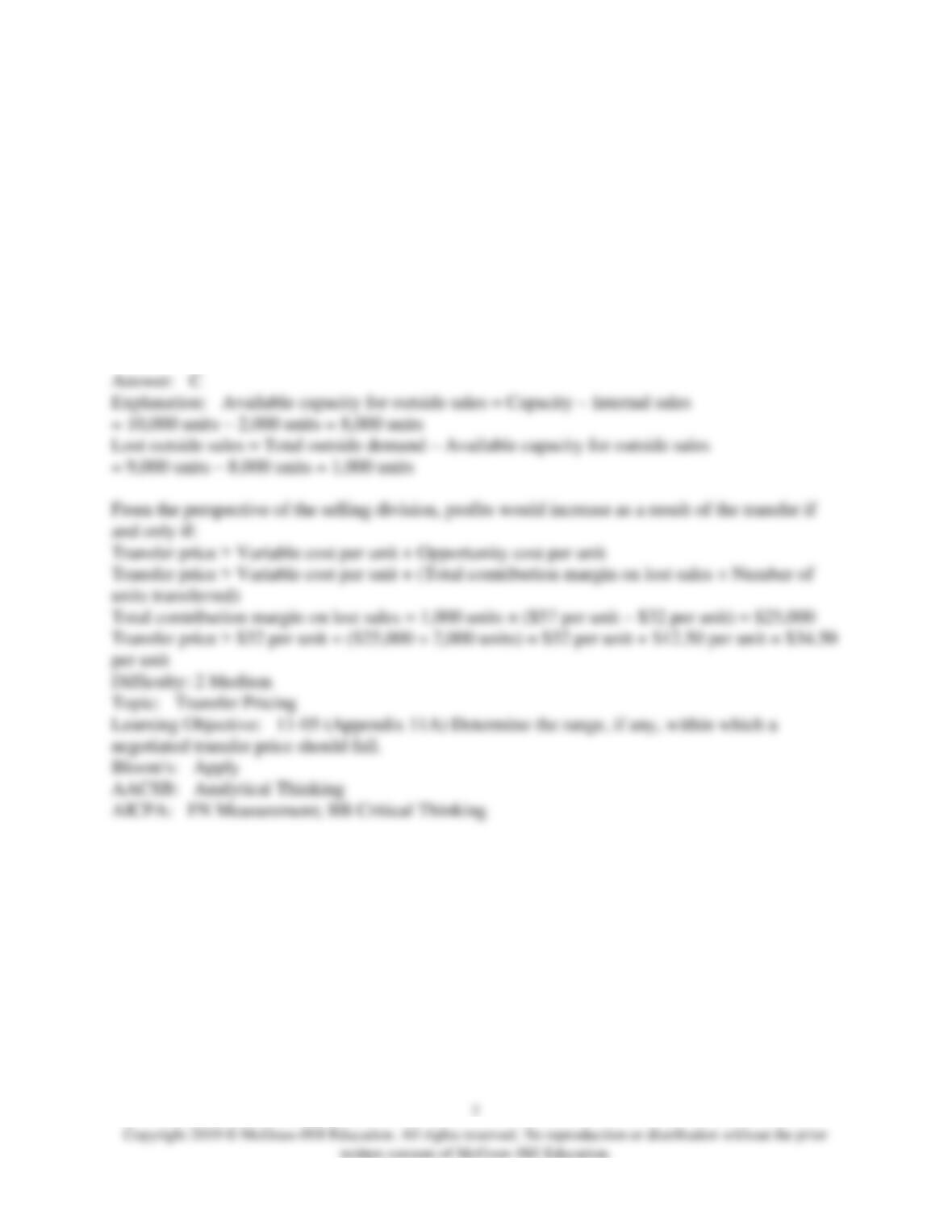
10) Division Delta of Golvin Corporation makes and sells a single product which is used by
manufacturers of fork lift trucks. Presently it sells 9,000 units per year to outside customers at
$57 per unit. The annual capacity is 10,000 units and the variable cost to make each unit is $32.
Division Echo of Golvin Corporation would like to buy 2,000 units a year from Division Delta to
use in its products. There would be no cost savings from transferring the units within the
company rather than selling them on the outside market. What should be the lowest acceptable
transfer price from the perspective of Division Delta?
A) $57.00 per unit
B) $19.50 per unit
C) $34.50 per unit
D) $32.00 per unit
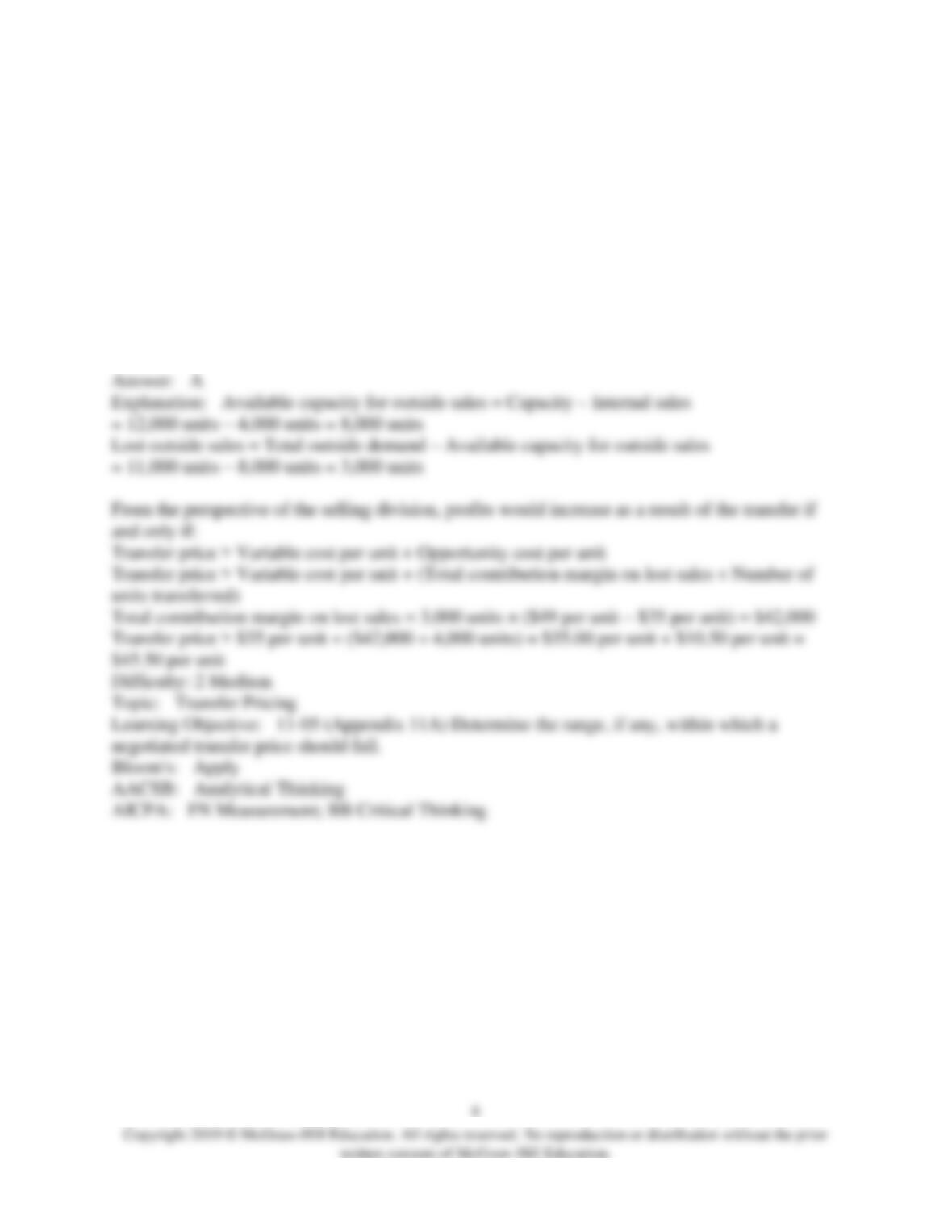
11) The Southern Division of Barstol Company makes and sells a single product, which is a part
used in manufacturing trucks. The annual production capacity is 12,000 units and the variable
cost of each unit is $35. Presently the Southern Division sells 11,000 units per year to outside
customers at $49 per unit. The Northern Division of Barstol Company would like to buy 4,000
units a year from Southern to use in its production. There would be no savings in variable costs
from transferring the units internally rather than selling them externally. The lowest acceptable
transfer price from the standpoint of the Southern Division should be closest to:
A) $45.50 per unit
B) $35.00 per unit
C) $32.00 per unit
D) $49.00 per unit
12) Toldness Products, Inc., has a Connector Division that manufactures and sells a number of
products, including a standard connector that could be used by another division in the company,
the Transmission Division, in one of its products. Data concerning that connector appear below:
Capacity in units
57,000
Selling price to outside customers
$
67
Variable cost per unit
$
22
Fixed cost per unit (based on capacity)
$
29
–
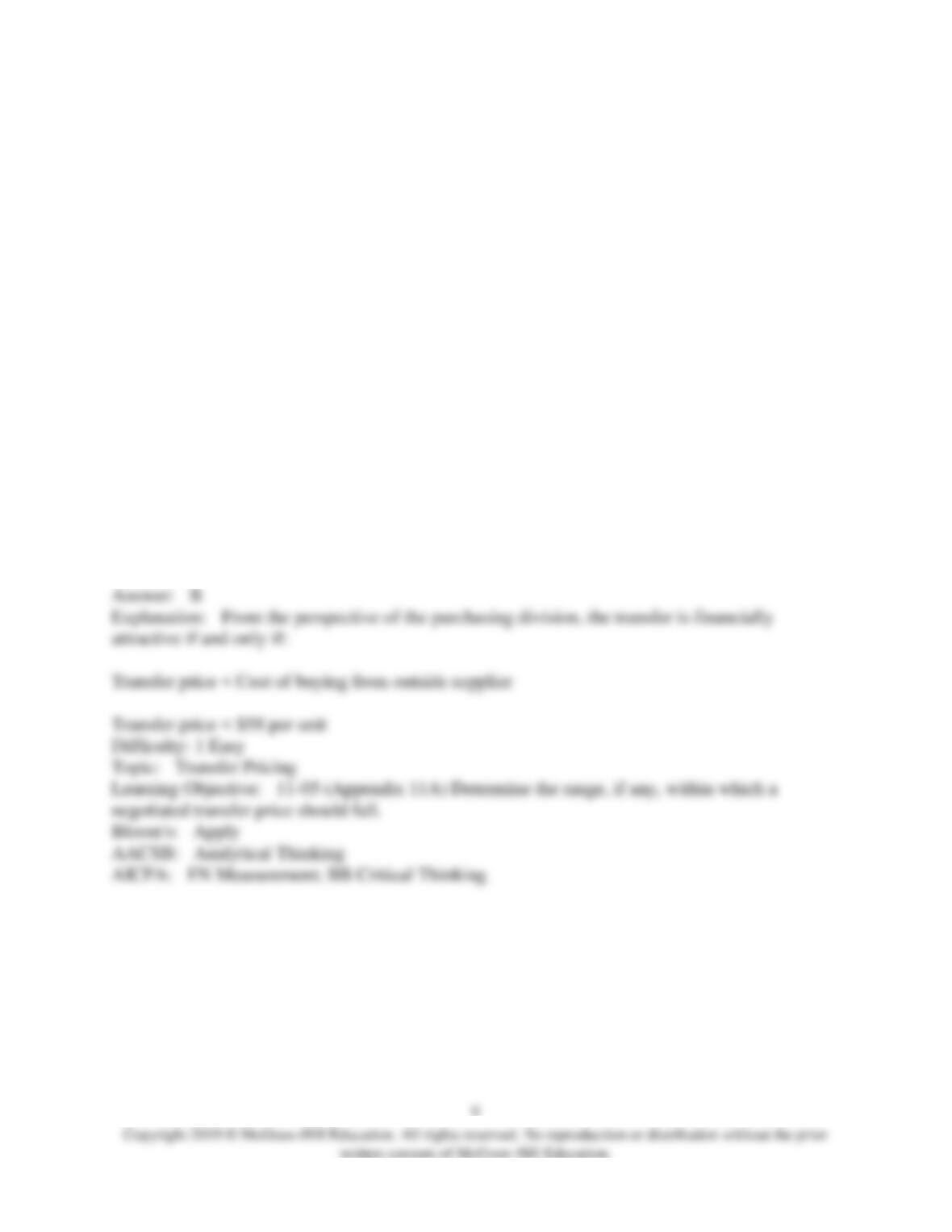
The Transmission Division is currently purchasing 11,000 of these connectors per year from an
overseas supplier at a cost of $58 per connector.
What is the maximum price that the Transmission Division should be willing to pay for
connectors transferred from the Connector Division?
A) $51 per unit
B) $58 per unit
C) $22 per unit
D) $29 per unit
13) Blitch Products, Inc., has a Screen Division that manufactures and sells a number of
products, including a standard screen that could be used by another division in the company, the
Home Security Division, in one of its products. Data concerning that screen appear below:
Capacity in units
45,000
Selling price to outside customers
$
53
Variable cost per unit
$
26
Fixed cost per unit (based on capacity)
$
16
–
The Home Security Division is currently purchasing 2,000 of these screens per year from an
overseas supplier at a cost of $50 per screen.
Assume that the Screen Division has enough idle capacity to handle all of the Home Security
Division’s needs. Does there exist a transfer price that would make both the Screen and Home
Security Division financially better off than if the Home Security Division were to continue
buying its screens from the outside supplier?
A) Yes, both divisions are always better off regardless of whether the selling division has enough
idle capacity to handle all of the buying division’s needs.
B) The answer cannot be determined from the information that has been provided.
C) Yes, the minimum transfer price that the selling division should be willing to accept is less
than the maximum transfer price that the buying division would accept.
D) No, the selling division’s price to outside customers is higher than the price that the buying
division has to pay its outside supplier.
14) If the lowest acceptable transfer price from the viewpoint of the selling division is $75 and
the opportunity cost per unit on outside sales is $24, then the variable cost per unit must be:
A) $24 per unit
B) $99 per unit
C) $51 per unit
D) $75 per unit

15) Lumpkins Products, Inc., has a Valve Division that manufactures and sells a number of
products, including a standard valve that could be used by another division in the company, the
Pump Division, in one of its products. Data concerning that valve appear below:
Capacity in units
46,000
Selling price to outside customers
$
62
Variable cost per unit
$
38
Fixed cost per unit (based on capacity)
$
12
–
The Pump Division is currently purchasing 9,000 of these valves per year from an overseas
supplier at a cost of $59 per valve.
Assume that the Valve Division is selling all of the valves it can produce to outside customers.
Also assume that none of the variable expenses can be avoided on transfers within the company.
What should be the minimum acceptable transfer price for the valves from the standpoint of the
Valve Division?
A) $50 per unit
B) $38 per unit
C) $62 per unit
D) $59 per unit
16) Division G makes a part that it sells to customers outside of the company. Data concerning
this part appear below:
Selling price to outside customers
$
87
Variable cost per unit
$
49
Total fixed costs
$
40,000
Capacity in units
4,000
–
Division H of the same company would like to use the part manufactured by Division G in one
of its products. Division H currently purchases a similar part made by an outside company for
$83 per unit and would substitute the part made by Division G. Division H requires 500 units of
the part each period. Division G has ample capacity to produce the units for Division H without
any increase in fixed costs and without cutting into sales to outside customers. If Division G sells
to Division H rather than to outside customers, the variable cost be unit would be $2 lower. What
should be the lowest acceptable transfer price from the perspective of Division G?
A) $47
B) $87
C) $83
D) $57
17) Nanke Products, Inc., has a Sensor Division that manufactures and sells a number of
products, including a standard sensor that could be used by another division in the company, the
Safety Products Division, in one of its products. Data concerning that sensor appear below:
Capacity in units
58,000
Selling price to outside customers
$
64
Variable cost per unit
$
20
Fixed cost per unit (based on capacity)
$
17
–
The Safety Products Division is currently purchasing 3,000 of these sensors per year from an
overseas supplier at a cost of $59 per sensor.
Assume that the Sensor Division is selling all of the sensors it can produce to outside customers.
What should be the minimum acceptable transfer price for the sensors from the standpoint of the
Sensor Division?
A) $37 per unit
B) $59 per unit
C) $20 per unit
D) $64 per unit
18) Mittan Products, Inc., has a Antennae Division that manufactures and sells a number of
products, including a standard antennae that could be used by another division in the company,
the Aircraft Products Division, in one of its products. Data concerning that antennae appear
below:
Capacity in units
68,000
Selling price to outside customers
$
68
Variable cost per unit
$
34
Fixed cost per unit (based on capacity)
$
22
–
The Aircraft Products Division is currently purchasing 4,000 of these antennaes per year from an
overseas supplier at a cost of $66 per antennae.
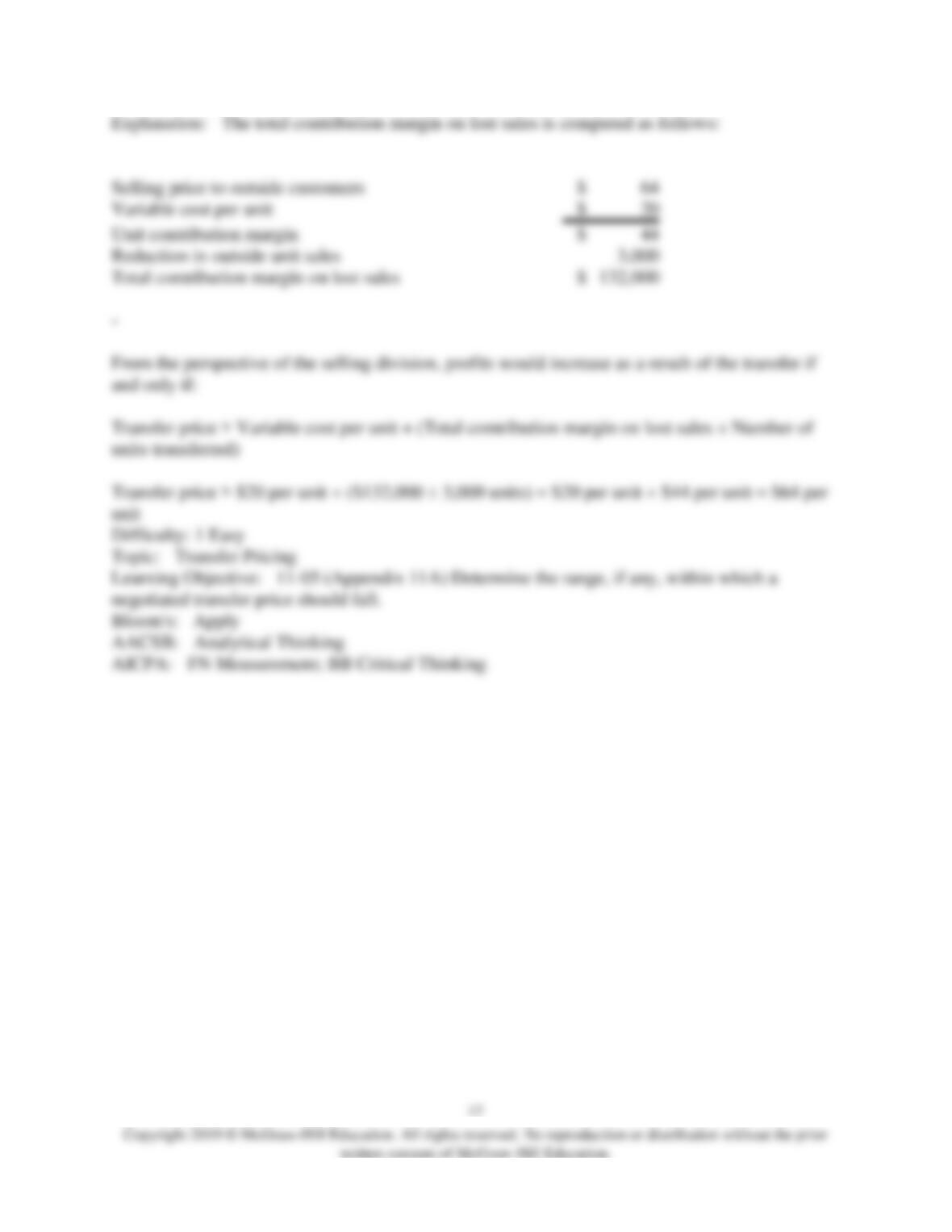
Assume that the Valve Division is selling all of the valves it can produce to outside customers.
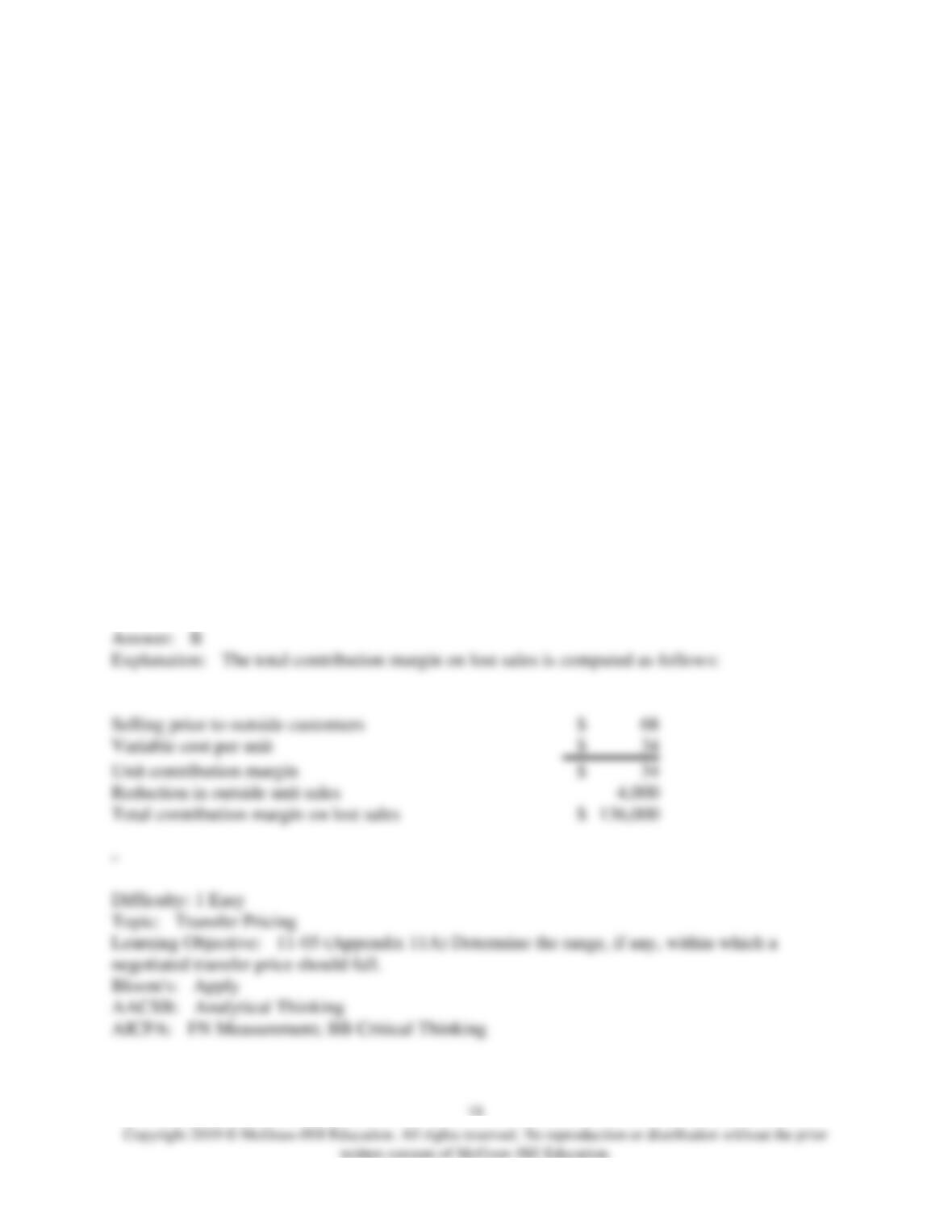
From the standpoint of the Valve Division, what is the lost contribution margin if the valves are
transferred internally rather than sold to outside customers?
A) $48,000
B) $136,000
C) $2,312,000
D) $152,000
Selling price to outside customers
$
Variable cost per unit
$
Unit contribution margin
$
Reduction in outside unit sales
Total contribution margin on lost sales
$
136,000
–
19) Division E of Harveq Company has the capacity for making 6,000 motors per month and
regularly sells 5,400 motors each month to outside customers at a contribution margin of $54 per
motor. The variable cost per motor is $41. Division F of Harveq Company would like to obtain
900 motors each month from Division E. What should be the lowest acceptable transfer price
from the perspective of Division E?
A) $59.00 per unit
B) $54.00 per unit
C) $41.00 per unit
D) $18.00 per unit
20) The Northern Division of Fiscar Corporation sells Part X2 to other companies for $87.20 per
unit. According to the company’s cost accounting system, the costs to Northern Division to make
a unit of Part X2 are:
Direct materials
$
42.70
Direct labor
$
5.80
Variable manufacturing overhead
$
9.60
Fixed manufacturing overhead
$
4.50
–
The Southern Division of Fiscar Corporation uses a part much like Part X2 in one of its products.
The Southern Division can buy this part from an outside supplier for $79.95 per unit. However,
the Southern Division could use Part X2 instead of this part that it purchases from outside
suppliers. What is the most that the Southern Division would be willing to pay the Northern
Division for Part X2?
A) $87.20 per unit
B) $62.60 per unit
C) $58.10 per unit
D) $79.95 per unit