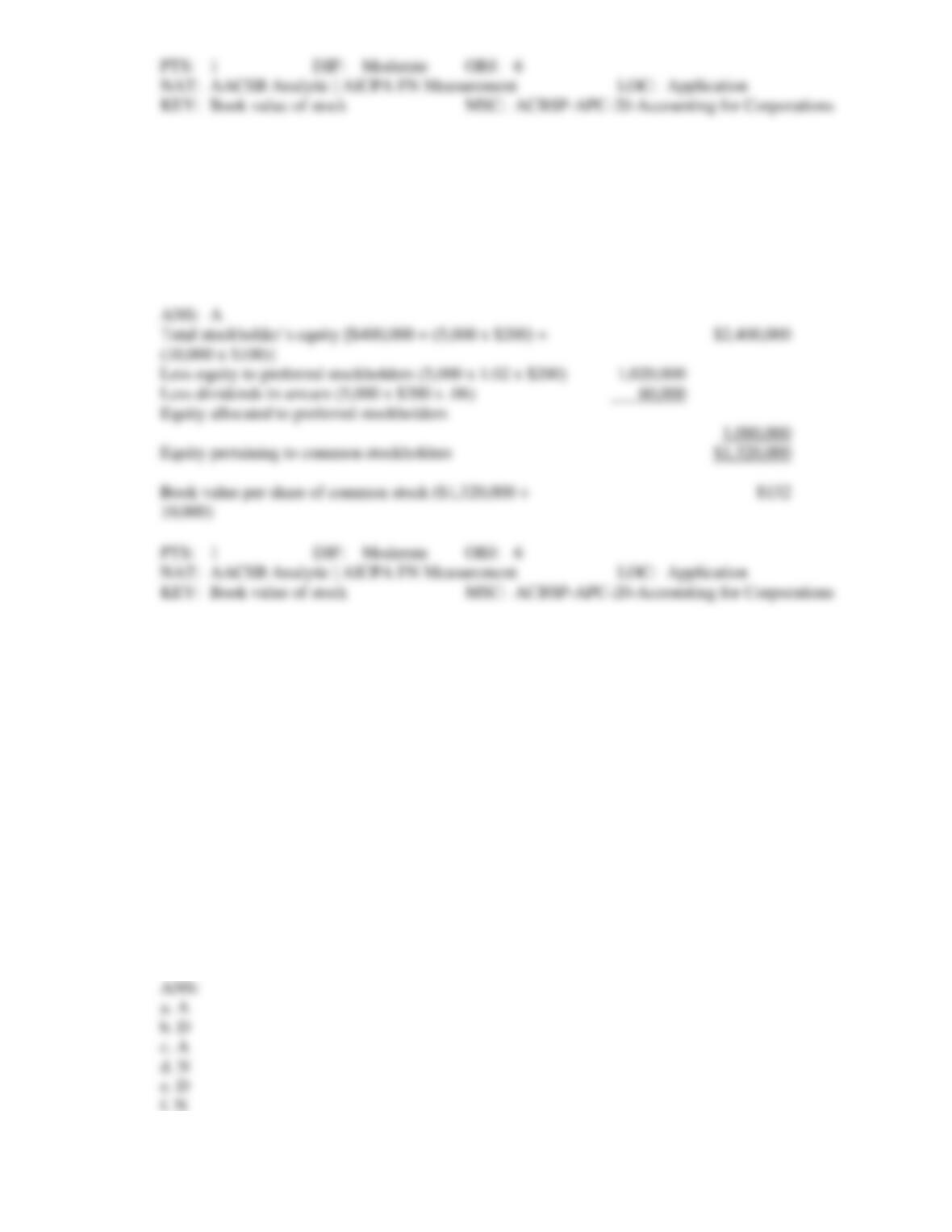
112. Winston Corporation has retained earnings of $400,000. It has 5,000 shares of 6 percent, $200 par
value preferred stock outstanding that is callable at 102. The preferred stock is cumulative, and one
year of dividends is in arrears. It also has 10,000 shares of $100 par value common stock outstanding.
Assume all stock is issued at par. The book value of each share of common stock is
a.
$132.
b.
$138.
c.
$102.
d.
$100.
SHORT ANSWER
1. Identify (by code letter) each of the following characteristics as being an advantage of (A), a
disadvantage of (D), or not applicable to (N) the corporate form of business.
a. Separate legal entity
b. Taxable entity resulting in double taxation
c. Continuous existence
d. Unlimited liability
e. Government regulation
f. Mutual agency
g. Ease of transfer of ownership
h. Ease of capital generation
i. Lack of mutual agency
j. Professional management
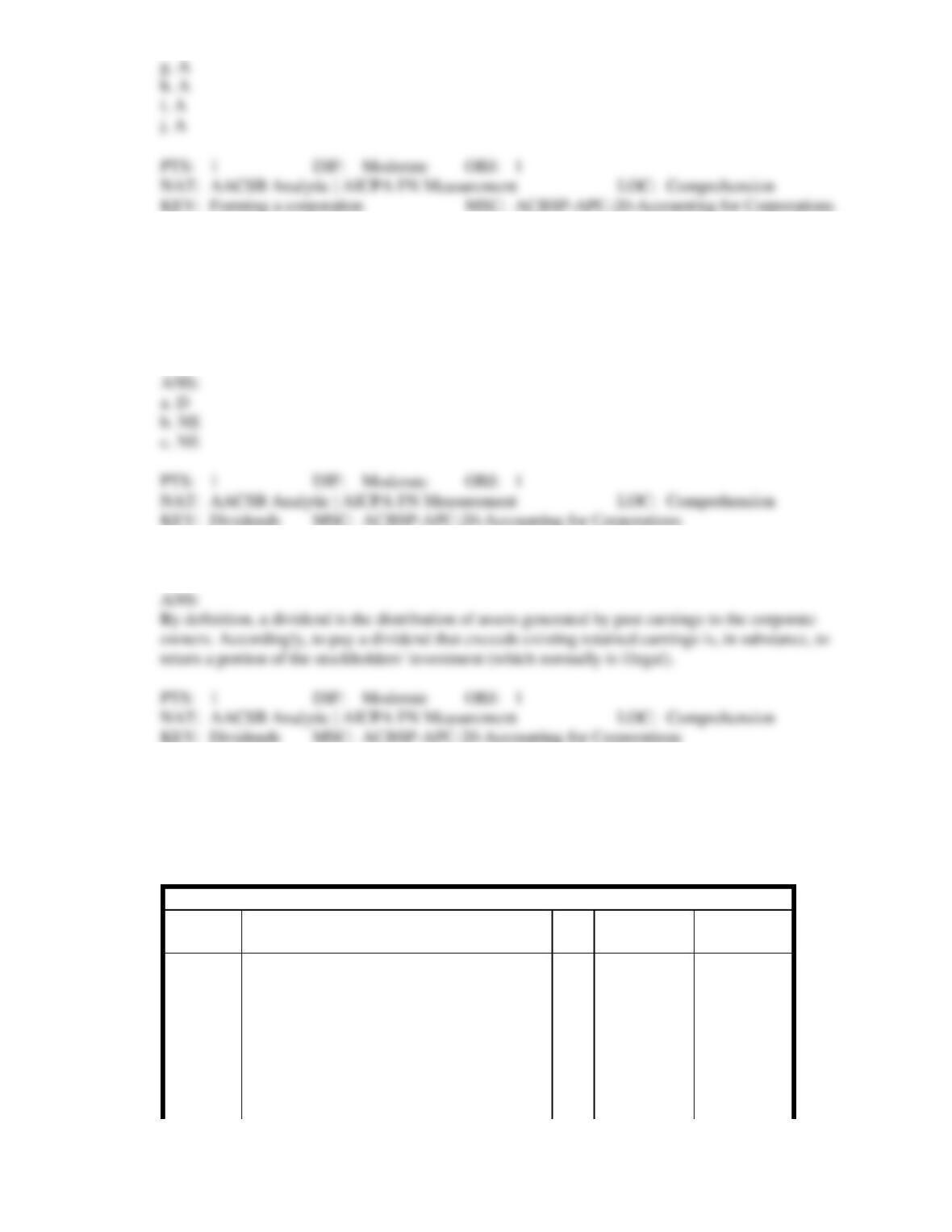
a. A
b. D
c. A
d. N
e. D
f. N
2. Indicate on the blanks below the net effect (I = increase, D = decrease, NE = no effect) of each of the
following entries on total stockholders’ equity.
a. To record the declaration of a cash dividend
b. To record the payment of a previously declared and recorded cash dividend
c. To close the Dividends account at the end of the accounting period
3. Why must a corporation have sufficient retained earnings before it may declare cash dividends?
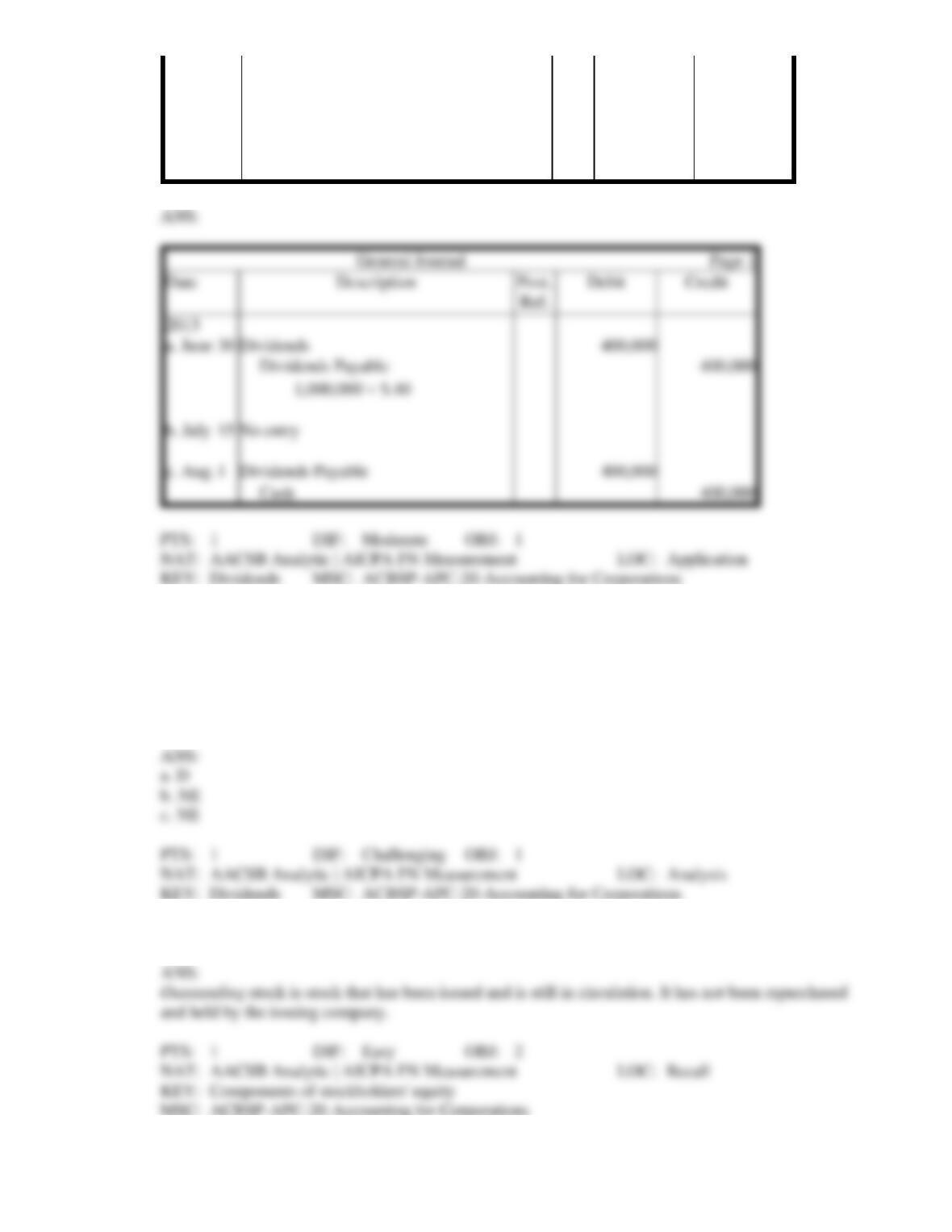
4. Mercy Corporation has 2,000,000 authorized shares of $20 par value common stock. As of June 30,
2013, there were 1,000,000 shares issued and outstanding. On June 30, 2013, the board of directors
declared a $0.40 per share cash dividend to be paid on August 1, 2013, to shareholders of record on
July 15, 2013. Prepare the necessary entries in journal form to be recorded on (a) the date of
declaration, (b) the date of record, and (c) the date of payment. (Omit explanations.)
General Journal
Page 1
Date
Description
Post.
Ref.
Debit
Credit
5. Indicate on the blanks below the net effect (I = increase, D = decrease, NE = no effect) of each of the
following entries on working capital.
a. To record the declaration of a cash dividend
b. To record the payment of a previously declared and recorded cash dividend
c. To close the Dividends account at the end of the accounting period
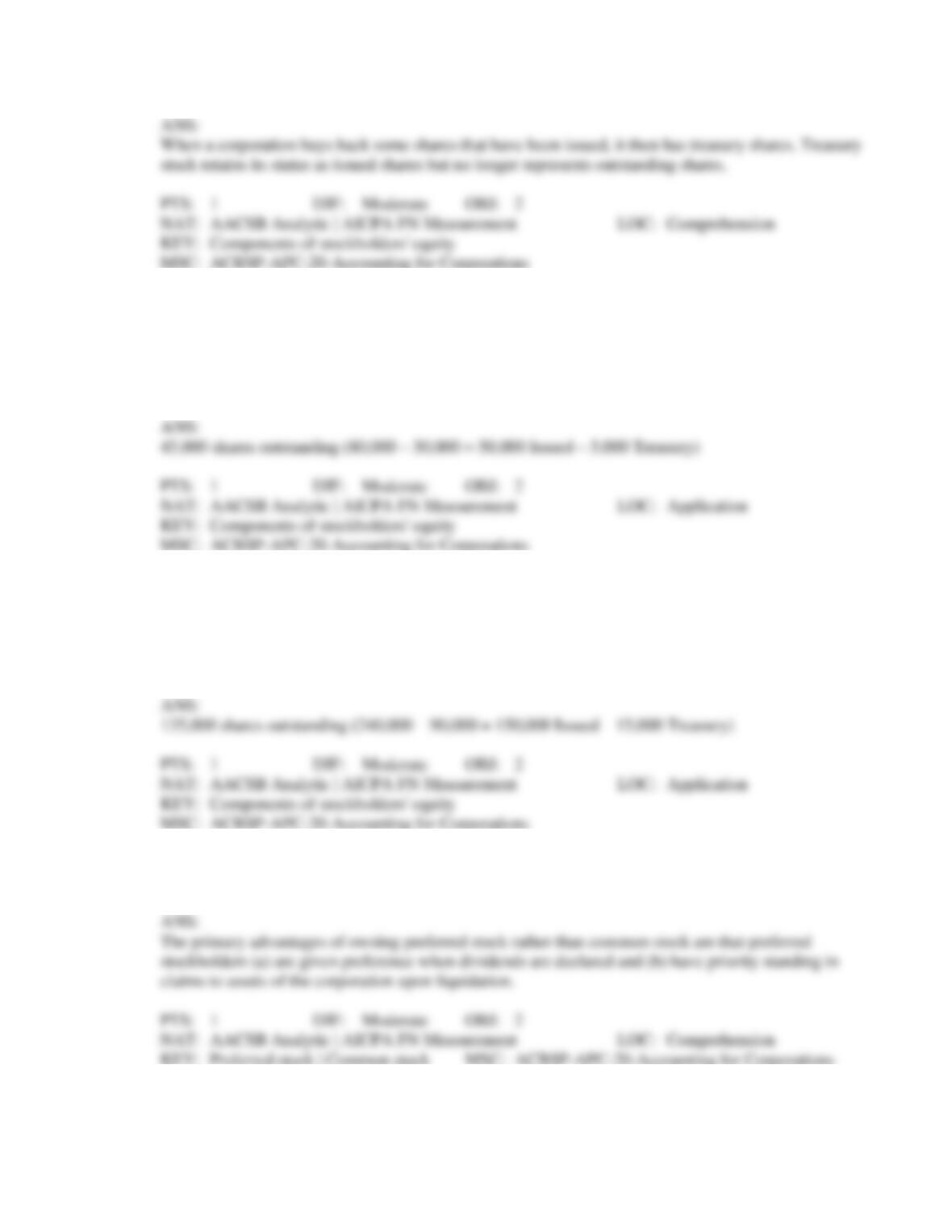
6. Define outstanding stock.
7. How is it possible for a corporation to have more shares issued than it has outstanding?
8. The following information relates to the number of common shares of the Marengo Corporation:
80,000 Authorized shares
30,000 Unissued shares
5,000 Treasury shares
Calculate the number of outstanding shares from the information given. Show your calculations.
9. The following information relates to the number of common shares of the Montgomery Corporation:
240,000 Authorized shares
90,000 Unissued shares
15,000 Treasury shares
Calculate the number of outstanding shares from the information given. Show your calculations.
10. Why might someone prefer to invest in a company by purchasing preferred stock rather than common
stock?
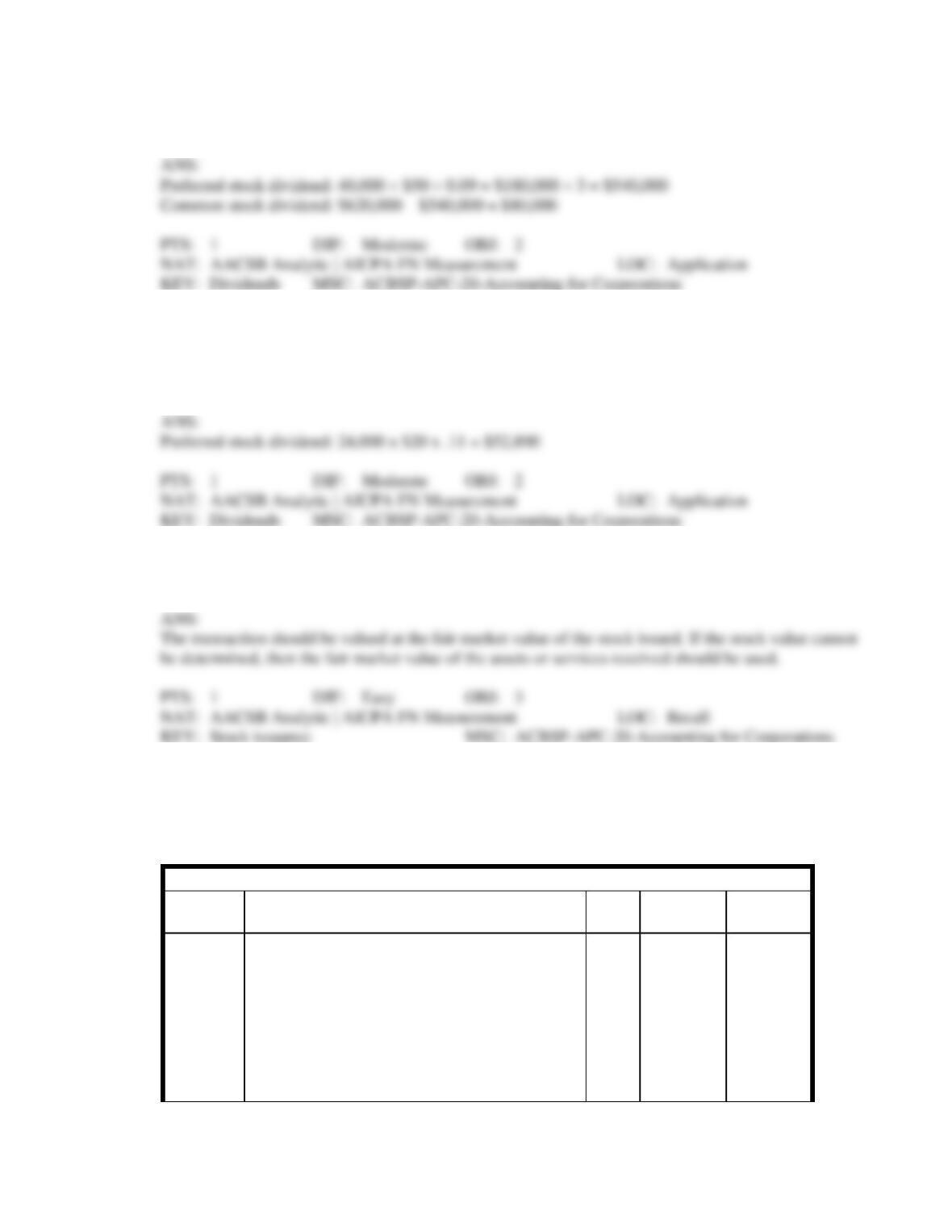
11. Margil Industries has 40,000 shares of 9 percent cumulative preferred stock and 30,000 shares of
common stock outstanding. Par value for each is $50. The company has paid no dividends for the past
two years. This year, a $620,000 dividend is paid. How much of the $620,000 is paid to the common
shareholders?
12. Randolph Corporation has 24,000 shares of 11 percent noncumulative preferred stock and 60,000
shares of common stock outstanding. Par value for each is $20. The company paid no dividends last
year. This year, a $200,000 dividend is paid. How much of the $200,000 is paid to the preferred
shareholders?
13. When stock is issued for noncash assets or services, how does one place a valuation (dollar amount) on
the transaction?
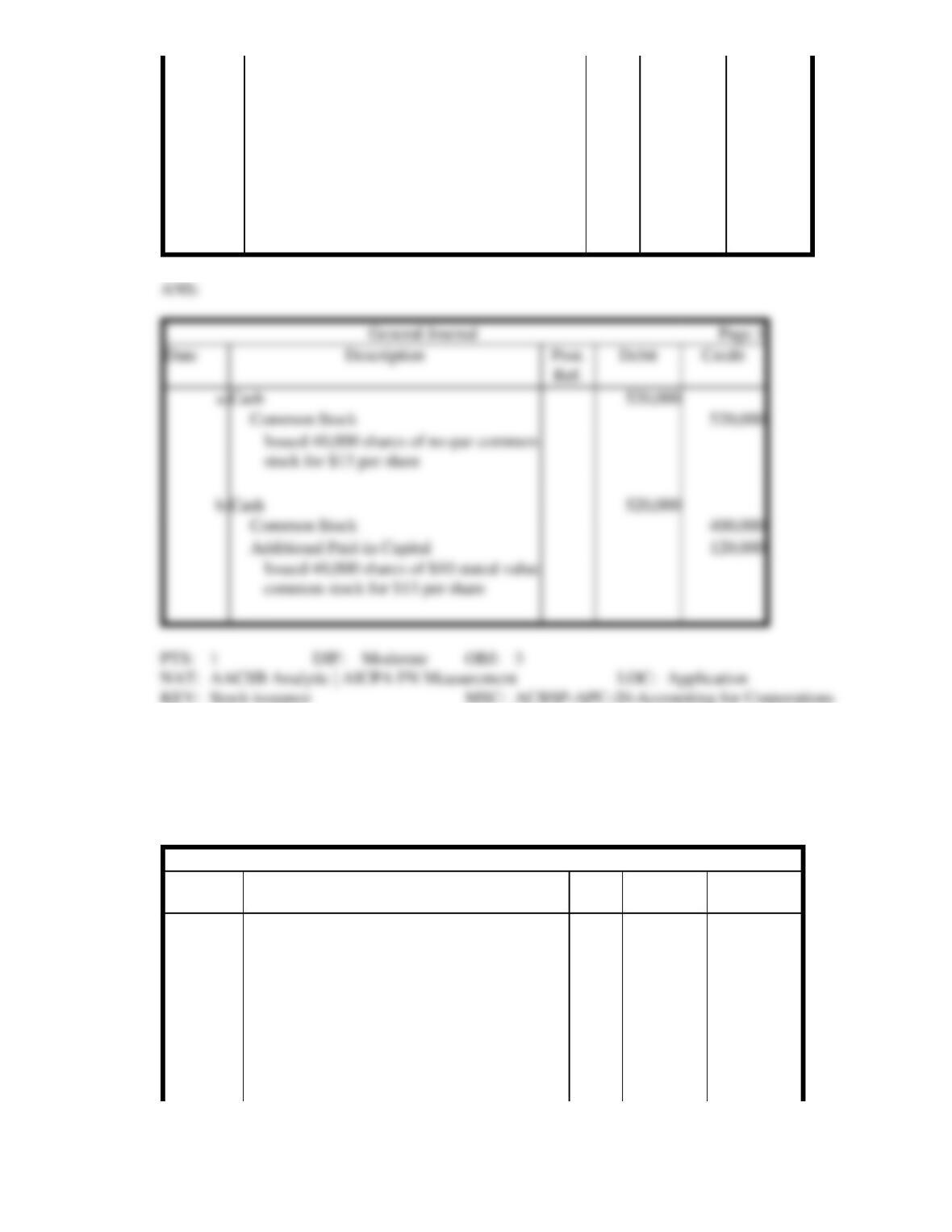
14. Simpson Corporation is authorized to issue 100,000 shares of no-par stock. The company recently sold
40,000 shares for $13 per share.
a. Prepare the entry in journal form to record the sale of the stock assuming there is no stated value.
b. Prepare the entry in journal form if a $10 stated value is authorized by the company’s board of
directors.
General Journal
Page 1
Date
Description
Post.
Ref.
Debit
Credit
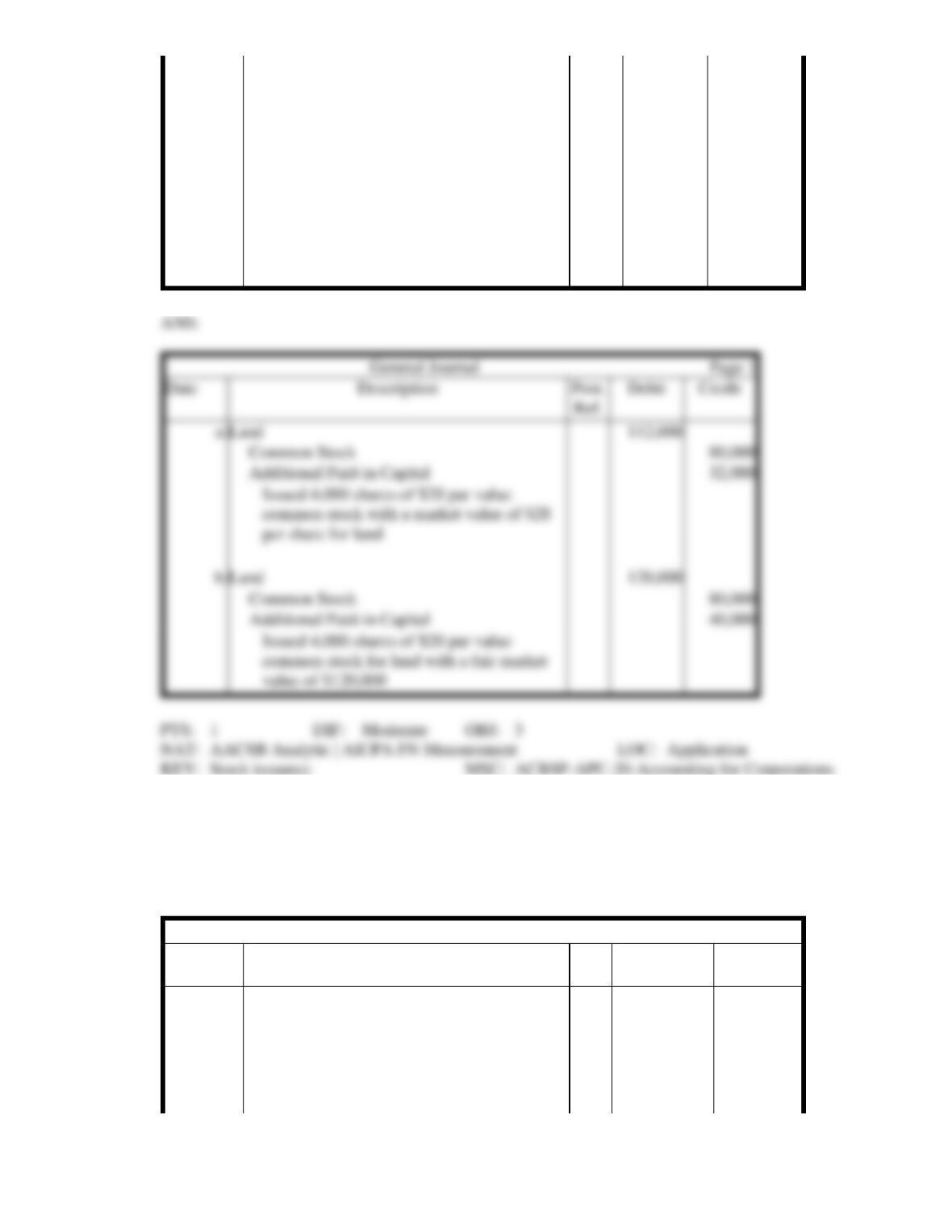
15. Tallaposa Corporation issued 4,000 shares of its $20 par value common stock for some land. The land
had a fair market value of $120,000.
Prepare the entries in journal form necessary to record the stock issue for the land under each of the
following conditions:
a. The stock was selling for $28 per share on the day of the transaction.
b. Management attempted to place a market value on the common stock but could not do so.
General Journal
Page 1
Date
Description
Post.
Ref.
Debit
Credit
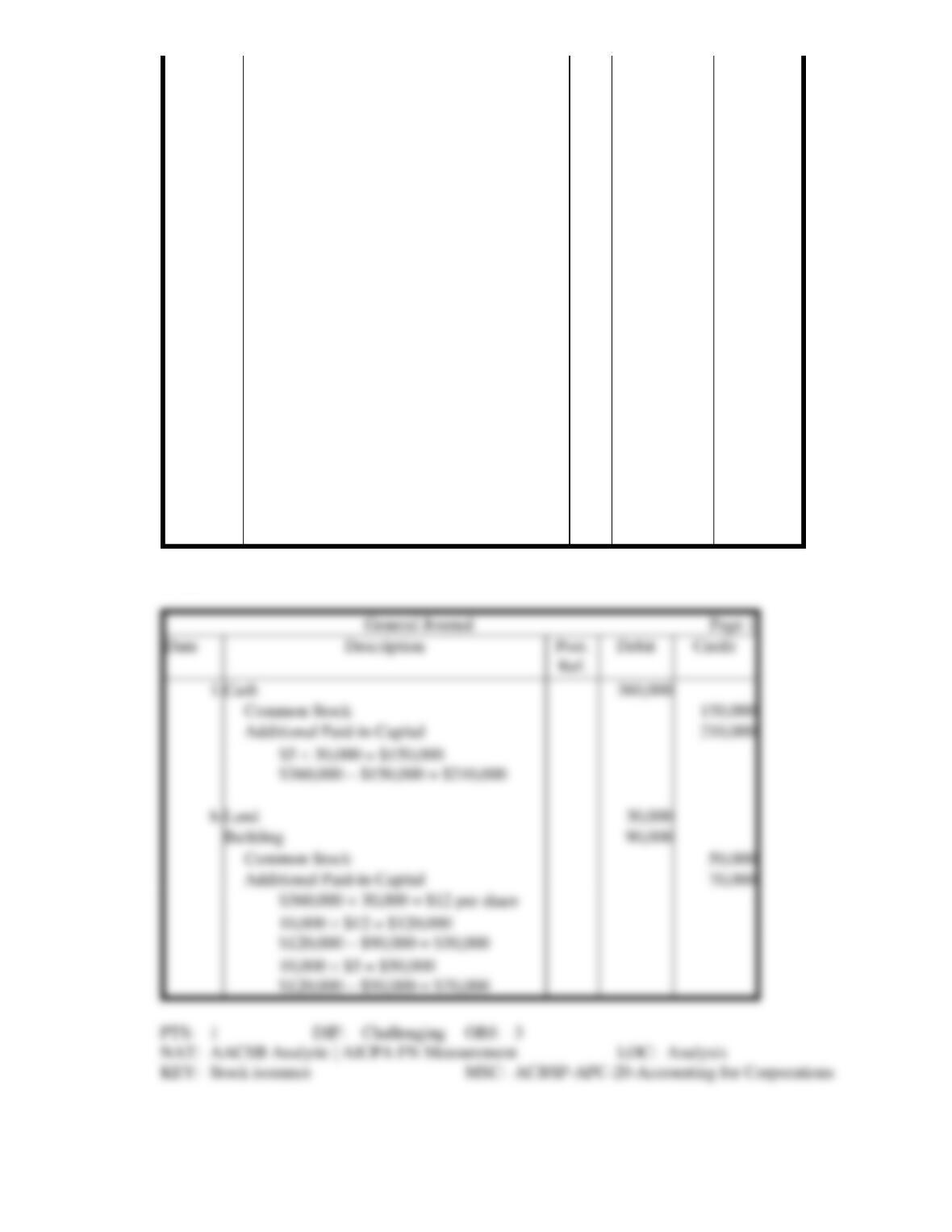
16. Poquito Corporation had both the following transactions occur on the same day:
1. Issued 30,000 shares of its $5 par value common stock for $360,000 cash.
2. Issued 10,000 shares of its $5 par value common stock in exchange for land and a building. The
building is estimated to have a market value of $90,000.
Prepare the entries in journal form to record the above transactions. Omit explanations, but show
computations.
General Journal
Page 1
Date
Description
Post.
Ref.
Debit
Credit
Additional Paid-in Capital
Common Stock
ANS:
Additional Paid-in Capital
$360,000 ÷ 30,000 = $12 per share
17. If there is no change in the number of shares authorized and issued from one year to the next, but there
is a change in the number of shares outstanding on those same dates, how would you explain that
change?
18. Prepare the entries in journal form necessary to record the following stock transactions of Fitzgerald
Corporation. These transactions represent all treasury stock transactions entered into by the company.
(Omit explanations.)
June
1
Purchased 2,000 shares of its own $30 par value common stock for $70 per
share, the current market price.
10
Sold 500 shares of treasury stock purchased on June 1 for $80 per share
20
Sold 700 shares of treasury stock purchased on June 1 for $58 per share.
30
Retired the remaining shares purchased on June 1. The original issue price was
$42 per share.
General Journal
Page 1
Date
Description
Post.
Ref.
Debit
Credit
ANS:
19. modified
Prepare entries in journal form without explanations to record the following transactions involving
Dailey Corporation’s $10 par value common stock:
Apr.
1
Purchased 500 shares of its own common stock for $24, the current market
price. This is the first transaction involving its own stock engaged in by the
company.
May
1
Sold 100 of the shares purchased on April 1 for $30.
June
1
Retired 100 of the shares purchased on April 1. The original issue price was
$16.
July
1
Sold 200 of the shares purchased on April 1 for $20.
General Journal
Page 1
Date
Description
Post.
Ref.
Debit
Credit
Cash
Treasury Stock, Common
Paid-in Capital, Treasury Stock
Cash
Paid-in Capital, Treasury Stock
Treasury Stock, Common
Additional Paid-in Capital
Retained Earnings
Treasury Stock, Common
20. The following amounts were reported by Ebert Corporation on December 31, 2012:
Common stock—$5 par value
$150,000
Additional paid-in capital
120,000
Treasury stock (8,000 shares at cost)
60,000
On January 3, 2013, 5,000 shares of treasury stock were sold. After the sale of the treasury shares, total
stockholders’ equity amounted to $277,500. No stockholders’ equity transactions other than the sale of
the treasury stock occurred between December 31, 2012, and January 3, 2013. From the information
given, compute the selling price per share of the treasury stock.
Treasury Stock, Common (500 $24)
Cash (100 $30)
Common Stock (100 $10)
21. Draw two distinctions between accounting for a stock split and accounting for a stock dividend.
22. Indicate the effect (I = increase, D = decrease, NE = no effect) of a stock split on each of the items
listed.
a. Assets
b. Balance of Common Stock account
c. Total contributed capital
d. Total retained earnings
e. Total stockholders’ equity
f. Par value per share
g. Total number of shares outstanding
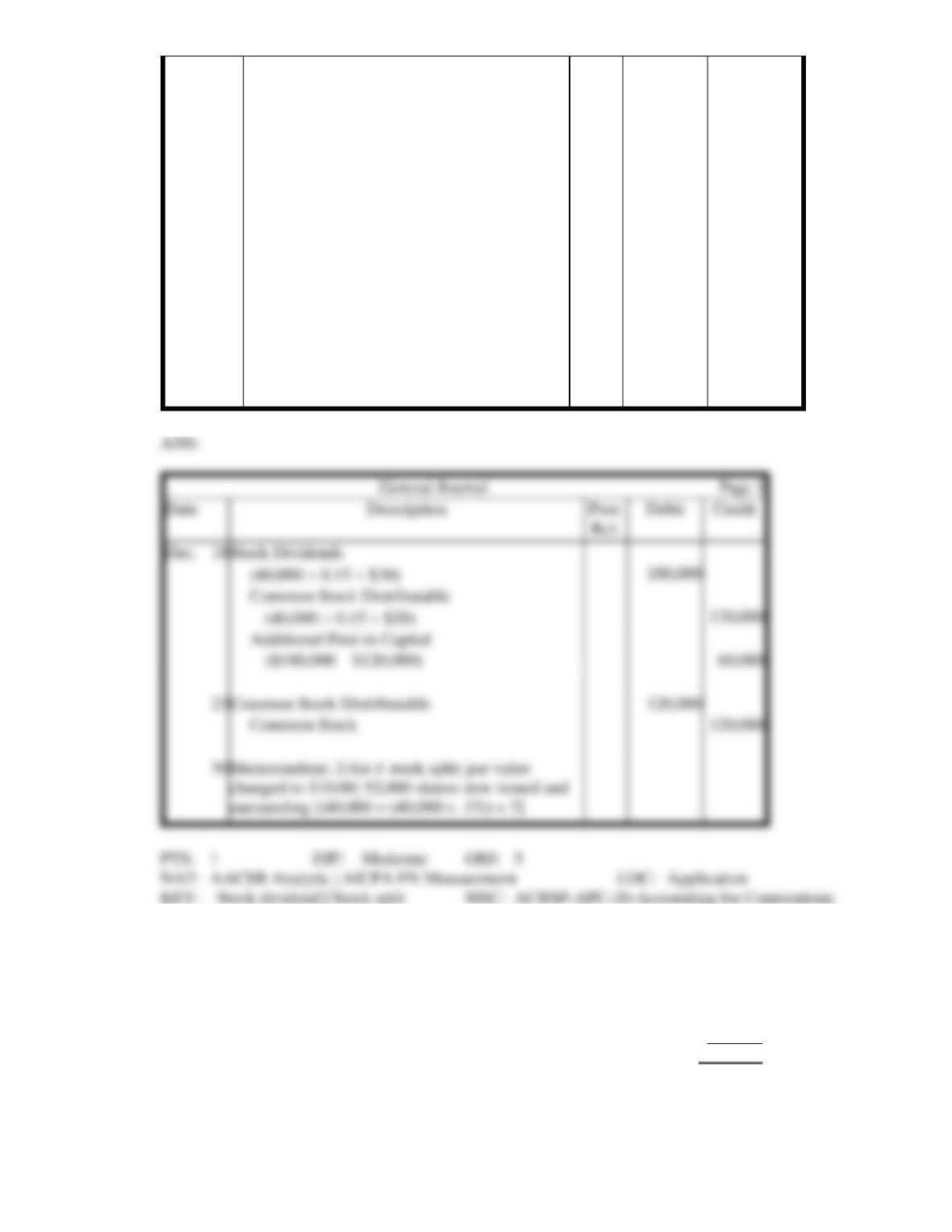
23. Walker Corporation has 40,000 shares of $20 par value common stock outstanding. Prepare entries in
journal form without explanations for the following transactions. (Market value of the stock was
$30.00 on December 16 and $31.00 on December 23.)
Dec.
16
Declared a 15 percent stock dividend.
23
Distributed the stock dividend.
30
Declared a 2-for-1 stock split.
General Journal
Page 1
Date
Description
Post.
Ref.
Debit
Credit
24. On its December 31, 2012, balance sheet, Houston Corporation reported its stockholders’ equity as
follows:
Common stock—$5 par value, 100,000 shares authorized,
50,000 shares issued and outstanding
$250,000
Additional paid-in capital
125,000
Retained earnings
400,000
Total stockholders’ equity
$775,000
During 2013, the following transactions occurred:
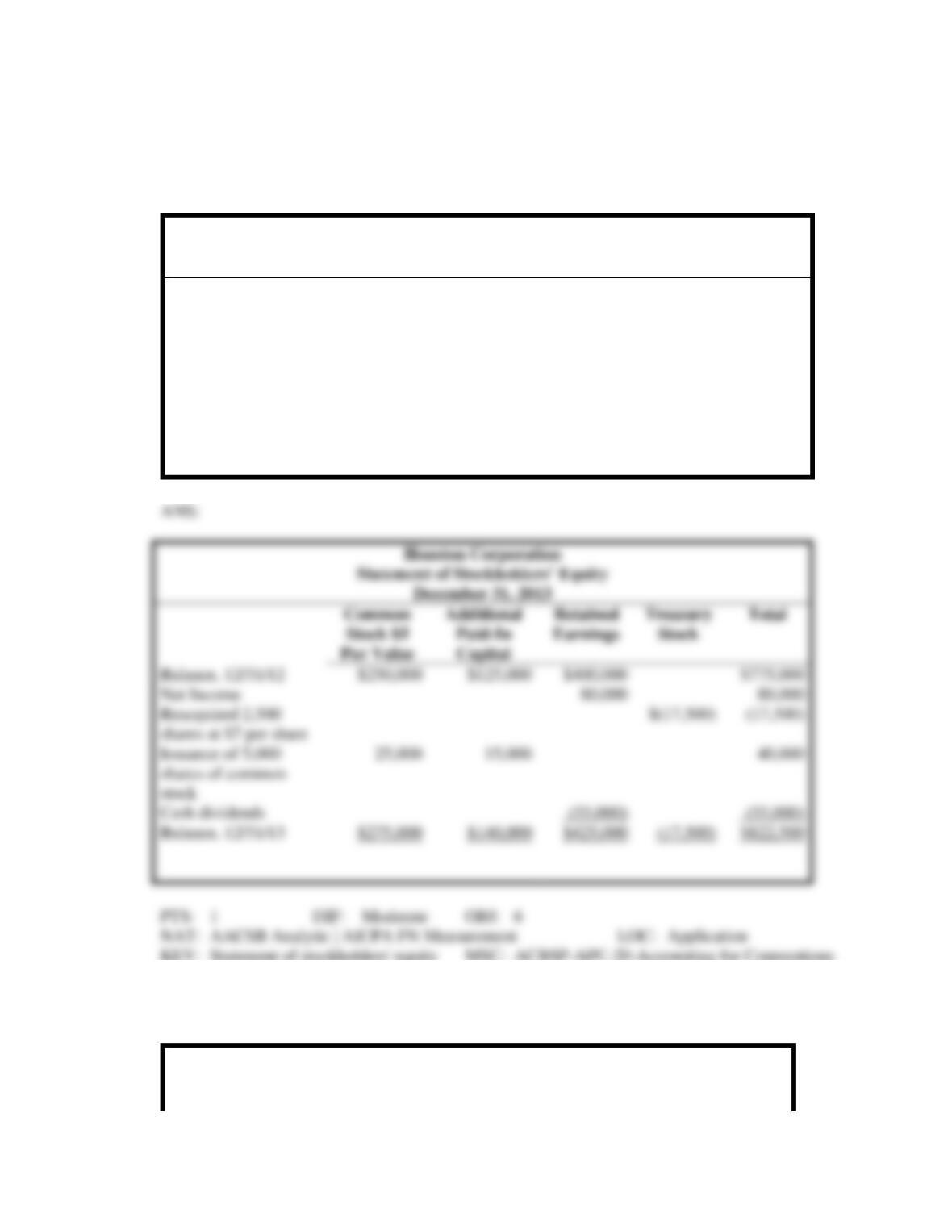
Reacquired 2,500 shares at $7 per share.
Issued 5,000 shares of common stock at $8 per share.
Cash dividends of $1 per share of common stock.
Net income for 2013 amounted to $80,000. No dividends were declared.
Prepare the Statement of Stockholders’ Equity as it should appear on December 31, 2013.
Houston Corporation
Statement of Stockholders’ Equity
For the Year Ended December 31, 2013
25. Compute the book values per share for (a) preferred and (b) common stock for Klemperer Corporation,
whose stockholders’ equity as of December 31, 2013, was as follows.
Stockholders’ Equity
Contributed capital
Preferred stock—6 percent cumulative, $100 par value,
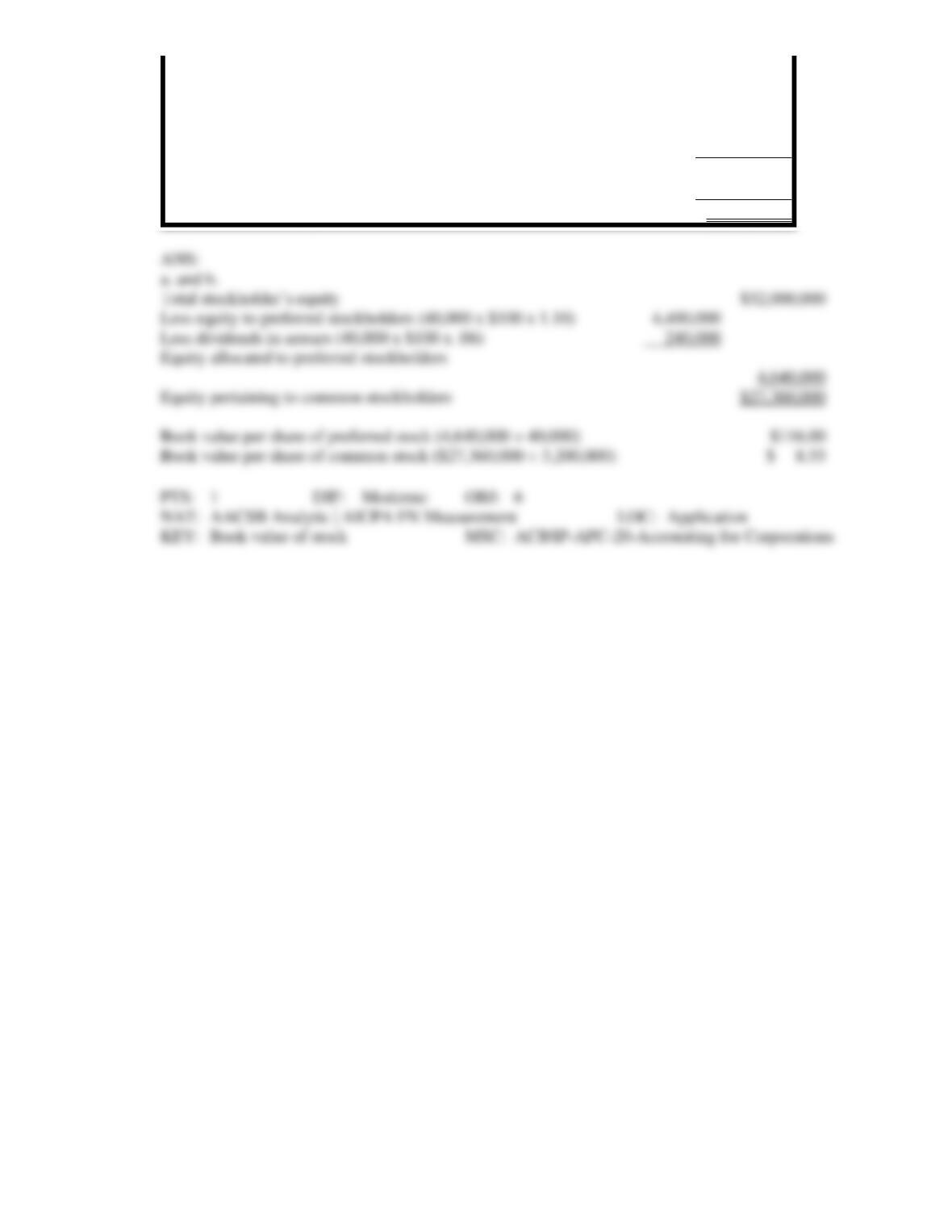
40,000 shares issued and outstanding (1 year’s dividends
in arrears), callable at 110
$ 4,000,000
Common stock—$5 par value, 4,000,000 shares authorized,
3,200,000 shares issued and outstanding
16,000,000
Additional paid-in capital, common
8,400,000
Total contributed capital
$28,400,000
Retained earnings
3,600,000
Total stockholders’ equity
$32,000,000
MATCHING
Match each definition with the correct term below.
a.
The maximum number of shares of stock that a corporation’s state charter allows it to
issue.
b.
A distribution among stockholders of the assets that a corporation’s earnings have
generated.
c.
A summary of the changes in the components of the stockholders’ equity section of the
balance sheet.
d.
A proportional distribution of shares among a corporation’s shareholders.
e.
Stock that does not have a par value.
f.
Represents a company’s total assets minus its liabilities.
g.
No-par stock that has a value assigned to it either by the board of directors or the state.
h.
A dividend declared by a company that is in excess of its retained earnings.
i.
The shares of stock that a corporation sells or otherwise transfers to stockholders.
j.
When a corporation increases the number of shares of stock issued and outstanding and
reduces the par or stated value proportionally.
1. Dividend
2. Liquidating dividend
3. Authorized shares
4. Issued shares
5. No-par stock
6. Stated value
7. Stock dividend
8. Stock split
9. Statement of stockholders’ equity
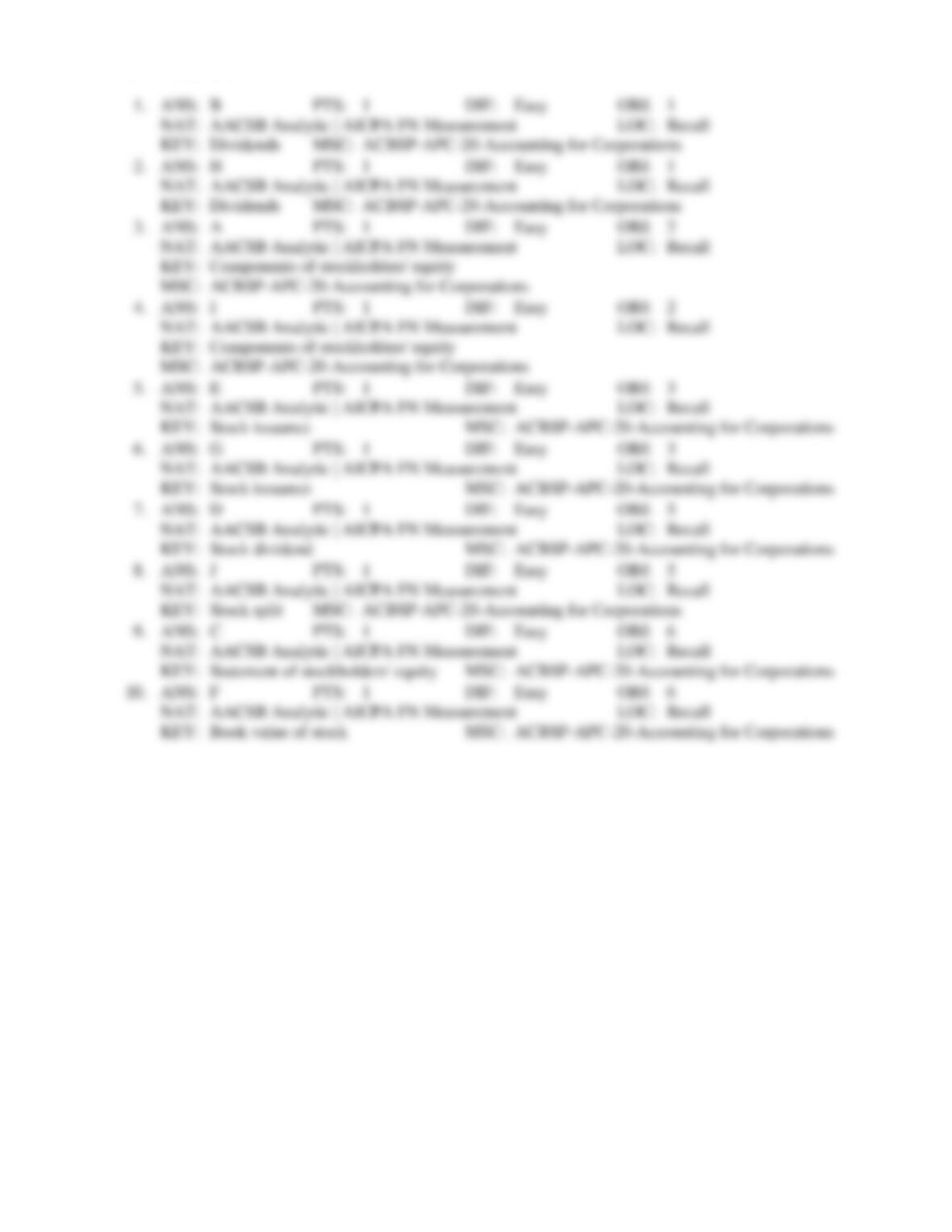
10. Book value
PROBLEM
1. Use the following information to obtain the ratios requested below. Where necessary, carry answers to
one decimal place.
Dividends per share: $.1.08
Market price per share: $60
Net income: $176,000
Average stockholders’ equity: $1,250,000
Earnings per share: $2.50
a. Dividends yield = _____________%
b. Return on equity = _____________%
c. Price/earnings (P/E) ratio = __________times