79) Par value of a stock refers to the:
A) Issue price of the stock.
B) Value assigned per share by the corporate charter.
C) Market value of the stock on the date of the financial statements.
D) Maximum selling price of the stock.
E) Dividend value of the stock.
80) When a corporation has only one class of stock, the stock is called:
A) Preferred stock.
B) Common stock.
C) Par value stock.
D) Stated value stock.
E) No-par value stock.
81) The least amount that the buyers of stock must contribute to the corporation or be at risk to
pay creditors at a future date is called the:
A) Par value of preferred.
B) Minimum legal capital.
C) Premium capital.
D) Stated value.
E) Working capital.
82) The total amount of cash and other assets received by a corporation from its stockholders in
exchange for its stock is:
A) Always equal to its par value.
B) Always equal to its stated value.
C) Referred to as paid-in capital.
D) Referred to as retained earnings.
E) Always below its stated value.
83) Stated value of no-par stock is:
A) Another name for redemption value.
B) An amount assigned to par value stock by the state of incorporation.
C) The market value of the stock on the date of issuance.
D) The difference between the par value of stock and the amount below or above par value paid-
in by the stockholder.
E) An amount assigned to no-par stock by the corporation’s board of directors.
84) Stockholders’ equity consists of which of the following?
A) Long-term assets.
B) Paid-in capital and retained earnings.
C) Paid-in capital and par value.
D) Retained earnings and cash.
E) Premiums and discounts.
85) A class of stock for which there is no minimum legal capital is called:
A) Convertible stock.
B) No-par stock.
C) Callable stock.
D) Noncumulative stock.
E) Discounted stock.
86) The number of shares a corporation’s charter allows it to sell:
A) Issued.
B) Authorized.
C) Subscribed.
D) Outstanding.
E) In treasury.
87) Retained earnings:
A) Generally consists of a company’s cumulative net income less any net losses and dividends
declared since its inception.
B) Can only be appropriated by setting aside a cash fund.
C) Represent an amount of cash available to pay shareholders.
D) Are never adjusted for anything other than net income or dividends.
E) Represents the amount shareholders are guaranteed to receive upon company liquidation.
88) Prior period adjustments to financial statements can result from:
A) Changes in estimates of salvage value.
B) Unacceptable accounting practices.
C) Discontinued operations.
D) Changes in tax law.
E) Changes in estimates of useful life.
89) Prior period adjustments are reported in the:
A) Multiple-step income statement.
B) Balance sheet.
C) Statement of retained earnings.
D) Statement of cash flows.
E) Single-step income statement.
90) Changes in accounting estimates are:
A) Considered accounting errors.
B) Reported as prior period adjustments.
C) Accounted for with a cumulative “catch-up” adjustment.
D) Statement of cash flow items.
E) Accounted for in current and future periods.
91) A company had a beginning balance in retained earnings of $430,000. It had net income of
$60,000 and declared and paid cash dividends of $56,250 in the current period. The ending
balance in retained earnings equals:
A) $546,250.
B) $426,250.
C) $116,250.
D) $433,750.
E) $490,000.
92) A company had a beginning balance in retained earnings of $400,000. It had net income of
$50,000 and declared and paid cash dividends of $55,000 in the current period. The ending
balance in retained earnings equals:
A) $505,000.
B) $405,000.
C) $395,000.
D) $455,000.
E) $350,000.
93) Companies report prior period adjustments, net of any income tax effects in the:
A) Statement of cash flows.
B) Balance sheet.
C) Statement of retained earnings.
D) Income statement.
E) No disclosure is required.
94) Changes in retained earnings are commonly reported in the:
A) Statement of cash flows.
B) Balance sheet.
C) Statement of stockholders’ equity.
D) Multiple-step income statement.
E) Single-step income statement.
95) A company made an error in calculating and reporting amortization expense in Year 1. The
error was discovered in Year 2. The item should be reported as a prior period adjustment:
A) on the Year 1 statement of retained earnings.
B) on the Year 1 income statement.
C) on the Year 2 statement of retained earnings.
D) on the Year 2 income statement.
E) accounted for with a cumulative “catch-up” adjustment in Year 2.
96) The statement of changes in stockholders’ equity:
A) Is part of the statement of retained earnings.
B) Shows only the ending balances in stockholders’ equity.
C) Describes changes in paid-in capital and retained earnings subcategories.
D) Does not include changes in treasury stock.
E) Is reported by very few companies.
97) The amount of income earned per share of a company’s outstanding common stock is known
as:
A) Restricted retained earnings per share.
B) Earnings per share.
C) Continuing operations per share.
D) Dividends per share.
E) Book value per share.
98) Mayan Company had net income of $132,000. The weighted-average common shares
outstanding were 80,000. The company has no preferred stock. The company’s earnings per
share is:
A) $1.65.
B) $1.59.
C) $44.00.
D) $26.67.
E) $1.71.
99) Mayan Company had net income of $132,000. The weighted-average common shares
outstanding were 80,000. The company declared a $27,000 dividend on its noncumulative,
nonparticipating preferred stock. There were no other stock transactions. The company’s earnings
per share is:
A) $1.65.
B) $1.99.
C) $1.31.
D) $0.34.
E) $4.89.
100) The price-earnings ratio is calculated by dividing:
A) Market value per share by earnings per share.
B) Earnings per share by par value per share.
C) Dividends per share by earnings per share.
D) Dividends per share by market value per share.
E) Market value per share by dividends per share.
101) A company has net income of $90,000; its weighted-average common shares outstanding
are 18,000. Its dividend per share is $0.45, its market price per share is $88, and its book value
per share is $76. Its price-earnings ratio equals:
A) 9.0.
B) 17.6.
C) 12.5.
D) 15.2.
E) 16.9.
102) A company has earnings per share of $9.60. Its dividend per share is $0.50, its market price
per share is $110, and its book value per share is $96. Its price-earnings ratio equals:
A) 1.15.
B) 0.87.
C) 19.2.
D) 10.0.
E) 11.46.
103) The amount of annual cash dividends distributed to common shareholders relative to the
common stock’s market value is the:
A) Dividend payout ratio.
B) Dividend yield.
C) Price-earnings ratio.
D) Current yield.
E) Earnings per share.
104) The dividend yield is computed by dividing:
A) Annual cash dividends per share by earnings per share.
B) Earnings per share by cash dividends per share.
C) Annual cash dividends per share by the market value per share.
D) Par value per share by cash dividends per share.
E) Cash dividends per share by retained earnings.
105) Stocks that pay large cash dividends on a regular basis are called:
A) Small capital stocks.
B) Mid capital stocks.
C) Growth stocks.
D) Large capital stocks.
E) Income stocks.
106) Dividend yield is the percent of cash dividends paid to common shareholders relative to the:
A) Common stock’s market value.
B) Earnings per share.
C) Investors’ purchase price of the stock.
D) Amount of retained earnings.
E) Amount of cash.
107) A company paid $0.48 in cash dividends per share. Its earnings per share is $3.20 and its
market price per share is $20.00. Its dividend yield equals:
A) 2.4%.
B) 6.25%.
C) 6.4%.
D) 6.67%.
E) 15.00%.
108) A company paid $0.85 in cash dividends per share. Its earnings per share is $3.50, and its
market price per share is $35.50. Its dividend yield equals:
A) 2.0%.
B) 2.4%.
C) 9.9%.
D) 21.4%.
E) 24.2%.
109) Book value per share:
A) Reflects the value per share if a company is liquidated at balance sheet amounts.
B) Is assets divided by equity.
C) Is assets divided by the number of common shares outstanding.
D) Measures the current market value assets.
E) Is equal to par value per share.
110) Book value per common share is computed by:
A) Multiplying the number of common shares outstanding times the market price per common
share.
B) Dividing total assets by the number of shares outstanding.
C) Dividing stockholders’ equity applicable to common shares by the number of common shares
outstanding.
D) Multiplying the number of common shares outstanding by par value per share.
E) Dividing the number of common shares outstanding by stockholders’ equity applicable to
common shares.
111) A company has 50,000 shares of common stock outstanding. The stockholders’ equity
applicable to common shares is $1,470,000, and the par value per common share is $5. The book
value per share is:
A) $4.75.
B) $14.70.
C) $10.00.
D) $29.40.
E) $47.50.
112) James Company has 1,000 shares of $10 par preferred stock, which were issued at par. It
also has 25,000 shares of common stock outstanding, and its total stockholders’ equity equals
$500,000. The book value per common share is:
A) $16.00.
B) $19.60.
C) $19.96.
D) $20.00.
E) $10.00.
113) MBP Company has 10,000 shares of $10 par preferred stock, which were issued at par. It
also has 250,000 shares of common stock outstanding, and its total stockholders’ equity equals
$4,000,000. The book value per common share is:
A) $16.67.
B) $16.00.
C) $40.00.
D) $15.60.
E) $10.00.
114) A company has 500 shares of $60 par value preferred stock outstanding. It also has 20,000
shares of common stock outstanding, and the total value of its stockholders’ equity is $680,000.
The company’s book value per common share equals:
A) $31.71.
B) $32.50.
C) $32.75.
D) $33.17.
E) $60.00.
115) The Discount on Common Stock account reflects:
A) The difference between the par value of stock and its issue price when it is issued at a price
below par value.
B) One share’s portion of the issued corporation’s net assets recorded in its accounts.
C) The difference between the par value of the stock and the amount paid-in by stockholders
when the amount paid-in is more than par value.
D) An amount of assets defined by state law that stockholders must invest and leave invested in a
corporation.
E) The amount a corporation must pay in addition to dividends in arrears if and when it exercises
its right to retire a share of callable preferred stock.
116) Percy Corporation was formed on January 1. The corporate charter authorized 100,000
shares of $10 par value common stock. During the first month of operation, the corporation
issued 400 shares to its attorneys in payment of a $5,000 charge for drawing up the articles of
incorporation. The entry to record this transaction would include:
A) A debit to Organization Expenses for $4,000.
B) A debit to Organization Expenses for $5,000.
C) A credit to Common Stock for $5,000.
D) A credit to Paid-in Capital in Excess of Par Value, Common Stock for $5,000.
E) A debit to Paid-in Capital in Excess of Par Value, Common Stock for $2,000.
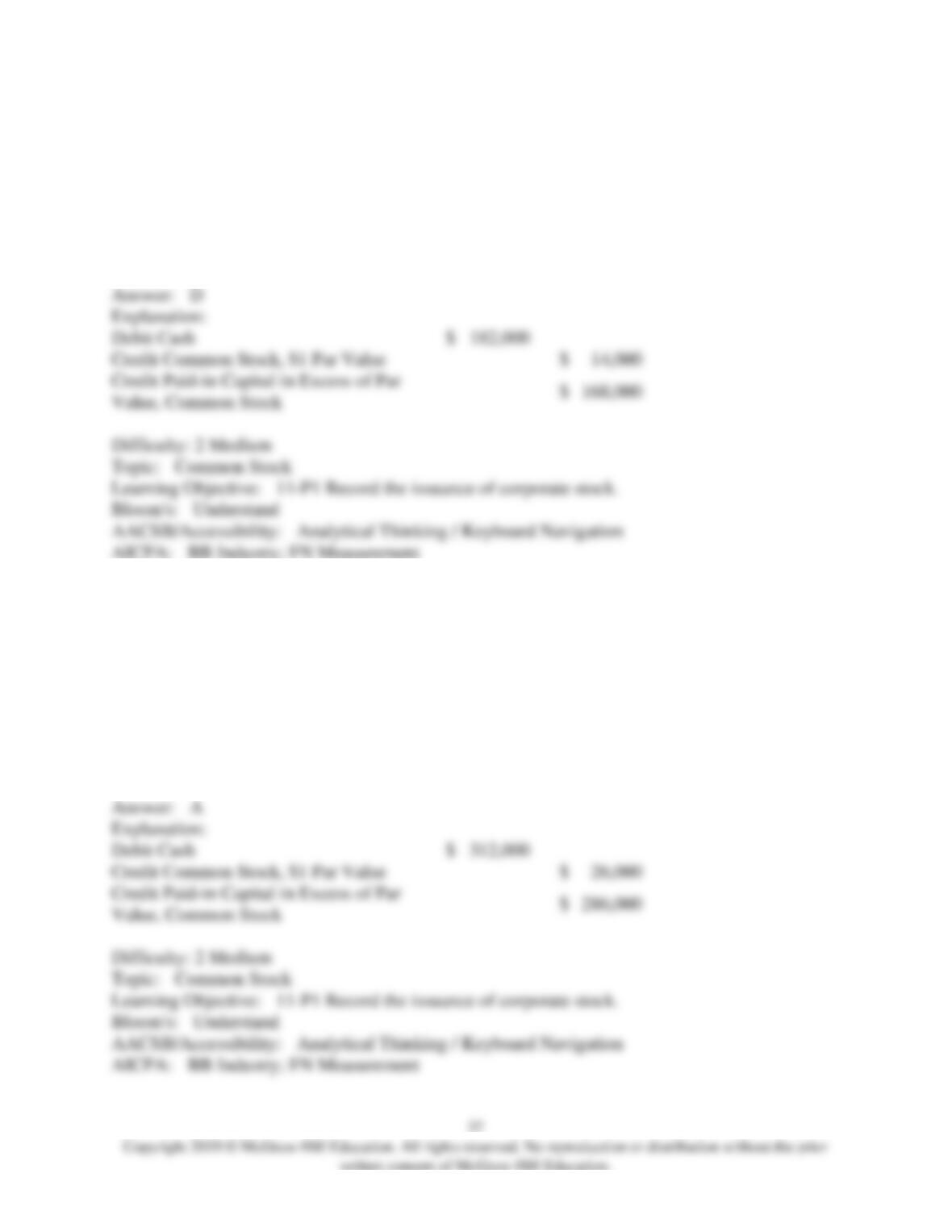
117) A corporation sold 14,000 shares of its $1 par value common stock at a cash price of $13
per share. The entry to record this transaction would include:
A) A debit to Paid-in Capital in Excess of Par Value, Common Stock for $182,000.
B) A debit to Cash for $14,000.
C) A credit to Common Stock for $182,000.
D) A credit to Common Stock for $14,000.
E) A credit to Paid-in Capital in Excess of Par Value, Common Stock for $196,000.
118) Comfort Mattresses, Inc. sold 26,000 shares of its $1 par value common stock at a cash
price of $12 per share. The entry to record this transaction would be:
A) Debit Cash $312,000; credit Common Stock $26,000; credit Paid-in Capital in Excess of Par
Value, Common Stock $286,000.
B) Debit Cash for $312,000; credit Common Stock $312,000.
C) Debit Common Stock $26,000; debit Paid-in Capital in Excess of Par Value, Common Stock
$286,000; credit Cash $312,000.
D) Debit Cash $312,000; credit Stock Liability $286,000; credit Common Stock $26,000.
E) Debit Common Stock $26,000; credit Cash $26,000.
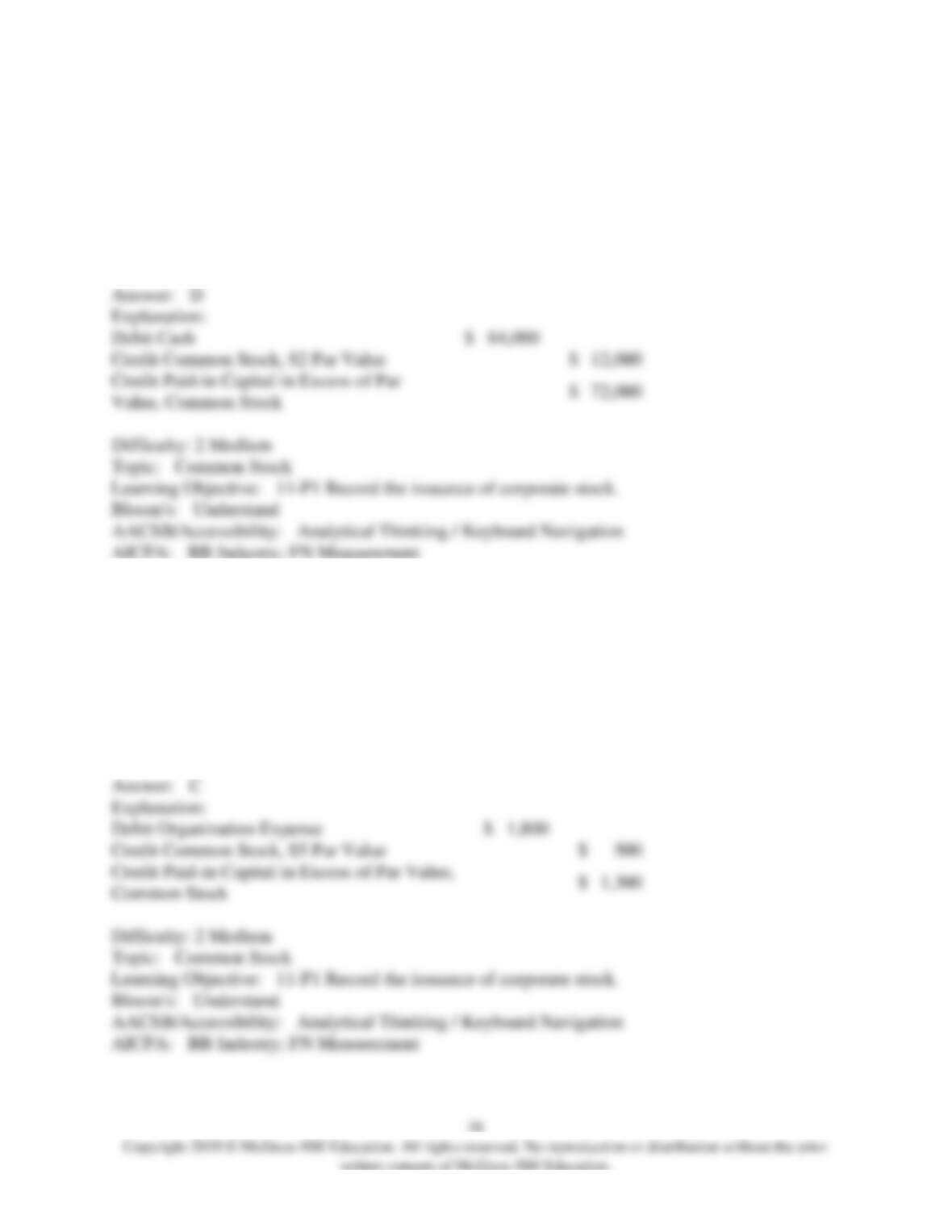
119) A corporation issued 6,000 shares of its $2 par value common stock in exchange for land
that has a market value of $84,000. The entry to record this transaction would include:
A) A debit to Common Stock for $12,000.
B) A debit to Land for $12,000.
C) A credit to Land for $12,000.
D) A credit to Paid-in Capital in Excess of Par Value, Common Stock for $72,000.
E) A credit to Common Stock for $84,000.
120) A corporation issued 100 shares of its $5 par value common stock in payment of a $1,800
charge from its accountant for assistance in filing its charter with the state. The entry to record
this transaction will include:
A) A $1,800 credit to Common Stock.
B) A $300 debit to Organization Expenses.
C) A $1,300 credit to Paid-in Capital in Excess of Par Value, Common Stock.
D) A $1,800 debit to Legal Expenses.
E) A $1,800 credit to Cash.
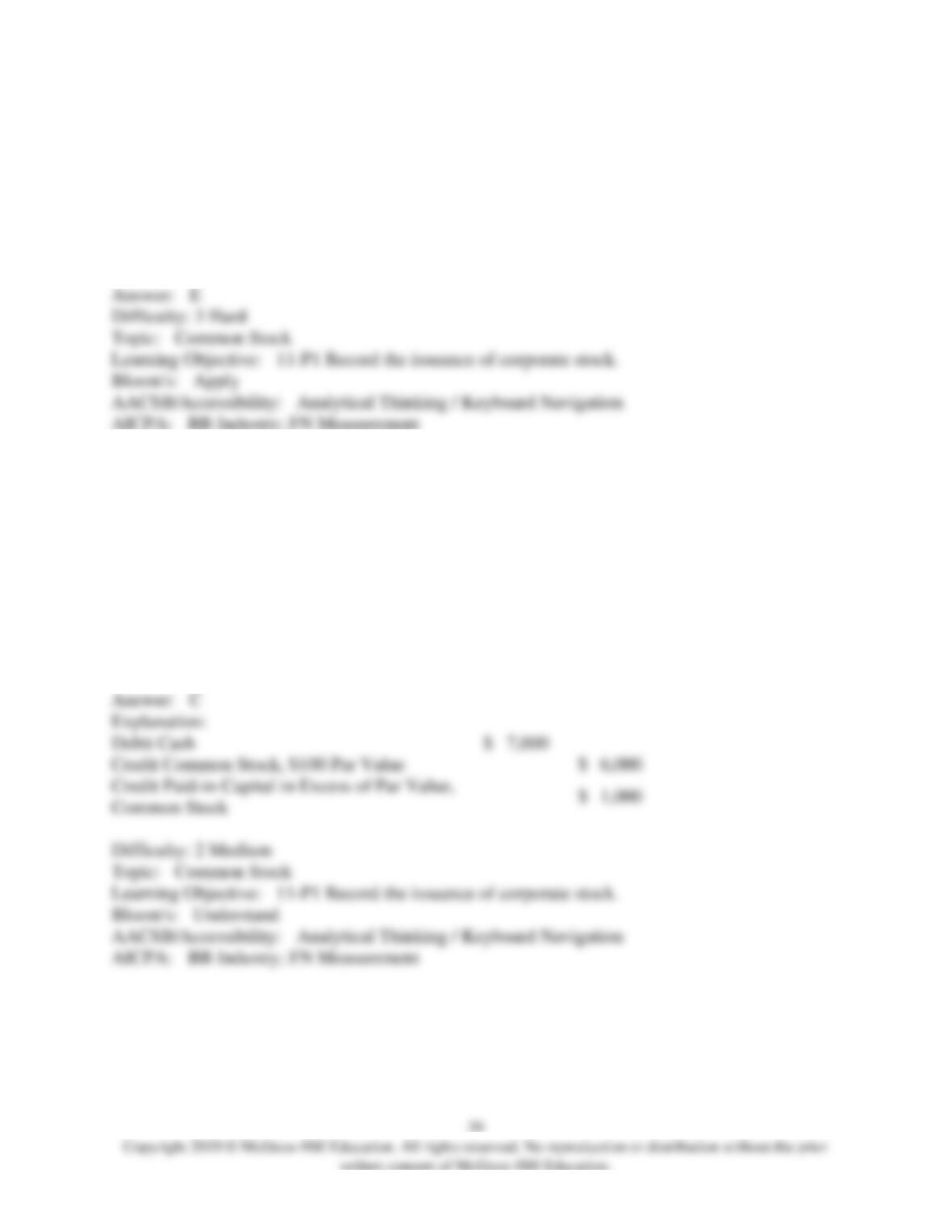
121) A company issued 60 shares of $100 par value common stock for $7,000 cash. The total
amount of paid-in capital is:
A) $100.
B) $600.
C) $1,000.
D) $6,000.
E) $7,000.
122) A company issued 60 shares of $100 par value common stock for $7,000 cash. The journal
entry to record the issuance is:
A) Debit Cash $7,000; credit Common Stock $7,000.
B) Debit Investment in Common Stock $7,000; credit Cash $7,000.
C) Debit Cash $7,000; credit Common Stock $6,000; credit Paid-in Capital in Excess of Par
Value, Common Stock $1,000.
D) Debit Common Stock $6,000, debit Investment in Common Stock $1,000; credit Cash
$7,000.
E) Debit Cash $7,000; credit Paid-in Capital in Excess of Par Value, Common Stock $6,000,
credit Common Stock $1,000.
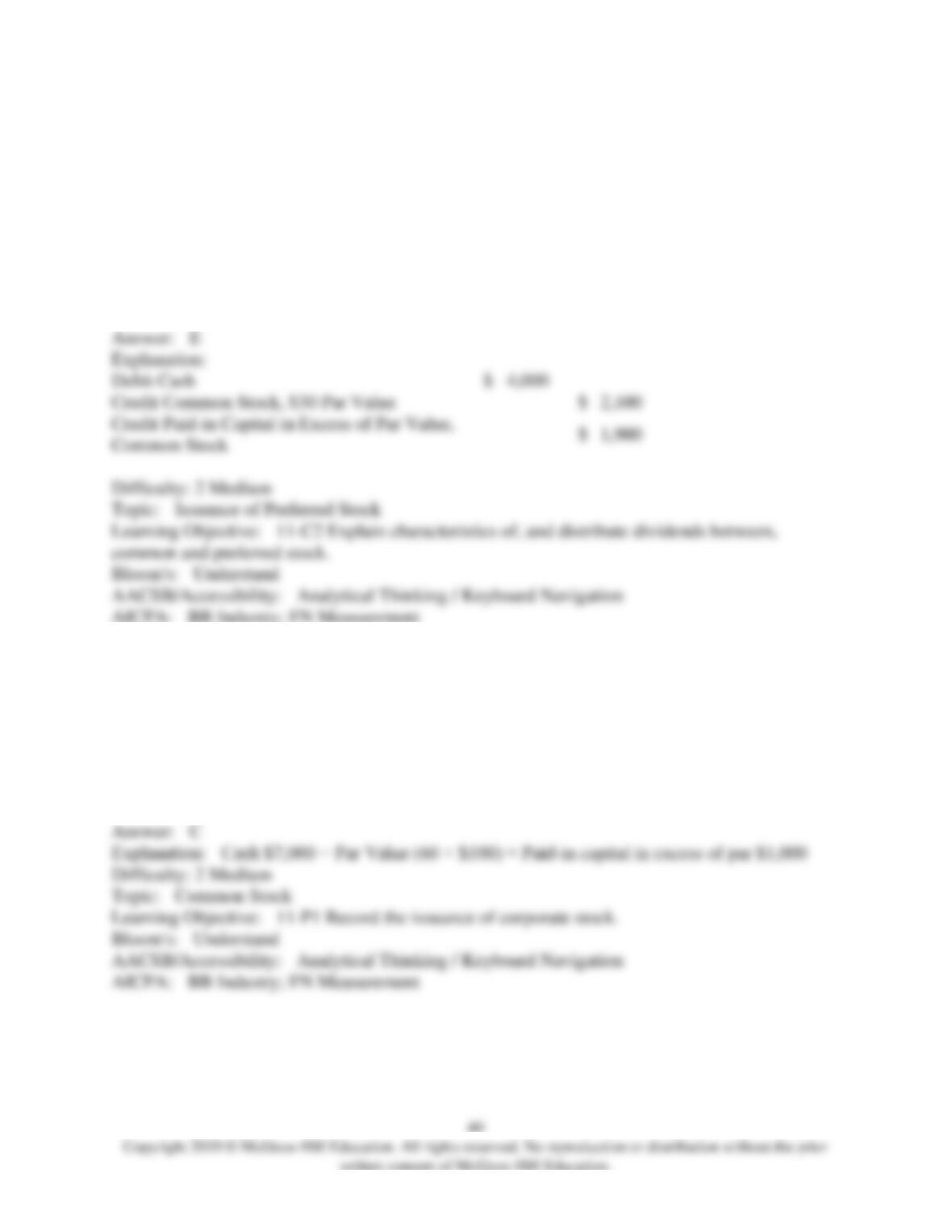
123) A company issued 70 shares of $30 par value preferred stock for $4,000 cash. The journal
entry to record the issuance is:
A) Debit Cash $2,100; credit Preferred Stock $2,100.
B) Debit Investment in Preferred Stock $2,100; credit Cash $2,100.
C) Debit Cash $4,000; credit Preferred Stock $4,000.
D) Debit Preferred Stock $2,100, debit Investment in Preferred Stock $1,900; credit Cash
$4,000.
E) Debit Cash $4,000; credit Paid-in Capital in Excess of Par Value, Preferred Stock $1,900,
credit Preferred Stock $2,100.
124) A company issued 60 shares of $100 par value common stock for $7,000 cash. The total
amount of paid-in capital in excess of par is:
A) $100.
B) $600.
C) $1,000.
D) $6,000.
E) $7,000.