166) West Company declared a $0.50 per share cash dividend. The company has 190,000 shares
issued, and 10,000 shares in treasury stock. The journal entry to record the payment of the
dividend is:
A) Debit Retained Earnings $90,000; credit Common Dividends Payable $90,000.
B) Debit Common Dividends Payable $95,000; credit Cash $95,000.
C) Debit Retained Earnings $5,000; credit Common Dividends Payable $5,000.
D) Debit Common Dividends Payable $90,000; credit Cash $90,000.
E) Debit Retained Earnings $95,000; credit Common Dividends Payable $95,000.
167) Fetzer Company declared a $0.55 per share cash dividend. The company has 200,000
shares authorized, 190,000 shares issued, and 8,000 shares in treasury stock. The journal entry to
record the payment of the dividend is:
A) Debit Retained Earnings $104,500; credit Common Dividends Payable $104,500.
B) Debit Common Dividends Payable $104,500; credit Cash $104,500.
C) Debit Retained Earnings $100,100; credit Common Dividends Payable $100,100.
D) Debit Common Dividends Payable $100,100; credit Cash $100,100.
E) Debit Retained Earnings $110,000; credit Common Dividends Payable $110,000.
168) Fargo Company’s outstanding stock consists of 400 shares of noncumulative 5% preferred
stock with a $10 par value and 3,000 shares of common stock with a $1 par value. During the
first three years of operation, the corporation declared and paid the following total cash
dividends.
Dividends Declared & Paid
year 1
$
20,000
year 2
$
6,000
year 3
$
32,000
The amount of dividends paid to preferred and common shareholders in year 1 is:
A) $200 preferred; $19,800 common.
B) $4,000 preferred; $16,000 common.
C) $17,000 preferred; $3,000 common.
D) $10,000 preferred; $10,000 common.
E) $20,000 preferred; $0 common.
169) Sweet Company’s outstanding stock consists of 1,000 shares of cumulative 5% preferred
stock with a $100 par value and 10,000 shares of common stock with a $10 par value. During the
first three years of operation, the corporation declared and paid the following total cash
dividends.
Dividends Declared & Paid
year 1
$
2,000
year 2
$
6,000
year 3
$
32,000
The amount of dividends paid to preferred and common shareholders in year 3 is:
A) $7,000 preferred; $25,000 common.
B) $5,000 preferred; $27,000 common.
C) $15,000 preferred; $17,000 common.
D) $32,000 preferred; $0 common.
E) $0 preferred; $32,000 common.
170) Sweet Company’s outstanding stock consists of 1,000 shares of noncumulative 5%
preferred stock with a $100 par value and 10,000 shares of common stock with a $10 par value.
During the first three years of operation, the corporation declared and paid the following total
cash dividends.
Dividends Declared & Paid
year 1
$
2,000
year 2
$
6,000
year 3
$
32,000
The total amount of dividends paid to preferred and common shareholders over the three-year
period is:
A) $15,000 preferred; $25,000 common.
B) $11,000 preferred; $29,000 common.
C) $5,000 preferred; $35,000 common.
D) $12,000 preferred; $28,000 common.
E) $10,000 preferred; $30,000 common.
171) Sweet Company’s outstanding stock consists of 1,000 shares of cumulative 5% preferred
stock with a $100 par value and 5,000 shares of common stock with a $10 par value. During the
first three years of operation, the corporation declared and paid the following total cash
dividends.
Dividends Declared & Paid
year 1
$
2,000
year 2
$
6,000
year 3
$
32,000
The total amount of dividends paid to preferred and common shareholders over the three-year
period is:
A) $15,000 preferred; $25,000 common.
B) $11,000 preferred; $29,000 common.
C) $5,000 preferred; $35,000 common.
D) $12,000 preferred; $28,000 common.
E) $10,000 preferred; $30,000 common.
172) Halverstein Company’s outstanding stock consists of 7,000 shares of cumulative 5%
preferred stock with a $10 par value and 3,000 shares of common stock with a $1 par value.
During the first three years of operation, the corporation declared and paid the following total
cash dividends.
Dividends Declared & Paid
Year 1
$
0
Year 2
$
6,000
Year 3
$
32,000
The amount of dividends paid to preferred and common shareholders in Year 2 is:
A) $3,500 preferred; $2,500 common.
B) $3,000 preferred; $3,000 common.
C) $0 preferred; $6,000 common.
D) $4,200 preferred; $1,800 common.
E) $6,000 preferred; $0 common.
173) Prior to June 30, a company has never had any treasury stock transactions. A company
repurchased 100 shares of its $1 par common stock on June 30 for $40 per share. On July 20, it
reissued 50 of these shares at $46 per share. On August 1, it reissued 20 of the shares at $38 per
share. What is the journal entry necessary to record the repurchase of stock on June 30?
A) Debit Common Stock $4,000; credit Cash $4,000.
B) Debit Common Stock $100; debit Treasury Stock $3,900; credit Cash $4,000.
C) Debit Treasury Stock $3,900; debit Paid-in Capital, Treasury Stock $100; credit Cash $4,000.
D) Debit Treasury Stock, Common $4,000; credit Cash $4,000.
E) Debit Cash $4,000; credit Treasury Stock $4,000.
174) Prior to June 30, a company has never had any treasury stock transactions. A company
repurchased 100 shares of its $1 par common stock on June 30 for $40 per share. On July 20, it
reissued 50 of these shares at $46 per share. On August 1, it reissued 20 of the shares at $38 per
share. What is the journal entry necessary to record the reissuance of treasury stock on July 20?
A) Debit Common Stock $2,300; credit Cash $2,300.
B) Debit Common Stock $20; debit Treasury Stock $2,290; credit Cash $2,300.
C) Debit Common Stock $2,300; credit Treasury Stock $2,000; credit Paid-In Capital, Treasury
Stock $300.
D) Debit Cash $2,300; credit Paid-in Capital, Treasury Stock $300; credit Treasury Stock
$2,000.
E) Debit Cash $2,300; credit Treasury Stock $2,300.
175) A corporation issued 2,500 shares of its no par common stock at a cash price of $11 per
share. The entry to record this transaction would be:
A) Debit Cash $27,500; credit Paid-in Capital in Excess of Par Value, Common Stock $2,500;
credit Common Stock $25,000.
B) Debit Cash $27,500; credit Common Stock $27,500.
C) Debit Common Stock $27,500; credit Cash $27,500.
D) Debit Treasury Stock $27,500; credit Cash $27,500.
E) Debit Treasury Stock $2,500; debit Paid-in Capital in Excess of Par Value, Treasury Stock
$25,000; credit Common Stock $27,500.
176) A corporation issued 5,000 shares of its no par common stock that was assigned a $1 stated
value per share. The issue price was $10 per share. The entry to record this transaction would be:
A) Debit Cash $50,000; credit Paid-in Capital in Excess of Stated Value, Common Stock
$45,000; credit Common Stock $5,000.
B) Debit Cash $50,000; credit Common Stock $50,000.
C) Debit Common Stock $50,000; credit Cash $50,000.
D) Debit Treasury Stock $50,000; credit Cash $50,000.
E) Debit Common Stock $25,000; debit Paid-in Capital in Excess of Par Value, Common Stock
$5,000; credit Common Stock $45,000.
177) What is a corporation? Identify the key advantages and disadvantages of corporations.
178) What are the rights generally granted to common stockholders?
179) Explain how to calculate the price-earnings ratio and describe how it is used in analysis of a
company’s financial condition and performance.
180) Explain how to compute dividend yield and discuss how it is used in analysis of a
company’s financial condition.
181) Explain how to compute book value per common share and discuss how it can be used to
analyze the financial condition of a corporation.
182) What is a stock split? How is a stock split different from a stock dividend?
183) Explain the difference between a large stock dividend and a small stock dividend. In
addition, explain how to record these two types of stock dividends.
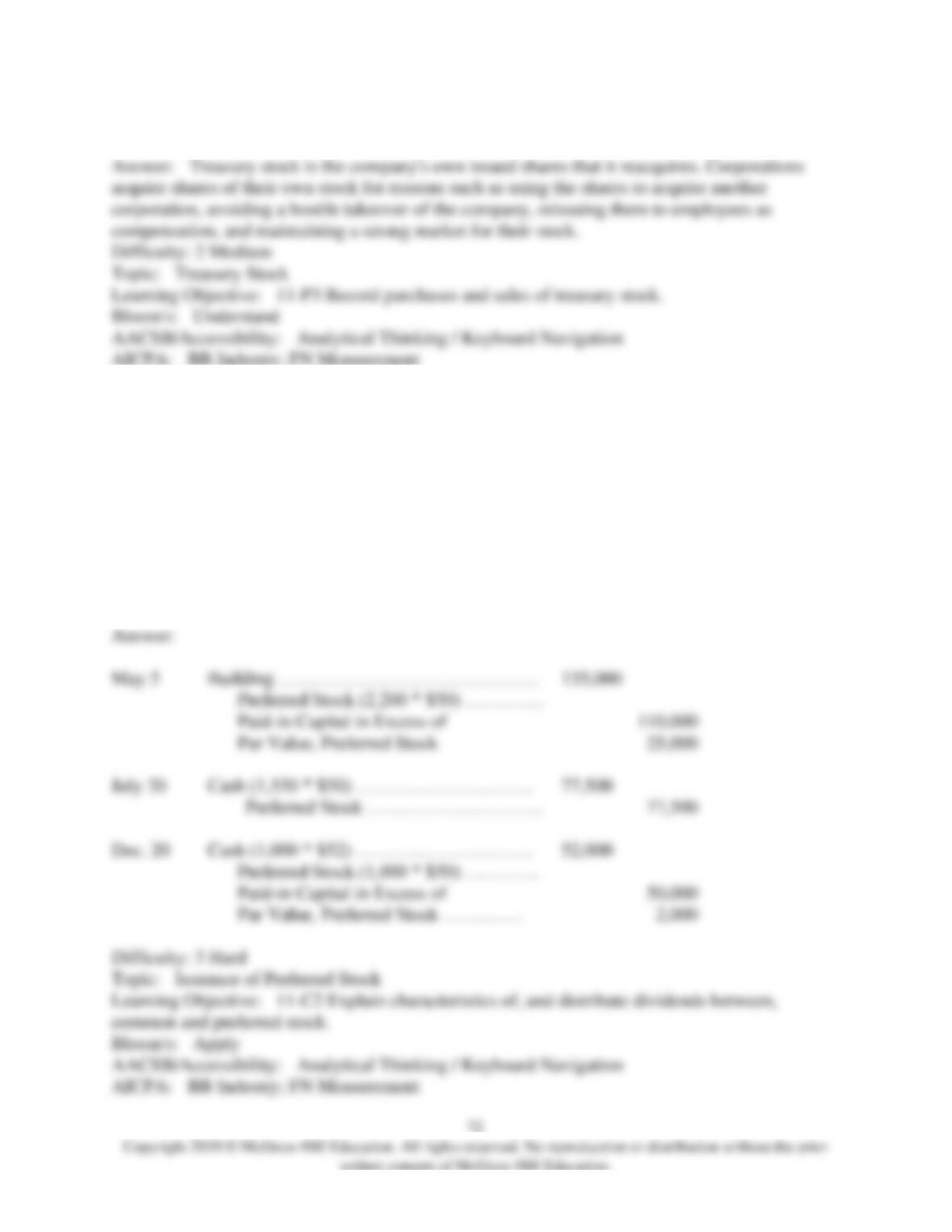
184) What is treasury stock? What reasons might a company hold treasury stock?
185) Boron Company is authorized to issue 50,000 shares of $50 par value, 8%, cumulative,
fully participating preferred stock, and 750,000 shares of $5 par value common stock. Prepare
journal entries to record the following selected transactions that occurred during the company’s
first year of operations:
May 5
Exchanged 2,200 shares of preferred stock for a building with a market
value of $135,000.
July 20
Sold 1,550 shares of preferred stock for $50 cash per share.
Dec. 20
Sold 1,000 shares of preferred stock at $52 cash per share.
May 5
135,000
July 20
77,500
Dec. 20
Cash (1,000 * $52) ………………………..
52,000
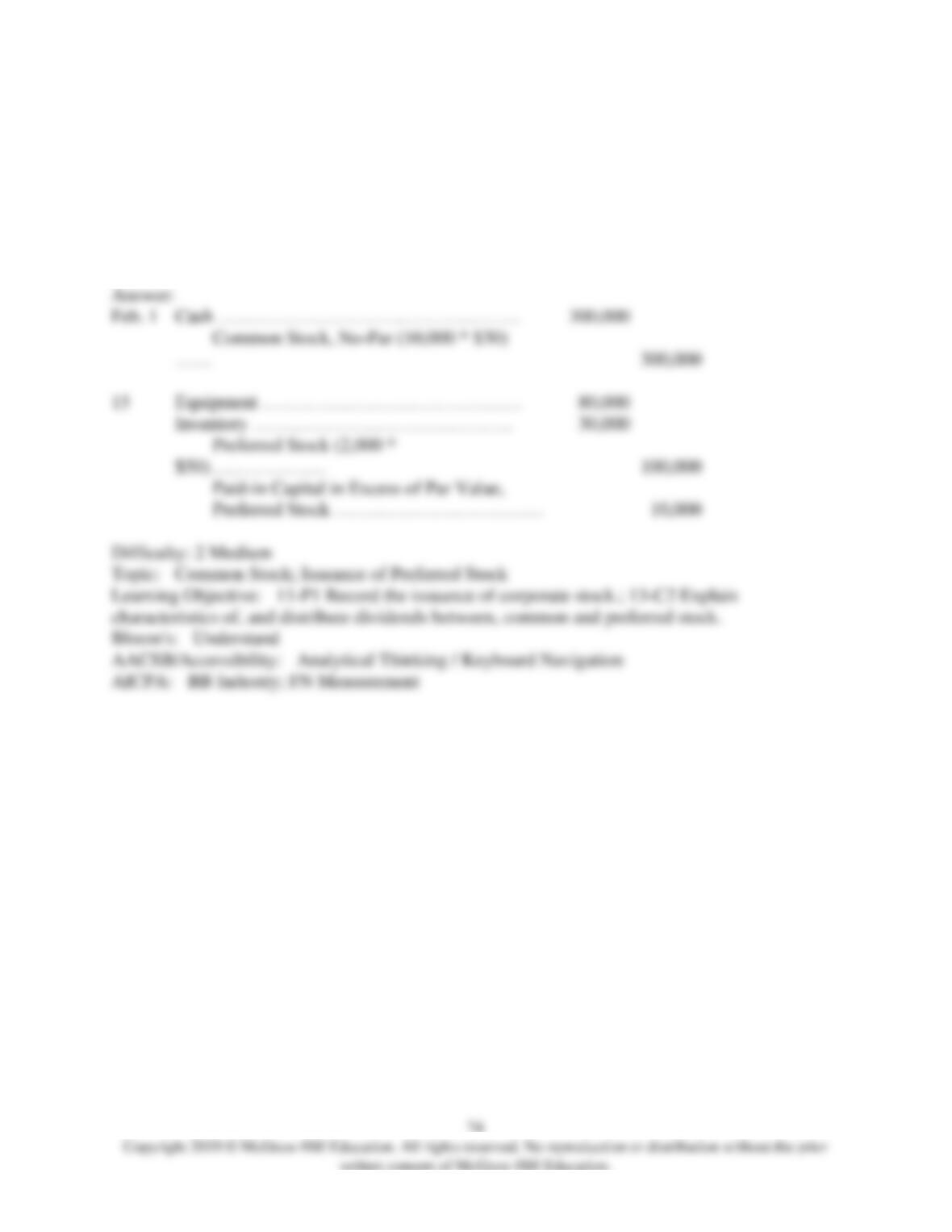
186) A corporation received its charter and began business this year. The company is authorized
to issue 500,000 shares of $100 par, 6%, noncumulative, nonparticipating preferred stock, and
1,000,000 shares of no-par common stock. The following selected transactions occurred during
this year:
Mar. 5
Issued 250 shares of preferred stock for $102 cash per share.
July 15
Exchanged 750 shares of common stock for $12,000 in legal
services incurred in the organization of the company.
Prepare journal entries to record these transactions.
Mar. 5
25,500
Jul. 15
Organization Expenses
12,000
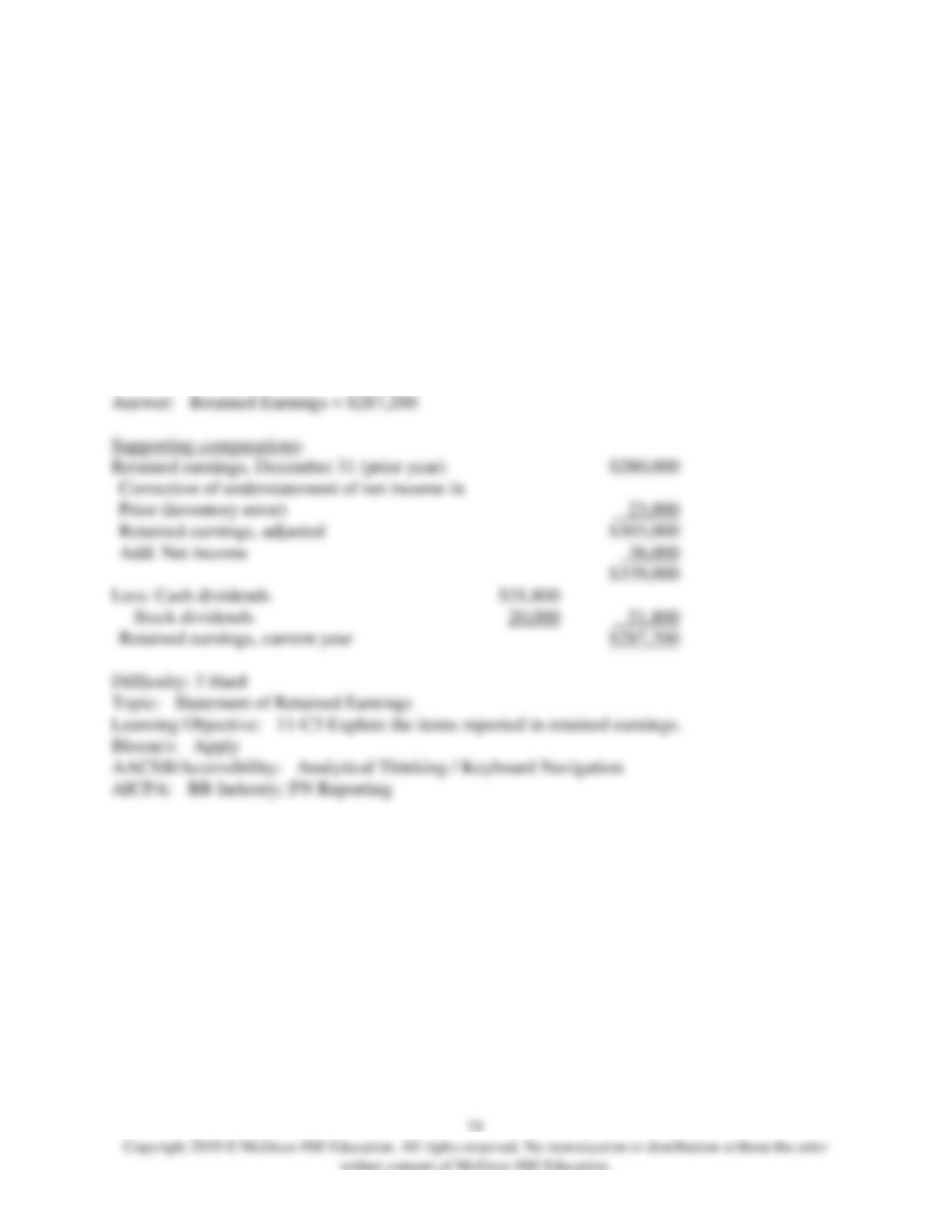
187) Rhoads Corporation is authorized to issue 250,000 shares of $50 par, 10%, noncumulative,
nonparticipating preferred stock and 5,000,000 shares of no-par common stock. Prepare journal
entries to record the following selected transactions that occurred during this year:
Feb. 1
Issued 10,000 shares of common stock for $30 cash per share
Feb. 15
Exchanged 2,000 shares of preferred stock for equipment and merchandise
inventory with market values of $80,000 and $30,000, respectively.
Feb. 1
15
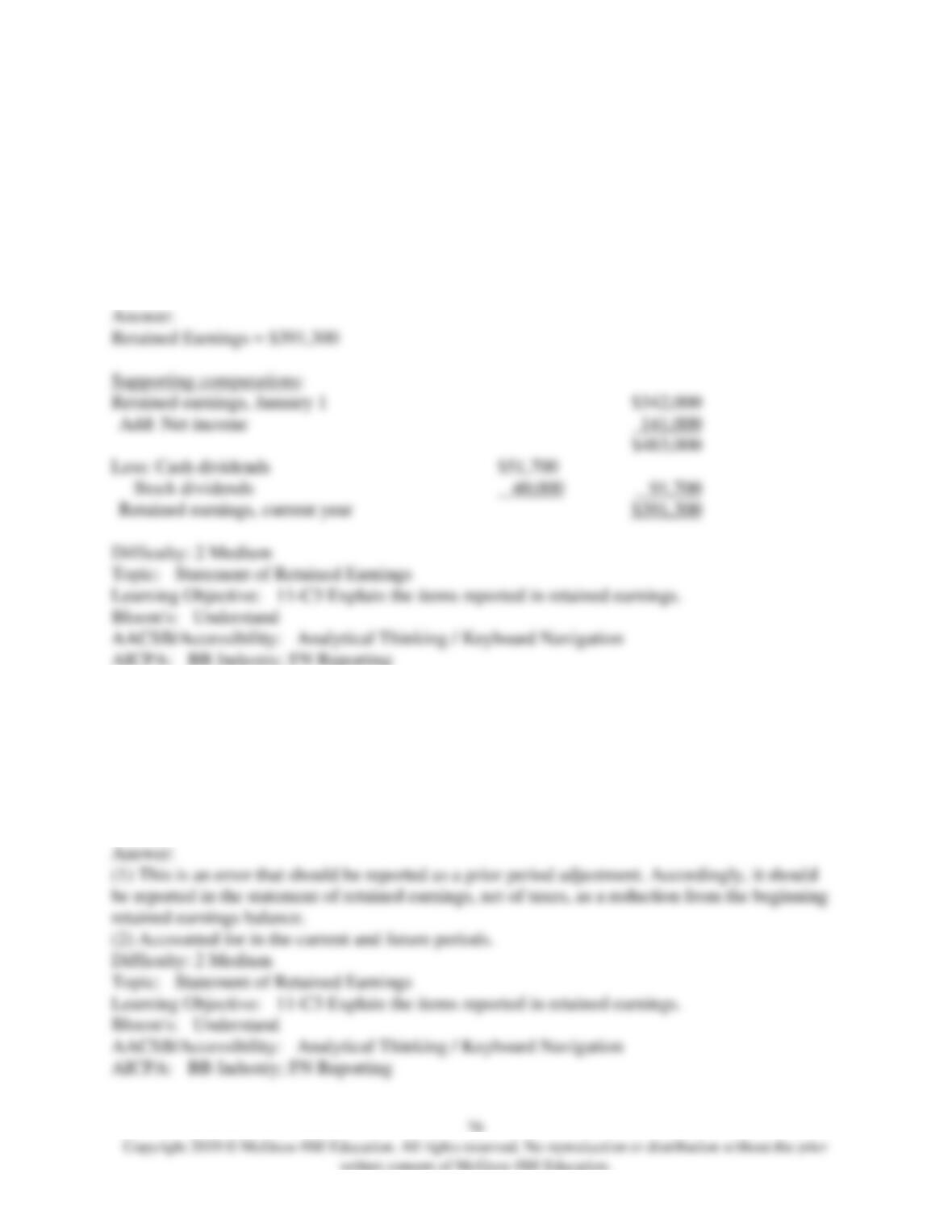
188) Given the following information about a corporation’s current year activities, compute the
retained earnings for the current year.
Retained earnings, December 31 (prior year)
$280,000
Cost of goods sold
$90,000
Other operating expenses
$54,000
Cash dividends
$31,800
Correction of understatement of net income in prior
period (inventory error)
$23,000
Stock dividends
$20,000
Net income
$36,000
Retained earnings, December 31 (prior year)
Correction of understatement of net income in
Prior (inventory error)
Retained earnings, adjusted
Add: Net income
Less: Cash dividends
Retained earnings, current year
189) Given the following information about a corporation’s current year activities, compute the
retained earnings for the current year.
Retained earnings, January 1
$342,000
Cash dividends
$51,700
Stock dividends
$40,000
Net income
$141,000
Retained earnings, January 1
Add: Net income
Less: Cash dividends
$51,700
Retained earnings, current year
190) Explain how each of the following items should be reported by a corporation:
(1) The accounting department discovered that an entry was made last year to Insurance Expense
instead of to Prepaid Insurance. The after-tax effect of the charge to Insurance Expense was
$5,000.
(2) The accounting department determined the depreciable lives of equipment will be five years
instead of the original estimate of seven years.
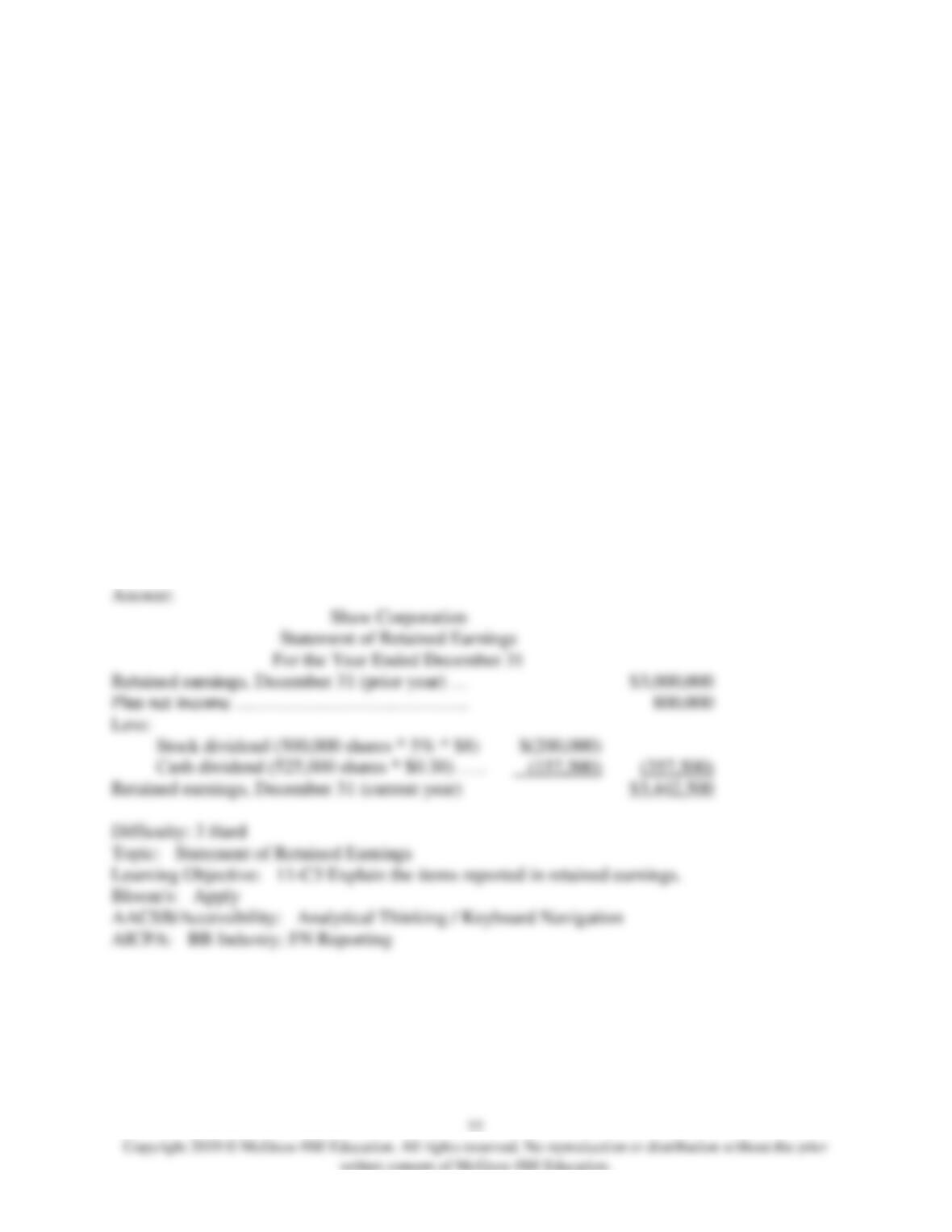
191) Shaw Corporation reported stockholders’ equity on December 31 of the prior year as
follows:
Common stock, $5 par value, 1,000,000 shares
authorized, 500,000 shares issued…….
$2,500,000
Paid-in capital in excess of par, common stock…
1,000,000
Retained earnings……………………………….
3,000,000
The following selected transactions occurred during the current year:
Feb. 15
The board of directors declared a 5% stock dividend to stockholders of record
on March 1, payable March 20. The stock was selling for $8 per share.
Mar. 9
Distributed the stock dividend.
May 1
A cash dividend of $0.30 per share was declared by the board of directors to
stockholders of record on May 20, payable June 1.
June 1
Paid the cash dividend.
Aug. 20
The board decided to split the stock 4-for-1, effective on September 1.
Sept. 1
Stock split 4-for-1.
Dec. 31
Earned a net income of $800,000 for the current year.
Prepare a statement of retained earnings as of December 31 of the current year.
Retained earnings, December 31 (prior year) …
Plus net income ………………………………..
Less:
Retained earnings, December 31 (current year)
78
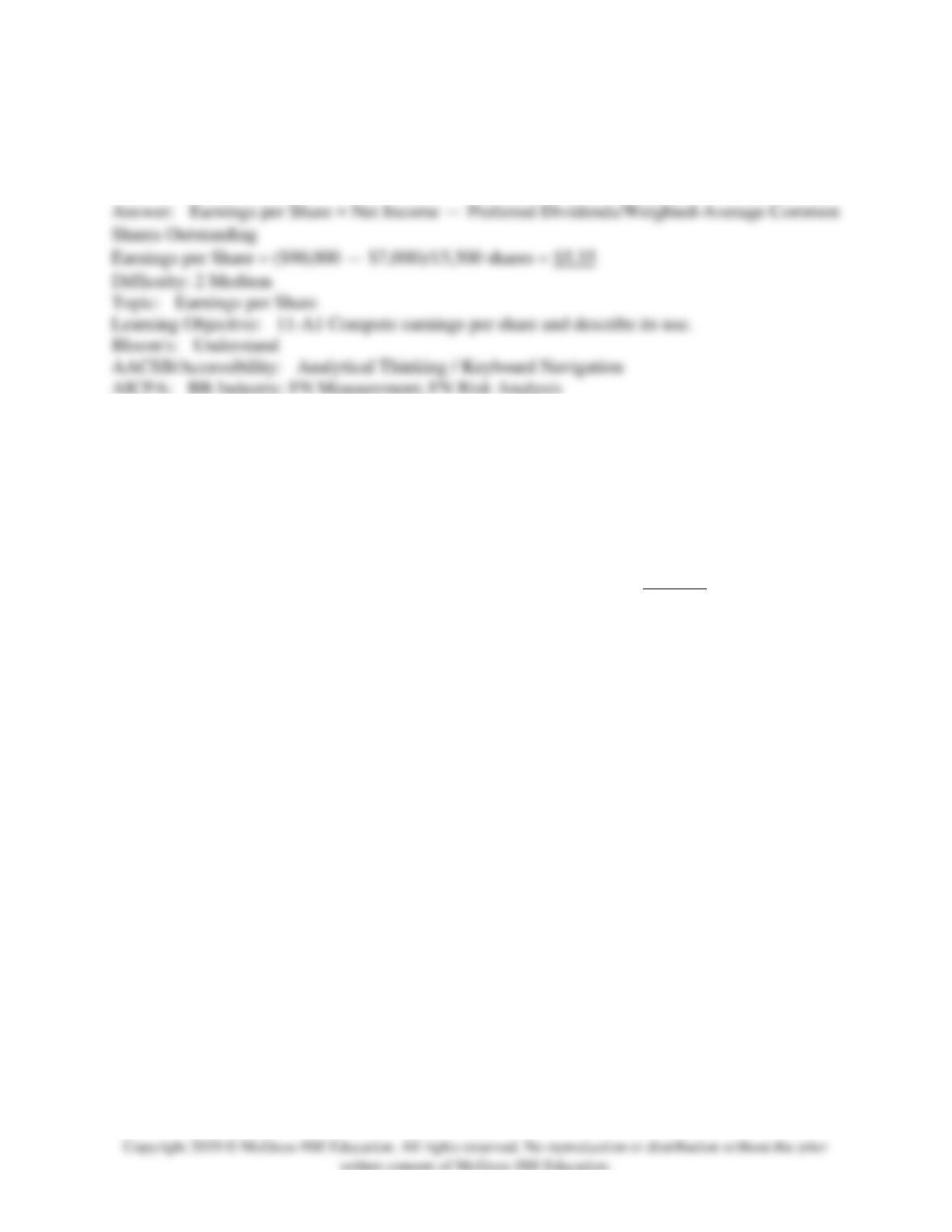
192) Beagle Company earned $90,000 in income and paid cash dividends of $7,000 to preferred
shareholders during the current year. Beagle had 15,500 weighted-average shares of common
stock outstanding for the year. Calculate the company’s earnings per share.
193) Slate Corporation had the following balances in its stockholders’ equity accounts at
December 31, 2017:
Common Stock, $10 par, 500,000 shares authorized,
20,000 shares issued ………………………………….
$200,000
Paid-in Capital in Excess of Par Value, Common …………
250,000
Retained Earnings ………………………………………..
500,000
Treasury Stock, 1,000 shares ……………………………
(20,000)
Total stockholders’ equity ………………………………..
$930,000
The following transactions occurred during 2018:
February 3
Sold and issued 2,000 shares of common stock for $22 per share.
May 10
Declared a $0.50 per share dividend on common stock.
October 12
Sold 500 shares of the treasury stock for $20 per share.
December 31
Net income for the year was determined to be $75,000.
Based on the above information, prepare a statement of stockholders’ equity for 2018. Use the
form below.
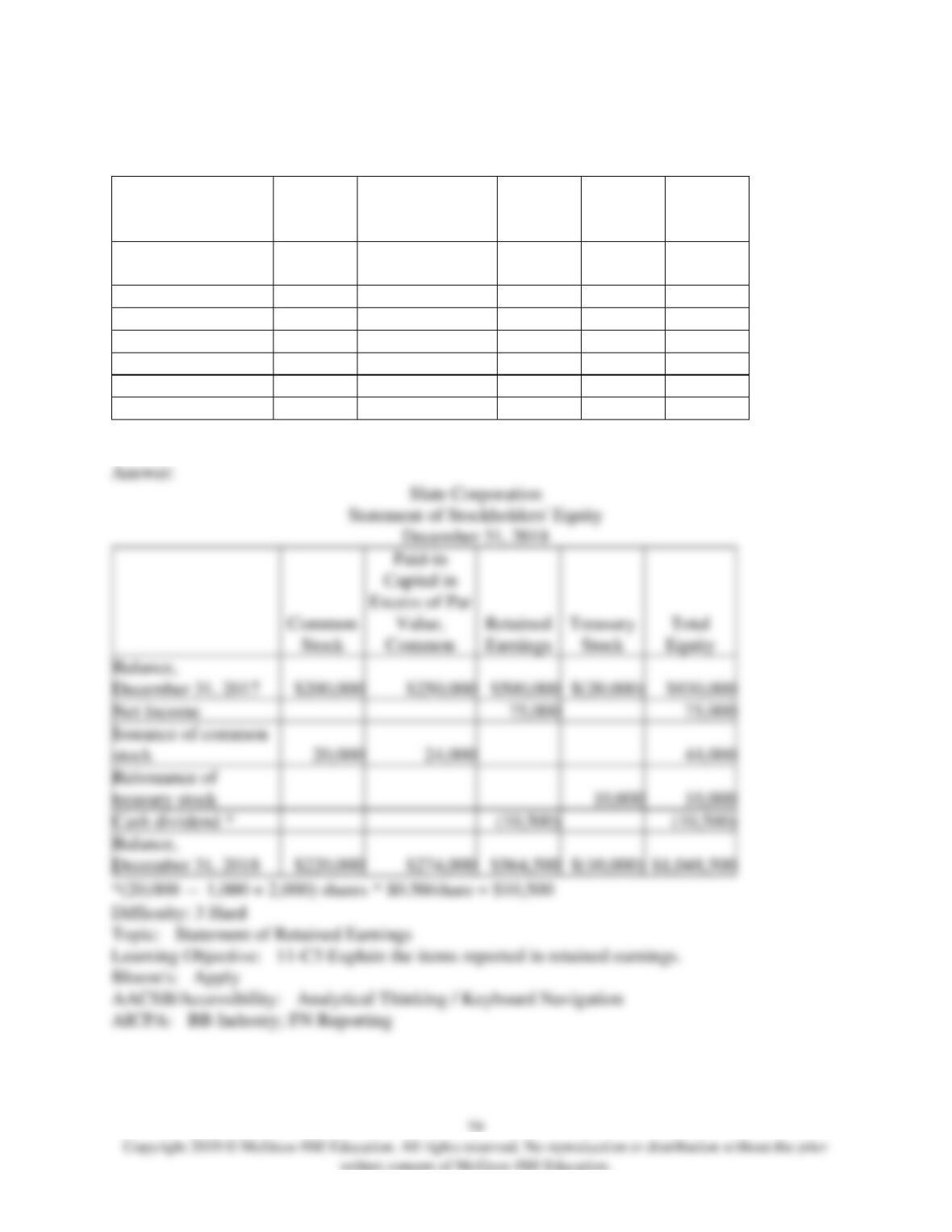
Slate Corporation
Statement of Stockholders’ Equity
December 31, 2018
Common
Stock
Paid-in Capital in
Excess of Par
Value, Common
Retained
Earnings
Treasury
Stock
Total
Equity
Balance,
December 31, 2017
$200,000
$250,000
$500,000
$(20,000)
$930,000
Common
Stock
Common
Retained
Earnings
Treasury
Stock
Equity
Balance,
December 31, 2017
$930,000
Net Income
stock
Reissuance of
treasury stock
Cash dividend *
Balance,
December 31, 2018
$1,048,500
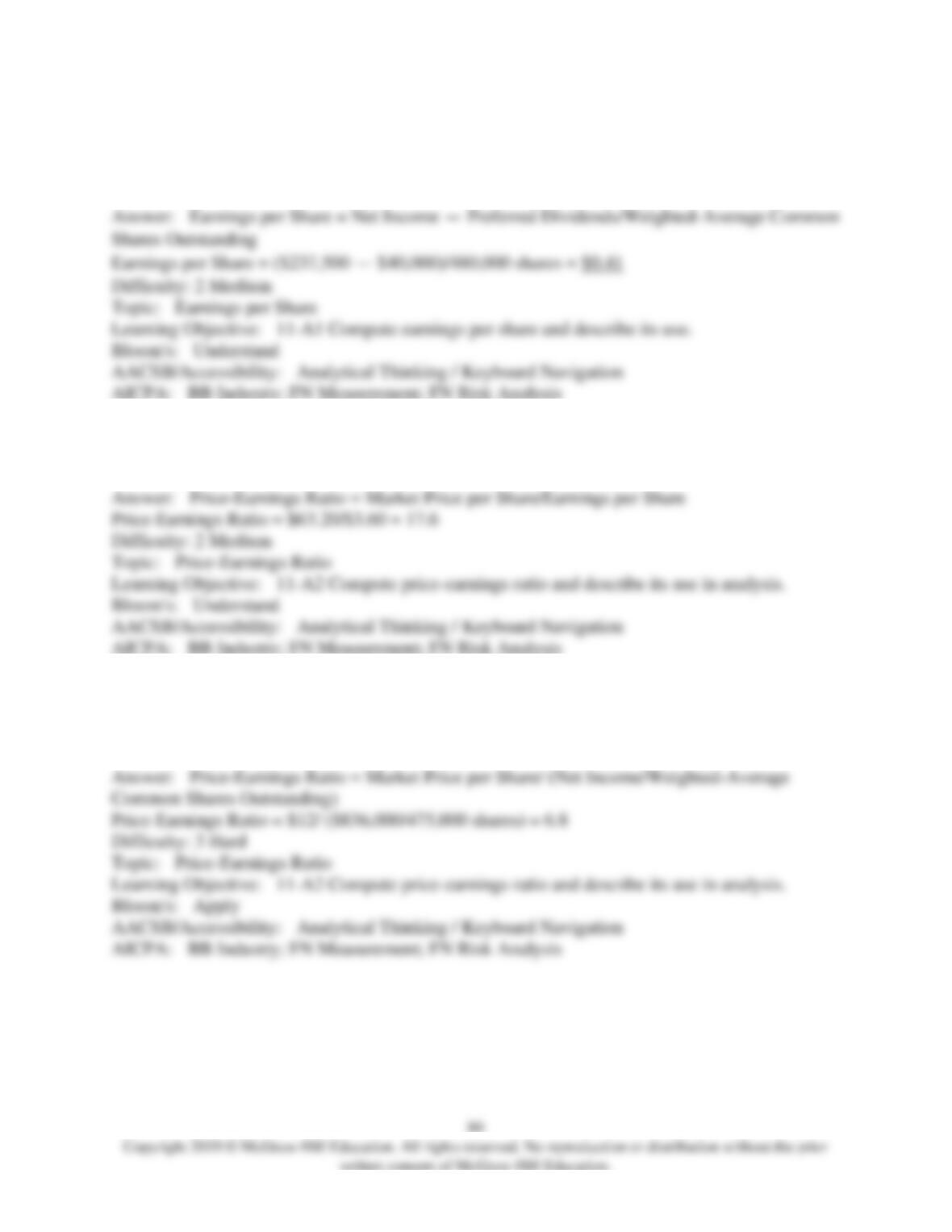
194) A corporation had current year net income of $237,500. It paid preferred dividends of
$40,000 cash and had 480,000 weighted-average shares of common stock outstanding. Calculate
the corporation’s earnings per share.
195) A company’s stock is selling for $63.20 per share and its earnings per share is $3.60 for the
current year. Calculate the price-earnings ratio.
196) A company reported net income of $836,000 for the current year. The year-end market
price per common share was $12 and there were 475,000 weighted-average shares of common
stock outstanding. Calculate the company’s price-earnings ratio.