Chapter 11 Standard Costs and Variance Analysis
11–37
Answers to Multiple Choice

Test Bank to accompany Jiambalvo Managerial Accounting, 6th Edition
11–38
MATCHING
161. Match each of the following terms with the phrase that most closely describes it. Each
answer may be used only once.
_____ 1. Attainable standard
_____ 2. Budgeted cost
_____ 3. Overhead controllable variance
_____ 4. Favorable variances
_____ 5. Ideal standard
_____ 6. Labor efficiency variance
_____ 7. Labor rate variance
_____ 8. Overhead volume variance
_____ 9. Standard cost
_____ 10. Unfavorable variances
A. Difference between the actual amount of overhead and the amount of overhead
that would be included in the flexible budget for the actual level of production
B. The cost that should be incurred to produce a good under anticipated conditions
C. Standards developed under the assumption that no obstacles will be
encountered
D. Difference between the actual hours worked and the standard hours allowed for
the number of units produced times the standard labor wage rate
E. Difference between the amount of overhead in the flexible budget and the
amount of overhead applied to production using the standard overhead rate
F. Variances where the actual prices or quantities are less than the standard
G. The cost, at standard, for the total number of units scheduled to be produced
H. Difference between the actual wage rate and the standard wage rate times the
actual number of hours worked
I. Variance where the actual prices or quantities are greater than standard
J. Standards which allow for expected deviations
Chapter 11 Standard Costs and Variance Analysis
11–39
EXERCISES
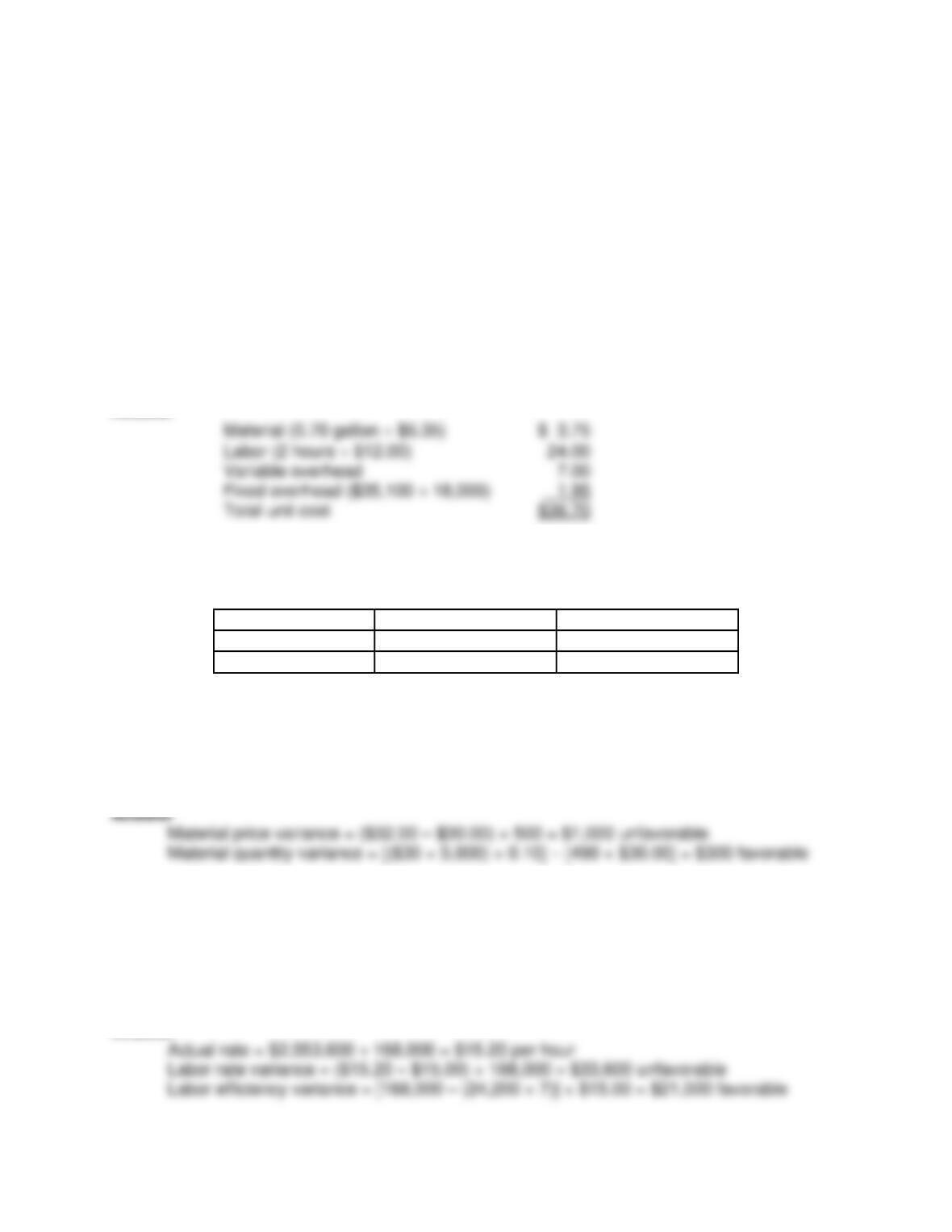
162. Beale Acid Company produces muriatic acid in ½ gallon containers. Its accounting
system uses standard costs. The standards per half gallon can of acid call for 0.70
gallons of material and 2.0 hours of labor. The material needed to produce a 0.5 gallon
can of product due to evaporation is 0.70 gallons of material. The standard cost per
gallon of material is $5.35. The standard cost per hour for labor is $12.00. Overhead is
applied at the rate of $8.95 per can. Expected production is 18,000 cans with fixed
overhead per year of $35,100, and variable overhead of $7.00 per half gallon can.
During 2017, 19,000 cans were produced; 15,000 gallons of material were
purchased at a cost of $87,750; 14,000 gallons of material were used in production. The
cost of direct labor incurred in 2017 was $465,300 based on an average actual wage
rate of $11.75 per hour. Actual overhead for 2017 was $170,000. Determine the
standard cost of each ½ gallon of muriatic acid.
Answer
163. Best Chocolates uses standard costing. During 2017, the company estimated the
following standard costs for one of its major products, cocoa bars.
Standard quantity
Standard price
Direct materials
0.10 pounds
$30 per pound
Direct labor
0.05 hours
$15 per hour
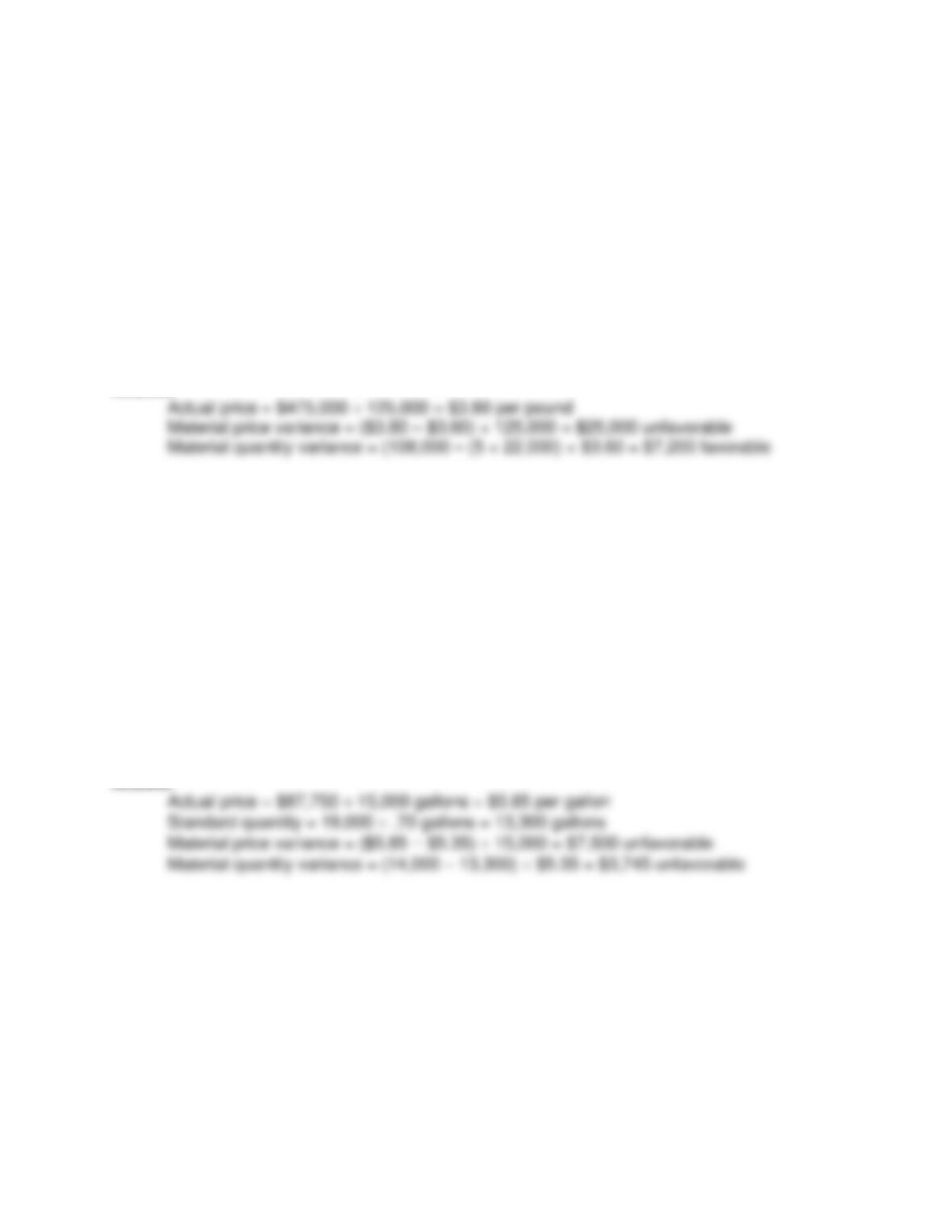
Best purchased 500 pounds of cocoa at a cost of $32 per pound. It produced and sold
5,000 chocolate bars using 490 pounds of cocoa and 250 direct manufacturing labor
hours at an average wage of $15.25 per hour. Calculate the material price variance and
material quantity variance, and indicate whether each variance is favorable or
unfavorable.
164. Reconly Company’s standards for the production of one handbag include 7 hours of
direct labor at a cost of $15.00 per hour. Last month, Reconly produced 24,200
handbags. Employees were paid $2,553,600 for working a total of 168,000 hours.
Calculate Reconly’s labor rate variance and labor efficiency variance and indicate
whether each variance is favorable or unfavorable.
Answer
Test Bank to accompany Jiambalvo Managerial Accounting, 6th Edition
11–40
165. Eval Industries employs a standard cost system and uses the following standards for the
production of one vase:
Direct materials: 5 pounds @ $3.60/pound
Direct labor: 1¼ hour @ $12.00/hour
Eval budgeted 21,600 vases for May. In addition, it purchased 125,000 pounds of direct
material at a total cost of $475,000. The total factory wages for May were $327,600. The
company manufactured 22,000 units of product during May using 108,000 pounds of
direct material and 28,000 direct labor hours. Estimated fixed manufacturing overhead
for May was $54,000. Actual total overhead was $70,000. The variable overhead rate is
$0.80 per unit, and the fixed overhead rate is $2.50 per unit. Determine the material
price variance and the material quantity variance for May. Indicate whether each
variance is favorable or unfavorable.
Answer
166. Watson Chemical Company produces a chemical used in dry cleaning. Its accounting
system uses standard costs. The standards per half gallon can of chemical call for 0.70
gallons of material and 2.0 hours of labor. The material needed to produce a 0.5 gallon
can of product due to evaporation is 0.70 gallons of material. The standard cost per
gallon of material is $5.35. The standard cost per hour for labor is $12.00. Overhead is
applied at the rate of $8.95 per can. Expected production is 18,000 cans with fixed
overhead per year of $35,100, and variable overhead of $7.00 per unit (a half gallon
can).
During 2017, 19,000 cans were produced; 15,000 gallons of material were
purchased at a cost of $87,750; 14,000 gallons of material were used in production. The
cost of direct labor incurred in 2017 was $465,300 based on an average actual wage
rate of $11.75 per hour. Actual overhead for 2017 was $170,000. Calculate the material
variances.
Answer
Chapter 11 Standard Costs and Variance Analysis
11–41
167. Palm Time Inc. budgeted 6,000 step stools for June under its standard costing system.
Each stool is sold for $22. Actual production for June was 6,300 stools. The company
uses units of product as the cost driver for overhead. Standards and actual costs follow
for June:
Budgeted and Standard
Actual
Direct materials
1.1 linear feet @ $2.40 a foot
6,400 feet purchased for
$15,040; 6,450 feet used
Direct labor
0.10 hours @ $14.00 per hour
620 hours @$14.30 per hour
Variable overhead
$16,800 total
$18,400
Fixed overhead
$15.00 per DLH
$9,200
Calculate the material price variance, material quantity variance, labor rate variance and
labor efficiency variance. Indicate if each of the variances is favorable or unfavorable.
Answer
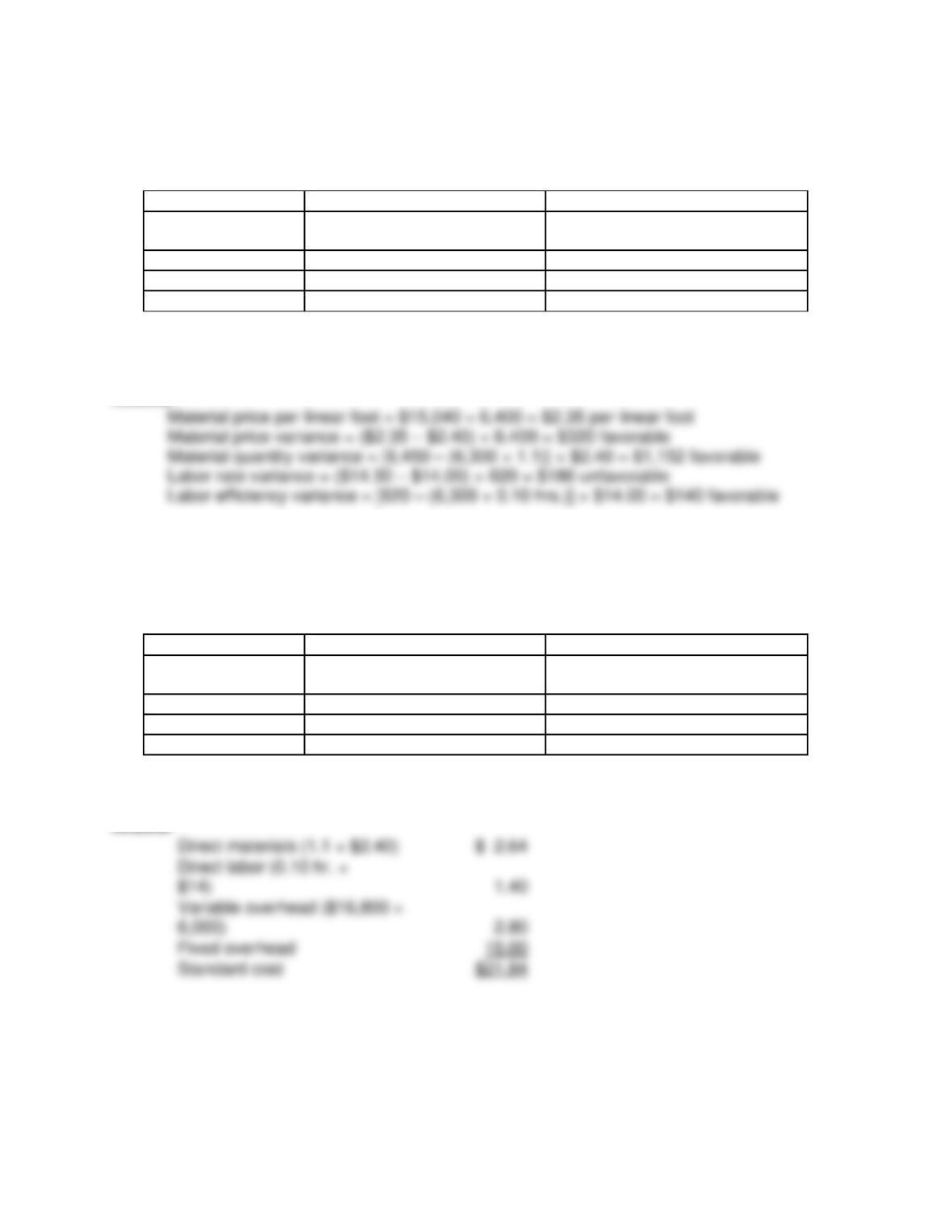
168. Palm Time, Inc. budgeted 6,000 step stools for June under its standard costing system.
Each stool is sold for $22. Actual production for June was 6,300 stools. The company
uses units of product as the cost driver for overhead. Standards and actual costs follow
for June:
Budgeted and Standard
Actual
Direct materials
1.1 linear feet @ $2.40 a foot
6,400 feet purchased for
$15,040; 6,450 feet used
Direct labor
0.10 hours @ $14.00 per hour
620 hours @$14.30 per hour
Variable overhead
$16,800 total
$18,400
Fixed overhead
$15.00 per stool
$9,200
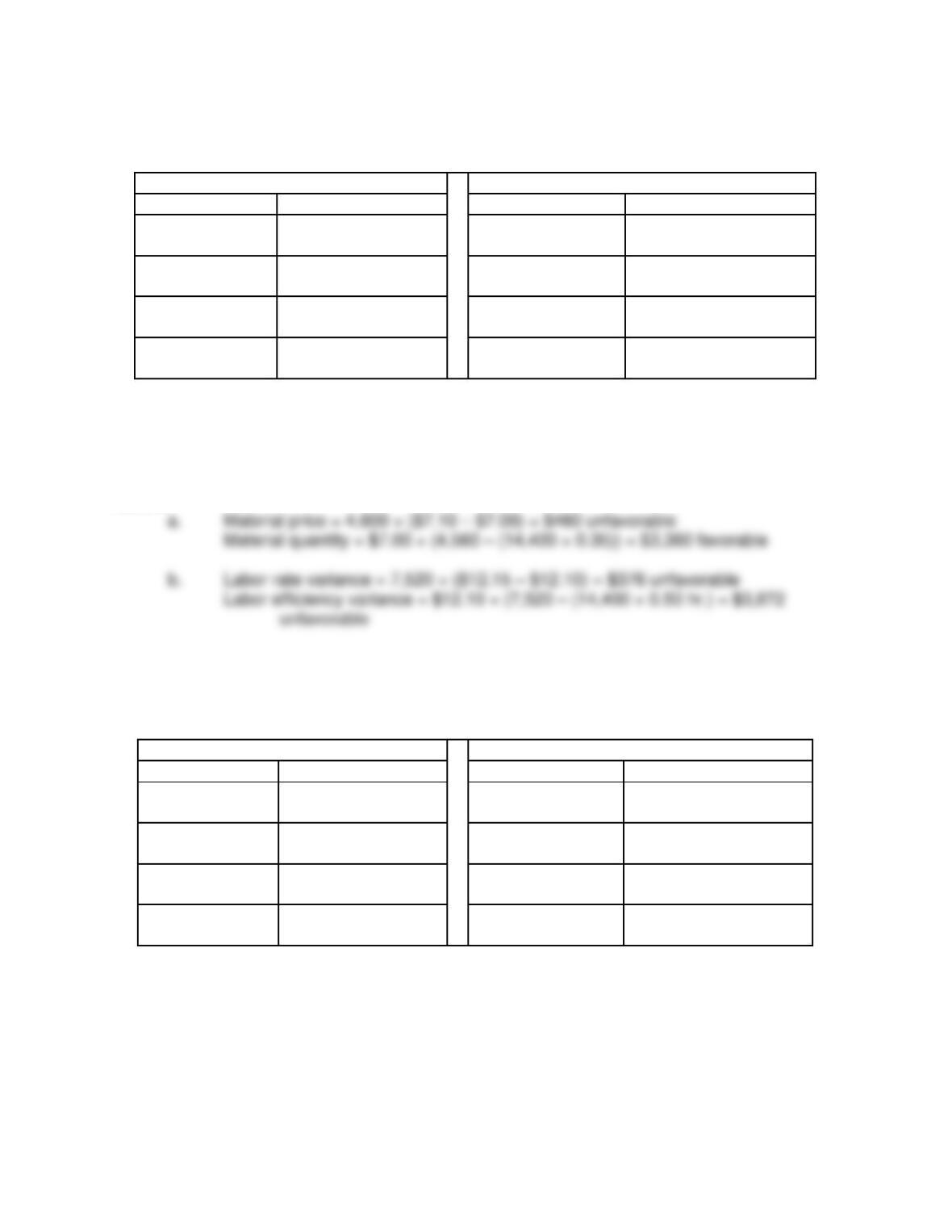
Show the calculation of the standard cost of one step stool.
Answer
Direct materials (1.1 × $2.40)
Fixed overhead
Standard cost
Test Bank to accompany Jiambalvo Managerial Accounting, 6th Edition
11–42
169. Germ Free produces hand sanitizer. It uses units as the cost driver for overhead and
employs a standard costing system. The following information was provided by the
company’s controller:
Actual Data
Standard and Budgeted Data
Produced
14,400 units
Budgeted units
14,200 units
Materials
purchased
4,600 lbs. for a total
of $32,660
Budgeted
materials
0.35 lb. @ $7.00 per lb.
Materials used
4,560 lbs.
Budgeted labor
0.5 hours @ $12.10 per
hour
Labor worked
7,520 hrs. costing
$91,368
Budgeted variable
overhead
$39,050
Actual overhead
Fixed $51,800;
Variable $38,100
Budgeted fixed
overhead
$51,120
a. Calculate the material price and quantity variances and indicate if each is
favorable or unfavorable.
b. Calculate the labor rate and efficiency variances and indicate if each is favorable
or unfavorable.
Answer
170. Germ Free produces hand sanitizer. It uses units as the cost driver for overhead and
employs a standard costing system. The following information was provided by the
company’s controller:
Actual Data
Standard and Budgeted Data
Produced
14,400 units
Budgeted units
14,200 units
Materials
purchased
4,600 lbs. for a total
of $32,660
Budgeted
materials
0.35 lb. @ $7.00 per lb.
Materials used
4,560 lbs.
Budgeted labor
0.5 hours @ $12.10 per
hour
Labor worked
7,520 hrs. costing
$91,368
Budgeted variable
overhead
$39,050
Actual overhead
$89,900
Budgeted fixed
overhead
$51,120
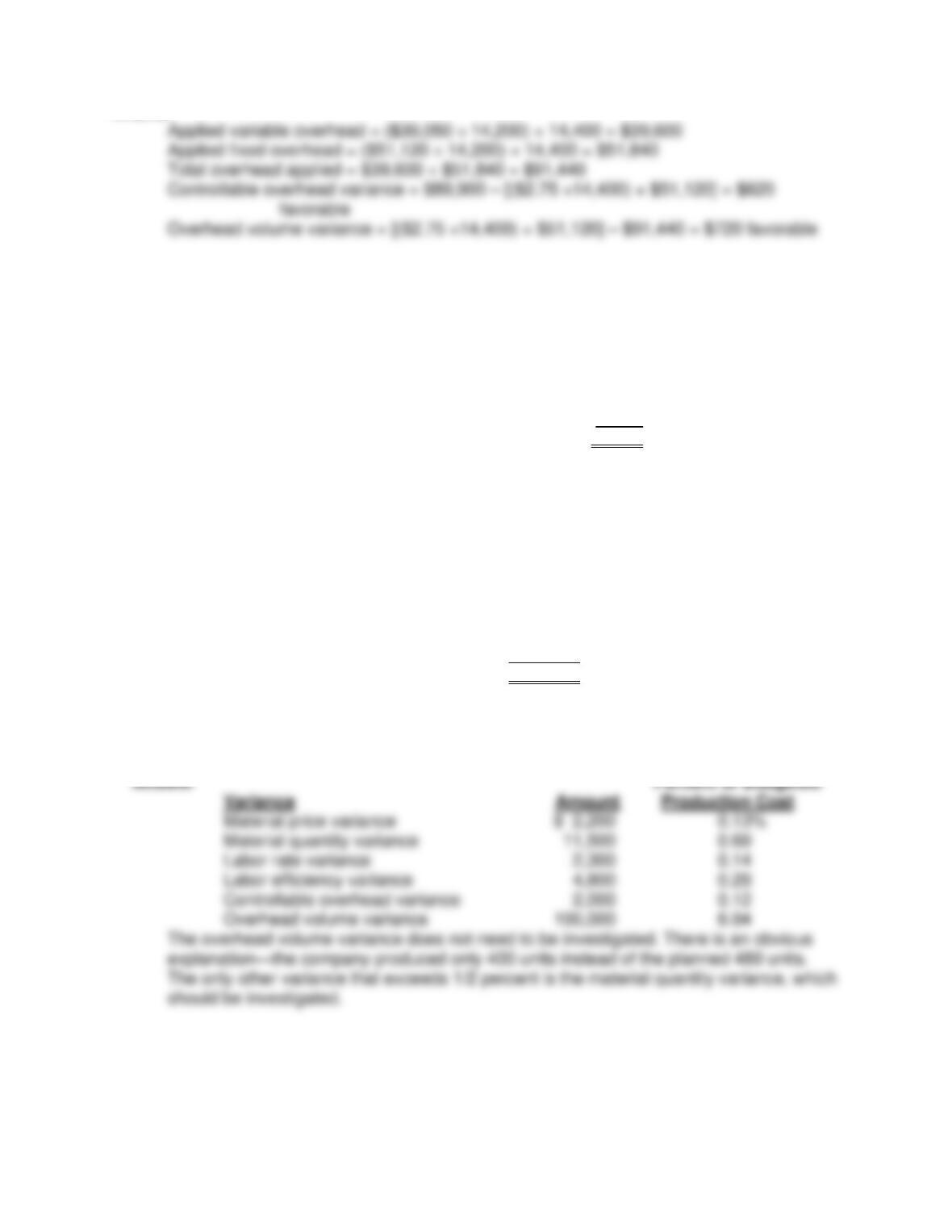
Calculate the controllable overhead variance and the overhead volume variances and
indicate if each is favorable or unfavorable.
Chapter 11 Standard Costs and Variance Analysis
11–43
Answer
171. At the start of the year, ChillerIce estimated that the company would produce 480
portable ice makers during the year (40 per month). Annual fixed overhead costs were
estimated to be $600,000 ($50,000 per month), and estimated variable overhead costs
were estimated to be $500 per unit. Standard cost per unit was set at $3,450:
Standard material cost $1,200
Standard labor cost 500
Standard overhead rate per unit 1,750
Total $3,450
During the year, the company experienced stiff competition and ended up producing and
selling only 400 ice makers. Budgeted annual total production costs were $1,656,000,
and actual production costs were $1,616,400. The standard cost variances were as
follows:
Material price variance $ 2,200 unfavorable
Material quantity variance 11,500 unfavorable
Labor rate variance (2,300) favorable
Labor efficiency variance 4,800 unfavorable
Controllable overhead variance 2,000 unfavorable
Overhead volume variance 100,000 unfavorable
Total $118,200 unfavorable
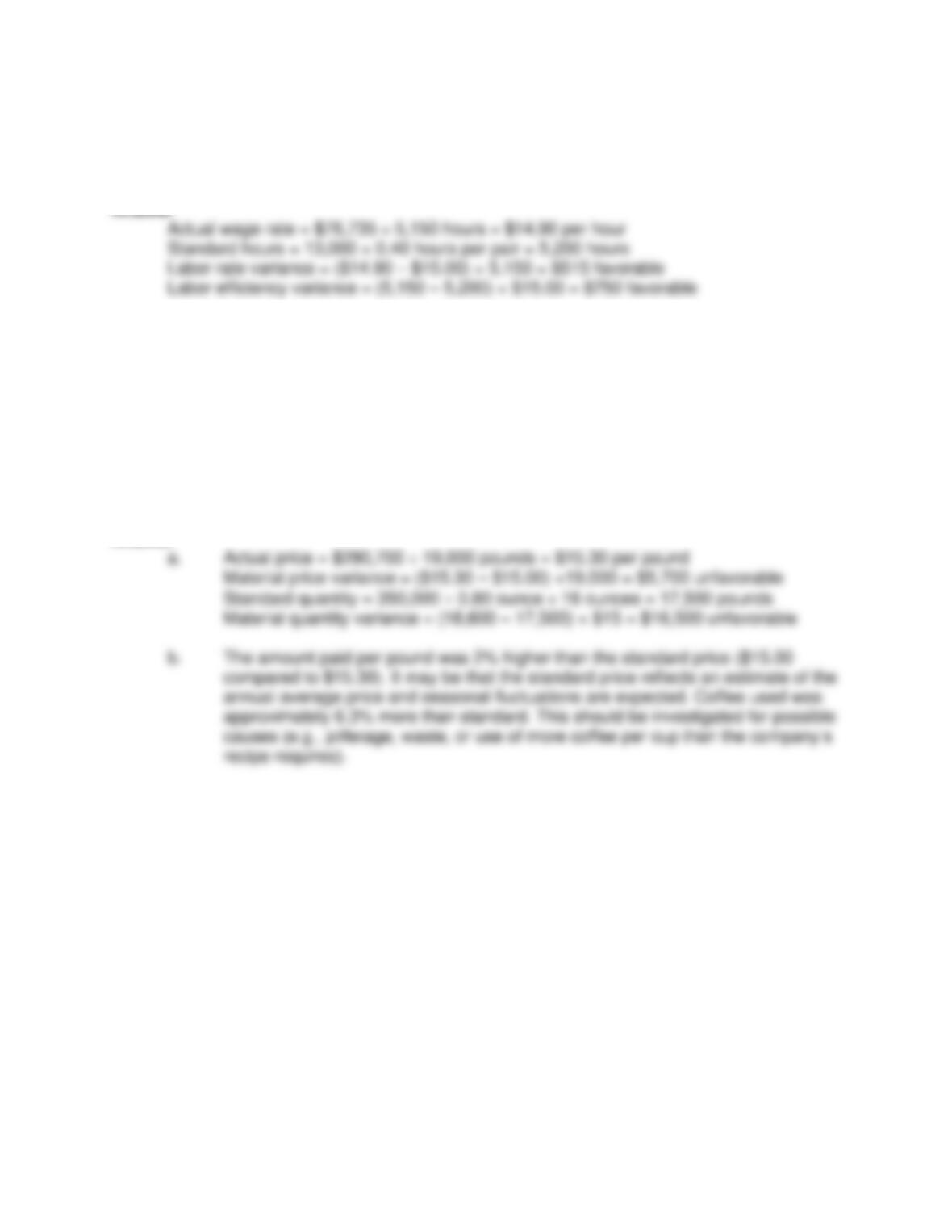
Suppose you are the CFO of ChillerIce and you have decided to investigate variances
which exceed a threshold of 1/2 percent of the total budgeted production cost. Which
variance(s) will you investigate? Explain the basis for your answer.
Test Bank to accompany Jiambalvo Managerial Accounting, 6th Edition
11–44
172. The standard labor cost in the production of a pair of Crocs is 0.40 hours at $15 per
hour. During the month of June, 13,000 pairs were produced. Actual labor costs were
$76,735 for 5,150 hours. Compute the labor rate and labor efficiency variances for the
month of June.
173. Caffeine Depot is a chain of coffee shops. The standard amount of ground coffee per
cup is 0.80 ounces. During the month of September, the company sold 350,000 cups of
coffee and used 18,600 pounds of coffee. Also during September, the company
purchased 19,000 pounds of coffee at a cost of $290,700. The standard price per pound
is $15. The company views variances greater than 0.8% of the flexible budget amount to
be considered significant.
a. Compute the material variances.
b. Do either or both of the variances warrant investigation? Explain why or why not.
Answer
174. Shining Car Wash is a mobile car washing services that provides car washes wherever a
customer desires. On average it takes 1.8 hours for travel and washing each vehicle.
During November, employees spent 1,064 labor hours to wash 560 cars at a total labor
cost of $13,300. During December, 960 labor hours were used to wash 480 cars at a
total labor cost of $11,520. The wage rate standard is $12.40 per hour.
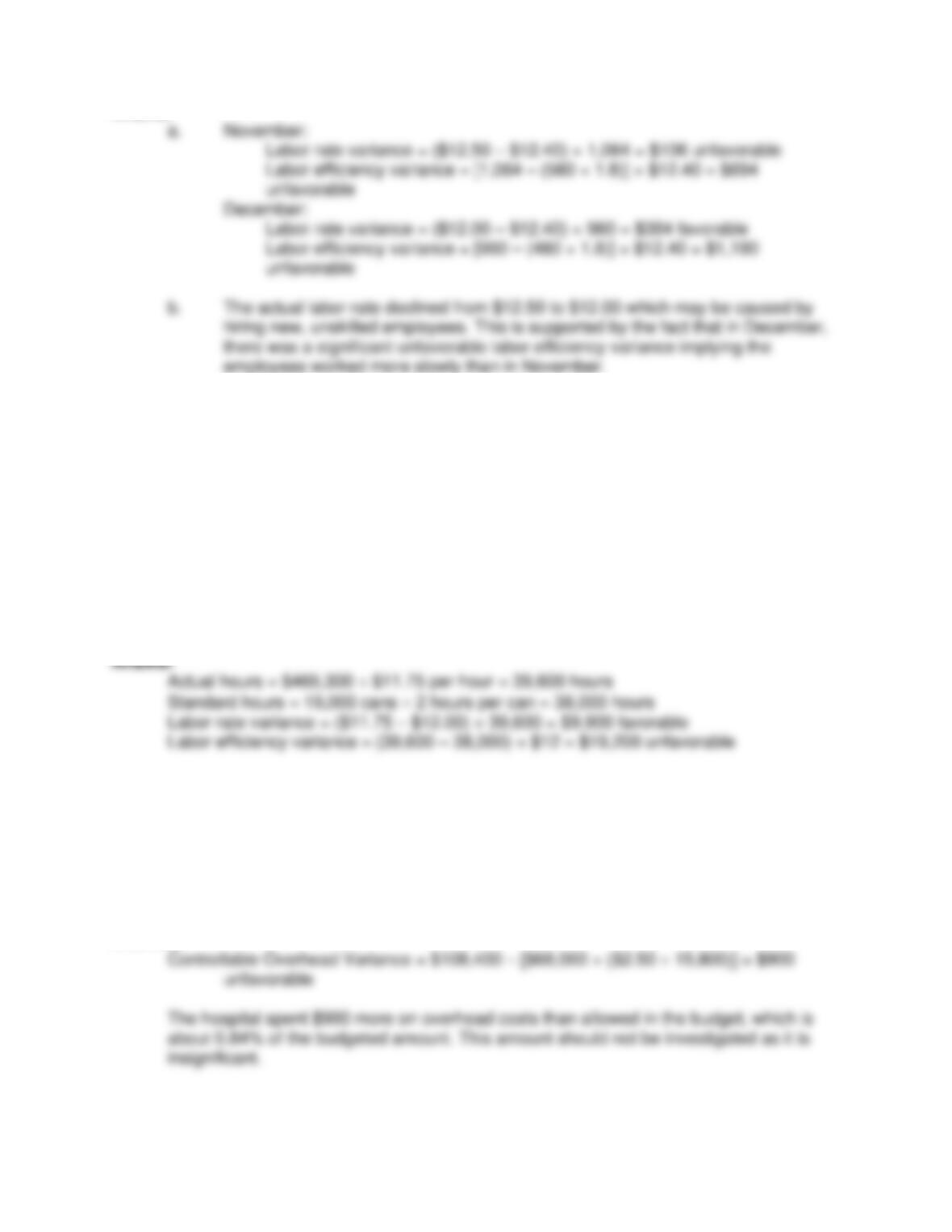
a. Calculate the labor rate and efficiency variances for each month and indicate if
each is favorable or unfavorable.
b. What trends can you spot regarding the variances over November and
December? What might be a cause for the labor rate variance? What might be a
cause for the labor efficiency variance?
Chapter 11 Standard Costs and Variance Analysis
11–45
Answer
175. Watson Chemical Company produces a chemical used in dry cleaning. Its accounting
system uses standard costs. The standards per half gallon can of chemical call for 0.70
gallons of material and 2.0 hours of labor. (0.70 gallons of material are needed to
produce a 0.5 gallon can of product due to evaporation.) The standard cost per gallon of
material is $5.35. The standard cost per hour for labor is $12.00. Overhead is applied at
the rate of $8.95 per can. Expected production is 18,000 cans with fixed overhead per
year of $35,100, and variable overhead of $7.00 per unit (a half gallon can).
During 2017, 19,000 cans were produced; 15,000 gallons of material were
purchased at a cost of $87,750; 14,000 gallons of material were used in production. The
cost of direct labor incurred in 2017 was $465,300 based on an average actual wage
rate of $11.75 per hour. Actual overhead for 2017 was $170,000. Calculate the labor
variances.
176. Orlando East Hospital is interested in analyzing overhead related to laundry services.
The hospital administrator estimated that monthly fixed costs would be $68,000 and
variable costs would be $2.50 per patient day. During the month of September, the
hospital had 15,800 patient days. Total overhead laundry costs were $108,400.
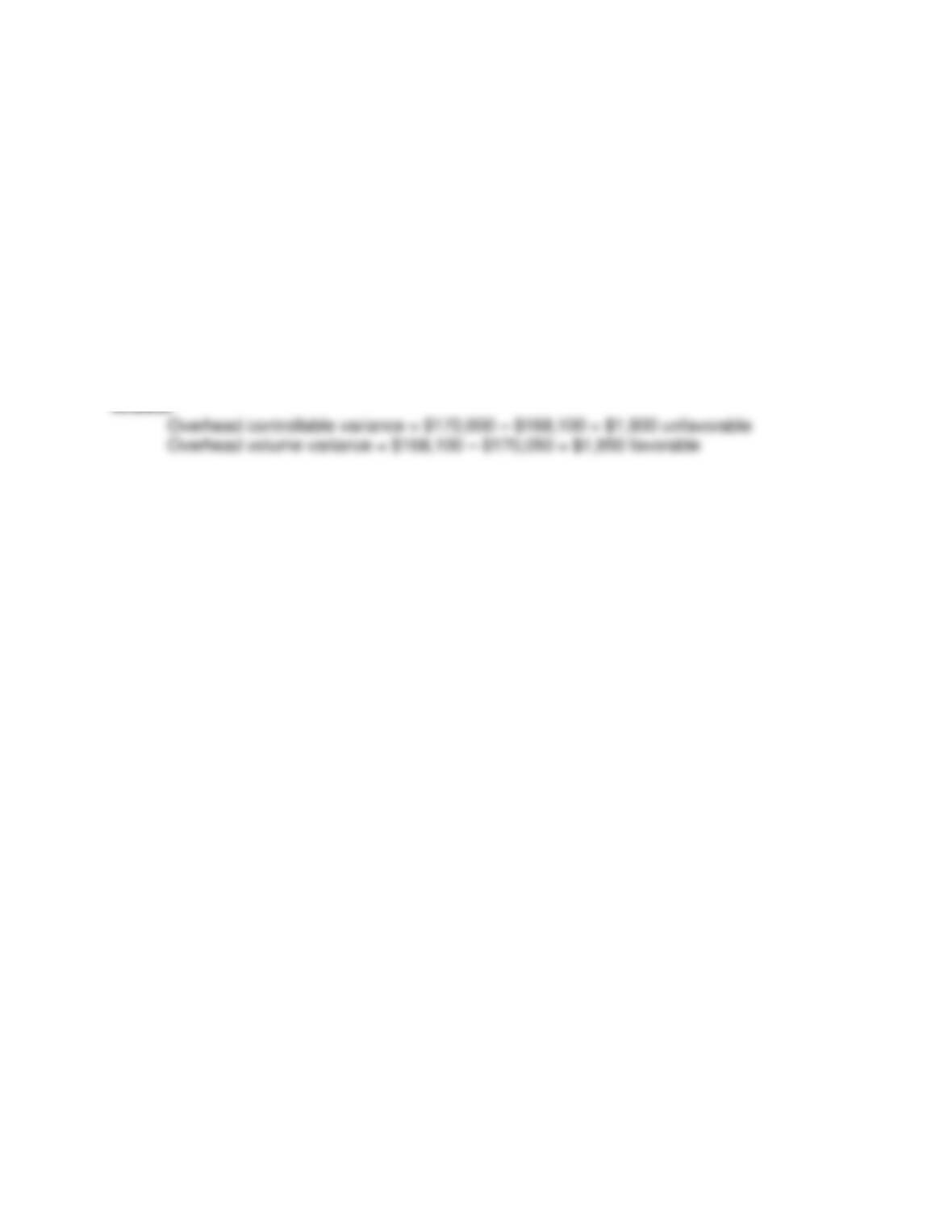
Calculate the controllable overhead variance. Analyze laundry costs for the month of
September.
Answers
Test Bank to accompany Jiambalvo Managerial Accounting, 6th Edition
11–46
177. Watson Chemical Company produces a chemical used in dry cleaning. Its accounting
system uses standard costs. The standards per half gallon can of chemical call for 0.70
gallons of material and 2.0 hours of labor. (0.70 gallons of material are needed to
produce a 0.5 gallon can of product due to evaporation.) The standard cost per gallon of
material is $5.35. The standard cost per hour for labor is $12.00. Overhead is applied at
the rate of $8.95 per can. Expected production is 18,000 cans with fixed overhead per
year of $35,100, and variable overhead of $7.00 per unit (a half gallon can).
During 2017, 19,000 cans were produced; 15,000 gallons of material were
purchased at a cost of $87,750; 14,000 gallons of material were used in production. The
cost of direct labor incurred in 2017 was $465,300 based on an average actual wage
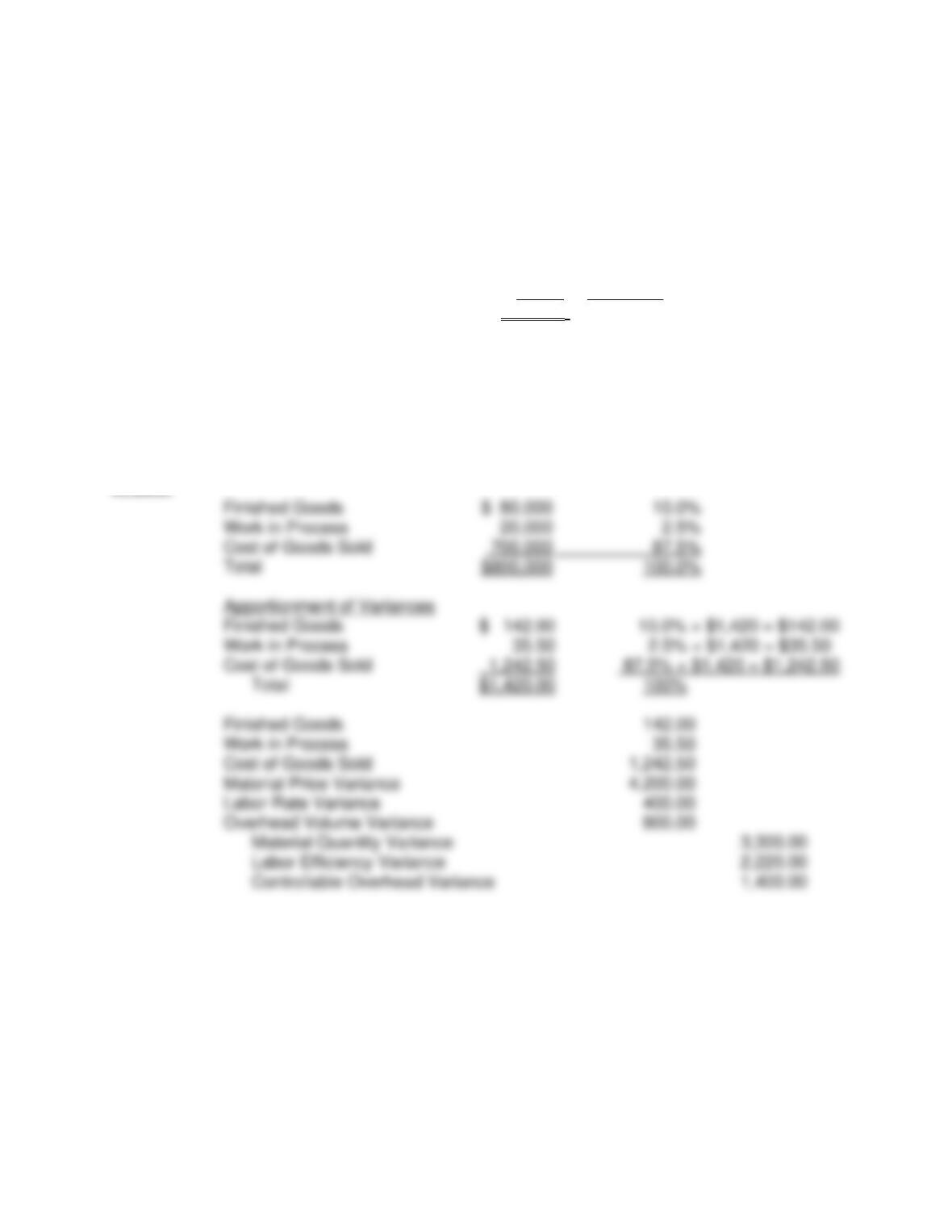
rate of $11.75 per hour. Actual overhead for 2017 was $170,000. Calculate the overhead
variances and indicate if each is favorable or unfavorable.
Chapter 11 Standard Costs and Variance Analysis
11–47
CHALLENGE EXERCISES
178. Winston Woolies provided the following summary of variances for the year ended
December 31, 2017:
Material price variance $4,200 Favorable
Material quantity variance (3,300) Unfavorable
Labor rate variance 400 Favorable
Labor efficiency variance (2,220) Unfavorable
Controllable overhead variance (1,400) Unfavorable
Overhead volume variance 900 Favorable
Total ($1,420) Unfavorable
At Winston Woolies, the ending balance in Finished Goods inventory is $80,000; the
ending balance in Work in Process inventory is $20,000, and the balance in Cost of
Goods Sold is $700,000. Winston Woolies considers the total variance to be material
and as such, should apportion it among Finished Goods inventory, Work in Process
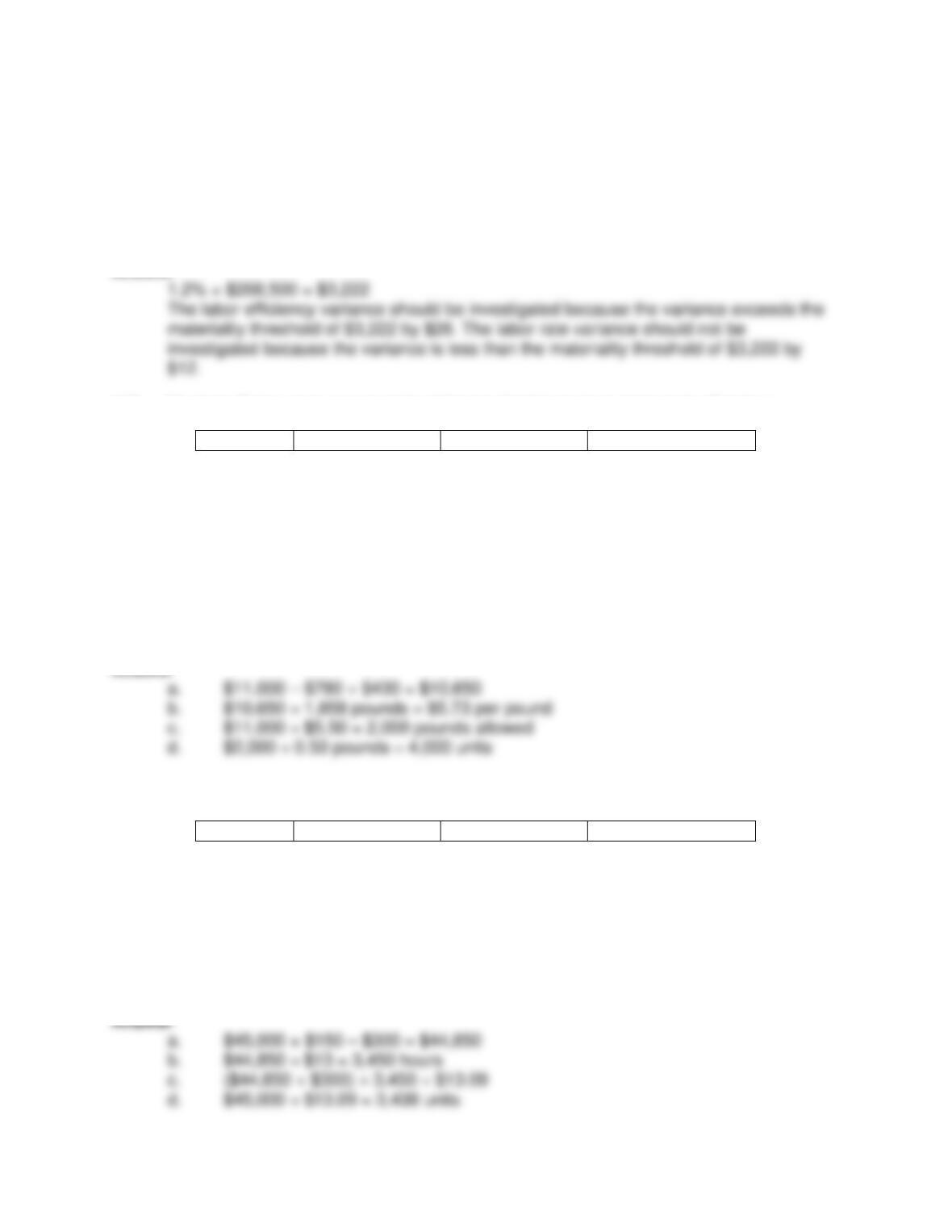
inventory, and Cost of Goods Sold. Prepare a journal entry to close the variance
accounts at Winston Woolies.
Answer
Test Bank to accompany Jiambalvo Managerial Accounting, 6th Edition
11–48
179. Gifts Galore, Inc. reported the following amounts for 2017:
Actual labor cost
$265,100
Labor rate variance
$3,210 U
Budgeted labor cost
$268,500
Labor efficiency variance
$3,250 F
The company employs management by exception and has a 1.2% materiality threshold
based on the budgeted allowance. Should the labor variances be investigated? Support
your answer with calculations, and briefly justify why or why not.
Answer
180. Martinez Bakery has prepared the following flexible budget analysis for October:
Cost
Flexible Budget
Price Variance
Quantity Variance
Materials
$11,000
$430 U
$780 F
Labor
45,000
470 F
150 U
Martinez Bakery purchased the same amount of units of materials as it used in
production. The number of pounds of materials used totaled 1,858. Each unit of product
requires a ½ pound of material. The standard cost per unit was $5.50 per pound.
a. How much is the actual cost of materials used?
b. How much did the company spend per pound of material?
c. How many pounds of material were allowed in the flexible budget?
d. How many units of product did the company produce?
Answer
181. Martinez Bakery has prepared the following flexible budget analysis for October:
Cost
Flexible Budget
Price Variance
Quantity Variance
Materials
$11,000
$430 U
$780 F
Labor
45,000
300 F
150 U
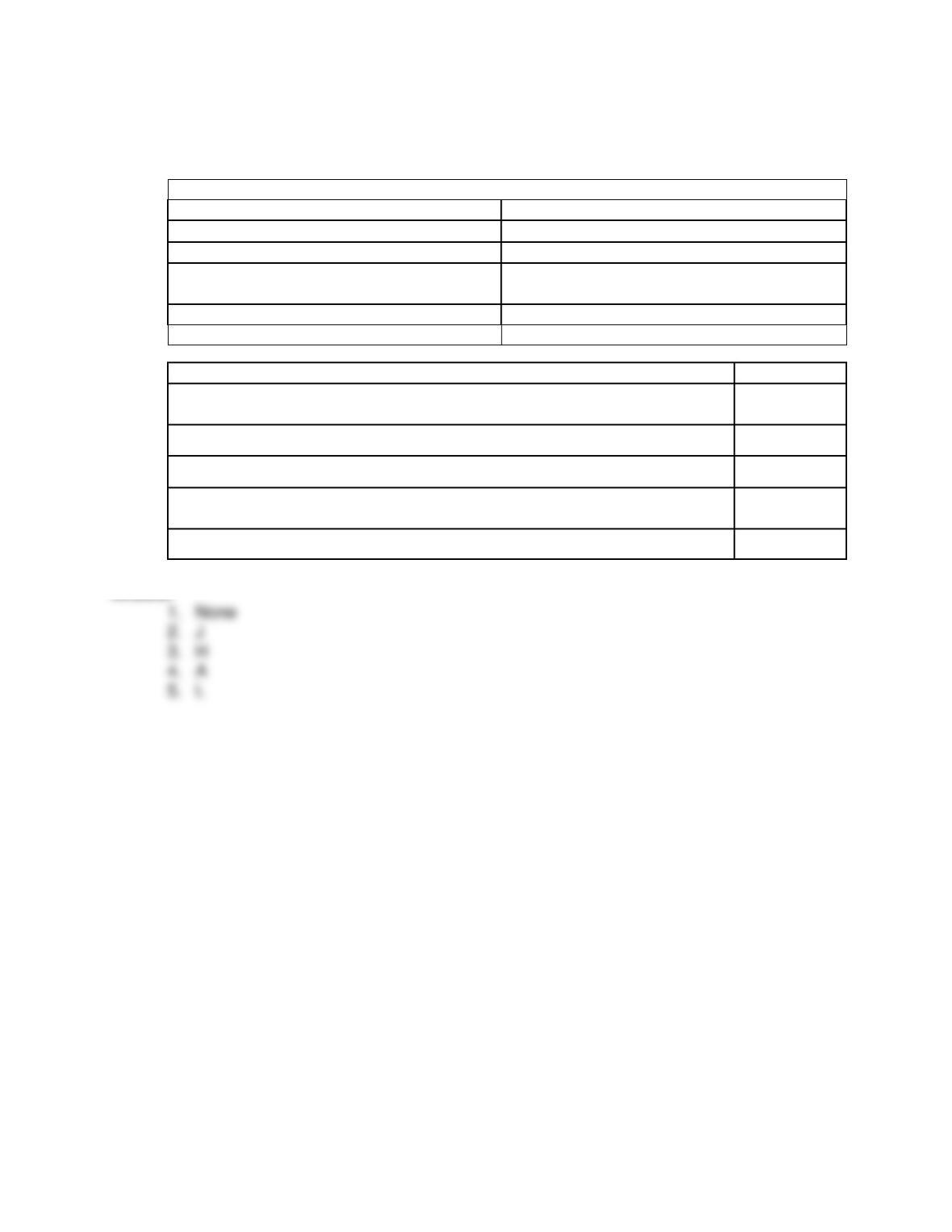
The actual labor rate per hour was $13.00. The standard labor time is 6 minutes per unit.
a. How much is the actual cost of labor incurred?
b. How much is the actual number of hours used?
c. How much is the standard labor rate allowed in the flexible budget?
d. How many units of product did the company produce?
Chapter 11 Standard Costs and Variance Analysis
11–49
182. Select the one variance that would most likely result from each of the cases presented
by printing the letter of your choice in the answer space provided. If no variance would
likely result directly from any case listed, print ‘None’ in the answer space.
Variances
A. favorable materials price variance
G. favorable labor efficiency variance
B. unfavorable materials price variance
H. unfavorable labor efficiency variance
C. favorable materials quantity variance
I. favorable overhead controllable variance
D. unfavorable materials quantity
variance
J. unfavorable overhead controllable
variance
E. favorable labor rate variance
K. favorable overhead volume variance
F. unfavorable labor rate variance
L. unfavorable overhead volume variance
Case
Answer
1. The company purchased more materials than it used during the
period.
2. Employees used more indirect materials than expected.
3. Employees worked more slowly than expected.
4. The purchasing manager skillfully negotiated a better price for higher
quality materials.
5. The company produced fewer units than budgeted.
Answer
Test Bank to accompany Jiambalvo Managerial Accounting, 6th Edition
11–50
183. Andros Company produces ladders. It uses direct labor hours as the cost driver for
overhead. The following information was provided concerning its standard cost system
for 2017:
Budgeted and Standard Data
Actual Data
Direct material
0.8 lbs. @ $6.40 per lb.
Produced
2,130 ladders
Direct labor
0.9 hrs. @ $15 per hr.
Materials purchased
1,700 lbs. for $11,135
Fixed overhead
$8.20 per labor hour
Direct materials
used
1,740 lbs.
Variable overhead
$11,700
Direct labor worked
2,010 hrs. costing $16,093
Production
2,000 ladders
Variable overhead
$11,620
Fixed overhead
$16,620
Calculate all the overhead variances and indicate if each is favorable or unfavorable.
Answer
Chapter 11 Standard Costs and Variance Analysis
11–51
SHORT-ANSWER ESSAYS
184. How are the standards for direct materials, direct labor, and manufacturing overhead
determined?
Answer
185. What is the difference between ideal standards and attainable standards?
Answer
186. A purchasing agent has found a new supplier for one of the company’s raw materials.
This supplier charges more for the raw material, but the material is of higher quality and
less will be wasted in the manufacturing process. If raw materials are purchased from
this supplier, what is likely to happen to the material price variance and the material
quantity variance?
Answer
187. What signal is provided by the overhead volume variance?
188. Frank Enterprises management claims, “We investigate all variances!” Is this a good
management policy? Why or why not?
Answer
Test Bank to accompany Jiambalvo Managerial Accounting, 6th Edition
11–52
189. Give an example of a favorable variance that might be indicative of a poor management
decision.
190. Explain how a focus on variances for performance analysis might lead to overproduction
in a non-bottleneck production department.
Answer
*191. JT Engines uses a standard costing system. When are each of the variances recorded
and how are the variance accounts closed at the end of the period?
Answer