76) Under the periodic inventory method, indicate the financial statement(s) on which you would find the
following items:
a) Cost of goods sold
b) Freight-In
c) Ending Inventory
d) Beginning Inventory
e) Purchase Discounts
77) Calculate: (a) net sales, (b) cost of goods sold, (c) gross profit, and (d) net income from the following:
Sales $3,000 Beginning Inventory $ 500
Sales Discount 150 Net purchases 1,300
Sales Returns & Ending Inventory 700
Allowances 80 Operating Expenses 300
78) Calculate: (a) net sales, (b) cost of goods sold, (c) gross profit, and (d) net income from the following:
Sales $1,700 Beginning Inventory $ 11
Sales Discount 5 Net purchases 1,200
Sales Returns & Ending Inventory 16
Allowances 15 Operating Expenses 100
79) Marie’s Law Firm’s unadjusted trial balance includes the following:
Cash $5,000
Unearned Legal Fees 2,200
Legal Fees Revenue 14,200
Using the above data, record the adjusting entry for $1,000 of the unearned legal fees earned.
80) Why is beginning and ending inventory kept as two separate figures in the cost of goods sold under
the Periodic method?
81) Prepare the general journal entry to record the adjustment for inventory:
Beginning inventory $8,000
Ending inventory 7,000
82) Camping for Fun purchased merchandise costing $1,200. Calculate the cost of goods sold under the
following different situations:
a) Beginning inventory $250 and no ending inventory.
b) Beginning inventory $300 and a $200 ending inventory.
c) No beginning inventory and a $100 ending inventory.
83)
Sales Beginning Inventory Purchases Ending Inventory Cost of Goods Sold Gross Profit
Operating Expenses Net Income Or Net Loss
50 20 16 a) 26 b) 8 c)
84)
Sales Beginning Inventory Purchases Ending Inventory Cost of Goods Sold Gross Profit
Operating Expenses Net Income Or Net Loss
38 14 d) 18 20 e) 10 8
21
85)
Sales Beginning Inventory Purchases Ending Inventory Cost of Goods Sold Gross Profit
Operating Expenses Net Income Or Net Loss
f) 16 20 12 g) 16 h) -2
86)
Sales Beginning Inventory Purchases Ending Inventory Cost of Goods Sold Gross Profit
Operating Expenses Net Income Or Net Loss
50 i) 20 14 j) 12 k) 4
11.2 Learning Objective 11-2
1) When completing a worksheet:
A) the ending inventory amount appears in the income statement debit column.
B) the beginning inventory amount appears in the adjustment credit column.
C) the ending inventory amount appears in the unadjusted trial balance debit column of the worksheet.
D) the beginning inventory amount appears in the balance sheet debit column of the worksheet.
2) The balance sheet columns on the worksheet prepared for Cleveland Goods had subtotals as follows:
debit column, $13,000, and credit column, $10,600. This information indicates that:
A) the company incurred a net income of $2,400.
B) the company incurred a net loss of $2,400.
C) an error was made when preparing the adjustments in the worksheet.
D) the unadjusted trial balance has an error.
3) The income statement columns on a worksheet have subtotals as follows: debit column, $12,000, and
credit column, $9,300. This indicates that:
22
A) the company incurred a net loss of $2,700.
B) the company earned a net income of $2,700.
C) there was an error in the unadjusted trial balance columns.
D) there was an error in the income statement columns.
4) During the preparation of the worksheet, the $5,000 balance of the Sam, Withdrawal account was
extended as a debit to the income statement columns. This error will:
A) overstate net income $5,000.
B) understate net income $5,000.
C) overstate net income $10,000.
D) understate net income $10,000.
5) Beginning and ending inventories are $980 and $880, respectively. The income statement debit and
credit columns of the worksheet total $2,500 and $2,500, respectively, not including the adjustment
amounts for beginning and ending inventories. The net income or loss for the period is:
A) $1,860 net income.
B) $1,860 net loss.
C) $100 net income.
D) $100 net loss.
6) On the worksheet the beginning Merchandise Inventory account appears in:
A) the adjustment column.
B) the trial balance and the balance sheet columns.
C) the trial balance and adjustment columns.
D) All of these answers are correct.
7) On the worksheet the ending Merchandise Inventory account appears in the:
A) adjusted trial balance and trial balance columns.
B) adjustment column.
C) adjustment, trial balance, and income statement columns.
D) adjustment, adjusted trial balance, and balance sheet columns.
8) The income summary amounts in the income statement columns of the worksheet represent:
A) income for the period.
B) adjustment for unearned revenue.
C) closing of the Capital account.
D) beginning and ending inventory.
9) Beginning and ending inventories for Jim’s Books are $12,800 and $8,400, respectively. The debit
amounts (not including Income Summary) in the income statement columns of the worksheet total
$13,800, and the credit amounts (not including Income Summary) total $15,000. The firm has a:
A) net income of $3,200.
B) net loss of $3,200.
C) net loss of $4,400.
D) net income of $4,400.
10) Which of the following items generally has a credit balance in the income statement columns of the
worksheet?
A) Purchase Returns and Allowances
B) Purchases
C) Accumulated Depreciation
D) Accounts Payable
11) Which inventory appears in the balance sheet column of the worksheet?
A) Ending inventory
B) Beginning inventory
C) Ending supplies
D) Purchases
12) The adjusted trial balance on the worksheet:
A) contains balances from the permanent accounts.
B) contains balances from the temporary accounts.
C) contains balances for all accounts with balances.
D) contains balances for all accounts requiring adjustments.
13) The trial balance columns on the worksheet are populated using the:
A) general journal.
B) general ledger.
C) subsidiary ledger.
D) None of the above
14) Sales would be found on the worksheet in the:
A) income statement debit column.
B) income statement credit column.
C) balance sheet debit column.
D) balance sheet credit column.
15) Beginning Merchandise Inventory would be found on the worksheet in the:
A) income statement debit column.
B) income statement credit column.
C) balance sheet debit column.
D) balance sheet credit column.
16) Owner’s Withdrawals would be found on the worksheet in the:
A) income statement debit column.
B) income statement credit column.
C) balance sheet debit column.
D) balance sheet credit column.
17) Owner’s Capital would be found on the worksheet in the:
A) income statement debit column.
B) income statement credit column.
C) balance sheet debit column.
D) balance sheet credit column.
18) The adjusted trial balance represents the combination of the unadjusted trial balance and the
adjustments columns.
19) On the worksheet, accumulated depreciation appears in the income statement columns.
20) On the worksheet, the Beginning Inventory account is found in the debit column of the Balance Sheet.
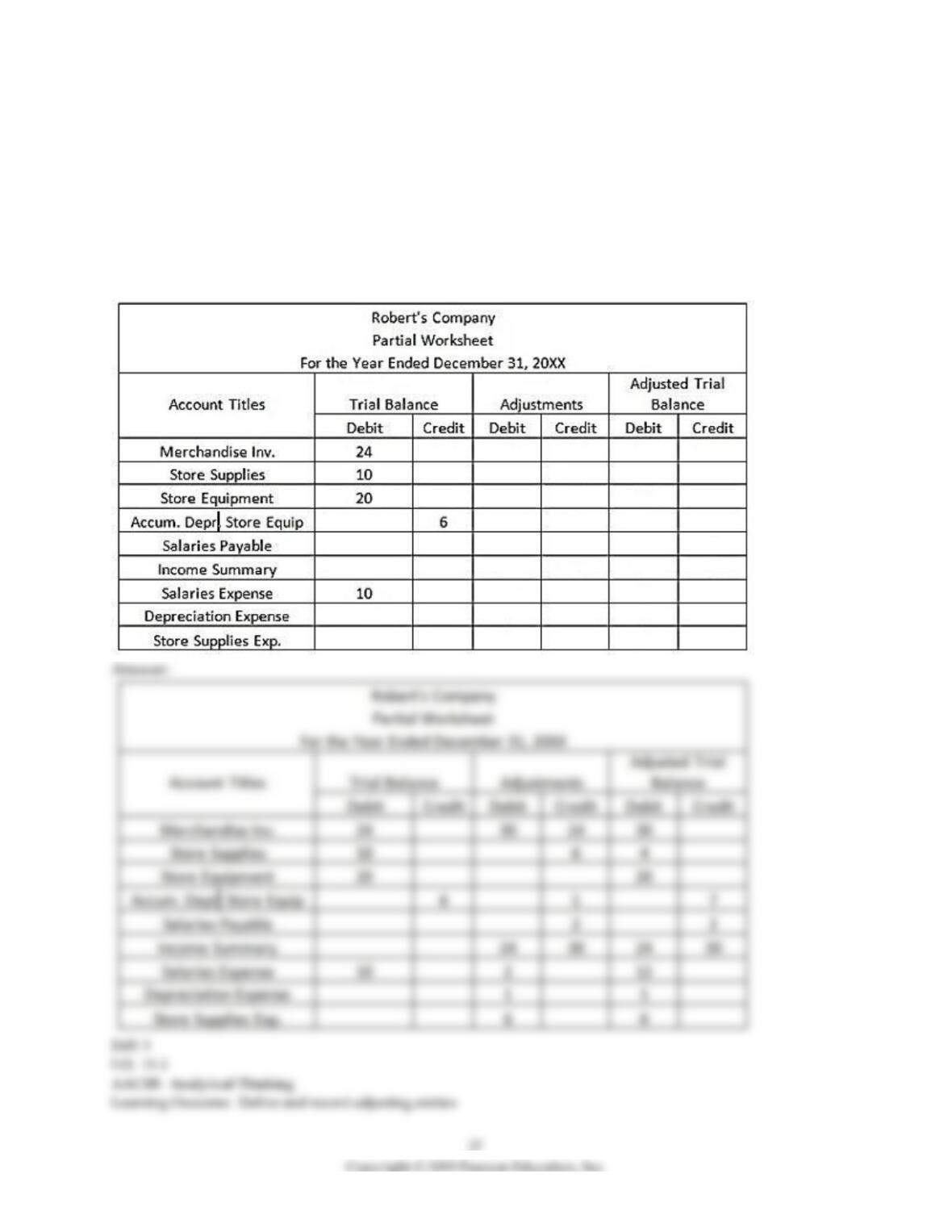
21) Use the following information to complete the partial worksheet for Robert’s Company. Record the
appropriate adjusting entries using the data below and extend the balances over to the adjusted trial
balance columns.
Merchandise inventory—ending $30
Store supplies on hand 4
Depreciation on store equipment 1
Accrued salaries 2
28
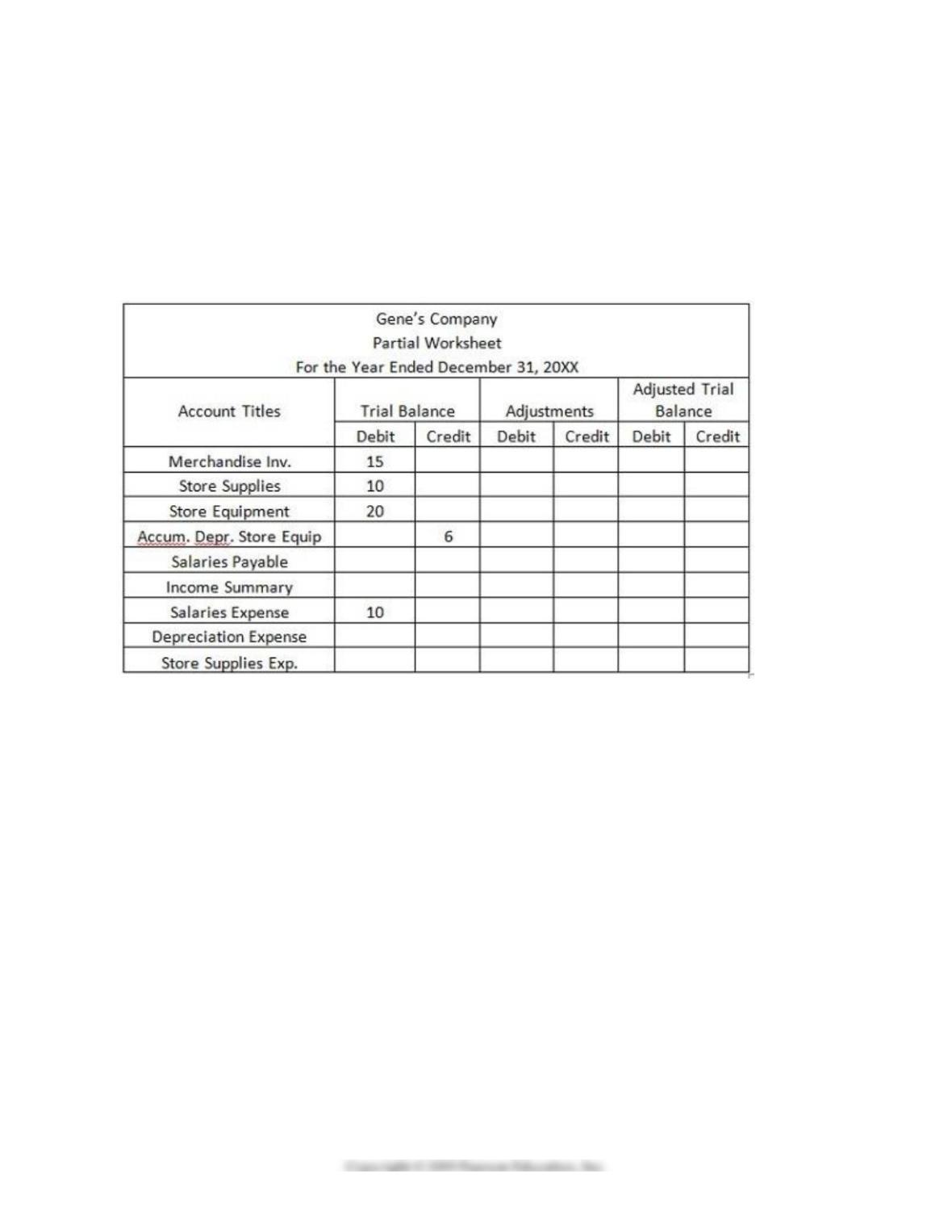
22) Use the following information to complete the partial worksheet for Gene’s Company. Record the
appropriate adjusting entries using the data below and extend the balances over to the adjusted trial
balance columns.
Merchandise inventory—ending $25
Store supplies on hand 3
Depreciation on store equipment 2
Accrued salaries 1
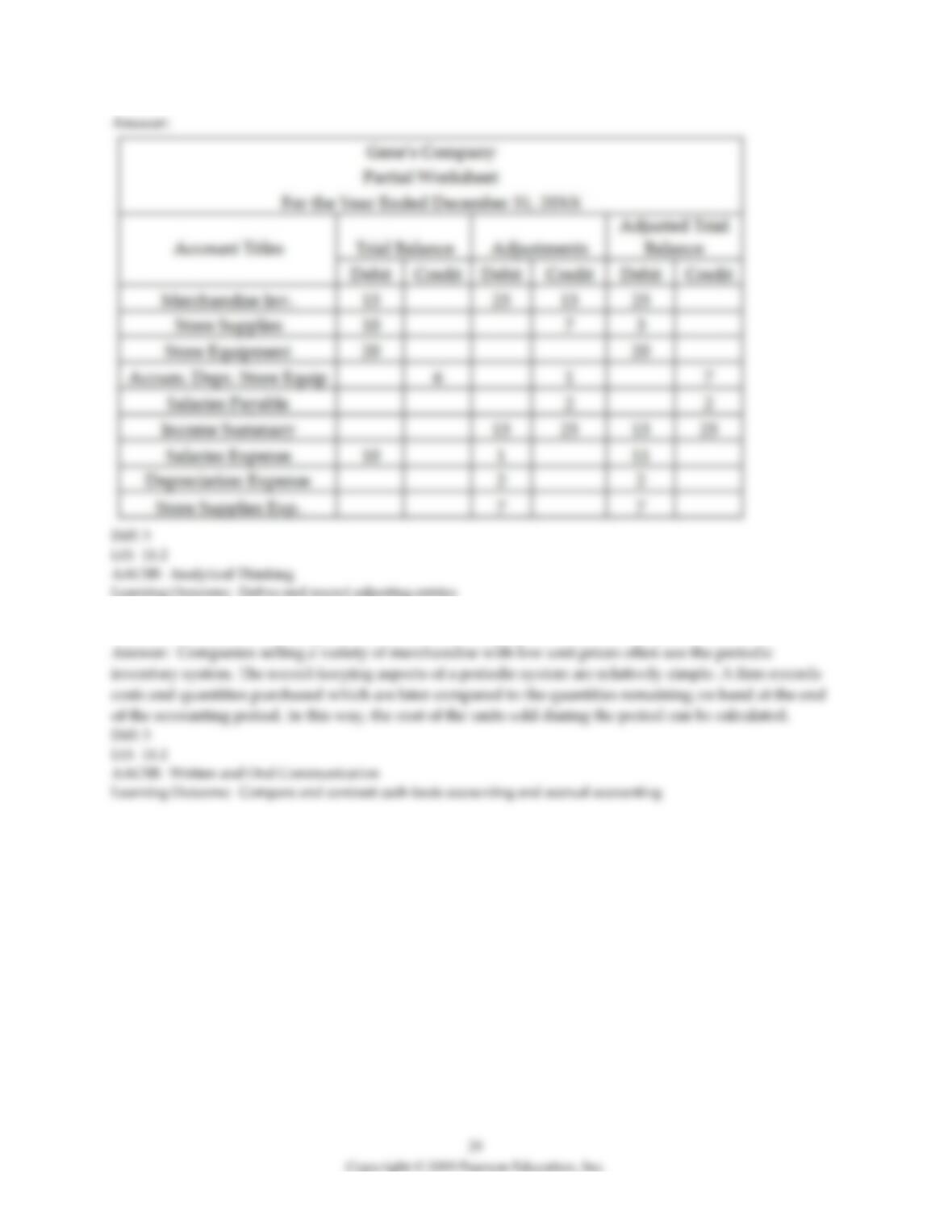
23) Discuss the reasons a company would consider using a periodic inventory system.
For each of the following, identify in Column 1 the balance the account will have in the adjusted trial
balance columns (debit or credit), in Column 2 the financial statement column(s) in which the account
balance will be found (income statement or balance sheet), and in Column 3 the effect the account will
have on the determination of net income (increase, decrease, or none).
24)
Column 1 Column 2 Column 3
Petty Cash
25)
Column 1 Column 2 Column 3
Merchandise inventory – ending
26)
Column 1 Column 2 Column 3
Prepaid Subscription
27)
Column 1 Column 2 Column 3
Unearned Rent Revenue
28)
Column 1 Column 2 Column 3
Accumulated Depreciation, Equip.
29)
Column 1 Column 2 Column 3
Salaries payable
30)
Column 1 Column 2 Column 3
Salaries expense
31)
Column 1 Column 2 Column 3
Purchases
32)
Column 1 Column 2 Column 3
Purchase discounts
33)
Column 1 Column 2 Column 3
Purchase returns and allowances
34)
Column 1 Column 2 Column 3
Sales
35)
Column 1 Column 2 Column 3
Sales returns and allowances
36)
Column 1 Column 2 Column 3
Sales discounts
37)
Column 1 Column 2 Column 3
Depreciation expense
38)
Column 1 Column 2 Column 3
Supplies expense