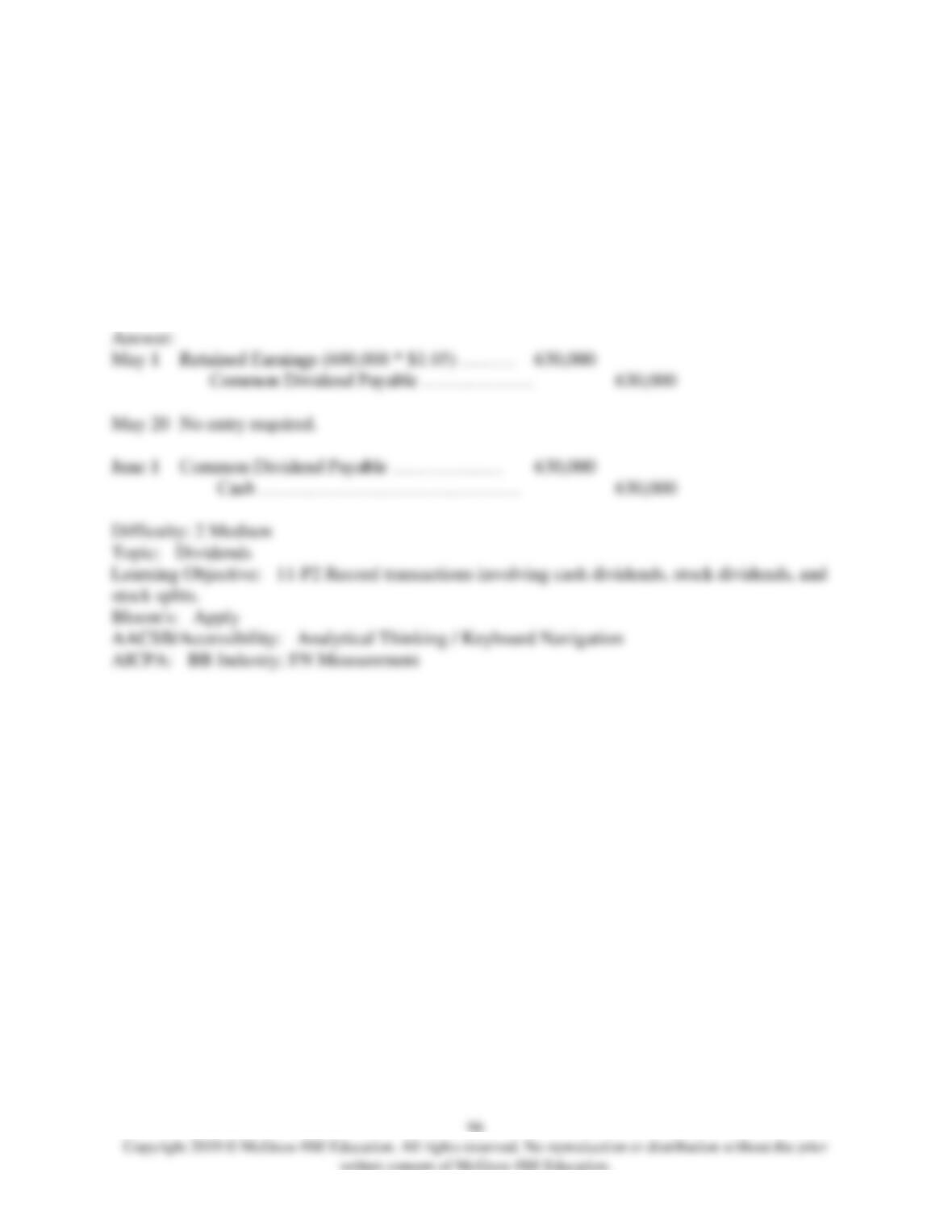
221) Cactus Joe Corporation reported stockholders’ equity on January 1 of the current year as
follows: Common Stock, $5 par value, 1,000,000 shares authorized, 600,000 shares issued; Paid-
in Capital in Excess of Par Value, Common Stock, $1,025,000; Retained Earnings, $1,850,000.
Prepare journal entries to record the following transactions:
May 1
A cash dividend of $1.05 per common share was declared by the board of
directors to stockholders of record on May 20, payable June 1.
May 20
The date of record.
June 1
Paid the cash dividend.
May 1
630,000
630,000
May 20
No entry required.
June 1
630,000
630,000
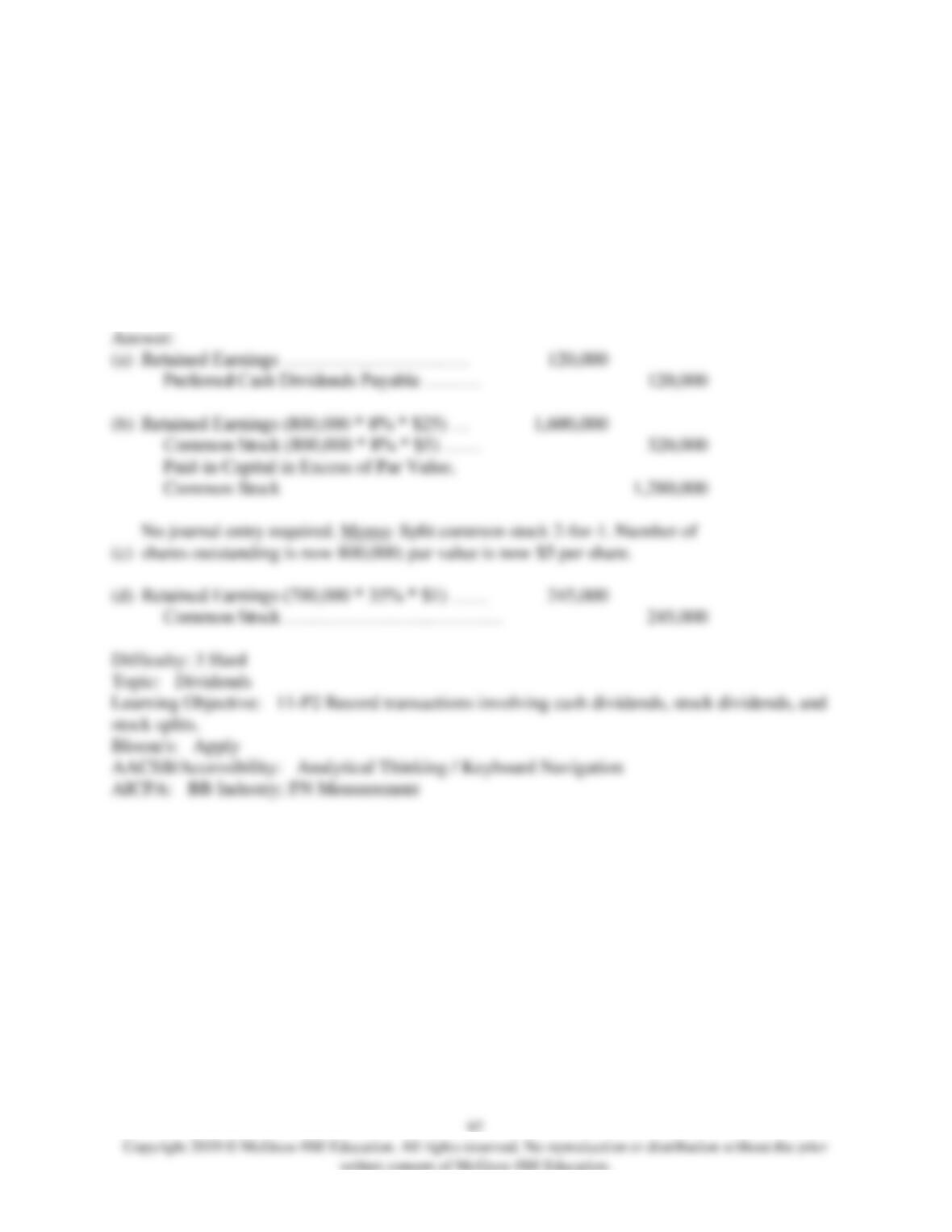
222) For each of the following independent transactions a through d, prepare the necessary
journal entry:
(a) Declared a $0.40 per share cash dividend on 300,000 shares of preferred stock outstanding.
(b) Declared and distributed an 8% stock dividend on 800,000 shares of $5 par value common
stock outstanding. Market price per common share on this date was $25.
(c) Declared and distributed a 2-for-1 stock split on 400,000 shares of $10 par value common
stock outstanding.
(d) Declared and distributed a 35% stock dividend on 700,000 common shares of $1 par value
common stock outstanding. Market price per common share on this date was $20.
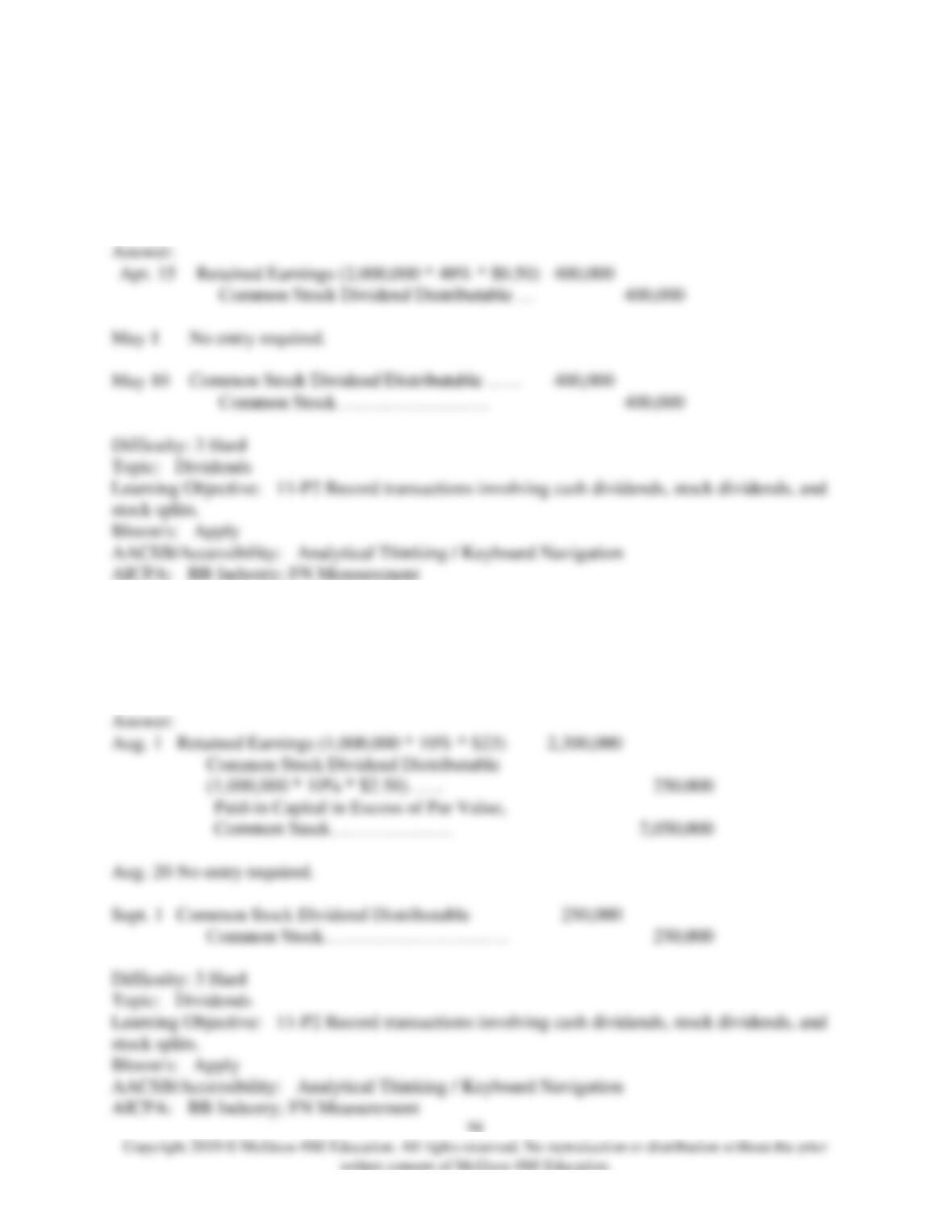
223) Parlay Corporation has 2,000,000 shares of $0.50 par value common stock outstanding. The
following selected transactions related to the company’s stock took place during the current year:
Apr. 15
Declared a 40% stock dividend to stockholders of record on May 1, to be
issued May 10. The current market value is $15 per common share.
Prepare necessary journal entries to record the events of April 15, May 1 and May 10.
Apr. 15
Retained Earnings (2,000,000 * 40% * $0.50)
May 1
No entry required.
May 10
224) On August 1, a company’s board of directors declared a 10% stock dividend to be
distributed on September 1 to the stockholders of record on August 20. The company had
1,000,000 shares of $2.50 par value common stock outstanding with a market value of $23 per
share. Prepare the journal entries required on August 1, August 20, and September 1.
Aug. 1
Retained Earnings (1,000,000 * 10% * $23)
Aug. 20
No entry required.
Sept. 1
Common Stock Dividend Distributable
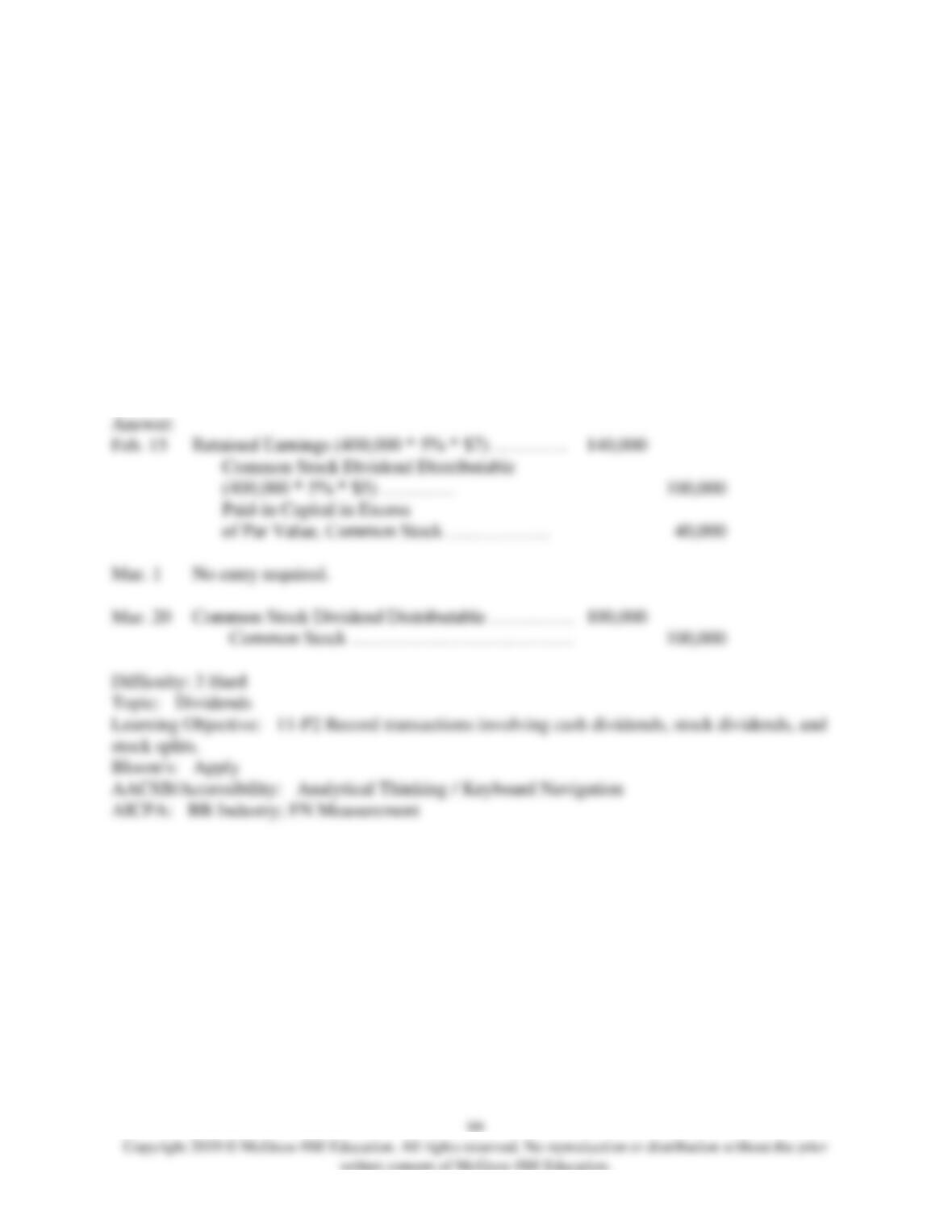
225) Dynasty Corporation had stockholders’ equity on January 1 as follows: Common Stock, $5
par value, 1,000,000 shares authorized, 400,000 shares issued; Paid-in Capital in Excess of Par
Value, Common Stock, $800,000; Retained Earnings, $3,600,000. Prepare journal entries to
record the following transactions:
Feb. 15
The board of directors declared a 5% stock dividend to stockholders of record
on March 1, to be issued on March 20. The stock was trading at $7 per share
prior to the dividend
Mar. 1
The date of record.
Mar. 20
Issued the stock dividend.
Feb. 15
140,000
Mar. 1
No entry required.
Mar. 20
100,000
226) A corporation had stockholders’ equity on January 1 as follows: Common Stock, $1 par
value, 1,500,000 shares authorized, 600,000 shares issued; Paid-in Capital in Excess of Par
Value, Common Stock, $1,100,000; Retained Earnings, $2,300,000. Prepare journal entries to
record the following transactions:
Feb. 15
The board of directors declared a 10% stock dividend to stockholders of record
on March 1, to be issued on April 15. The stock was trading at $12 per share
prior to the dividend.
Mar. 31
Sold 100,000 shares of common stock for $13 per share.
Apr. 15
Issued the stock dividend.
Feb. 15
Retained Earnings (600,000 * 10% * $12)
Mar. 31
Cash
Apr. 15
Common Stock Dividend Distributable
227) A company had the following stockholders’ equity on January 1:
Common Stock — $1 par value; 1,000,000 shares authorized,
350,000 shares issued and outstanding ……….
$ 350,000
Paid-in capital in excess of par value, common stock ……….
700,000
Retained earnings ……………………………………………
364,000
Total stockholders’ equity ……………………………………
$1,414,000
On January 10, the company declared a 40% stock dividend to stockholders of record on January
25, to be distributed January 31. The market value of the stock on January 10 prior to the
dividend was $20 per share. What is the book value per common share on February 1?
228) A company reported the following stockholders’ equity on January 1 of the current year:
Common stock, $10 par, 1,000,000 shares authorized, 250,000 shares
issued …………………..
$2,500,000
Paid-in capital in excess of par, common ………………
1,260,000
Retained earnings ………………………………………
1,675,000
Total stockholders’ equity …………………..………….
$5,435,000
Prepare journal entries for the following selected transactions related to this company’s stock
during the current year:
Mar. 1
Purchased 10,000 shares of treasury stock for $18 per share.
May 5
Sold 4,000 shares of treasury stock for $16 per share.
Oct. 12
Sold 2,000 shares of treasury stock for $19 per share.
Mar. 1
Treasury Stock……………………………
May 5
Cash (4,000 shares * $16)…………………
Retained Earnings…………………………
Oct. 12
Cash (2,000 shares * $19)…………………
103
229) Underwood Company’s only treasury stock transactions for the current year follow: (1)
2,000 shares of its common stock were purchased on June 1 for $80,000; (2) On July 1 it
reissued 500 of these shares at $45 per share; (3) On August 1 it reissued an additional 500
treasury shares at $38 per share.
1) Prepare the journal entries required to record these transactions.
2) Calculate the balance in Paid-in Capital, Treasury Stock, on September 1 assuming its
beginning-year balance is zero.
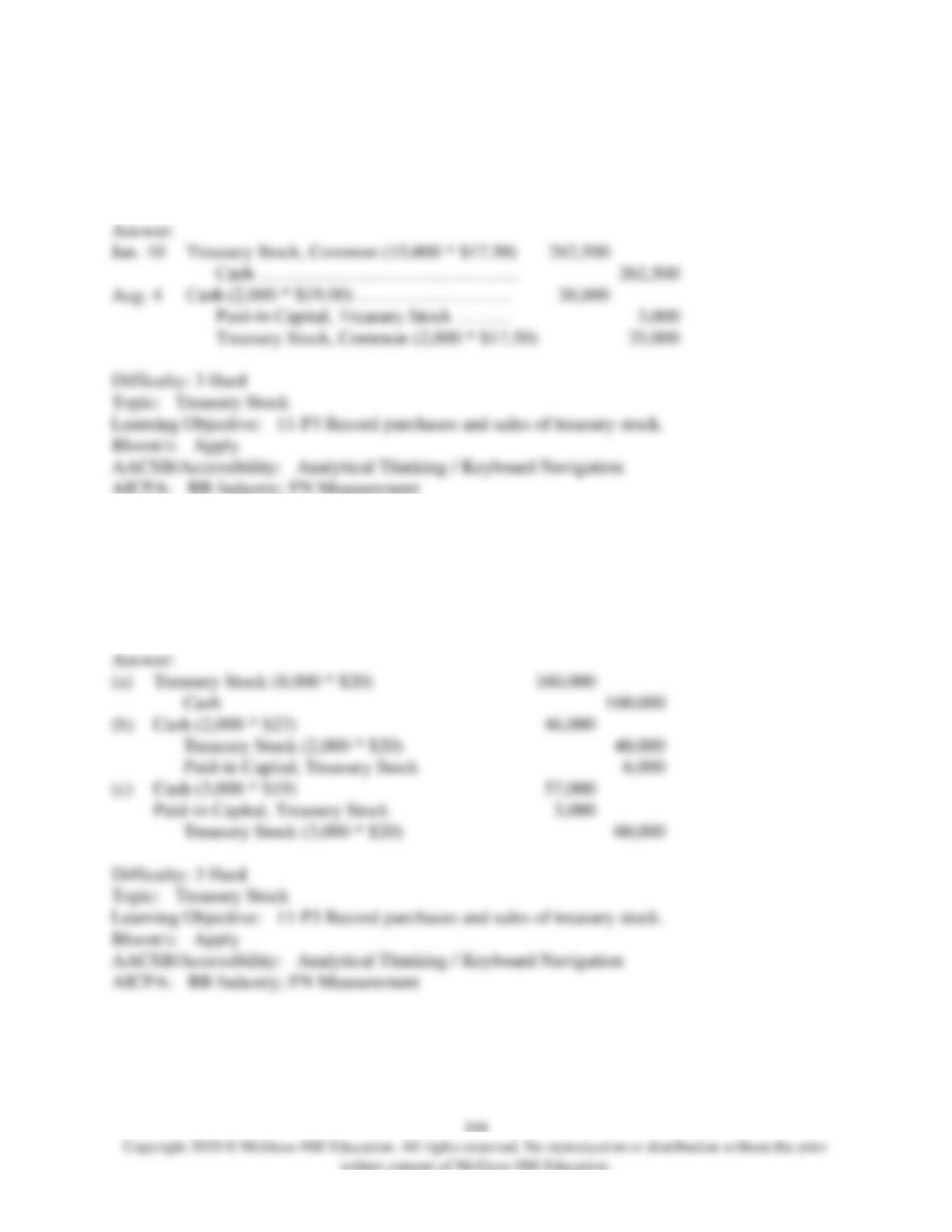
230) On January 10, Mood Corporation purchased 15,000 shares of its own common stock at
$17.50 per share. On August 4, a total of 2,000 treasury shares were sold at $19.00 per share.
These are the only treasury stock transactions ever made by the corporation. Prepare the journal
entries required on January 10 and August 4.
231) Record the following transactions of Naches Corporation in general journal form:
(a) Reacquired 8,000 of its own $3 par value common stock at $20 cash per share. The stock was
originally issued at $15 per share.
(b) Sold 2,000 shares of the stock reacquired under part (a) at $23 cash per share.
(c) Sold 3,000 shares of the stock reacquired under part (a) at $19 cash per share.
232) The group responsible for overseeing the corporation’s activities is (are) the ________.
233) A corporation is responsible for its own acts and debts because it is considered a ________.
234) The ________ protects stockholders’ proportional interest in a corporation by allowing
them to purchase their proportional share of any common stock later issued by the corporation.
235) A stock ________ keeps stockholder records and prepares official lists of stockholders for
stockholder meetings and dividend payments.
236) The number of shares that a corporation’s charter allows it to sell is the ________ stock.
237) The total amount of cash and other assets the corporation receives from its stockholders in
exchange for common stock is called ________.
238) The cumulative net income and loss not distributed as dividends to a corporation’s
shareholders is called ________.
239) Stock that has been issued and is held by stockholders is ________ stock.
240) The amount assigned per share to stock by the corporation in its charter is the ________.
241) Stock not assigned a value per share by the corporate charter, allowing it to be issued at any
price, is called ________.
242) ________ is a general term that refers to any shares issued to obtain owner financing in a
corporation.
243) The least amount that the buyers of stock must contribute to the corporation or be at risk to
pay creditors at a future date is called ________.
244) ________ are corrections of material errors in prior period financial statements.
245) ________ is the amount of income earned per share of a company’s outstanding common
stock.
246) ________ is the stockholders’ equity applicable to common shares divided by the number of
common shares outstanding.
247) ________ is the annual amount of cash dividends per share distributed to common
shareholders relative to the stock’s market price.
109
248) When preferred stock is cumulative and the directors either do not declare a dividend to
preferred stockholders or declare one that does not cover the total amount of cumulative
dividends, the unpaid amount is called ________.