94) Broadway Ltd. purchased equipment on January 1, 2016, for $800,000, estimating a five-
year useful life and no residual value. In 2016 and 2017, Broadway depreciated the asset using
the straight-line method. In 2018, Broadway changed to sum-of-years’-digits depreciation for this
equipment. What depreciation would Broadway record for the year 2018 on this equipment?
A) $120,000.
B) $160,000.
C) $200,000.
D) $240,000.
95) On January 1, 2016, Al’s Sporting Goods purchased store fixtures at a cost of $180,000. The
anticipated service life was 10 years with no residual value. Al’s has been using the double-
declining balance method, but in 2018 adopted the straight-line method because the company
believes it provides a better measure of income. Al’s has a December 31 year-end. The journal
entry to record depreciation for 2018 is:
A)
Depreciation expense
23,040
Accumulated depreciation
23,040
B)
Depreciation expense
14,400
Accumulated depreciation
14,400
C)
Accumulated depreciation
28,800
Retained earnings
28,800
D) No entry
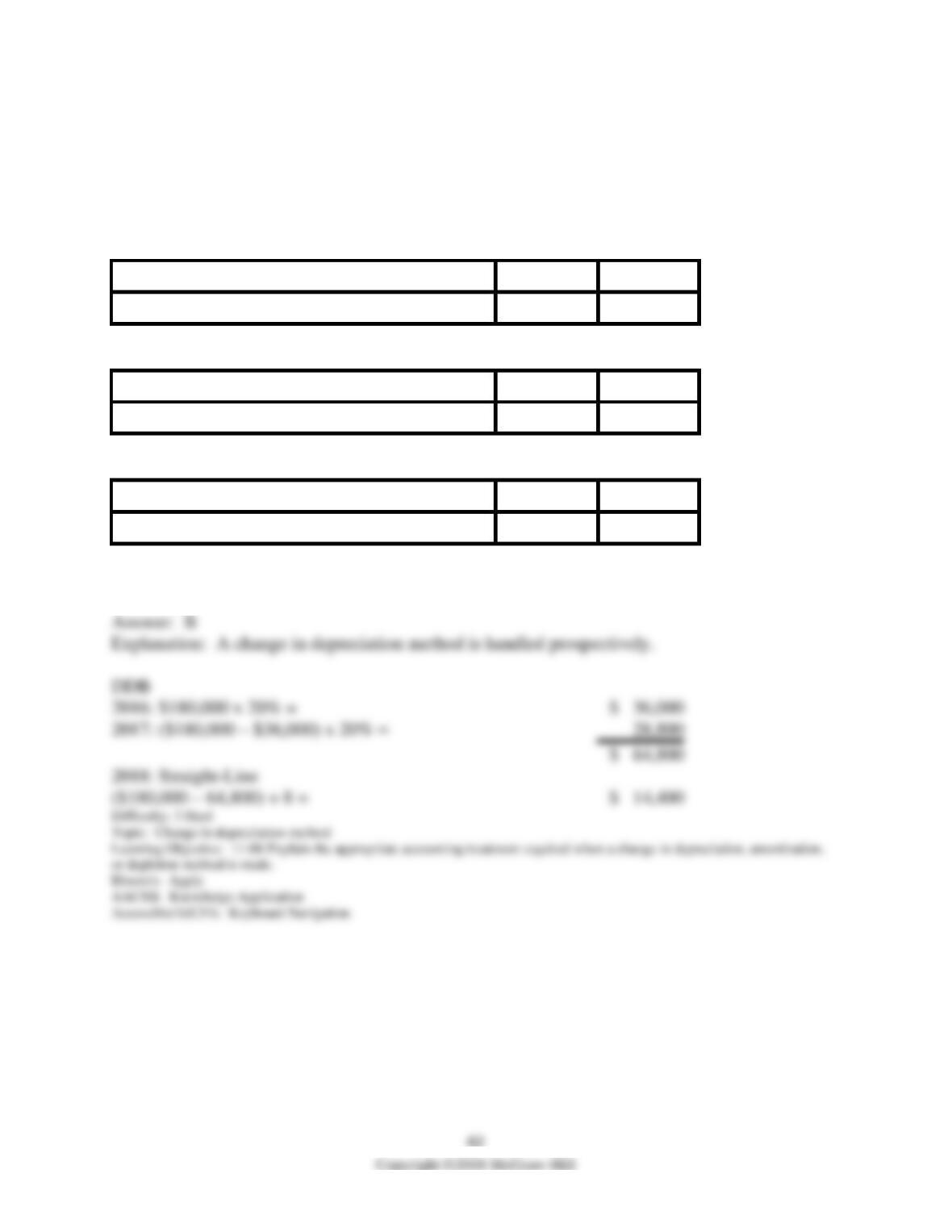
2016: $180,000 x 20% =
2017: ($180,000 – $36,000) x 20% =
2018: Straight-Line
($180,000 – 64,800) ÷ 8 =
96) A major addition to equipment should have been capitalized in the year 2018 but was
incorrectly expensed. Which of the following is (are) true?
A) Income in 2018 is understated.
B) Income in future years is overstated.
C) Assets in 2018 are understated.
D) All of these answer choices are true.
97) If a material error is discovered in an accounting period subsequent to the period in which
the error is made:
A) No adjustments are made.
B) No prior years’ financial statements are restated but corrections are made in future years.
C) Any previous years’ financial statements are retrospectively restated to reflect the correction.
D) No prior years’ financial statements are restated but prior effects are corrected in the current
balance of retained earnings.
98) An asset should be written down if there has been an impairment of value that is:
A) Relevant and objectively determined.
B) Material and market driven.
C) Unplanned and sudden.
D) Significant.
99) Recognition of impairment for property, plant, and equipment is required if book value
exceeds:
A) Fair value.
B) Present value of expected cash flows.
C) Undiscounted expected cash flows.
D) Accumulated depreciation.
100) Which of the following represents an event that indicates an asset’s book value may not be
recoverable?
A) A significant adverse change in how the asset is being used or in its physical condition.
B) A significant adverse change in legal factors or in the business climate.
C) A realization that the asset will be disposed of significantly before the end of its estimated
useful life.
D) All of these answer choices are correct.
101) The amount of impairment loss is the excess of book value over:
A) Amortized cost.
B) Undiscounted future cash flows.
C) Fair value.
D) Future revenues.
102) Accounting for impairment losses:
A) Involves a two-step process for recoverability and measurement.
B) Applies only to depreciable assets.
C) Applies only to assets with finite lives.
D) All of these answer choices are correct.
103) In testing for recoverability of property, plant, and equipment, an impairment loss is
required if the:
A) Asset’s book value exceeds the undiscounted sum of expected future cash flows.
B) Undiscounted sum of its expected future cash flows exceeds the asset’s book value.
C) Present value of expected future cash flows exceeds its book value.
D) All of these answer choices are incorrect.
104) An impairment loss has the effect of:
A) Reducing total assets.
B) Increasing liabilities.
C) Reducing total revenues.
D) None of these answer choices are correct.
105) At the end of its 2018 fiscal year, a triggering event caused Janero Corporation to perform
an impairment test for one of its manufacturing facilities. The following information is available:
Book value
$
65
million
Estimated undiscounted future cash flows
60
million
Fair value
50
million
The manufacturing facility is:
A) Impaired because its book value exceeds undiscounted future cash flows.
B) Not impaired because its book value exceeds undiscounted future cash flows.
C) Not impaired because it continues to produce revenue.
D) Impaired because its book value exceeds fair value.
106) Fryer Inc. owns equipment for which it paid $90 million. At the end of 2018, it had
accumulated depreciation on the equipment of $27 million. Due to adverse economic conditions,
Fryer’s management determined that it should assess whether an impairment loss should be
recognized for the equipment. The estimated undiscounted future cash flows to be provided by
the equipment total $60 million, and the equipment’s fair value at that point is $40 million. Under
these circumstances, Fryer:
A) Would record no impairment loss on the equipment.
B) Would record a $3 million impairment loss on the equipment.
C) Would record a $23 million impairment loss on the equipment.
D) None of these answer choices are correct.
107) Wilson Inc. owns equipment for which it paid $70 million. At the end of 2018, it had
accumulated depreciation on the equipment of $12 million. Due to adverse economic conditions,
Wilson’s management determined that it should assess whether an impairment loss should be
recognized for the equipment. The estimated undiscounted future cash flows to be provided by
the equipment total $60 million, and the equipment’s fair value at that point is $50 million. Under
these circumstances, Wilson:
A) Would record no impairment loss on the equipment.
B) Would record an $8 million impairment loss on the equipment.
C) Would record a $20 million impairment loss on the equipment.
D) None of these answer choices are correct.
108) Alou Corporation reported the following information at year-end:
Book Value
Estimated
Cash Flows
Fair Value
Building
$
500,000
$
380,000
$
360,000
Patent
$
35,000
$
40,000
$
38,000
Copyright
$
40,000
$
38,000
$
39,000
Machine
$
100,000
$
120,000
$
85,000
Based on the above information, what is the total amount of impairment loss that Alou should
record at year end?
A) $141,000.
B) $126,000.
C) $123,000.
D) $122,000.
109) Oak Inc. has the following information regarding its assets:
Book Value
Estimated
Cash Flows
Fair Value
Equipment
$
35,000
$
30,000
$
28,000
Building
$
68,000
$
70,000
$
65,000
Patent
$
30,000
$
34,000
$
32,000
What amount of loss should be recorded due to asset impairments?
A) $10,000.
B) $9,000.
C) $8,000.
D) $7,000.
110) Jung Inc. owns a patent for which it paid $66 million. At the end of 2018, it had
accumulated amortization on the patent of $16 million. Due to adverse economic conditions,
Jung’s management determined that it should assess whether an impairment loss should be
recognized for the patent. The estimated undiscounted future cash flows to be provided by the
patent total $43 million, and the patent’s fair value at that point is $35 million. Under these
circumstances, Lester:
A) Would record no impairment loss on the patent.
B) Would record a $7 million impairment loss on the patent.
C) Would record a $15 million impairment loss on the patent.
D) Would record a $31 million impairment loss on the patent.
111) In 2017, Antle Inc. had acquired Demski Co. and recorded goodwill of $245 million as a
result. The net assets (including goodwill) from Antle’s acquisition of Demski Co. had a 2018
year-end book value of $580 million. Antle assessed the fair value of Demski at this date to be
$700 million, while the fair value of all of Demski’s identifiable tangible and intangible assets
(excluding goodwill) was $550 million. The amount of the impairment loss that Antle would
record for goodwill at the end of 2018 is:
A) $150 million.
B) $95 million.
C) $0.
D) None of these answer choices are correct.
112) Which of the following types of subsequent expenditures normally is capitalized?
A) Additions.
B) Improvements.
C) Rearrangements.
D) All of these answer choices are normally capitalized.
113) Which of the following types of subsequent expenditures normally is capitalized?
A) An extension of the useful life of the asset.
B) An increase in the operating efficiency of the asset.
C) An increase in the quality of the goods or services produced by the asset.
D) All of these answer choices are normally capitalized.
114) A major expenditure increased a truck’s life beyond the original estimate of life. GAAP
permits the expenditure to be debited to:
A) Repairs.
B) Accumulated depreciation.
C) Major repairs.
D) None of these answer choices are correct.
115) Adding a refrigeration unit to a delivery truck that previously did not have this capability is
an example of:
A) Repairs and maintenance.
B) Improvement.
C) Rearrangement.
D) Addition.
116) The replacement of a major component increased the productive capacity of production
equipment from 10 units per hour to 18 units per hour. The expenditure should be debited to:
A) Repairs expense.
B) Maintenance expense.
C) Equipment.
D) Gain from repairs
117) The cost of an engine tune-up is an example of which of the following expenditures taking
place after acquisition of the asset:
A) Additions.
B) Improvements.
C) Maintenance.
D) Rearrangements.
118) Ryan Company purchased a building on January 1, 2018, for $250,000. In addition, during
2018 the following costs related to the building have been incurred:
Utilities
$
12,000
Property tax
4,000
Expansion of the building
53,000
New air conditioning system
28,000
General maintenance
$
19,000
The amount of expenditures to capitalize for the year (not including the initial purchase of the
building) is:
A) $35,000.
B) $85,000.
C) $81,000.
D) $72,000.
119) Calloway Shoes purchased a delivery truck on September 30, 2018, for $32,000. The
estimated useful life of the truck is 10 years with no residual value. After five years, the
refrigeration unit will need to be replaced. The $8,000 cost of the unit is included in the cost of
the truck. Calloway uses the straight-line depreciation method. Depreciation for 2018 under U.S.
GAAP and International Financial Reporting Standards (IFRS), respectively, is:
U.S.GAAP
IFRS
a.
$
3,200
$
3,200
b.
$
800
$
800
c.
$
800
$
1,000
d.
$
3,200
$
4,000
A) option A
B) option B
C) option C
D) option D
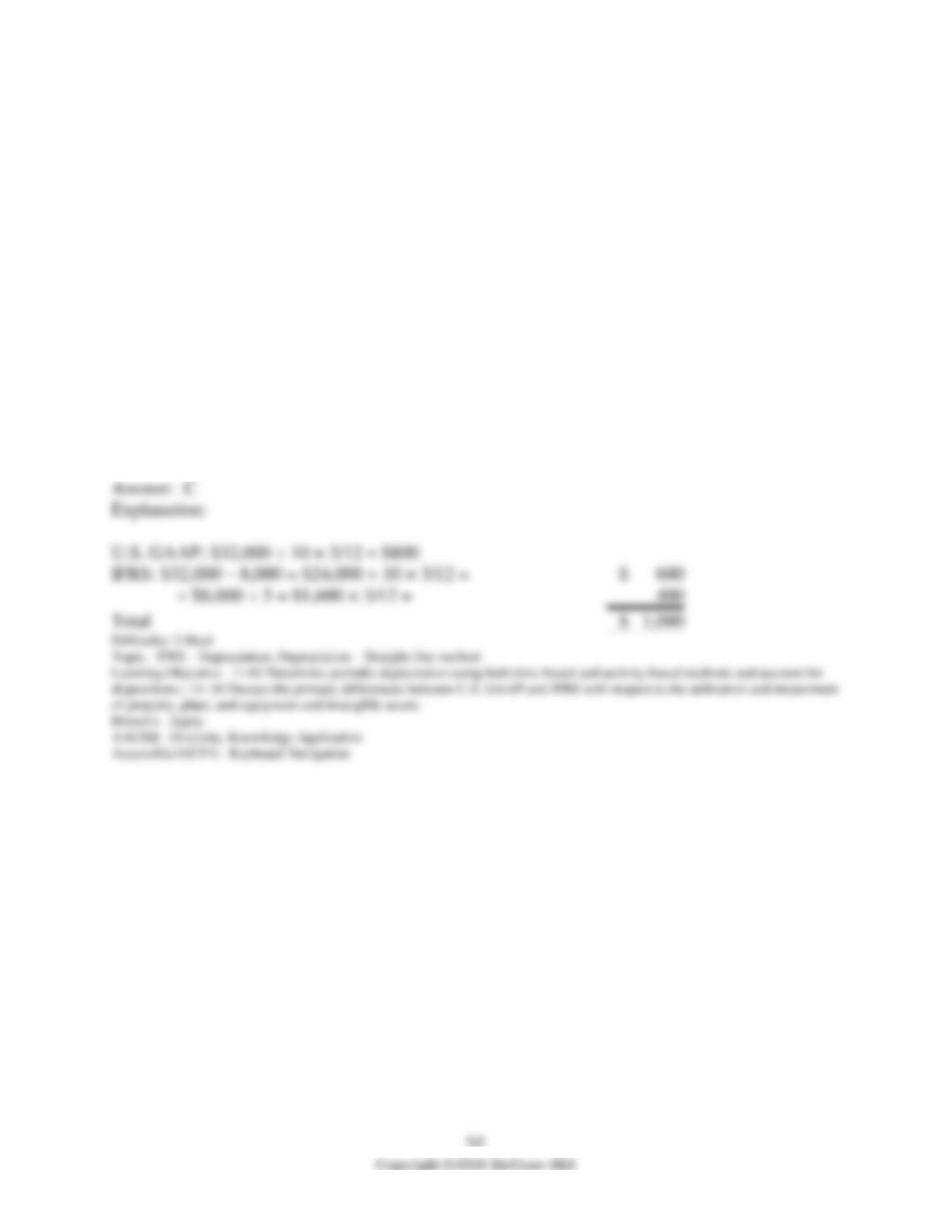
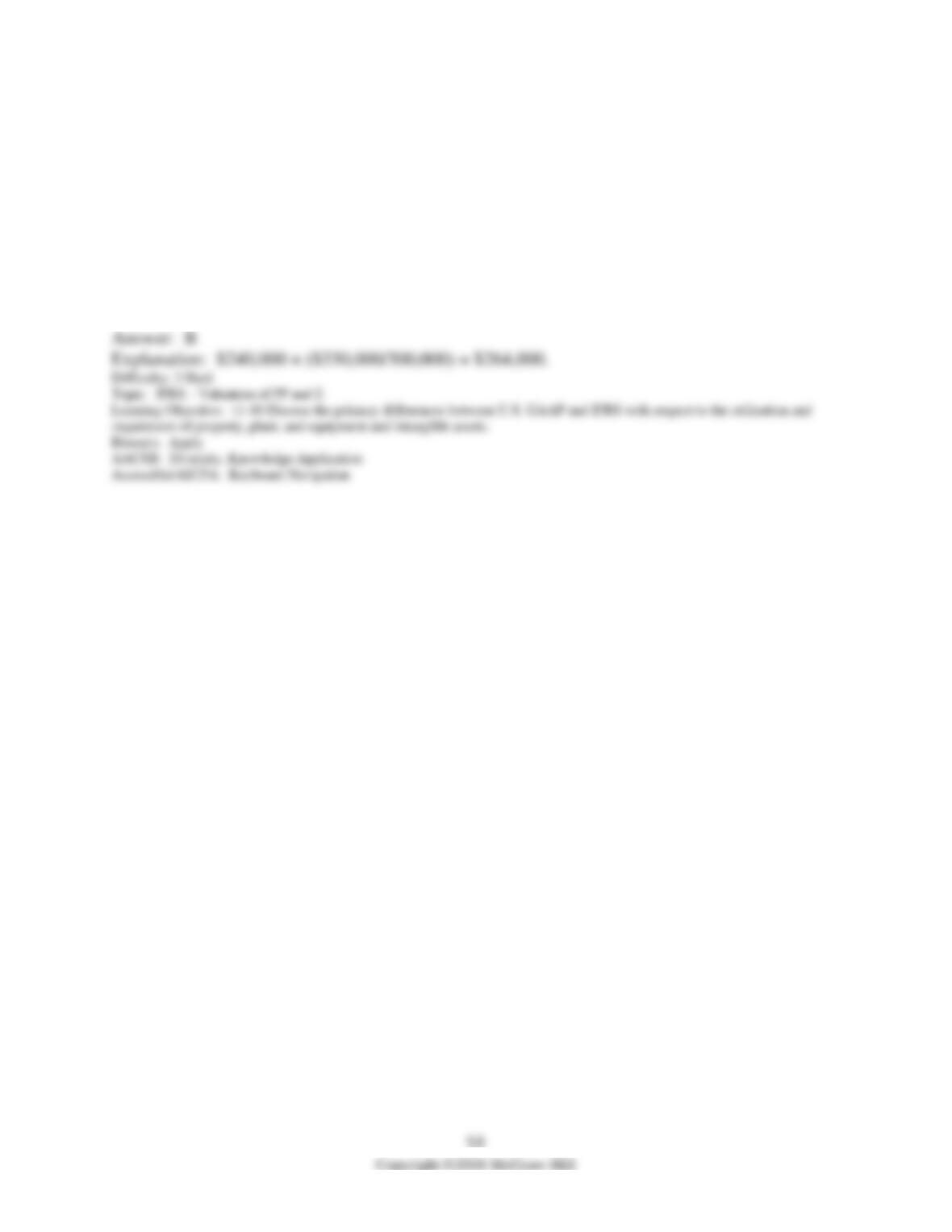
U.S. GAAP: $32,000 ÷ 10 × 3/12 = $800
IFRS: $32,000 – 8,000 = $24,000 ÷ 10 × 3/12 =
+ $8,000 ÷ 5 = $1,600 × 3/12 =
Total
120) Robertson Inc. prepares its financial statements according to International Financial
Reporting Standards (IFRS). At the end of its 2018 fiscal year, the company chooses to revalue
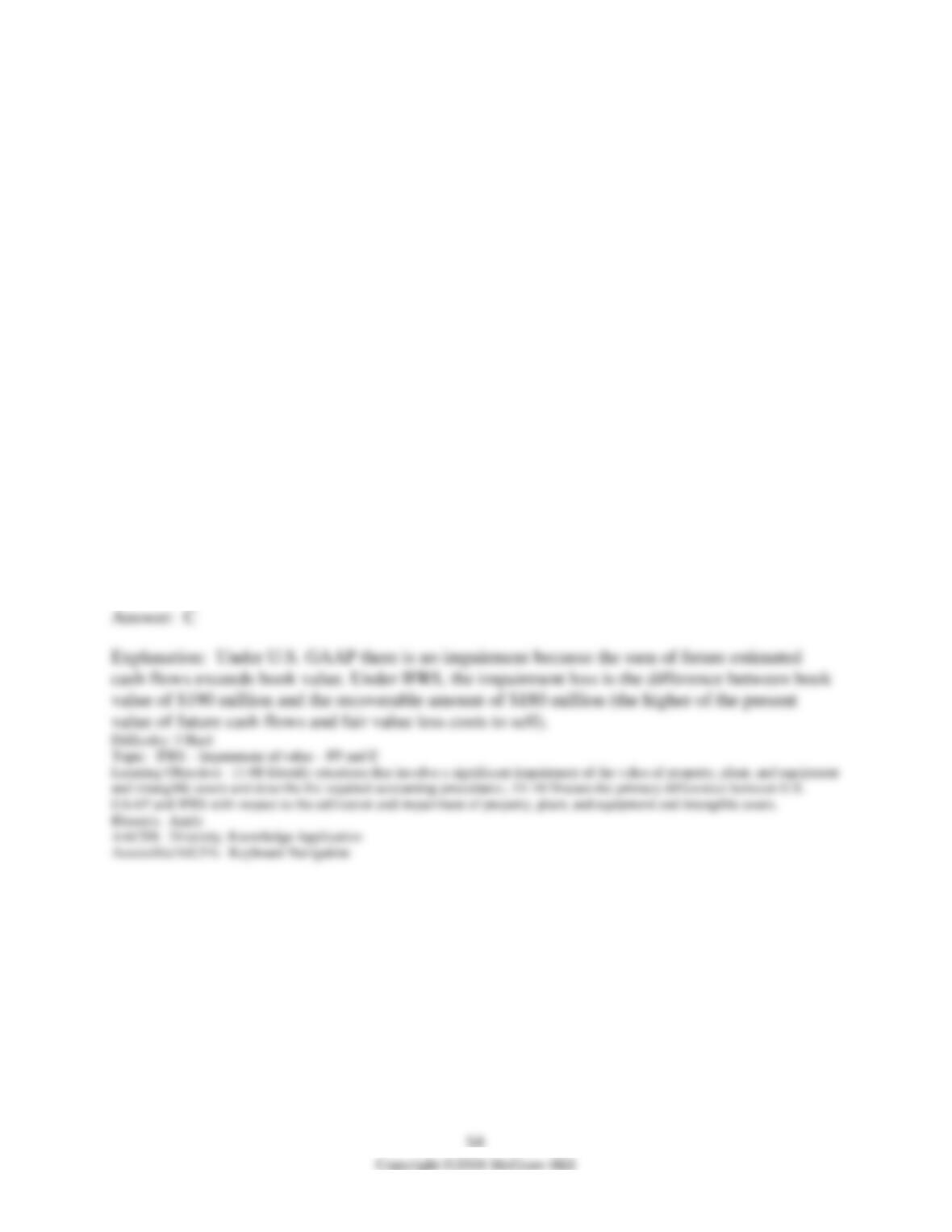
its equipment. The equipment cost $540,000, had accumulated depreciation of $240,000 at the
end of the year after recording annual depreciation, and had a fair value of $330,000. After the
revaluation, the accumulated depreciation account will have a balance of:
A) $240,000.
B) $264,000.
C) $270,000.
D) None of these answer choices are correct.
121) Rice Industries owns a manufacturing plant in a foreign country. Political unrest in the
country indicates that Rice should investigate for possible impairment. Below is information
related to the plant’s assets ($ in millions):
Book value
$
190
Undiscounted sum of future estimated cash flows
210
Present value of future cash flows
175
Fair value less cost to sell (determined by appraisal)
180
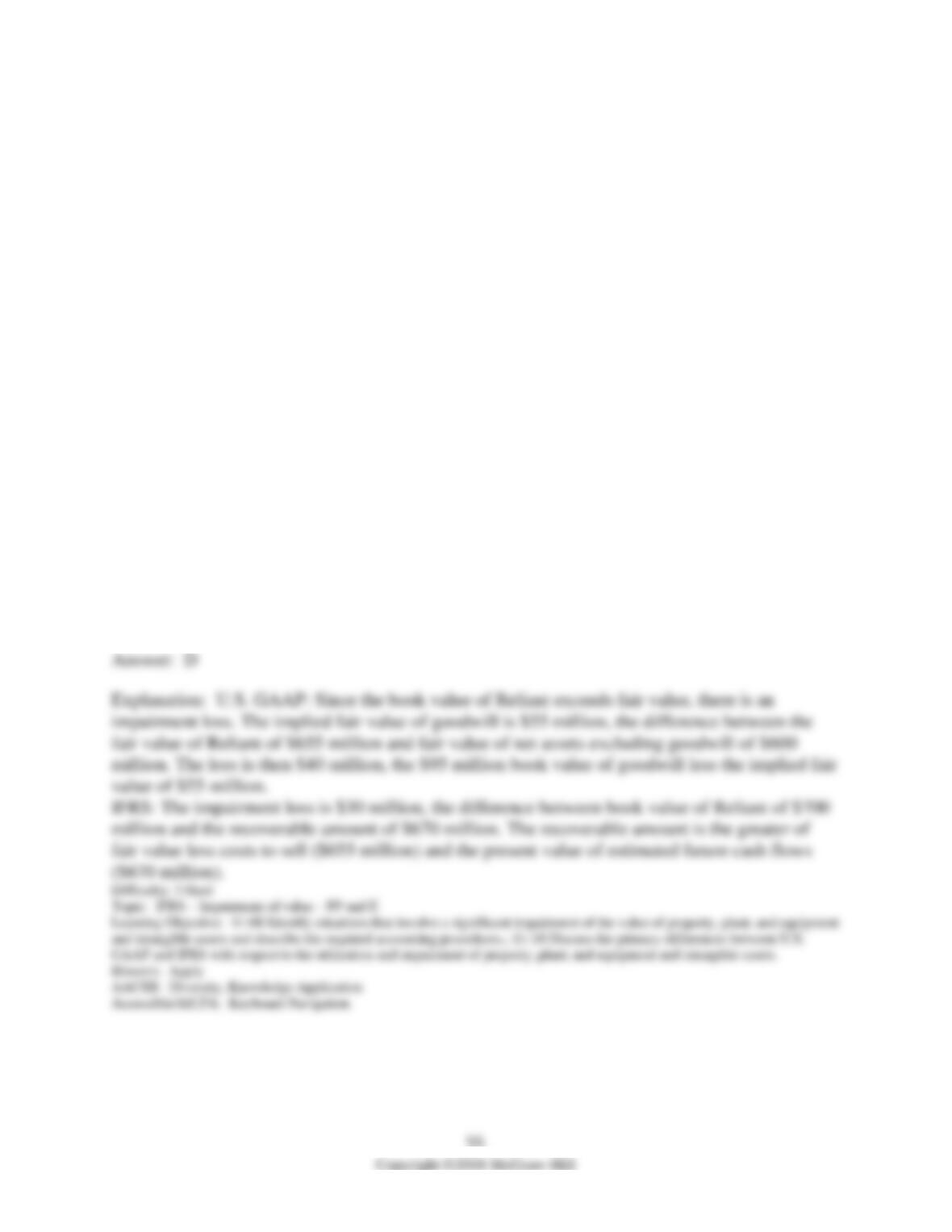
The amount of impairment loss that Rice should recognize according to U.S. GAAP and IFRS,
respectively, is:
U.S.GAAP
IFRS
a.
$
10
million
$
10
million
b.
$
15
million
$
15
million
c.
$
0
$
10
million
d.
There is no impairment under both U.S. GAAP and IFRS.
A) option A
B) option B
C) option C
D) option D
122) Kingston Corporation has $95 million of goodwill on its books from the 2016 acquisition of
Reliant Motors. At the end of its 2018 fiscal year, management has provided the following
information for its required goodwill impairment test ($ in millions):
Fair value of Reliant (approximates fair value less costs to sell)
$
655
Fair value of Reliant’s net assets (excluding goodwill)
600
Book value of Reliant’s net assets (including goodwill)
700
Present value of estimated future cash flows
670
Assuming that Reliant is considered a reporting unit for U.S. GAAP and a cash-generating unit
for IFRS, the amount of goodwill impairment loss that Kingston should recognize according to
U.S. GAAP and IFRS, respectively, is:
U.S.GAAP
IFRS
a.
$
45
million
$
45
million
b.
$
55
million
$
45
million
c.
$
0
$
30
million
d.
$
40
million
$
30
million
A) option A
B) option B
C) option C
D) option D
123) According to International Financial Reporting Standards (IFRS), the revaluation of
equipment when fair value exceeds book value, results in:
A) An increase in net income.
B) A decrease in net income.
C) An increase in other comprehensive income.
D) A decrease in other comprehensive income.
124) According to International Financial Reporting Standards (IFRS), biological assets are
valued at:
A) Cost less accumulated depreciation.
B) Fair value less estimated costs to sell.
C) Cost less accumulated depletion.
D) None of these answer choices are correct.
125) According to International Financial Reporting Standards (IFRS), the impairment loss for
property, plant, and equipment is the difference between book value and:
A) The undiscounted sum of estimated future cash flows.
B) The present value of future cash flows.
C) Fair value less costs to sell.
D) The higher of the present value of estimated future cash flows and the fair value less costs to
sell.
126) According to International Financial Reporting Standards (IFRS), the level of testing for
goodwill impairment is the:
A) Reporting unit.
B) Subsidiary companies.
C) Cash-generating unit.
D) None of these answer choices are correct.
127) The normal treatment of litigation costs to successfully defend an intangible right under
U.S. GAAP and International Financial Reporting Standards (IFRS), respectively, is:
U.S. GAAP
IFRS
a.
Capitalize
Expense
b.
Capitalize
Capitalize
c.
Expense
Capitalize
d.
Expense
Expense
A) option A
B) option B
C) option C
D) option D
128) Canliss Mining uses the retirement method to determine depreciation on its office
equipment. During 2016, its first year of operations, office equipment was purchased at a cost of
$14,000. Useful life of the equipment averages four years and no salvage value is anticipated. In
2018, equipment costing $5,000 was sold for $600 and replaced with new equipment costing
$6,000. Canliss would record 2018 depreciation of:
A) $3,500.
B) $4,400.
C) $5,400.
D) None of these answer choices are correct.
129) Canliss Mining uses the replacement method to determine depreciation on its office
equipment. During 2016, its first year of operations, office equipment was purchased at a cost of
$14,000. Useful life of the equipment averages four years and no salvage value is anticipated. In
2018, equipment costing $5,000 was sold for $600 and replaced with new equipment costing
$6,000. Canliss would record 2018 depreciation of:
A) $3,500.
B) $4,400.
C) $5,400.
D) None of these answer choices are correct.
59
Listed below are five terms followed by a list of phrases that describe or characterize each of the
terms. Match each phrase with the correct term.
A) Aggregates assets that are physically dissimilar when calculating depreciation.
B) Produces a level amount of annual depreciation.
C) Estimates service life in units of output.
D) Does not subtract residual value from cost when calculating depreciation.
E) Occurs with a significant decline in value.
130) Write-down of asset
131) Straight-line method
132) Composite method
133) Double-declining balance
134) Activity-based method