Chapter 11: Federal Government Accounting and Reporting
Multiple Choice
1. In the federal government, which organizations make appropriations and which make
apportionments?
a. The Congress makes appropriations, and department heads apportion the
appropriations to individual agencies or divisions within the department.
b. The Congress makes appropriations, and the Treasury Department
appropriates to individual departments the total amount apportioned by
the Congress.
c. The President makes appropriations, and department heads periodically
apportion parts of the appropriations to agencies in the department.
d. The Congress makes appropriations, and the Office of Management and
Budget periodically apportions parts of the appropriations to departments.
2. What is the federal counterpart of the state and local government “encumbrance”?
a. obligation
b. allotment
c. outlay
d. apportionment
3. What does a credit balance in the account “Allotments – realized resources” show?
a. The agency’s cash balance with the Treasury.
b. The amount available to a department for allotment to an agency
c. The amount of goods or services ordered by an agency but not received.
d. The amount of resources available to an agency for obligation or commitment.
4. What is the name of the entity that recommends accounting standards for the federal
government?
a. the Governmental Accounting Standards Board
b. the Federal Accounting Standards Advisory Board
c. the Financial Accounting Standards Board
d. the American Institute of Certified Public Accountants

5. What is the rule regarding depreciation of federal capital assets classified as general property
plant and equipment (General PP&E)?
a. All General PP&E is capitalized and depreciated.
b. General PP&E is capitalized and depreciated only for federal business-type activities.
c. All General PP&E is expensed at the time of acquisition.
d. Federal agencies have the option of depreciating or not depreciating General PP&E.
6. Which one of the following actions requires both budgetary accounting and proprietary
accounting entries in an agency’s accounts?
a. agency records obligation based on a contract for supplies
b. agency records year-end accrual for funded salaries
c. agency asks Treasury to pay invoice for supplies
d. agency uses supplies previously recorded as supplies inventory
7. When do federal agencies make an entry to record “Fund Balance with the Treasury”?
a. when the Treasury tells the agency the Federal government has sufficient cash to pay bills
b. each time the department of which the agency is a part allots funds to the agency
c. when the Office of Management and Budget apportions funds to the department of which
the agency is a part
d. when the Congress makes and the President approves an appropriation
8. At what point in the budgetary cycle does an agency record a decrease (a debit) to the account
“Allotments – realized resources”?
a. When the Office of Management and Budget makes an apportionment.
b. When the Department makes a quarterly allotment to the agency.
c. When the agency uses commitment accounting and makes a commitment for supplies.
d. When the agency uses supplies from its inventory.
9. When a federal agency receives supplies that have been ordered previously, what kind of entry
(or entries) is (or are) required?
a. both a budgetary and a proprietary entry
b. only a proprietary entry
c. only a budgetary entry
d. neither a budgetary nor a proprietary entry
10. A federal agency that uses commitment accounting makes a commitment for supplies in the

amount of $40,000. When it places the purchase order, however, the cost of the supplies is only
$38,000. How is the $2,000 difference accounted for in the budgetary accounts?
a. No budgetary entry is needed at this point in the budgetary accounting cycle.
b. Commitments is debited for $40,000, Allotments – realized resources is credited for
$2,000, and Undelivered orders – obligations, unpaid is credited for $40,000.
c. Commitments is debited for $38,000 and Undelivered orders – unpaid is credited for
$38,000.
d. Allotments – realized resources is debited for $2,000 and Commitments is credited for
$2,000.
11. A federal agency received allotments of $95,000. It does not use commitment accounting. It
placed three orders totaling $70,000, received all the supplies ordered, and approved invoices
totaling $73,000 for the three orders. It then consumed $55,000 of those supplies. It then placed
another order for $12,000, but the agency has not yet received delivery. How much of the
agency’s allotment is available for additional obligation?
a. $13,000
b. $33,000
c. $10,000
d. $40,000
12. If a federal agency were to take a trial balance of the budgetary accounts at any point in time,
what would the right side of the trial balance show?
a. the cumulative results of the agency’s appropriations
b. the status of the agency’s budgetary resources
c. the agency’s fund balance with Treasury
d. the total amount appropriated to the agency
13. When are expenses and liabilities recognized for the federal social security program?
a. when benefits are paid to the recipients
b. when benefits are earned by the recipients
c. when benefits are due and payable at the end of a reporting period
d. when the social security trust fund receives cash from employees and employers
14. Which of the following statements is false?
a. Depreciation is recorded as an expense in an agency’s proprietary accounts.

b. Vacation leave cannot be accrued at year-end unless the agency has sufficient appropriated
funds to pay for it.
c. The account Undelivered orders – obligations, unpaid remains open at year-end until it is
paid in the following year.
d. If the agency receives an invoice in an amount greater than the amount of the purchase
order and agrees that invoice amount is correct, an adjustment is needed to the account
“Allotments – realized resources.”
15. What basis of accounting is used in the Statement of Net Costs prepared by a federal agency?
a. the budgetary basis
b. the accrual basis
c. the cash basis
d. the modified accrual basis
16. Name the two major categories of funds reported in the U.S. Government consolidated
statement of operations and changes in net position?
a. budgetary funds and proprietary funds
b. General Fund and Trust Funds
c. non-earmarked funds and earmarked funds
d. appropriated funds and non-appropriated funds
17. Which of the following does not account for the differences between budgetary resources used
by a Federal agency and the agency’s net cost of operations?
a. depreciation of equipment acquired in a previous year
b. requisitions for supplies needed but not ordered
c. supplies received during the year but not used
d. accrual of a liability that had not been funded
18. Which of the following is the correct sequence of activities within the federal budgetary
accounting cycle?
a. appropriation, apportionment, allotment, obligation

b. obligation, allotment, apportionment, appropriation
c. allotment, obligation, appropriation, apportionment
d. apportionment, allotment, obligation, appropriation
19. Which of the following actions will reduce the balance in the budgetary account
“Allotments – realized resources”?
a. Administering department makes a quarterly allotment to the agency.
b. Agency, which uses commitment accounting, makes a commitment to acquire materials.
c. Agency sends disbursement schedule to Treasury requesting payment of invoice.
d. Agency makes year-end accrual for unbudgeted, but accrued vacation pay,
Problems
20. (Matching)
Match the entity that takes the action with the nature of the action taken by putting the
number of the action taken (second column) next to the letter for the entity (first
column).
Entity that takes action Nature of action taken
a. Congress 1. Allots
b. Office of Management and Budget 2. Appropriates
c. Treasury 3. Obligates
d. Department 4. Apportions
e. Agency 5. Disburses
21. (True or False)
State whether each of the following are true or false, regarding the recording of
transactions and events in the budgetary and the proprietary accounts. For statements
that are false, state why they are false.
a. Obligations are recorded in budgetary accounts, but not in proprietary accounts.
b. In budgetary accounting, entries are made to record the expending of
appropriations when supplies are consumed.
c. In proprietary accounting, an expense may be charged in the current period even
though the appropriation that funded the expense was charged in a previous
period.
d. For every entry made in the budgetary accounts, a corresponding entry must be
made in the proprietary accounts.
e. One similarity between federal government accounting and state and local
government accounting in governmental-type funds is that placing an order
causes the recording of a budgetary entry, while receipt of the supplies ordered
causes both a budgetary and a financial accounting entry
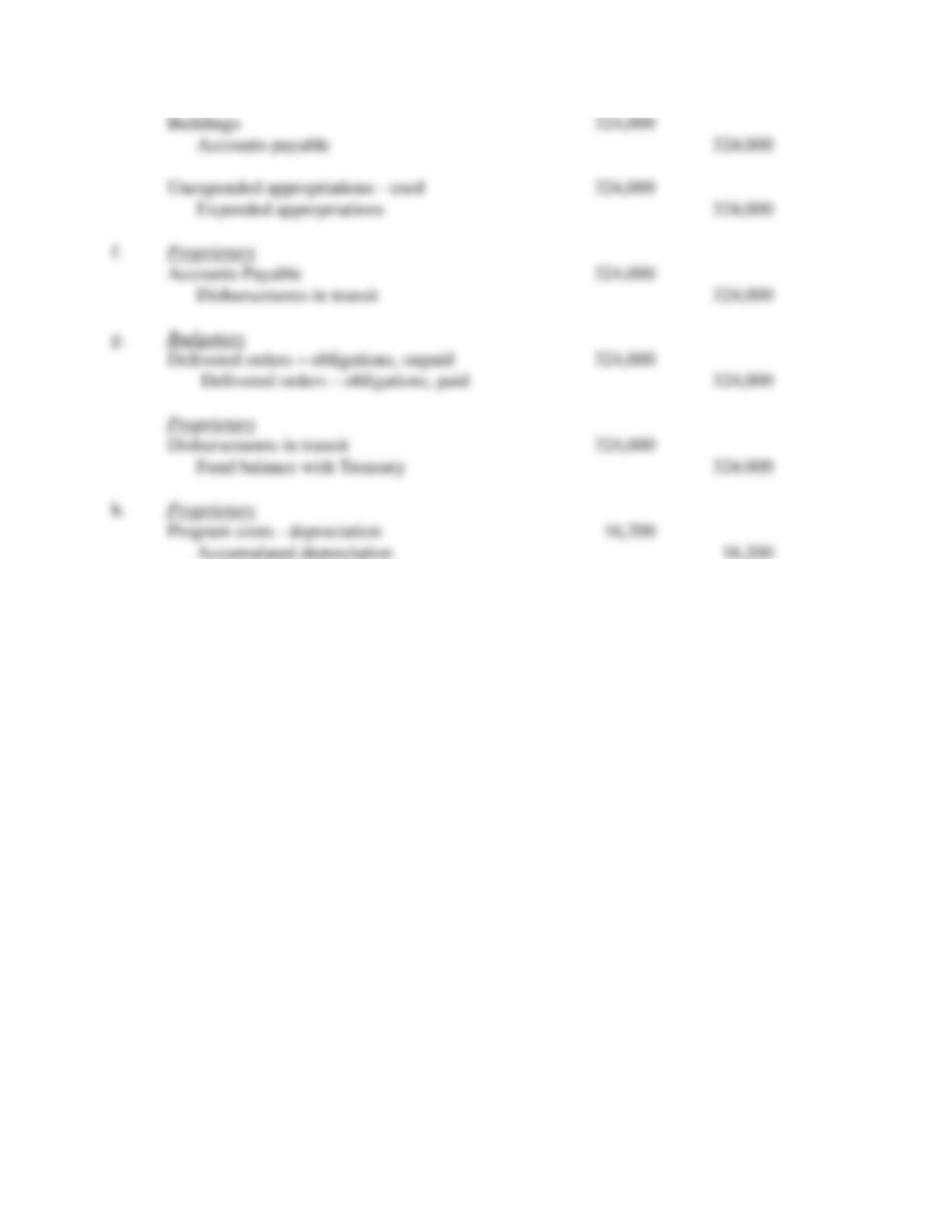
22. (Journal entries – set of transactions regarding contracts)
The Federal Bureau of Building Construction (BBC) receives an annual appropriation to
perform construction activities. BBC does not use commitment accounting; instead, it
obligates funds upon the award of contracts Prepare budgetary and proprietary journal
entries to record the following transactions.
a. BBC received an appropriation of $2,000,000.
b. The Office of Management and Budget apportioned $500,000 of the
appropriation to the Department of Domestic Construction, which oversees the
BBC
c. The Department allotted the entire $500,000 apportionment to the BBC.
d. BBC awarded a building construction contract for $300,000.
e. The contractor completed construction of the building. Because of a change
order, however, the total cost of the work was $324,000. BBC accepted the
work and recorded the asset and the invoice for $324,000.
f. BBC sent a disbursement schedule to the Treasury requesting payment of the
$324,000.
g. Treasury notified BBC that payment was made to the contractor for $324,000.
h. At year-end, BBC recorded six months’ depreciation ($16,200) on the building
23. (Journal entries – set of transactions)
The Federal Bureau of Nutrition Standards (BNS), a unit of the Health Department, is
responsible for establishing standards for the quality and nutritional content of packaged
food products. Prepare budgetary and proprietary entries to record the following
transactions for the month of October, 2013.
a. BNS received an appropriation in the amount of $900,000.
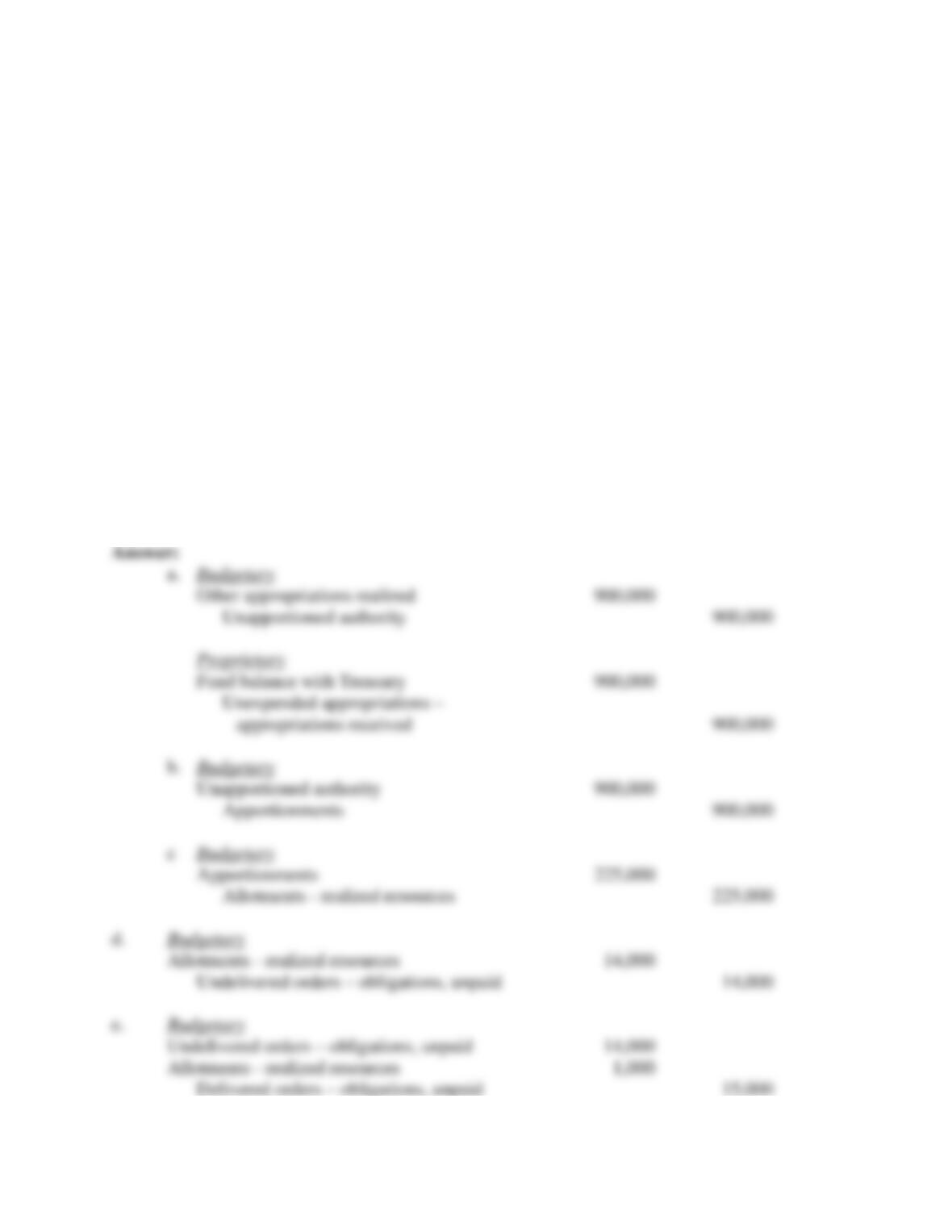
b. The Office of Management and Budget apportioned the entire appropriation.
c. The Health Department made the first quarter’s allotment of $225,000 to BNS.
d. BNS placed a purchase order for $14,000 for testing supplies. (BNS does not
use commitment accounting.)
e. All the supplies arrived in good order. The vendor submitted an invoice for
$15,000 because additional supplies were shipped. (The purchase order
permitted a 10 percent delivery overrun.) The invoice was accepted by BNS,
and the supplies were placed in inventory.
f. BNS sent a disbursement schedule to Treasury, requesting payment of the
$15,000 invoice.
g. Treasury notified BNS that the $15,000 invoice was paid.
h. BNS used $6,000 of the supplies acquired in transaction e. (BNS charges all
expenses to the account “Inspection program costs.”)
i. BNS sent a disbursement schedule to Treasury, requesting salary checks in the
amount of $100,000.
j. Treasury sent salary checks to BNS in the amount of $100,000 for payment to
BNS employees.
k. BNS made adjusting journal entries to accrue salary expenses in the amount of
$8,000, so it could prepare month-end financial statements.