61
Listed below are five terms followed by a list of phrases that describe or characterize five of the
terms. Match each phrase with the correct term.
A) Triggers commencement of depreciation.
B) Cost less accumulated depreciation.
C) Expenditures made to restructure an asset without addition, replacement, or improvement.
D) Only used for tax purposes.
E) Three methods are employed to record these costs.
135) Book value
136) Date placed in service
137) Percentage depletion
138) Rearrangements
139) Improvements
63
Listed below are five terms followed by a list of phrases that describe or characterize each of the
terms. Match each phrase with the correct term.
A) Cost allocation for an intangible asset.
B) Cost allocation for a natural resource.
C) Cost less residual value.
D) Amount of use expected from plant and equipment asset.
E) Treated prospectively like a change in estimate
140) Depletion
141) Change in depreciation method
142) Service life
143) Allocation base
144) Amortization
Listed below are five terms followed by a list of phrases that describe or characterize each of the
terms. Match each phrase with the correct term.
A) Allocation of cost for plant and equipment.
B) Is a change in accounting estimate.
C) Results from subsequent year correction of a material error.
D) Expenditures made to maintain a given level of benefits from an asset.
E) Generate declining amounts of depreciation over time.
145) Depreciation
146) Prior period adjustment
147) Accelerated methods
148) Change in useful life
149) Repairs and maintenance
Listed below are five terms followed by a list of phrases that describe or characterize each of the
terms. Match each phrase with the correct term.
A) Cost allocation for plant and equipment.
B) Results in depreciation declining by the same amount in subsequent years.
C) The reason for not amortizing goodwill.
D) Estimates service life in years.
E) Aggregates assets that are similar.
150) Indefinite life
151) Group method
152) Depreciation
153) Time-based method
154) Sum-of-the-years’-digits method
Listed below are five terms followed by a list of phrases that describe or characterize each of the
terms. Match each phrase with the correct term.
A) Considered if indicated that book value may not be recoverable.
B) Estimate of recoverable cost at end of an asset’s life.
C) Should be capitalized since they provide future benefits.
D) Capitalize unless unsuccessful.
E) Should be expensed unless they are material and provide a future benefit.
155) Rearrangements
156) Additions
157) Impairment
158) Residual value
159) Cost of defending intangible rights
Listed below are 10 terms followed by a list of phrases that describe or characterize the terms.
Match each phrase with the correct term.
A) Cost allocation for an intangible asset.
B) Adding a new major component to existing plant and equipment.
C) Can be expressed in units of time or in units of activity.
D) Cost allocation for natural resources.
E) The amount the company expects to receive for the asset at the end of its life.
F) The replacement of a major component of plant and equipment asset.
G) Allocates an equal amount of depreciable base to each period.
H) Estimates service life in terms of a measure of activity.
I) The difference between cost and residual value.
J) Multiplies book value by twice the straight-line rate.
160) Improvements
161) Service life
162) Amortization
163) Straight-line method
164) Double-declining balance
165) Activity-based method
166) Residual value
167) Depletion
168) Additions
169) Allocation base
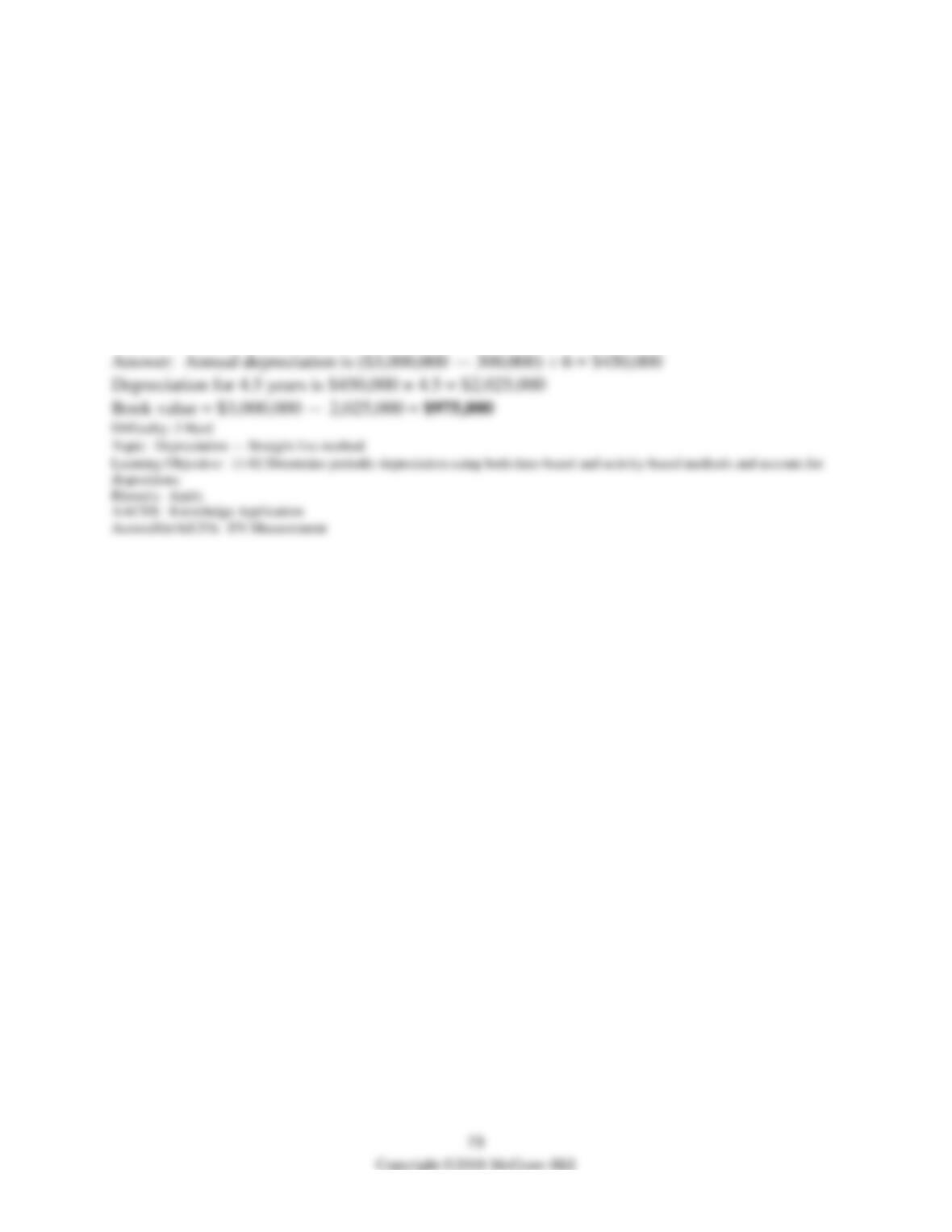
170) Ellen’s Antiques reported the following in its December 31, 2018, balance sheet:
Equipment $4,000,000
Accumulated depreciation–equipment $3,150,000
In a disclosure note, Ellen’s indicates that it uses straight-line depreciation over eight years and
estimates salvage value at 10% of cost.
Required: Compute the average age of Ellen’s equipment at 12/31/2017.
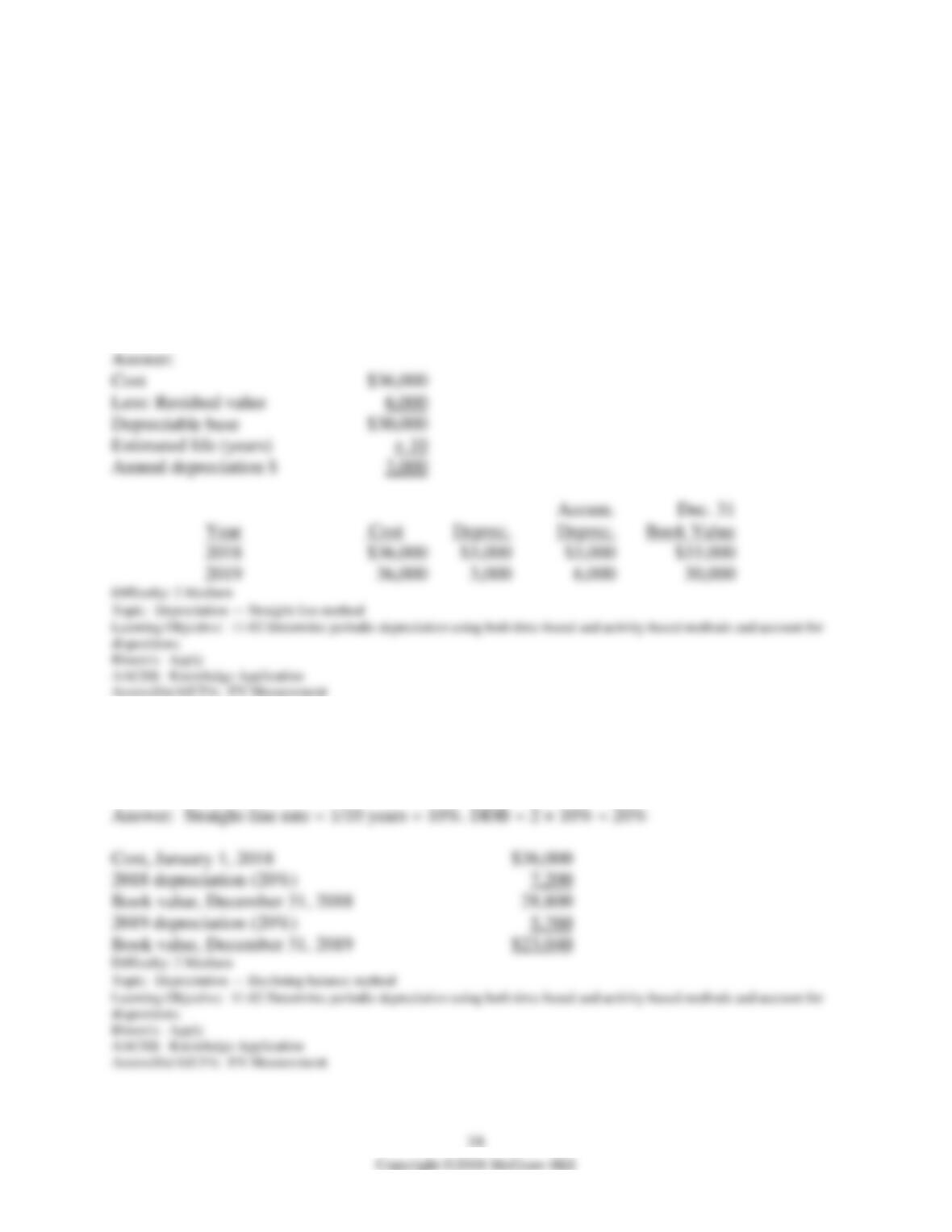
171) Comet Cleaning Co. reported the following on its December 31, 2018, balance sheet:
Equipment (at cost) $3,000,000
In a disclosure note, Comet indicates that it uses straight-line depreciation over six years and
estimates salvage value as 10% of cost. Comet’s equipment averages 4.5 years at December 31,
2018.
Required:
What is the book value of Comet’s equipment at December 31, 2018?
Use the following to answer the question(s) below:
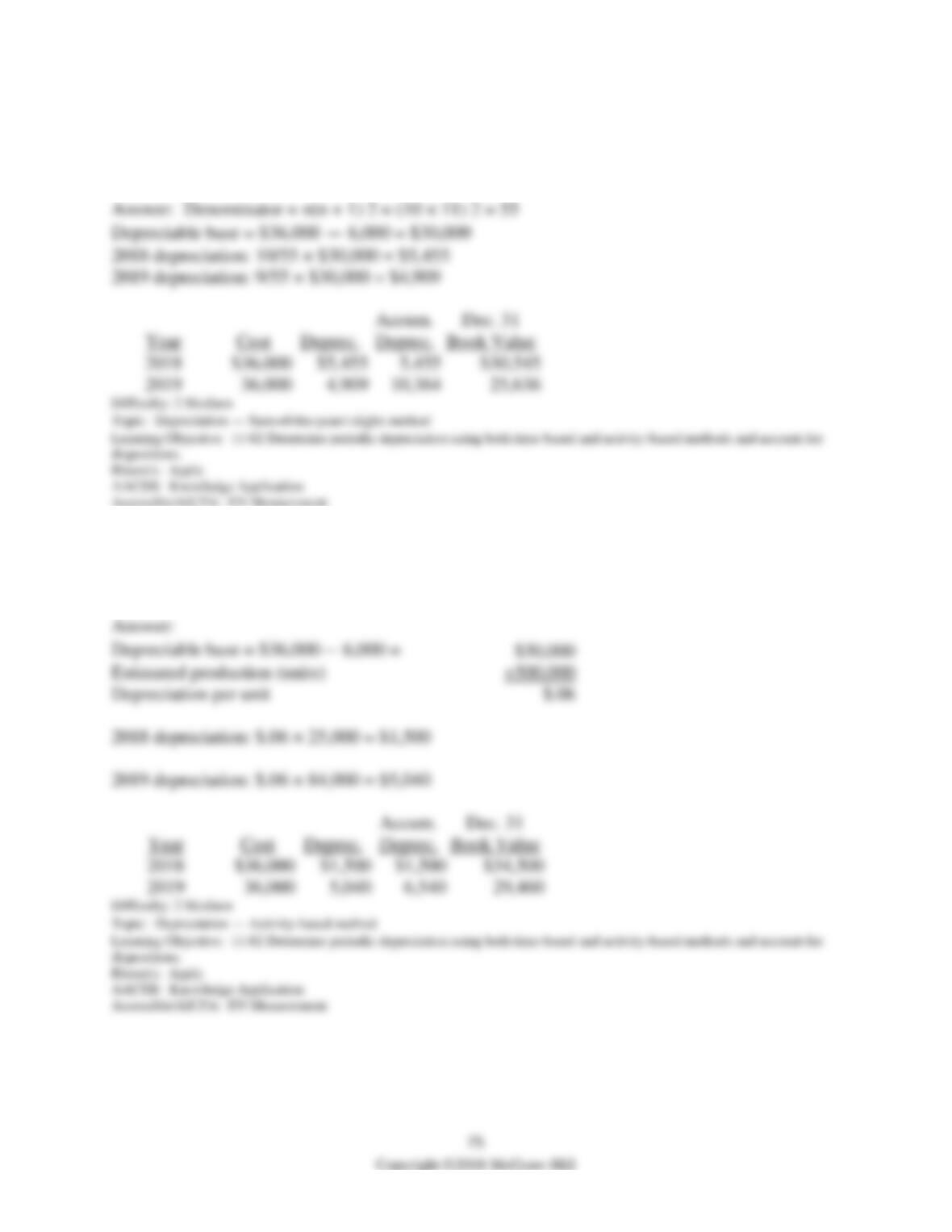
On January 1, 2018, Hobart Mfg. Co. purchased a drill press at a cost of $36,000. The drill press
is expected to last 10 years and has a residual value of $6,000. During its 10-year life, the
equipment is expected to produce 500,000 units of product. In 2018 and 2019, 25,000 and 84,000
units, respectively, were produced.
172) Required:
Compute depreciation for 2018 and 2019 and the book value of the drill press at December 31,
2018 and 2019, assuming the straight-line method is used.
173) Required:
Compute depreciation for 2018 and 2019 and the book value of the drill press at December 31,
2018 and 2019, assuming the double-declining-balance method is used.
174) Required:
Compute depreciation for 2018 and 2019 and the book value of the drill press at December 31,
2018 and 2019, assuming the sum-of-the-years’-digits method is used.
175) Required:
Compute depreciation for 2018 and 2019 and the book value of the drill press at December 31,
2018 and 2019, assuming the units-of-production method is used.
Use the following to answer the question(s) below:
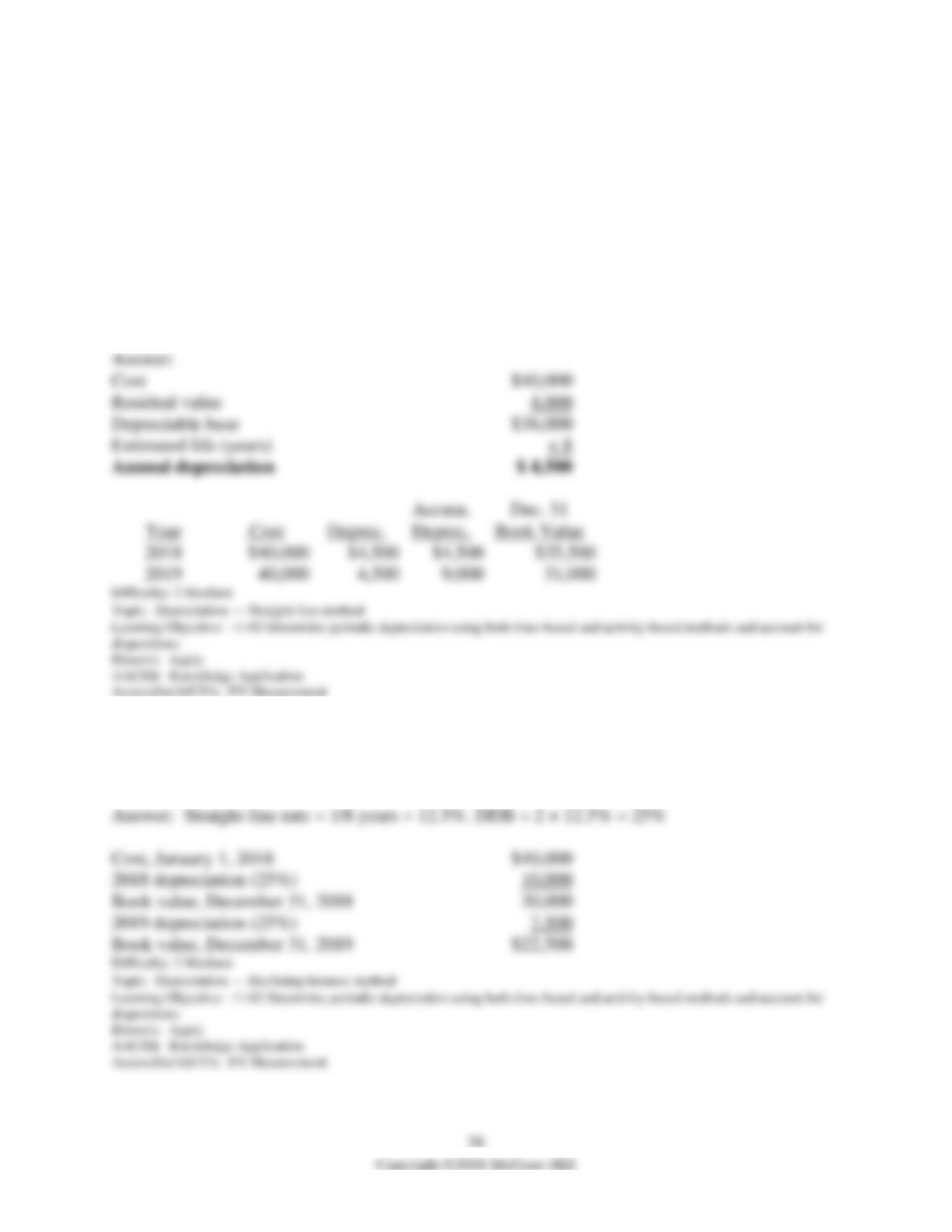
On January 1, 2018, Morrow Inc. purchased a spooler at a cost of $40,000. The equipment is
expected to last eight years and have a residual value of $4,000. During its eight-year life, the
equipment is expected to produce 250,000 units of product. In 2018 and 2019, 42,000 and 76,000
units respectively were produced.
176) Required:
Compute depreciation for 2018 and 2019 and the book value of the spooler at December 31,
2018 and 2019, assuming the straight-line method is used.
177) Required:
Compute depreciation for 2018 and 2019 and the book value of the spooler at December 31,
2018 and 2019, assuming the double-declining-balance method is used.
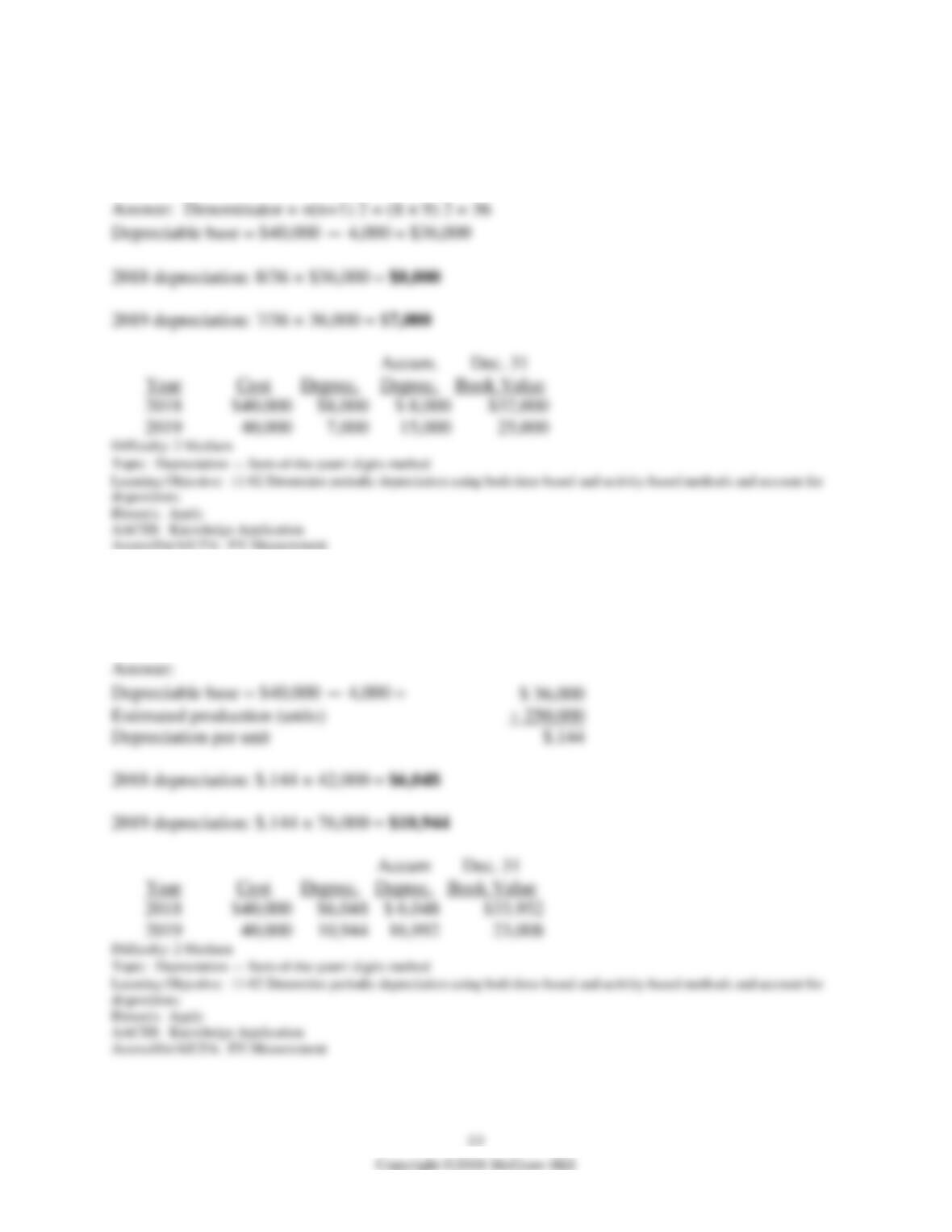
178) Required:
Compute depreciation for 2018 and 2019 and the book value of the spooler at December 31,
2018 and 2019, assuming the sum-of-the-years’-digits method is used.
179) Required:
Compute depreciation for 2018 and 2019 and the book value of the spooler at December 31,
2018 and 2019, assuming the units-of-production is used.
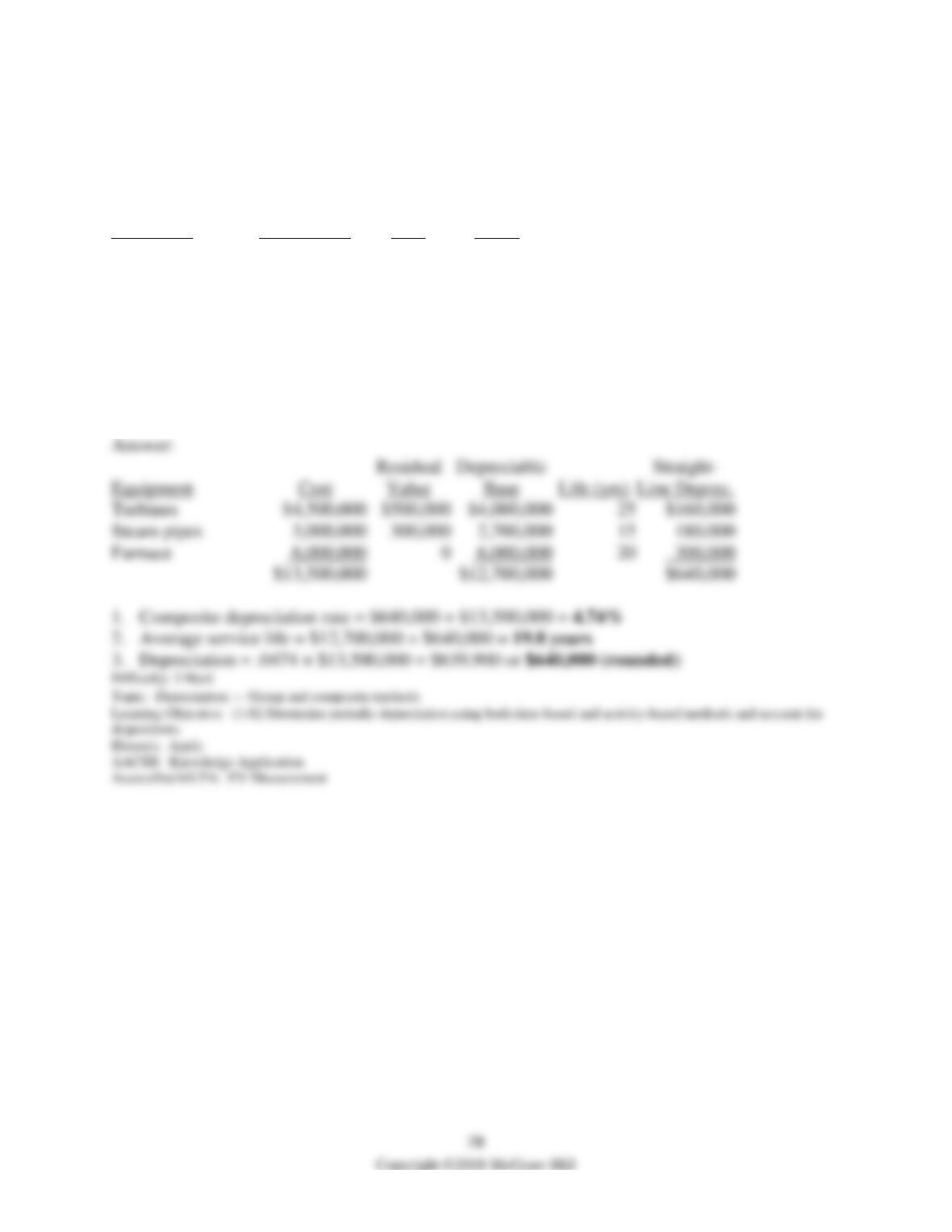
180) Nature Power Company uses the composite method and straight-line depreciation for its
power plant equipment. Its Apple River plant, which began generating electricity January 1,
2018, had the following equipment:
Estimated
Residual
Equipment
Life (Years)
Cost
Value
Turbines
25
$4,500,000
$500,000
Steam pipes
15
3,000,000
300,000
Furnace
20
6,000,000
0
Required:
1. Compute the composite depreciation rate.
2. Compute the average service life.
3. Compute 2018 depreciation.
Residual
Equipment
Value
Turbines
$4,500,000
$500,000
$160,000
Steam pipes
300,000
Furnace
6,000,000
0
300,000
$13,500,000
$640,000
Use the following to answer the question(s) below:
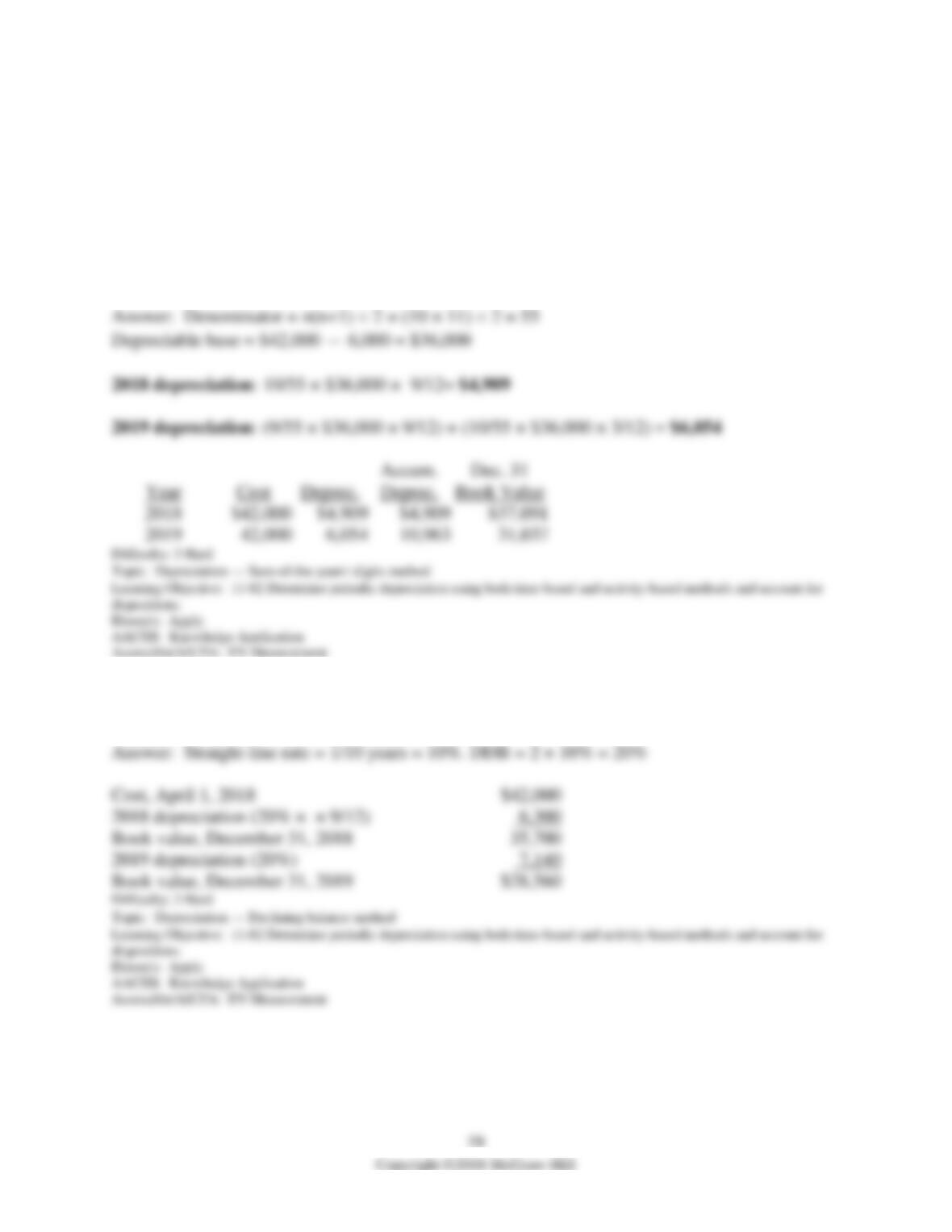
On April 1, 2018, Parks Co. purchased machinery at a cost of $42,000. The machinery is
expected to last 10 years and to have a residual value of $6,000.
181) Required:
Compute depreciation for 2018 and 2019 and the book value of the machinery at December 31,
2018 and 2019, assuming the sum-of-the-years’-digits method is used.
182) Compute depreciation for 2018 and 2019 and the book value of the machinery at December
31, 2018 and 2019, assuming double-declining balance method is used.
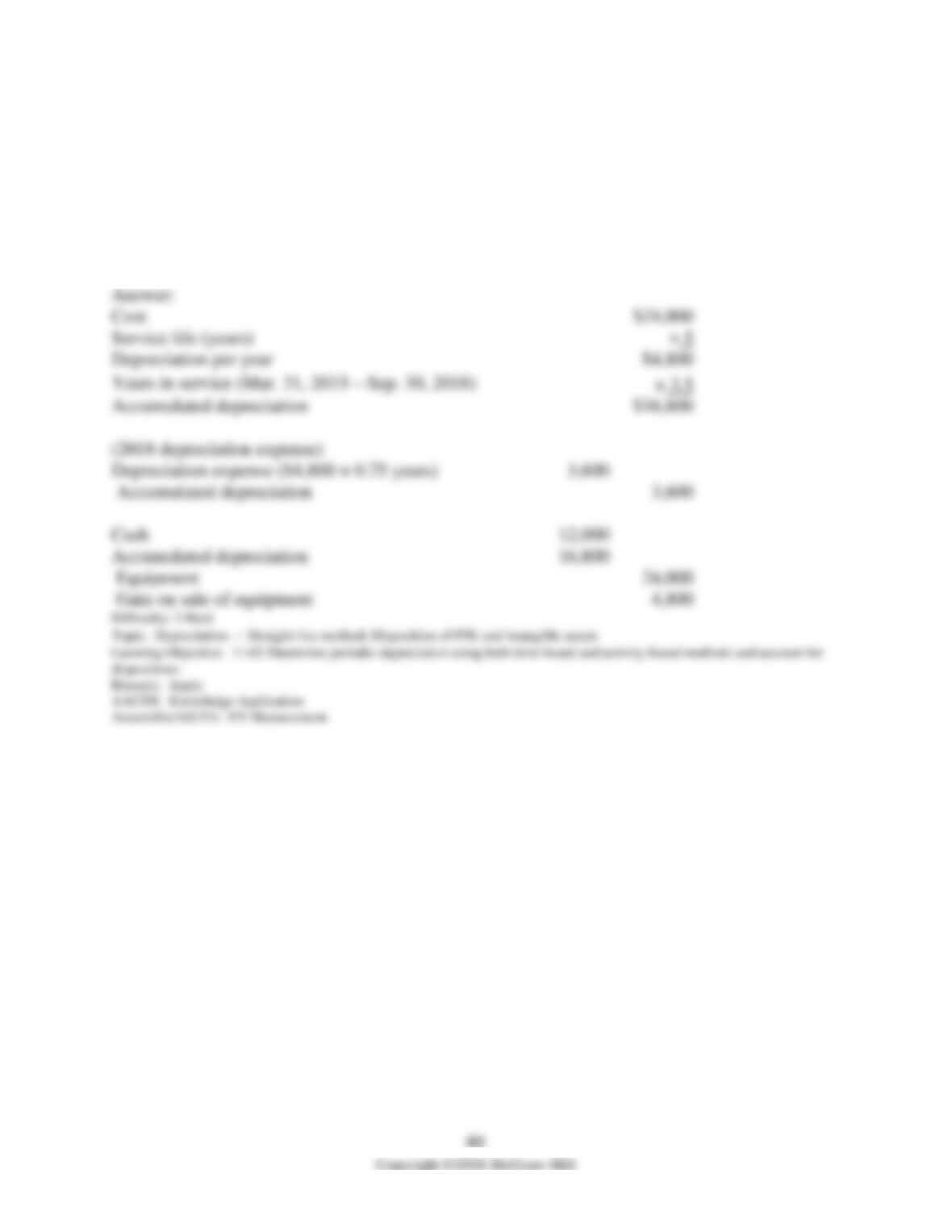
183) On September 30, 2018, Sternberg Company sold office equipment for $12,000. The
equipment was purchased on March 31, 2015, for $24,000. The asset was being depreciated over
a five-year life using the straight-line method, with depreciation based on months in service. No
residual value was anticipated.
Required:
Prepare the journal entries to record 2018 depreciation and the sale of the equipment.