CHAPTER 11: COST BEHAVIOR AND COST-VOLUME-PROFIT ANALYSIS
1. Cost behavior refers to the manner in which a cost changes as a related activity changes.
a. True
b. False
2. Cost behavior refers to the manner in which a cost changes as a related activity changes.
a. True
b. False
3. The variable cost per unit remains constant with changes in the level of activity.
a. True
b. False
4. Monthly rent on a factory building is an example of a fixed cost.
a. True
b. False
5. Direct materials cost is an example of a fixed cost of production.
a. True
b. False
6. The relevant range is useful for analyzing cost behavior for management decision-making
purposes.
a. True
b. False
7. The range of activity over which changes in cost are of interest to management is called the
relevant range.
a. True
b. False
8. Total fixed costs remain constant as the level of activity changes within the relevant range.
a. True
b. False
Chapter 11: Cost Behavior and Cost-Volume-Profit Analysis
9. The graph of the variable costs when plotted against the activity level appears as a line parallel
to horizontal axis.
a. True
b. False
10. Fixed costs are costs that vary in total dollar amount as the level of activity changes.
a. True
b. False
11. A production supervisor’s salary that does not vary with the number of units produced is an
example of a fixed cost.
a. True
b. False
12. Variable costs are costs that vary on a per-unit basis as the level of manufacturing activity
changes.
a. True
b. False
13. Variable costs are costs that vary in total in direct proportion to changes in the activity level.
a. True
b. False
14. Variable costs are costs that remain constant in total with changes in the activity level.
a. True
b. False
15. Direct materials and direct labor costs are examples of variable costs of production.
a. True
b. False
Chapter 11: Cost Behavior and Cost-Volume-Profit Analysis
16. Variable cost per unit remains the same regardless of activity level.
a. True
b. False
17. A mixed cost has characteristics of both a variable cost and a fixed cost.
a. True
b. False
18. Rental charges of $60,000 per year plus $2 for each machine hour over 15,000 hours is an
example of a fixed cost.
a. True
b. False
19. A rental cost of $40,000 plus $0.50 per machine hour of use is an example of a mixed cost.
a. True
b. False
20. The fixed cost per unit varies with changes in the level of activity.
a. True
b. False
21. For purpose of analysis, mixed costs can generally be separated into their variable and fixed
components.
a. True
b. False
22. The contribution margin ratio is the same as the variable cost ratio.
a. True
b. False
23. Variable costs as a percentage of sales is equal to 100% minus the contribution margin ratio.
a. True
b. False
Chapter 11: Cost Behavior and Cost-Volume-Profit Analysis
24. If sales total $2,000,000, fixed costs total $600,000, and variable costs are 60% of the sales,
the contribution margin ratio is 40%.
a. True
b. False
25. If sales total $1,000,000, fixed costs total $200,000, and variable costs are 55% of the sales,
the contribution margin ratio is 55%.
a. True
b. False
26. If sales total $5,000,000, fixed costs total $400,000, and variable costs are 2,750,000, the
contribution margin ratio is 45%.
a. True
b. False
27. The unit contribution margin is the dollars available from each unit of sales to cover fixed cost
and provide income from operations.
a. True
b. False
28. The ratio that indicates the percentage of each sales dollar available to cover the fixed costs
and to provide operating income is termed as contribution margin ratio.
a. True
b. False
29. The break-even point (in units) is calculated by dividing the total estimated fixed costs by the
net sales of a period.
a. True
b. False
30. The point in operations at which revenues and expenses are exactly equal is called the break–
even point.
a. True
b. False
Chapter 11: Cost Behavior and Cost-Volume-Profit Analysis
31. Break-even analysis is a type of cost-volume-profit analysis.
a. True
b. False
32. A change in fixed costs as a result of increase in the property tax rates will increase the break-
even point.
a. True
b. False
33. A change in fixed costs as a result of increase in yearly insurance premium will decrease the
break-even point.
a. True
b. False
34. If employees accept a wage contract that decreases the unit contribution margin, the break-
even point will decrease.
a. True
b. False
35. If direct materials cost per unit increases, the break-even point will increase.
a. True
b. False
36. If direct materials cost per unit decreases, the break-even point will increase.
a. True
b. False
37. If direct materials cost per unit decreases, the amount of sales necessary to earn a desired
amount of profit will decrease.
a. True
b. False
Chapter 11: Cost Behavior and Cost-Volume-Profit Analysis
38. If fixed costs are $300,000 and variable costs are 70% of break-even sales, profit is zero when
sales revenue is $1,000,000.
a. True
b. False
39. If fixed costs are $850,000 and the unit contribution margin is $50, profit is zero when 15,000
units are sold.
a. True
b. False
40. If fixed costs are $220,000 and the unit contribution margin is $25, the sales necessary to earn
an operating income of $30,000 are 10,000 units.
a. True
b. False
41. If fixed costs are $450,000 and the unit contribution margin is $50, the sales necessary to earn
an operating income of $30,000 are 14,000 units.
a. True
b. False
42. Only a single line, which represents the difference between total sales revenues and total costs,
is plotted on the profit-volume chart.
a. True
b. False
43. Only a single line, which represents the difference between total sales revenues and total costs,
is plotted on the cost-volume-profit chart.
a. True
b. False
44. Cost-volume-profit analysis can be presented in both graphically and equation form.
a. True
b. False
Chapter 11: Cost Behavior and Cost-Volume-Profit Analysis
45. If a business sells two products, it is not possible to estimate the break-even point.
a. True
b. False
46. If a business sells four products, it is not possible to estimate the break-even point.
a. True
b. False
47. Even if a business sells six products, it is possible to estimate the break-even point.
a. True
b. False
48. A low operating leverage is normal for highly automated industries.
a. True
b. False
49. DeGiaimo Co. has an operating leverage of 5. If next year’s sales are expected to increase by
10%, then the company’s operating income will increase by 50%.
a. True
b. False
50. If the unit selling price is $40, the volume of sales is $3,000,000, sales at the break-even point
amount to $2,500,000, and the maximum possible sales are $3,300,000, the margin of safety
will be 12,500 units.
a. True
b. False
51. If the unit selling price is $50, the volume of sales is $450,000, sales at the break-even point
amount to $375,000, and the maximum possible sales are $550,000, the margin of safety will
be 2,000 units.
a. True
b. False
Chapter 11: Cost Behavior and Cost-Volume-Profit Analysis
52. If the volume of sales is $4,000,000 and sales at the break-even point amount to $3,200,000,
the margin of safety will be 20%.
a. True
b. False
53. If the volume of sales is $6,000,000 and sales at the break-even point amount to $4,800,000,
the margin of safety will be 25%.
a. True
b. False
54. If the volume of sales is $6,000,000 and sales at the break-even point amount to $5,000,000,
the margin of safety will be 20%.
a. True
b. False
55. Cost behavior refers to the manner in which:
a. a cost changes as the related activity changes.
b. a cost is allocated to products.
c. a cost is used in setting selling prices.
d. a cost is estimated.
56. Costs that remain constant on a per-unit level as the level of activity changes are called:
a. fixed costs.
b. mixed costs.
c. opportunity costs.
d. variable costs.
Chapter 11: Cost Behavior and Cost-Volume-Profit Analysis
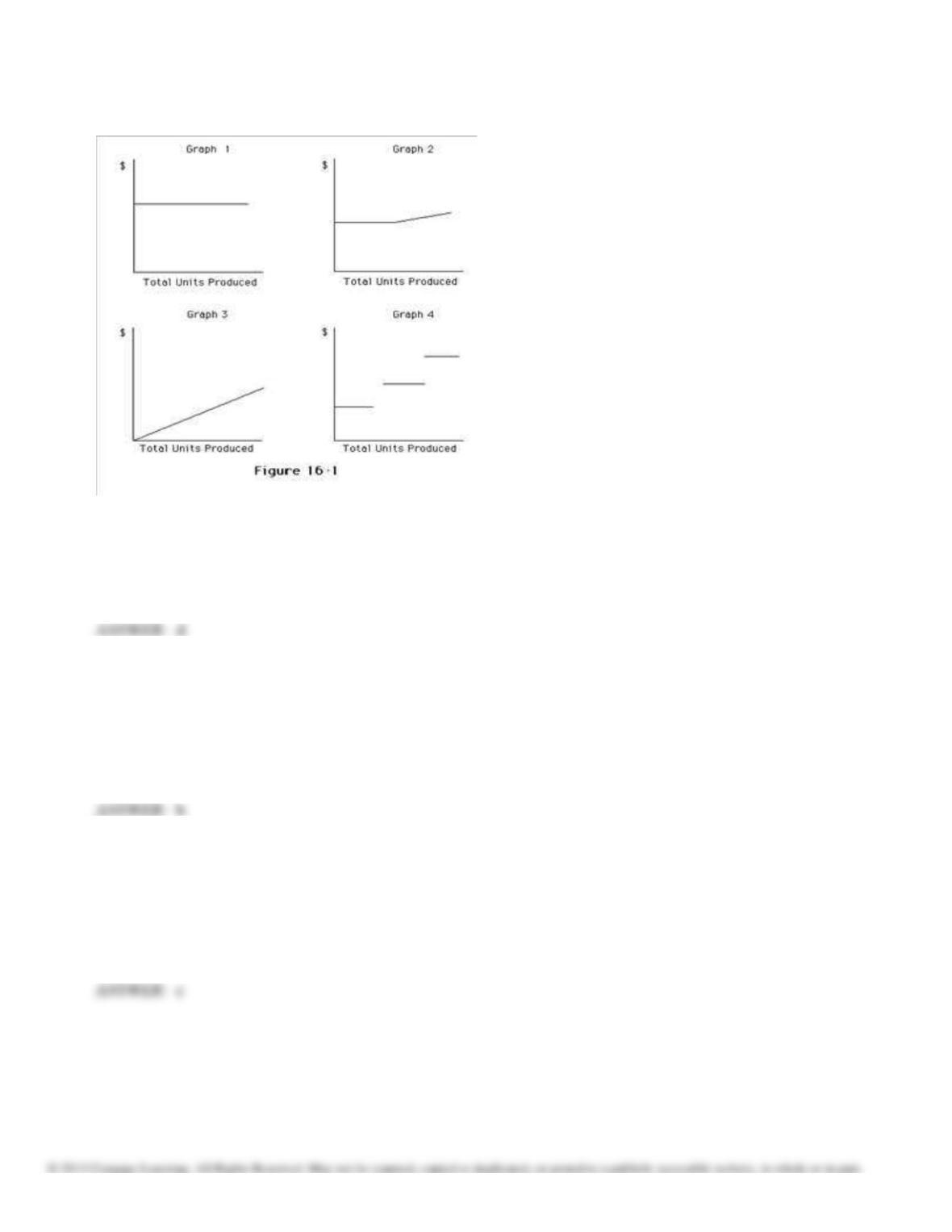
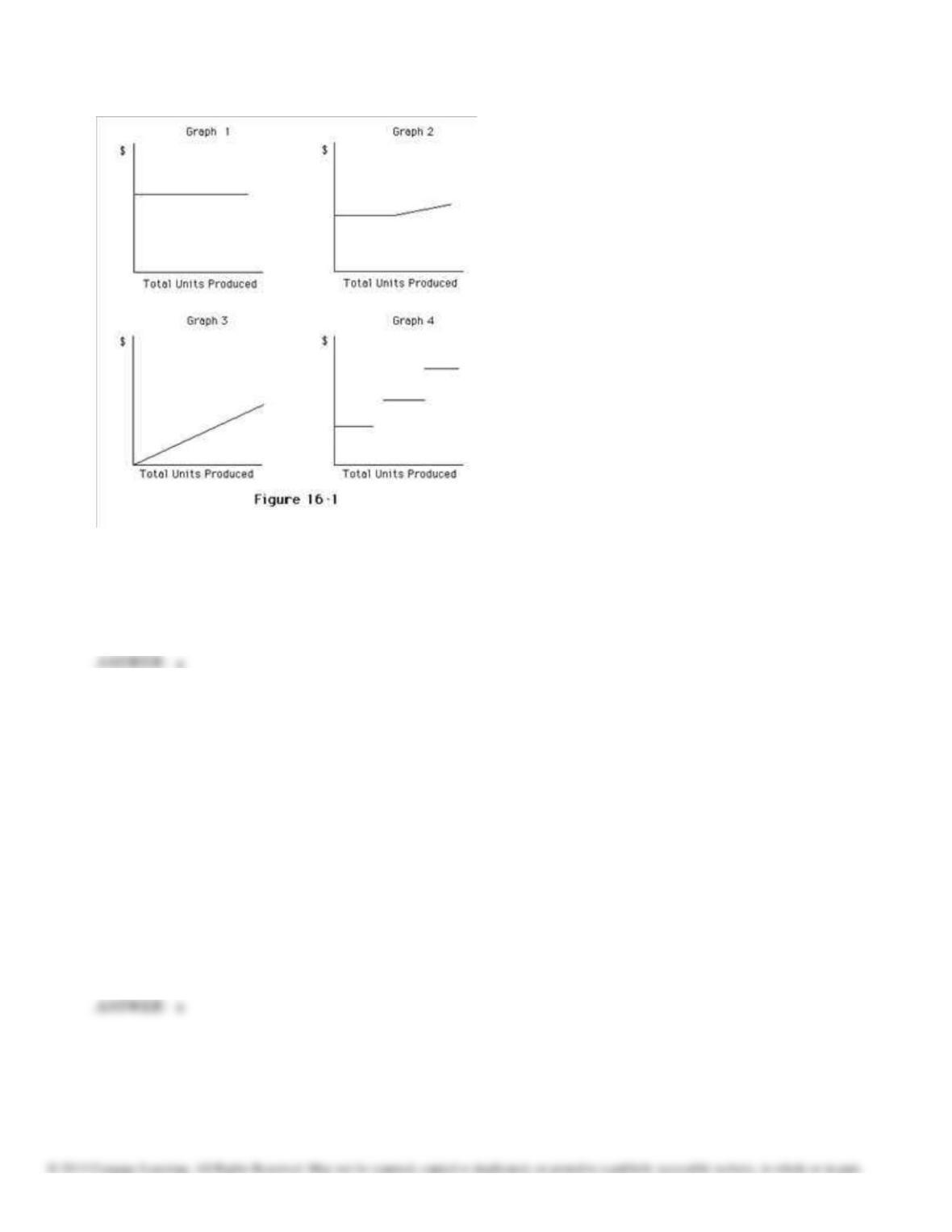
57. Which of the following graphs illustrates the behavior of a total fixed cost within the specified
relevant range?
a. Graph 2
b. Graph 3
c. Graph 4
d. Graph 1
58. Which of the following costs is an example of fixed cost?
a. Hourly wages of machine operators
b. Plant manager salary
c. Direct materials
d. Direct labor
59. Which of the following best describes the behavior of the variable cost per unit?
a. Decreases with increase in production
b. Decreases with decrease in production
c. Remains constant with change in production
d. Increases with increase in production
Chapter 11: Cost Behavior and Cost-Volume-Profit Analysis
60. Which of the following activity bases would be the most appropriate for food costs of a
hospital?
a. Number of cooks scheduled to work
b. Number of x-rays taken
c. Number of patients who are admitted in the hospital
d. Number of scheduled surgeries
61. Which of the following activity bases would be the most appropriate for gasoline costs of a
delivery service such as UPS?
a. Number of trucks employed
b. Number of miles driven
c. Number of trucks in service
d. Number of packages delivered
62. Costs that vary in total in direct proportion to changes in an activity level are called:
a. fixed costs.
b. sunk costs.
c. variable costs.
d. differential costs.
63. Which of the following is an example of a cost that varies in total as the number of units
produced changes?
a. Salary of a production supervisor
b. Direct materials cost
c. Property taxes on factory buildings
d. Straight-line depreciation on factory equipment
64. Which of the following is an example of a cost that varies in total as the number of units
produced changes?
a. Electricity cost per KWH to operate factory equipment
b. Monthly rent on a factory building
c. Straight-line depreciation on factory equipment
d. Salary of a production supervisor
Chapter 11: Cost Behavior and Cost-Volume-Profit Analysis
65. Which of the following is true about the changes in fixed cost?
a. An increase in production will result in an increase in per unit fixed cost.
b. A decrease in fixed cost will result in an increase in variable cost.
c. An increase in production will result in a decrease in per unit fixed cost.
d. A decrease in production will result in an increase in total fixed cost.
66. Which of the following statements is true regarding fixed and variable costs?
a. Both costs are constant when considered on a per-unit basis.
b. Both costs are constant when considered on a total basis.
c. Fixed costs are fixed in total, and variable costs are fixed per unit.
d. Variable costs are fixed in total, and fixed costs vary in total.
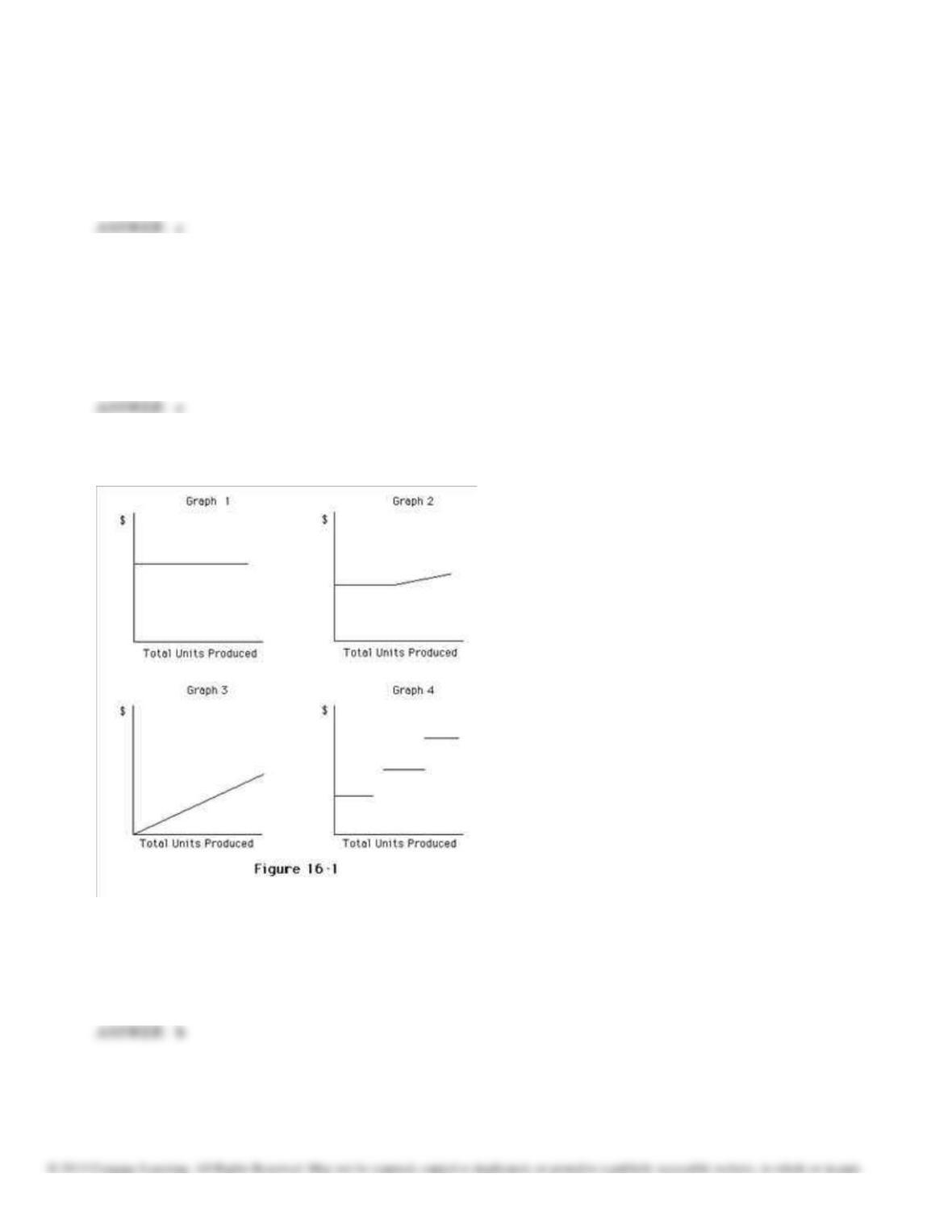
67. Which of the following graphs illustrates the behavior of a total variable cost?
a. Graph 2
b. Graph 3
c. Graph 4
d. Graph 1
Chapter 11: Cost Behavior and Cost-Volume-Profit Analysis
68. The graph of a variable cost per unit when plotted against its related activity base appears as a:
a. circle.
b. rectangle.
c. straight line.
d. curved line.
69. Which of the following describes the behavior of the fixed cost per unit?
a. Decreases with increase in production
b. Decreases with decrease in production
c. Remains constant with changes in production
d. Increases with increase in production
70. Knowing how costs behave to change in the level of activity is useful to management for all
the following reasons except for:
a. predicting customer demand.
b. predicting profits as sales and production volumes change.
c. estimating costs.
d. changing an existing product production.
Chapter 11: Cost Behavior and Cost-Volume-Profit Analysis
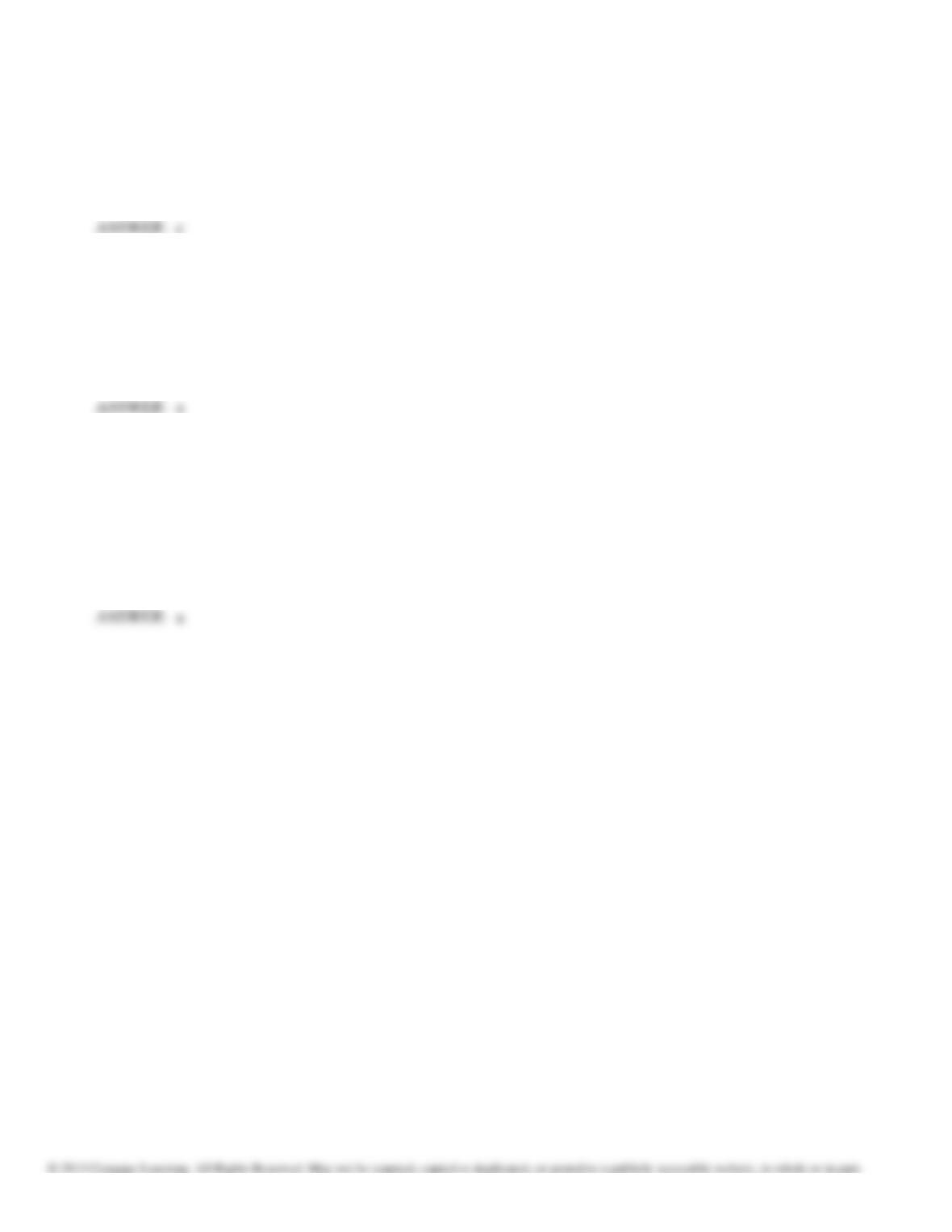
71. Which of the following graphs illustrates the nature of a mixed cost?
a. Graph 2
b. Graph 3
c. Graph 4
d. Graph 1
72. Given the following cost and activity observations for Alifix Company’s utilities, use the
highlow method to calculate Alifix’s fixed costs per month.
Cost
Machine Hours
January
$55,800
24,000
February
76,100
33,500
March
59,800
25,600
April
68,000
26,500
a. $4,516
b. $9,100
c. $5,750
d. $2,400
Chapter 11: Cost Behavior and Cost-Volume-Profit Analysis
73. Which of the following costs is a mixed cost?
a. Salary of a factory supervisor
b. Electricity costs of $2 per kilowatt-hour
c. Rental costs of $5,000 per month plus $0.30 per machine hour of use
d. Straight-line depreciation on factory equipment
74. Given the following costs and activity observations for Pike Company’s utilities, use the
high-low method to calculate Pike’s variable utilities costs per machine hour.
Cost Machine Hours
May $ 8,300 15,000
June 10,400 20,000
July 7,200 12,000
August 9,500 18,000
a. $0.55
b. $0.60
c. $0.52
d. $0.40
75. As production increases, what should happen to the variable costs per unit?
a. Remain constant
b. Increase
c. Decrease
d. Either increase or decrease, depending on the fixed costs
76. Winston Co. manufactures office furniture. During the most productive month of the year,
3,500 desks were manufactured at a total cost of $84,400. In its slowest month, the company
made 1,100 desks at a cost of $46,000. Using the high-low method of cost estimation, total
fixed costs are:
a. $56,000.
b. $28,400.
c. $17,600.
d. $29,900.
77. For the purpose of analysis, mixed costs are generally:
a. classified as fixed costs.
b. classified as variable costs.
c. classified as period costs.
d. separated into their variable and fixed cost components.
78. Given the following costs and activity observations for Pike Company’s utilities, use the
highlow method to calculate Pike Company’s variable utilities costs per machine hour.
Cost Machine Hours
March $3,100 15,000
April 2,700 10,000
May 2,900 12,000
June 3,500 18,000
a. $0.10
b. $0.19
c. $0.21
d. $0.27
79. Tucker Co. manufactures office furniture. During the most productive month of the year, 3,600
desks were manufactured at a total cost of $192,000. In its slowest month, the company made
1,200 desks at a cost of $72,000. Using the high-low method of cost estimation, total fixed
costs per month are:
a. $120,000.
b. $12,000.
c. $72,000.
d. $11,600.
80. The systematic examination of the relationships among selling prices, volume of sales and
production, costs, expenses, and profits is termed as:
a. contribution margin analysis.
b. cost-volume-profit analysis.
c. budgetary analysis.
d. gross profit analysis.
81. In cost-volume-profit analysis, all costs are classified into the following two categories:
a. mixed costs and variable costs.
b. sunk costs and fixed costs.
c. discretionary costs and sunk costs.
d. variable costs and fixed costs.
82. The contribution margin ratio is:
a. the same as the variable cost ratio.
b. the same as profit.
c. the portion of equity contributed by the stockholders.
d. the same as the profit-volume ratio.