2. Use the following information to obtain the ratios requested below. Where necessary, carry answers to
one decimal place.
Dividends per share: $.76
Market price per share: $40
Net income: $64,000
Stockholders’ equity, beginning of year: $500,000
Stockholders’ equity, end of year: $530,000
Earnings per share: $1.75
a. Dividends yield = _____________%
b. Return on equity = _____________%
c. Price/earnings (P/E) ratio = __________ times
3. Mercer Corporation has 200,000 shares of $10 stated value no-par common stock authorized, and
160,000 shares were outstanding during 2012. The following transactions relate to cash dividends of
Mercer Corporation for the year ended December 31, 2012. Prepare entries in journal form without
explanations to record the following transactions:
June
1
Declared a semiannual cash dividend of $0.50 per common share.
15
Compiled the list of individual shareholders eligible for the dividend declared
on June 1.
July
5
Paid the dividend declared on June 1.
Dec.
1
Declared a semiannual cash dividend of $0.50 per common share to be paid on
January 5, 2010.
15
Compiled the list of individual shareholders eligible for the dividend declared
on December 1.
31
Closed the Dividends account at year end.
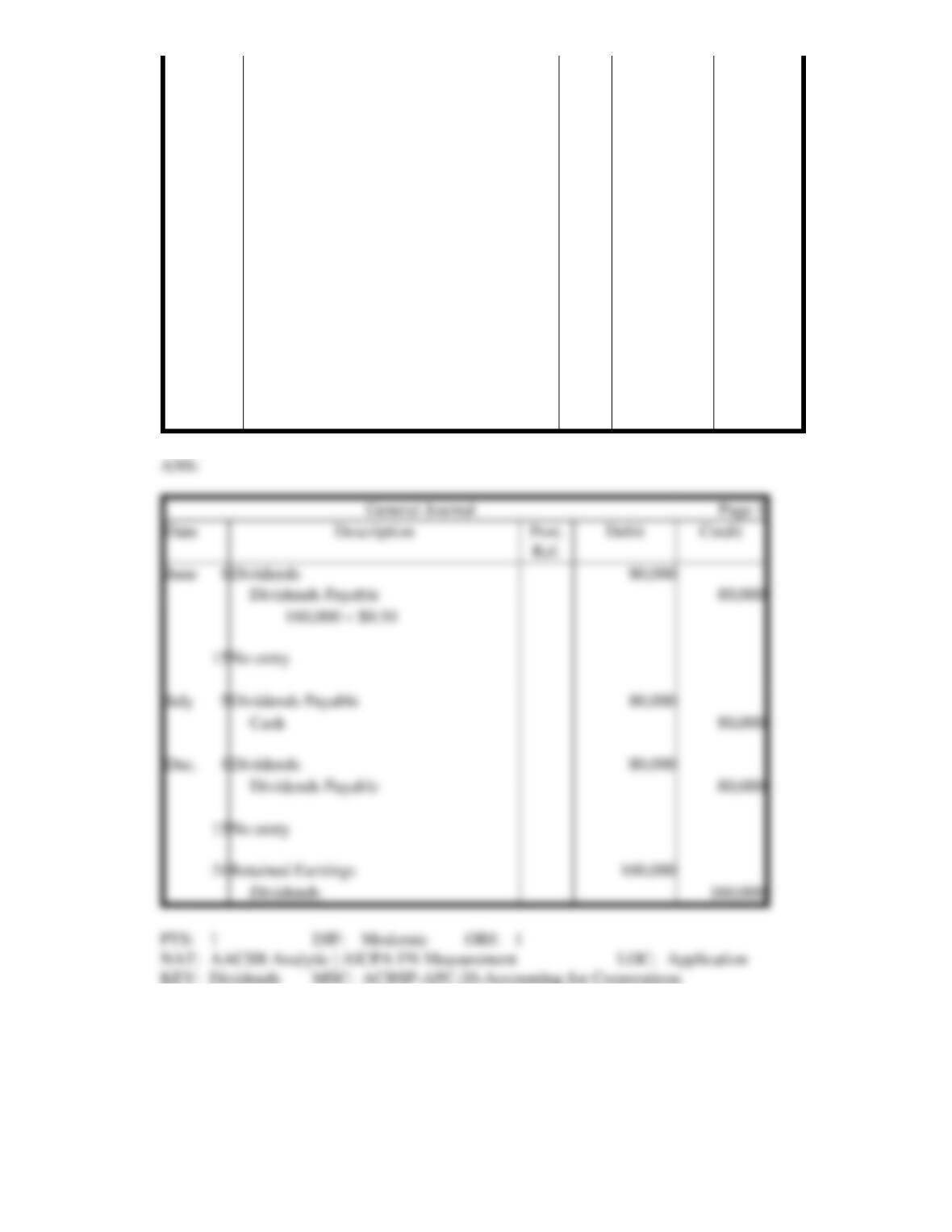
General Journal
Page 1
Date
Description
Post.
Ref.
Debit
Credit
4. Duncan Corporation has 2,000 shares of $100 par value, 6 percent cumulative preferred stock and
20,000 shares of $10 par value common stock outstanding. In its first four years of operation, Duncan
Corporation paid cash dividends as follows: 2010, $15,000; 2011, $0; 2012, $20,000; 2013, $25,000.
Calculate the total cash dividends received by owners of preferred and common stock in each year.
5. Bibb Corporation had the following stock outstanding for years 2010 through 2013:
Preferred Stock—$100 par value, 8 percent cumulative, 10,000 shares authorized, 4,000 shares issued
and outstanding
Common Stock—$20 par value, 10,000 shares authorized, 6,000 shares issued and outstanding
Bibb paid $15,000, $30,000, $100,000, and $130,000 in cash dividends during 2010, 2011, 2012, and
2013, respectively.
a. Calculate the total cash dividends received by owners of preferred and common stock and the
dividends in arrears in each year.
b. Now assume that the preferred stock is noncumulative rather than cumulative. Calculate the total
cash dividends received by owners of preferred and common stock in each year.
6. Paloma Corporation had 5,000 shares of $100 par value, 9 percent cumulative preferred stock and
30,000 shares of $10 par value common stock outstanding during each of its first four years of
operation. The following amounts of cash dividends were paid during the years indicated: 2010, $0;
2011, $80,000; 2012, $220,000; 2013, $270,000. Determine the cash dividends per share paid to the
preferred and common stockholders during each of the four years.
7. People’s Electric Company omitted all its preferred stock dividends indefinitely in an effort to improve
liquidity. All of the company’s cumulative preferred stock was affected. According to the Wall Street
Journal, “Some interpreted the drastic action as a requisite for the cash-strapped utility to secure a new
credit agreement. . . . If the credit agreement falls through, the omission of preferred-stock dividends
would suggest People’s Electric is perilously close to filing for bankruptcy.” What is cumulative
preferred stock? Why is the omission of dividends on those shares a drastic action? If new bank
financing is not obtained, why would the company have to consider declaring bankruptcy?
8. The information that follows pertains to stockholders’ equity data of Winston Corporation on
December 31, 2013. Compute the amount of each item indicated by a letter in the listing below.
Par value per common share
$ 20
Balance of Common Stock account
$300,000
No. of shares authorized
40,000
No. of shares issued and outstanding
a
Balance of Additional Paid-in Capital account
$ b
Balance of Retained Earnings account
$160,000
2010: Preferred
(none declared)
2010: Common
(none declared)
2011: Common
($80,000 – $80,000)
2012: Preferred
$11.00
[$45,000 + ($90,000 – $80,000) = $55,000 ÷ 5,000]
2012: Common
$5.50
($220,000 – $55,000 = $165,000 ÷ 30,000)
2013: Preferred
$9.00
$9.00 ($45,000 ÷ 5,000)
2013: Common
$7.50
$7.50 ($270,000 – $45,000 = $225,000 ÷ 30,000)
Total contributed capital
$ c
Total stockholders’ equity
$600,000
9. The information that follows pertains to stockholders’ equity data of the Keswick Corporation on
December 31, 2013. Compute the amount of each item indicated by a letter in the listing below. Round
answers to two decimal places.
Par value per common share
$ 20
Balance of Common Stock account
$ a
No. of shares authorized
20,000
No. of shares issued and outstanding
15,000
Balance of Additional Paid-in Capital account
$ b
Balance of Retained Earnings account
$ 50,000
Average issuance price per share of common stock
$ c
Total stockholders’ equity
$510,000
10. Stonehurst Corporation is authorized to issue 100,000 shares of $5 stated value common stock and
2,000 shares of $100 par value, 6 percent preferred stock. Prepare entries in journal form without
explanations to record the following transactions:
July
15
Issued 1,000 shares of common stock to an attorney for a bill of $7,000 in
connection with the organization of the corporation.
25
Issued 2,000 shares of preferred stock for cash of $120 per share.
27
Issued 10,000 shares of common stock in exchange for land for a plant site
valued at $75,000.
Aug.
1
Issued 5,000 shares of common stock for $35,000 in cash.
General Journal
Page 1
Date
Description
Post.
Ref.
Debit
Credit
July
Start-up and Organization Costs
Additional Paid-in Capital, Common
($7,000 – $5,000)
Additional Paid-in Capital, Preferred
($240,000 – $200,000)
Land (or Plant Site)
Additional Paid-in Capital, Common
($75,000 – $50,000)
11. On its December 31, 2012, balance sheet, Montrose Corporation reported its stockholders’ equity as
follows:
Common stock—$5 par value, 100,000 shares authorized,
50,000 shares issued and outstanding
$250,000
Additional paid-in capital
125,000
Retained earnings
400,000
Total stockholders’ equity
$775,000
During 2013, the following transactions occurred:
Reacquired 2,500 shares at $7 per share.
Sold 1,200 shares of treasury stock at $8 per share.
Sold 500 shares of treasury stock at $6 per share.
Net income for 2010 amounted to $80,000.
a. Prepare the entries in journal form for the three transactions involving treasury stock. (Omit
explanations.)
b. Compute the amount of total contributed capital to be reported on the December 31, 2013, balance
sheet.
General Journal
Page 1
Date
Description
Post.
Ref.
Debit
Credit
Common Stock (5,000 $5)
12. Kagel Corporation had 30,000 shares of $5 par value common stock issued and outstanding on
December 31, 2012. Each share was issued during 2010 at $14 per share. Prepare the entries in journal
form without explanations for the following transactions occurring in 2013:
Jan.
4
Purchased 5,000 shares of treasury stock for $16 per share. This is the first
transaction involving its own stock ever engaged in by the company.
31
Sold 1,000 shares of treasury stock for $15 per share.
Feb.
20
Sold 1,000 shares of treasury stock for $18 per share.
Mar.
16
Sold 1,000 shares of treasury stock for $11 per share.
Apr.
5
Retired 2,000 shares of treasury stock.
May
8
Purchased 500 shares of treasury stock for $12 per share.
31
Retired the 500 shares of treasury stock purchased on May 8.
General Journal
Page 1
Date
Description
Post.
Ref.
Debit
Credit
Treasury Stock, Common (1,200 $7)
Paid-in Capital, Treasury Stock
($9,600 – $8,400 = $1,200)
($3,500 – $3,000 = $500)
Treasury Stock, Common (5,000 $16)
Cash (1,000 $15)
Feb.
Treasury Stock, Common (1,000 $16)
Mar.
Apr.
Additional Paid-in Capital [2,000 ($14 – $5)]
13. In its 2013 annual report, Etowah Company indicated that the number of common shares held in the
treasury decreased from 45,546,171 in 2012 to 3,397,381 in 2013. The following also was reported:
By Board authorization, effective December 31, 2013 the Company canceled 50 million shares of
common stock held in treasury. As a result of the cancellation, common stock decreased by $62.5
million, capital in excess of par value of stock decreased by $114 million, and retained earnings
decreased by $1,559.5 million.
The shares canceled or retired represent almost 25 percent of the shares of common stock issued by
Etowah. Using the information above, answer the following questions about Etowah Company in order
to explain the accounting for the treasury shares by Etowah.
a. Did the company buy any treasury shares during the year?
b. Prepare the entry in journal form that was made to record the cancellation or retirement of the
treasury shares. (Omit explanations.)
c. At what average price were the treasury shares purchased, and at what average price were they
originally issued?
d. What do you think was management’s reason for purchasing the treasury shares?
General Journal
Page 1
Date
Description
Post.
Ref.
Debit
Credit
Additional Paid-in Capital [500 ($14 – $5)]
14. Issuing common and preferred stock generally has been popular among corporations. However, some
companies have bought back their common stock. For what reasons would a company buy back its
own shares?
15. In the appropriate column below, indicate the effect (I = increase, D = decrease, NE = no effect) of the
entry to record the declaration of a common stock dividend and the effect (I = increase, D = decrease,
NE = no effect) of the entry to record the distribution of a (previously declared and recorded) common
stock dividend on each of the items listed.
Declaration
Distribution
a. Assets
b. Balance of Common Stock account
c. Total contributed capital
d. Total retained earnings
e. Total stockholders’ equity
f. Par value per share
g. Total number of shares outstanding
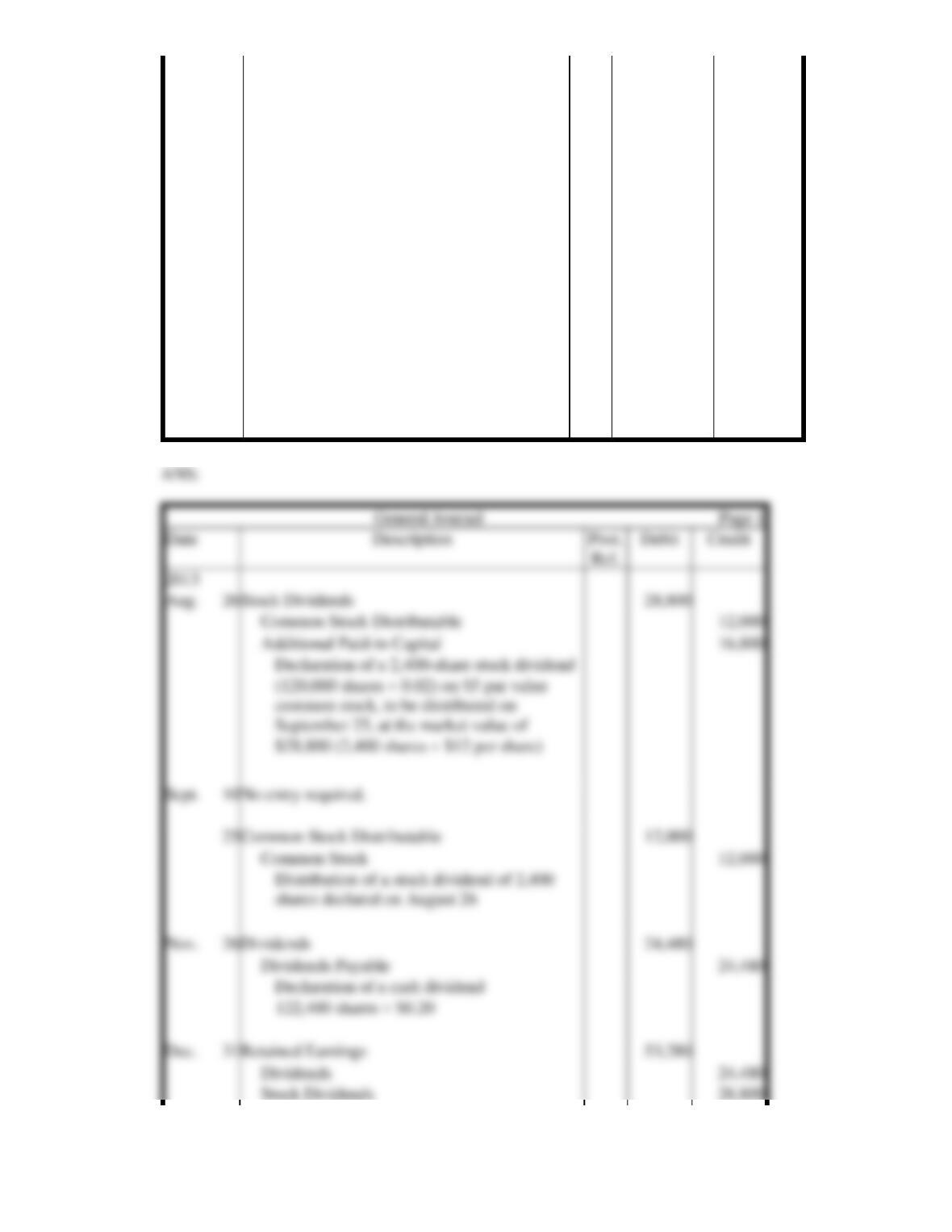
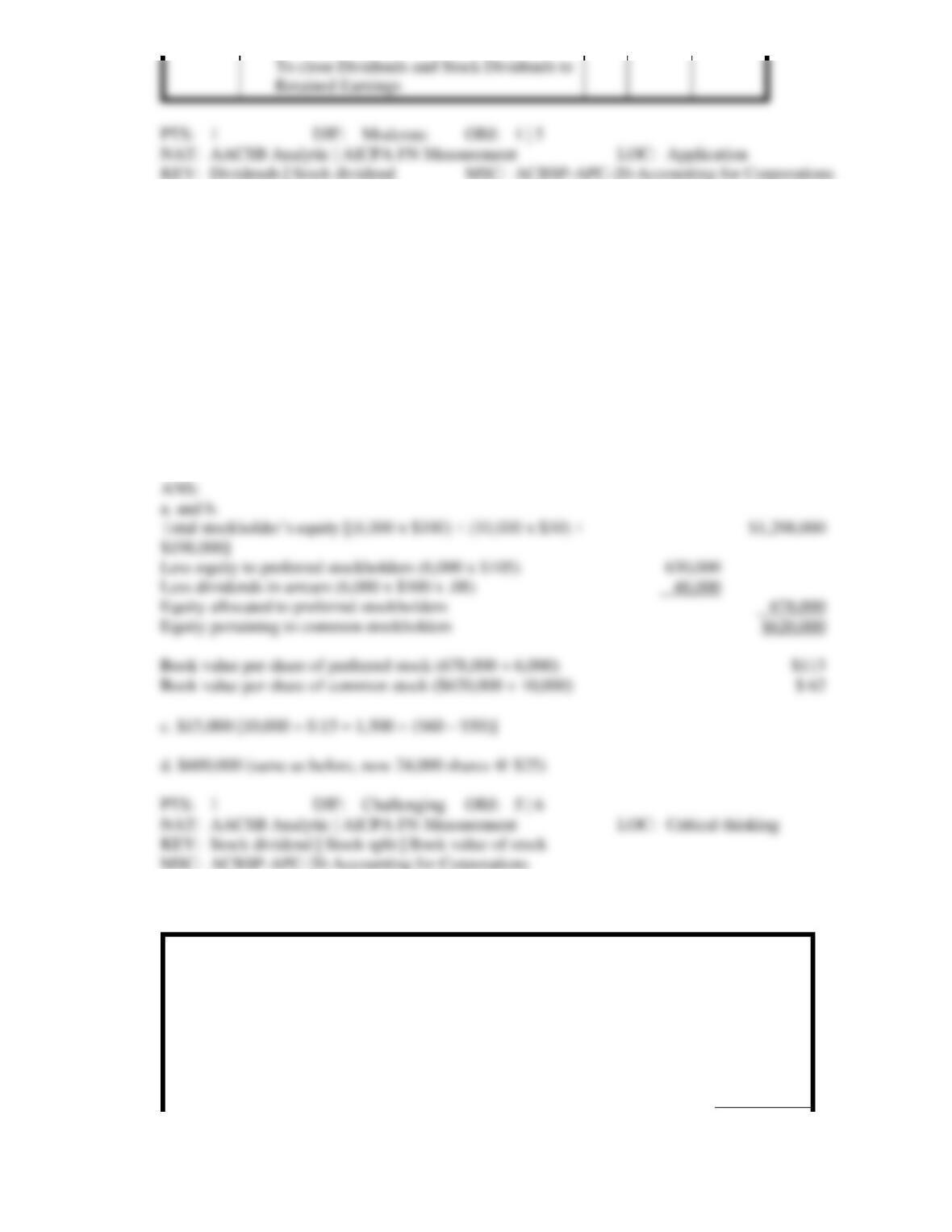
16. On August 26, 2013, Booth Corporation’s board of directors declared a 2 percent stock dividend
applicable to the outstanding shares of its $5 par value common stock, of which 150,000 shares are
authorized, 130,000 are issued, and 10,000 are held in the treasury. The stock dividend was
distributable on September 25 to stockholders of record on September 10. On August 26, the market
value of the common stock was $12 per share. On November 26, the board of directors declared a
$0.20 per share cash dividend. No other stock transactions have occurred. Record the transactions on
August 26, September 10, September 25, and November 26. Make the December 31 entry to close
Dividends and Stock Dividends to Retained Earnings.
General Journal
Page 1
Date
Description
Post.
Ref.
Debit
Credit
17. a. Elton Corporation has 6,000 shares of $100 par value, 8 percent cumulative preferred stock and
10,000 shares of $50 par value common stock outstanding. All shares were issued at par value. In
addition, retained earnings total $198,000. If the preferred stock is callable at $105 per share and one
year’s dividends are in arrears, compute book value per share of preferred stock.
b. Assume the same facts as in a above. Calculate book value per share of common stock.
c. Assume the same facts as in a above and that Elton Corporation declares a 15 percent stock dividend
on its common stock. If the market value on the declaration date was $60 per share, for what amount
will Additional Paid-in Capital, Common be credited?
d. Assume the same facts as in a above and that Elton Corporation declares a 4-for-1 stock split on its
preferred stock. After the split, total par value of preferred stock equals what amount?
18. The stockholders’ equity of Westester Corporation as of December 31, 2013, is as follows:
Stockholders’ Equity
Contributed capital
Preferred stock—7 percent cumulative, $100 par value,
$103 call value, 30,000 shares authorized, issued,
and outstanding
$3,000,000
Common stock—$10 par value, 1,500,000 shares authorized,
1,200,000 shares issued and outstanding
12,000,000
Additional paid-in capital, common
5,175,000
Total contributed capital
$20,175,000
Retained earnings
2,750,000
Total stockholders’ equity
$22,925,000
The preferred stock has one year’s dividends in arrears.
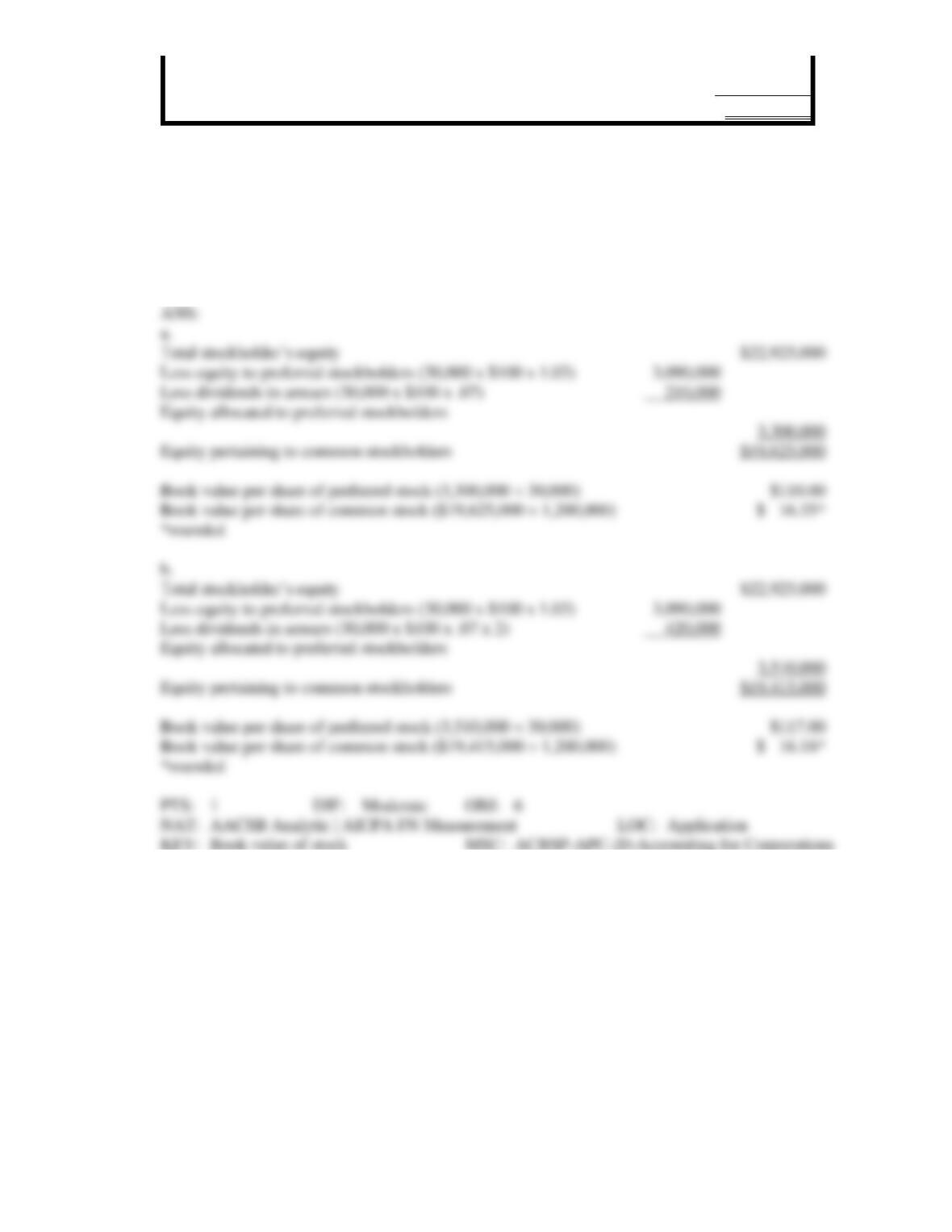
a. Compute the book value per share of preferred stock and the book value per share of common stock.
(Round to the nearest cent.)
b. Assume the preferred stock has two years’ dividends in arrears. Compute the book value per share of
preferred stock and the book value per share of common stock. (Round to the nearest cent.)
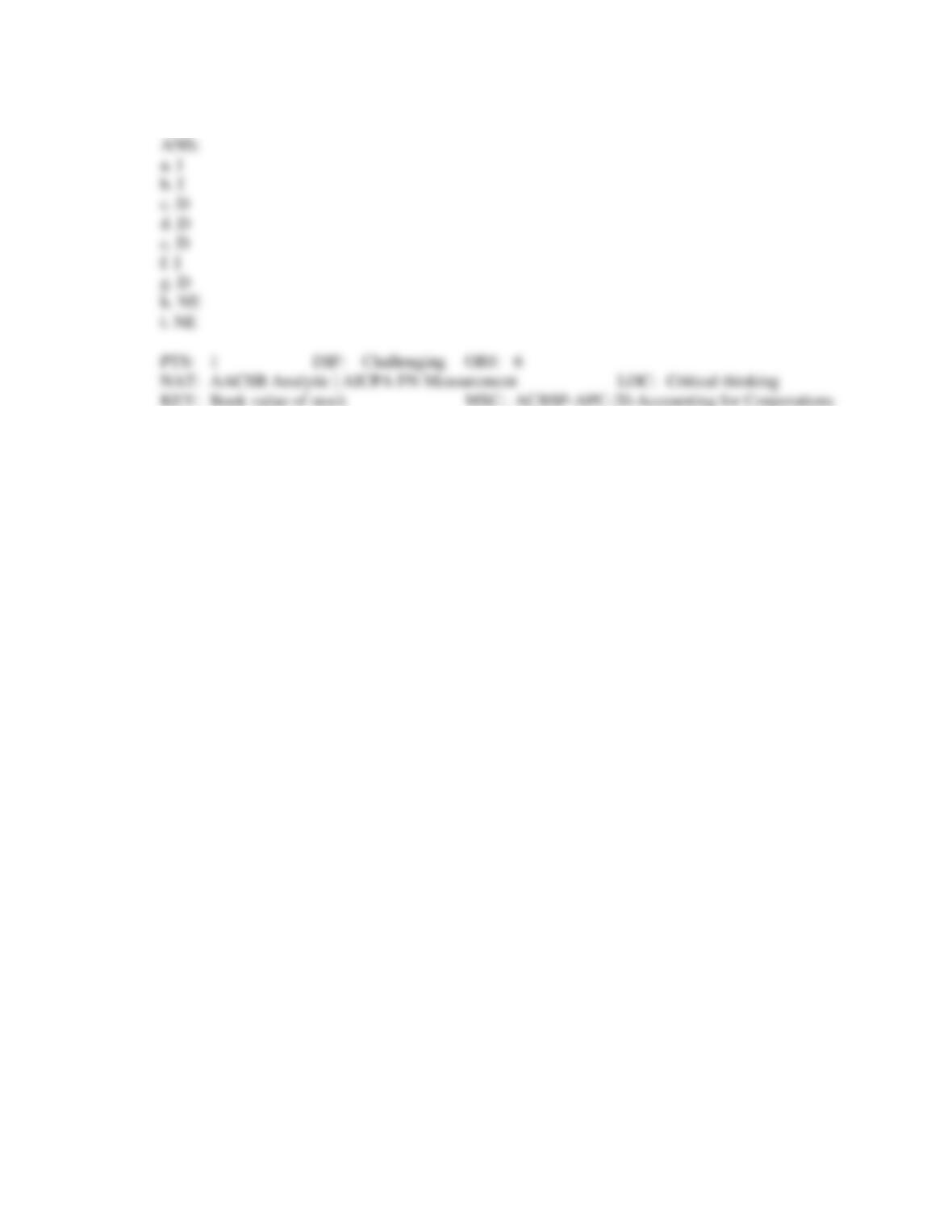
19. At December 31, 2013, the book value per share of common stock of Big Time Corporation amounted
to $21 per share. Determine the effect of each of the following items on the book value per share of
common stock computation assuming each item occurs after December 31, 2013. Consider each item
independently of the other items listed. Indicate your answer for each (I = increase, D = decrease, or
NE = no effect) in the appropriate blank.
a. Sale of newly issued shares of common stock at $23 per share
b. Purchase of treasury stock for $16 per share
c. Declaration of current cash dividends on preferred stock
d. Declaration and distribution of stock dividends on common stock
e. Sale of treasury stock (purchased at $16 per share) for $19 per share
f. Entry to close net income for the period to the Retained Earnings account
g. Dividends in arrears on preferred stock
h. Purchase of a truck with cash
i. Payment of a previously declared and recorded cash dividend on common stock