77. Which of the following is true regarding IFRS versus U.S. GAAP depreciation requirements?
78. IFRS require a review of the parameters used in measuring depreciation
79. IFRS require the initial cost of operational assets to be
80. Property, plant, and equipment may be written up to fair value under
IFRS
GAAP
I.
Yes
Yes
II.
Yes
No
III.
No
Yes
IV.
No
No
81. Priscilla Company purchased a machine on January 1, 2010, for $90,000 with a $24,000 salvage value and a
nine-year useful life. The company uses double-declining-balance depreciation.
Required:
Compute the depreciation expense (to the nearest whole dollar) for 2010 and 2011.
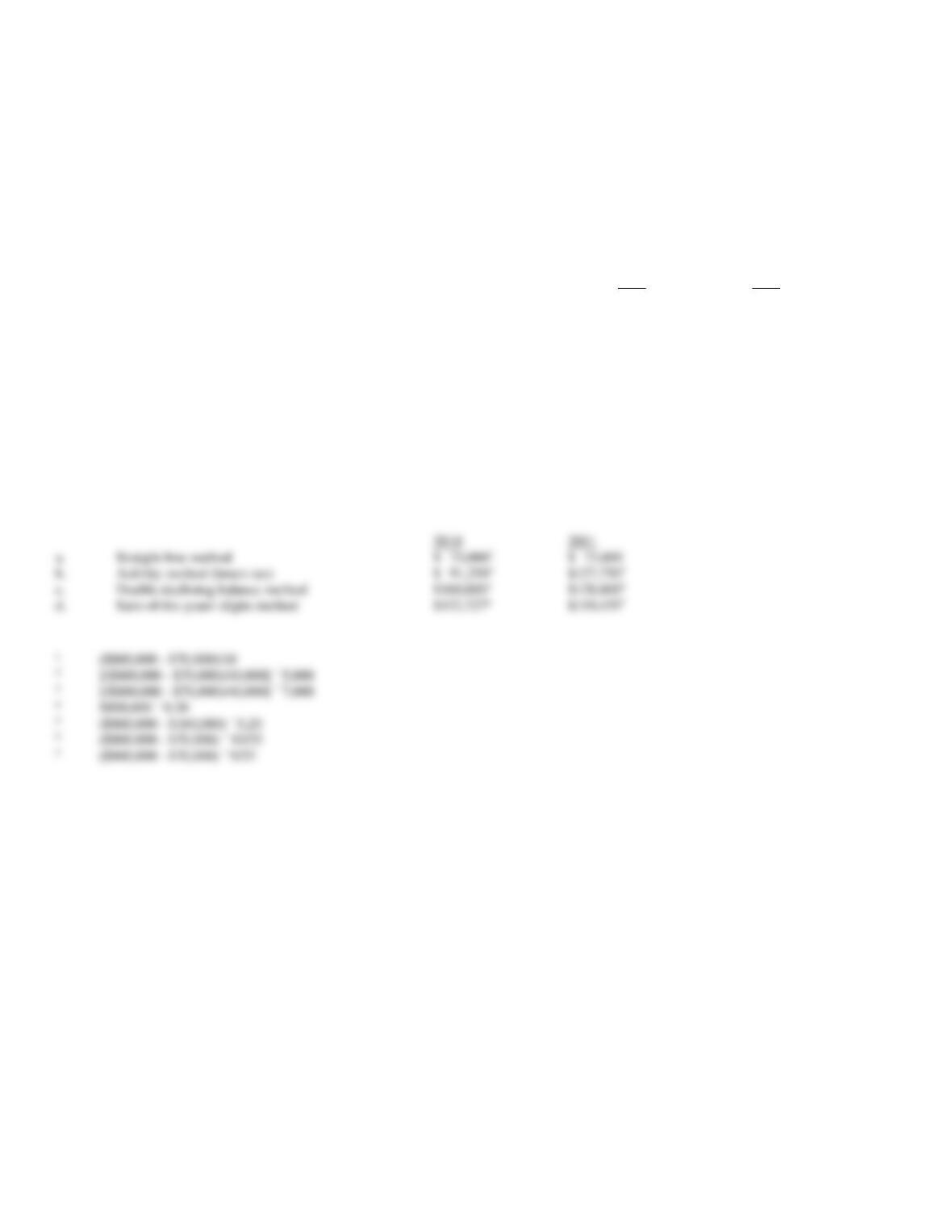
82. Green Bay Mfg. Co. purchased equipment on January 1, 2010, at a cost of $800,000. The equipment is
expected to have a service life of ten years, or 40,000 hours, and a residual value of $70,000. During 2010, the
equipment was operated for 5,000 hours, and during 2011, it was operated for 7,000 hours.
Required:
Determine the depreciation expense for this machine in 2010 and 2011 under each of the following depreciation
methods:
2010
2011
a.
Straight-line method
__________
__________
b.
Activity method (hours ran)
__________
__________
c.
Double declining balance method
__________
__________
d.
Sum-of-the-years’-digits method
__________
__________
83. The Jeffries Co. purchased a machine on January 1, 2010. The machine cost $495,000. It had an estimated
life of ten years, or 25,000 units, and an estimated residual value of $45,000. In 2010, Jeffries produced 3,000
units.
Required:
Compute the depreciation charge for 2010 using each of the following methods:
a.
Double-declining-balance method
b.
Activity method (units of output)
c.
Sum-of-the-years’-digits method
d.
Straight-line method
2010
2011
a.
Straight-line method
$ 73,000
Activity method (hours ran)
c.
Double-declining-balance method
d.
Sum-of-the-years’-digits method
($800,000 – $70,000)/10
[($800,000 – $70,000)/40,000] ´ 5,000
[($800,000 – $70,000)/40,000] ´ 7,000
$800,000 ´ 0.20
($800,000 – $160,000) ´ 0.20
($800,000 – $70,000) ´ 10/55
($800,000 – $70,000) ´ 9/55
84. Consider the following:
a.
Renegade Corp. bought a machine costing $22,400 on January 1, 2010. A six-year life was estimated, and a $1,400 residual value was
expected. The sum-of-the-years’-digits depreciation method was used.
Compute depreciation expense for 2014.
b.
The company bought a machine costing $50,000 on January 1, 2010. A six-year life was expected, and residual value was estimated to
be $8,000. The 150%-declining-balance depreciation method was used.
Compute depreciation expense for 2011.
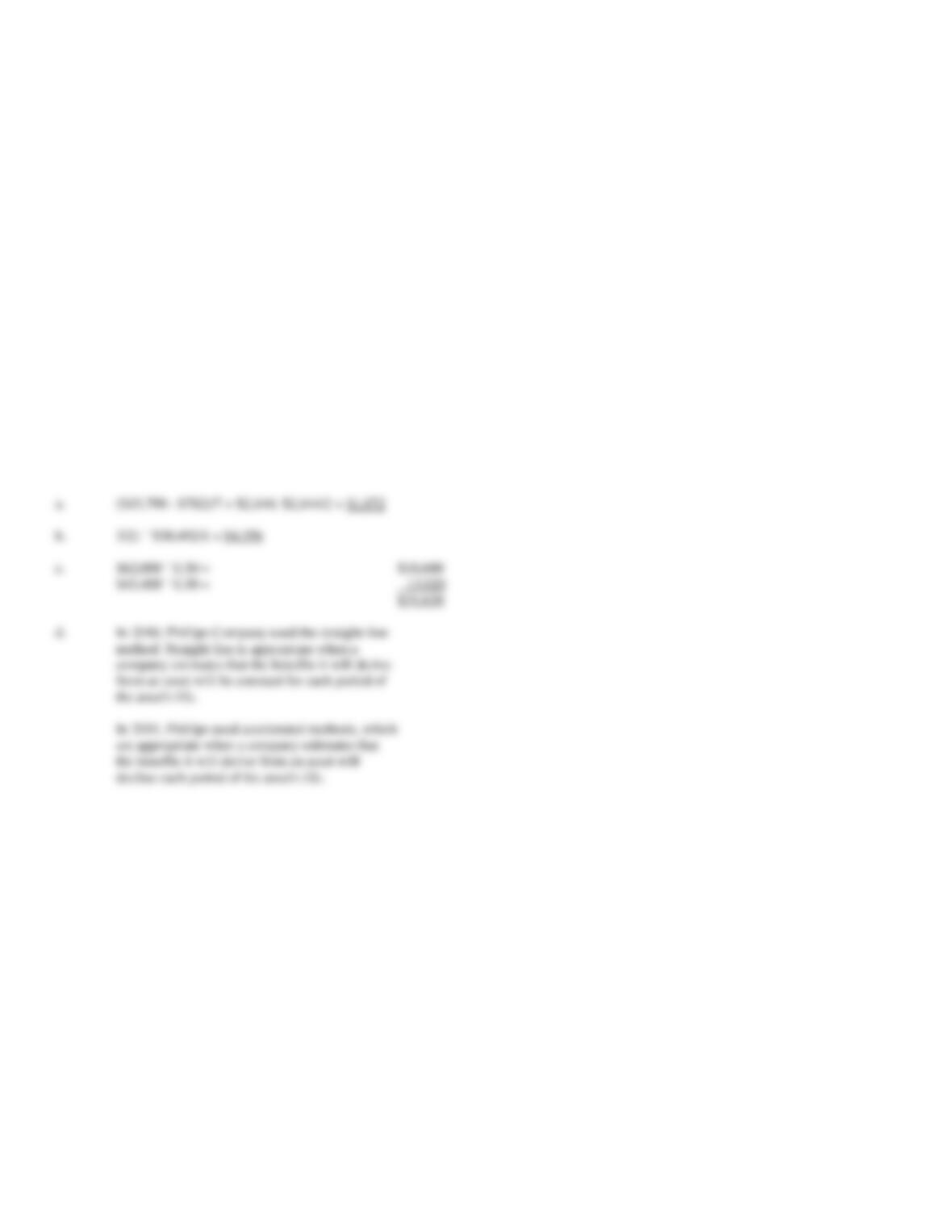
($22,400 – $1,400)/21 ´ 2 = $2,000
$50,000 ´ 0.25 = $12,500; $50,000 – $12,500 = $37,500; $37,500 ´ 0.25 = $9,375
85. On January 1, 2010, Paradise Resorts purchased a machine. Residual value was estimated to be $16,000
after a 20-year life. Using sum-of-the-years’-digits depreciation, the company recorded $10,500 depreciation
expense in 2012.
Required:
Compute the cost of the machine.
18/210 ´ X
= $10,500
= $122,500
$122,500 + $16,000
$495,000 ´ 2 ´ 1/10 = $99,000
[($495,000 – $45,000)/25,000] ´3,000 = $54,000
($495,000 – $45,000) ´10/55 = $81,818
($495,000 – $45,000)/10 = $45,000
86. On January 1, 2010, Farmer Inc. purchased five machines at a cost of $14,000 each. The company adopted
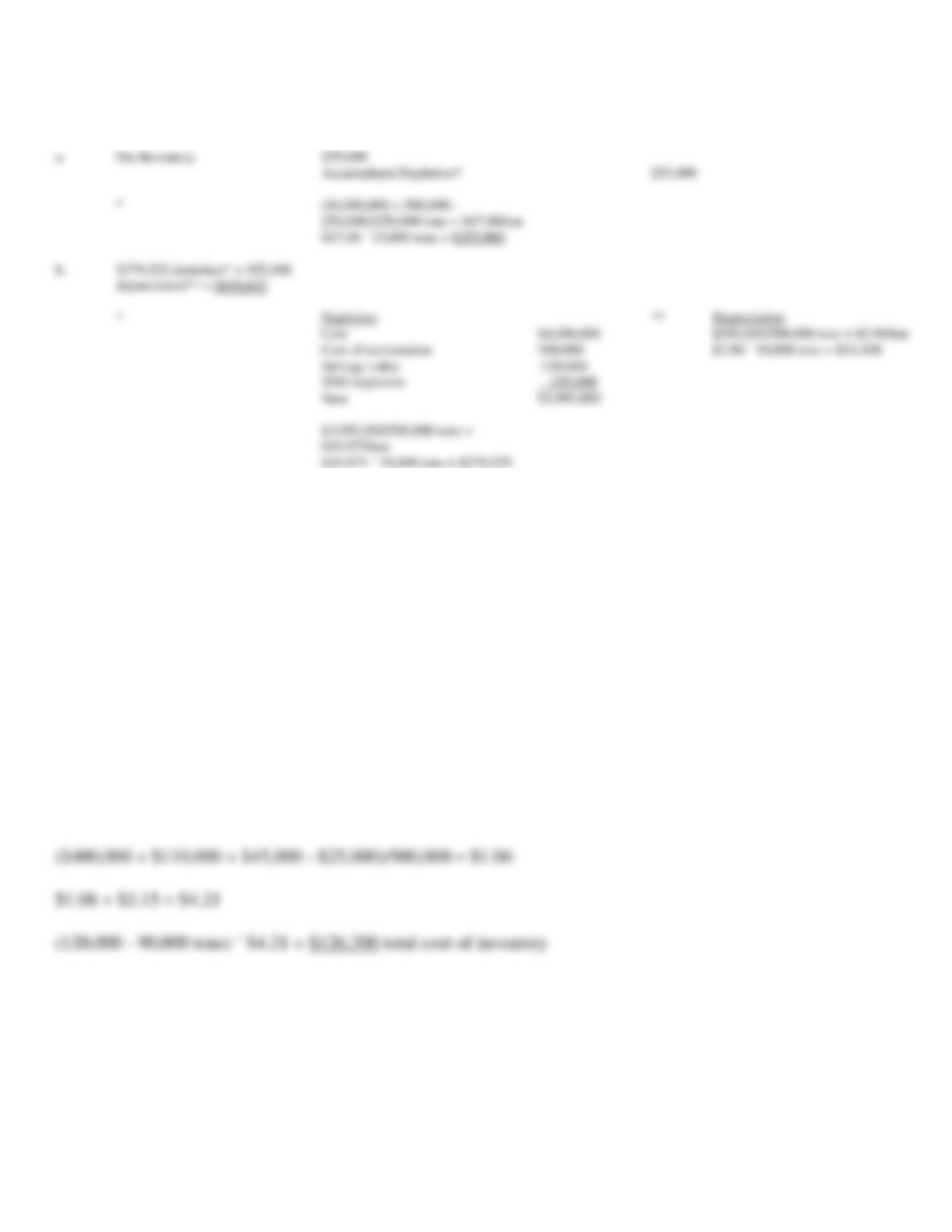
the group (straight-line) depreciation method, using an eight-year life with a $2,800 salvage value per machine.
Correct depreciation was recorded in 2010 and 2011. On January 1, 2012, one of the machines was sold for
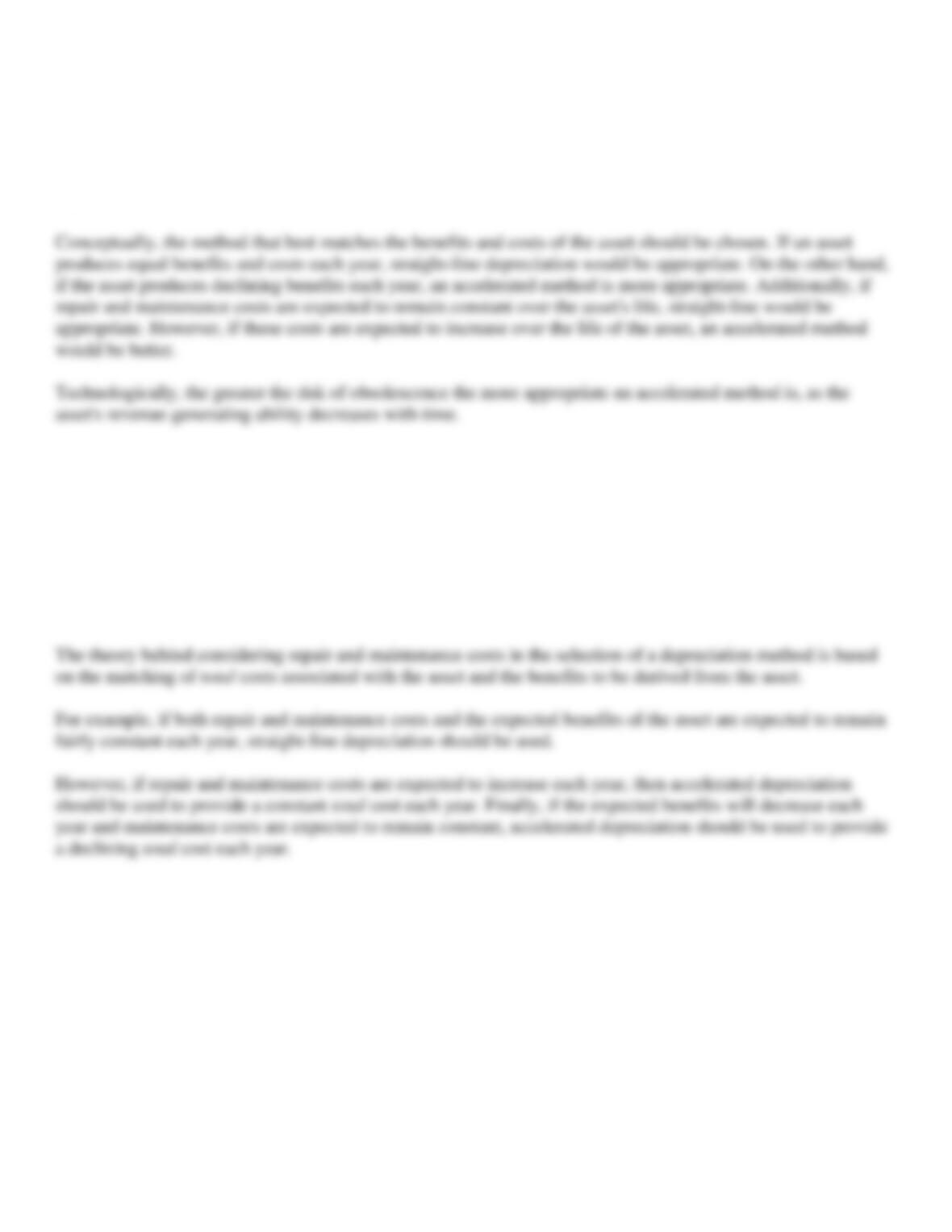
$6,500. On January 3, 2012, a new unrelated piece of equipment was purchased for $15,000 with no salvage
value and a six-year life. It will be depreciated using the straight-line method.
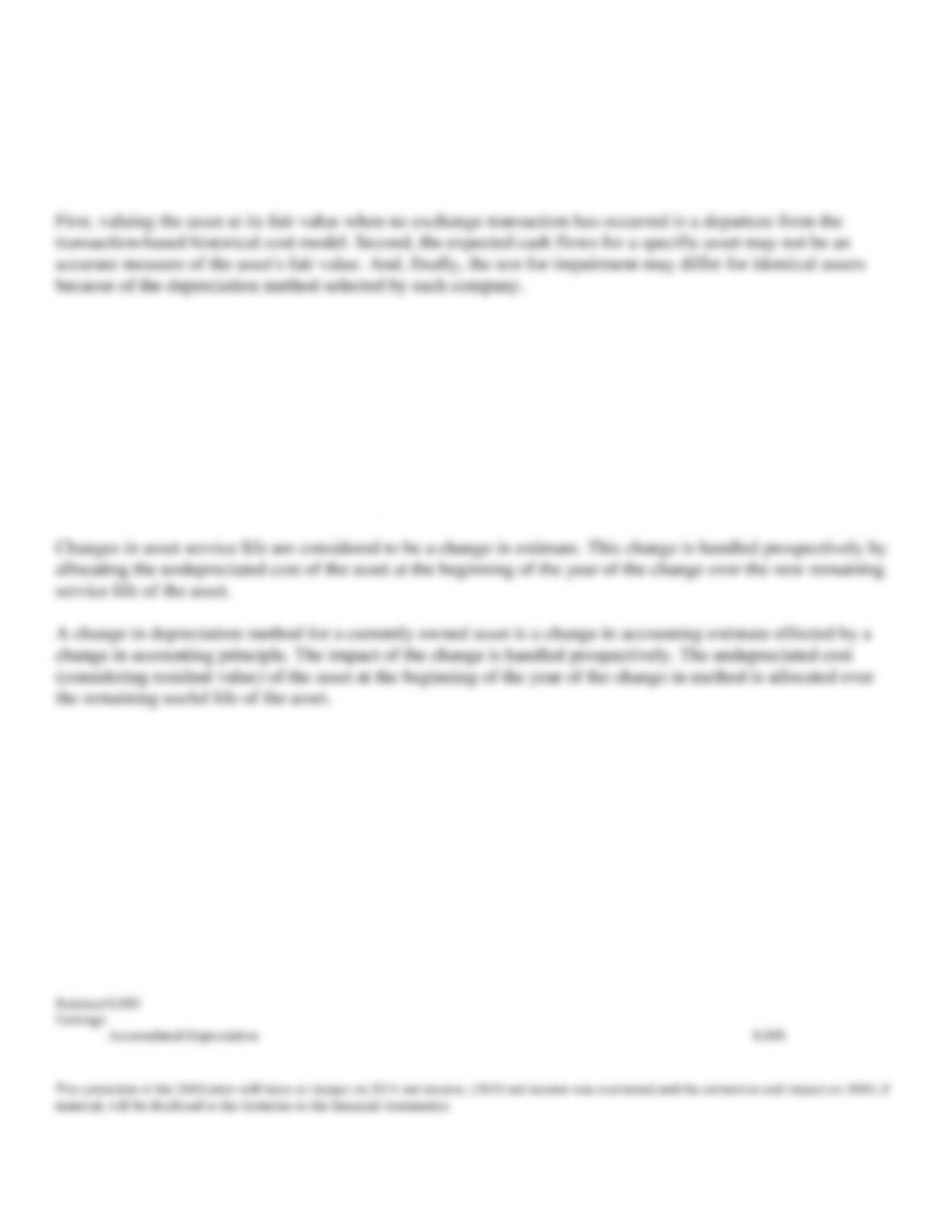
Required:
Prepare appropriate journal entries for
a.
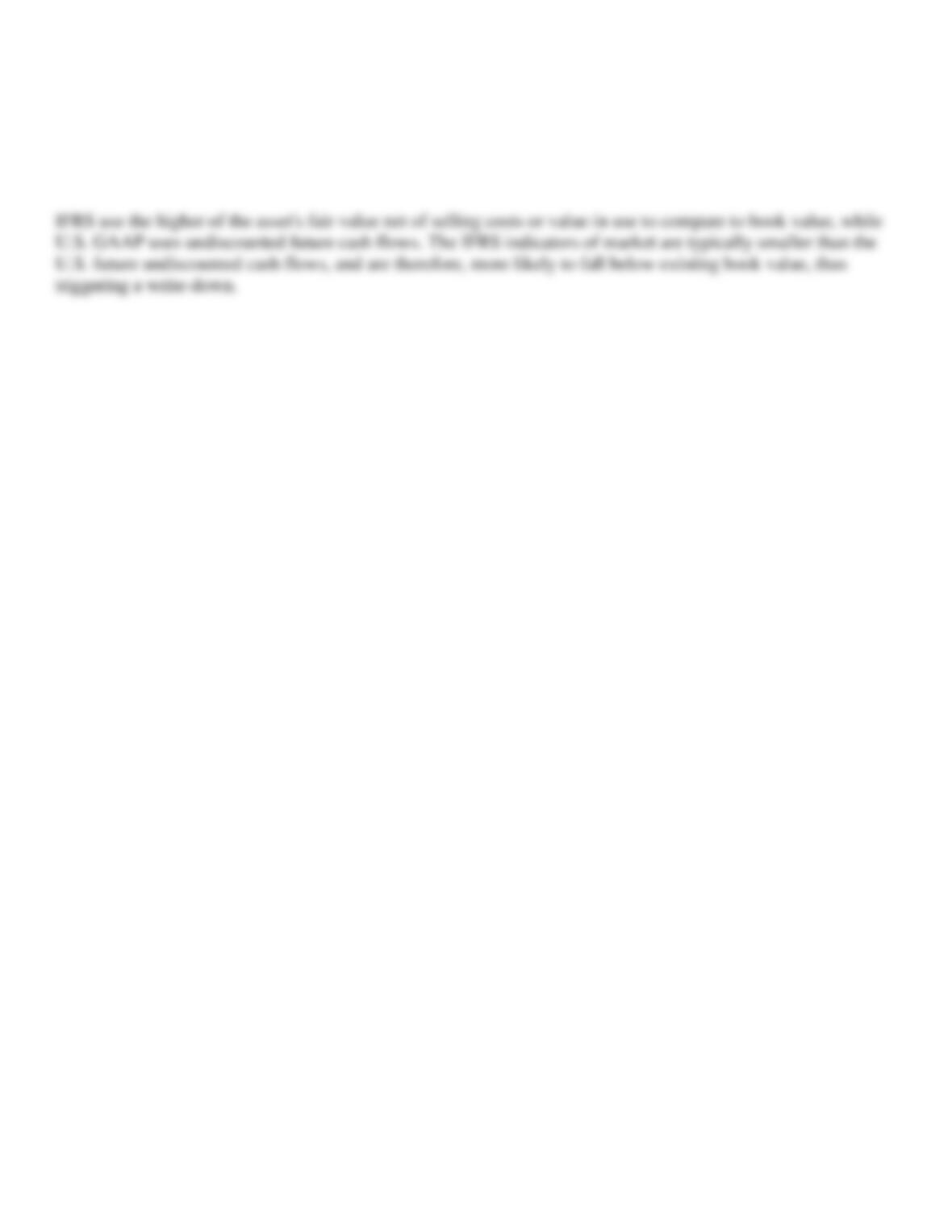
January 1, 2012
b.
December 31, 2012, to record depreciation expense
87. On January 1, 2010, Richard Co. bought a machine for $10,000. Residual value was estimated to be $400
and a five-year life was used for straight-line depreciation. On January 1, 2012, it was estimated that the total
life from acquisition date should have been six years and residual value should have been estimated at $600.
Required:
Compute depreciation expense for 2012.
a.
Cash
6,500
Machines
14,000
b.
Depreciation Expense*
8,100
*
[($70,000 – $14,000) ´10%] + ($15,000/6)
88. Consider the following:
a.
Phillips Co. bought a machine for $15,790 on July 1, 2010. The estimated life of the machine was seven years, and salvage value was
estimated to be $782. The straight-line depreciation method was used.
Compute depreciation expense for 2010.
b.
Phillips Co. bought a machine costing $30,492 on January 1, 2011. A six-year life was estimated with no salvage value. The
sum-of-the-years’-digits depreciation method was used.
Compute depreciation expense for 2014.
c.
Phillips Co. bought a machine costing $62,000 on January 1, 2011. Salvage value was estimated to be $2,000, a five-year life was
determined, and 150%-declining-balance depreciation was used.
Compute the amount that would be in the accumulated depreciation account on December 31, 2012.
d.
What rationale could be given to justify management’s change in depreciation methods for assets acquired in 2011?
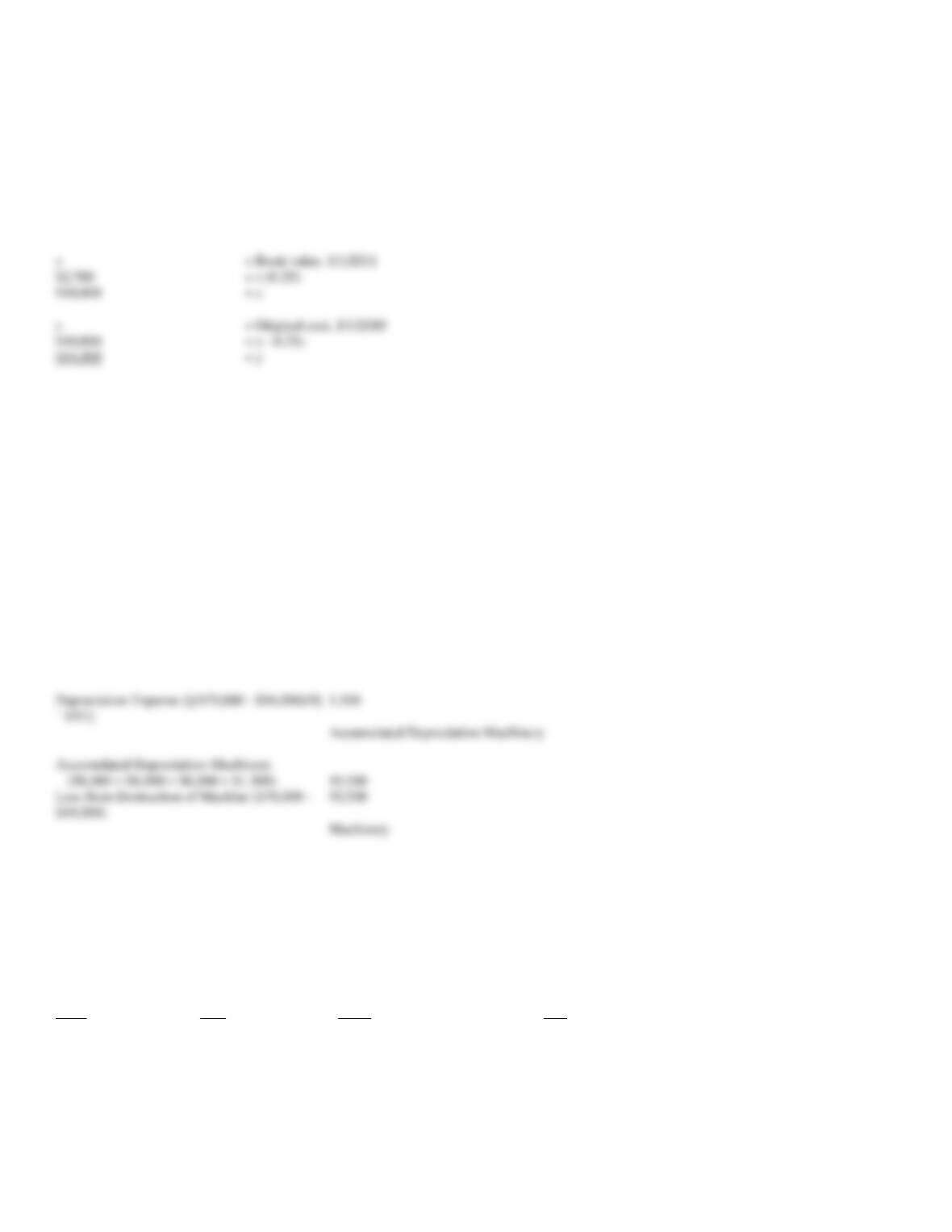
($15,790 – $782)/7 = $2,144; $2,144/2 = $1,072
b.
3/21 ´ $30,492/1 = $4,356
$62,000 ´ 0.30 =
$18,600
$43,400 ´ 0.30 =
13,020
$31,620
89. On January 1, 2010, Mills purchased a machine that had an estimated useful life of six years and $5,000
residual value. The depreciation on this machine was $2,700 in 2011 using the 150%-declining-balance
depreciation method.
Required:
Compute the cost of this machine.
90. On April 1, 2010, an uninsured machine was totally destroyed in an accident at Robles’ manufacturing plant.
The machine had been acquired on January 1, 2007, at a cost of $70,000. The machine had been expected to
have a useful life of nine years and a residual value of $16,000. Robles depreciates machines using the
straight-line method and computes depreciation to the nearest whole month. No depreciation has been recorded
in 2010.
Required:
Record the 2010 depreciation expense and the disposal of the machine.
Accumulated Depreciation-Machinery
Accumulated Depreciation-Machinery
($6,000 + $6,000 + $6,000 + $1,500)
19,500
Machinery
91. Information for heterogeneous assets A, B, and C of Health Clubs of America is provided below. The
company uses composite depreciation for these assets.
Estimated Residual
Estimated
Asset
Cost
Value
Life
A
$100,000
$10,000
9 years
B
60,000
4,000
8 years
C
40,000
8,000
4 years
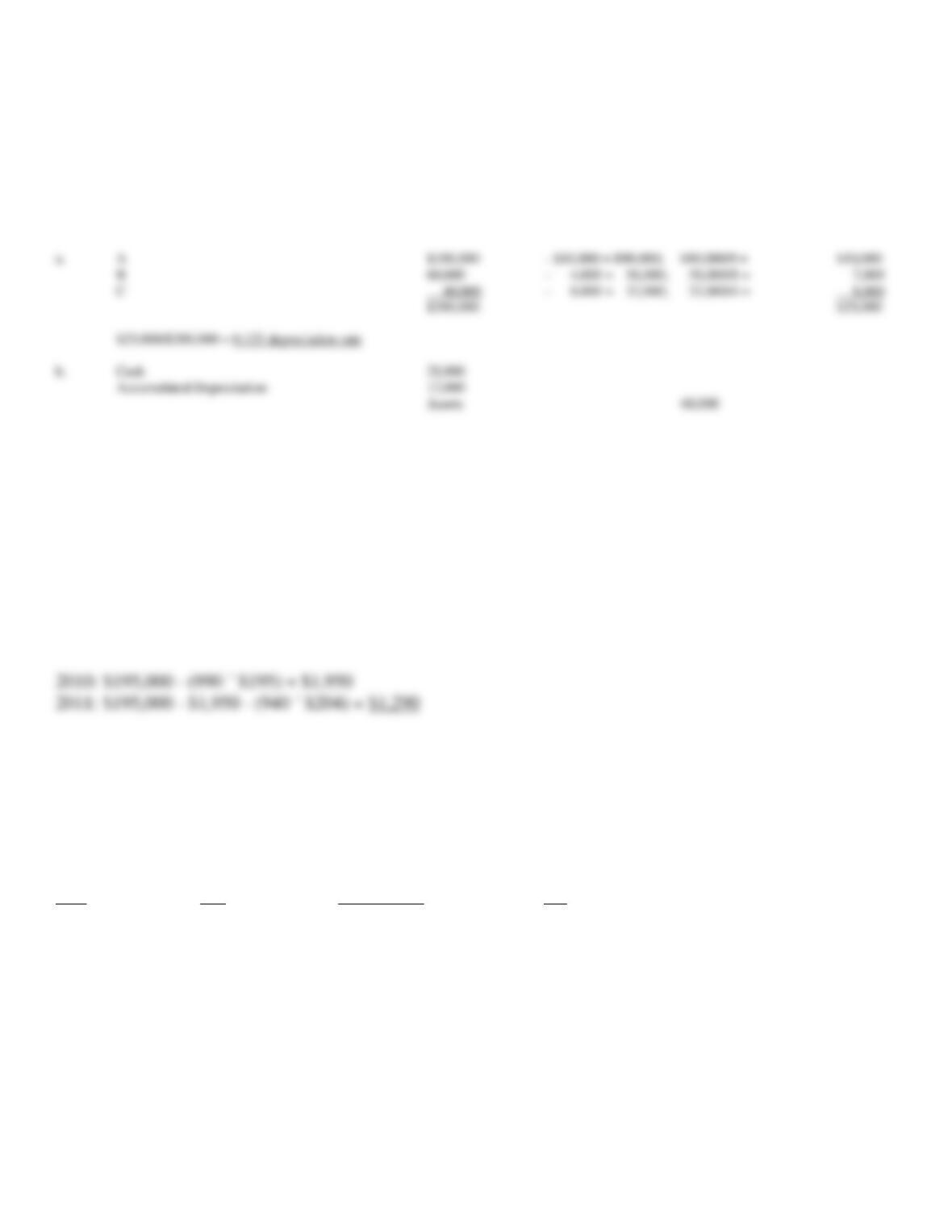
= Book value, 1/1/2011
$2,700
$10,800
= Original cost, 1/1/2010
$10,800
$14,400
Required:
a.
Calculate the composite depreciation rate.
b.
Journalize the sale of Asset C for $28,000 after two full years of use.
92. Panhandle Utilities bought 1,000 poles on January 1, 2010, at a cost of $195,000 and a residual value of
$15,000. In 2010, 10 of the poles were destroyed in a train accident. In 2011, 50 of the poles were sold at a price
of $60 each. The replacement cost per pole at the end of 2010 was $195, but the replacement cost had risen to
$204 by the end of 2011.
Required:
Calculate the depreciation expense for 2010 and 2011 using the inventory system.
93. On January 1, 2010, the Winter Co. acquired three assets that it intends to combine into a single account and
depreciate using the composite depreciation (straight-line) method. The assets have the following
characteristics:
Asset
Cost
Residual Value
Life
1
$100,000
$16,000
6 years
2
90,000
4,000
8 years
3
62,500
3,700
4 years
Required:
a.
Determine the composite rate for depreciation of these assets.
b.
Why did Winter Co. use a composite rate than a group depreciation rate?
a.
A
$100,000
– $10,000 = $90,000;
$90,000/9 =
B
60,000
– 4,000 = 56,000;
56,000/8 =
C
40,000
– 8,000 = 32,000;
32,000/4 =
$200,000
$25,000/$200,000 = 0.125 depreciation rate
b.
Cash
28,000
Accumulated Depreciation
12,000
Assets
40,000
94. On April 20, 2010, Moss Co. purchased an asset costing $66,000 with a useful life of nine years and a
residual value of $6,000. The company uses sum-of-the-years’-digits depreciation.
Required:
Compute depreciation expense for 2010 using the
a.
nearest whole month method
b.
nearest whole year method
c.
half-year convention method
a.
($66,000 – $6,000) ´ 8/12 ´ 9/45 = $8,000
b.
($66,000 – $6,000) ´ 9/45 = $12,000
c.
($66,000 – $6,000) ´ 9/45 ´ 1/2 = $6,000
95. The Rubio Company purchased a truck for $50,000 on October 10, 2010. The truck has a salvage value of
$5,000 and an eight-year useful life. The company uses double-declining-balance depreciation.
Required:
Compute depreciation expense for 2010 using the
a.
nearest whole month method
b.
nearest whole year method
c.
half-year convention method
a.
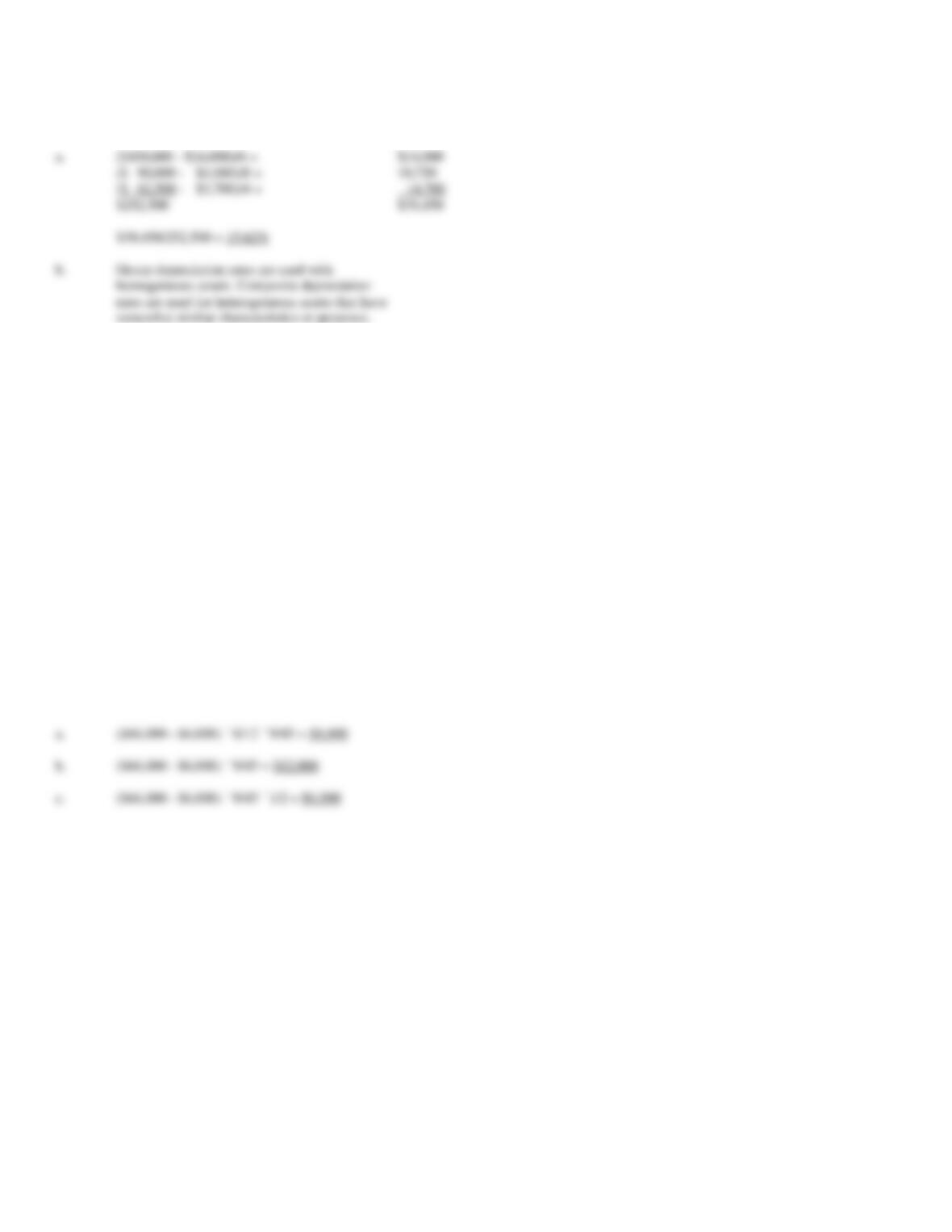
($100,000 – $16,000)/6 =
$14,000
10,750
($ 62,500 – $3,700)/4 =
14,700
$252,500
$39,450
$39,450/252,500 = 15.62%
96. On January 1, 2010, Tomas Company purchased machinery costing $3,000,000. The company uses
straight-line depreciation and estimated the machinery’s useful life to be 12 years and its residual value to be
$600,000.
At the end of 2013, the company felt that technological advances had caused an impairment of its machinery
and that its remaining useful life was only four years. The company estimates the machinery will generate cash
inflows of $500,000 and cash outflows of $100,000 each of the next four years. The company uses a 15% rate
of return to evaluate capital budgeting projects.
Required:
a.
Determine if an impairment loss has occurred. (Show all calculations).
b.
Calculate the amount of any impairment loss to be recognized. The present value of an annuity is 2.85498; present value of $1 is
0.57175; and future value of annuity is 4.99338.
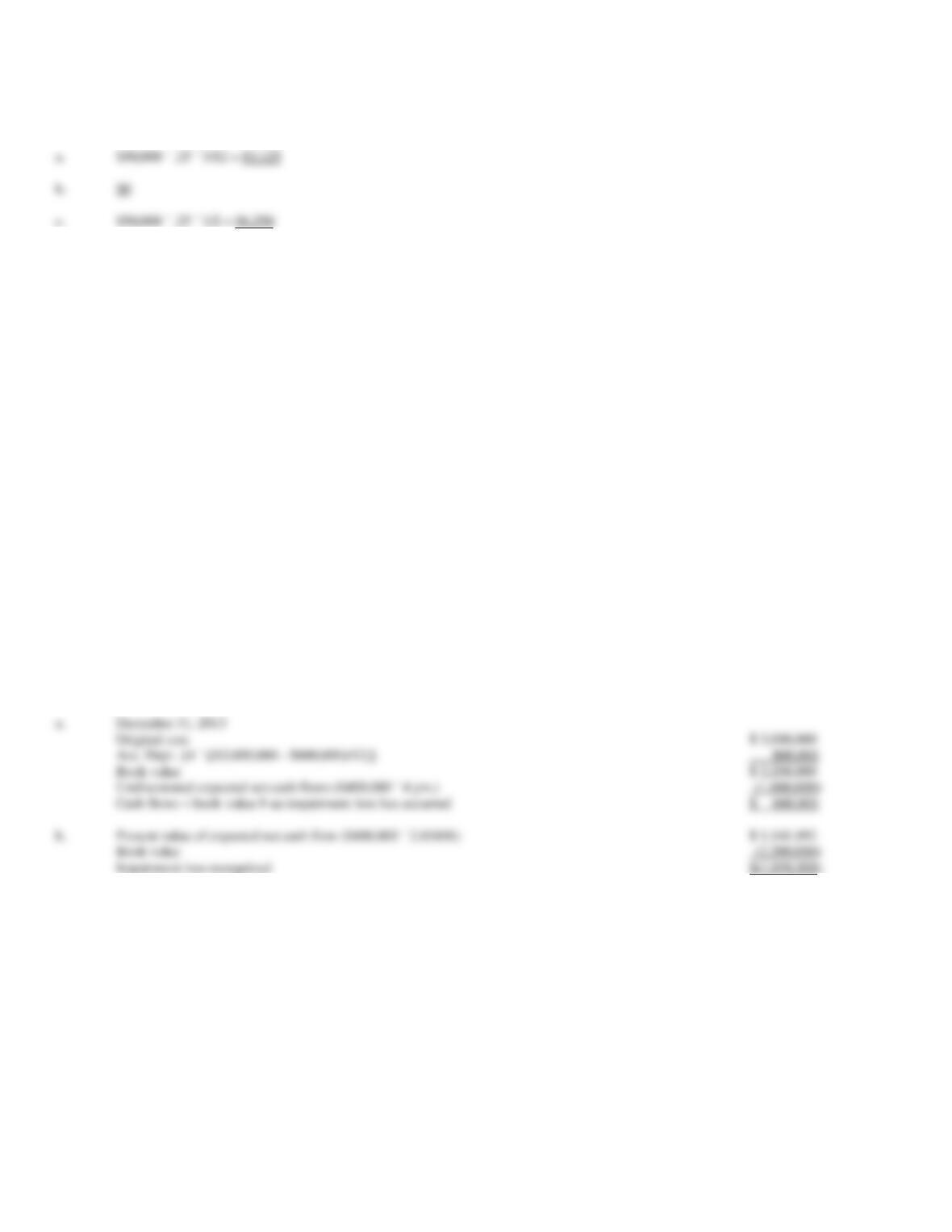
a.
December 31, 2013
Original cost
$ 3,000,000
Acc. Depr. {4 ´ [($3,000,000 – $600,000)/12]}
800,000
Book value
$ 2,200,000
Undiscounted expected net cash flows ($400,000 ´ 4 yrs.)
(1,600,000)
Cash flows < book value Þ an impairment loss has occurred
$ 600,000
Present value of expected net cash flow ($400,000 ´ 2.85498)
$ 1,141,992
Book value
(2,200,000)
Impairment loss recognized
$(1,058,008)
97. On January 1, 2010, Carter Company purchased office furniture for $80,000. Other data on the purchase
include the following:
Estimated useful life
10 years
MACRS life
7 years
Estimated residual value
$5,000
Financial statement depreciation
Straight-line
MACRS depreciation
200% declining balance
a.
$50,000 ´ .25 ´ 3/12 = $3,125
c.
$50,000 ´ .25 ´ 1/2 = $6,250
Required:
a.
Compute the depreciation deduction for the 2010 tax return.
b.
Assume the asset is sold on April 1, 2018 for $3,000. Compute the gain/loss on disposal for both financial reporting and tax reporting.
98. On January 1, 2010, the Miller Oil Company acquired equipment at a cost of $45,000. At that time, the
equipment was estimated to have a residual value of $5,000 at the end of an estimated five-year service life.
During 2010 and 2011, the company recorded straight-line depreciation on the equipment.
Required:
Prepare all the journal entries for 2012 relating to the equipment for each of the following independent
situations (ignoring income taxes):
a.
Assume that the company switched to sum-of-the-years’-digits depreciation at the beginning of 2012 with a new estimated remaining
life of four years.
b.
Assume, instead, that at the beginning of 2012, the equipment is determined to have a five-year remaining service life. Straight-line
depreciation will still be used.
c.
Assume, instead, that at the beginning of 2012 the company discovered that it had erroneously ignored the estimated residual value in
the computation of its depreciation for 2010 and 2011.
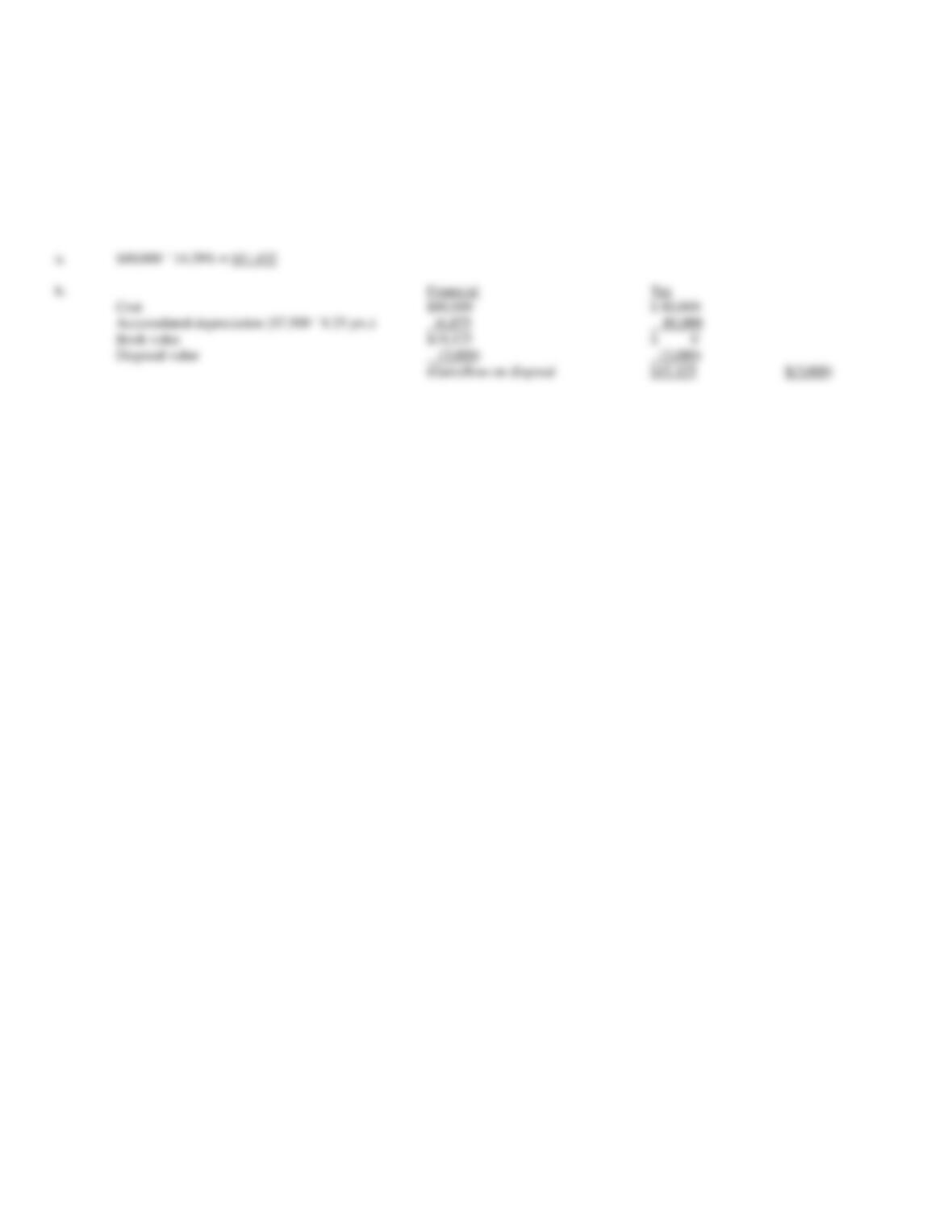
a.
$80,000 ´ 14.29% = $11,432
b.
Financial
Tax
Cost
$80,000
$ 80,000
Accumulated depreciation ($7,500 ´ 8.25 yrs.)
6l,875
80,000
Book value
$18,125
(Gain)/loss on disposal
$15,125
$(3,000)
99. On January 2, 2010, Choi Co. bought a machine for $400,000 with a salvage value of $20,000 and a
four-year useful life. Straight-line depreciation was used. However, during 2010 and 2011, depreciation expense
was erroneously calculated using a $50,000 salvage value. The error was discovered in 2012 after the 2011
books had been closed.
Required:
Prepare the correcting entry in 2012.
100. On January 1, 2010, Broadway Co. had purchased a machine for $60,000. This machine had an estimated
service life of eight years and an estimated residual value of $4,000. It has been depreciated by the straight-line
method since acquisition. On January 1, 2013, it was determined that the remaining service life for this machine
was nine years and that the residual value would be $3,000.
Required:
Record the depreciation expense for 2013.
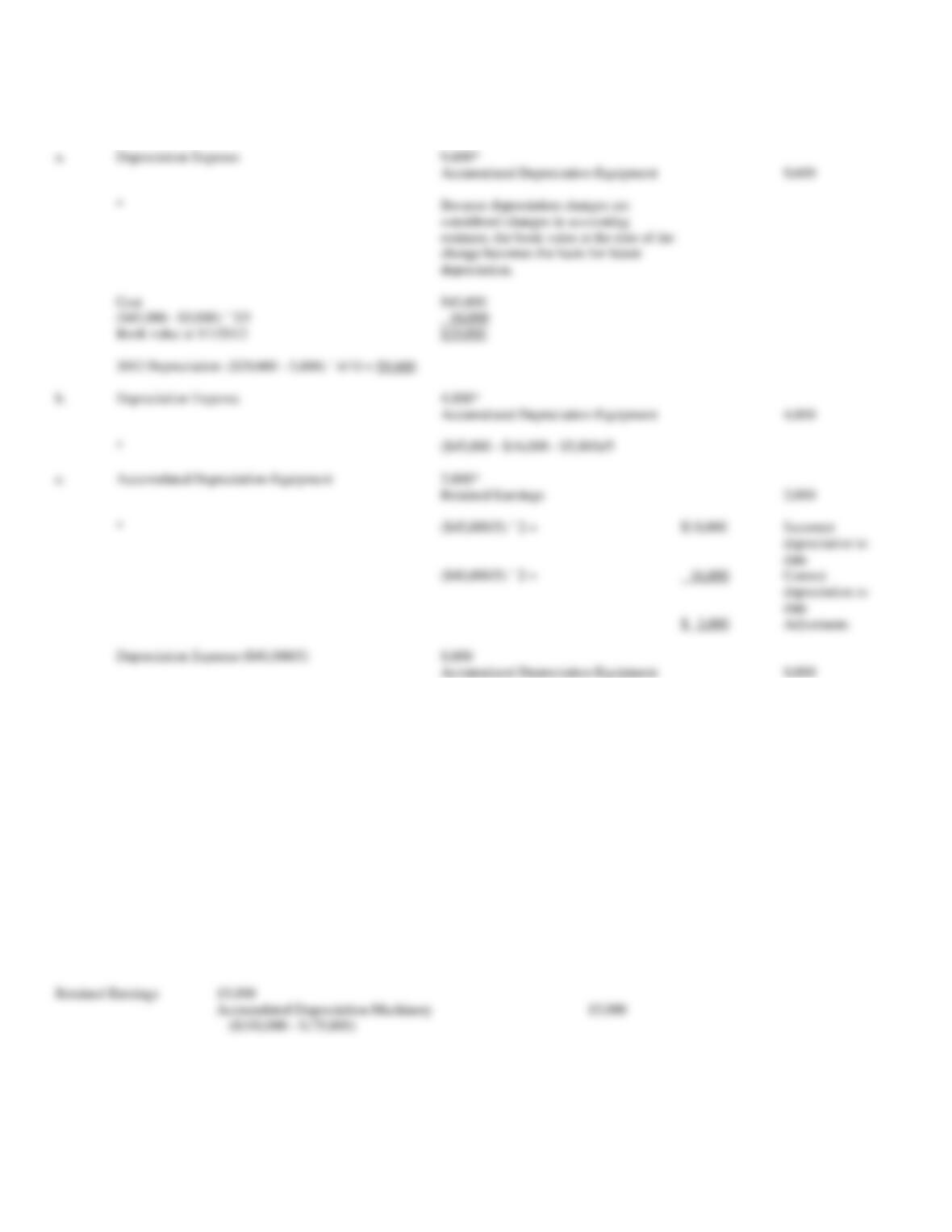
Accumulated Depreciation-Machinery
4,000
*
$60,000 – [($60,000 – $4,000)/8](3 yr) = $39,000
($39,000 – $3,000) = $36,000 new depreciable base
101. On January 1, 2010, the Kim Corp. acquired a parcel of land for $4,000,000 from which it expects to
extract 250,000 tons of ore over the next ten years. Afterwards, the land will be reclaimed at an estimated cost
of $500,000 and sold for an estimated $250,000. In 2011, a building was constructed on the mine site for
$580,000 with an estimated zero value when mining is completed.
During 2010, 15,000 tons were mined, and in 2011, 19,000 tons were mined. At the beginning of 2011, the
amount of ore remaining was revised to 200,000 tons.
Required:
a.
Prepare the depletion entry for 2010.
b.
Determine the total amount of inventoriable costs to be recorded in 2011.
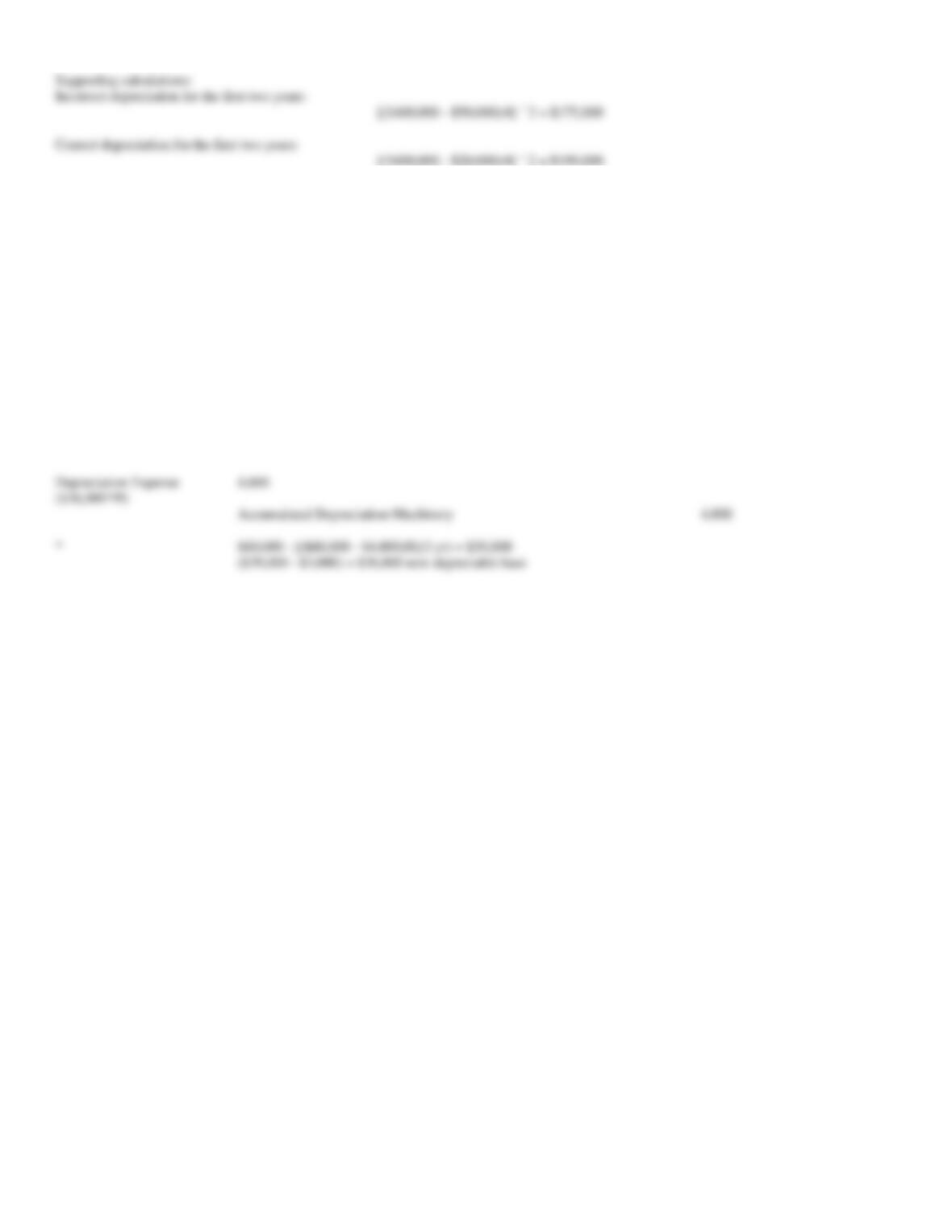
Incorrect depreciation for the first two years:
[($400,000 – $50,000)/4] ´ 2 = $175,000
Correct depreciation for the first two years:
[($400,000 – $20,000)/4] ´ 2 = $190,000
102. Information concerning a mine is as follows:
Costs of production (excluding depletion)
$3.15 per ton
Number of tons sold this year
90,000 tons
Development costs incurred
$45,000
Residual value of land after mining
$25,000
Estimated number of tons of ore to be mined
500,000 tons
Cost of the land
$400,000
Number of tons mined this year
120,000 tons
Cost of restoring property after mining is completed
$110,000
Required:
Compute the total cost of inventory at the end of the year.
Ore Inventory
255,000
Accumulated Depletion*
255,000
$17.00 ´ 15,000 tons = $255,000
*
Depletion
Depreciation
Cost
$4,000,000
$580,000/200,000 tons = $2.90/ton
Cost of reclamation
500,000
$2.90 ´ 19,000 tons = $55,100
Salvage value
-250,000
2010 depletion
-255,000
Base
$3,995,000
$19.975 ´ 19,000 tons = $379,525
103. The straight-line and accelerated depreciation methods differ significantly in the amount and timing of the
depreciation expense recognized and reported each year.
Required:
Discuss the factors that should be considered when choosing between the straight-line and accelerated
depreciation methods.
104. It has been suggested that repair and maintenance costs should be considered when selecting a depreciation
method.
Required:
Discuss the reasoning behind this assertion and explain how it would be implemented.
105. GAAP now requires that impairment losses be recognized when they occur to reflect the fair value of
productive assets.
Required:
Discuss three of the concerns that some accountants have about this practice.
106. When accounting for long-lived assets, companies may make modifications in the procedures related to
specific assets. Companies may change depreciation methods or may change an estimate of the service life of
the assets.
Required:
Describe how these two types of accounting changes are to be handled.
107. In 2010, the Hermes Corporation failed to record $8,000 in depreciation expense. The error was discovered
in May of 2011.
Required:
Make the appropriate journal entry in the books of Hermes Corporation in the year 2011. Explain the impact of
the error correction on the Hermes’ 2011 net income.
108. Generally, IFRS require asset impairments to be recorded sooner than U.S. GAAP requires recognition.
Required:
Discuss the differences between IFRS and GAAP procedures for identifying and measuring asset impairments,
and explain why the IFRS approach is likely to result in write-downs sooner.