11-1
Chapter 11 Financial Statement Analysis Answer Key
Multiple Choice Questions
1.
Which of the following is not a category of financial statement ratios?
2.
Management’s use of resources can best be evaluated by focusing on measures of:
11-2
3.
An individual interested in making a judgment about the profitability of a company should:
4.
An entity’s current ratio will be influenced by:
11-3
5.
A potential creditor’s judgment about granting credit would be most influenced by the
potential customer’s:
6.
The comparison of activity measures of different companies is complicated by the fact
that:
11-4
7.
The inventory turnover calculation:
8.
If a firm’s payment terms for sales made on account to its customers were 2/10, n30, the
number of days’ sales in accounts receivable would be expected to be:
11-5
9.
Asset turnover calculations:
10.
When a firm has financial leverage:
11-6
11.
The dividend payout ratio describes:
12.
The price/earnings ratio:
11-7
13.
If the P/E ratio of a company’s common stock were 12, and its earnings were $2.50 per
common share:
14.
Another term for the price/earnings ratio is:
11-8
15.
A higher P/E ratio means that:
16.
When a corporation has both common stock and preferred stock outstanding:
11-9
17.
A management that wanted to increase the financial leverage of its firm would:
18.
If a firm’s debt ratio was 25%, its debt/equity ratio would be:
11–10
19.
A leveraged buyout refers to:
20.
Book value per share of common stock of a manufacturing company:
11–11
21.
A common size income statement:
22.
Financial leverage:
11–12
23.
Which of the following is(are) an example of a measure of leverage?
24.
For the fiscal year ended March 31, 2017, a company reported earnings per share of $1.95
and cash dividends per share of $0.30. During fiscal 2018, the company had a 3–for–2
stock split. In the annual report for the fiscal year ended March 31, 2018, earnings per
share and cash dividends for fiscal 2017 would be reported, respectively, as:
11–13
25.
Which of the following are examples of physical measures of activity that are sometimes
disclosed in corporate annual reports?
Essay Questions
11–14
26.
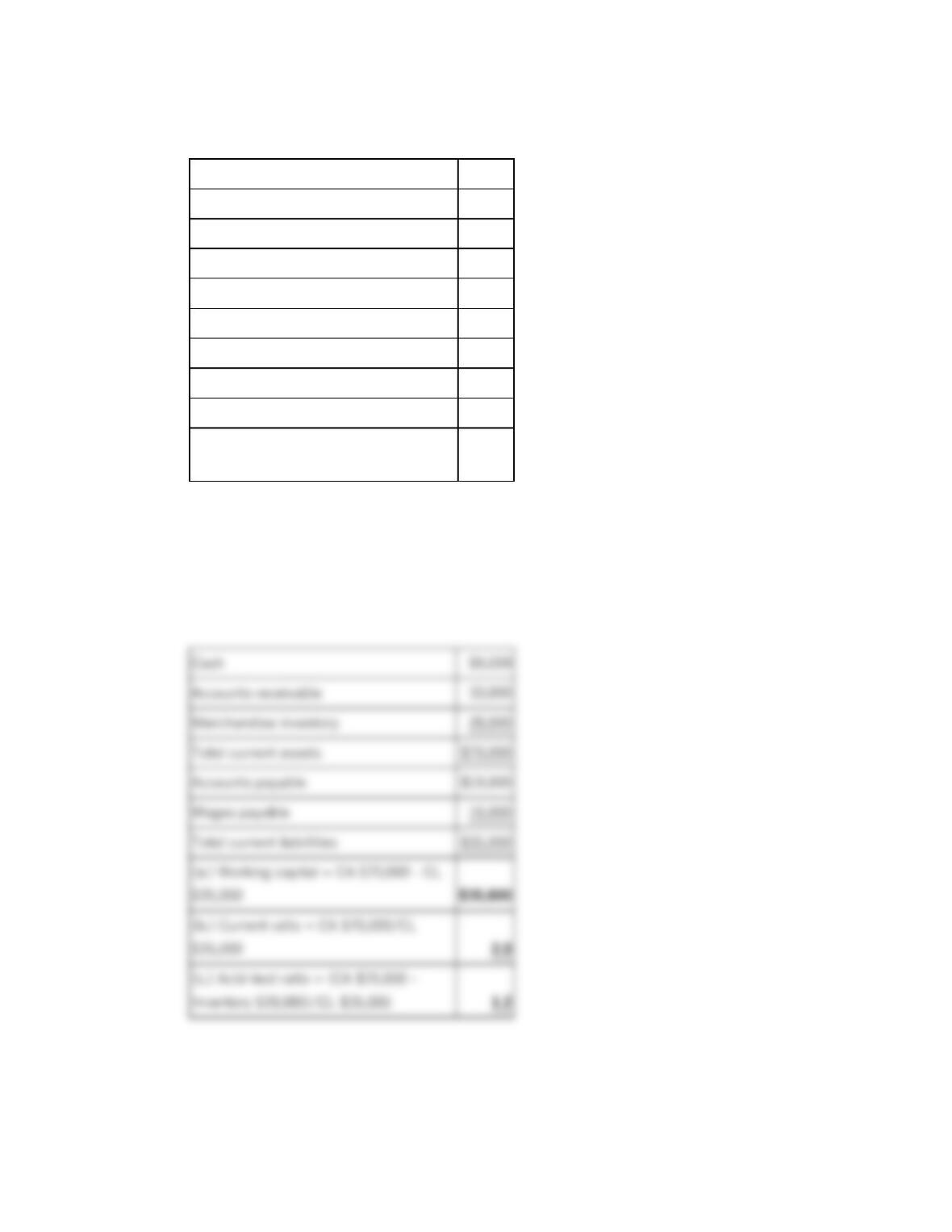
The following amounts were reported on the December 31, 2016, balance sheet:
Cash
$9,000
Accounts receivable
33,000
Common stock
50,000
Wages payable
16,000
Retained earnings
125,000
Land
30,000
Accounts payable
19,000
Bonds payable
110,000
Merchandise inventory
28,000
Buildings and equipment, net of
accumulated depreciation
220,000
Required:
(a.) Calculate working capital at December 31, 2016.
(b.) Calculate the current ratio at December 31, 2016.
(c.) Calculate the acid-test ratio at December 31, 2016.
27.
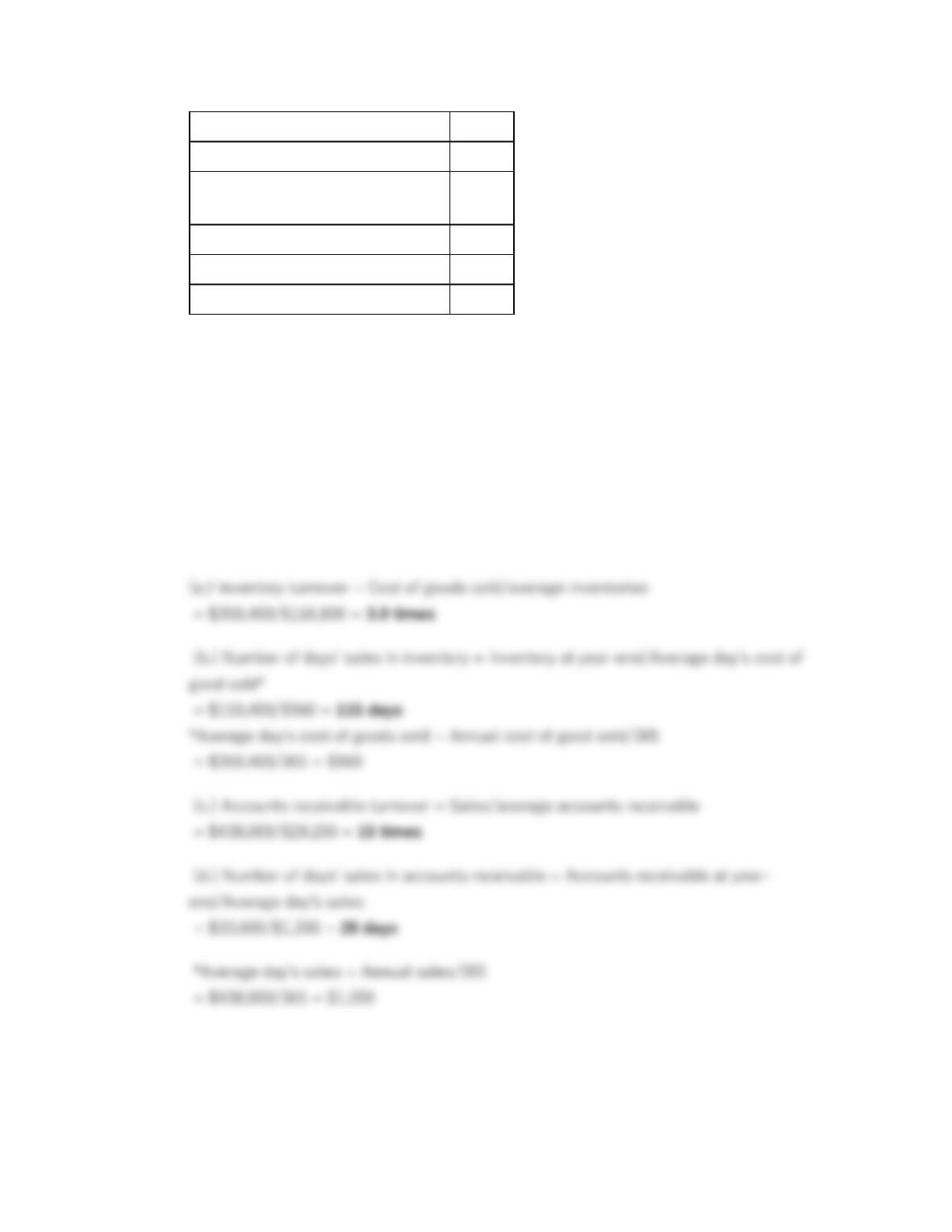
The following information was available for the year ended December 31, 2016:
Cash
Accounts receivable
Merchandise inventory
Total current assets
Accounts payable
Wages payable
Total current liabilities
(a.) Working capital = CA $70,000 – CL
(b.) Current ratio = CA $70,000/CL
$35,000
(c.) Acid-test ratio = (CA $70,000 –
Inventory $28,000)/CL $35,000
11–15
Net sales
$438,000
Cost of goods sold
350,400
Average accounts receivable for the
year
29,200
Accounts receivable at year-end
33,600
Average inventory for the year
116,800
Inventory at year-end
110,400
Required:
(a.) Calculate the inventory turnover for 2016.
(b.) Calculate the number of days’ sales in inventory for 2016, using year-end inventories.
(c.) Calculate the accounts receivable turnover for 2016.
(d.) Calculate the number of days’ sales in accounts receivable for 2016, using year-end
accounts receivable.
28.
The following information was available for the year ended December 31, 2016:
11–16
Net income
$180,000
Average total assets
2,000,000
Dividends per share
1.44
Earnings per share
4.00
Market price per share at year-end
72.00
Required:
(a.) Calculate the price/earnings ratio for 2016.
(b.) Calculate the dividend payout ratio for 2016.
(c.) Calculate the dividend yield for 2016.
29.
The following information was available for the year ended December 31, 2016:
Earnings before interest and taxes
(operating income)
$97,500
Interest expense
15,000
Income tax expense
22,500
Net income
60,000
Total assets at year-end
288,000
Total liabilities at year-end
216,000
Required:
(a.) Calculate the debt ratio at December 31, 2016.
(b.) Calculate the debt/equity ratio at December 31, 2016.
(c.) Calculate the times interest earned for the year ended December 31, 2016.