Proportion of Services Used by:
Department Direct costs Personnel Cafeteria Machining
Assembly
Personnel $ 30,000 0.40 0.30 0.30
Cafeteria $ 50,000 0.20 0.50 0.30
Machining $ 80,000
Assembly $ 70,000
Required:
Compute the allocation of service department costs to producing departments for July 2020 using
the step method.
82
117) Data Master is a computer software consulting company. Its three major functional areas
are computer programming, information systems consulting, and software training. Cynthia
Moore, a pricing analyst in the Accounting Department, has been asked to develop total costs for
the functional areas. These costs will be used as a guide in pricing a new contract. In computing
these costs, Moore is considering three different methods of allocating overhead costs: the direct
method, the step method, and the reciprocal method. Moore assembled the following data on
overhead from its two service departments, the Information Systems Department and the
Facilities Department.
Service Departments User Departments
Info Systems Facilities Computer Program Consulting Training Total
Budgeted Overhead $ 50,000 $ 25,000 $ 75,000 $ 110,000 $
85,000 $ 345,000
Info Systems (hours) 400 1,100 600 900
3,000
Facilities (Square feet) 200,000 400,000 600,000 800,000
2,000,000
Information systems are allocated on the basis of hours of computer usage; facilities are allocated
on the basis of floor space.
Required:
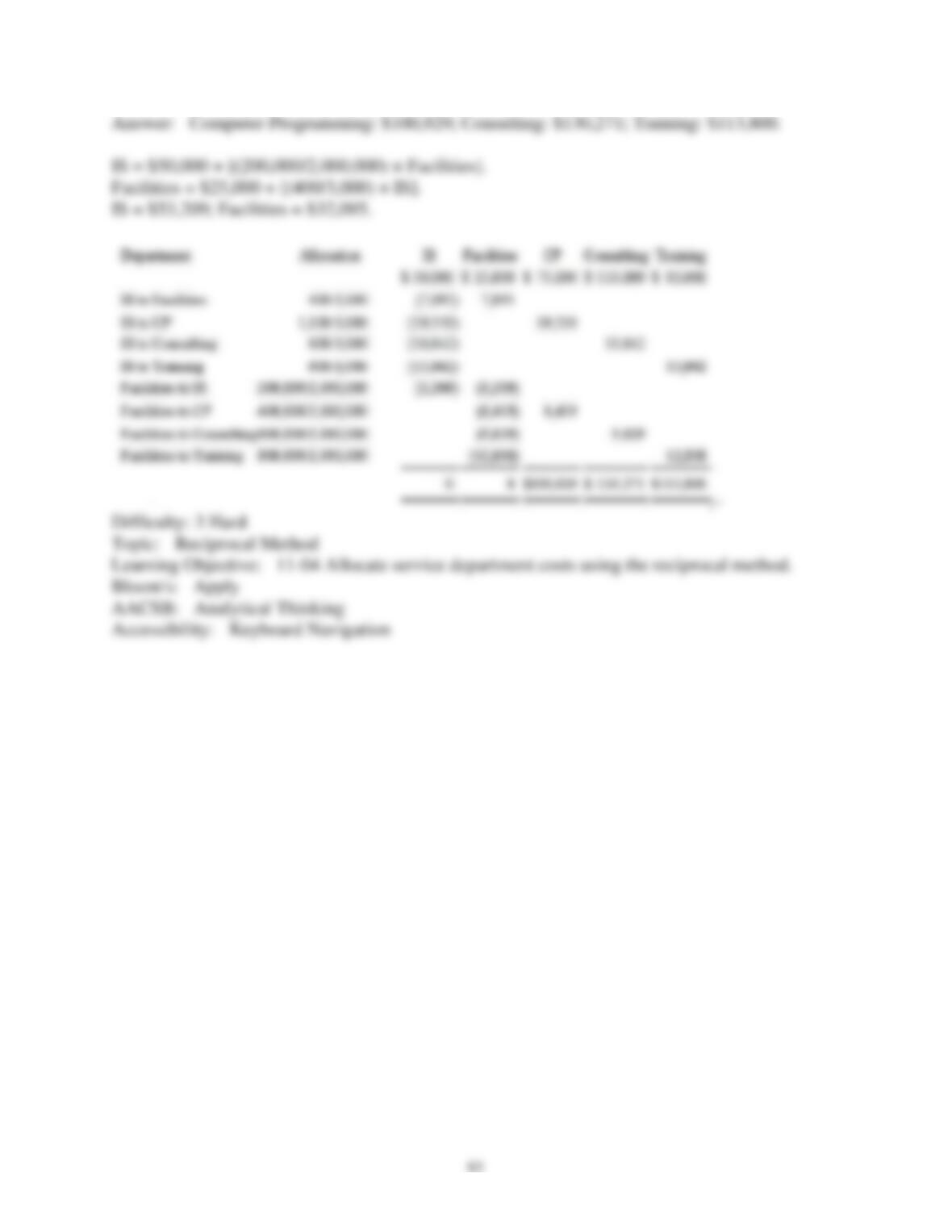
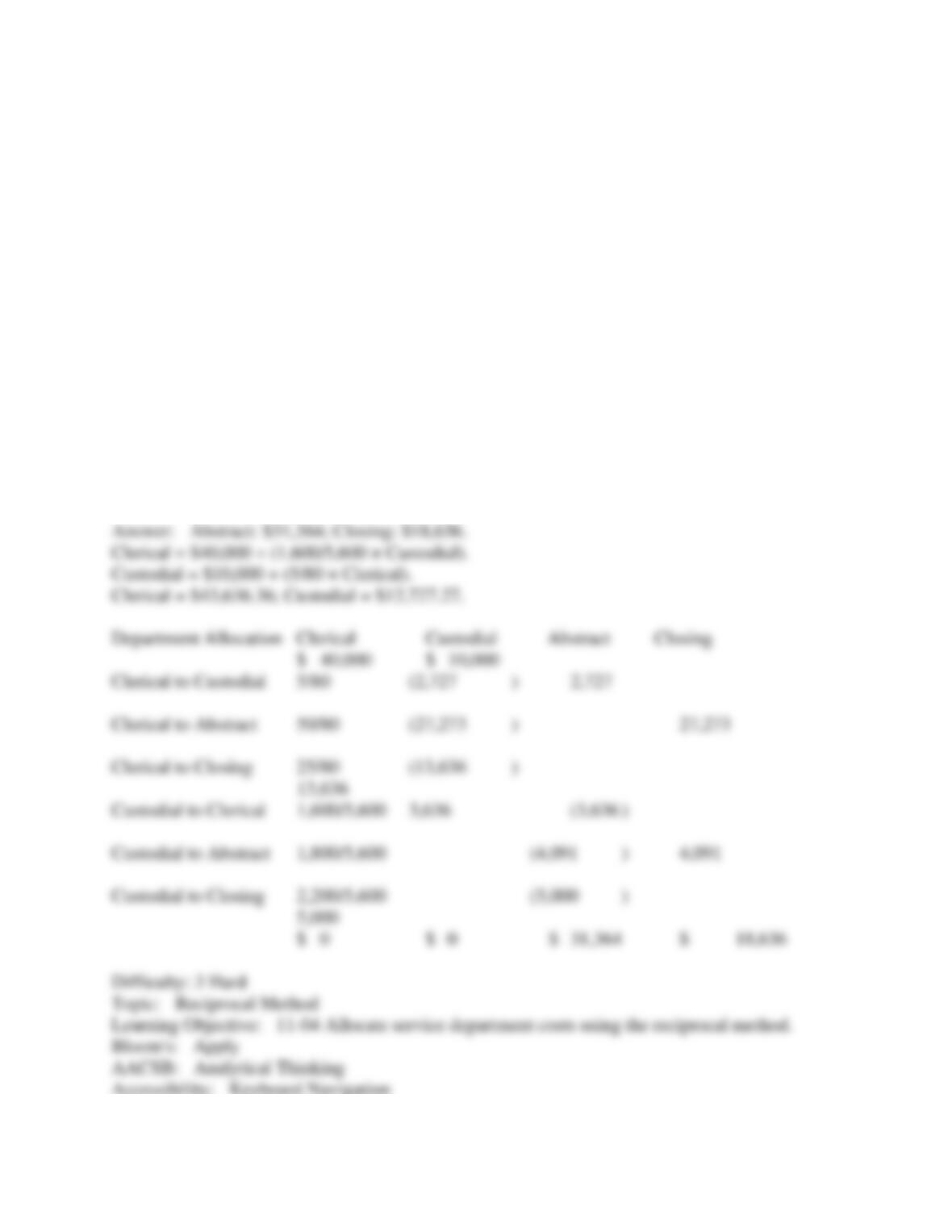
Allocate the service department costs to the user departments using the reciprocal method.
Round to the nearest whole dollar.
84
118) Jack Donaldson owns and operates Jack’s Abstracting Service. Jack’s two revenue
generating operations (Abstracting Services and Closing Services) are supported by two service
departments: Clerical and Custodial. Costs in the service departments are allocated in the
following order using the designated allocation bases.
Clerical: number of transactions processed.
Custodial: square footage of space occupied.
Average and expected activity levels for next month are as follows:
Number of Transactions Square Footage
Expected Costs
Abstract services 50 1,800
Closing services 25 2,200
Clerical 1,600 $ 40,000
Custodial 5 10,000
Required:
Use the reciprocal method to allocate the service department costs to the revenue generating
departments. Provide the total costs for the revenue departments.
119) Yellville Regional Hospital is a small hospital with two service departments and three
85
revenue areas:
Service Department Direct Costs Square Feet Laundry Pounds
Housekeeping (HK) $ 80,000 – 16,000
Laundry $ 132,000 500
Revenue Areas:
Surgery $ 400,000 1,500 48,000
Semiprivate Rooms $ 200,000 2,000 24,000
Maternity $ 150,000 1,000 12,000
The hospital wants to allocate the service department costs to the revenue areas. Housekeeping is
allocated based on square footage; Laundry is allocated based on pounds of laundry. The normal
capacity for Surgery is 200 hours per month; normal capacity for semiprivate rooms is 600
patient days; and normal capacity for maternity is 200 patient days.
Required:
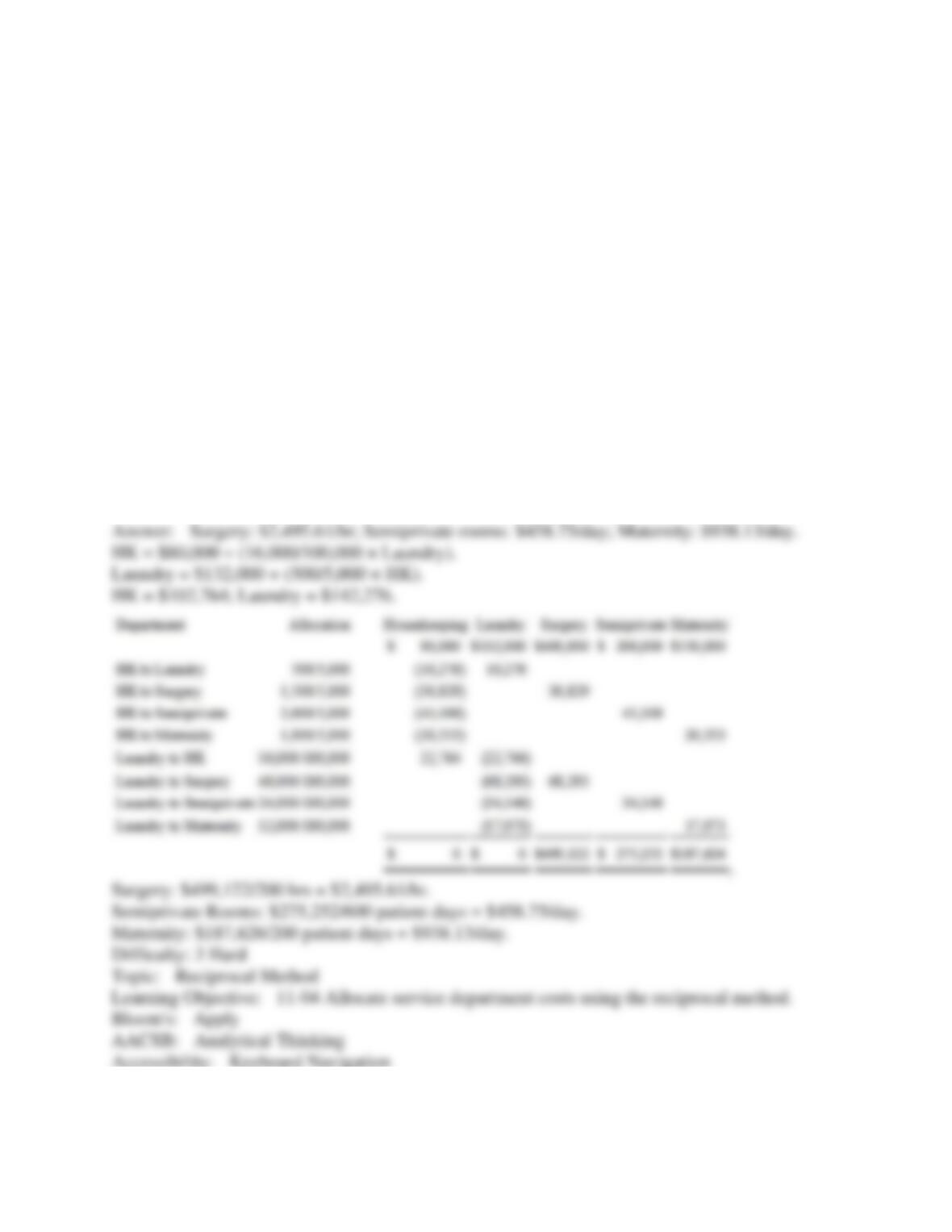
Determine the overhead rate for the three revenue areas. Allocate the service department costs to
the revenue areas using the reciprocal method.
120) Franklin Corporation has three operating departments (Fabricating, Assembly, and
Finishing) and two service departments (Custodial and Administrative). The following
information has been provided:
Custodial Admin Fabricating Assembly Finishing
Department Costs $ 250,000 $ 400,000 —
— —
# employees 10 — 80 100 60
Square feet — 15,000 30,000 35,000 20,000
Allocations are based on the following:
Custodial: Square feet
Administrative: Number of employees
Required:
Franklin has been approached by Sparkle Cleaning to outsource the custodial service. Assuming
all costs are variable, what is the relevant cost of the custodial department to compare with the
Sparkle Cleaning bid?
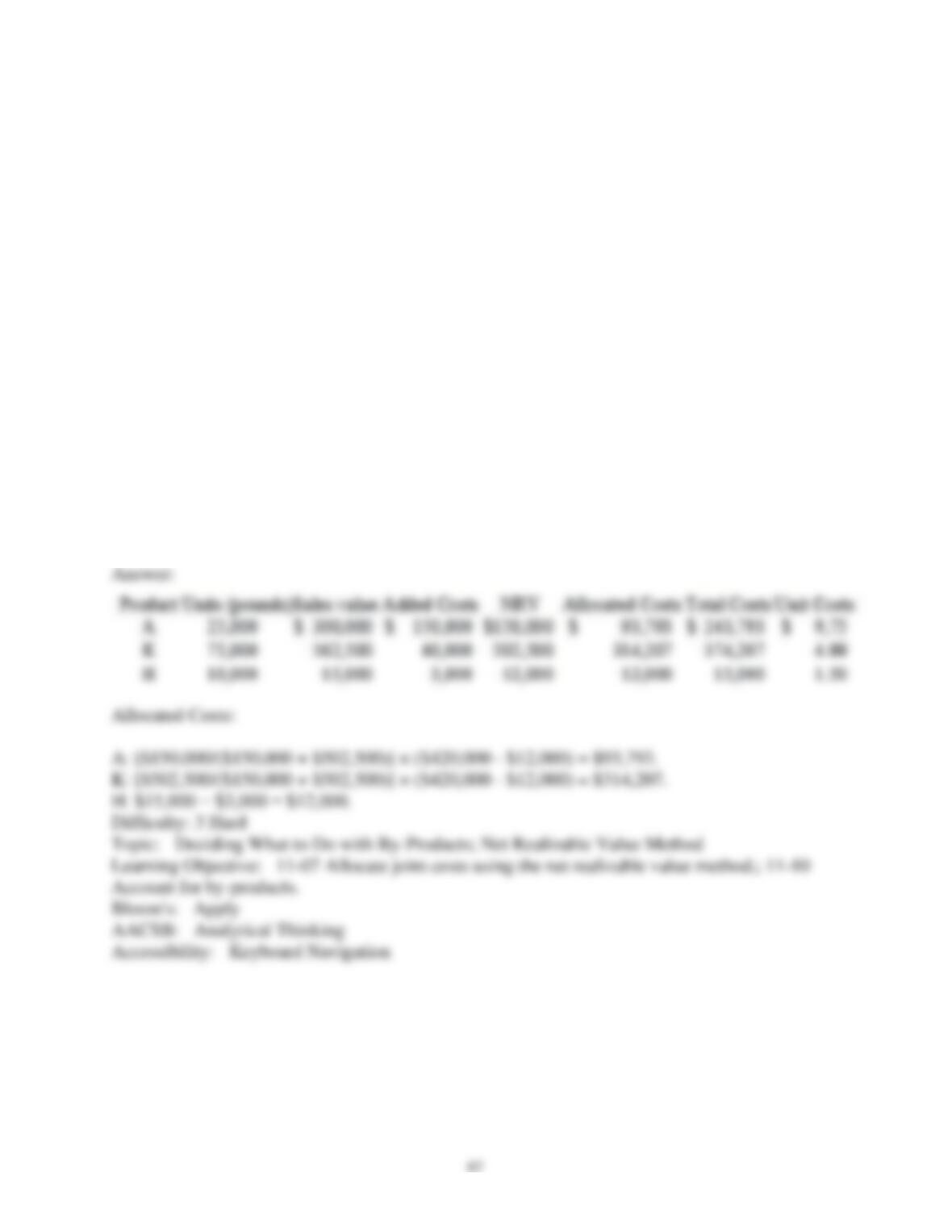
121) The Joplin Company conducts a simple chemical process in Department #1, which
produces three separate items: A, K, and H. A is processed further in Department #2. K is
processed further in Department #3. Product H is a by-product, to be accounted for by the cost
reduction method. The following information relates to September:
Department #1’s costs $420,000.
Department #2’s costs $150,000.
Department #3’s costs $60,000.
A: 25,000 pounds completed; 23,500 pounds sold for $12 per pound.
K: 75,000 pounds completed; 70,000 pounds sold for $7.50 per pound.
H: 10,000 pounds completed; 10,000 pounds sold for $1.50 per pound. (There are shipping costs
of $0.30 per pound.)
There were no beginning inventories.
Required:
Prepare a schedule to show the computation for the unit costs per pound for Products A, K, and
H assuming Joplin uses the estimated net realizable value method to allocate joint costs to the
main products.
88
122) Simpson Manufacturing Enterprises uses a joint production process that produces three
products at the split-off point. Joint production costs during April were $720,000. The company
uses the net realizable value method for allocating joint costs. Product information for April was
as follows:
Product
R S T
Gallons produced 2,500 5,000 7,500
Sales prices per gallon:
At the split-off $ 100 $ 80 $ 20
After further processing $ 150 $ 115 $ 30
Costs to process after split-off $ 150,000 $ 150,000 $ 100,000
Required:
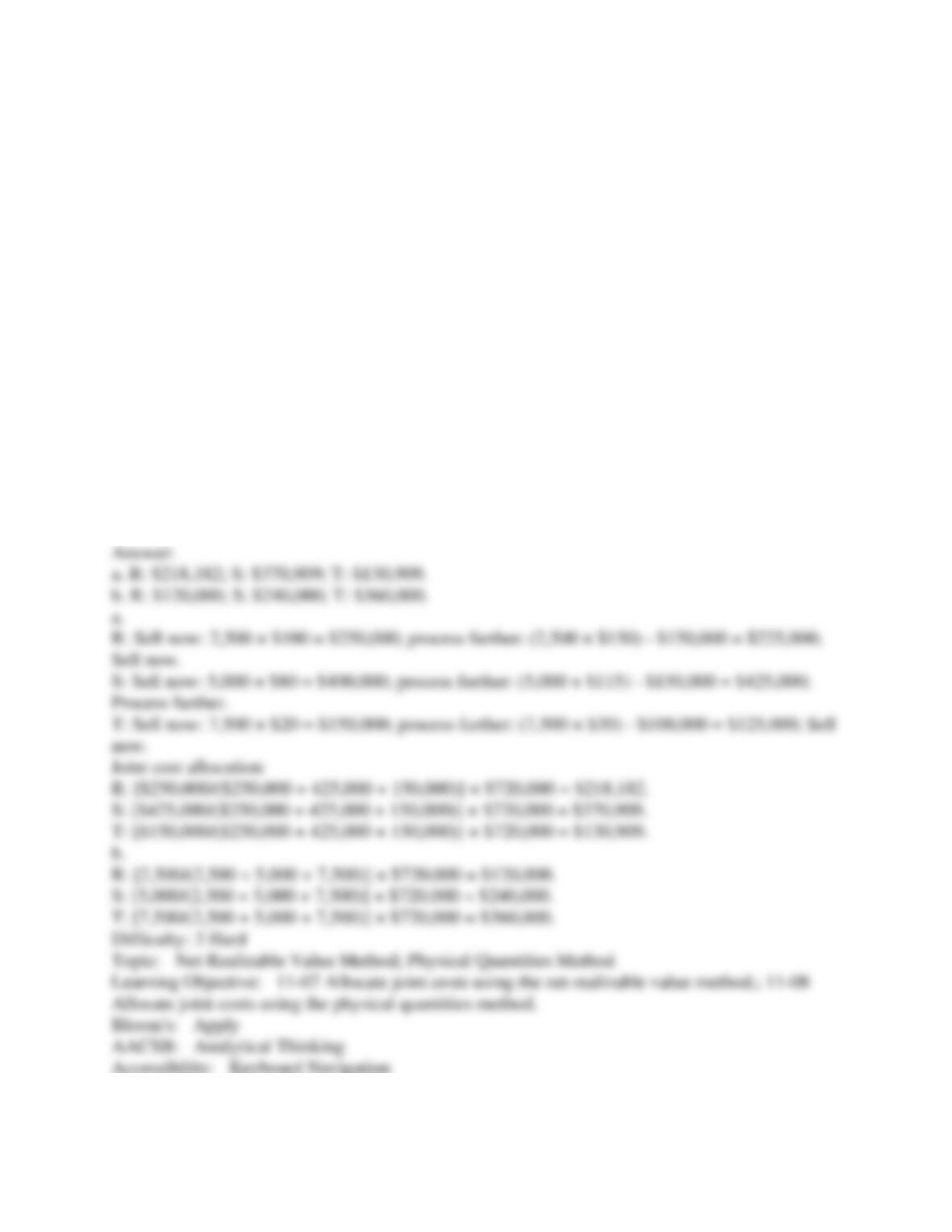
a. Assume that all three products are main products and that they can be sold at the split-off point
or processed further, whichever is economically beneficial to Simpson. Allocate the joint costs to
the three products.
b. Assume that Simpson uses the physical quantities method to allocate the joint costs. How
much would be allocated to each of the three products?
123) Clean-Burn, Inc. is a small petroleum company that acquires high-grade crude oil from low-
volume production wells owned by individuals and small partnerships. The crude oil is processed
in a single refinery into Two Oil, Six Oil, and impure distillates. Clean-Burn does not have the
technology or capacity to process these products further and sell most of its output each month to
major refineries. There were no inventories on November 1.
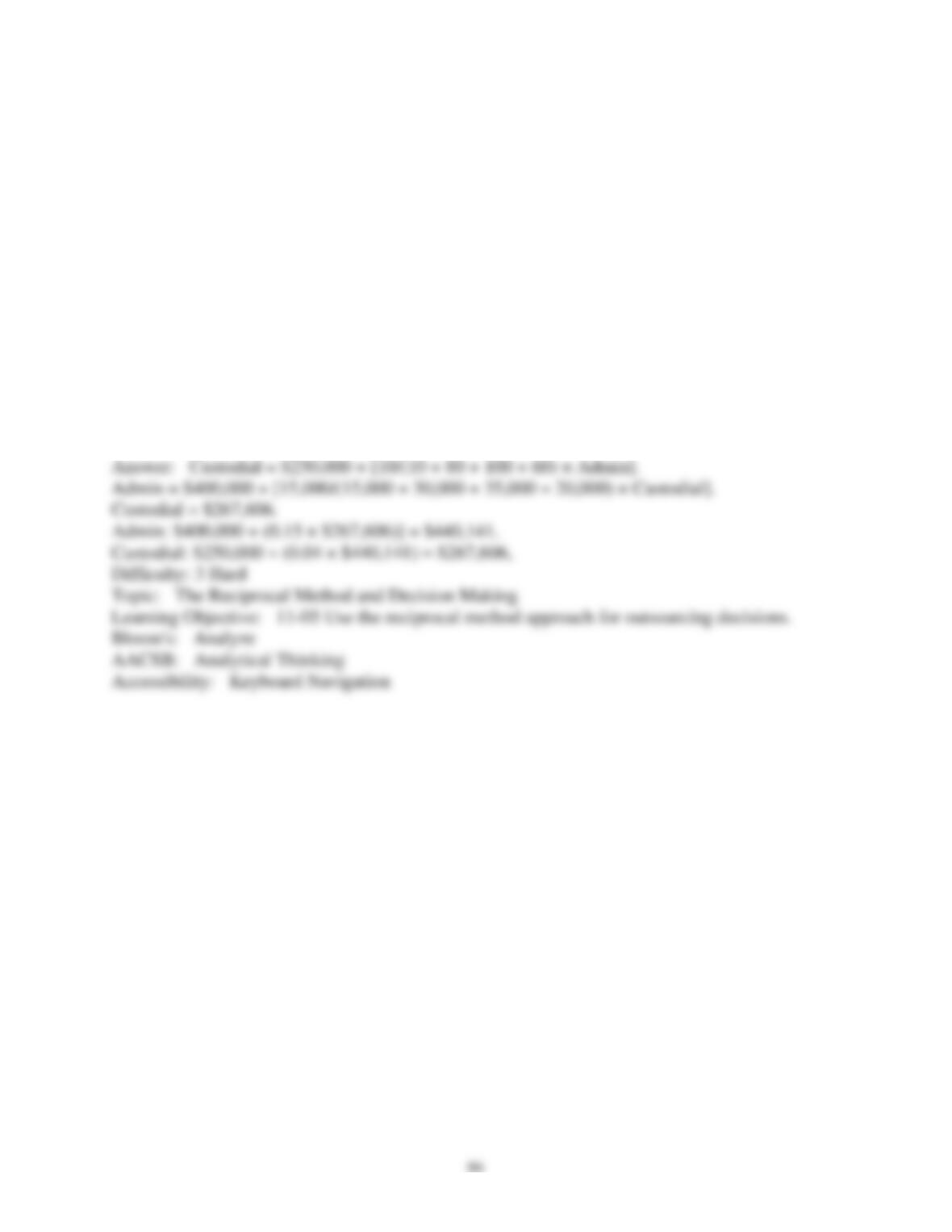
Crude oil acquired and placed into production $ 5,000,000
Direct labor and related costs 2,000,000
Refinery overhead 3,000,000
Production and sales
Two Oil, 300,000 barrels produced; 280,000 barrels sold at $20 each.
Six Oil, 240,000 barrels produced; 220,000 barrels sold at $30 each.
Distillates, 120,000 barrels produced and sold at $15 per barrel.
Required:
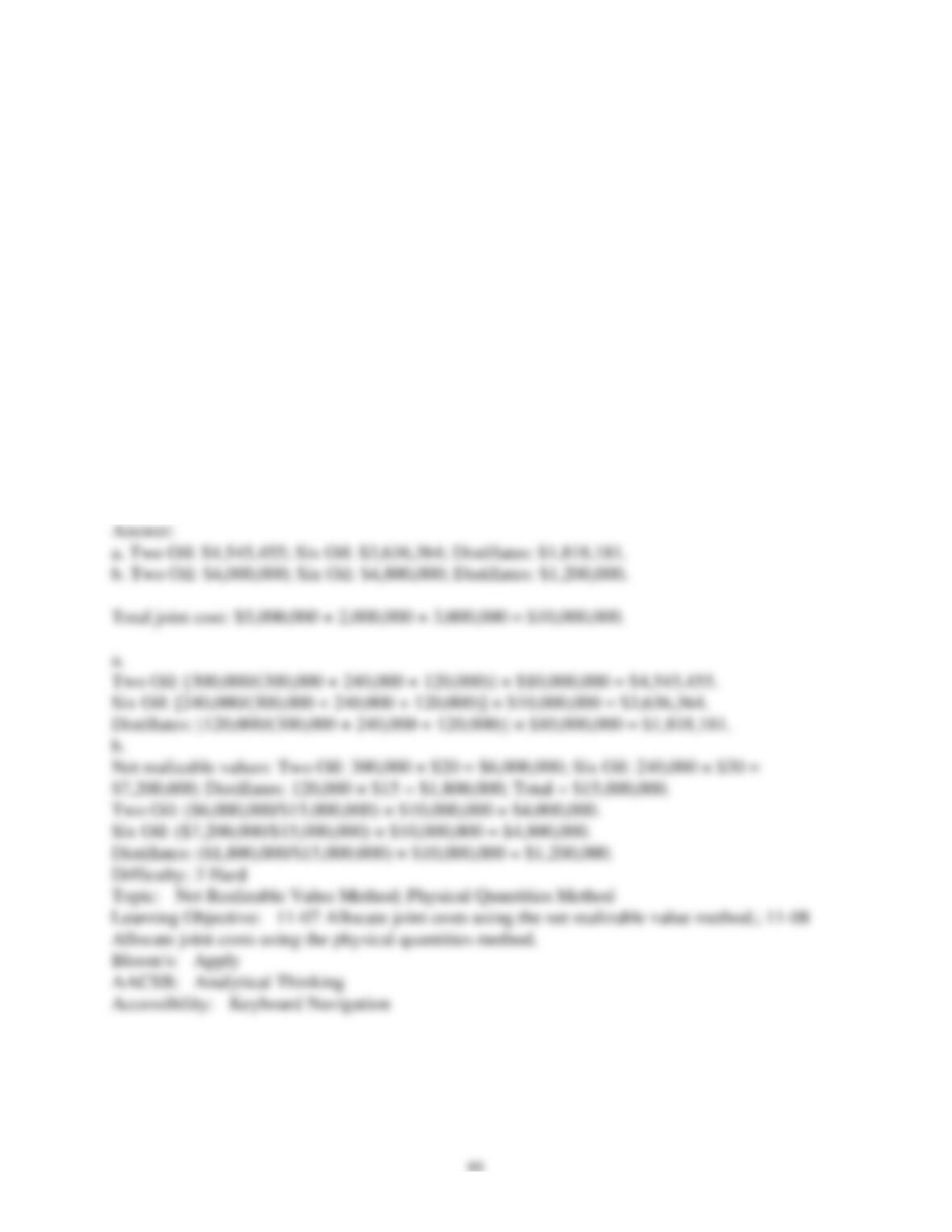
a. Allocate the joint costs to the products using the physical quantities method.
b. Allocate the joint costs to the products using the net realizable value method.
124) Smokey Enterprises buys Liquid Charcoal for $0.80 a gallon. At the end of processing in
Department 1, the liquid charcoal splits off into Products U, V, and W. Product U is sold at the
split-off point, with no further processing. Products V and W require further processing before
they can be sold; Product V is processed in Department 2, and Product W is processed in
Department 3. Following is a summary of costs and other related data for the most recent
accounting period:
Department
1 2 3
Cost of liquid charcoal $ 104,000
Direct labor $ 16,000 $ 45,000 $ 65,000
Manufacturing overhead $ 10,000 $ 27,000 $ 49,000
Products
U V W
Gallons sold 20,000 30,000 50,000
Gallons on hand end of period 15,000 0 15,000
Sales in dollars $ 30,000 $ 96,000 $ 142,000
There were no beginning inventories and there was no liquid charcoal on hand at the end of the
period. All gallons on hand in ending inventory were complete as to processing.
Required:
a. Determine the product cost for U, V, and W, assuming the physical quantities method is used
to allocate joint costs.
b. Determine the product cost for U, V, and W, assuming the net realizable value method is used
to allocate joint costs.
125) The Wang Company conducts a simple chemical process in Department #1, which produces
three separate items: A, B, and C. A is processed further in Department #2. B is processed
further in Department #3. Product C can be sold immediately. The following information relates
to October:
Department #1’s costs $540,000.
Department #2’s costs $120,000.
Department #3’s costs $300,000.
A: 25,000 pounds completed; 23,500 pounds sold for $12 per pound.
B: 75,000 pounds completed; 70,000 pounds sold for $7.50 per pound.
C: 50,000 pounds completed; 46,000 pounds sold for $5.00 per pound.
There were no beginning inventories.
Required:
a. Allocate the joint process costs to Products A, B, and C assuming the estimated net realizable
value method is used.
b. Allocate the joint process costs to products A, B, and C assuming the physical quantities
method is used.
126) The Marketplace Corporation produces two consumer products and a by-product. Zylon is
ready for sale after split-off, while Qytol must be further processed. The by-product is a heavy
residue in the bottom of the vat. The net realizable value of the by-product is credited against the
$565,000 joint cost of the Heating Department. Volume and cost data for February is as follows:
Gallons
Produced Selling Price Additional
Processing
Zylon 200,000 $ 2.00 0
Qytol 400,000 1.10 $ 40,000
By-Product 5,000 0.50 0
Required:
a. Allocate the Heating Department cost to the products using the physical quantities method.
b. Allocate the Heating Department cost to the products using the estimated net realizable value
(workback) method.
127) The Delicious Canning Company processes tomatoes into ketchup, tomato juice, and
canned tomatoes. During the summer, the joint costs of processing the tomatoes were $420,000.
There were no beginning or ending inventories for the summer. Production and sales value
information for the summer were as follows:
Product Cases Additional Costs Selling Price
Ketchup 100,000 $ 3.00 per case $ 28 per case
Juice 150,000 5.00 per case $ 25 per case
Canned 200,000 2.50 per case 10 per case
Required:
a. Determine the amount allocated to each product if the estimated net realizable value method is
used.
b. Determine the amount allocated to each product if the physical quantities method is used.
128) The Joplin Company conducts a simple chemical process in Department #1, which
produces three separate items: A, K, and H. A is processed further in Department #2. K is
processed further in Department #3. Product H is a by-product, to be accounted for by the other
revenue method. The following information relates to September:
Department #1’s costs $420,000.
Department #2’s costs $150,000.
Department #3’s costs $60,000.
A: 25,000 pounds completed; 23,500 pounds sold for $12 per pound.
K: 75,000 pounds completed; 70,000 pounds sold for $7.50 per pound.
H: 10,000 pounds completed; 10,000 pounds sold for $1.50 per pound. (There are shipping costs
of $0.30 per pound.)
There were no beginning inventories.
Required:
Prepare a schedule to show the computation for the unit costs per pound for Products A, K, and
H assuming Joplin uses the physical quantities method to allocate joint costs to the main
products.
129) Highlands, Inc. operates a sawmill facility. The company accounts for the sawdust that
results from the primary sawing operation as a by-product. The sawdust is sold to another
company at a price of $1.00 per hundred cubic feet. Normally, sales revenue from the sawdust is
$21,200 per month. The sawdust is charged to inventory at $2.20 per hundred cubic feet,
although there is no direct cost to process it.
As an alternative, Highlands can rent equipment that will process the dust into imitation logs for
fireplaces. These logs sell for $25.00 per log to wholesalers, who package and add scent to them.
75 logs can be produced from 100 cubic feet of sawdust.
Cost of the equipment to produce these logs and the additional personnel required to operate the
equipment are $360,000 per month, regardless of the output.
Required:
Should Highlands sell the sawdust for $1.00 per hundred cubic feet or process it into imitation
logs? Support your answer with the appropriate calculations.
96
130) Voorhees Manufacturing Corporation produces three products in a joint process. Additional
information is as follows:
Product O P Q Total
Units produced 42,000 50,000 8,000 100,000
Sales value at split off $ 250,000 $ 50,000 $ 20,000 $ 320,000
Additional costs if processed further $ 18,000 $ 30,000 $ 10,000 $
58,000
Sales value if processed further $ 290,000 $ 70,000 $ 25,000 $
385,000
Joint costs $ 300,000
Product weights in pounds 84,000 150,000 8,000 242,000
Required:
(a) Determine which products should be sold at split-off and which should be processed further.
(b) Assuming Voorhees makes decisions that are in its best interest for overall profitability, what
would be the company’s gross margin?
131) Ridgeline Enterprises produces three products in a joint process. Products A and B are
processed further. Additional information is as follows:
A B C Total
Units produced 42,000 50,000 8,000 100,000
Sales value at split-off $ 250,000 $ 30,000 $ 20,000 $ 300,000
Additional costs if processed further $ 18,000 $ 30,000 $ 0 $
48,000
Sales value if processed further $ 290,000 $ 70,000 $ 0 $
360,000
Joint Costs $ 200,000
Product Weight in pounds 168,000 300,000 32,000 500,000
Required:
(a) Allocate the joint costs, assuming that all products are joint products and joint-costs are
allocated using the physical quantities method.
(b) Allocate the joint costs using the physical quantities method, assuming that product C is
considered a by-product, whose sales value is deducted from the total joint costs.
98
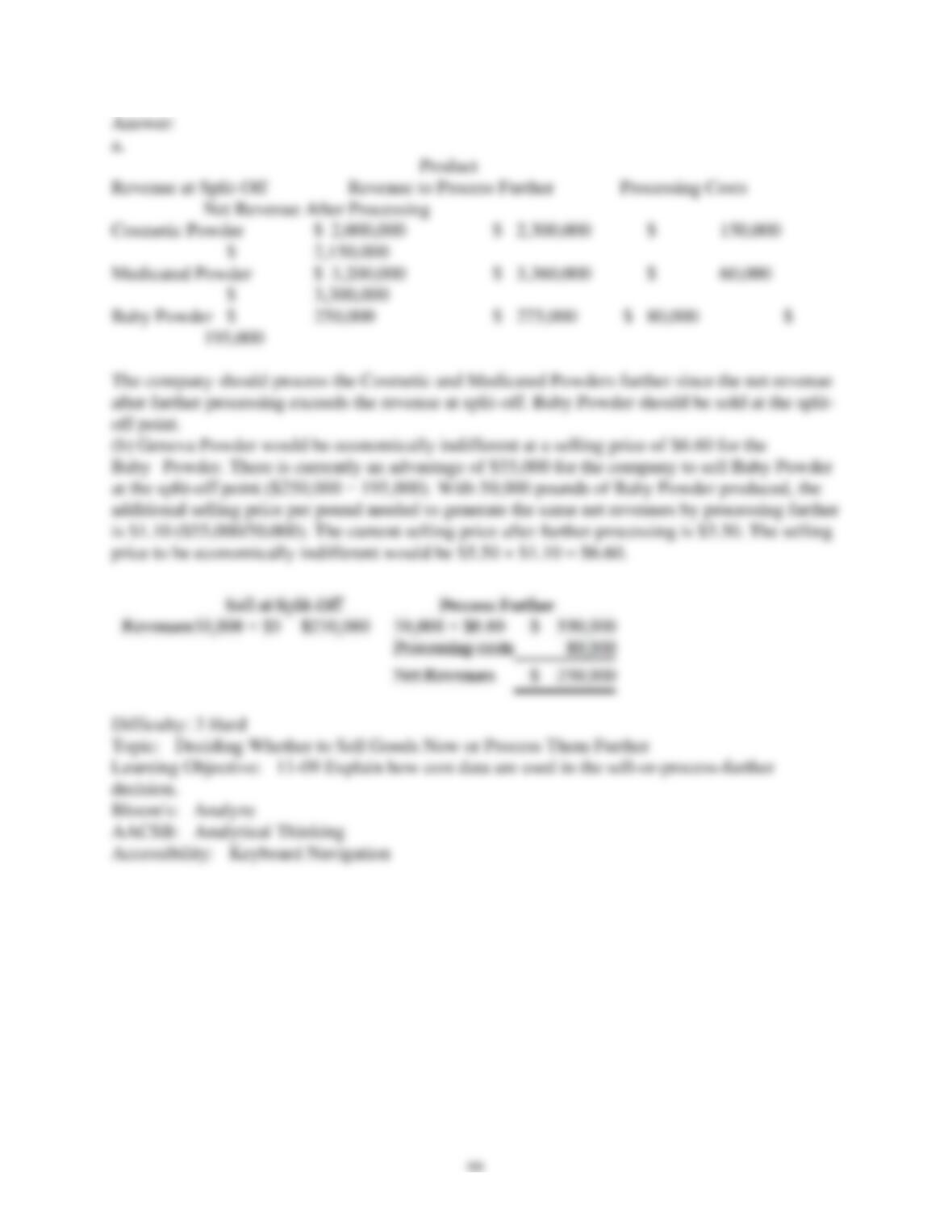
132) Geneva Powder Company produces body powders in batches. Each type of powder can be
sold in its current condition or processed further and specialized for high-priced department
stores. Joint processing costs are $200,000. Data concerning the various products appear below:
Type of Powder Number of Pounds Price per Pound
at Split-Off Further Processing Costs Price after Processing
Further
Cosmetic Powder 200,000 $ 10 $ 150,000 $ 11.50
Medicated Powder 400,000 $ 8 $ 60,000 $ 8.40
Baby Powder 50,000 $ 5 $ 80,000 $ 5.50
Required:
(a) Determine which products should be sold at split-off and which should be processed further.
(b) The Regis Department Store approaches Geneva Powder. Regis would like Geneva Powder
to process Baby Powder into a special powder for its infants department. At what price per
pound would Geneva Powder be economically indifferent between selling the powder at the
split-off point and processing it further for Regis?
133) Indicate whether the following costs would be treated as joint product costs or costs
incurred after the split-off point. Use J for joint product costs and S for costs incurred after the
split-off point.
(a) Cost of planting, growing and picking pineapples in a pineapple factory
(b) Costs of processing apples at a cider mill
(c) Costs of processing pineapples into juice and sliced pineapples
(d) Depreciation on oil rigs for an oil producer
(e) Costs of running a fishing boat used to catch varieties of fish, lobsters, etc.
(f) Labor costs, of “shucking” clams to produce clam chowder
(g) Costs of chopping onions to be used in spaghetti sauce and soup in a food manufacturer
(h) Cost of processing rejected meat parts into hot dogs in a meat processing plant
(i) Cost of processing wood and sawdust into particle board in a sawmill
(j) Ingredients and packaging added to batches of spaghetti in (g) above
(k) Costs of refining gasoline in (d) above
(l) Processing of pulp into paperboard in a paper manufacturer
(m) Utility costs of processing timber for a lumber manufacturer