105. If by-product revenue is treated as other revenue instead of deducted from the net–
realizable-value of the main products:
11–82
106. Computer Information Services is a computer software consulting company. Its three
major functional areas are computer programming, information systems consulting, and software
training. Carol Birch, a pricing analyst in the Accounting Department, has been asked to develop
total costs for the functional areas. These costs will be used as a guide in pricing a new contract.
In computing these costs, Birch is considering three different methods of allocating overhead
costs-the direct method, the step method, and the reciprocal method. Birch assembled the
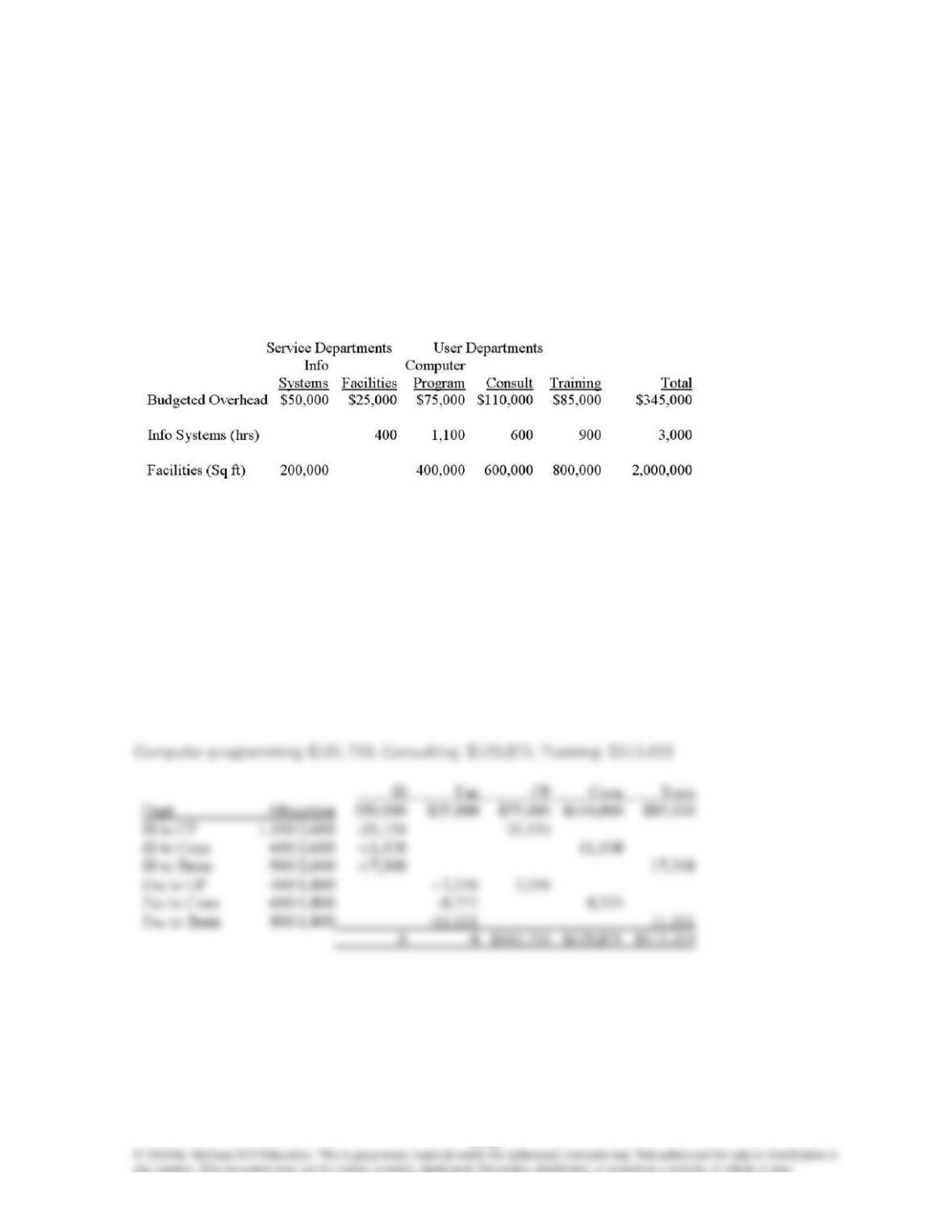
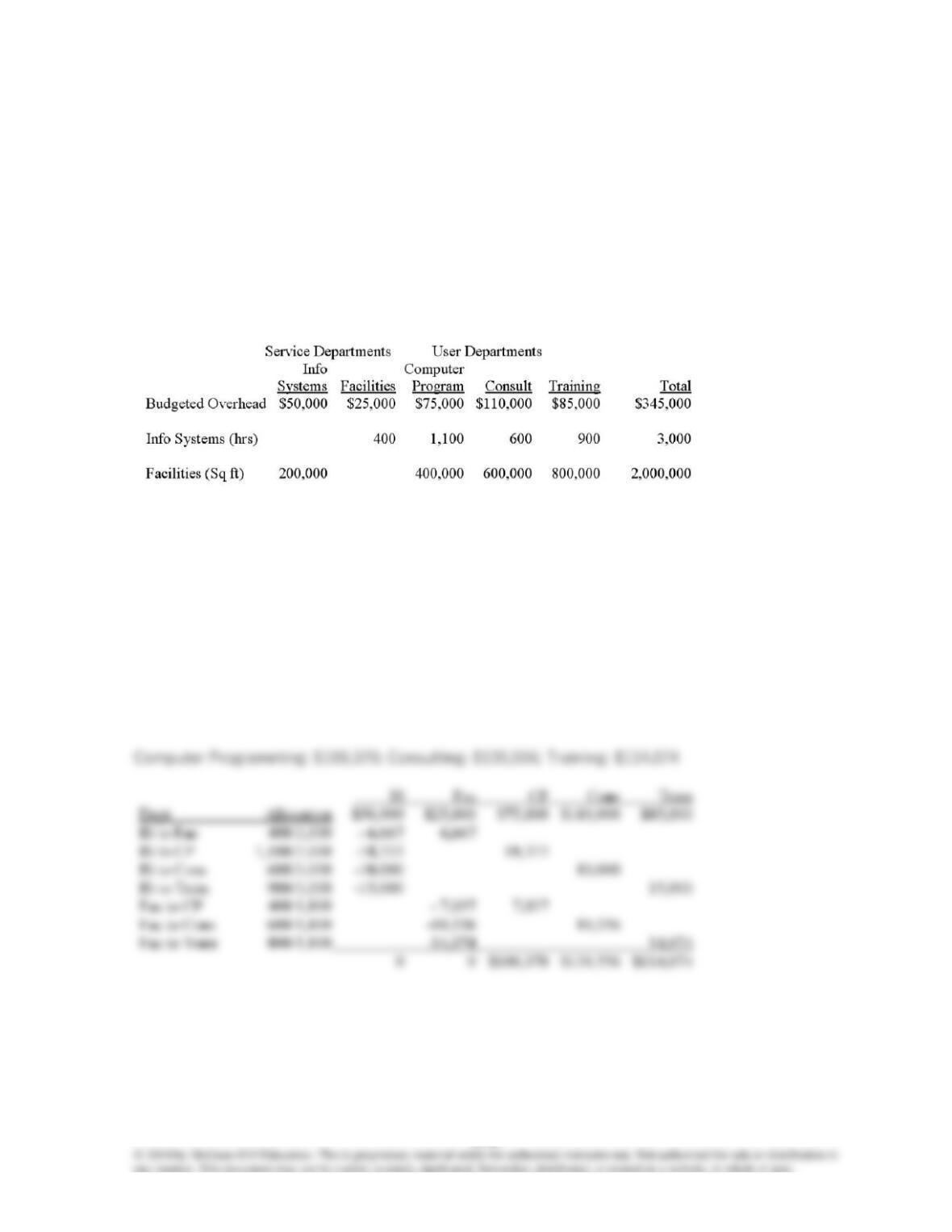
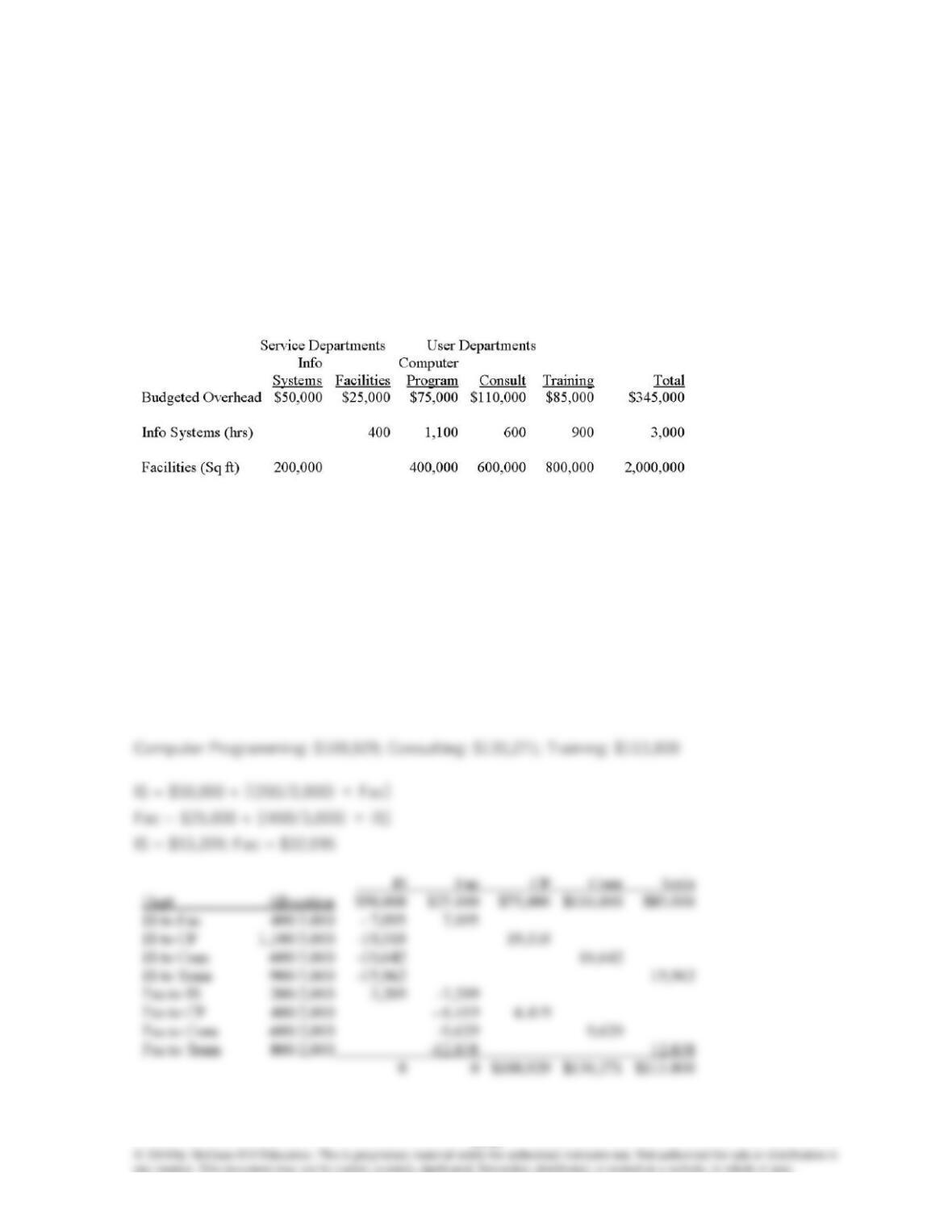
following data on overhead from its two service departments, the Information Systems
Department and the Facilities Department.
Information systems is allocated on the basis of hours of computer usage; facilities are allocated
on the basis of floor space.
Required:
Allocate the service department costs to the user departments using the direct method. (Round to
the nearest dollar and provide total user department costs)
11–83
107. Computer Information Services is a computer software consulting company. Its three
major functional areas are computer programming, information systems consulting, and software
training. Carol Birch, a pricing analyst in the Accounting Department, has been asked to develop
total costs for the functional areas. These costs will be used as a guide in pricing a new contract.
In computing these costs, Birch is considering three different methods of allocating overhead
costs-the direct method, the step method, and the reciprocal method. Birch assembled the
following data on overhead from its two service departments, the Information Systems
Department and the Facilities Department.
Information systems is allocated on the basis of hours of computer usage; facilities are allocated
on the basis of floor space.
Required:
Allocate the service department costs to the user departments using the step method. Allocate
Information Systems first and round to the nearest dollar. Provide total user department costs.
11–84
108. Computer Information Services is a computer software consulting company. Its three
major functional areas are computer programming, information systems consulting, and software
training. Carol Birch, a pricing analyst in the Accounting Department, has been asked to develop
total costs for the functional areas. These costs will be used as a guide in pricing a new contract.
In computing these costs, Birch is considering three different methods of allocating overhead
costs-the direct method, the step method, and the reciprocal method. Birch assembled the
following data on overhead from its two service departments, the Information Systems
Department and the Facilities Department.
Information systems is allocated on the basis of hours of computer usage; facilities are allocated
on the basis of floor space.
Required:
Allocate the service department costs to the user departments using the reciprocal method.
Round to the nearest dollar.
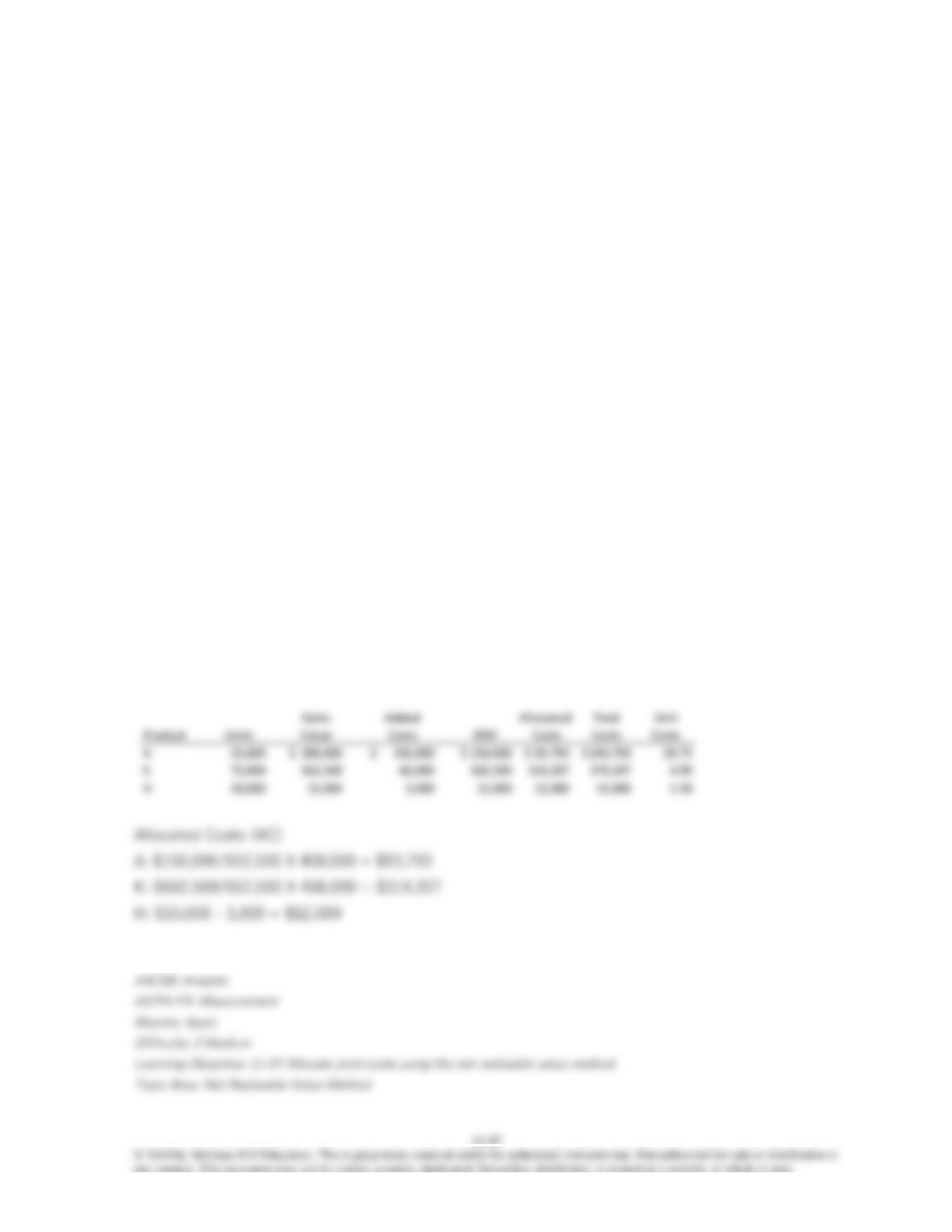
109. The Darl Company conducts a simple chemical process in Department #1, which produces
three separate items: A, K, and H. A is processed further in Department #2. K is processed further
in Department #3. Product H is a by-product, to be accounted for by the cost reduction method.
The following information relates to September:
Department #1’s costs $420,000.
Department #2’s costs $150,000.
Department #3’s costs $60,000.
A: 25,000 pounds completed; 23,500 pounds sold for $12 per pound.
K: 75,000 pounds completed; 70,000 pounds sold for $7.50 per pound.
H: 10,000 pounds completed; 10,000 pounds sold for $1.50 per pound. (There are shipping costs
of $0.30 per pound.)
There were no September 1st inventories.
Required:
Prepare a schedule to show the computation for the unit costs per pound for Products A, K, and H
assuming Darl uses the estimated net realizable value method to allocate joint costs to the main
products.
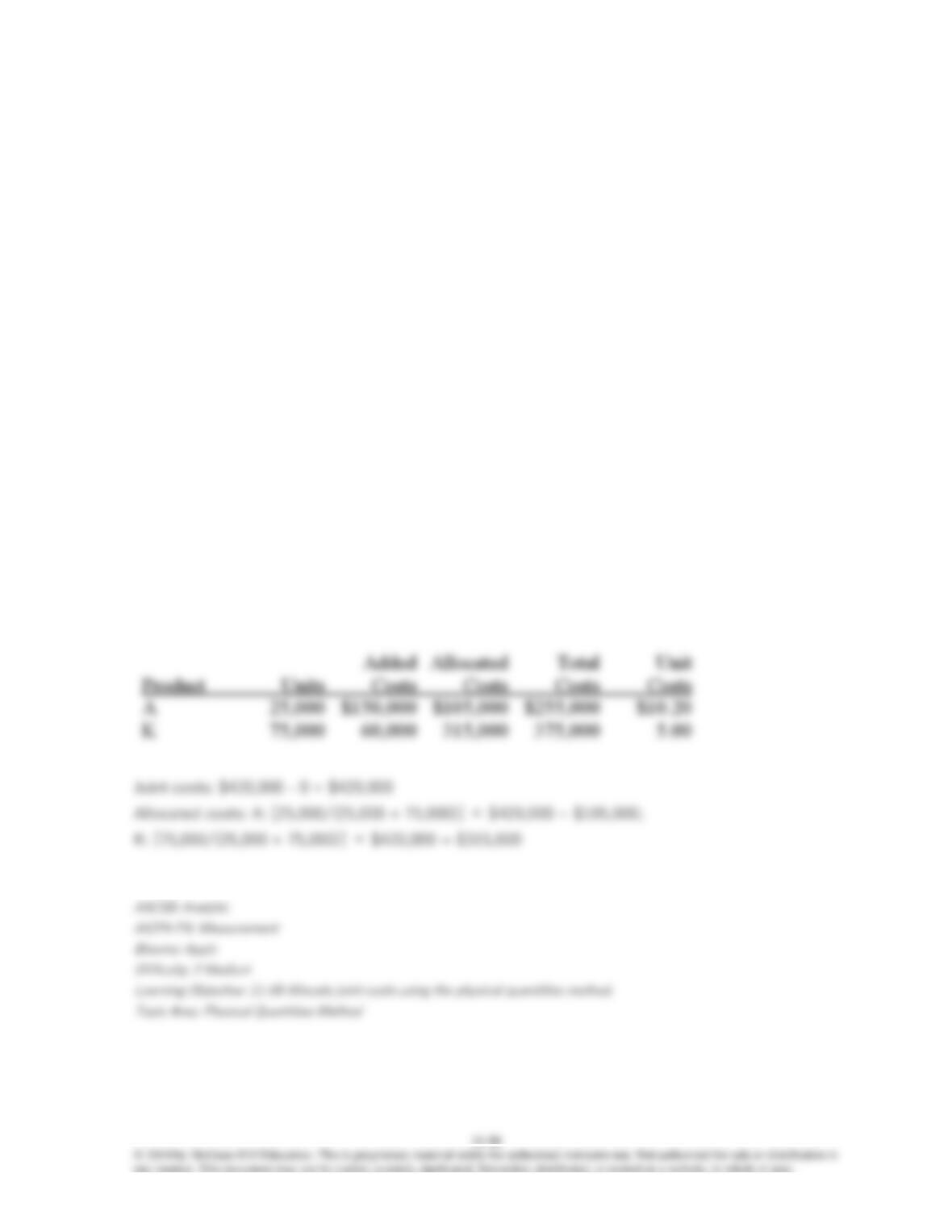
110. The Darl Company conducts a simple chemical process in Department #1, which produces
three separate items: A, K, and H. A is processed further in Department #2. K is processed further
in Department #3. Product H is a by-product, to be accounted for by the other revenue method.
The following information relates to September:
Department #1’s costs $420,000.
Department #2’s costs $150,000.
Department #3’s costs $60,000.
A: 25,000 pounds completed; 23,500 pounds sold for $12 per pound.
K: 75,000 pounds completed; 70,000 pounds sold for $7.50 per pound.
H: 10,000 pounds completed; 10,000 pounds sold for $1.50 per pound. (There are shipping costs
of $0.30 per pound.)
There were no September 1st inventories.
Required:
Prepare a schedule to show the computation for the unit costs per pound for Products A, K, and H
assuming Darl uses the physical quantities method to allocate joint costs to the main products.
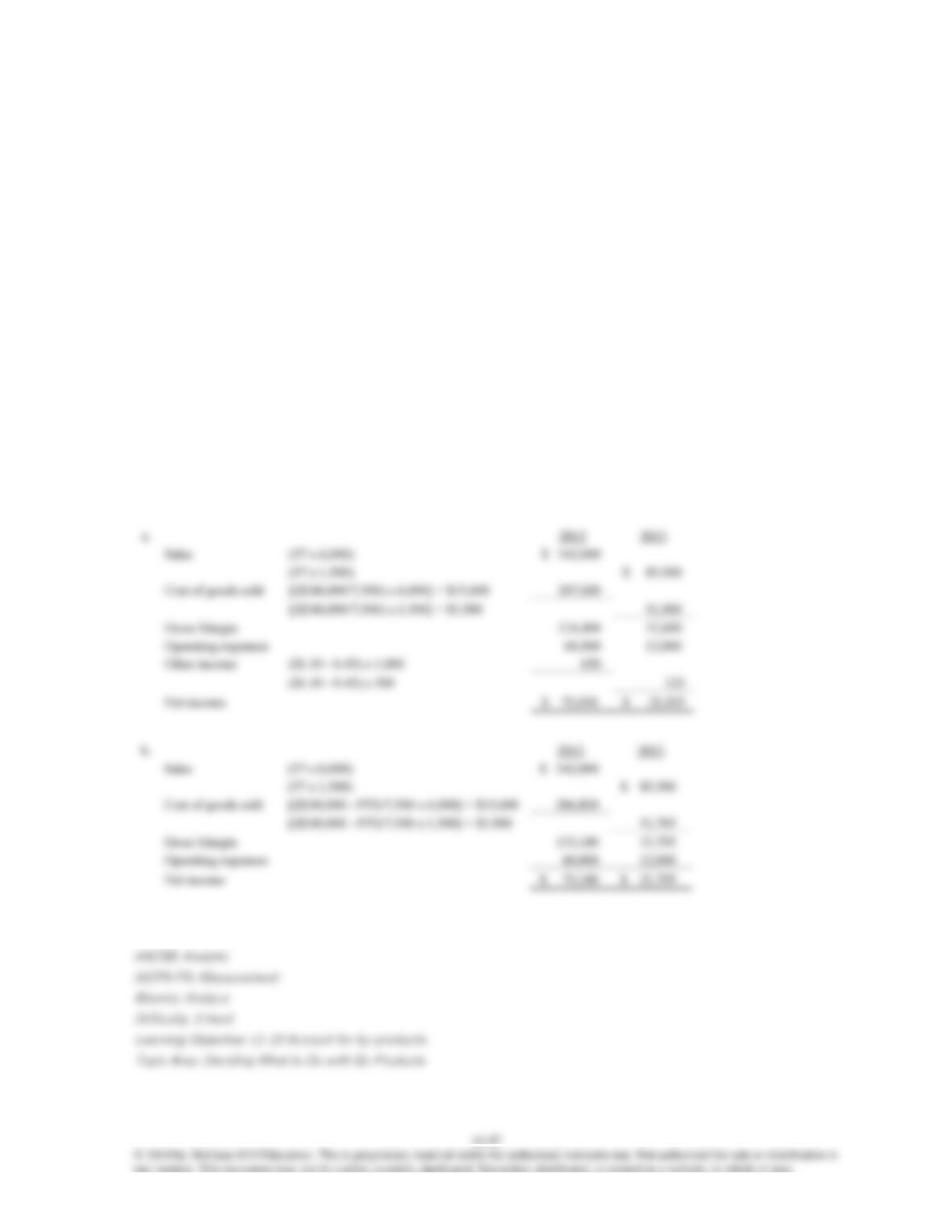
111. The McClean Manufacturing Company started the production of K1 (its main product) and
S2 (its by-product) on January 2, 2012. During 2012, 7,500 units of K1 and 1,500 units of S2 were
produced. In 2012, 6,000 units of K1 and 1,000 units of S2 were sold at $57.00 and $1.10 per unit,
respectively. Production was halted at the end of 2012 and the inventory was sold in 2013 at the
normal selling prices. The joint production costs were $240,000 and are entirely avoidable. The
separable costs to produce K1 were $2.60 per unit and to produce S2 were $0.45 per unit.
Operating expenses were $60,000 in 2012 and $12,000 in 2013.
Required:
a. Prepare an income statement for 2012 and 2013 assuming the “other revenue” method of
accounting for by-products is used.
b. Prepare an income statement for 2012 and 2013, assuming the “cost reduction” method of
accounting for by-products is used.
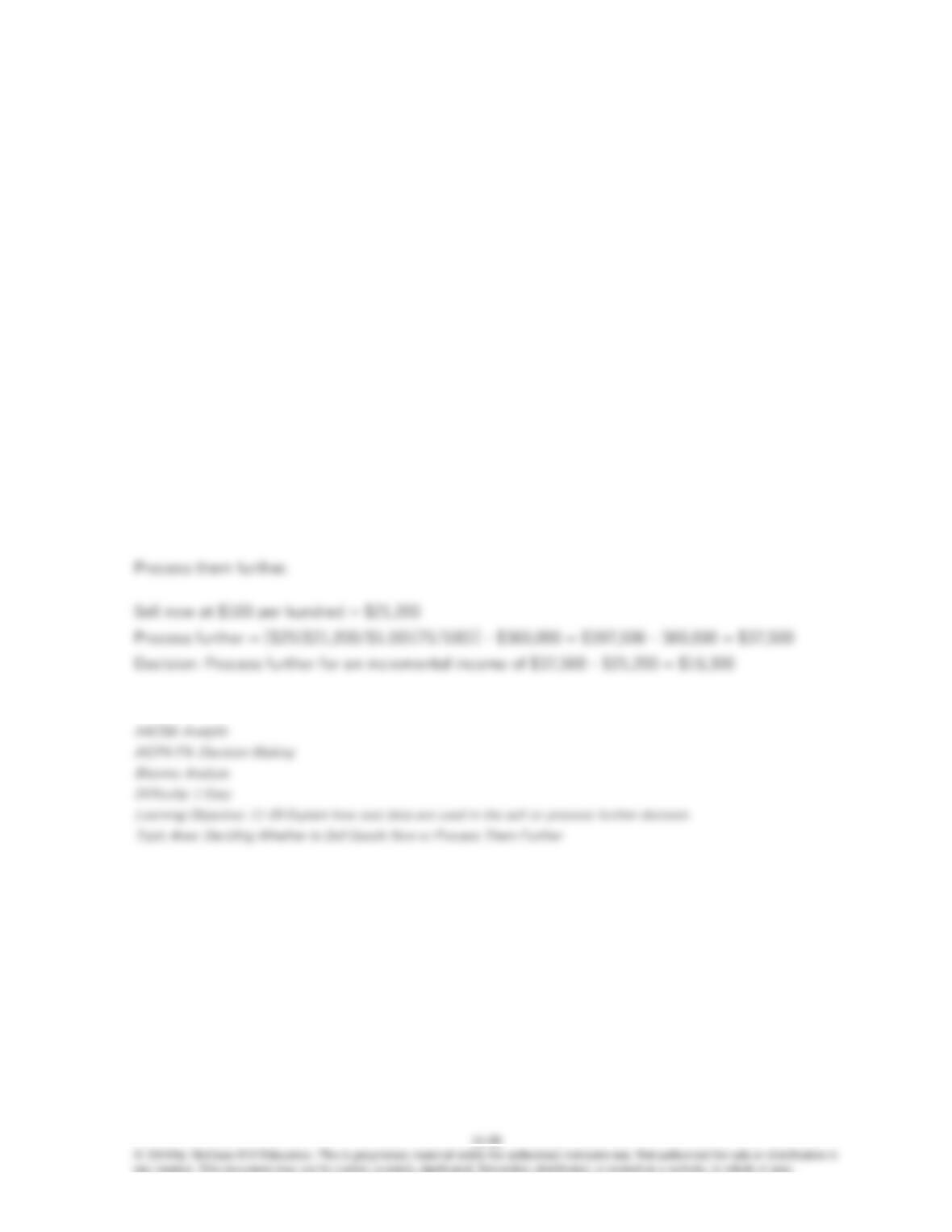
112. Canadian Mills, Inc. operates a sawmill facility. The company accounts for the sawdust
that results from the primary sawing operation as a by-product. The sawdust is sold to another
company at a price of $1.00 per hundred cubic feet. Normally, sales revenue from the sawdust is
$21,200 per month. The sawdust is charged to inventory at $2.20 per hundred cubic feet, although
there is no direct cost to process it.
As an alternative, the company can rent equipment that will process the dust into imitation logs
for fireplaces. These logs sell for $25.00 per hundred to wholesalers, who package and add scent
to them. 75 logs can be produced from 100 cubic feet of sawdust.
Cost of the equipment to produce these logs and the additional personnel required to operate the
equipment are $360,000 per month, regardless of the output.
Required:
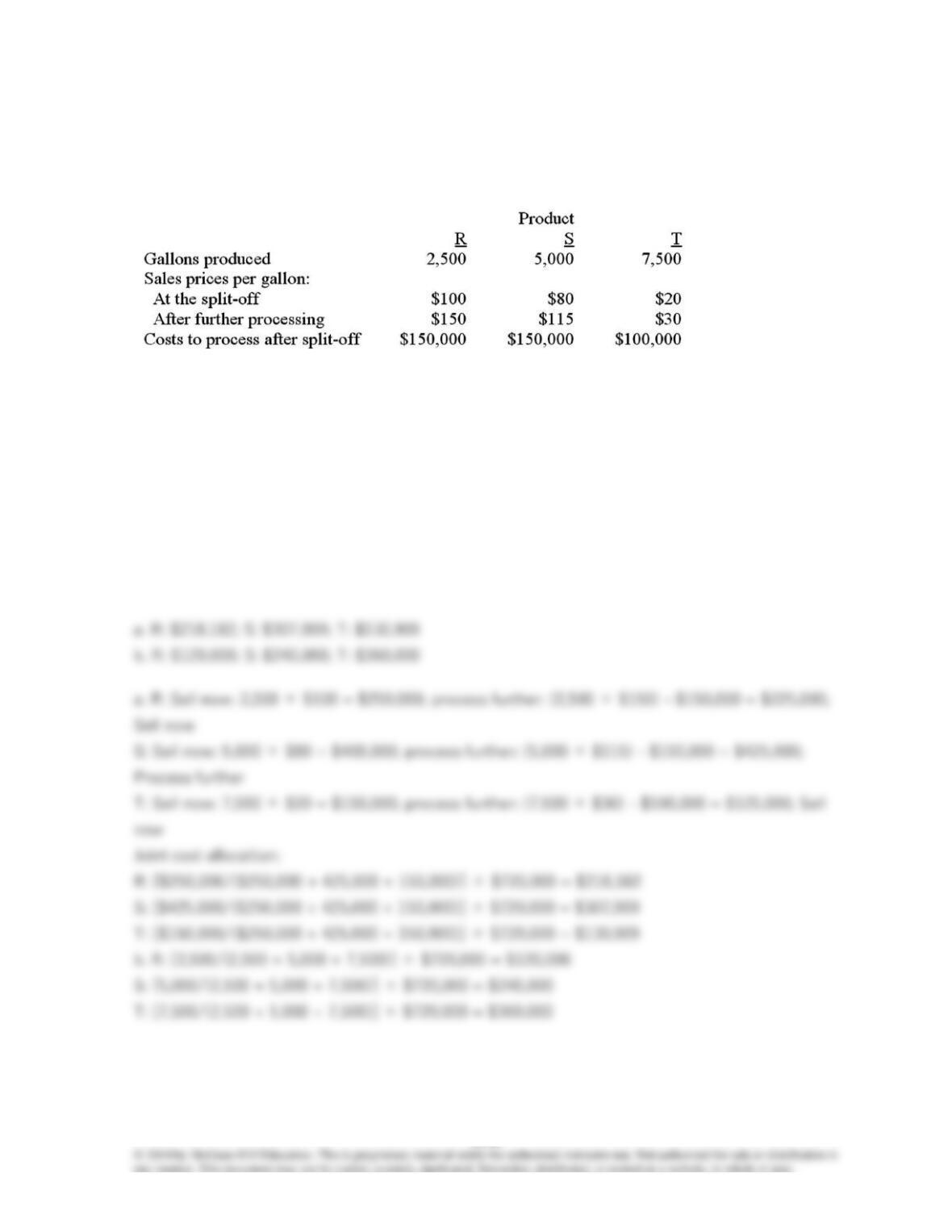
A) Should the company sell the sawdust for $1.00 per hundred cubic feet or process it into
imitation logs? Support your answer with the appropriate calculations.
11–89
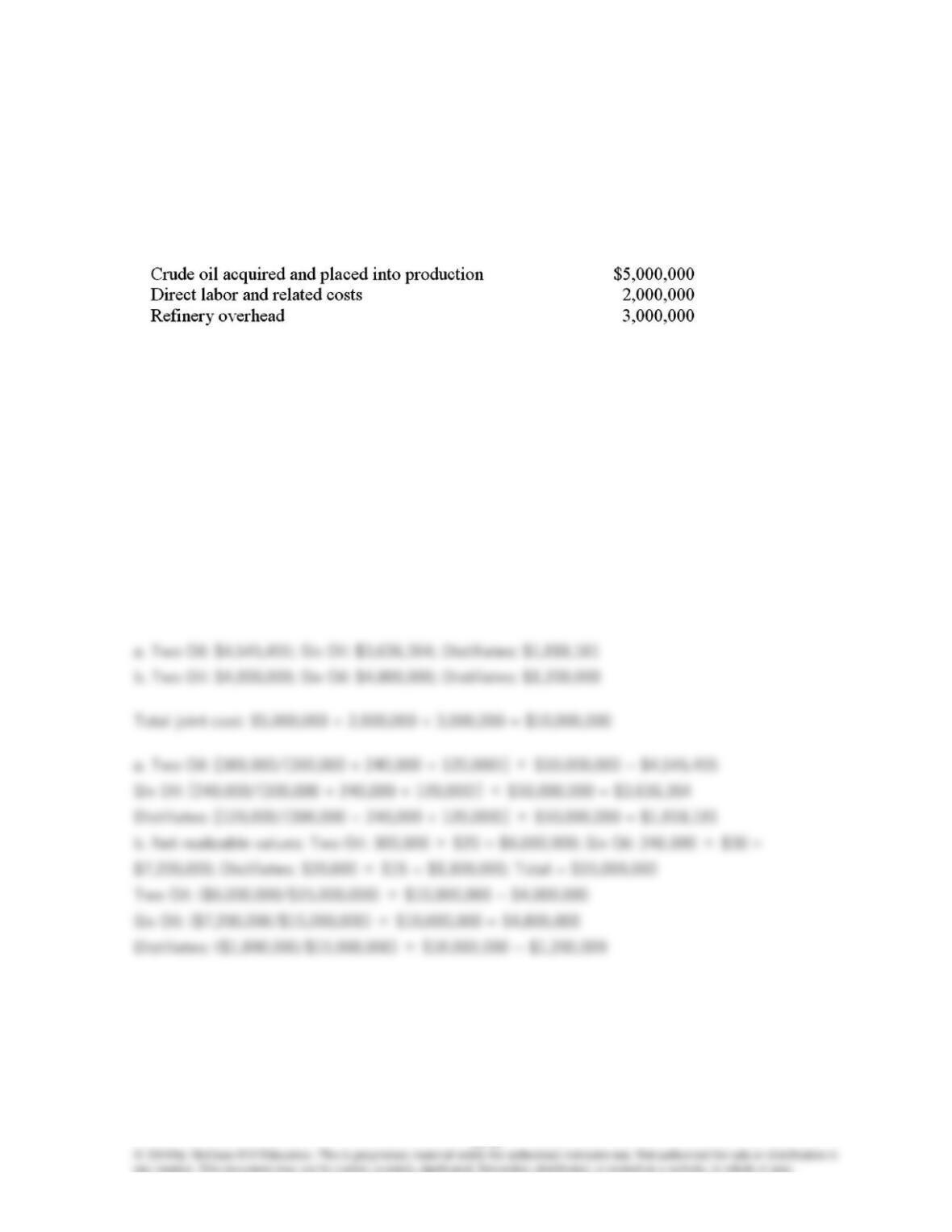
113. A manufacturing company uses a joint production process that produces three products at
the split-off point. Joint production costs during April were $720,000. The company uses the net
realizable value method for allocating joint costs. Product information for April was as follows:
Required:
a. Assume that all three products are main products and that they can be sold at the split–off
point or processed further, whichever is economically beneficial to the company. Allocate the joint
costs to the three products.
b. Assume that the company uses the physical quantities method to allocate the joint costs. How
much would be allocated to each of the three products?
11–90
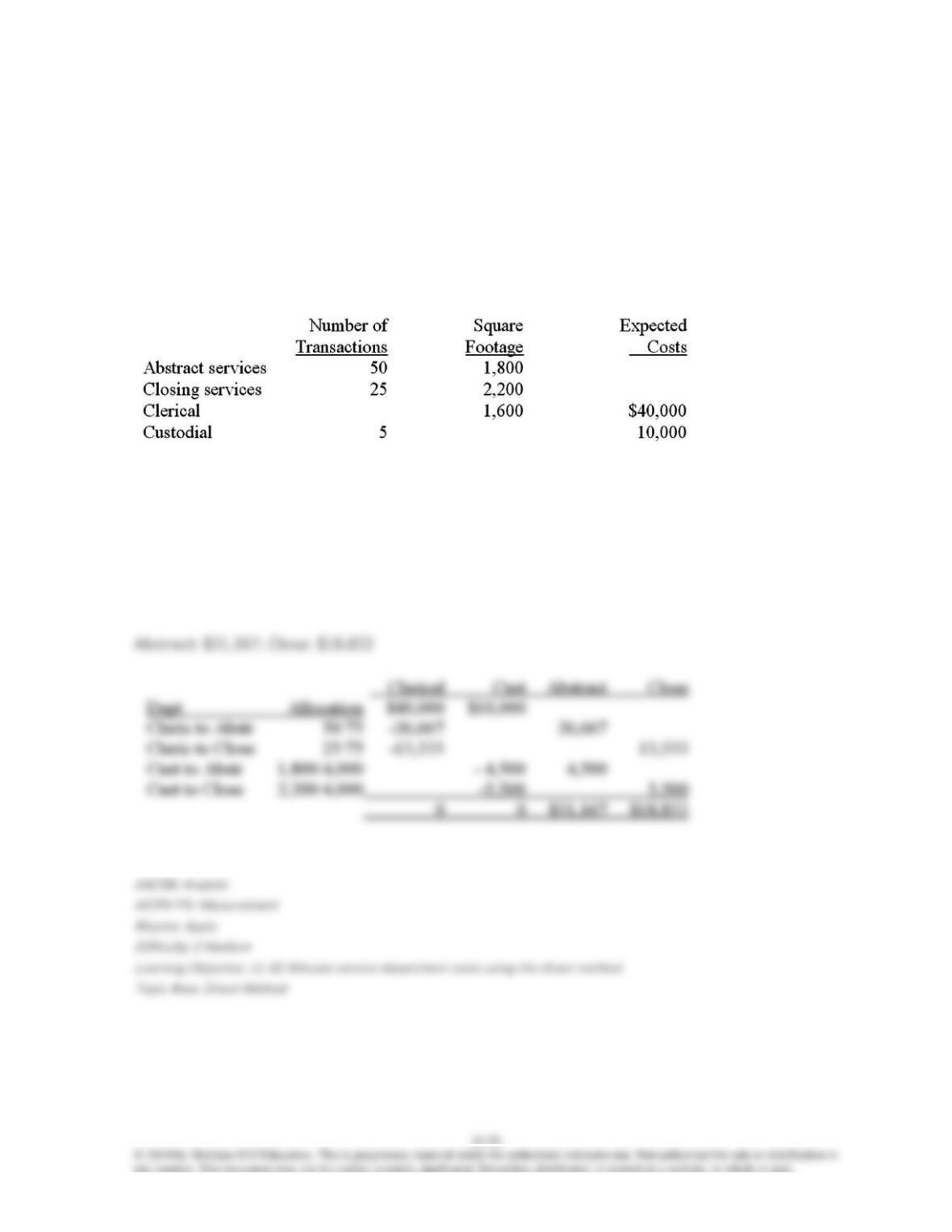
114. Petro-Chem Inc. is a small company that acquires high-grade crude oil from low-volume
production wells owned by individuals and small partnerships. The crude oil is processed in a
single refinery into Two Oil, Six Oil, and impure distillates. Petro-Chem does not have the
technology or capacity to process these products further and sells most of its output each month
to major refineries. There were no inventories on November 1.
Production and sales
Two Oil, 300,000 barrels produced; 280,000 barrels sold at $20 each.
Six Oil, 240,000 barrels produced; 220,000 barrels sold at $30 each.
Distillates, 120,000 barrels produced and sold at $15 per barrel.
Required:
a. Allocate the joint costs to the products using the physical quantities method.
b. Allocate the joint costs to the products using the net realizable value method.
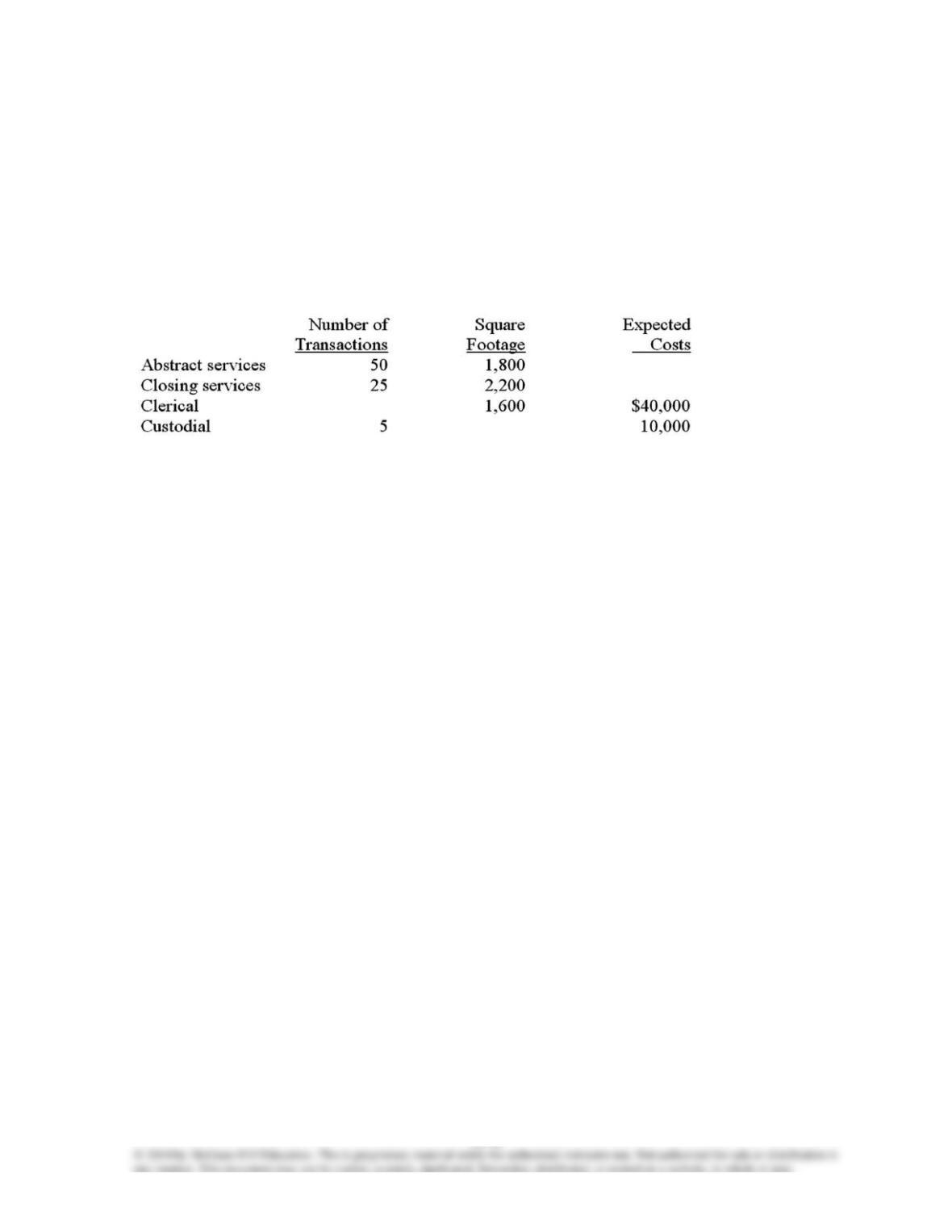
115. Harry Dorffman owns and operates Harry’s Abstracting Service. Harry’s two revenue
generating operations (Abstracting Services and Closing Services) are supported by two service
departments: Clerical and Custodial. Costs in the service departments are allocated in the
following order using the designated allocation bases.
Clerical: number of transactions processed.
Custodial: square footage of space occupied.
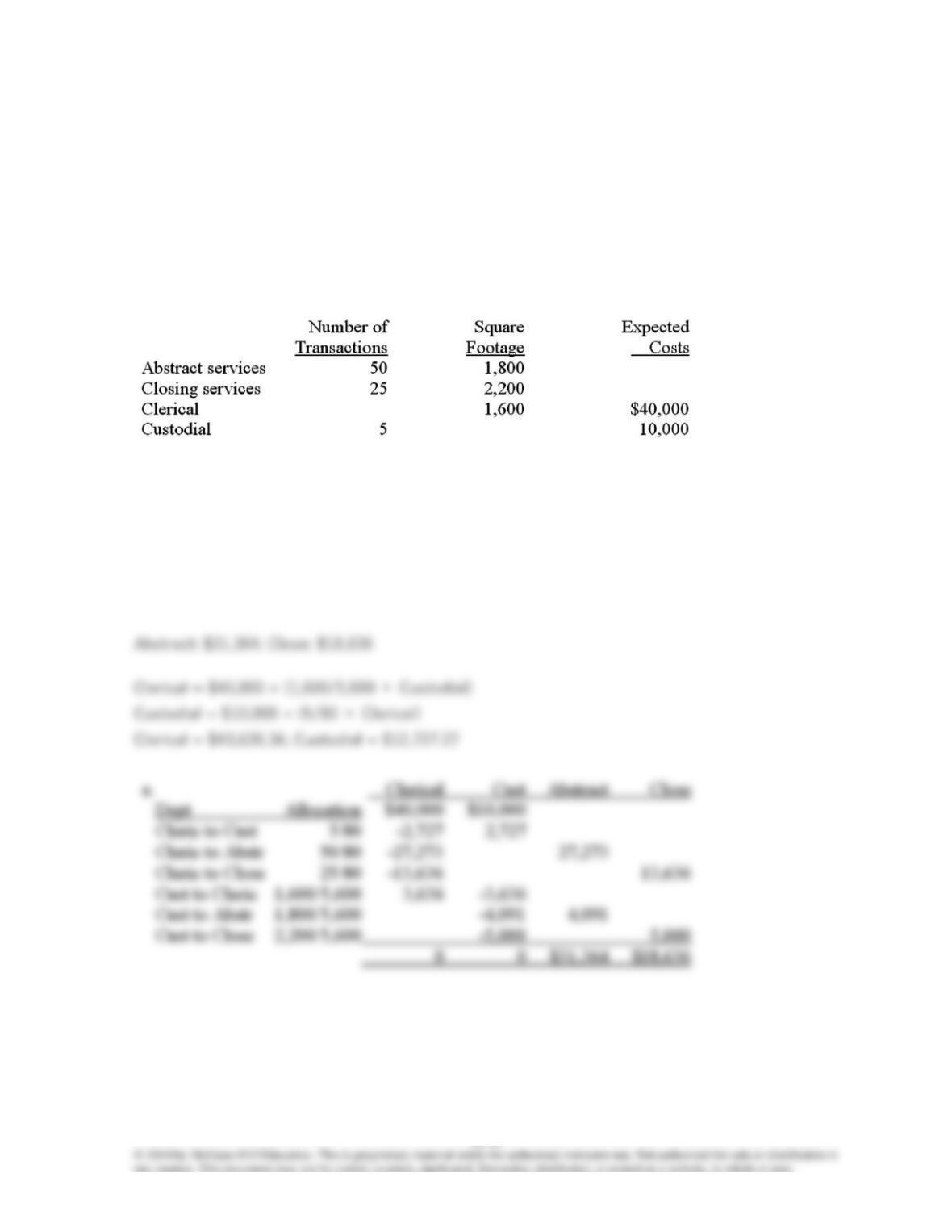
Average and expected activity levels for next month are as follows:
Required:
Use the direct method to allocate the service department costs to the revenue generating
departments. Provide the total costs for the revenue departments.
11–92
116. Harry Dorffman owns and operates Harry’s Abstracting Service. Harry’s two revenue
generating operations Abstracting Services and Closing Services are supported by two service
departments: Clerical and Custodial. Costs in the service departments are allocated in the
following order using the designated allocation bases.
Clerical: number of transactions processed.
Custodial: square footage of space occupied.
Average and expected activity levels for next month are as follows:
Required:
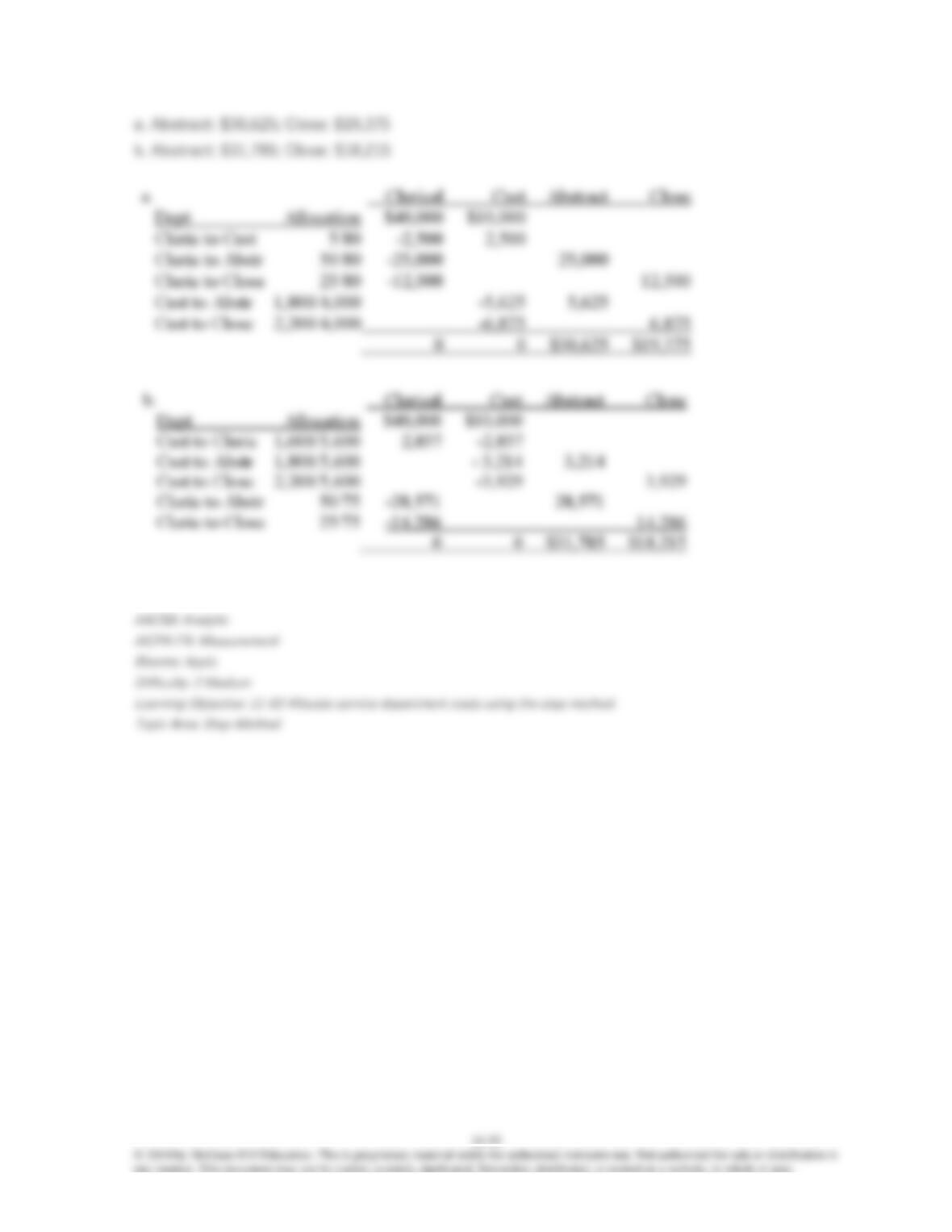
a. Use the step method to allocate the service department costs to the revenue generating
departments. Assume Clerical costs are allocated before Custodial costs and round all
calculations to the nearest whole dollar. Provide the total costs for the revenue departments.
b. Use the step method to allocate the service department costs to the revenue generating
departments but now assume Custodial costs are allocated before Clerical costs. Provide the total
costs for the revenue departments.
11–94
117. Harry Dorffman owns and operates Harry’s Abstracting Service. Harry’s two revenue
generating operations (Abstracting Services and Closing Services) are supported by two service
departments: Clerical and Custodial. Costs in the service departments are allocated in the
following order using the designated allocation bases.
Clerical: number of transactions processed.
Custodial: square footage of space occupied.
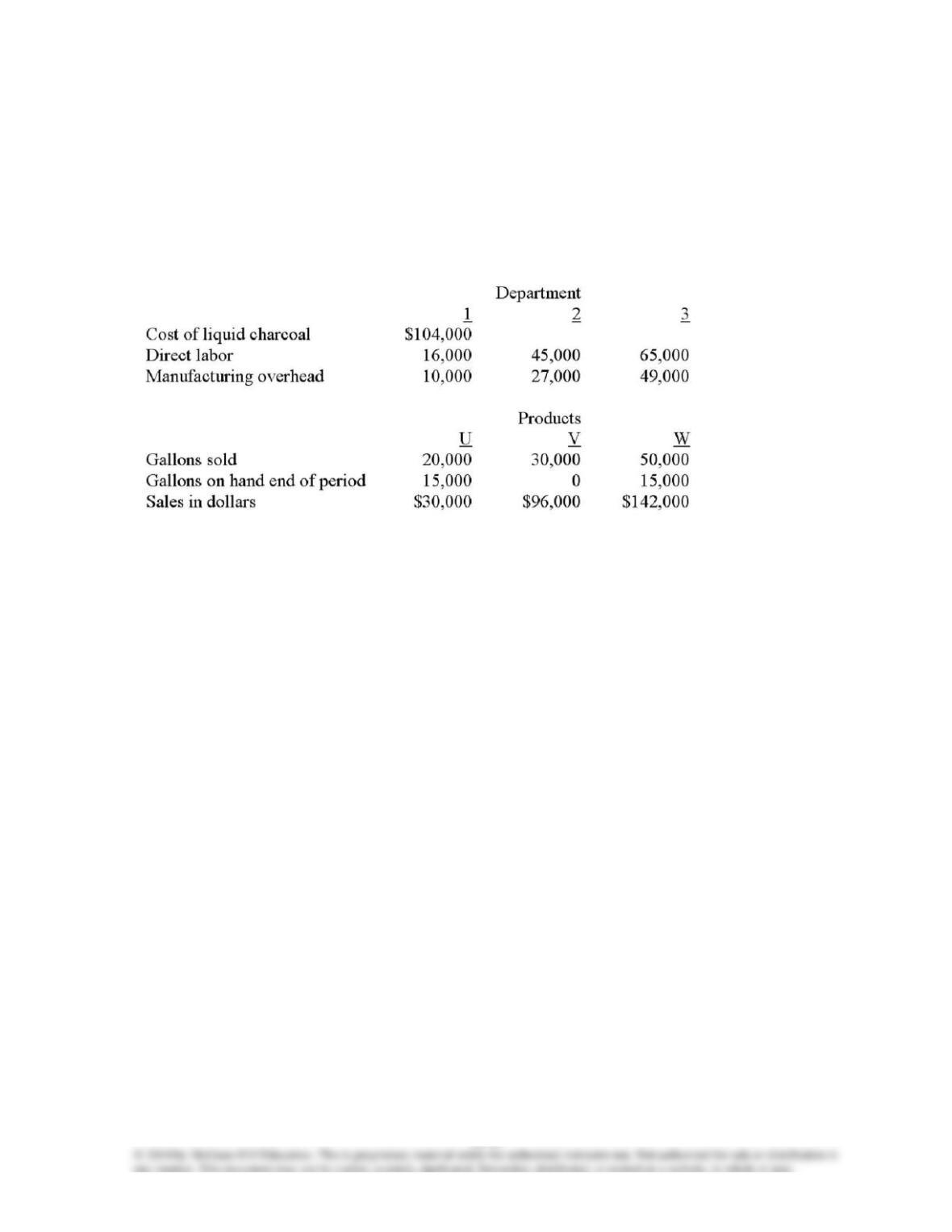
Average and expected activity levels for next month are as follows:
Required:
Use the reciprocal method to allocate the service department costs to the revenue generating
departments. Provide the total costs for the revenue departments.
11–95
118. Daz Manufacturing Company buys Liquid Charcoal for $0.80 a gallon. At the end of
processing in department 1, the liquid charcoal splits off into Products U, V, and W. Product U is
sold at the split-off point, with no further processing. Products V and W require further processing
before they can be sold; Product V is processed in Department 2, and Product W is processed in
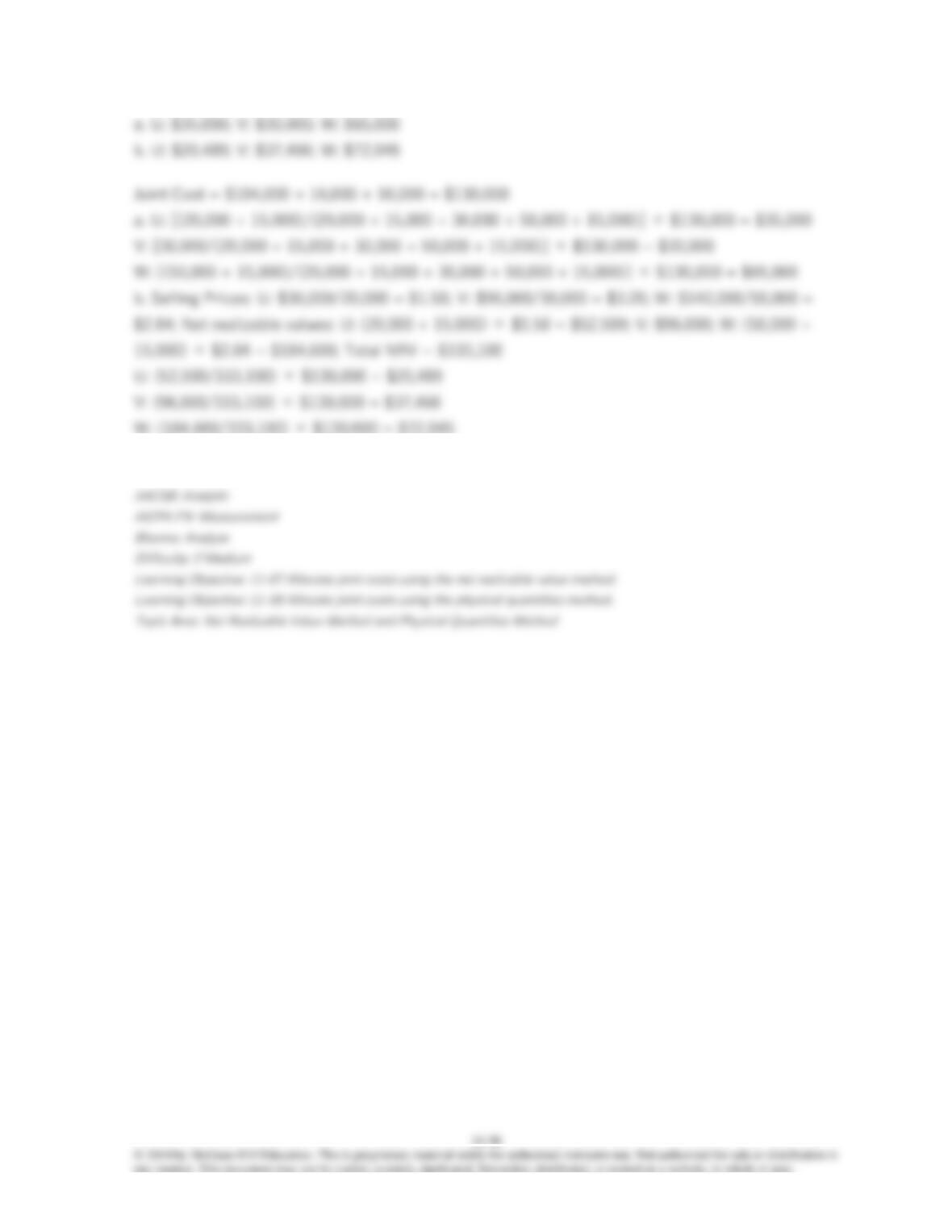
Department 3. Following is a summary of costs and other related data for the most recent
accounting period:
There were no beginning inventories and there was no liquid charcoal on hand at the end of the
period. All gallons on hand in ending inventory were complete as to processing. Daz uses the
estimated net realizable value method of allocating joint costs.
Required:
a. Determine the product cost for U, V, and W, assuming the physical quantity method is used to
allocate joint costs.
b. Determine the product cost for U, V, and W, assuming the net realizable value method is used
to allocate joint costs.
11–97
119. The Tworek Company conducts a simple chemical process in Department #1, which
produces three separate items: A, B, and C. A is processed further in Department #2. B is
processed further in Department #3. Product C can be sold immediately. The following
information relates to October:
Department #1’s costs $540,000.
Department #2’s costs $120,000.
Department #3’s costs $300,000.
A: 25,000 pounds completed; 23,500 pounds sold for $12 per pound.
B: 75,000 pounds completed; 70,000 pounds sold for $7.50 per pound.
C: 50,000 pounds completed; 46,000 pounds sold for $5.00 per pound.
There were no October 1st inventories.
Required:
a. Allocate the joint process costs to Products A, B, and C assuming the estimated net realizable
value method is used.
b. Allocate the joint process costs to products A, B, and C assuming the physical quantities
method is used.
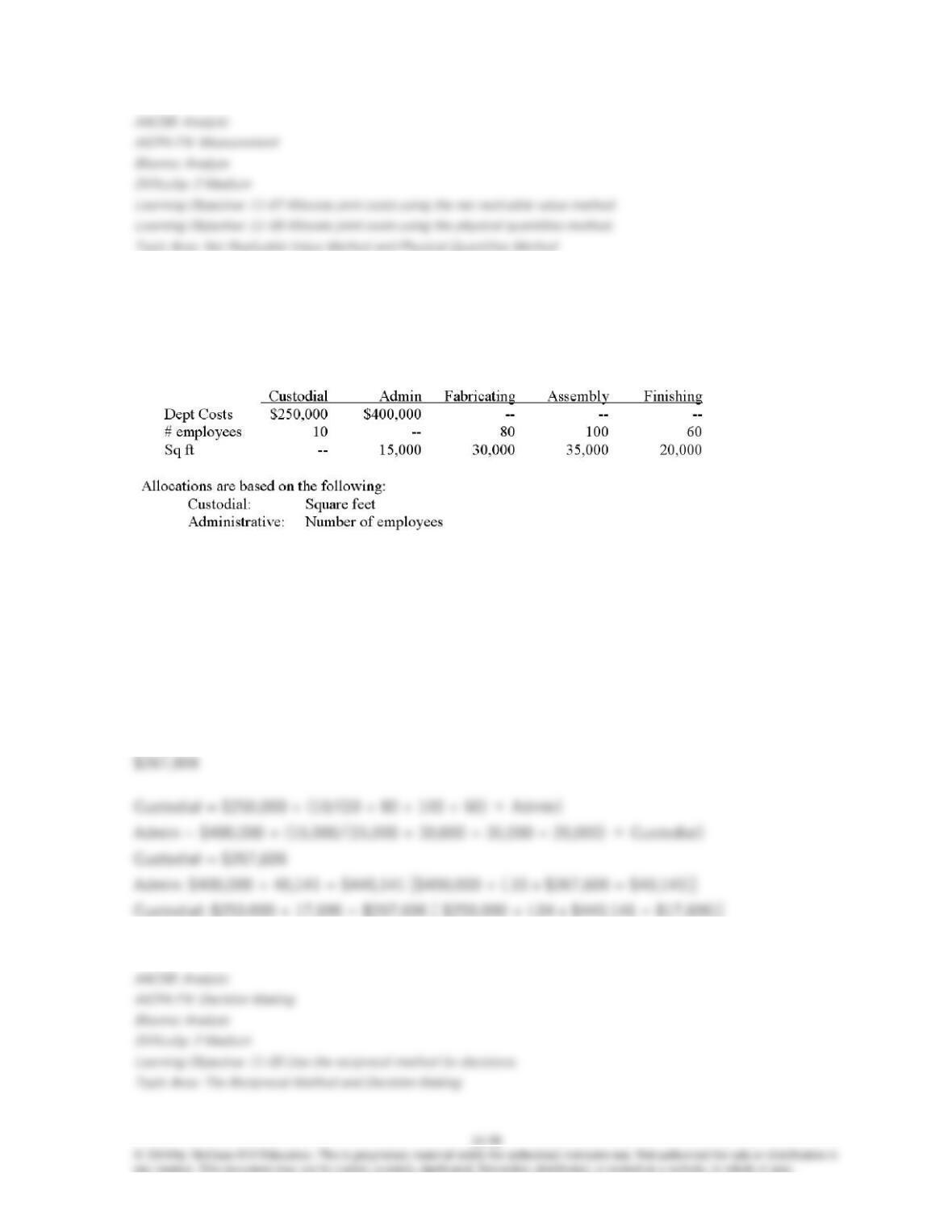
120. Albertville Corp has three operating departments (Fabricating, Assembly, and Finishing)
and two service departments (Custodial and Administrative). The following information has been
provided:
Required:
Albertville has been approached by ServiceMaster to outsource the custodial service.
Assuming
all costs are variable
, what is the relevant cost of the custodial department to compare with the
ServiceMaster bid?
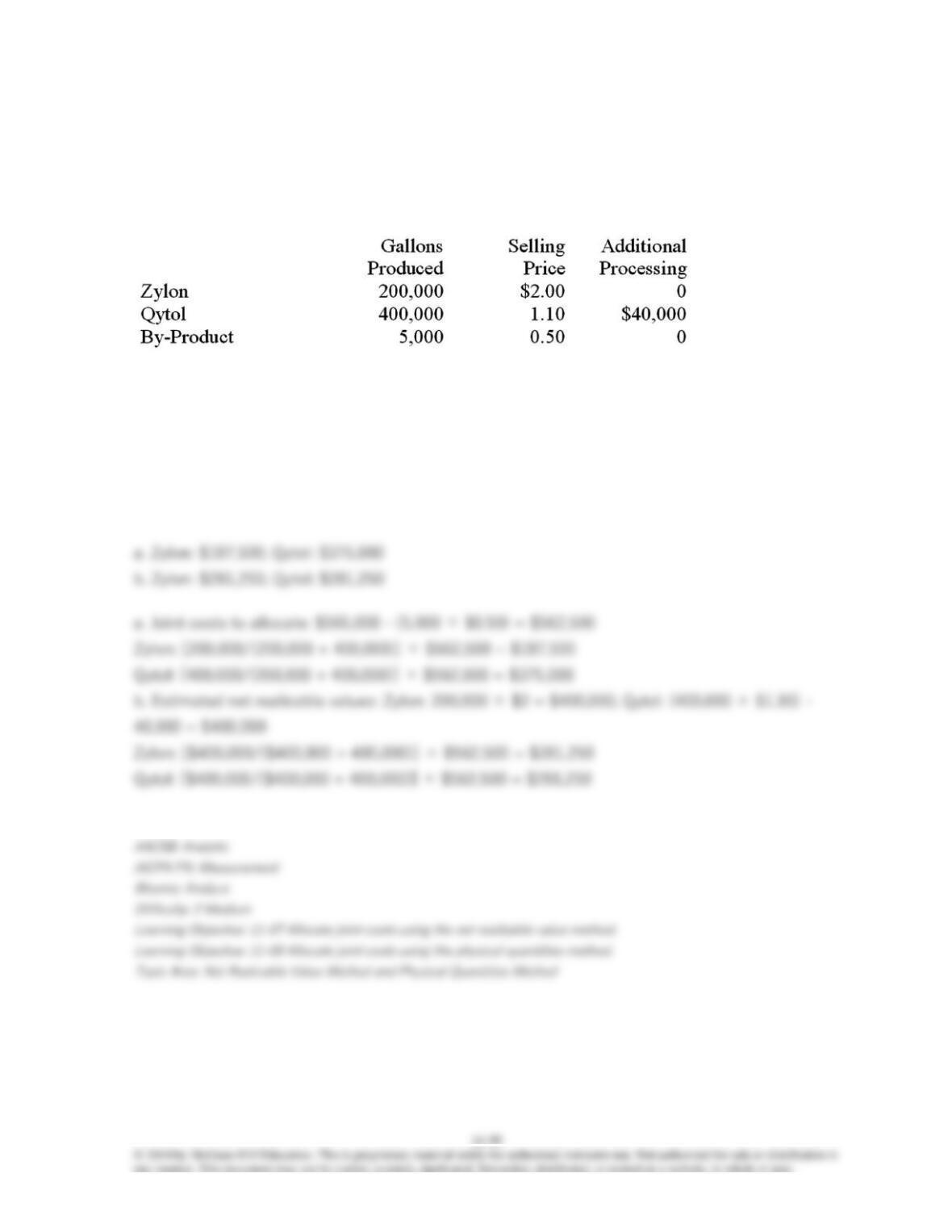
121. The Scottso Corporation produces two consumer products and a by-product. Zylon is
ready for sale after split-off, while Qytol must be further processed. The by-product is a heavy
residue in the bottom of the vat. The net realizable value of the by-product is credited against the
$565,000 joint cost of the Heating Department. Volume and cost data for February is as follows:
Required:
a. Allocate the Heating Department cost to the products using the physical quantities method.
b. Allocate the Heating Department cost to the products using the workback method.
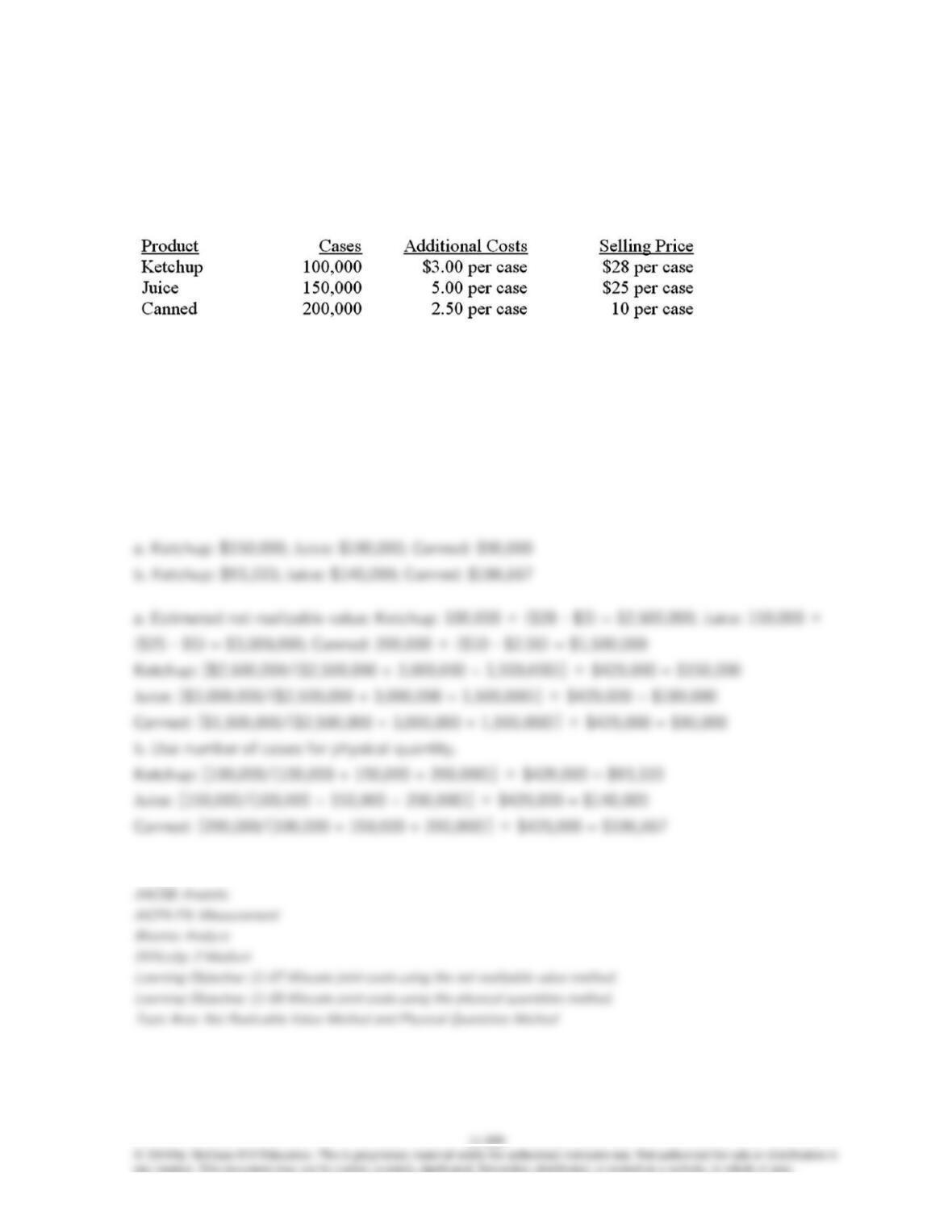
122. Red Sauce Canning Company processes tomatoes into ketchup, tomato juice, and canned
tomatoes. During the summer, the joint costs of processing the tomatoes were $420,000. There
was no beginning or ending inventories for the summer. Production and sales value information
for the summer were as follows:
Required:
a. Determine the amount allocated to each product if the estimated net realizable value method is
used.
b. Determine the amount allocated to each product if the physical units method is used.