Chapter 11 – Flexible Budgeting and Analysis of Overhead Costs
97. Tyrant Enterprises, Inc. uses a standard cost system when accounting for its sole product.
Manufacturing overhead is applied to production on the basis of process hours. Planned
activity is 60,000 process hours per month, which gives rise to the following per-unit
standards:
Variable overhead: 13 hours at $15 per hour
Fixed overhead: 13 hours at $7 per hour
During September, 5,100 units were produced and the company incurred the following
overhead costs: variable, $942,500; fixed, $429,000. Actual process hours totaled 65,000.
Required:
A. Calculate the spending and efficiency variances for variable overhead.
B. Calculate the budget and volume variances for fixed overhead.
Solution:
11-6
98. Amnesty Elements uses a standard cost system, applying manufacturing overhead on the
basis of machine hours. The company’s overhead standards per unit are shown below.
Variable overhead: 4 hours at $9 per hour
Fixed overhead: 4 hours at $6* per hour
*Based on planned monthly activity of 120,000 machine hours
Actual data for May were:
Number of units produced: 29,000
Number of machine hours worked: 125,000
Variable overhead costs incurred: $1,085,000
Fixed overhead costs incurred: $755,000
Required:
A. Calculate the spending and efficiency variances for variable overhead.
B. Calculate the budget and volume variances for fixed overhead.
Solution:
99. The following information relates to Joplin Company for the period just ended:
Standard variable overhead rate per hour
$1
Standard fixed-overhead rate per hour
$2
Planned monthly activity
40,000 machine hours
Actual production completed
82,000 units
Standard machine processing time
Two units per hour
Actual variable overhead
$37,000
Actual total overhead
$121,000
Actual machine hours worked
40,500
Chapter 11 – Flexible Budgeting and Analysis of Overhead Costs
All of the company’s overhead is variable or fixed in nature.
Required:
A. Calculate the spending and efficiency variances for variable overhead.
B. Calculate the budget and volume variances for fixed overhead.
Solution:
100. Consider the seven statements that follow.
1. An analysis of fixed overhead will typically result in the computation of the fixed-overhead
spending variance and the fixed-overhead volume variance.
2. The standard rate for fixed overhead is computed by dividing a company’s budgeted fixed
overhead for the period by the planned manufacturing activity.
3. A company uses direct labor hours to apply manufacturing overhead to units of production.
If the company reports an unfavorable labor efficiency variance, that same firm might report a
favorable variable-overhead efficiency variance in the same accounting period.
4. The amount of actual fixed overhead for an accounting period is used to compute the fixed-
overhead volume variance.
5. If a company’s standard hours allowed for the manufacturing activity attained exceeds the
planned manufacturing activity, the firm will report a favorable fixed-overhead volume
variance.
6. The amount of fixed overhead that a company has budgeted for an accounting period will
increase or decrease with the actual number of units produced.
7. The fixed-overhead volume variance indicates whether the level of production activity
attained is higher or lower than the level originally anticipated.
Required:
Determine whether the preceding statements are true or false. If a statement is false, briefly
explain why it is false.
Solution:
11-9
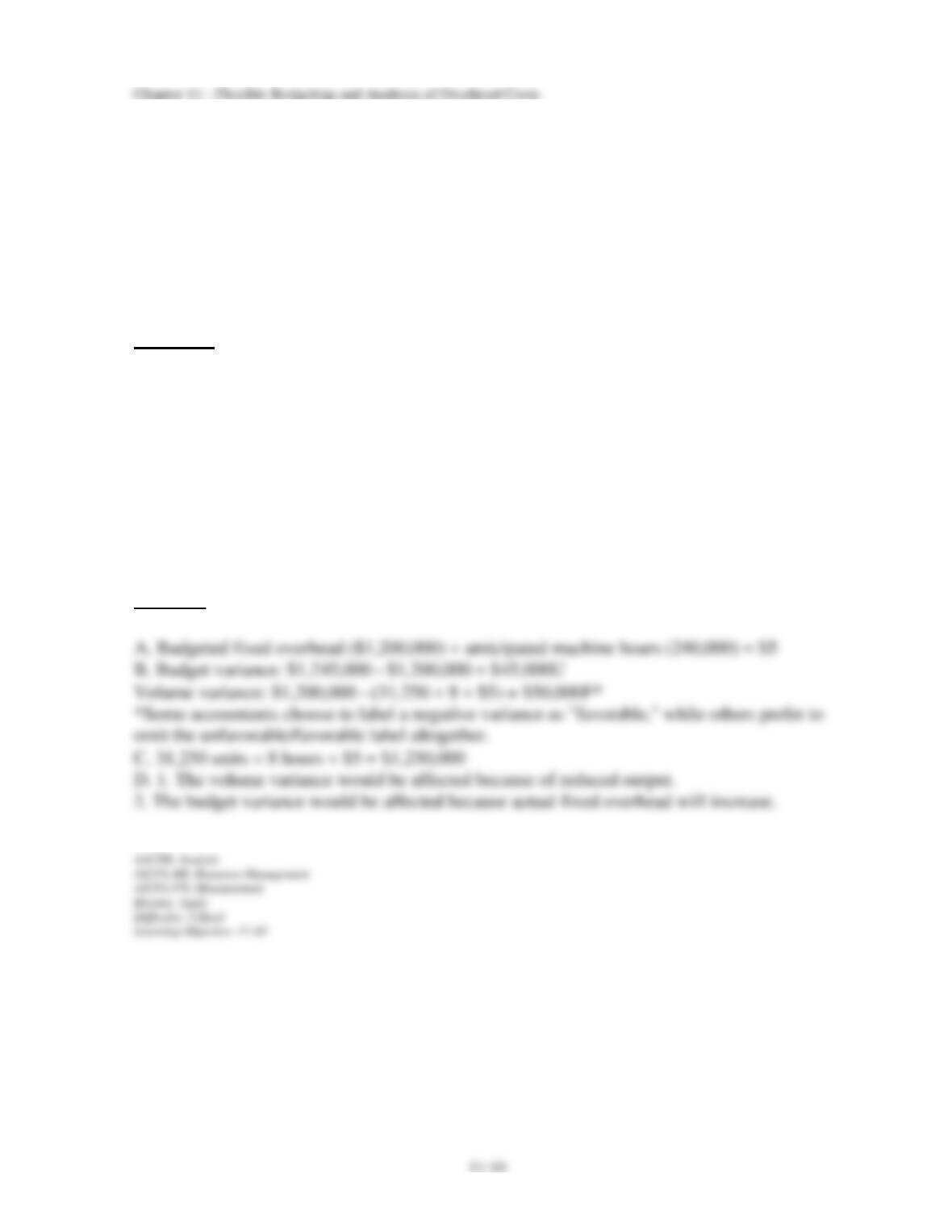
101. The following selected information was extracted from the accounting records of
Comprehensive Technologies, Inc.:
Planned manufacturing activity: 40,000 machine hours
Standard variable-overhead rate per machine hour: $16
Budgeted fixed overhead: $100,000
Variable-overhead spending variance: $92,000U
Variable-overhead efficiency variance: $102,000F
Fixed-overhead budget variance: $25,000U
Total actual overhead: $675,000
Required:
Determine the following: actual fixed overhead, actual variable overhead, actual machine
hours worked, standard machine hours allowed for actual production, and the fixed-overhead
volume variance.
Solution
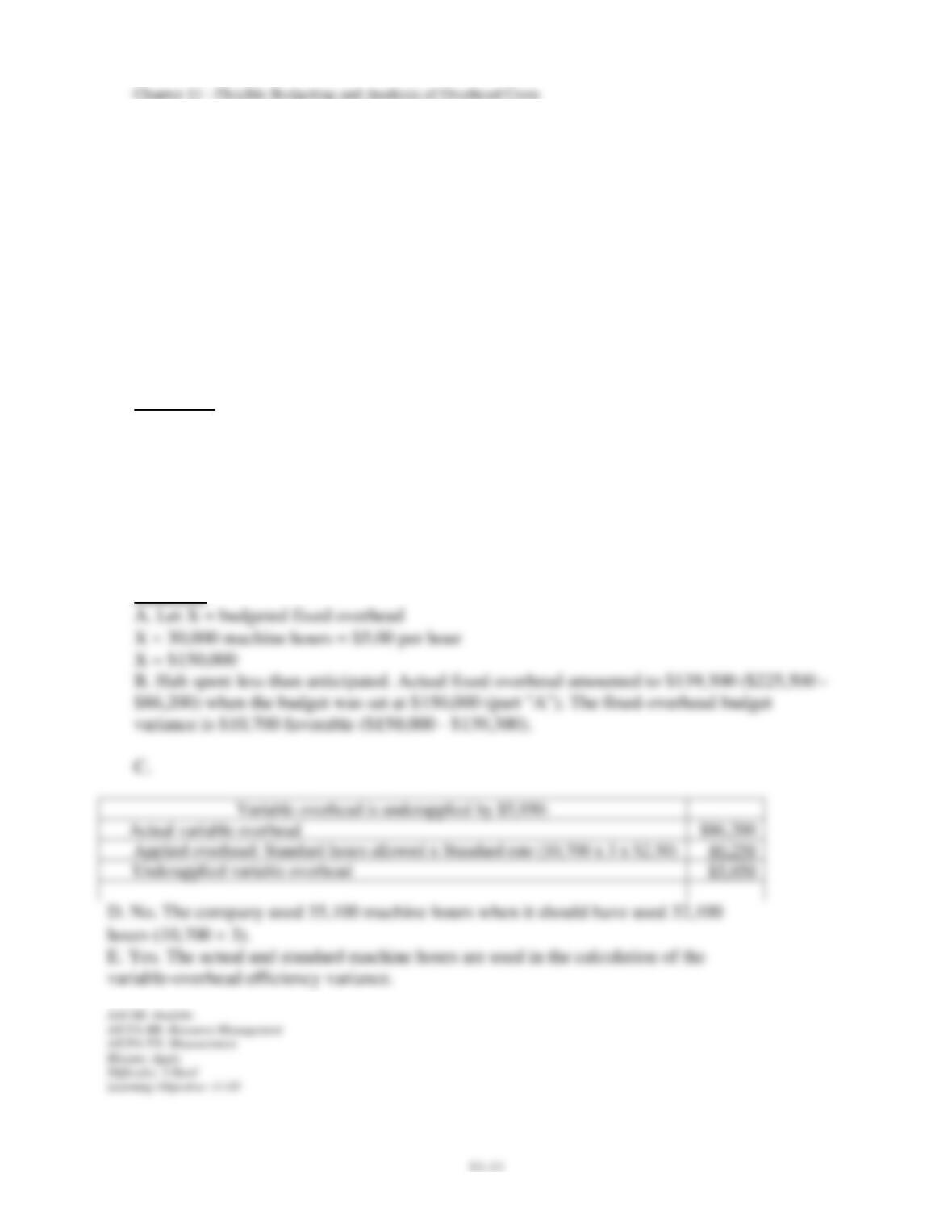
102. Waldren Corporation applies fixed manufacturing overhead to production on the basis of
machine hours worked. The following data relate to the month just ended:
Actual fixed overhead incurred: $1,245,000
Budgeted fixed overhead: $1,200,000
Anticipated machine hours: 240,000
Standard machine hours per finished unit: 8
Actual finished units completed: 31,250
Required:
A. Compute Waldren’s standard fixed-overhead rate per machine hour.
B. Determine Waldren’s fixed-overhead budget variance and fixed-overhead volume
variance.
C. Calculate the amount of fixed overhead applied to production.
D. Consider the two events that follow and determine whether the event will affect the fixed-
overhead budget variance, the fixed-overhead volume variance, both variances, or neither
variance. Assume that Waldren has not yet revised its standards to reflect these events if a
revision is warranted.
1. A raw material shortage halted production for two days.
2. An additional assembly-line supervisor was hired at the beginning of the month.
Solution:
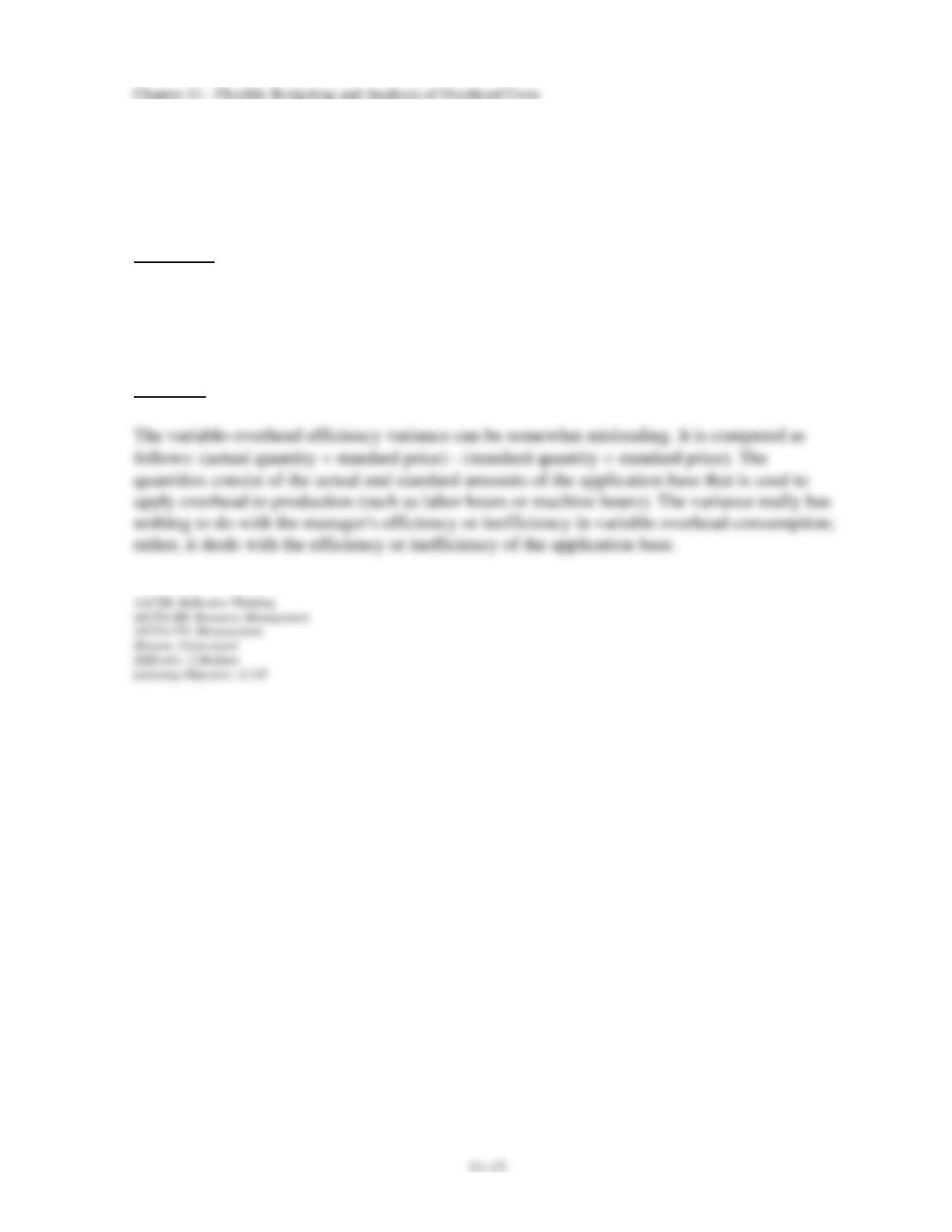
103. Halt Company uses a standard cost system and applies manufacturing overhead to
products on the basis of machine hours. The following information is available for the year
just ended:
Standard variable-overhead rate per machine hour: $2.50
Standard fixed-overhead rate per machine hour: $5.00
Planned activity during the period: 30,000 machine hours
Actual production: 10,700 finished units
Production standard: Three machine hours per unit
Actual variable overhead: $86,200
Actual total overhead: $225,500
Actual machine hours worked: 35,100
Required:
A. Calculate the budgeted fixed overhead for the year.
B. Did Halt spend more or less than anticipated for fixed overhead? How much?
C. Was variable overhead under- or overapplied during the year? By how much?
D. Was Halt efficient in its use of machine hours? Briefly explain.
E. Would the company’s efficiency or inefficiency in the use of machine hours have any effect
on Halt’s overhead variances? If “yes,” which one(s)?
Solution:
104. A production manager was recently given a performance report that showed a sizable
unfavorable variable-overhead efficiency variance. The manager was puzzled as to how the
department could be inefficient in the use/incurrence of this cost.
Required:
Briefly explain the nature of this variance to the manager. Does the variance really have much
to do with variable overhead efficiencies or inefficiencies? Discuss.
Solution:
105. Briefly explain the nature of the fixed-overhead volume variance. Be sure to address the
issue of capacity utilization in your response.
Solution:
11–14
106. Riviera Beach Pink Flamingos has the following standards and flexible-budget data.
Standard variable-overhead rate
$6.00 per direct-labor
hour
Standard quantity of direct labor
2 hours per unit of output
Budgeted fixed overhead
$100,000
Budgeted output
25,000 units
Actual results for April are as follows:
Actual output
20,000 units
Actual variable overhead
$320,000
Actual fixed overhead
$97,000
Actual direct labor
50,000 hours
Required:
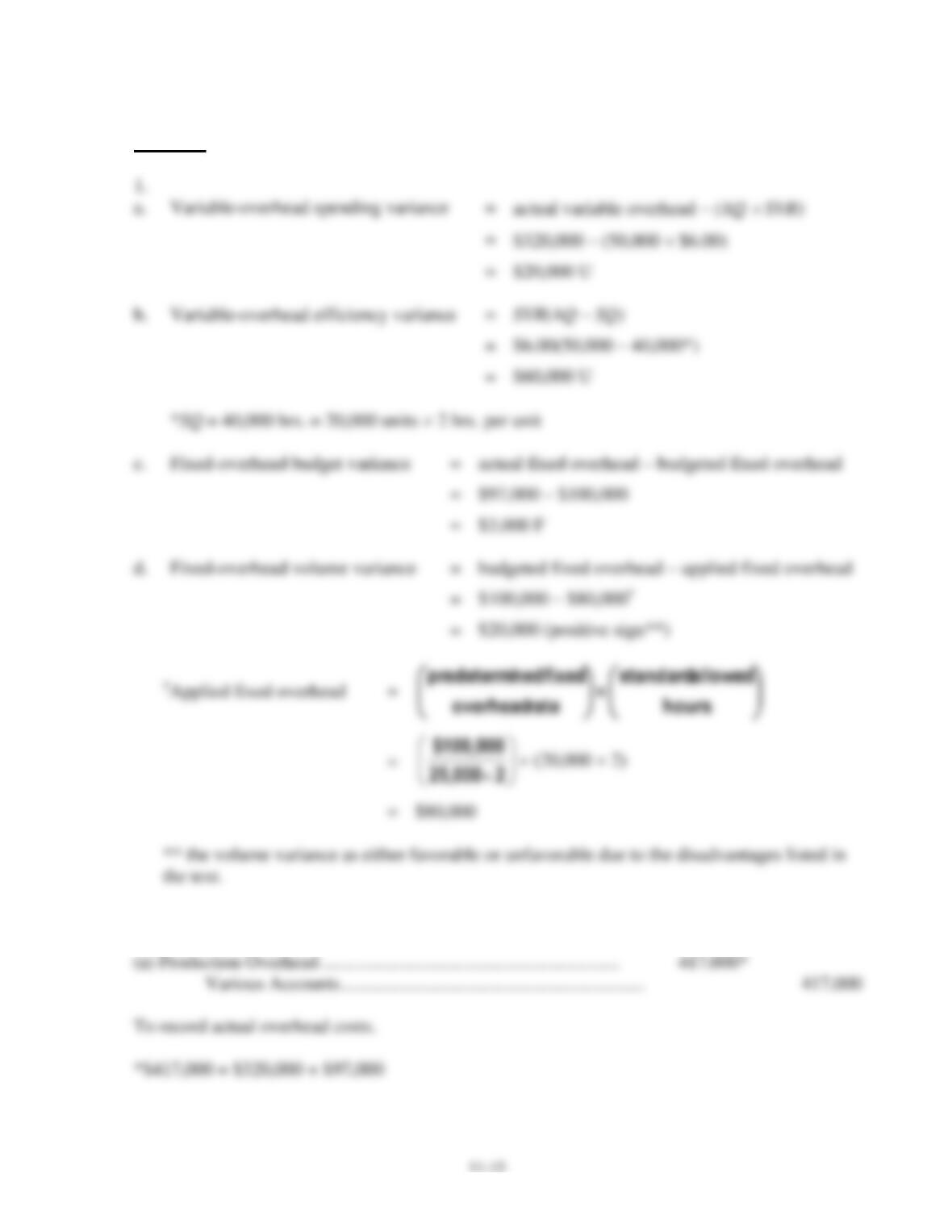
1. Use the variance formulas to compute the following variances. Indicate whether each vari–
ance is favorable or unfavorable, where appropriate.
(a) Variable-overhead spending variance.
(b) Variable-overhead efficiency variance.
(c) Fixed-overhead budget variance.
(d) Fixed-overhead volume variance.
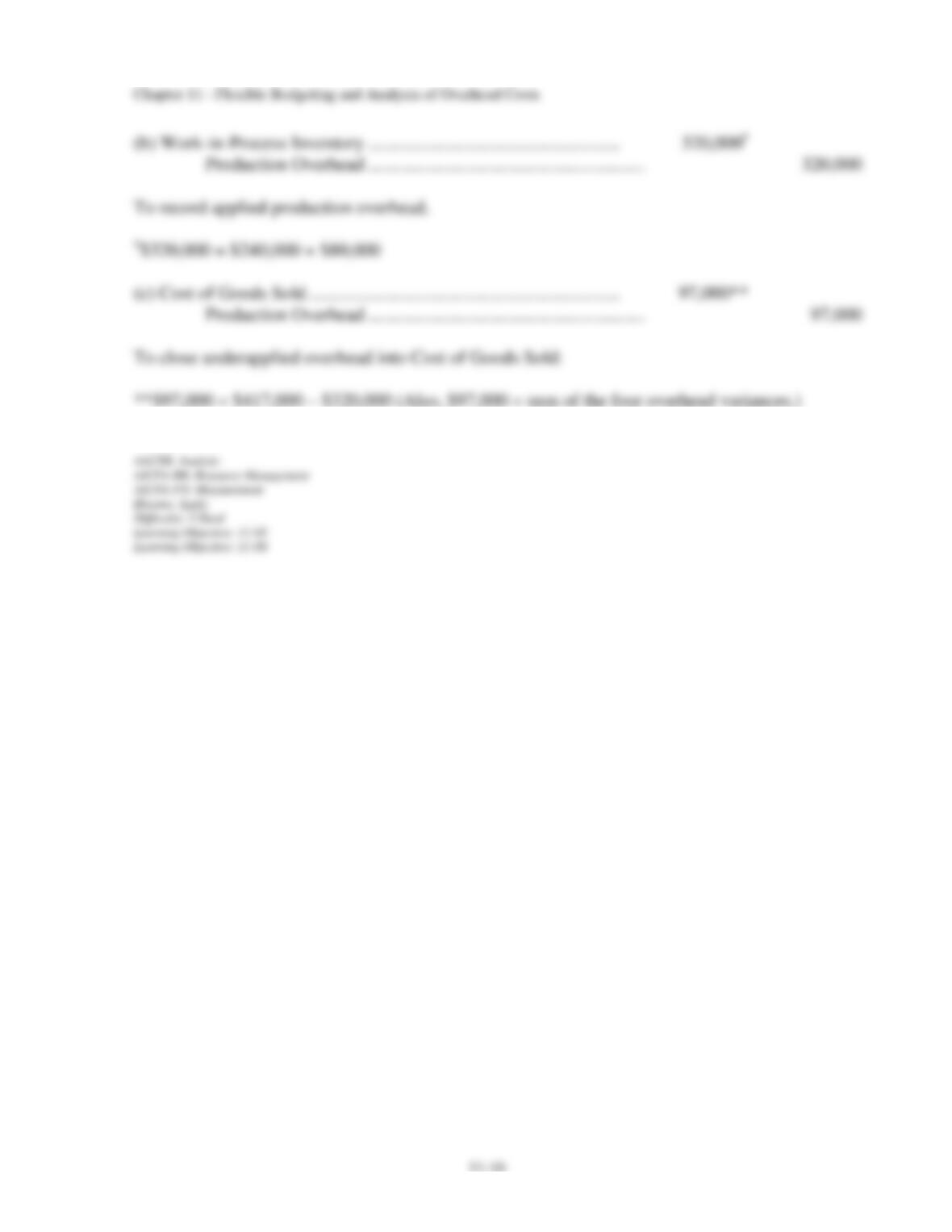
2. Prepare journal entries to
(a) Record the incurrence of actual variable overhead and actual fixed overhead.
(b) Add variable and fixed overhead to Work-in-Process Inventory.
(c) Close underapplied or overapplied overhead into Cost of Goods Sold.
Chapter 11 – Flexible Budgeting and Analysis of Overhead Costs
Solution:
2.
107. The following data pertain to Auxilary Backup Computers for the month of April.
Static Budget
Actual
Units sold
10,000
9,000
Sales revenue
$120,000
$103,500
Variable manufacturing cost
40,000
36,000
Fixed manufacturing cost
20,000
20,000
Variable selling and administrative cost
10,000
9,000
Fixed selling and administrative cost
10,000
10,000
Required:
Compute the sales-price and sales-volume variances for April.
Solution: