94) Delite Confectionary Company produces various types of candies. Several candies could be
sold at the split-off point or processed further and sold in a different form after further
processing. The candies are produced in a joint processing operation with $500,000 of joint
processing costs monthly, which are allocated based on pounds produced. Information
concerning this process for a recent month appears below:
Candy type Number of pounds Price per pound at split-off Further
processing costs Price after processing further
Sweet Meats 50,000 $ 8 $ 75,000 $ 10.00
Chocolate Delight 100,000 $ 10 $ 30,000 $ 10.50
Minty Wonders 25,000 $ 5 $ 20,000 $ 5.50
Based on the information presented, which of the products should be processed further?
A) Sweet Meats only.
B) Both Sweet Meats and Chocolate Delight.
C) Minty Wonders only.
D) Both Sweet Meats and Minty Wonders.
95) Delite Confectionary Company produces various types of candies. Several candies could be
sold at the split-off point or processed further and sold in a different form after further
processing. The candies are produced in a joint processing operation with $500,000 of joint
processing costs monthly, which are allocated based on pounds produced. Information
concerning this process for a recent month appears below:
Candy type Number of pounds Price per pound at split-off Further
processing costs Price after processing further
Sweet Meats 50,000 $ 8 $ 75,000 $ 10.00
Chocolate Delight 100,000 $ 10 $ 30,000 $ 10.50
Minty Wonders 25,000 $ 5 $ 20,000 $ 5.50
The net advantage (disadvantage) of processing Sweet Meats further is:
A) a $25,000 disadvantage to process further.
B) a $32,143 advantage to process further.
C) a $25,000 advantage to process further.
D) a $282,143 disadvantage to process further.
96) Delite Confectionary Company produces various types of candies. Several candies could be
sold at the split-off point or processed further and sold in a different form after further
processing. The candies are produced in a joint processing operation with $500,000 of joint
processing costs monthly, which are allocated based on pounds produced. Information
concerning this process for a recent month appears below:
Candy type Number of pounds Price per pound at split-off Further
processing costs Price after processing further
Sweet Meats 50,000 $ 8 $ 75,000 $ 10.00
Chocolate Delight 100,000 $ 10 $ 30,000 $ 10.50
Minty Wonders 25,000 $ 5 $ 20,000 $ 5.50
The joint processing costs in this operation:
A) Should be allocated to products to determine whether they are sold at split-off or processed
further.
B) Should be ignored in determining whether to sell at split-off or process further.
C) Should be ignored in making all product decisions.
D) Are never included in product cost, as they are misleading to all management decisions.
97) Delite Confectionary Company produces various types of candies. Several candies could be
sold at the split-off point or processed further and sold in a different form after further
processing. The candies are produced in a joint processing operation with $500,000 of joint
processing costs monthly, which are allocated based on pounds produced. Information
concerning this process for a recent month appears below:
Candy type Number of pounds Price per pound at split-off Further
processing costs Price after processing further
Sweet Meats 50,000 $ 8 $ 75,000 $ 10.00
Chocolate Delight 100,000 $ 10 $ 30,000 $ 10.50
Minty Wonders 25,000 $ 5 $ 20,000 $ 5.50
If Chocolate Delight is processed further, the gross profit margin that will appear in a product
line income statement for Chocolate Delight (rounded to the nearest whole dollar) would be:
A) $734,286.
B) $520,000.
C) $1,020,000.
D) $632,596.
98) The Foxmoor Company produces three products, X, Y, and Z, from a single raw material
input. Product Y can be sold at the split-off point for total revenues of $50,000 or it can be
processed further at a total cost of $16,000 and then sold for $68,000. Product Y:
A) Should be sold at the split-off point, rather than processed further.
B) Would increase the company’s overall net income by $18,000 if processed further and then
sold.
C) Would increase the company’s overall net income by $68,000 if processed further and then
sold.
D) Would increase the company’s overall net income by $2,000 if processed further and then
sold.
99) Product C is one of several joint products that come out of Department M. The joint costs
incurred in Department M total $40,000. Product C can be sold at split-off or processed further
and sold as a higher quality item. The decision to process further should be based on the:
A) Assumption that the $40,000 is irrelevant.
B) Allocation of the $40,000, using the net realizable value.
C) Allocation of the $40,000, using a physical measures approach.
D) Allocation of the $40,000, using the relative sales value at split-off method.
100) The characteristic that is most often used to distinguish a product as either a main product
or a by-product is the amount of:
A) Sales value of the products produced during the common production process.
B) Direct manufacturing costs (e.g., materials) incurred before the split-off point.
C) Physical measures in the products produced during the common production process.
D) Time (i.e., labor) required to produce the products from start to finish.
101) If by-product revenue is treated as other revenue instead of deducted from the net–
realizable-value of the main products:
A) Overall gross margin of the company will be higher.
B) Overall gross margin of the company will be lower.
C) The answer would depend on how joint product costs were allocated.
D) There is no difference in the overall gross margin of the company.
102) Products with a relatively minor sales value are called:
A) Scrap.
B) Spoilage.
C) By-products.
D) Main products.
103) Joint products and by-products are produced simultaneously by a single process or series of
processes and:
A) Joint products are salable at the split-off point, but by-products are not.
B) By-products are salable at the split-off point, but joint products are not.
C) The revenue from by-products may be recognized at the time of production.
D) All by-products must be allocated some portion of joint costs.
104) Which of the following statements regarding accounting for by-products is true?
A) If all products are sold in the same period as they are produced, treating by-product revenue
as other revenue will result in a higher overall gross margin.
B) If all products are sold in the same period as they are produced, treating by-product net-
realizable-value as a deduction of the cost of the main products will result in a higher overall
gross margin.
C) If all products are sold in the same period as they are produced, total reported revenues will
be the same regardless of how by-product revenue is accounted for.
D) If all products are sold in the same period as they are produced, the reported gross margin will
be the same regardless of how by-product revenue is accounted for.
105) For each of the support service costs listed below, name an appropriate cost allocation base:
(1.) Building rental cost
(2.) Payroll department salaries
(3.) Company cafeteria cost
(4.) Human resources department
(5.) Accounting department
(6.) Computer equipment depreciation
(7.) Insurance costs on computer equipment
(8.) Depreciation on company airplane
(9.) Factory manager
(10.) Cost to clean company uniforms
(11.) Costs of corporate daycare facility
(12.) Equipment maintenance
(13.) Cost of corporate workout facility
(14.) Building insurance
(15.) Cost of delivery truck for a moving company
106) Wimbledon Corporation has two production Departments, Assembly and Machining, and
two service departments, Personnel and Cafeteria. Direct costs for each department and the
proportion of service costs used by the various departments for the month of July, 2020 are as
follows:
Proportion of Services Used by:
Department Direct costs Personnel Cafeteria Machining Assembly
Personnel $ 30,000 0.40 0.30 0.30
Cafeteria $ 50,000 0.20 0.50 0.30
Machining $ 80,000
Assembly $ 70,000
Required:
Compute the allocation of service department costs to producing departments for July 2020 using
the direct method.
107) Prestige Financial Credit Company produces two styles of credit reports: Individual and
Corporate. The difference between the two is the amount of background information and data
collection required. The Corporate report uses more skilled personnel because additional
checking and data are required. Total support service costs to be allocated are $3,200,000. The
relevant figures for the year just completed follow:
Allocation base Individual Corporate
Data purchased $ 40,000 $ 80,000
Research hours 24,000 30,000
Interview hours 1,000 10,000
Number of reports 16,000 3,000
Required:
For each of the four potential allocation bases, determine the amount of support service cost
allocated to each type of report. Round all percentages to two decimal places.
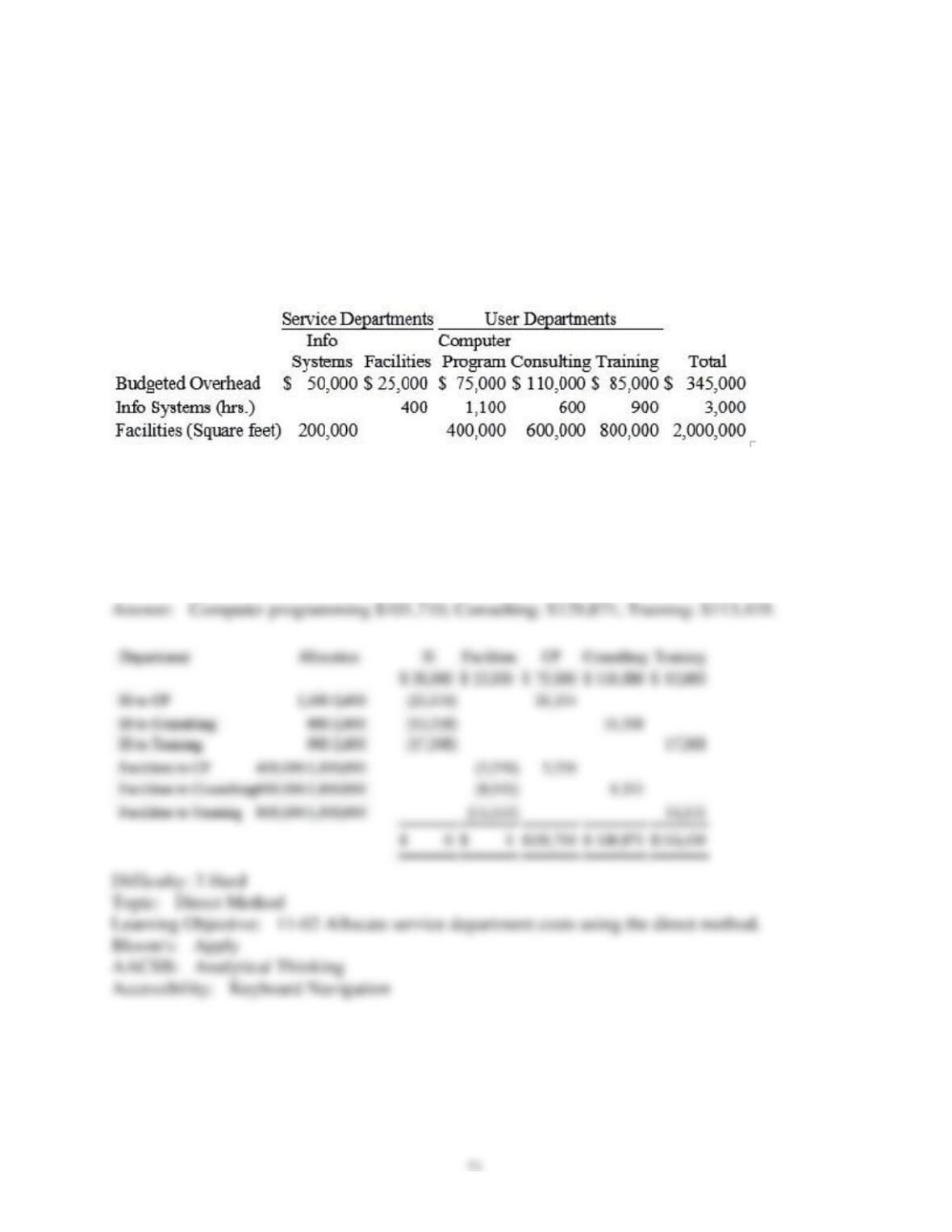
108) Data Master is a computer software consulting company. Its three major functional areas
are computer programming, information systems consulting, and software training. Cynthia
Moore, a pricing analyst in the Accounting Department, has been asked to develop total costs for
the functional areas. These costs will be used as a guide in pricing a new contract. In computing
these costs, Moore is considering three different methods of allocating overhead costs: the direct
method, the step method, and the reciprocal method. Moore assembled the following data on
overhead from its two service departments, the Information Systems Department and the
Facilities Department.
Information systems are allocated on the basis of hours of computer usage; facilities are allocated
on the basis of floor space.
Required:
Allocate the service department costs to the user departments using the direct method. (Round to
the nearest whole dollar and provide total user department costs.)
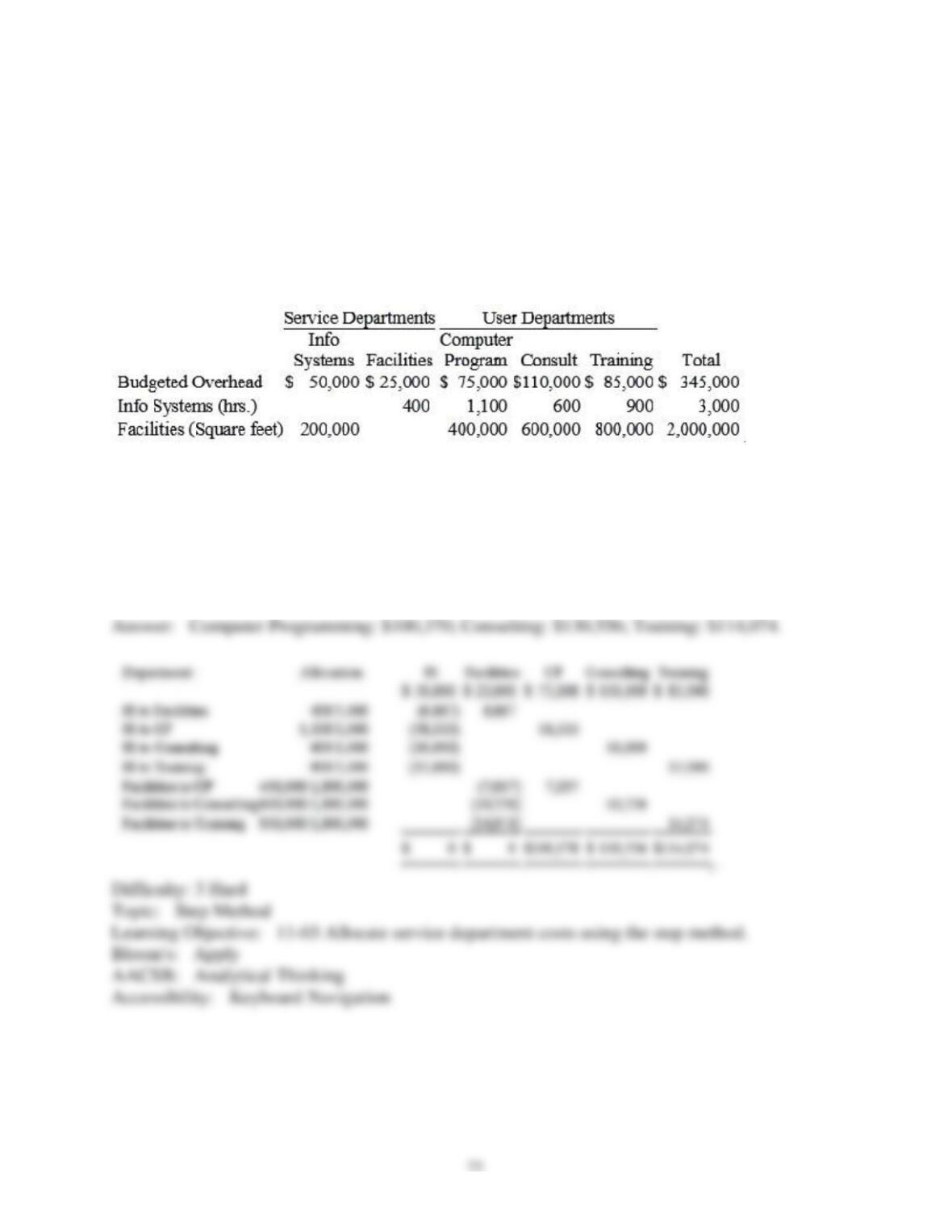
109) Data Master is a computer software consulting company. Its three major functional areas
are computer programming, information systems consulting, and software training. Cynthia
Moore, a pricing analyst in the Accounting Department, has been asked to develop total costs for
the functional areas. These costs will be used as a guide in pricing a new contract. In computing
these costs, Moore is considering three different methods of allocating overhead costs-the direct
method, the step method, and the reciprocal method. Moore assembled the following data on
overhead from its two service departments, the Information Systems Department and the
Facilities Department.
Information systems are allocated on the basis of hours of computer usage; facilities are allocated
on the basis of floor space.
Required:
Allocate the service department costs to the user departments using the step method. Allocate
Information Systems first and round to the nearest whole dollar. Provide total user department
costs.
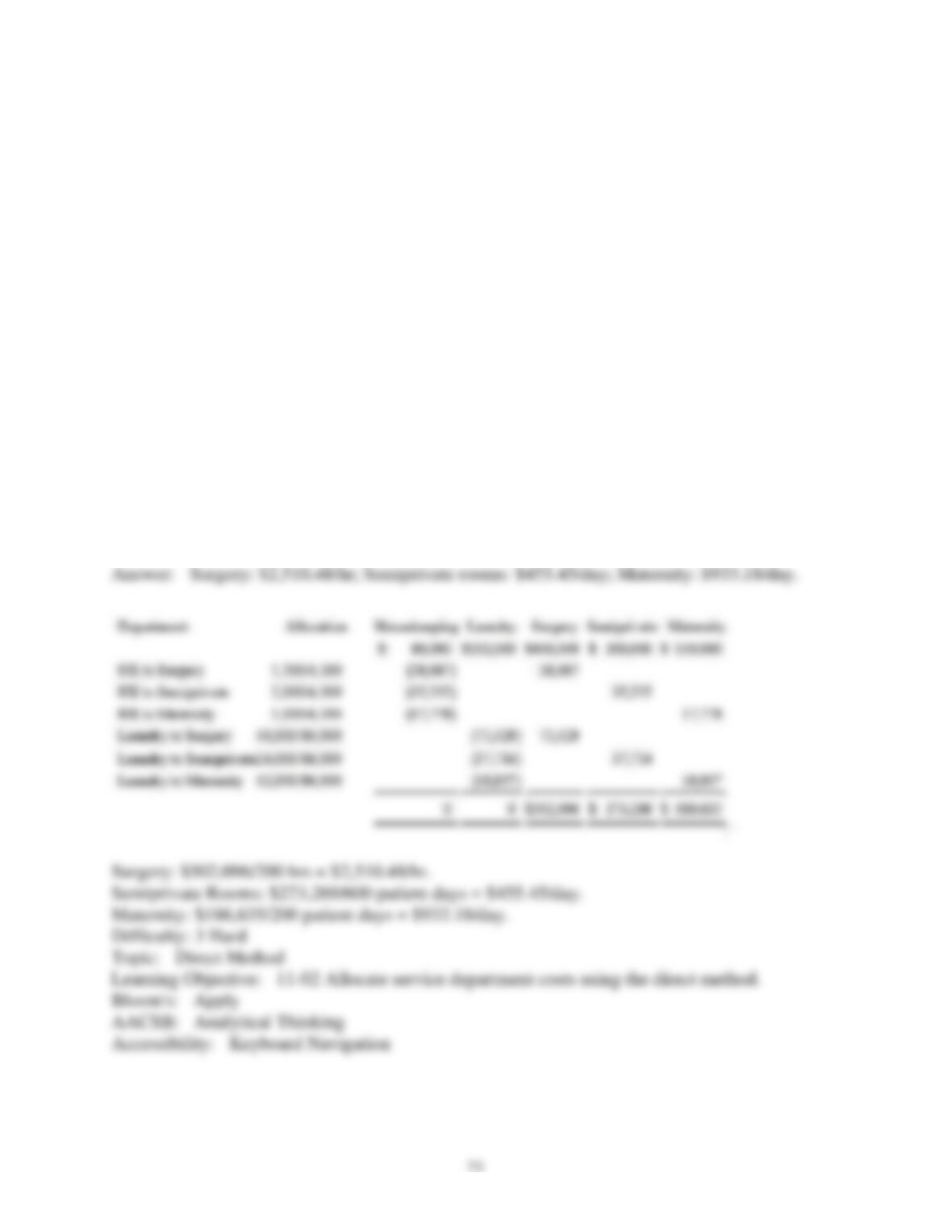
110) Yellville Regional Hospital is a small hospital with two service departments and three
revenue areas:
Service Department Direct Costs Square Feet
Laundry Pounds
Housekeeping (HK) $ 80,000 – 16,000
Laundry $ 132,000 500
Revenue Areas:
Surgery $ 400,000 1,500 48,000
Semiprivate rooms $ 200,000 2,000 24,000
Maternity $ 150,000 1,000 12,000
The hospital wants to allocate the service department costs to the revenue areas. Housekeeping is
allocated based on square footage; Laundry is allocated based on pounds of laundry. The normal
capacity for Surgery is 200 hours per month; normal capacity for semiprivate rooms is 600
patient days; and normal capacity for maternity is 200 patient days.
Required:
Determine the overhead rate for the three revenue areas. Allocate the service department costs to
the revenue areas using the direct method.
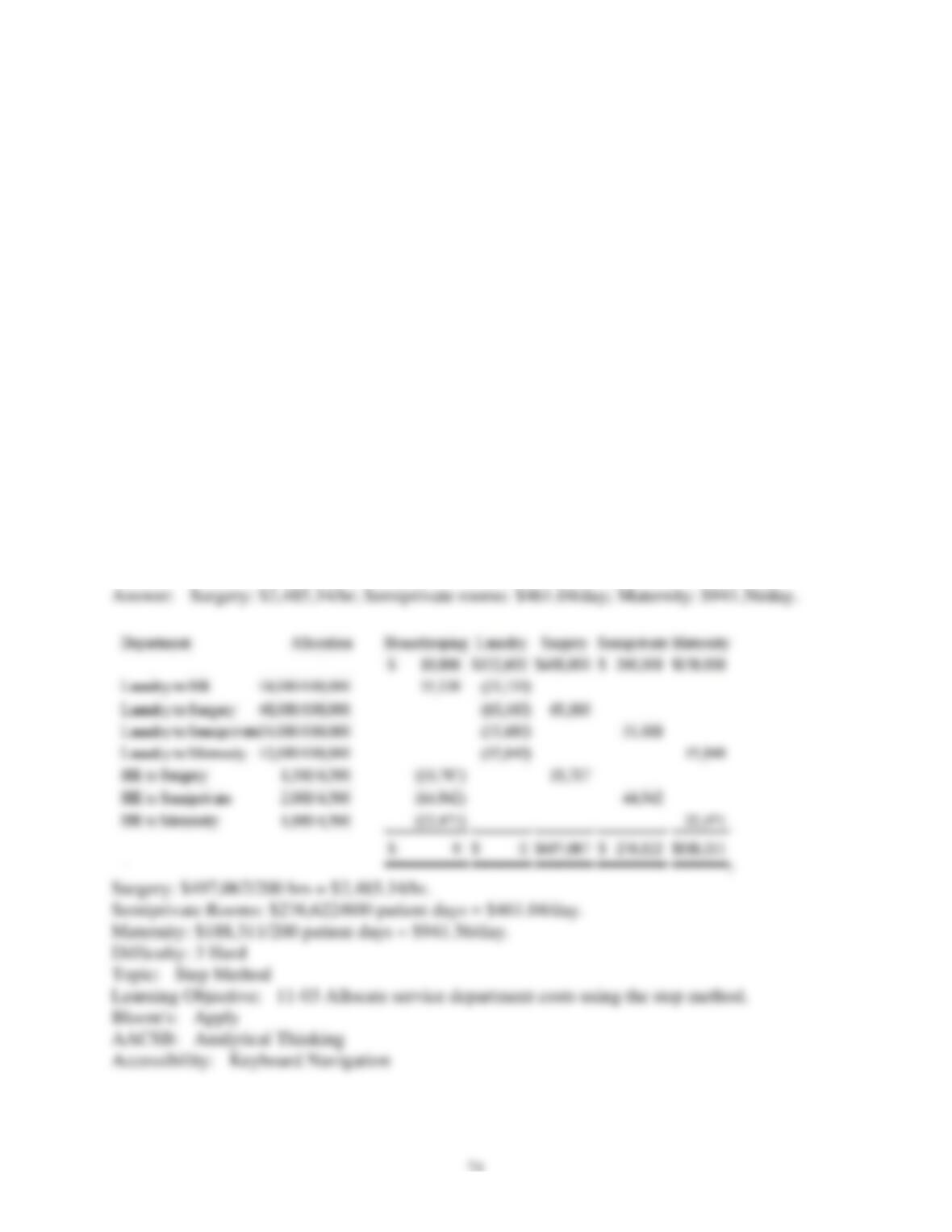
111) Yellville Regional Hospital is a small hospital with two service departments and three
revenue areas:
Service Department Direct Costs Square Feet
Laundry Pounds
Housekeeping (HK) $ 80,000 – 16,000
Laundry $ 132,000 500 –
Revenue Areas:
Surgery $ 400,000 1,500 48,000
Semiprivate rooms $ 200,000 2,000 24,000
Maternity $ 150,000 1,000 12,000
The hospital wants to allocate the service department costs to the revenue areas. Housekeeping is
allocated based on square footage; Laundry is allocated based on pounds of laundry. The normal
capacity for Surgery is 200 hours per month; normal capacity for semiprivate rooms is 600
patient days; and normal capacity for maternity is 200 patient days.
Required:
Determine the overhead rate for the three revenue areas. Allocate the service department costs to
the revenue areas using the step method. Allocate the service department with the largest dollar
value first.
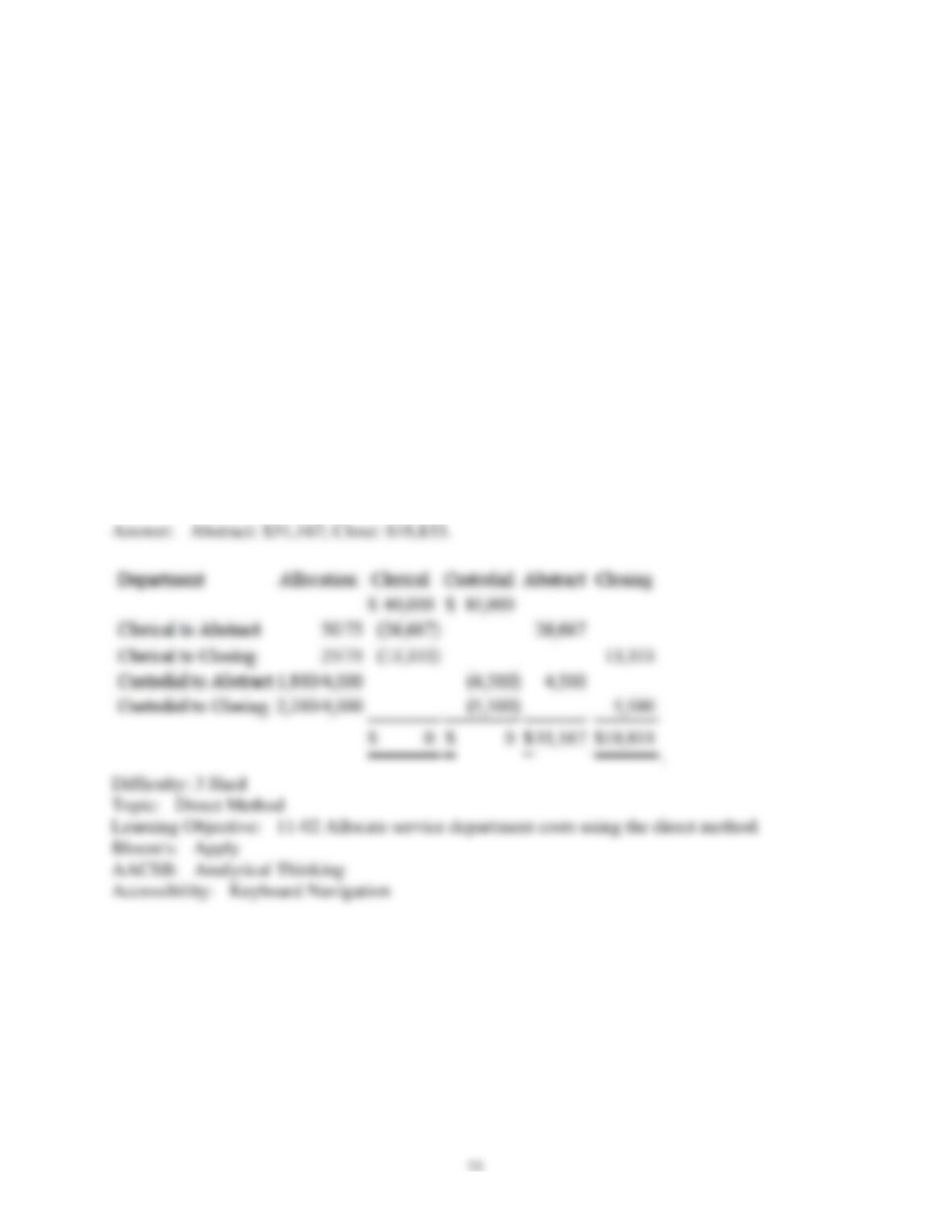
112) Jack Donaldson owns and operates Jack’s Abstracting Service. Jack’s two revenue
generating operations (Abstracting Services and Closing Services) are supported by two service
departments: Clerical and Custodial. Costs in the service departments are allocated in the
following order using the designated allocation bases.
Clerical: number of transactions processed.
Custodial: square footage of space occupied.
Average and expected activity levels for next month are as follows:
Numbers of Transactions Square Footage
Expected Costs
Abstract services 50 1,800
Closing services 25 2,200
Clerical 1,600 $ 40,000
Custodial 5 10,000
Required:
Use the direct method to allocate the service department costs to the revenue generating
departments. Provide the total costs for the revenue departments.
76
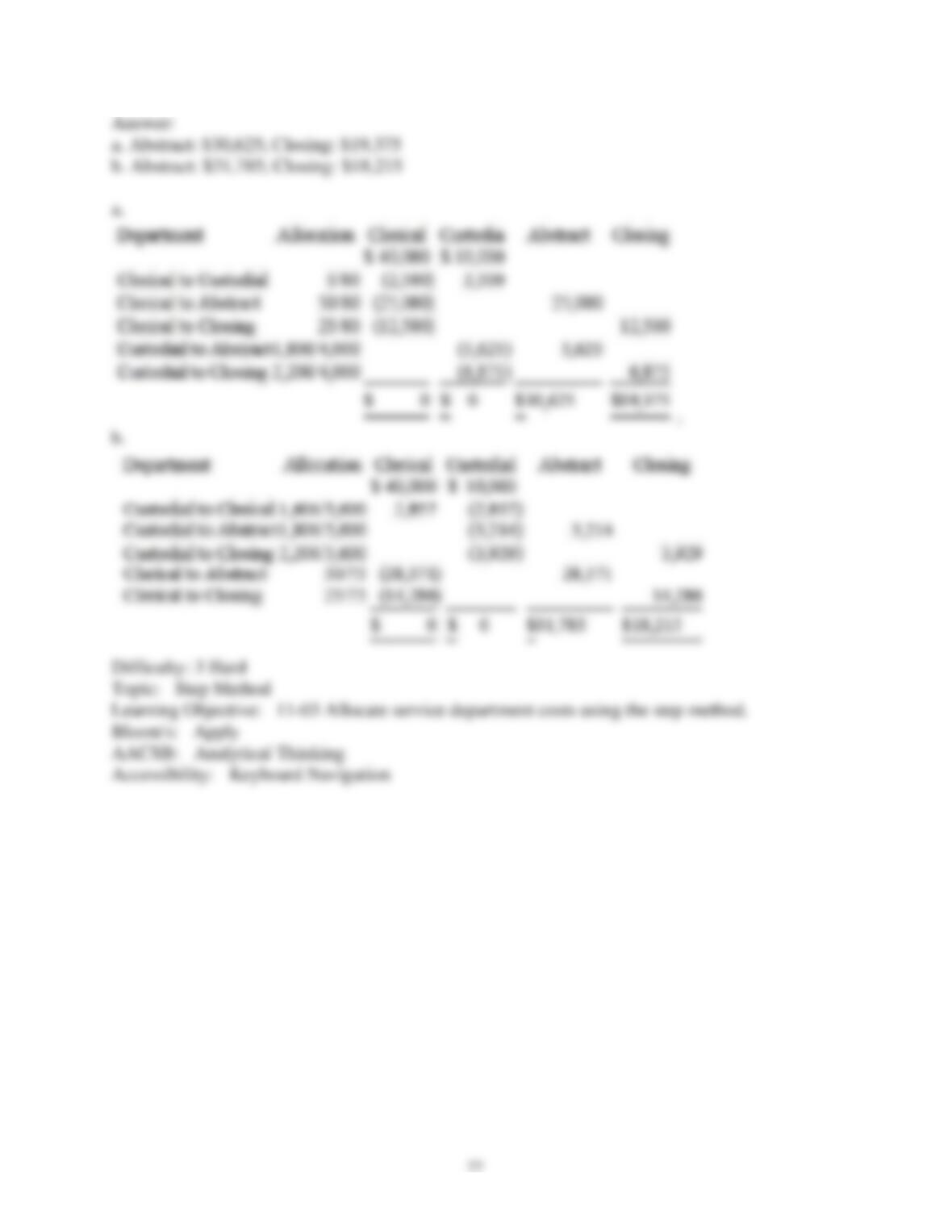
113) Jack Donaldson owns and operates Jack’s Abstracting Service. Jack’s two revenue
generating operations Abstracting Services and Closing Services are supported by two service
departments: Clerical and Custodial. Costs in the service departments are allocated in the
following order using the designated allocation bases.
Clerical: number of transactions processed.
Custodial: square footage of space occupied.
Average and expected activity levels for next month are as follows:
Number of
Transactions Square Footage Expected
Costs
Abstract services 50 1,800
Closing services 25 2,200
Clerical 1,600 $ 40,000
Custodial 5 10,000
Required:
a. Use the step method to allocate the service department costs to the revenue generating
departments. Assume Clerical costs are allocated before Custodial costs and round all
calculations to the nearest whole dollar. Provide the total costs for the revenue departments.
b. Use the step method to allocate the service department costs to the revenue generating
departments but now assume Custodial costs are allocated before Clerical costs. Provide the total
costs for the revenue departments.
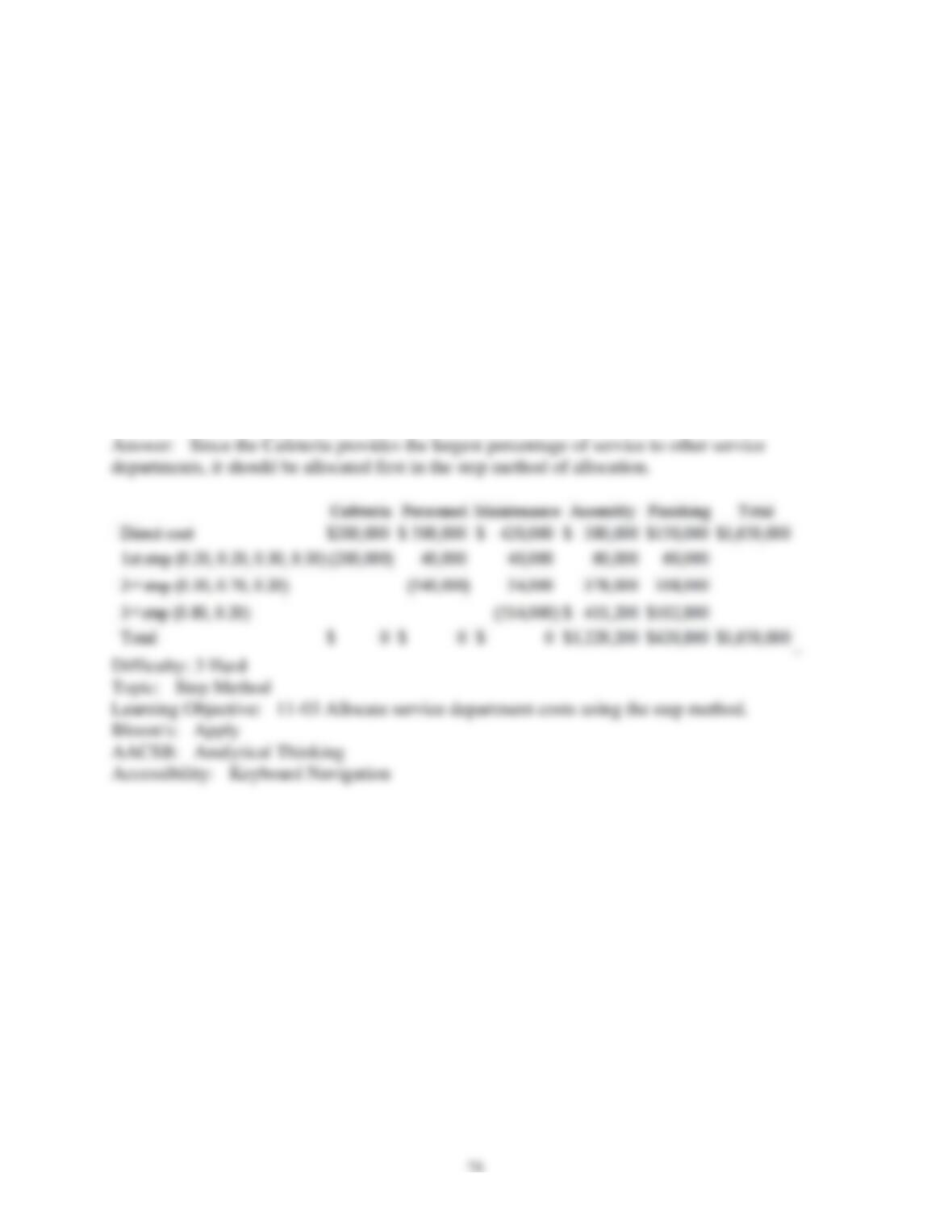
114) Aardvark Industries has two production departments, Assembly and Finishing, and three
Service Departments, Personnel, Maintenance, and Cafeteria. Data relevant to Aardvark are:
Department Direct Cost Personnel Maintenance Cafeteria Assembly
Finishing
Personnel $ 500,000 0.10 0.70 0.20
Maintenance 420,000 0.80 0.20
Cafeteria 200,000 0.20 0.20 0.30 0.30
Assembly 380,000
Finishing 150,000
Required:
Allocate the service department costs of Aardvark Industries using the step method of cost
allocation.
79
115) Mena Corporation has two production departments, Assembly and Finishing, and three
service departments, Personnel, Maintenance, and Cafeteria. Data relevant to Mena are:
Department Direct cost Personnel Maintenance Cafeteria Assembly Finishing
Personnel $ 500,000 0.10 0.70 0.20
Maintenance 420,000 0.80 0.20
Cafeteria 200,000 0.20 0.20 0.30 0.30
Assembly 380,000
Finishing 150,000
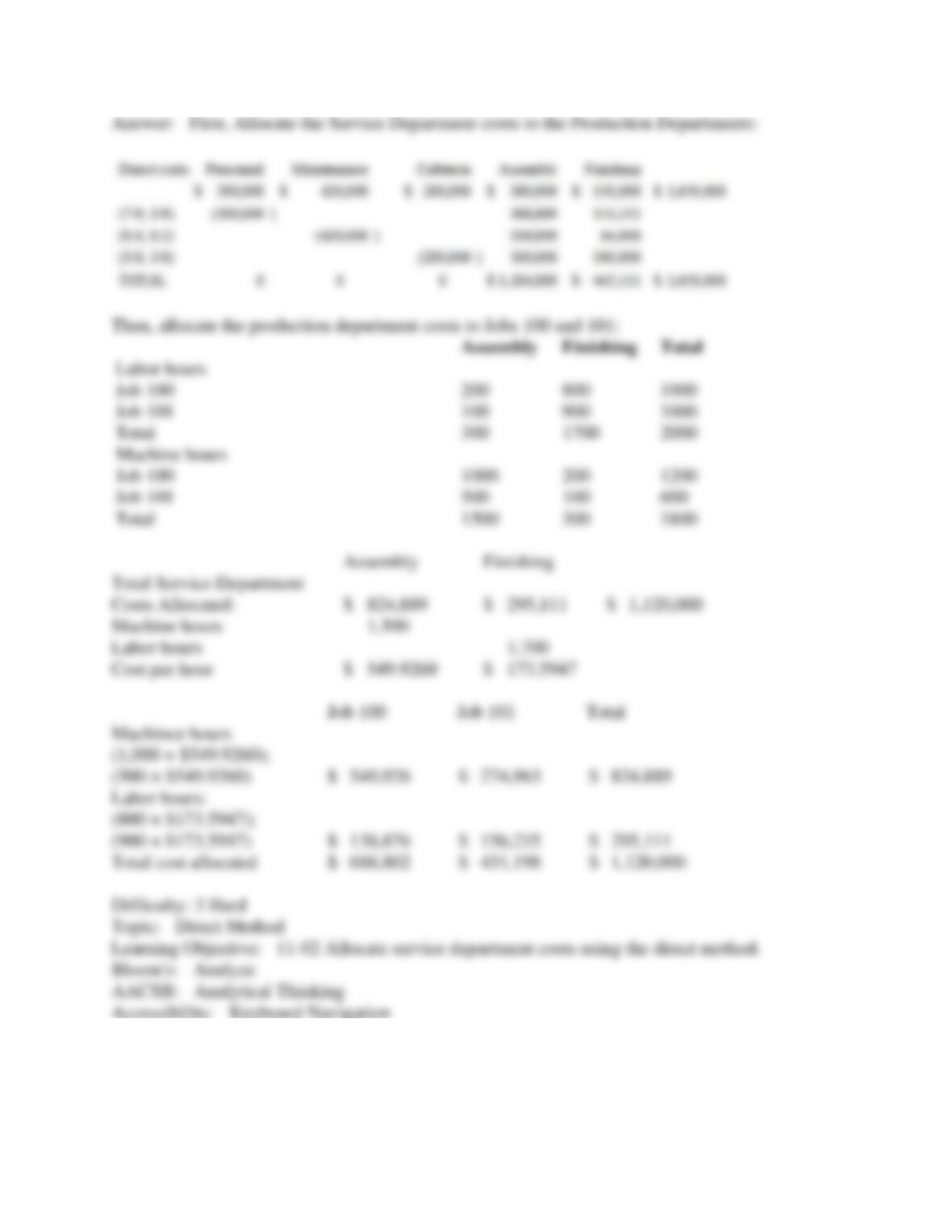
Assembly and Finishing worked on two jobs during the month: Jobs 100 and 101. Costs are
allocated to jobs based on machine hours in Assembly and labor hours in Finishing. The machine
and labor hours worked in each department are as follows:
Assembly Finishing
Job 100 Labor Hours 200 800
Machine Hours 1,000 200
Job 101 Labor Hours 100 900
Machine Hours 500 100
Required:
Determine the amount of service department costs to be allocated to Jobs 100 and 101. Mena
allocates service department costs to production departments using the direct method of
allocation. (Round cost per hour to four decimal places and all other calculations to the nearest
whole dollar.)
80
116) Boston Corporation has two production departments, Assembly and Machining, and two
service departments, Personnel and Cafeteria. Direct costs for each department and the
proportion of service costs used by the various departments for the month of July, 2020 are as
follows: