67) Advanced Computer Solutions, Inc. has two main services: (1) time on a timeshared
computer system and (2) proprietary computer programs. The operation department (Op)
provides computer time and the programming department (P) writes programs.
The percentage of each service used by each department for a typical period is:
Supplied
User Op P
Op — 40 %
P 30 % —
Sold to customers 70 % 60 %
In a typical period, the operation department (Op) spends $4,500 and the programming
department (P) spends $2,500.
Under the step method (Op first), what is the cost of the computer time and the computer
programs for sale?
Time Programs
A. $ 4,500 $ 2,500
B. $ 3,150 $ 3,850
C. $ 1,350 $ 5,650
D. $ 2,700 $ 4,300
A) Option A
B) Option B
C) Option C
D) Option D
42
68) Advanced Computer Solutions, Inc. has two main services: (1) time on a timeshared
computer system, and (2) proprietary computer programs. The operation department (Op)
provides computer time and the programming department (P) writes programs.
The percentage of each service used by each department for a typical period is:
Supplied
User Op P
Op — 40 %
P 30 % —
Sold to customers 70 % 60 %
In a typical period, the operation department (Op) spends $4,500 and the programming
department (P) spends $2,500.
Under the reciprocal method what is the algebraic solution to the cost allocation problem?
A) Op = $4,500 + 0.40P; P = $2,500 + 0.30Op.
B) Op = $4,500 + 0.70P; P = $2,500 + 0.60Op.
C) Op = $2,500 + 0.40P; P = $4,500 + 0.30Op.
D) Op = $2,500 + 0.70P; P = $4,500 + 0.60Op.
69) Which of the following best describes the objective of joint cost allocation?
A) Inventory valuation.
B) Pricing goods for sale.
C) Making decisions about levels of production.
D) Making decisions about raw materials requirements.
70) Allocated joint costs are useful for:
A) Setting the selling price of a product.
B) Determining whether to continue producing an item.
C) Controlling user department costs.
D) Determining inventory cost for accounting purposes.
71) For the purposes of allocating joint costs to joint products, the sales price at the point of sale,
reduced by the cost to complete after split-off, is assumed to be equal to the: (CPA adapted)
A) Total costs.
B) Joint costs.
C) Sales price less a normal profit margin at point of sale.
D) Net realizable value at split-off.
72) Which of the following cost items is not allocable as joint costs when a single manufacturing
process produces several main products and several by-products?
A) Direct materials.
B) Variable overhead.
C) Direct labor.
D) Freight-out.
73) Which of the following is not a step needed to maximize the profits from joint products?
A) Forecasting the sales price of each final product.
B) Identifying alternative sets and quantities of final products possible from the joint process.
C) Determining how to allocate joint costs to the final products.
D) Estimating the costs required to further process joint products into salable products.
74) Which of the following statements about maximizing the profit of joint product processes is
true?
A) Joint processing costs incurred prior to split-off should be allocated before making those
decisions.
B) Only additional expenditures for further processing are relevant.
C) Only revenues from selling or processing beyond the split-off point are relevant.
D) Revenues from selling or processing beyond the split-off point and additional expenditures
for further processing are relevant.
75) For purposes of allocating joint costs to joint products, the estimated net realizable value at
split-off is equal to:
A) Final sales price reduced by cost to complete after split-off.
B) Sales price less a normal profit margin at the point of sale.
C) Separable product cost plus a normal profit margin.
D) Total sales value less joint costs at point of split-off.
76) The method of accounting for joint product costs that will produce the same gross margin
percentage for all products is the:
A) Replacement method.
B) Physical quantities method.
C) Net realizable value method.
D) Units produced method.
77) Which of the following statements is false?
A) The estimated net realizable value for a product is its estimated selling price after processing
the product beyond the split-off point.
B) In general, it is better to use a product’s market value at the split-off point than its estimated
net realizable value.
C) The estimated net realizable value at the split-off point is calculated by taking the sales value
after further processing and deducting the additional processing costs.
D) It is better to use the net realizable value method for allocating joint costs than the estimated
net realizable value method.
78) Net realizable value at the split-off point is used to allocate:
Costs After Split-off Point Incurred Joint Costs
A. No No
B. No Yes
C. Yes No
D. Yes Yes
A) Option A
B) Option B
C) Option C
D) Option D
79) Products X, Y, and Z are produced from the same process at a cost of $5,200. Five thousand
pounds of raw material yields 1,500 X, 2,500 Y, and 1,000 Z. Selling prices are: X $2 per unit, Y
$4 per unit, and Z valueless. The ending inventory of X is 50 units. What is the value of the
ending inventory if joint costs are allocated using net realizable value?
A) $21.67.
B) $31.20.
C) $40.00.
D) $42.00.
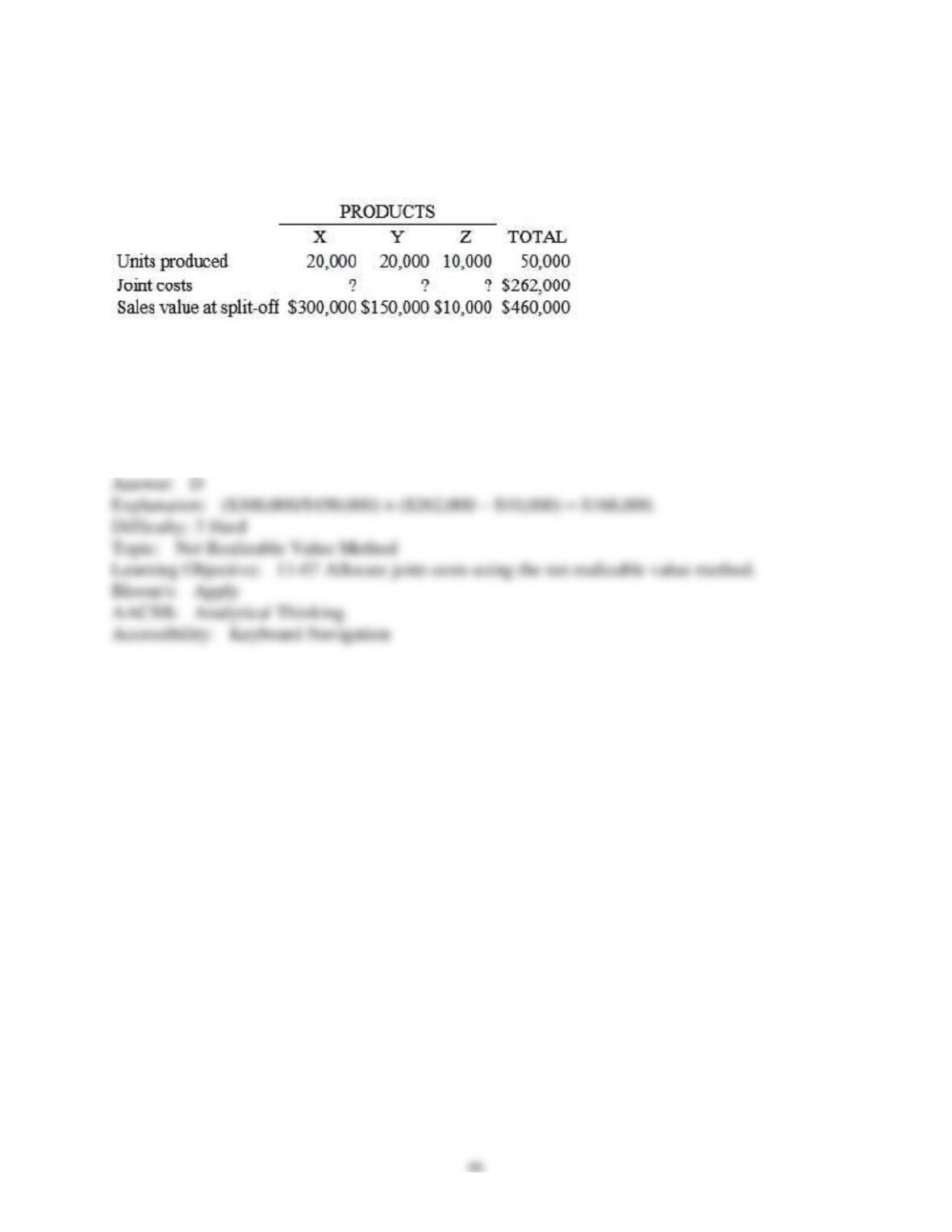
80) Bonanza Co. manufactures products X and Y from a joint process that also yields a by-
product, Z. Revenue from sales of Z is treated as a reduction of joint costs. Additional
information is as follows:
Joint costs were allocated using the net realizable value method at the split-off point. The joint
costs allocated to product X were
A) $75,000.
B) $100,800.
C) $150,000.
D) $168,000.
81) Great Falls Company makes two products, Wool Gloves and Wool Mittens. They are
initially processed from the same raw material and then, after split-off, further processed
separately. Additional information is as follows:
Gloves Mittens Total
Final Sales Price $ 9,000 $ 6,000 $ 15,000
Joint Costs Prior to Split-Off Point ? ? $ 6,600
Costs Beyond Split-Off Point $ 3,000 $ 3,000 $ 6,000
What are the joint costs allocated to Gloves and Mittens assuming Great Falls uses the estimated
net realizable value approach?
Gloves Mittens
A. $ 3,300 $ 3,300
B. $ 3,960 $ 2,640
C. $ 4,400 $ 2,200
D. $ 4,560 $ 2,040
A) Option A
B) Option B
C) Option C
D) Option D
82) Atkinson, Inc., manufactures products A, B, and C from a common process. Joint costs were
$60,000. Additional information is as follows:
If Processed Further
Product Units
Produced Sales Value at Split-Off Sales Value
Additional Costs
A 6,000 $ 40,000 $ 55,000 $ 4,000
B 4,000 35,000 45,000 6,000
C 2,000 25,000 30,000 8,000
12,000 $ 100,000 $ 130,000 $ 18,000
Assuming that joint production costs are allocated using the physical quantities method (units
produced), what were the costs allocated to Product A?
A) $27,000.
B) $29,000.
C) $33,000.
D) $30,000.
83) Atkinson, Inc., manufactures products A, B, and C from a common process. Joint costs were
$60,000. Additional information is as follows:
If Processed Further
Product Units
Produced Sales Value at Split-Off Sales Value
Additional Costs
A 6,000 $ 40,000 $ 55,000 $ 4,000
B 4,000 35,000 45,000 6,000
C 2,000 25,000 30,000 8,000
12,000 $ 100,000 $ 130,000 $ 18,000
Assuming that joint product costs are allocated using the net realizable value method, what were
the total costs assigned to Product B?
A) $26,000.
B) $26,796.
C) $27,000.
D) $28,286.
84) Tanner Corporation produced 3,660 units, consisting of three separate products, in a joint
process for the year. The market for these products was so unstable that it was not practical to
estimate the selling price of the products. A cost of $425,000 was incurred in the joint process.
Product X’s production was 80% of product Y’s while product Z’s production was 125% of
product Y’s. What is the amount of the joint cost allocable to product X (rounded to the nearest
whole dollar) assuming Tanner uses the physical quantities method of allocation?
A) $111,475.
B) $114,865.
C) $139,344.
D) $141,667.
85) Cariboo Manufacturing Company incurred a joint cost of $600,000 in the production of X
and Y in a joint process. Presently, 1,800 of X and 1,400 of Y are being produced each month.
Management plans to decrease X’s production by 300 units in order to increase the production of
Y by 500 units. Additionally, this change will require minor modifications, which will add
$20,000 to the joint cost. This cost is entirely attributable to product Y. What is the amount of
the joint costs allocable to X and Y before changes to existing production assuming Cariboo
allocates their joint costs according to the proportion of X and Y produced?
Product X Product Y
A. $ 262,500 $ 337,500
B. $ 264,706 $ 335,294
C. $ 273,529 $ 326,471
D. $ 337,500 $ 262,500
A) Option A
B) Option B
C) Option C
D) Option D
86) Upton Company produces two main products and a by-product out of a joint process. The
ratio of output quantities to input quantities of direct material used in the joint process remains
consistent from month to month. Upton has employed the physical quantities method to allocate
joint production costs to the two main products. The net realizable value of the by-product is
used to reduce the joint production costs before the joint costs are allocated to the main products.
Data regarding Upton’s operations for the current month are presented in the chart below. During
the month, Upton incurred joint production costs of $2,520,000. The main products are not
marketable at the split-off point and, thus, have to be processed further.
First Main Product Second Main Product
By-Product
Monthly output in pounds 90,000 150,000 60,000
Selling Price per pound $ 30 $ 14 $ 2
Separable process costs $ 540,000 $ 660,000
The amount of joint production cost that Upton would allocate to the Second Main Product by
using the physical quantities method to allocate joint production costs would be:
A) $1,200,000.
B) $1,260,000.
C) $1,500,000.
D) $1,575,000.
87) The Mallak Company produced three joint products at a joint cost of $100,000. Two of these
products were processed further. Production and sales were:
Product Weight Sales Additional Processing Costs
P 300,000 lbs. $ 245,000 $ 200,000
Q 100,000 lbs. 30,000 -0-
R 100,000 lbs. 175,000 100,000
If the estimated net realizable value method is used and product Q is accounted for as a main
product, how much of the joint costs would be allocated to product R?
A) $38,889.
B) $41,667.
C) $50,000.
D) $62,500.
88) The Mallak Company produced three joint products at a joint cost of $100,000. Two of these
products were processed further. Production and sales were:
Product Weight Sales Additional Processing Costs
P 300,000 lbs. $ 245,000 $ 200,000
Q 100,000 lbs. 30,000 -0-
R 100,000 lbs. 175,000 100,000
Assume Q is a by-product and Mallak uses the cost reduction method of accounting for by-
product cost. If estimated net realizable value is used, how much of the joint costs would be
allocated to product R?
A) $38,889.
B) $43,750.
C) $50,000.
D) $62,500.
89) The Mallak Company produced three joint products at a joint cost of $100,000. Two of these
products were processed further. Production and sales were:
Product Weight Sales Additional Processing Costs
P 300,000 lbs. $ 245,000 $ 200,000
Q 100,000 lbs. 30,000 -0-
R 100,000 lbs. 175,000 100,000
If joint costs are allocated based on relative weight of the outputs and all products are main
products, how much of the joint costs would be allocated to product P?
A) $43,750.
B) $50,000.
C) $60,000.
D) $62,500.
90) The Mallak Company produced three joint products at a joint cost of $100,000. Two of these
products were processed further. Production and sales were:
Product Weight Sales Additional Processing Costs
P 300,000 lbs. $ 245,000 $ 200,000
Q 100,000 lbs. 30,000 -0-
R 100,000 lbs. 175,000 100,000
What is the net income of Mallak Company if the estimated net realizable value method of joint
cost allocation is used?
A) $20,000.
B) $50,000.
C) $150,000.
D) $350,000.
91) Cambridge Company manufactures three main products, L, M, and N, from a joint process.
Additional information for June production activity follows:
L M N Total
Units produced 50,000 40,000 10,000 100,000
Joint costs ? ? ? $ 450,000
Sales value at split-off $ 420,000 $ 270,000 $ 60,000 $ 750,000
Additional costs if process further $ 88,000 $ 30,000 $ 12,000 $
130,000
Sale value if processed further $ 538,000 $ 320,000 $ 78,000 $
936,000
Assuming that the 10,000 units of N were processed further and sold for $78,000, what was
Cambridge’s gross profit from this sale? Assume the physical quantities method of allocation is
used.
A) $21,000.
B) $28,500.
C) $30,000.
D) $66,000.
92) Which of the following is not a physical measure that can be used for allocating joint costs
using the physical quantities method?
A) Tons of steel.
B) Ounces of gold.
C) Dollars of labor.
D) Feet of lumber.
93) In joint product costing and analysis, which one of the following costs is relevant when
deciding the point at which a product should be sold in order to maximize profits? (CMA
adapted)
A) Separable costs after the split-off point.
B) Joint costs to the spilt-off point.
C) Sales salaries for the period when the units were produced.
D) Purchase costs of the materials required for the joint products.