41) The Amazing Widget Company issues $500,000 of 6%, 10-year bonds at 103 on March 31, 2014. The bond
pays interest on March 31 and September 30. The market rate of interest on the issuance date was 4%. Assume the
company uses the straight-line method for amortization. The journal entry to record the first interest payment on
September 30, 2014 is a:
A) debit to Cash for $15,000.
B) debit to Interest expense for $15,750.
C) debit to Interest expense for $14,250.
D) credit to Premium on bonds payable for $750.
42) The Amazing Widget Company issues $500,000 of 6%, 10-year bonds at 103 on March 31, 2014. The bond
pays interest on March 31 and September 30. The market rate of interest on the issuance date was 4%. Assume the
company uses the straight-line method for amortization. What net balance will be reported for the bonds on the
balance sheet on September 30, 2014?
A) $500,000.
B) $515,000.
C) $514.250.
D) $515,250.
43) The Cases Company issues $800,000 of 7%, 10-year bonds on March 31, 2013. The bond pays interest on
March 31 and September 30. Which of the following statements is TRUE?
A) If the market rate of interest is 8%, the bonds will issue at a premium.
B) If the market rate of interest is 8%, the bonds will issue at a discount.
C) If the market rate of interest is 8%, the bonds will issue at par.
D) If the market rate of interest is 8%, the bonds will issue above par.
44) Blanding Company issues $1,000,000 of 8%, 10-year bonds at 98 on February 28, 2012. The bond pays interest
on February 28 and August 31. The market rate of interest on the issuance date was 10%. On August 31, 2012, how
much cash did Blanding pay out to bondholders?
A) $41,000
B) $40,000
C) $80,000
D) $39,000
45) The Amazing Widget Company issues $500,000 of 6%, 10-year bonds at 103 on March 31, 2013. The bond
pays interest on March 31 and September 30. The market rate of interest on the issuance date was 4%. On
September 30, 2013, how much cash did the company pay out to bondholders?
A) $14,250
B) $30,000
C) $15,000
D) $7,500
46) On January 1, 2013, Davie Services issued $20,000 of 8% bonds that mature in five years. They were issued at
par—for the same amount as the face value. Please provide the journal entry to issue the bonds.
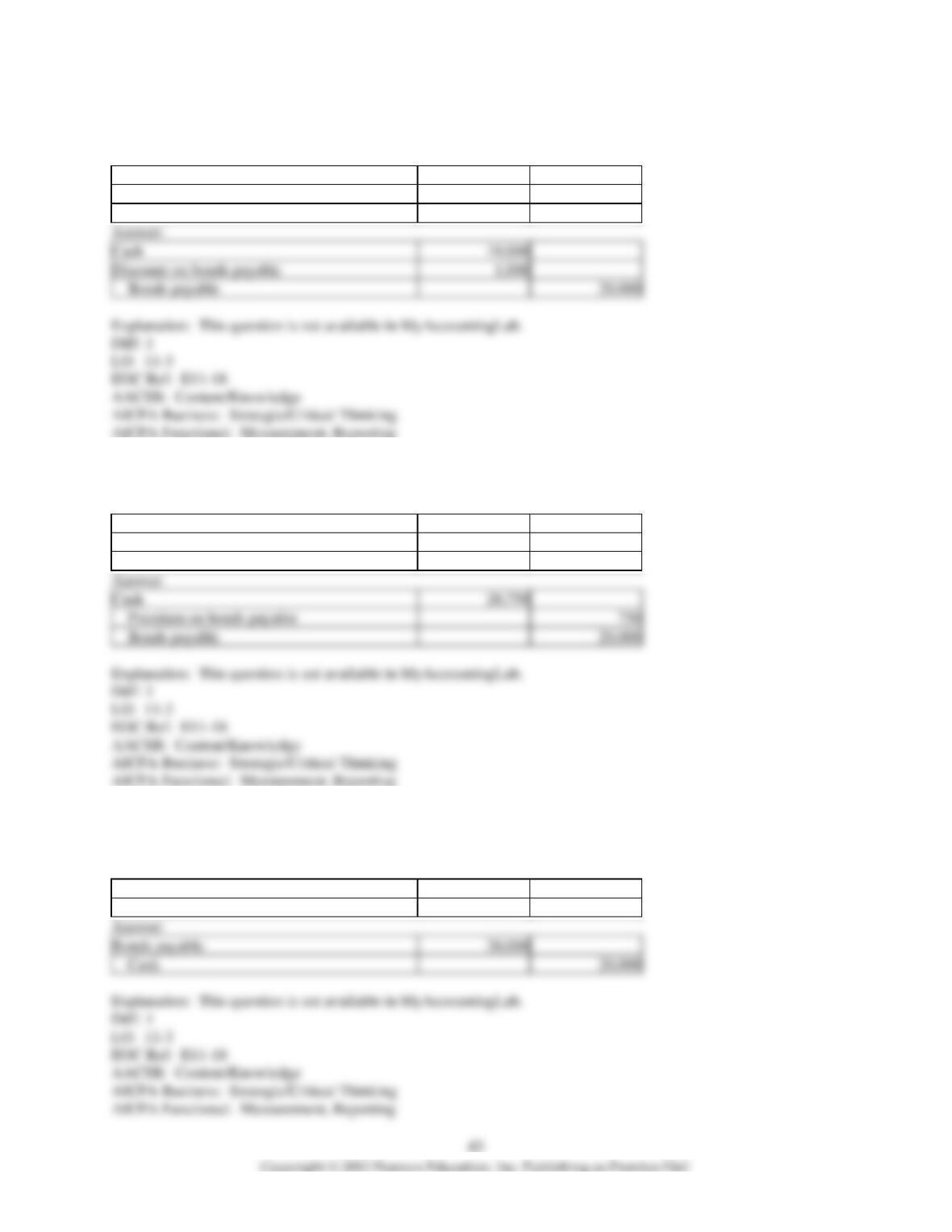
47) On January 1, 2013, Davie Services issued $20,000 of 8% bonds that mature in five years. They were sold at
discount, for a total of $19,000. Please provide the journal entry to issue the bonds.
Cash
Discount on bonds payable
48) On January 1, 2013, Davie Services issued $20,000 of 8% bonds that mature in five years. They were sold at a
premium, for a total of $20,750. Please provide the journal entry to issue the bonds.
Cash
49) On January 1, 2013, Davie Services issued $20,000 of 8% bonds that mature in five years. They were issued at
par—for the same amount as the face value. On January 1, 2018, when the bonds mature, Davie Services will make
the final principal payment. Please provide the journal entry for that payment.
Bonds payable
50) On January 1, 2013, Davie Services issued $20,000 of 8% bonds that mature in five years. They were sold at
par. The bonds pay semiannual interest payments on June 30 and December 31 of each year. Please provide the
journal entry for the payment made on June 30, 2013.
Interest expense
51) On January 2, 2014, Mahoney Sales issued $10,000 in bonds for $9,400. They were 5-year bonds with a stated
rate of 4%, and pay semiannual interest payments. Mahoney Sales uses straight-line method to amortize bond
discount. Please provide the journal entry for the first interest payment on June 30, 2014.
Interest expense
52) On January 2, 2014, Mahoney Sales issued $10,000 in bonds for $10,900. They were 5-year bonds with a stated
rate of 4%, and pay semiannual interest payments. Mahoney Sales uses straight-line method to amortize bond
premium. Please provide the journal entry for the first interest payment to be made on June 30, 2014.
Interest expense
Premium on bonds payable
53) On November 1, 2013, Archangel Services issued $200,000 of 10–year bonds with a stated rate of 3%. The
bonds were sold at par, and make semiannual payments on April 30 and October 31. At December 31, 2013,
Archangel made an adjusting entry to accrue interest at year-end. Please provide that journal entry.
Interest expense
54) On November 1, 2013, Archangel Services issued $200,000 of 10–year bonds with a stated rate of 3%. The
bonds were sold at par and make semiannual payments on April 30 and October 31. At December 31, 2013,
Archangel made an adjusting entry to accrue interest at year-end. No further entries were made until April 30, 2014,
when the first payment was sent out. Please provide the journal entry for this payment.
Interest expense
Interest payable
55) On November 1, 2013, Archangel Services issued $200,000 of 10–year bonds with a stated rate of 3%. The
bonds were sold at discount for $191,000 and make semiannual payments on April 30 and October 31. At
December 31, 2013, Archangel made an adjusting entry to accrue interest at year-end. Please provide that entry.
Interest expense
56) On November 1, 2013, Archangel Services issued $200,000 of 10–year bonds with a stated rate of 3%. The
bonds were sold at discount for $191,000 and make semiannual payments on April 30 and October 31. At
December 31, 2013, Archangel made an adjusting entry to accrue interest at year-end. No further entries were made
until April 30, 2014 when the first interest payment was made. Please provide the journal entry for that payment.
Interest payable
1,000
Interest expense
2,300
Discount on bonds payable
300
Cash
3,000
Interest payable
1,000
Interest expense
2,300
Discount on bonds payable
300
Cash
3,000
57) McDonald Sales prepared a bond issue of $20,000 dated January 1, 2013. The bonds have a stated rate of 3%
and a term of 6 years. The bond issue was delayed, and the bonds were finally sold on March 1, 2013 at par. Please
provide the journal entry for the issue of the bonds on March 1, 2013.
Cash
Interest payable
100
Bonds payable
58) McDonald Sales prepared a bond issue of $20,000 dated January 1, 2013. The bonds have a stated rate of 3%
and a term of 6 years. The bond issue was delayed, and the bonds were finally sold on March 1, 2013 at par. On
June 30, 2013, the first semiannual interest payment is made. Please provide the journal entry for that payment
transaction.
Interest expense
Interest payable
Learning Objective 11-4
1) Interest payable would normally be shown on the balance sheet in current liabilities.
2) FICA tax payable would normally be shown on the balance sheet in long–term liabilities.
3) Accounts payable is always shown on the balance sheet in current liabilities.
4) The current portion of notes payable would normally be shown on the balance sheet in long-term liabilities.
5) The current portion of mortgages payable would normally be shown on the balance sheet in current liabilities.
6) Balances for bonds payable on the balance sheet will show the balances minus any discount or plus any premium.
7) Please refer to the following list of liability balances.
Accounts payable
$12,000
Employee benefits payable
360
Employee income tax payable
190
Interest payable
1,300
Estimated warranty payable
2,600
Long-term notes payable
32,000
FICA tax payable
590
Sales tax payable
370
Long-term notes payable
4,000
Bond payable
50,000
Current portion of long-term notes payable
2,000
What is the total amount of current liabilities?
A) $19,410
B) $68,270
C) $18,270
D) $105,410
8) Please refer to the following list of liability balances.
Accounts payable
$12,000
Employee benefits payable
360
Employee income tax payable
190
Interest payable
1,300
Estimated warranty payable
2,600
Long-term notes payable
32,000
FICA tax payable
590
Sales tax payable
370
Long-term notes payable
4,000
Bond payable
50,000
Current portion of long-term notes payable
2,000
What is the total amount of long-term liabilities?
A) $88,000
B) $86,000
C) $84,000
D) $54,000
Learning Objective 11-5
1) The time value of money is based on the concept that money earns interest over time.
2) Rules of GAAP require that bond premiums or discounts be amortized using the straight-line method.
3) If the difference between the effective-interest method of amortizing bond discount and the straight-line method
is immaterial, then GAAP permits use of the straight-line method.
4) The time value of money is related to which of the following concepts?
A) Money loses value over time as it is spent.
B) Money earns interest over time and grows in value.
C) Money loses its purchasing power because of inflation.
D) Money can buy extra time.
5) If $10,000 is invested for one year and earns an annual interest rate of 7%, it will grow in value to:
A) $10,700.
B) $17,000.
C) $700
D) $70,000.
6) Using the present value tables, please compute the present value of $20,000 discounted back 5 periods at 4%.
A) $16,400
B) $19,240
C) $18,180
D) $16,440
7) Using the present value tables, please compute the present value of an annuity which pays $2,000 per year for 10
years, discounted at 7%.
A) $14,048
B) $19,240
C) $18,180
D) $16,440
8) Compute the present value of a bond:
The principal amount is $50,000, the stated rate is 3%, and the term of the bond is 6 years. The bond pays interest
semiannually. At the time of issue, the market rate is 4%. Please compute the present value of the bond at market
rate using the present value tables.
A) $39,400
B) $7,931
C) $47,331
D) $59,000
9) Compute the present value of a bond:
The principal amount is $140,000, the stated rate is 9%, and the term of the bond is 4 years. The bond pays interest
semiannually. At the time of issue, the market rate is 8%. Please compute the present value of the bond at market
rate using the present value tables.
A) $144,758
B) $42,418
C) $102,340
D) $142,000
10) On January 1, 2014, Partridge Company issued $50,000 of 6-year bonds with a stated rate of 3%. The market
rate at time of issue was 4%, so the bonds were discounted and sold for $47,331. Partridge uses the effective–
interest rate of amortization for bond discount. Semiannual interest payments are made on June 30 and December
31 of each year. How much interest expense will be recorded when the first interest payment is made? (Please
round to the nearest whole dollar.)
A) $167
B) $947
C) $750
D) $2,000
11) On January 1, 2014, Partridge Company issued $50,000 of 6-year bonds with a stated rate of 3%. The market
rate at time of issue was 4%, so the bonds were discounted and sold for $47,331. Partridge uses the effective–
interest rate of amortization for bond discount. Semiannual interest payments are made on June 30 and December
31 of each year. Which of the following is the correct journal entry to record the first interest payment? (Please
round all amounts to the nearest whole dollar.)
A)
Interest expense
1,000
Cash
1,000
B)
Interest expense
947
Discount on bonds payable
197
Cash
750
C)
Interest expense
750
Discount on bonds payable
250
Cash
1,000
D)
Interest expense
1,000
Discount on bonds payable
750
Cash
250
12) On January 1, 2013, Diab Services issued $140,000 of 4-year bonds with a stated rate of 9%. The market rate at
time of issue was 8%, so the bonds were issued with a premium and sold for $144,758. Diab uses
the effective-interest method to amortize bond premium. Semiannual interest payments are made on June 30 and
December 31 of each year. How much interest expense will be recorded when the first interest payment is made?
A) $5,790
B) $6,300
C) $11,200
D) $1,050
13) On January 1, 2013, Diab Services issued $140,000 of 4–year bonds with a stated rate of 9%. The market rate at
time of issue was 8%, so the bonds were issued with a premium and sold for $144,758. Diab uses the effective–
interest method to amortize bond premium. Semiannual interest payments are made on June 30 and December 31 of
each year. Which of the following is the correct journal entry to record the first interest payment?
A)
Interest expense
5,600
Cash
5,600
B)
Interest expense
5,600
Discount on bond payable
700
Cash
6,300
C)
Interest expense
5,790
Premium on bonds payable
510
Cash
6,300
D)
Cash
6,300
Premium on bonds payable
700
Interest expense
5,600
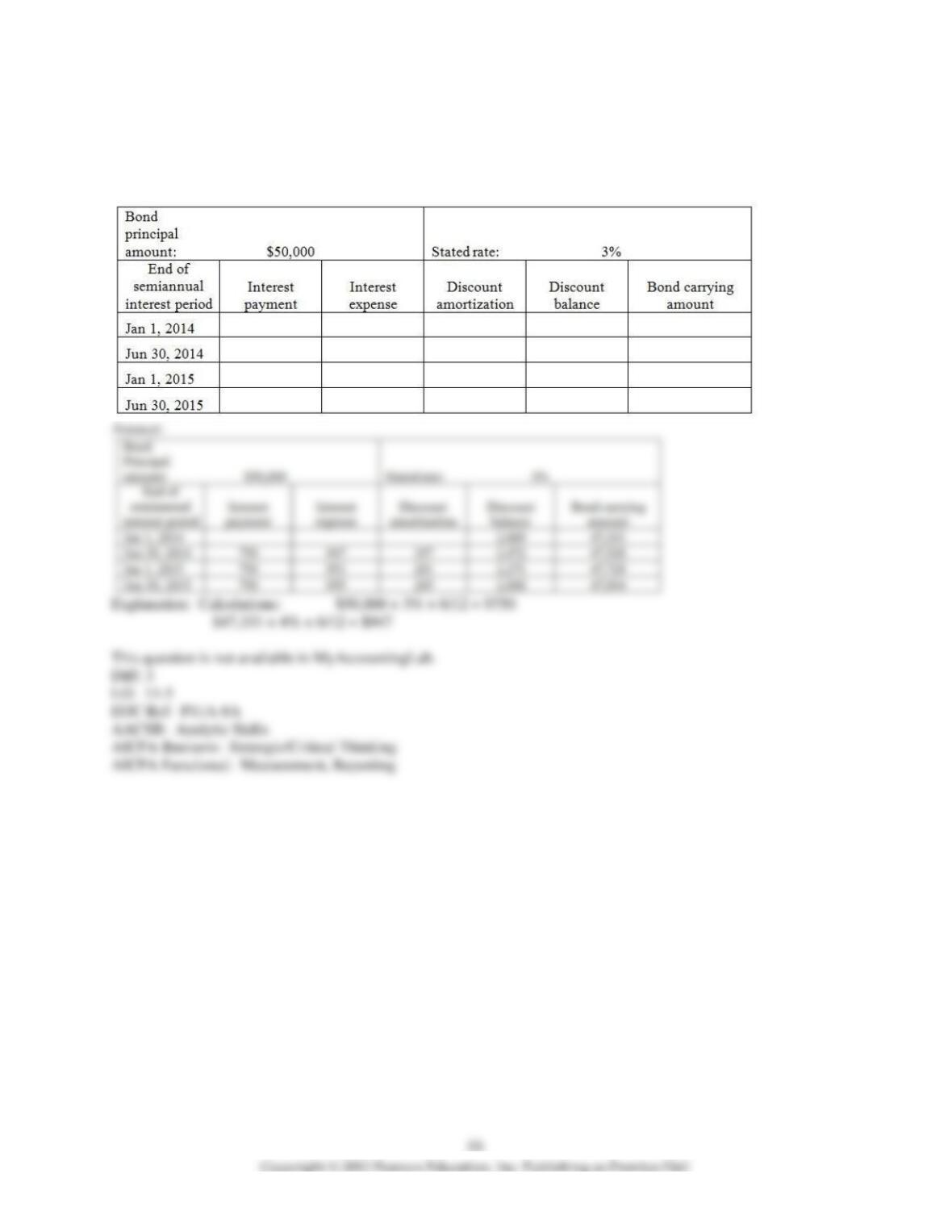
14) On January 1, 2014, Partridge Company issued $50,000 of 6-year bonds with a stated rate of 3%. The market
rate at time of issue was 4%, so the bonds were discounted and sold for $47,331. Partridge uses the effective–
interest rate of amortization for bond discount. Semiannual interest payments are made on June 30 and December
31 of each year. Please complete the amortization table for the first four interest payments.
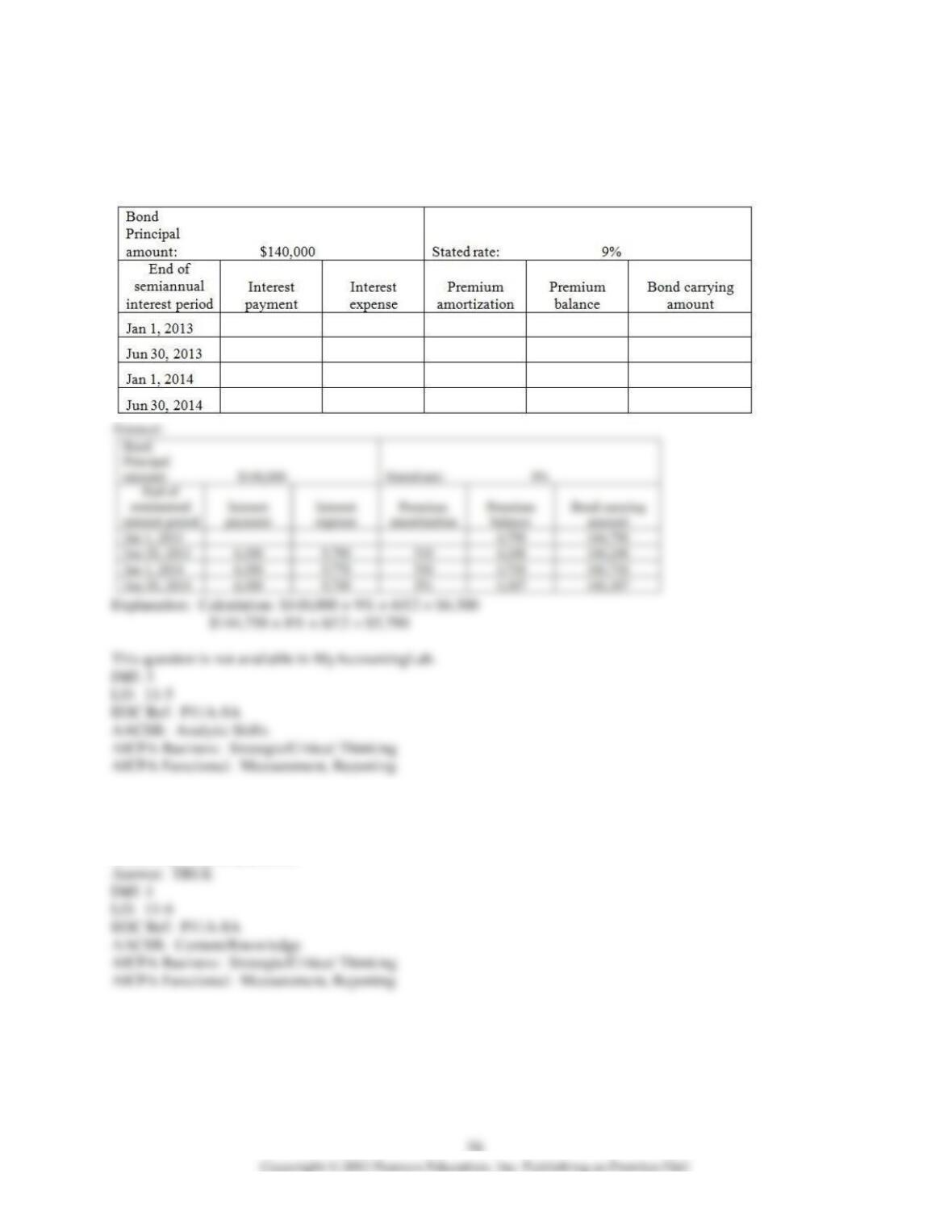
15) On January 1, 2013, Diab Services issued $140,000 of 4–year bonds with a stated rate of 9%. The market rate at
time of issue was 8%, so the bonds were issued at a premium and sold for $144,758. Diab uses the effective-interest
method to amortize bond premium. Semiannual interest payments are made on June 30 and December 31 of each
year. Please complete the amortization table for the first four interest payments.
Learning Objective 11-6
1) The main reason companies retire bonds prior to their maturity date is to relieve the pressure of paying
semiannual interest payments.
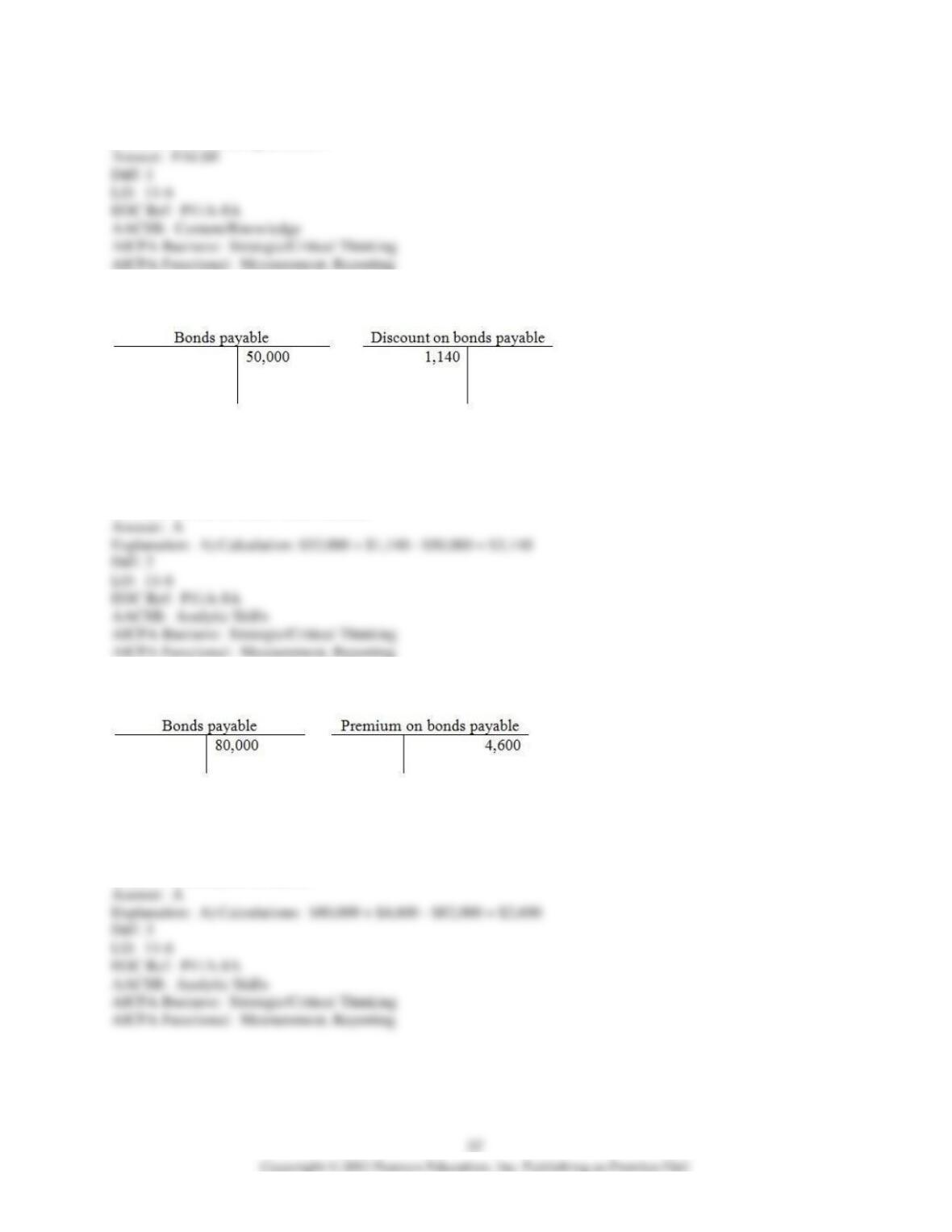
2) If a company wishes to retire bonds early, they may call the bonds if the bonds are callable, but they may not
purchase them on the open market.
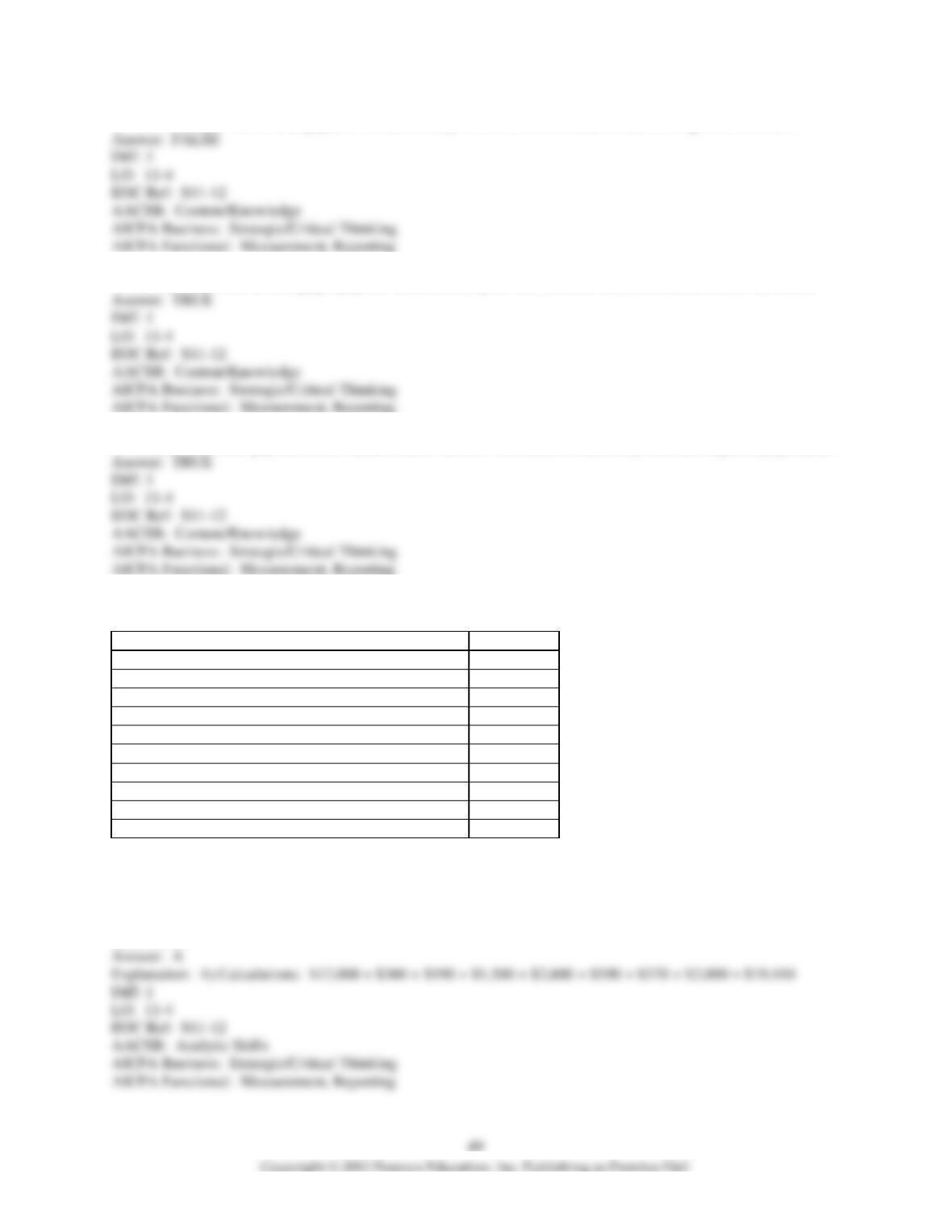
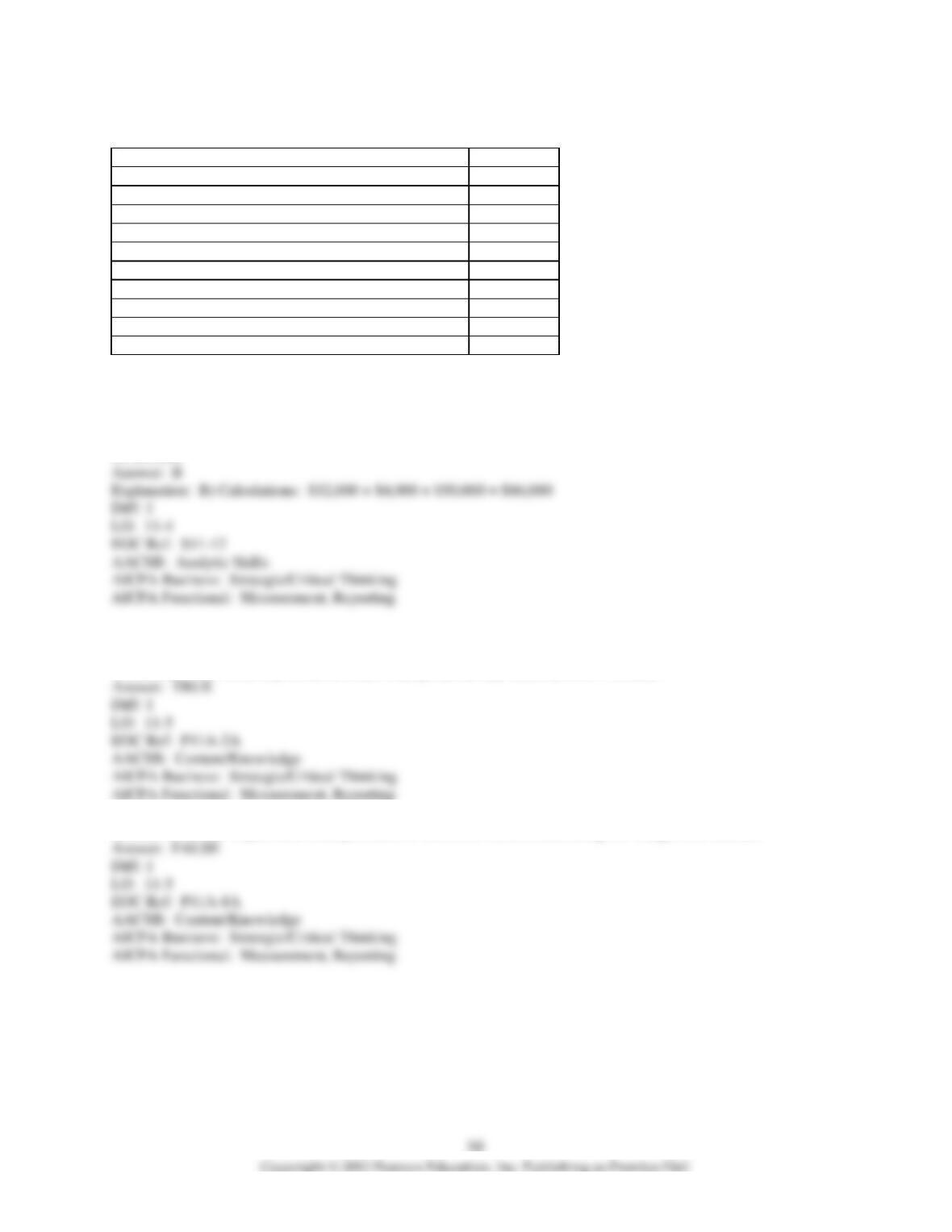
3) On May 1, 2013, Metro Company has bonds with balances as shown below.
If Metro retires the bonds for $52,000, what will be the effect on the income statement?
A) There will be a loss on retirement of $3,140.
B) There will be a gain on retirement of $3,140.
C) There will be sales revenue of $3,140.
D) There will be no effect on net income.
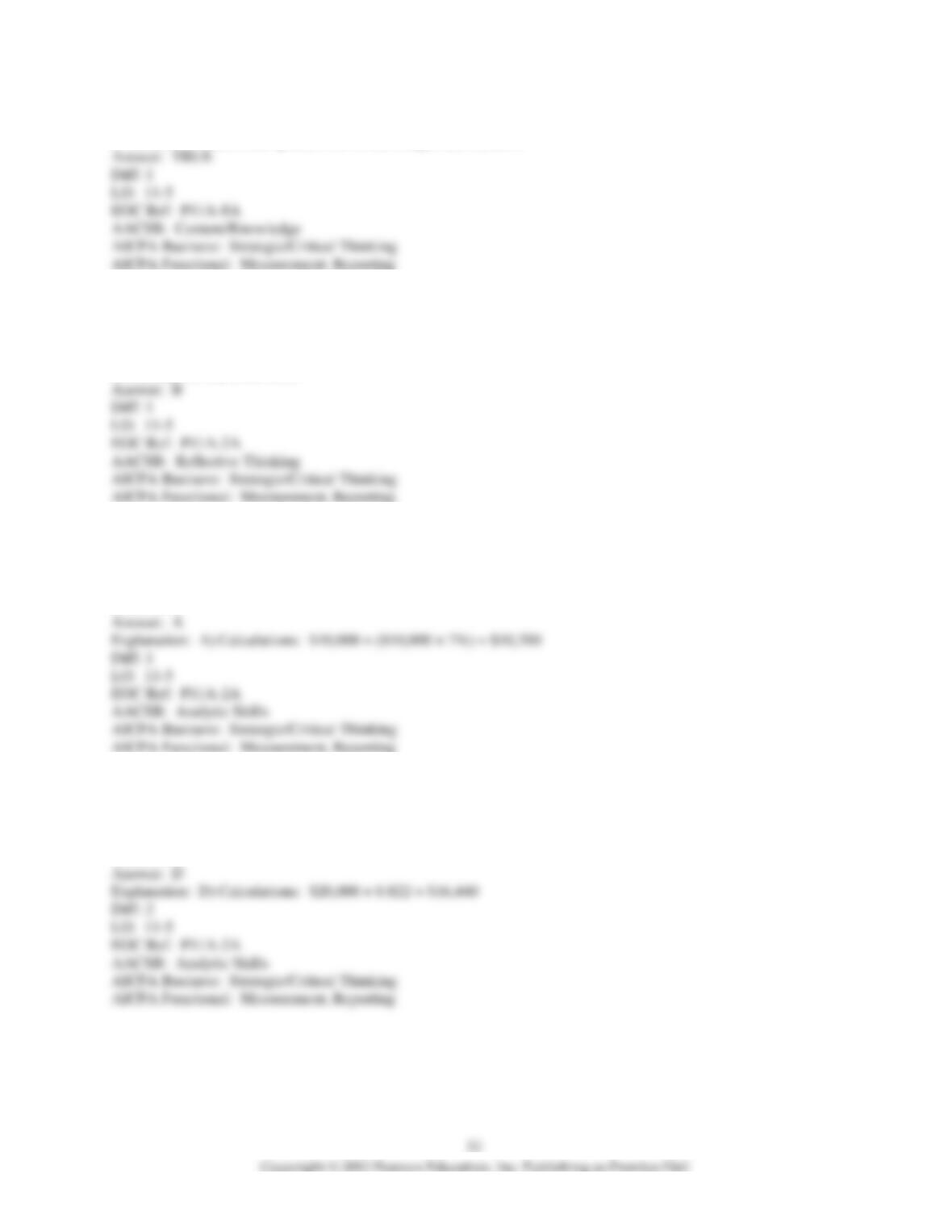
4) On October 15, 2013, Rural Sales has a bond with balances as shown below.
If Rural Sales wishes to retire the bonds for $82,000, what will be the effect on the income statement?
A) Gain on retirement of $2,600
B) Loss on retirement of $2,600
C) Gain on retirement of $2,000
D) Loss on retirement of $2,000
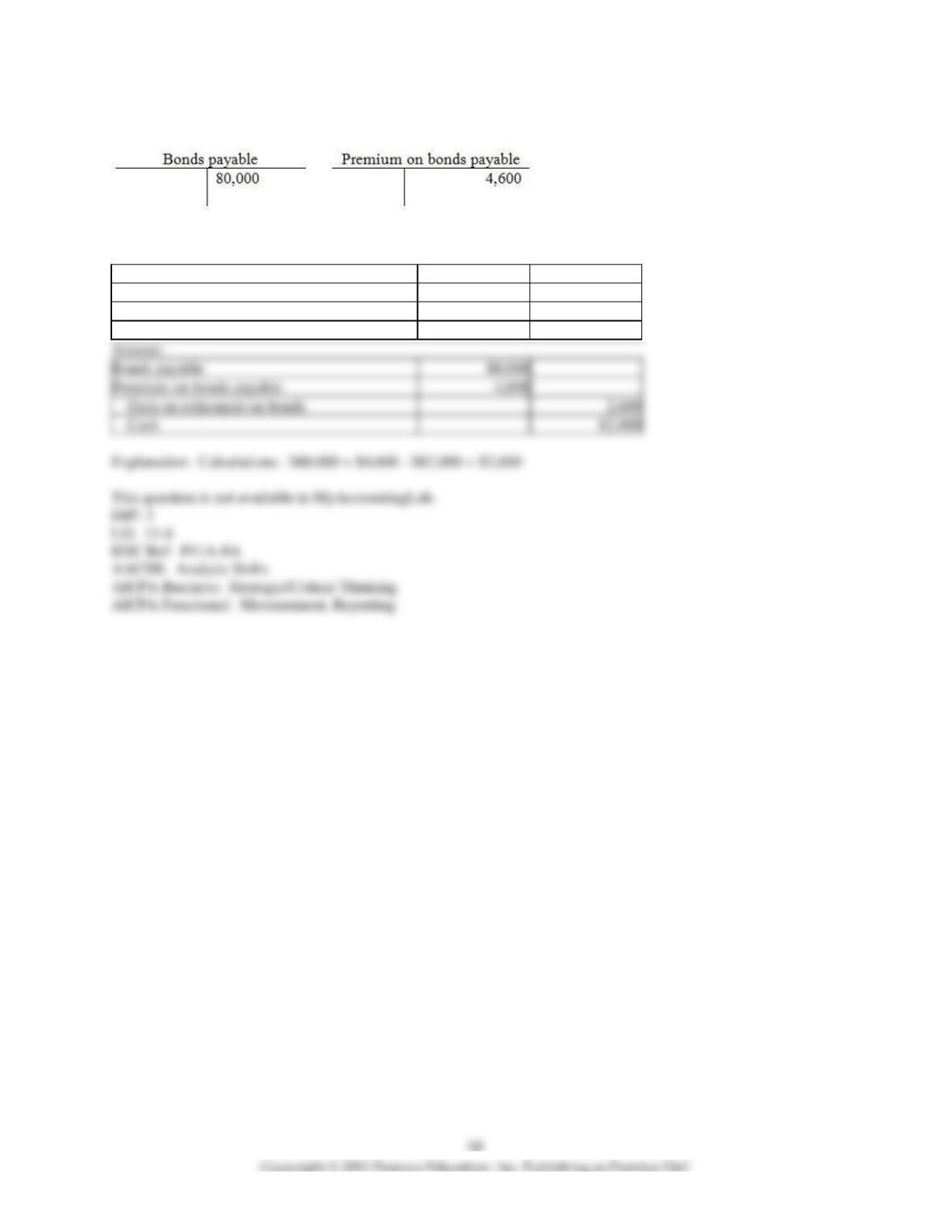
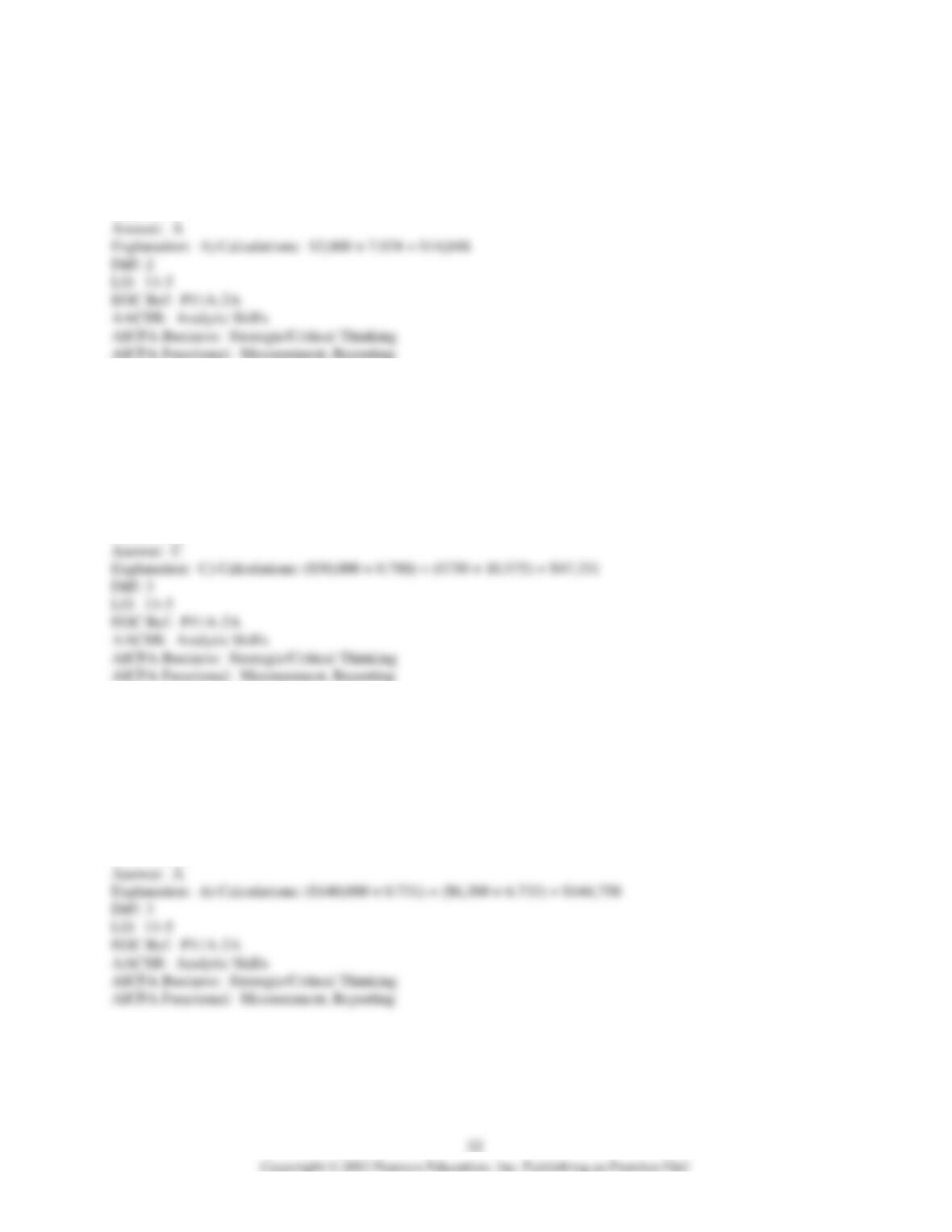
5) On October 15, 2013, Rural Sales has a bond with balances as shown below.
Rural Sales retires the bonds for $82,000. Please provide the journal entry to retire the bonds.
Bonds payable
Premium on bonds payable
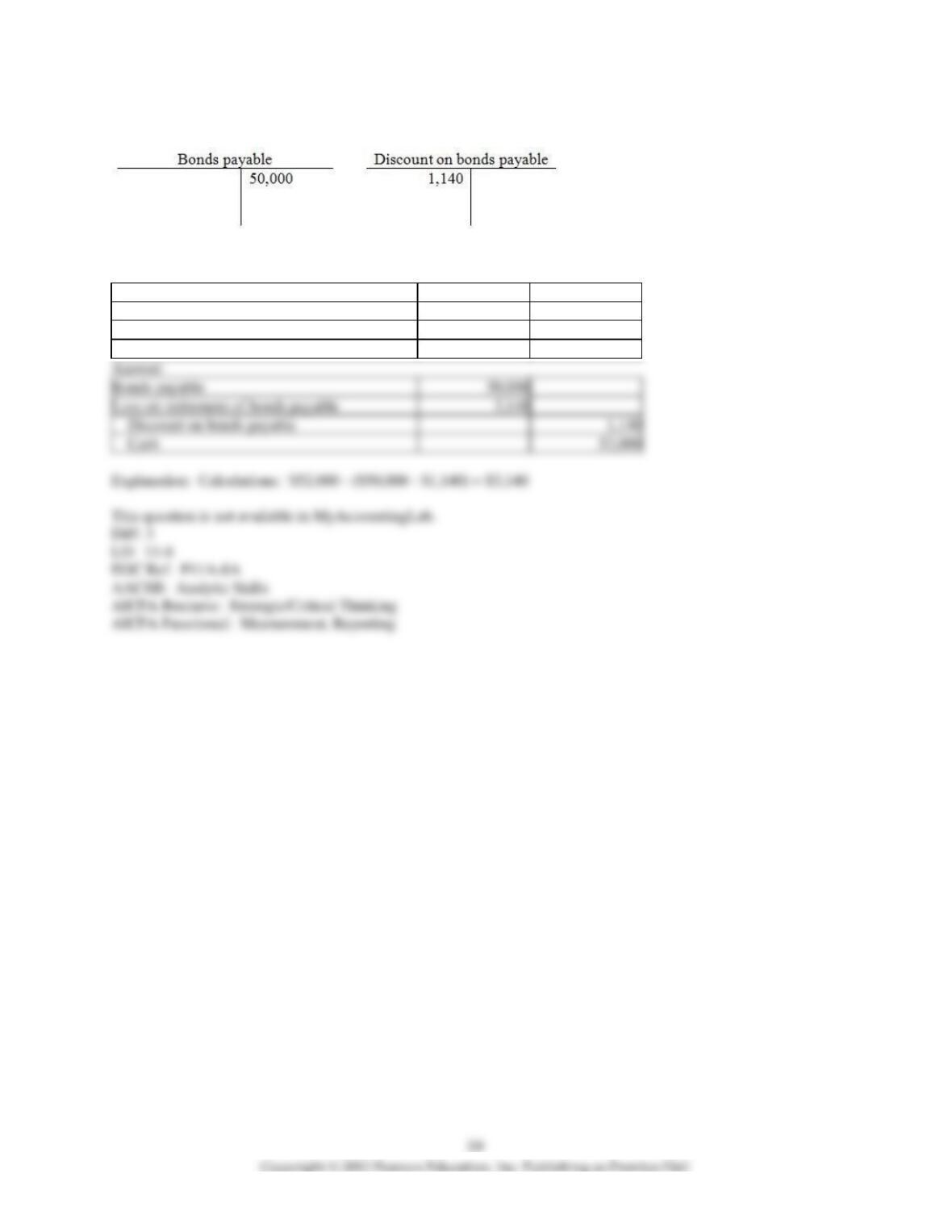
6) On May 1, 2014, Metro Company has bonds with balances as shown below.
Metro retires the bonds for $52,000. Please provide the journal entry to retire the bonds.
Bonds payable
Loss on retirement of bonds payable