26) The loss from discontinued operations includes:
A) operating loss of discontinued segment during divestiture period.
B) loss on sale of discontinued segment.
C) unusual and infrequent losses.from other segments of the company.
D) A and B.
27) Changes in accounting principles include changes:
A) from FIFO to average cost for inventory.
B) required because the FASB issues new accounting pronouncements.
C) to the estimated useful life of a building.
D) A and B.
28) For a retailer, how is Interest Expense classified on a multistep income statement?
A) Operating Expenses
B) Selling Expense
C) Financing Expense
D) Other Expenses and Losses
29) Accounting changes:
A) make it difficult to compare one period with preceding periods.
B) require detailed information to keep investors from being misled.
C) may result when companies discover errors they have made in applying accounting principles that
must be corrected.
D) all of the above statements are correct.
30) For a merchandiser, how is Interest Revenue classified on the income statement?
A) Income from Discontinued Operations
B) Income from Financing Activities
C) Other Revenues and Gains
D) As a component of Net Sales Revenue
31) The estimated value of a company is $18 million. The company has 2 million shares outstanding at a
market price of $10 per share. You already own 1,000 shares of the stock. Based on this information, the
investment decision rule is:
A) You should buy more shares of the stock.
B) You should hold the stock for now.
C) You should sell the stock.
D) There is not enough information to make a decision.
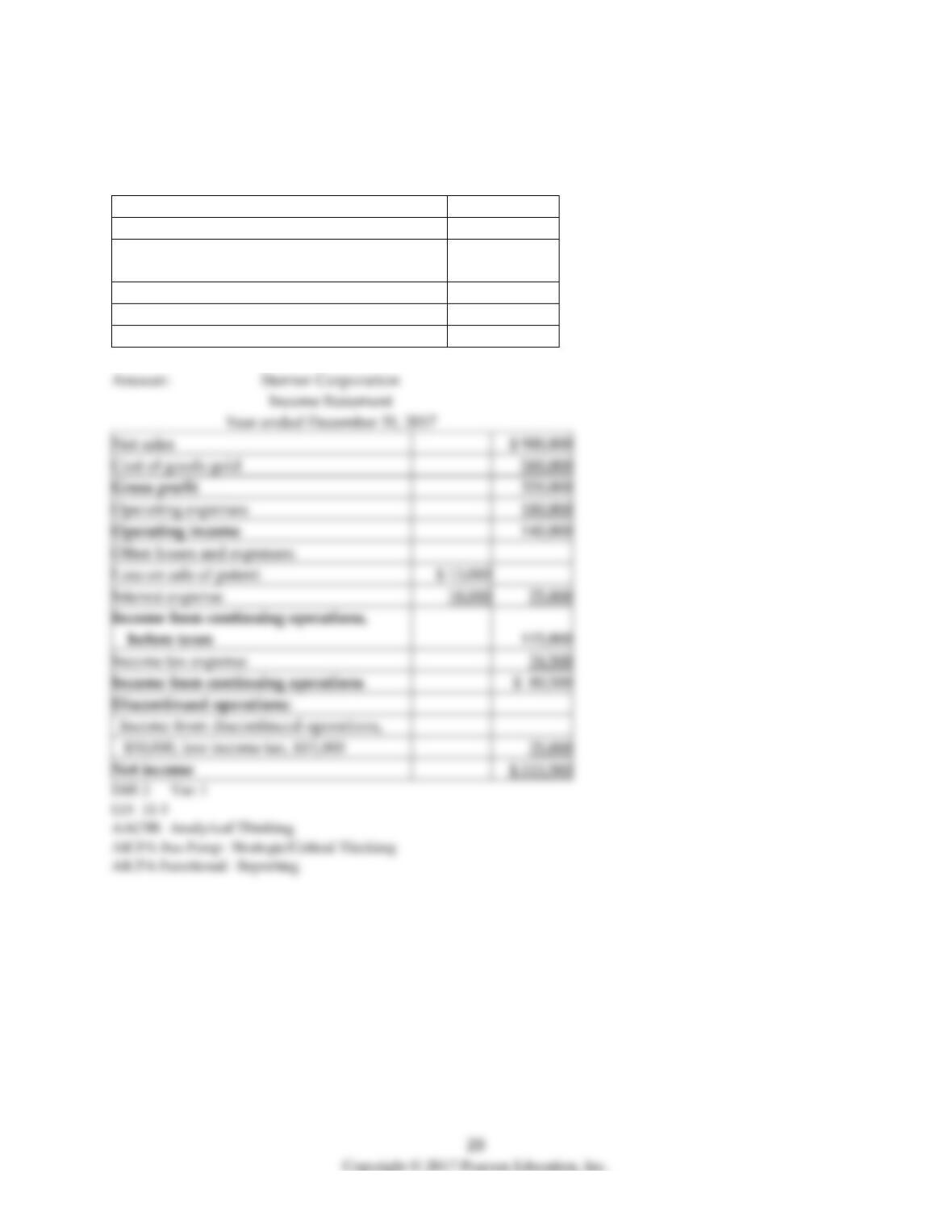
32) Prepare a multistep income statement for Sterner Corporation for the year ending December 31, 2017.
The tax rate for Sterner Corporation is 30%. Omit earnings per share. The following information is
available:
Net Sales
$900,000
Operating Expenses
180,000
Income from Discontinued Operations (before
tax)
50,000
Loss on Sale of Patent
15,000
Cost of Goods Sold
580,000
Interest Expense
10,000
Net sales
Cost of goods gold
Operating expenses
Other losses and expenses:
Loss on sale of patent
Interest expense
Income tax expense
4 Learning Objective 11-4
1) Diluted earnings per share takes into account potential decreases in outstanding shares of common
stock.
2) Earnings per share shows how much income a company earned for each share of common stock.
3) Earnings per share is used to help determine the value of a share of common stock.
4) Earnings per share is calculated:
A) only for preferred stock.
B) only for common stock.
C) for common and preferred stock.
D) only for treasury stock.
5) The weighted-average number of shares of common stock outstanding takes into account the changes
that might occur in:
A) treasury stock purchases or reissuances.
B) the acquisition of stock classified as trading securities.
C) the issuance of additional shares of preferred stock.
D) none of the above.
6) Earnings per share (EPS) is calculated as:
A) net income divided by the number of shares of common stock issued at the end of the year.
B) net income divided by the number of shares of common stock outstanding at the end of the year.
C) net income divided by the weighted-average number of shares of common stock outstanding
throughout the year.
D) net income divided by the weighted-average number of shares of common stock issued throughout
the year.
7) When calculating earnings per share, preferred dividends are:
A) added to net income in the numerator of the EPS calculation.
B) added to common shares in the denominator of the EPS calculation.
C) subtracted from common shares in the denominator of the EPS calculation.
D) subtracted from net income in the numerator of the EPS calculation.
8) A company is required to report both basic and diluted earnings per share when the:
A) company’s capital structure includes convertible preferred stock.
B) company prepares consolidated financial statements.
C) company has foreign currency transaction gains and losses.
D) company reports both net income and comprehensive income.
9) Wendell Corporation reported net income for the current year of $800,000. Wendell had 6000 shares of
$90 par value, 12% preferred stock outstanding and 42,000 shares of $1 par value common stock
outstanding for the entire year. Earnings per share is: (Round your final answer to the nearest cent.)
A) $15.32.
B) $90.00.
C) $17.50.
D) $19.05.
10) Padowski Corporation’s net income for the current year is $550,000. At year end, the corporation had
outstanding 2500 shares of 18%, $100 par value nonconvertible preferred stock and 17,000 shares of $10
par value common stock. No shares were issued or retired during the year. What is basic earnings per
share? (Round your final answer to the nearest cent.)
A) $25.90
B) $100.00
C) $29.71
D) $32.35
11) Corporations with convertible securities outstanding such as convertible preferred stock report:
A) basic and diluted EPS.
B) basic EPS only.
C) diluted EPS only.
D) no EPS figures.
12) A company reports basic earnings per share of $5.00 per share. The company has convertible
preferred stock that can be converted into common stock. What will diluted earnings per share equal?
A) $5.00 per share
B) more than $5.00 per share
C) less than $5.00 per share
D) There is not enough information
13) Earnings per share amounts are computed for:
A) income from discontinued operations.
B) income from continuing operations.
C) net income.
D) all of the above.
14) 1. During 2017, Vanderbilt Corporation had 500,000 shares of $1 par value common stock outstanding
and 25,000 shares of 5%, $100 par value preferred stock outstanding. There were no stock transactions
during the year. Net income for the year was $540,000. Compute the earnings per share.
2. During 2017, Fusion Valley Corporation had 500,000 shares of $1 par value common stock outstanding
and 40,000 shares of 5%, $100 par value preferred stock outstanding. There were no stock transactions
during the year. Net income for the year was $740,000. Compute the earnings per share.
5 Learning Objective 11-5
1) Items of comprehensive income, other than net income, do not enter into the determination of earnings
per share.
2) Comprehensive income does not include foreign-currency translation gains/losses.
3) Comprehensive income can be presented alone in a separate statement of comprehensive income.
4) Comprehensive income is the company’s change in total stockholders’ equity from all sources.
5) Comprehensive income is:
A) used to determine earnings per share only.
B) used to determine net income only.
C) not used to determine net income or earnings per share.
D) used to determine net income or earnings per share.
6) Westside Corporation had an investment in available-for-sale securities of $70,000. This investment
experienced an unrealized loss of $5000 during the year. Westside Corporation had a balance in its
available-for-sale account of $169,000 at year end. Ignoring income taxes, the effect of this loss on
comprehensive income will be:
A) $70,000 increase.
B) $65,000 decrease.
C) $104,000 increase.
D) $5000 decrease.
7) Comprehensive income includes net income plus:
A) Unrealized Gains on Investments in Available-for-Sale Securities.
B) Foreign-Currency Transaction Gain.
C) Realized Gains on Investments in Available-for-Sale Securities.
D) Unrealized Gains on Investments in Trading Securities.
8) Comprehensive income includes net income plus:
A) Foreign-Currency Transaction Gain.
B) Equity-Method Investment Revenue.
C) Foreign-Currency Translation Gain.
D) Unrealized Gains on Investments in Trading Securities.
9) The Playscape Company reports the following for the fiscal year ending December 31, 2017:
Net income
$900,000
Foreign-Currency Translation Gain, net of tax
$220,000
Unrealized Loss on Investment in Available-for-Sale Securities, net of tax
(440,000)
Unrealized Loss on Investment in Trading Securities, net of tax
(120,000)
What is comprehensive income for the fiscal year ending December 31, 2017?
A) $560,000
B) $680,000
C) $900,000
D) $1,120,000
10) The Brankov Tool and Die Company reports the following for the fiscal year ended December 31,
2018:
Net income
$1,430,000
Foreign-Currency Transaction Loss, net of tax
($44,000)
Foreign-Currency Translation Loss, net of tax
($28,000)
Unrealized Loss on Investment in Trading Securities, net of tax
($12,000)
Unrealized Loss on Investment in Available-for-Sale Securities, net of tax
($51,500)
What is comprehensive income for the year ended December 31, 2018?
A) $1,346,000
B) $1,306,500
C) $1,350,500
D) $1,358,000
11) Other Comprehensive Income is reported on the:
A) income statement.
B) statement of comprehensive income.
C) statement of retained earnings.
D) balance sheet.
12) Accumulated Other Comprehensive Income is reported in the:
A) income statement.
B) statement of comprehensive income.
C) statement of retained earnings.
D) statement of stockholders’ equity.
13) Footnotes about a company’s segments are useful because the notes reveal:
A) the different types of business activities and the different economic environments.
B) the company’s internal controls over financial reporting.
C) the company’s blueprint for competitive advantage.
D) the outside auditor’s audit report.
14) Segments may be created by:
A) different types of business activities.
B) geographic areas covered.
C) product lines offered.
D) all of the above.
15) Footnote 1 of every public company’s financial statements contains all of the following EXCEPT:
A) The company’s revenue recognition policy.
B) How the company determines its fiscal year reporting period.
C) The impact of recently issued accounting principles that might impact comparability of reported
income and that might have required accounting changes.
D) The amount of compensation (including bonuses) paid to the company’s CEO and CFO.
16) Which of the following statements regarding annual reports covering corporate social responsibility is
INCORRECT?
A) While reporting under this framework is voluntary in the United States, the SEC has endorsed these
types of nonfinancial reports.
B) These reports contain mandatory disclosures on how companies are conducting and governing their
businesses in ways that only benefit their shareholders.
C) Some countries mandate some form of corporate social responsibility reporting in order to be listed on
their stock exchanges.
D) Many of the world’s largest businesses issue corporate social responsibility reports under the strict
guidelines of the Global Reporting Initiative.
6 Learning Objective 11-6
1) Management issues a report on internal control over financial reporting along with the company’s
financial statements.
2) Publicly-traded companies have the option to have their financial statements audited.
3) Publicly-traded companies are required to file their annual financial statements with the Securities and
Exchange Commission.
4) An audit report is addressed to the board of directors and stockholders of the audited company.
5) It is NOT the independent auditor‘s responsibility to determine whether the audited company’s
financial statements comply with GAAP.
6) The combined audit report on a company’s financial statements and internal control over financial
reporting typically contains five paragraphs.
7) Management states that it has conducted an assessment of internal controls over financial reporting
based on the framework established by the Sarbanes-Oxley Act of 2002.
8) The qualified opinion is the highest statement of assurance that an independent certified public
accountant can express.
9) The financial statements are the responsibility of:
A) the independent auditors.
B) the shareholders.
C) management.
D) the board of directors.
10) The statement of management’s responsibility for internal control indicates all of the following
EXCEPT:
A) that management is responsible for establishing and maintaining an adequate system of internal
control.
B) that management has conducted an assessment of internal control over financial reporting based on
the framework established by the Committee of Sponsoring Organizations of the Treadway Commission.
C) that management states that the internal controls of the company have been audited by the company’s
outside auditors and refers to their report.
D) that management states that the internal controls of the company have been designed by the
company’s outside auditors.
11) Which entity requires companies issuing publicly traded stock to have their financial statements
audited by an outside auditor?
A) Securities and Exchange Commission
B) Internal Revenue Service
C) Committee of Sponsoring Organizations
D) Financial Accounting Standards Board
12) The independent auditors’ report is addressed to:
A) stockholders only.
B) board of directors only.
C) board of directors and stockholders.
D) management.
13) In an unqualified opinion, the auditing firm expresses that the company’s:
A) financial statements are in conformity with U.S. GAAP.
B) financial statements present fairly, in all material respects, the company’s financial position as of the
end of the accounting period and results of operations for a period of time.
C) financial statements provide substantial evidence that the company is a safe investment.
D) A and B
14) Which statement about a company’s internal controls over financial reporting is FALSE?
A) Management must determine whether the internal controls over financial reporting are effective.
B) Management is responsible for maintaining an adequate system of internal control over financial
reporting.
C) The internal controls over financial reporting are established by the outside auditors.
D) The internal controls over financial reporting are assessed by management.
15) The independent auditors conduct the audit, in accordance with the standards of the Public Company
Accounting Oversight Board (United States), for:
A) financial statements only.
B) internal controls over financial reporting only.
C) management skills.
D) financial statements and internal controls over financial reporting.
16) The first paragraph of the combined audit report on financial statements and internal controls:
A) describes how the audit was performed in accordance with U.S. GAAP and auditing standards.
B) identifies the company and financial statements audited.
C) describes inherent limitations in a system of internal controls.
D) describes a system of internal controls.