4) If a bond is issued at a premium, it will sell for more than face value.
5) The issue price of a bond—whether it is sold at par, premium, or discount—has no effect on the required
principal repayment at maturity.
6) Once a bond has been sold to a bondholder, it may not be re-sold to other investors, but must be held by the first
buyer until maturity.
7) When a bond is sold, the selling price is generally equivalent to the present value of the bond payments.
8) Which of the following is the amount the borrower must pay back to the bondholders?
A) Market value
B) Present value
C) Stated interest value
D) Principal amount
9) Which of the following occurs when a bond’s stated interest rate is less than the market interest rate?
A) The bond will be issued at a premium.
B) The bond will be issued at maturity value.
C) The bond will be issued at a discount.
D) The bond will be issued at par.
10) Which of the following occurs when a bond’s stated interest rate is higher than the market interest rate?
A) The bond will be issued at a premium.
B) The bond will be issued at maturity value.
C) The bond will be issued at a discount.
D) The bond will be issued at par.
11) Which of the following is TRUE of a premium on bonds payable?
A) A premium on bonds payable is added to the bonds payable balance and shown with long–term liabilities on the
balance sheet.
B) A premium on bonds payable is added to the bonds payable balance and shown with owner’s equity on the
balance sheet.
C) A premium on bonds payable is subtracted from the bonds payable balance and shown with long–term liabilities
on the balance sheet.
D) A premium on bonds payable is subtracted from the bonds payable balance and shown with the current liabilities
on the balance sheet.
12) Which of the following is TRUE of a discount on bonds payable?
A) A discount on bonds payable is added to the bonds payable balance and shown with long-term liabilities on the
balance sheet.
B) A discount on bonds payable is subtracted from the bonds payable balance and shown with the current liabilities
on the balance sheet.
C) A discount on bonds payable is added to the bonds payable balance and shown with owner’s equity on the
balance sheet.
D) A discount on bonds payable is subtracted from the bonds payable balance and shown with long-term liabilities
on the balance sheet.
13) A bond payable is similar to which of the following?
A) Accounts receivable
B) Property, plant & equipment
C) Note payable
D) Note receivable
14) Which of the following describes the term maturity date?
A) The date on which each interest payment is made
B) The date on which the bond is issued
C) The date on which the principal amount is repaid to the bondholder
D) The date on which the bond is cancelled
15) The reason people buy bonds is to:
A) earn interest.
B) reduce their income taxes.
C) save money.
D) receive dividend payments.
16) The interest rate on which cash payments to bondholders are based is the:
A) market rate.
B) discount rate.
C) stated rate.
D) amortization rate.
17) The market rate is the rate used to calculate the actual cash payments made to bondholders.
18) Which of the following describes a term bond?
A) A bond that repays principal in installments
B) A bond that gives the bondholder a claim for specific assets if the issuer fails to pay
C) A bond that matures at one specified time
D) A bond that is not backed by specific assets
19) Which of the following describes a serial bond?
A) A bond that repays principal in installments
B) A bond that gives the bondholder a claim for specific assets if the issuer fails to pay
C) A bond that matures at one specified time
D) A bond that is not backed by specific assets
20) Which of the following describes a secured bond?
A) A bond that repays principal in installments
B) A bond that gives the bondholder a claim for specific assets if the issuer fails to pay
C) A bond that matures at one specified time
D) A bond that is not backed by specific assets
21) Which of the following describes a debenture?
A) A bond that repays principal in installments
B) A bond that gives the bondholder a claim for specific assets if the issuer fails to pay
C) A bond that matures at one specified time
D) A bond that is not backed by specific assets
22) Which of the following statements is TRUE about a bond that is issued at a discount?
A) It will be sold at par.
B) Its interest rate is higher than the prevailing market rate.
C) It will repay principal at less than the face value.
D) It will be sold for less than the face value.
23) Which of the following statements is TRUE about a bond that is issued at a premium?
A) It will be sold above par.
B) Its interest rate lower than the prevailing market rate.
C) It will repay principal at more than the face value.
D) It will be sold at par.
24) If bonds with a face value of $100,000 are sold at 88, the amount of cash proceeds is:
A) $108,800.
B) $100,000.
C) $88,000.
D) $99,912.
25) If bonds with a face value of $100,000 are sold at par, the amount of cash proceeds is:
A) $108,800.
B) $100,000.
C) $88,000.
D) $99,912.
26) If bonds with a face value of $100,000 are sold at 102, the amount of cash proceeds is:
A) $108,800.
B) $100,000.
C) $99,898.
D) $102,000.
27) The time value of money is based on which of the following concepts?
A) The concept that money becomes obsolete over time
B) The concept that money earns income over time
C) The concept that money loses its purchasing power over time
D) The concept that money can be converted into other currencies over time
28) If a bond’s stated interest rate is lower than the market rate, which of the following is TRUE?
A) The bond will be issued at a premium.
B) The bond will be issued at par.
C) The bond will be issued at a discount.
D) The bond will be issued for an amount higher than the maturity value.
29) If a bond’s stated interest rate is higher than the market rate, which of the following is TRUE?
A) The bond will be issued at a premium.
B) The bond will be issued at par.
C) The bond will be issued at a discount.
D) The bond will be issued for an amount lower than the maturity value.
30) If a bond’s stated interest rate is the same as the market rate, which of the following is TRUE?
A) The bond will be issued at a premium.
B) The bond will be issued at par.
C) The bond will be issued at a discount.
D) The bond will be issued for an amount lower than the maturity value.
31) A bond is sold for an amount less than its face value. Which of the following statements would explain why?
A) The bond‘s stated rate is lower than the prevailing market rate at time of sale.
B) The bond’s stated rate is the same as the prevailing market rate at time of sale.
C) The bond’s stated rate is higher than the prevailing market rate at time of sale.
D) The bond is not secured by specific assets of the issuer.
32) A bond is sold for an amount higher than face value. Which of the following statements would explain why?
A) The bond‘s stated rate is lower than the prevailing market rate at time of sale.
B) The bond’s stated rate is the same as the prevailing market rate at time of sale.
C) The bond‘s stated rate is higher than the prevailing market rate at time of sale.
D) The bond is not secured by specific assets of the issuer.
33) A bond is sold for an amount equal to its face value. Which of the following statements would explain why?
A) The bond‘s stated rate is lower than the prevailing market rate at time of sale.
B) The bond’s stated rate is the same as the prevailing market rate at time of sale.
C) The bond’s stated rate is higher than the prevailing market rate at time of sale.
D) The bond is not secured by specific assets of the issuer.
Learning Objective 11-3
1) If a company issues a bond in-between interest payments, the company can pay a prorated portion of the interest
payment on the regular payment date.
2) Premium on bonds payable is spread over the term of the bonds and reduces total interest expense.
3) The bond carrying amount is the balance in the bond payable account subtracted from or added to the balance in
either the discount or premium account.
4) The balance in the Bonds payable account is a credit of $50,000. The balance in the Discount on bonds payable
account is a debit of $1,500. The bond carrying amount is $51,500.
5) The balance in the Bonds payable account is a credit of $50,000. The balance in the Discount on bonds payable
is a debit of $1,500. The balance sheet will report the bond balance as $48,500.
6) The balance in the Bonds payable account is a credit of $50,000. The balance in the Premium on bonds payable
account is a credit of $900. The bond carrying amount is $50,900.
7) The balance in the Bonds payable is a credit of $50,000. The balance in the Premium on bonds payable is a credit
of $900. The balance sheet will report the bond balance as $49,100.
8) Discount on bonds payable is considered to be additional interest expense of the company that issues the bond.
9) Premium on bonds payable is considered to be additional interest expense of the company that issues the bond.
10) On January 1, 2012, Davie Services issued $20,000 of 8% bonds that mature in five years. They were sold at
discount, for a total of $19,000. On January 1, 2017, when the bonds mature, Davie Services will make the final
principal payment. That entry will be which of the following?
A) Debit Bond discount for $1,000 and credit Cash for $1,000.
B) Debit Bonds payable for $19,000 and credit Cash for $1,000.
C) Debit Bonds payable for $20,000 and credit Cash for $20,000.
D) Debit Bonds payable for $19,000, debit Bond discount for $1,000 and credit Cash for $19,000.
11) On January 1, 2012, Davie Services issued $20,000 of 8% bonds that mature in five years. They were sold at a
premium, for a total of $20,750. On January 1, 2017, when the bonds mature, Davie Services will make the final
principal payment. That entry will include which of the following?
A) Debit Bond premium for $250 and credit Cash for $250.
B) Debit Bonds payable for $20,750 and credit Cash for $20,750.
C) Debit Bonds payable for $20,000 and credit Cash for $20,000.
D) Debit Bonds payable for $20,000, credit Bond premium for $750 and Credit Cash for $19,250.
12) On January 1, 2013, Davie Services issued $20,000 of 8% bonds that mature in five years. They were sold at
par. The bonds pay semiannual interest payments on June 30 and December 31 of each year. On June 30, 2013,
how much are the total interest payments made to bondholders?
A) $800.00
B) $1,600.00
C) $160.00
D) $133.33
13) On January 1, 2013, Davie Services issued $20,000 of 8% bonds that mature in five years. They were sold at
discount, for a total of $19,000. The bonds pay semiannual interest payments on June 30 and December 31 of each
year. On June 30, 2013, how much is the total amount paid to bondholders?
A) $253.33
B) $1,520.00
C) $760.00
D) $800.00
14) On January 1, 2013, Davie Services issued $20,000 of 8% bonds that mature in five years. They were sold at a
premium, for a total of $20,750. The bonds pay semiannual interest payments on June 30 and December 31 of each
year. On June 30, 2013, how much is the total amount paid to bondholders?
A) $276.67
B) $800.00
C) $1,660.00
D) $830.00
15) The balance in the Bonds payable account is a credit of $50,000. The balance in the Discount on bonds payable
account is a debit of $1,500. How much is the bond carrying amount?
A) $1,500
B) $50,000
C) $51,500
D) $48,500
16) On December 31, 2013, Peterson Sales has a Bonds payable balance of $40,000 and a Discount on bonds
payable of $2,100. On the balance sheet, how will this information be shown?
A) $40,000 less discount of $2,100 for a net balance of $37,900
B) $40,000 plus discount for a total balance of $42,100
C) $40,000 only
D) $40,000 less one-tenth of $2,100 for a net balance of $39,790
17) The balance in the Bonds payable account is a credit of $50,000. The balance in the Premium on bonds payable
account is a credit of $900. How much is the bond carrying amount?
A) $900
B) $50,900
C) $51,900
D) $49,100
18) On December 31, 2013, Peterson Sales has a bonds payable balance of $40,000 and a premium on bonds
payable of $900. On the balance sheet, how will this information be shown?
A) $40,000 less premium of $900 for a net balance of $39,100
B) $40,000 less one-tenth of $900 for a net balance of $39,910
C) $40,000 only
D) $40,000 plus a premium of $900 for a net balance of $40,900
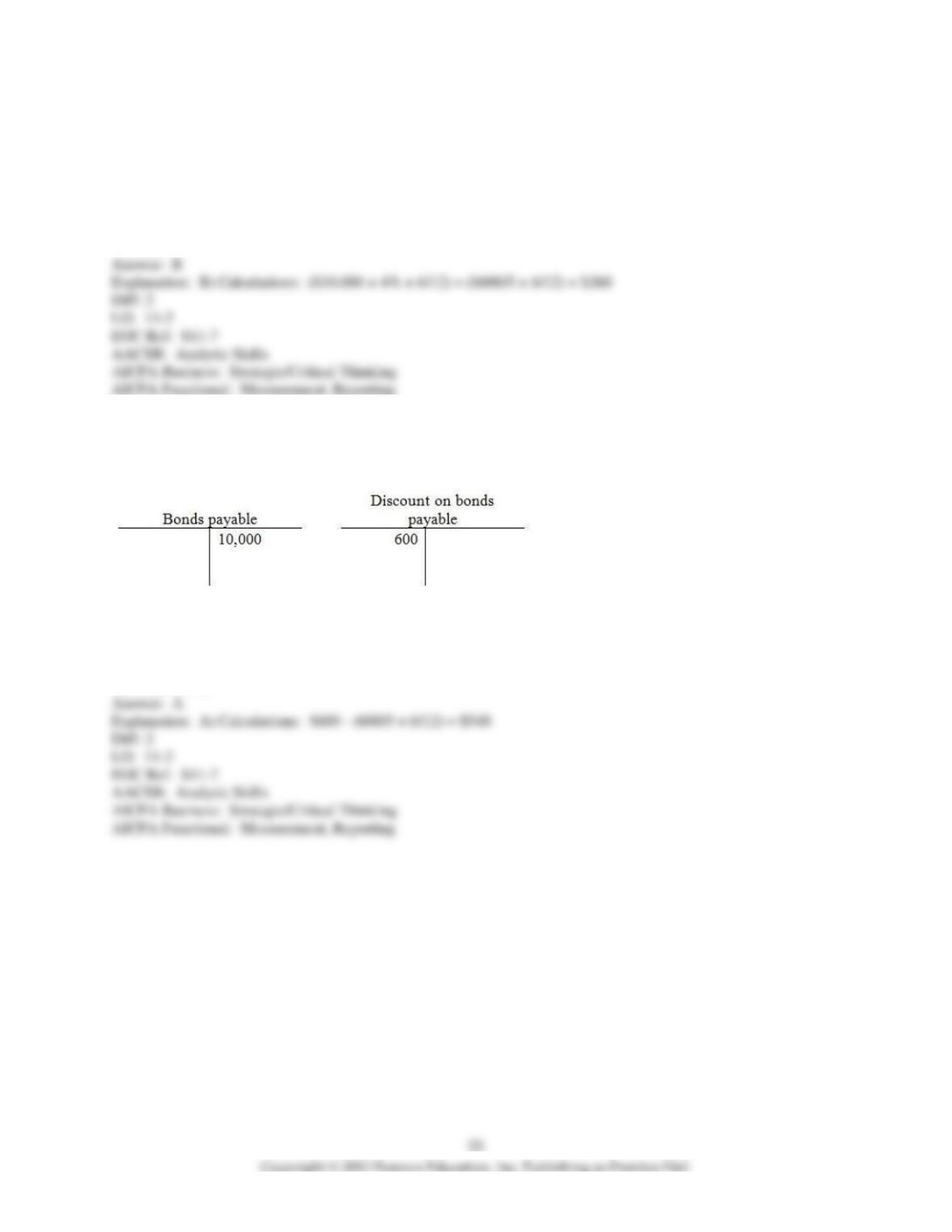
19) On January 2, 2014, Mahoney Sales issued $10,000 in bonds for $9,400. They were 5-year bonds with a stated
rate of 4%, and pay semiannual interest payments. Mahoney Sales uses the straight-line method to amortize the
bond discount. On June 30, 2014, when Mahoney makes the first payment to bondholders, how much will they
report as interest expense?
A) $200
B) $260
C) $60
D) $400
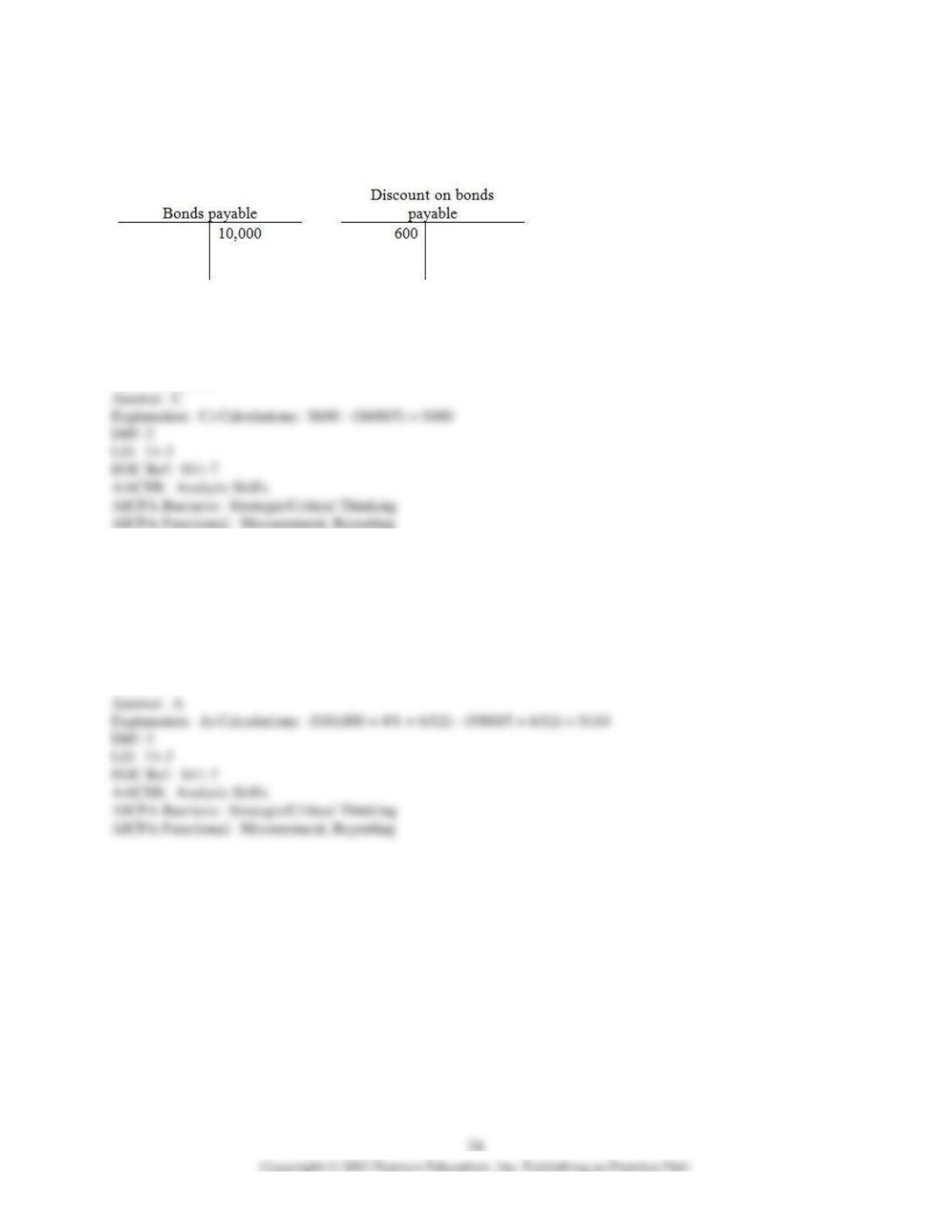
20) On January 2, 2014, Mahoney Sales issued $10,000 in bonds for $9,400. They were 5-year bonds with a stated
rate of 4%, and pay semiannual interest payments. Mahoney Sales uses the straight–line method to amortize the
bond discount. Immediately after issue of the bonds, the ledger balances appeared as follows:
After the first interest payment on June 30, 2014, what was the balance in the discount account?
A) Debit of $540
B) Debit of $600
C) Debit of $660
D) Credit of $60
21) On January 2, 2014, Mahoney Sales issued $10,000 in bonds for $9,400. They were 5-year bonds with a stated
rate of 4%, and pay semiannual interest payments. Mahoney Sales uses straight-line method to amortize bond
discount. Immediately after issue of the bonds, the ledger balances appeared as follows:
After the second interest payment on December 31, 2014, what was the balance in the discount account?
A) Debit of $540
B) Debit of $720
C) Debit of $480
D) Credit of $660
22) On January 2, 2014, Mahoney Sales issued $10,000 in bonds for $10,900. They were 5–year bonds with a stated
rate of 4%, and pay semiannual interest payments. Mahoney Sales uses the straight-line method to amortize the
bond premium. On June 30, 2014, when Mahoney makes the first payment to bondholders, how much will they
report as interest expense?
A) $110
B) $450
C) $90
D) $290
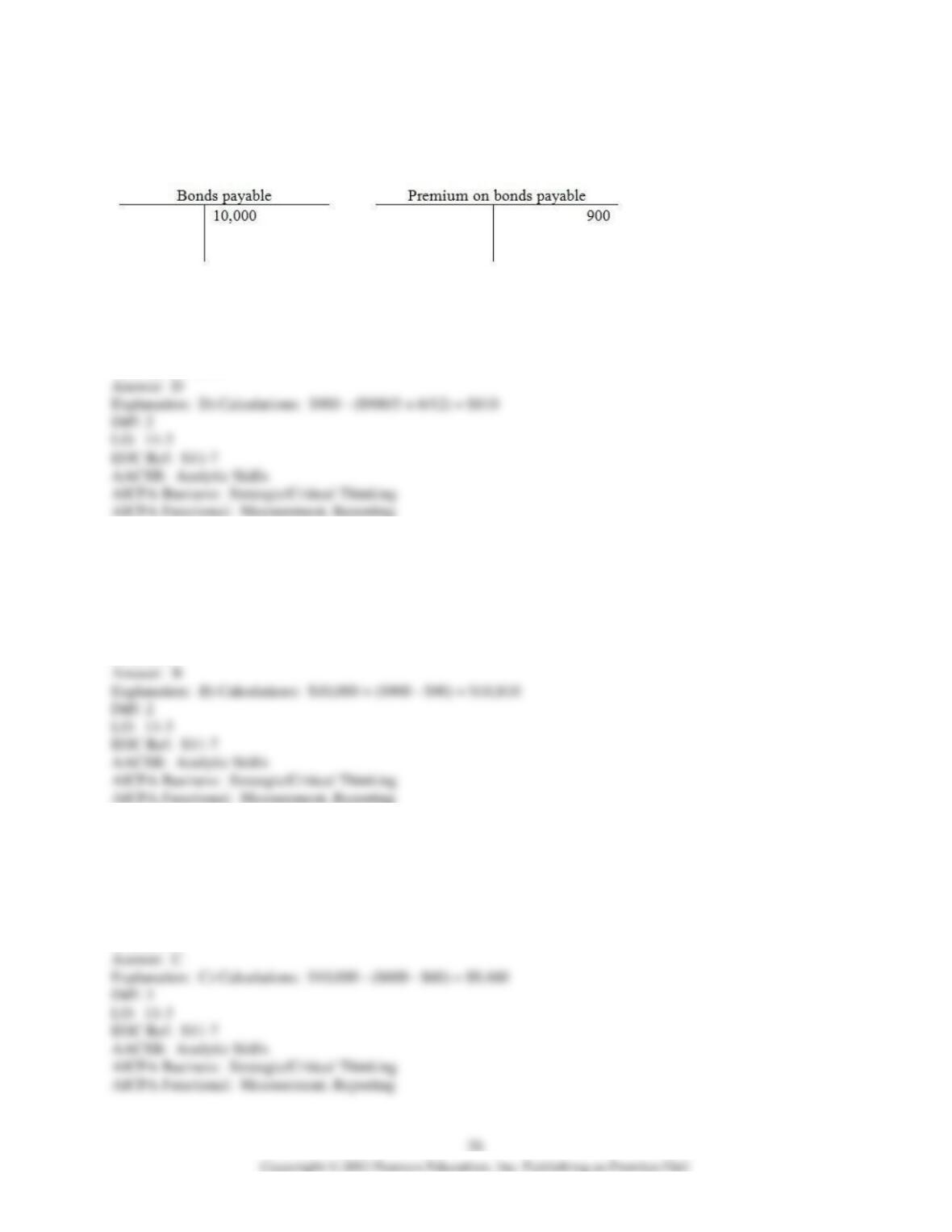
23) On January 2, 2014, Mahoney Sales issued $10,000 in bonds for $10,900. They were 5-year bonds with a stated
rate of 4%, and pay semiannual interest payments. Mahoney Sales uses the straight–line method to amortize the
bond premium. Immediately after issue of the bonds, the ledger balances appeared as follows:
After the first interest payment on June 30, 2014, what was the balance in the premium account?
A) Debit of $90
B) Debit of $600
C) Credit of $990
D) Credit of $810
24) On January 2, 2014, Mahoney Sales issued $10,000 in bonds for $10,900. They were 5–year bonds with a stated
rate of 4%, and pay semiannual interest payments. Mahoney Sales uses the straight–line method to amortize the
bond premium. After the first interest payment on June 30, 2014, what was the bond carrying amount?
A) $9,100
B) $10,810
C) $9,810
D) $9,190
25) On January 2, 2014, Mahoney Sales issued $10,000 in bonds for $9,400. They were 5-year bonds with a stated
rate of 4%, and pay semiannual interest payments. Mahoney Sales uses the straight–line method to amortize the
bond discount. After the first interest payment on June 30, 2014, what was the bond carrying amount?
A) $10,000
B) $9,400
C) $9,460
D) $9,880
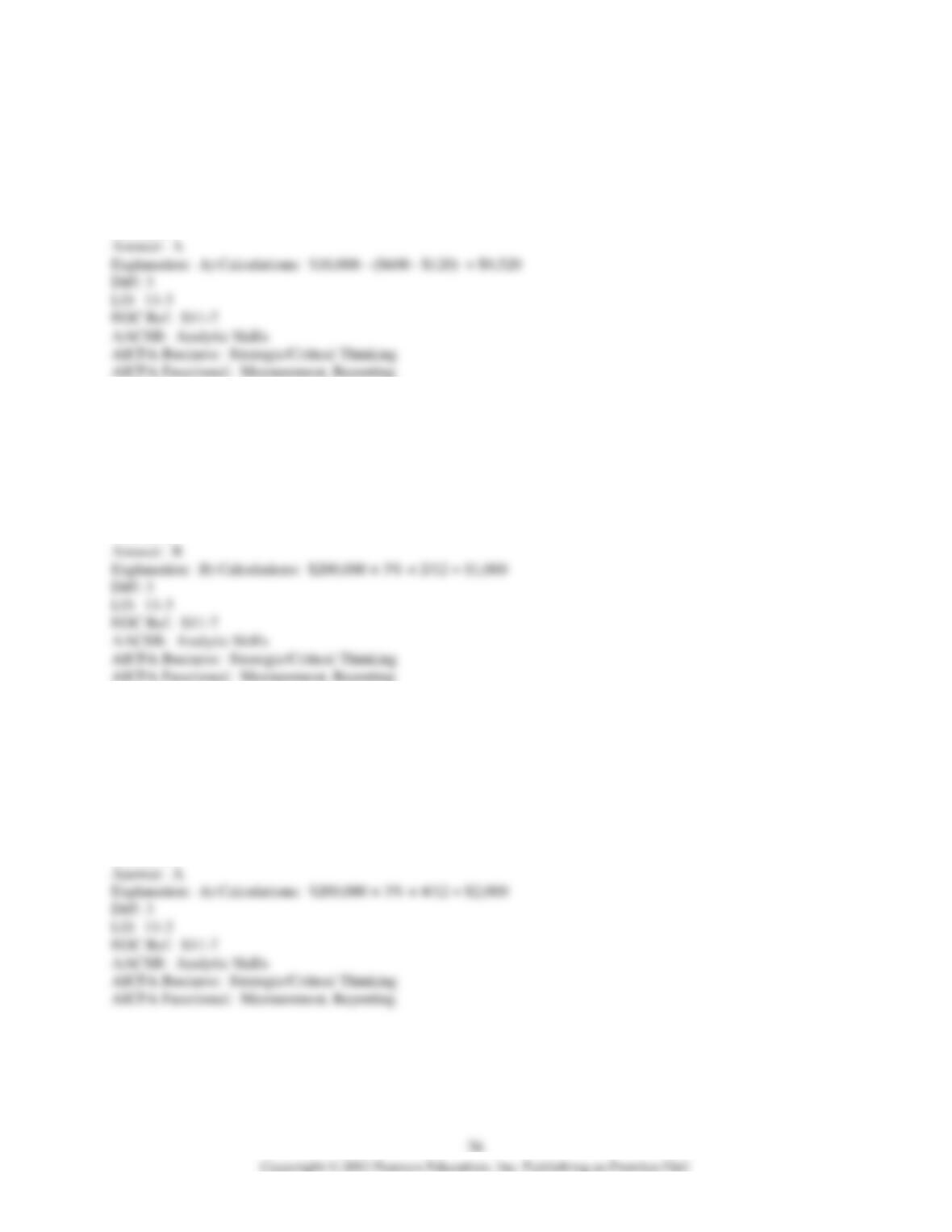
26) On January 2, 2014, Mahoney Sales issued $10,000 in bonds for $9,400. They were 5-year bonds with a stated
rate of 4%, and pay semiannual interest payments. Mahoney Sales uses the straight–line method to amortize the
bond discount. After the second interest payment on December 31, 2014, what was the bond carrying amount?
A) $9,520
B) $9,400
C) $9,460
D) $9,880
27) On November 1, 2015, Archangel Services issued $200,000 of 10-year bonds with a stated rate of 3%. The
bonds were sold at par, and make semiannual payments on April 30 and October 31. At December 31, 2015,
Archangel made an adjusting entry to accrue interest at year-end. How much interest expense will be recorded at
December 31, 2015?
A) $6,000
B) $1,000
C) $500
D) $1,500
28) On November 1, 2015, Archangel Services issued $200,000 of 10-year bonds with a stated rate of 3%. The
bonds were sold at par, and make semiannual payments on April 30 and October 31. At December 31, 2015,
Archangel made an adjusting entry to accrue interest at year-end. No further entries were made until April 30, 2016,
when the first payment was sent out. At that time, how much interest expense was recorded for the period of
January through April, 2016?
A) $2,000
B) $1,000
C) $6,000
D) $3,000
29) On November 1, 2015, Archangel Services issued $200,000 of 10-year bonds with a stated rate of 3%. The
bonds were sold at discount for $191,000, and make semiannual payments on April 30 and October 31. At
December 31, 2015, Archangel made an adjusting entry to accrue interest at year-end. How much interest expense
is recorded at December 31, 2015?
A) $1,075
B) $2,000
C) $1,150
D) $2,150
30) On November 1, 2015, Archangel Services issued $200,000 of 10-year bonds with a stated rate of 3%. The
bonds were sold at discount for $191,000, and make semiannual payments on April 30 and October 31. At
December 31, 2015, Archangel made an adjusting entry to accrue interest at year-end. No further entries were made
until April 30, 2016 when the first interest payment was made. How much interest expense will be recorded for the
period of January through April, 2016?
A) $3,000
B) $2,700
C) $2,000
D) $2,300
31) McDonald Sales prepared a bond issue of $20,000 dated January 1, 2013. The bonds have a stated rate of 3%
and a term of 6 years. The bond issue was delayed, and the bonds were finally sold on March 1, 2013 at par. How
much cash will McDonald receive for the bonds?
A) $19,900
B) $20,000
C) $20,100
D) $20,300
32) McDonald Sales prepared a bond issue of $20,000 dated January 1, 2013. The bonds have a stated rate of 3%
and a term of 6 years. The bond issue was delayed, and the bonds were finally sold on March 1, 2013 at par. The
journal entry to record the issuance of the bonds on March 1, 2013 will include which of the following?
A) Credit to Interest payable of $100
B) Credit to Bonds payable for $20,100
C) Debit to Cash for $20,300
D) Credit to Cash for $20,110
33) McDonald Sales prepared a bond issue of $20,000 dated January 1, 2013. The bonds have a stated rate of 3%
and a term of 6 years. The bond issue was delayed, and the bonds were finally sold on March 1, 2013 at par. On
June 30, 2013, the first semiannual interest payment is made. How much will be paid out to bondholders on June
30, 2013?
A) $100
B) $200
C) $300
D) $600
34) McDonald Sales prepared a bond issue of $20,000 dated January 1, 2013. The bonds have a stated rate of 3%
and a term of 6 years. The bond issue was delayed, and the bonds were finally sold on March 1, 2013 at par. On
June 30, 2011, the first semiannual interest payment is made. How much is the total amount of interest expense
McDonalds will record for the first half of 2013?
A) $600
B) $200
C) $300
D) $350
35) McDonald Sales prepared a bond issue of $20,000 dated January 1, 2013. The bonds have a stated rate of 3%
and a term of 6 years. The bond issue was delayed, and the bonds were finally sold on March 1, 2013 at par. On
June 30, 2013, the first semiannual interest payment is made. The journal entry to record that interest payment will
include which of the following line items?
A) Credit Cash for $200
B) Debit Cash for $300
C) Credit Interest payable for $100
D) Debit Interest expense for $200
36) Blanding Company issues $1,000,000 of 8%, 10-year bonds at 98 on February 28, 2014. The bond pays interest
on February 28 and August 31. The market rate of interest on the issuance date was 10%. The journal entry to
record the issuance would include a:
A) debit to Cash for $1,000,000.
B) credit to Bonds payable for $980,000.
C) credit to Discount on bonds payable for $20,000.
D) debit to Cash for $980,000.
37) Blanding Company issues $1,000,000 of 8%, 10-year bonds at 98 on February 28, 2014. The bond pays interest
on February 28 and August 31. The market rate of interest on the issuance date was 10%. Assume Blanding uses
the straight-line method for amortization. The journal entry to record the first interest payment on August 31, 2014
would be a:
A) debit to Cash for $40,000.
B) debit to Interest expense for $41,000.
C) debit to Interest expense for $39,000.
D) debit to Discount on bonds payable for $1,000.
38) Blanding Company issues $1,000,000 of 8%, 10-year bonds at 98 on February 28, 2014. The bond pays interest
on February 28 and August 31. The market rate of interest on the issuance date was 10%. Assume Blanding uses
the straight-line method for amortization. What net balance will be reported for the bonds on the balance sheet on
August 31, 2014?
A) $981,000
B) $1,000,000
C) $979,000
D) $980,000
39) Blanding Company issues $1,000,000 of 8%, 10-year bonds at 98 on February 28, 2014. The bond pays interest
on February 28 and August 31. The market rate of interest on the issuance date was 10%. Assume Blanding uses
the straight-line method for amortization. The interest accrual entry at December 31, 2014 would include:
A) a debit to Interest expense $26,667.
B) a credit to Interest payable of $26,667.
C) a credit to Cash of $26,667
D) no entry at December 31, 2014.
40) The Amazing Widget Company issues $500,000 of 6%, 10-year bonds at 103 on March 31, 2014. The bond
pays interest on March 31 and September 30. The market rate of interest on the issuance date was 4%. Assume the
company uses the straight-line method for amortization. The journal entry to record the issuance would include a:
A) debit to Cash for $500,000.
B) credit to Bonds payable for $515,000.
C) credit to Discount on bonds payable for $15,000.
D) debit to Cash for $515,000.