Chapter 11 – Flexible Budgeting and Analysis of Overhead Costs
46. Assume that machine hours drive the cost for overhead. The difference between the actual
variable overhead incurred and the applied variable overhead is the:
47. What will cause the variable-overhead efficiency variance?
48. Canister Industries uses labor hours to apply variable overhead to production. If the
company’s workers were very inefficient during the period, which of the following statements
would be true about the variable-overhead efficiency variance?
49. The difference between the total actual factory overhead and the total factory overhead
applied to production is the:
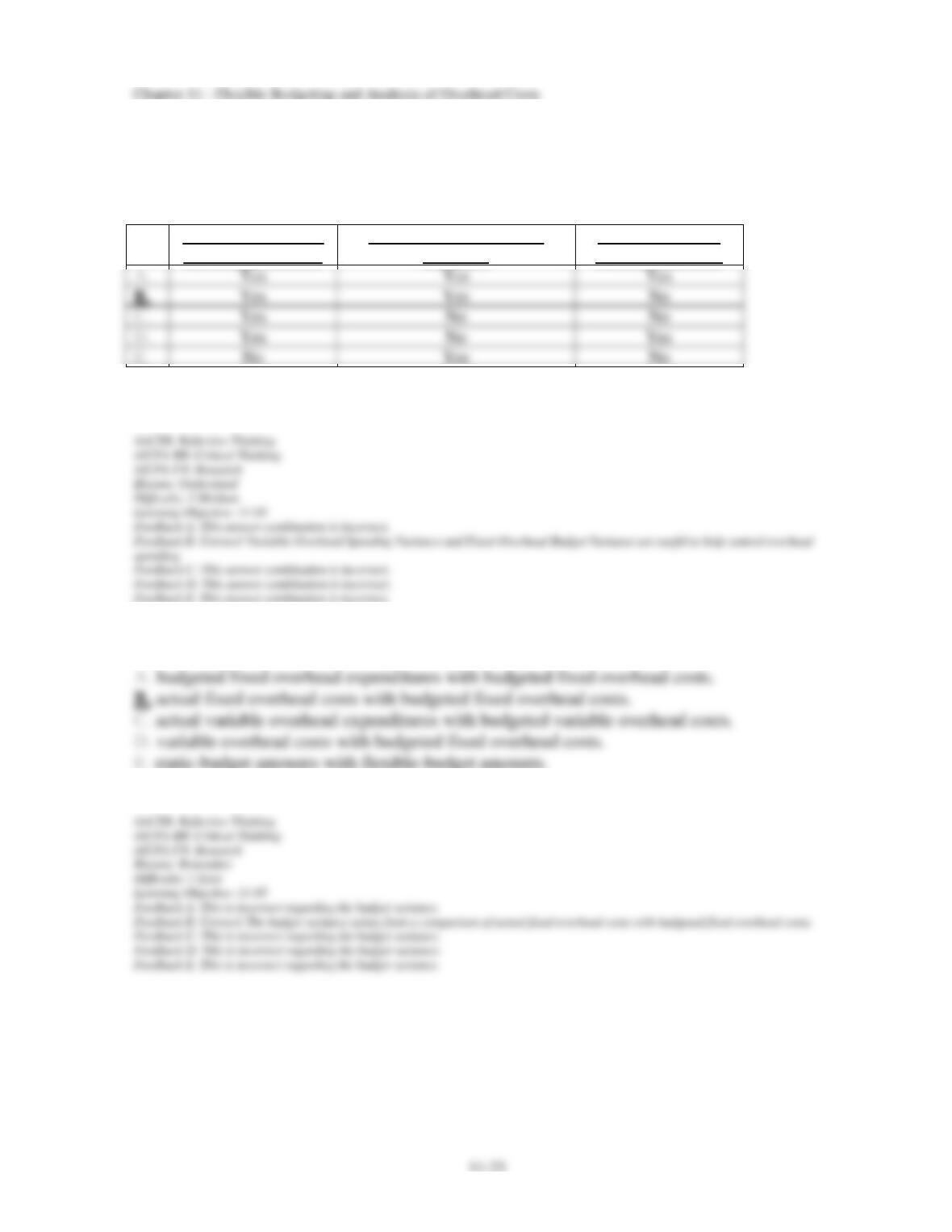
50. Which of the following variances would be useful to help control overhead spending?
Variable-Overhead
Spending Variance
Fixed-Overhead Budget
Variance
Fixed- Overhead
Volume Variance
51. The budget variance arises from a comparison of:
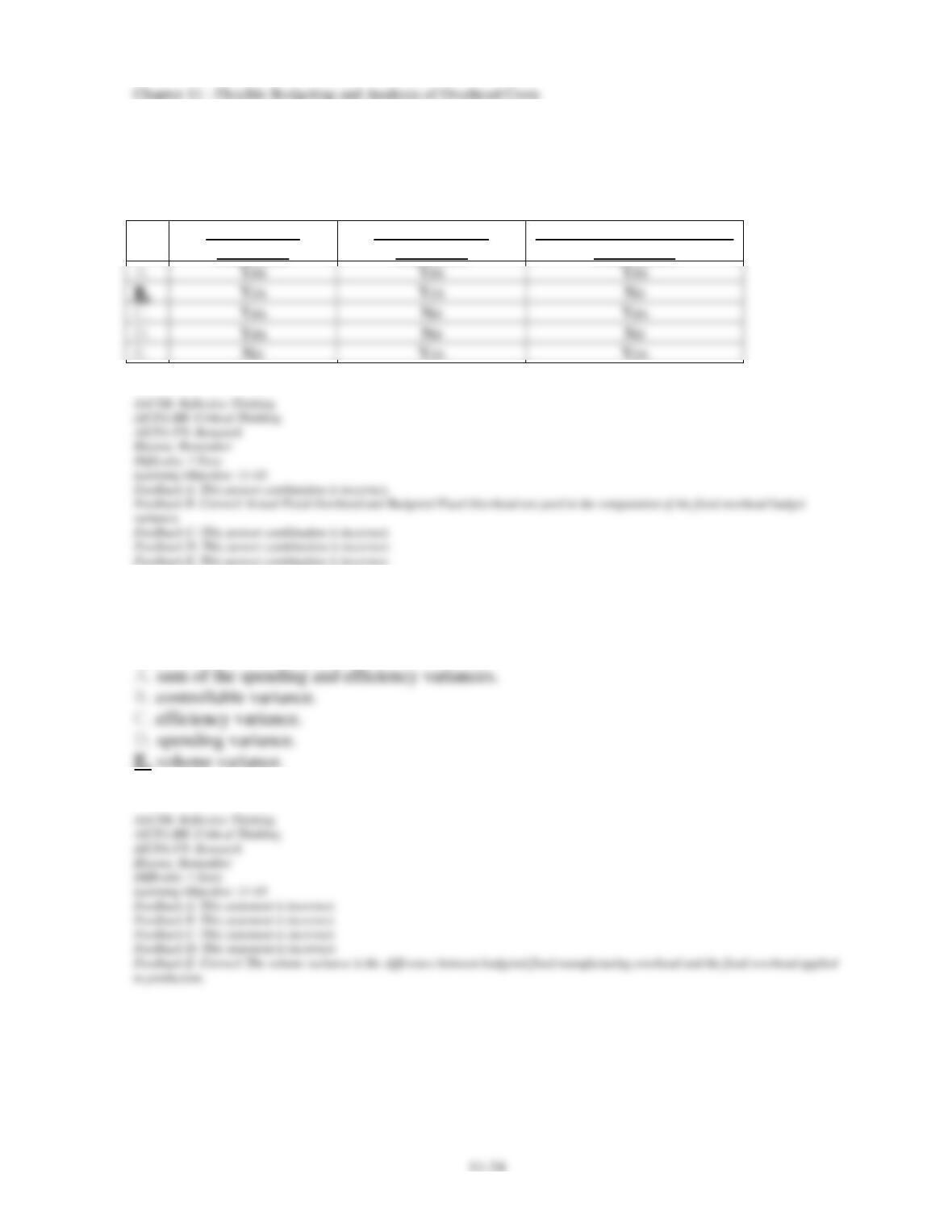
52. Which of the following is used in the computation of the fixed overhead budget variance?
Actual Fixed
Overhead
Budgeted Fixed
Overhead
Fixed Overhead Applied to
Production
53. The difference between budgeted fixed manufacturing overhead and the fixed overhead
applied to production is the:
54. A fixed-overhead volume variance would normally arise when:
55. Which variance is commonly associated with measuring the cost of under- or over-
utilization of plant capacity?
Chapter 11 – Flexible Budgeting and Analysis of Overhead Costs
Use the following information to answer Questions 56 and 57.
Bannister Motors Corporation reported the following variances for the period just ended:
Variable-overhead spending variance: $50,000U
Variable-overhead efficiency variance: $28,000U
Fixed-overhead budget variance: $70,000U
Fixed-overhead volume variance: $30,000U
56. If Bannister desires to analyze variances that arose primarily from managers’ expenditures
in excess of anticipated amounts, the company should focus on variances that total:
57. If Bannister prepared an overhead cost performance report, which of these overhead
variances is likely to be excluded from the report?
58. Orlando Company, which applies overhead to production on the basis of machine hours,
reported the following data for the period just ended:
Actual units produced: 12,000
Actual variable overhead incurred: $77,700
Actual machine hours worked: 18,800
Standard variable overhead cost per machine hour: $4.50
If Orlando estimates 1.5 hours to manufacture a completed unit, the company’s variable-
overhead spending variance is:
59. Priority Company, which applies overhead to production on the basis of machine hours,
reported the following data for the period just ended:
Actual units produced: 9,000
Actual variable overhead incurred: $54,400
Actual machine hours worked: 16,000
Standard variable overhead cost per machine hour: $3.50
If Priority estimates two hours to manufacture a completed unit, the company’s variable-
overhead efficiency variance is:
Chapter 11 – Flexible Budgeting and Analysis of Overhead Costs
Use the following information to answer Questions 60 and 61.
Admac Technologies has a standard variable overhead rate of $4.50 per machine hour, and
each unit produced has a standard time allowed of three hours. The company’s static budget
was based on 46,000 units. Actual results for the year follow.
Actual units produced: 42,000
Actual machine hours worked: 120,000
Actual variable overhead incurred: $520,000
60. Admac’s variable-overhead spending variance is:
61. Admac’s variable-overhead efficiency variance is:
62. Messenger, Inc. has a standard variable overhead rate of $5 per machine hour, with each
completed unit expected to take three machine hours to produce. A review of the company’s
accounting records found the following:
Actual production: 19,500 units
Variable-overhead efficiency variance: $9,000U
Variable-overhead spending variance: $21,000F
What was Messenger’s actual variable overhead during the period?
63. Hope, Inc. has a standard variable overhead rate of $4 per machine hour, with each
completed unit expected to take three machine hours to produce. A review of the company’s
accounting records found the following:
Actual variable overhead: $210,000
Variable-overhead efficiency variance: $18,000U
Variable-overhead spending variance: $30,000F
How many units did Hope actually produce during the period?
64. Campaign Company, which applies overhead to production on the basis of machine hours,
reported the following data for the period just ended:
Actual units produced: 12,000
Actual fixed overhead incurred: $730,000
Actual machine hours worked: 60,000
Budgeted fixed overhead: $720,000
Planned level of machine-hour activity: 50,000
If Campaign estimates four hours to manufacture a completed unit, the company’s standard
fixed overhead rate per machine hour would be:
65. Auditory Company, which applies overhead to production on the basis of machine hours,
reported the following data for the period just ended:
Actual units produced: 13,000
Actual fixed overhead incurred: $742,000
Standard fixed overhead rate: $15 per hour
Budgeted fixed overhead: $720,000
Planned level of machine-hour activity: 48,000
If Auditory estimates four hours to manufacture a completed unit, the company’s fixed-
overhead budget variance would be:
66. Approach Company, which applies overhead to production on the basis of machine hours,
reported the following data for the period just ended:
Actual units produced: 14,800
Actual fixed overhead incurred: $791,000
Standard fixed overhead rate: $13 per hour
Budgeted fixed overhead: $780,000
Planned level of machine-hour activity: 60,000
If Approach estimates four hours to manufacture a completed unit, the company’s fixed-
overhead volume variance would be:
Use the following information to answer Questions 67 and 68.
Forward Venture Company, which uses a standard cost system, budgeted $600,000 of fixed
overhead when 40,000 machine hours were anticipated. Other data for the period were:
Actual units produced: 10,000
Standard production time per unit: 3.9 machine hours
Fixed overhead incurred: $620,000
Actual machine hours worked: 42,000
67. Forward Venture Company’s fixed-overhead budget variance is:
68. Forward Venture Company’s fixed-overhead volume variance is:
69. Solution Enterprises incurred $828,000 of fixed overhead during the period. During that
same period, the company applied $845,000 of fixed overhead to production and reported an
unfavorable budget variance of $41,000. How much was Solution’s budgeted fixed
overhead?
Chapter 11 – Flexible Budgeting and Analysis of Overhead Costs
Use the following information to answer Questions 70 and 71.
Sigmo Company, which uses a standard cost system, budgeted $800,000 of fixed overhead
when 50,000 machine hours were anticipated. Other data for the period were:
Actual units produced: 10,600
Actual machine hours worked: 51,800
Actual variable overhead incurred: $475,000
Actual fixed overhead incurred: $790,100
Standard variable overhead rate per machine hour: $8.50
Standard production time per unit: 5 hours
70. Sigmo’s variable-overhead efficiency variance is:
71. Sigmo’s fixed-overhead budget variance is:
Chapter 11 – Flexible Budgeting and Analysis of Overhead Costs
Use the following information to answer Questions 72 – 74.
Theory Enterprises uses a standard cost system and prepared the following budget for May
when 24,000 machine hours of activity were anticipated: variable overhead, $48,000; fixed
overhead: $240,000. Actual data for May were:
Standard machine hours allowed for output attained: 25,000
Actual machine hours worked: 24,000
Variable overhead incurred: $50,000
Fixed overhead incurred: $250,000
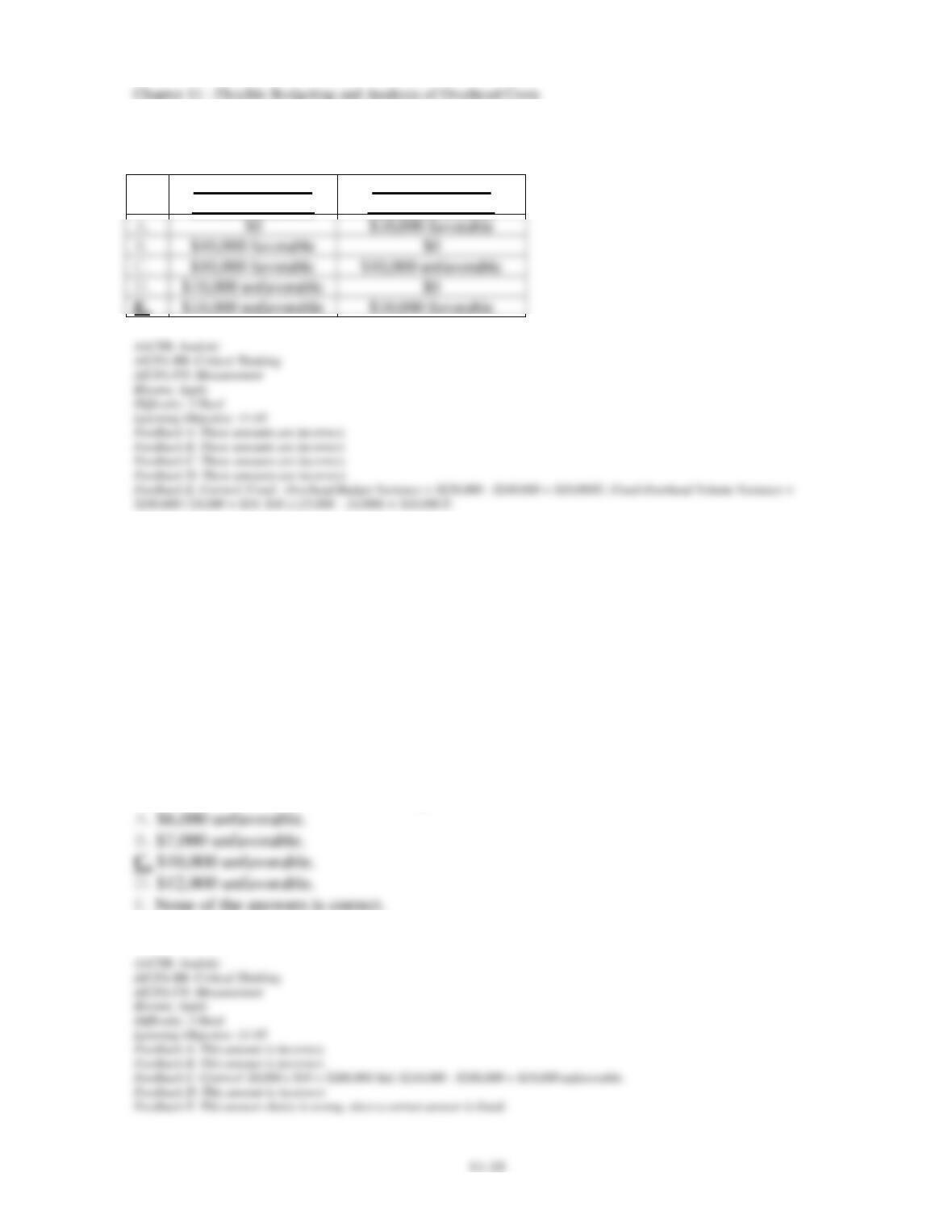
72. The standard variable overhead rate for May is:
73. The variable-overhead spending and efficiency variances for Theory are:
Variable-Overhead
Spending Variance
Variable-Overhead
Efficiency Variance
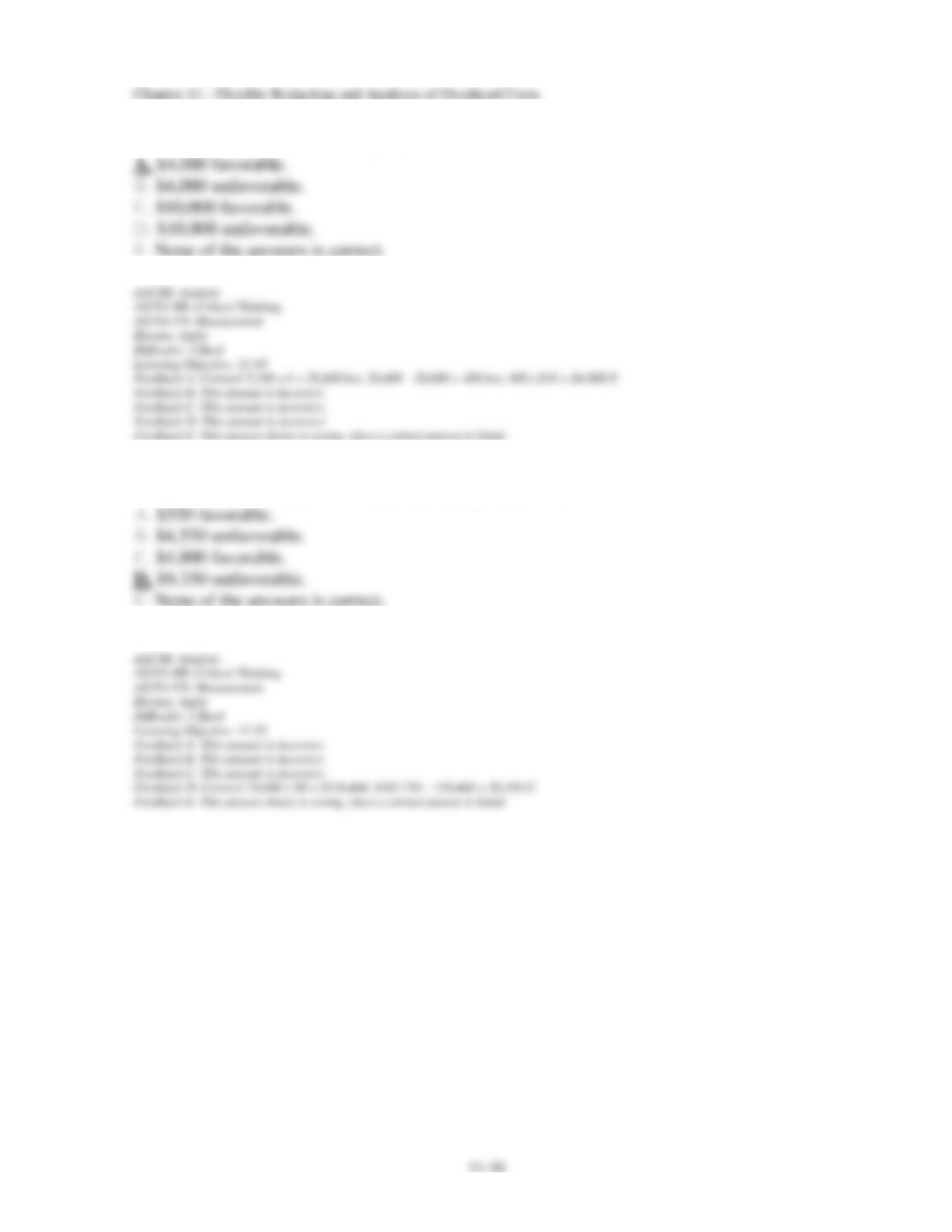
74. The fixed-overhead budget and volume variances for Theory are:
Fixed-Overhead
Budget Variance
Fixed-Overhead
Volume Variance
Use the following information to answer Questions 75 – 79.
Match Point, Inc. has the following overhead standards:
Variable overhead: 4 hours at $8 per hour
Fixed overhead: 4 hours at $10 per hour
The standards were based on a planned activity of 20,000 machine hours when 5,000 units
were scheduled for production. Actual data follow.
Variable overhead incurred: $167,750
Fixed overhead incurred: $210,000
Machine hours worked: 19,800
Actual units produced: 5,100
75. Match Point’s fixed-overhead budget variance is:
76. Match Point’s fixed-overhead volume variance is:
77. Match Point’s variable-overhead spending variance is:
78. Match Point’s variable-overhead efficiency variance is:
79. The amount of variable overhead that Match Point applied to production is:
Chapter 11 – Flexible Budgeting and Analysis of Overhead Costs
Use the following information to answer Questions 80 and 81.
Institute Technologies is choosing new cost drivers for its accounting system. One driver is
labor hours; the other is a combination of machine hours for unit variable costs and number of
setups for a pool of batch-level costs. Data for the past year follow.
Budget
Actual
Labor hours
200,000
200,000
Machine hours
360,000
450,000
Number of setups
3,000
3,300
Unit variable cost pool
$1,600,000
$2,000,000
Batch-level cost pool
$900,000
$990,000
80. Assume that both cost pools for Institute are combined into a single pool, and labor hours
is the driver. The total flexible budget for the actual level of labor hours and the total variance
for the combined pool are:
Flexible Budget
Variance
81. Assume that the two separate pools are used for Institute. The flexible budget dollar
amounts for the actual level of machine hours and actual number of setups are:
Unit Variable Cost
Pool
Batch-Level Cost
Pool
83. In an effort to reduce record-keeping, companies that sell perishable goods will often enter
84. When actual variable cost per unit equals standard variable cost per unit, the difference
between actual and budgeted contribution margin is explained by a combination of which two
variances?