1. The human resource department in a manufacturing company would be considered a
service
department.
2. One reason to allocate service department costs to user departments is to encourage the
user departments to monitor their use of the service department costs.
3. The direct method makes no cost allocations between or among service departments.
4. The selection of an allocation base in the direct method is easier than the selection of an
allocation base in the step method.
5. The step method allocates some, but not all, service department costs to other service
departments.
6. One advantage of the step method is that all reciprocal services are recognized between
service departments.
7. With the reciprocal method, the total service department costs less the direct costs of the
service department equals the cost allocated to the service department.
8. One potential disadvantage of the reciprocal method is it could overstate the cost of
running the organization’s service departments.
9. In deciding whether to outsource a service department or not, the cost of the service
department should be estimated using the step method of allocation.
10. Joint products are outputs from common inputs and a common production process.
11. Joint costs are processing costs incurred after the split-off point in a common production
process.
12. The
estimated net realizable value
for a product is its estimated selling price after
processing the product beyond the split-off point.
13. In general, it is better to use a product’s market value at the split-off point than its
estimated net realizable value in allocating joint costs.
14. The
estimated net realizable value
at the split-off point is calculated by taking the sales
value after further processing and deducting the additional processing costs.
15. If a company’s two joint products can be sold at the split-off point, there is no reason for
allocating the joint costs to the products.
16. The
physical quantities method
of allocating joint costs is often used when the output
sales prices are highly volatile.
17. The
physical quantities method
allocates joint costs so that each joint product has the
same gross margin as a percentage of sales.
18. In a sell-or-process-further decision, the additional costs incurred after the split-off point
are irrelevant.
19. In a sell-or-process-further decision, the common costs incurred prior to the spilt-off point
are irrelevant.
20. Since by-products have minor sales value, alternative methods of accounting for them will
not have a material effect on the financial statements.
21. Which of the following is the
least
practical reason for allocating service department costs
to user departments?
22. Service department costs are:
23. A management purpose for allocating joint costs of a processing center to the various
products produced is to:
24. Which of the following service departments could logically use space occupied (square
footage) to allocate its costs to user departments?
25. Which of the following departments is
not
a service department in a typical manufacturing
company?
26. Criteria for selecting allocation bases for service department allocations should
not
include:
27. Which of the following statements is (are) false regarding the direct method of allocating
service department costs?
(A) The selection of an allocation base in the direct method is easier than the selection of an
allocation base in the step method.
(B) Once an allocation is made from a service department using the direct method, no further
allocations are made back to that department.
28. Which of the following methods provides no data for service departments to monitor each
other’s costs?
29. If two service departments service the same number of departments, which service
department’s costs should be allocated first when using the step method?
30. Which of the following is a weakness of the step method of service cost allocations?
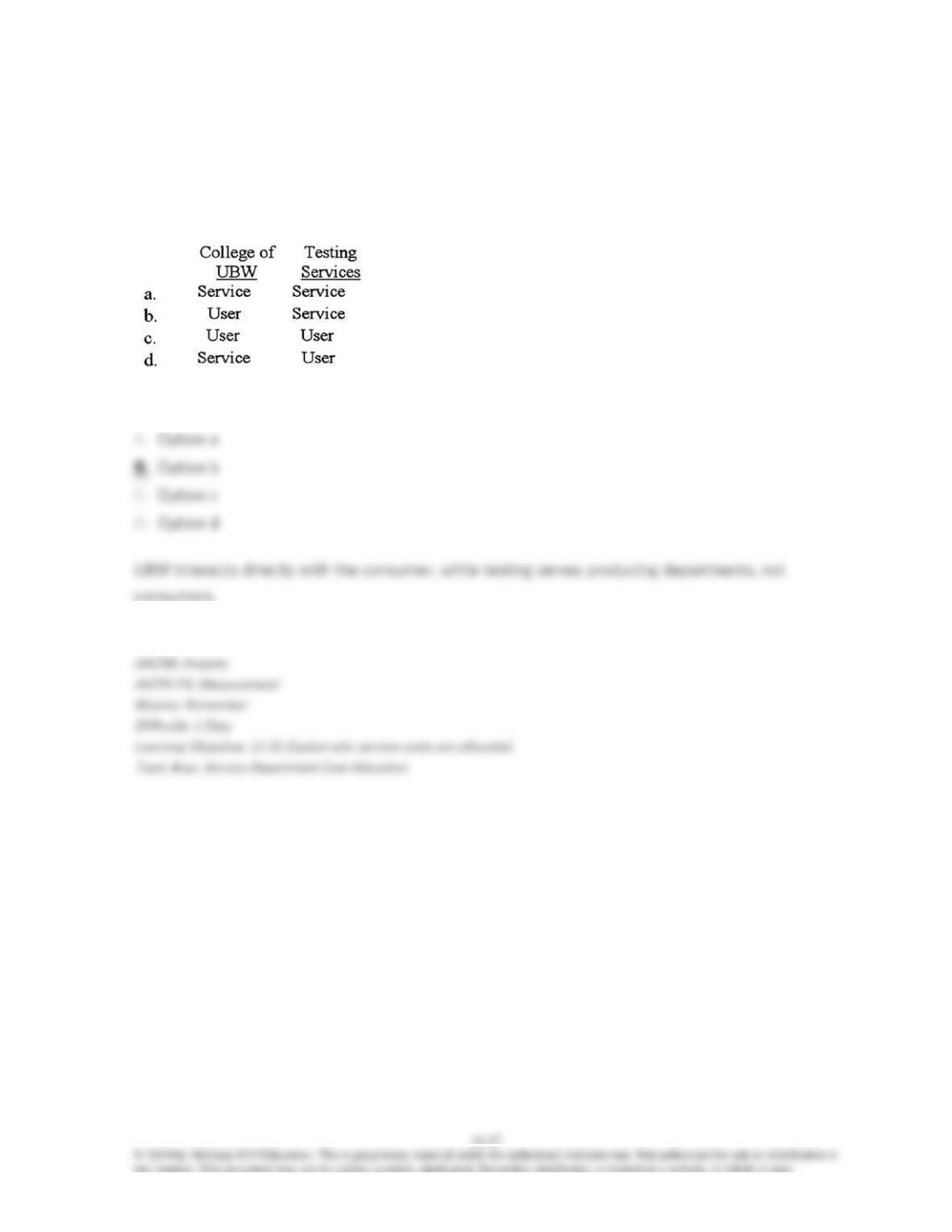
31. LaCrescent University has 20 departments. Two of its best departments are the (1)
College of UBW (Underwater Basket Weaving) and (2) Testing Services. The College of UBW
attempts to teach students the difficult, but useful, skill of weaving baskets underwater. Testing
Services grades examinations for professors. How would these two departments be classified?
32. Joint products and byproducts are produced simultaneously by a single process or series
of processes and:
33. Which of the following best describes the objective of joint cost allocation?
34. Allocated joint costs are useful for:
35. Which of the following cost items is not allocable as joint costs when a single
manufacturing process produces several main products and several by-products?
36. For purposes of allocating joint costs to joint products, the estimated net realizable value
at split-off is equal to:
37. The method of accounting for joint product costs that will produce the same gross margin
percentage for all products is the: