Accounting, 9e (Horngren)
Chapter 11 Long-Term Liabilities, Bonds Payable, and Classification of Liabilities on the Balance Sheet
Learning Objective 11-1
1) The current portion of notes payable is the principal amount that will be paid within one year of the balance sheet
date.
2) The current portion of notes payable must be reported on the balance sheet combined with the long-term portion
under long-term liabilities.
3) When a long-term note payable is issued, the entire amount should be initially recorded as a long–term note
payable.
4) A mortgage payable is a debt that is backed with a security interest in property.
5) The difference between a mortgage payable and a note payable is that notes payable are always long-term.
6) Installment payments for mortgages are normally paid once per year.
7) Installment payments for mortgages typically contain both an amount for principal repayment and an amount for
interest.
8) On July 1, 2013, Avery Services issued a 4% long-term note payable for $10,000. It is payable over a 5-year term
in $2,000 principal installments on July 1 of each year. Each yearly installment will include both principal
repayment of $2,000 and interest payment for the preceding one-year period. On July 1, 2014, after the first
installment payment is made, Avery will have to reclassify an additional $2,000 from long-term notes payable to the
current portion of long-term notes payable.
9) When a long-term note payable that requires annual installment payments is initially recorded, it is first recorded
as a long-term note payable. Then, at the same date, a second entry is made to reclassify the current portion.
10) When a company accrues interest payable on a long-term note at year-end, the interest payable must be shown
as a long-term liability on the balance sheet, along with the long–term note payable balance.
11) On July 1, 2013, Avery Services issued a long-term note payable for $10,000. It is payable over a 5-year term in
$2,000 installments on July 1 of each succeeding year. When the note was issued, the principal amount was
recorded in Long-term notes payable and a second entry was made to reclassify the current portion. How will this
information be shown on the balance sheet dated December 31, 2013?
A) $10,000 shown as current liability only
B) $2,000 shown as current liability; $10,000 shown as long-term liability
C) $2,000 shown as current liability; $8,000 shown as long–term liability
D) The entire $10,000 shown as long-term liability
12) On July 1, 2013, Avery Services issued a 4% long-term note payable for $10,000. It is payable over a 5-year
term in $2,000 principal installments on July 1 of each year. Each yearly installment will include both principal
repayment of $2,000 and interest payment for the preceding one-year period. What happens on December 31, 2013
before statements are prepared?
A) Avery must accrue $200 of interest expense.
B) Avery must accrue for the coming $2,000 principal payment.
C) Avery must pay out $200 of interest expense to the note holder.
D) Avery does not need to take any actions.
13) On July 1, 2013, Avery Services issued a 4% long–term note payable for $10,000. It is payable over a 5-year
term in $2,000 principal installments on July 1 of each year. Each yearly installment will include both principal
repayment of $2,000 and interest payment for the preceding one-year period. What happens on July 1, 2014?
A) Avery pays out $400 of interest only.
B) Avery pays out $400 of interest plus $2,000 of principal.
C) Avery pays out $2,000 of principal only.
D) Avery pays out the $200 of interest that was accrued at year-end.
14) On July 1, 2013, Avery Services issued a 4% long–term note payable for $10,000. It is payable over a 5-year
term in $2,000 principal installments on July 1 of each year. Which of the following entries needs to be made at July
1, 2013 to reclassify the current portion of the note?
A)
Long-term notes payable
2,000
Cash
2,000
B)
Current portion of long-term notes payable
2,000
Long-term notes payable
2,000
C)
Long-term notes payable
2,000
Accounts payable
2,000
D)
Long-term notes payable
2,000
Current portion long-term notes payable
2,000
15) On July 1, 2013, Avery Services issued a 4% long-term note payable for $10,000. It is payable over a 5-year
term in $2,000 principal installments on July 1 of each year. Which of the following entries needs to be made at
year-end 2013 to accrue interest?
A)
Interest expense
200
Cash
200
B)
Interest expense
200
Interest payable
200
C)
Interest expense
400
Accounts payable
400
D)
Interest revenue
400
Cash
400
16) On November 1, 2012, EZ Products borrowed $48,000 on a 5%, 10-year note with annual installment payments
of $4,800 plus interest due on November 1 of each succeeding year. On November 1, the principal amount was
initially recorded as Long-term notes payable, and then a second entry was made to reclassify the current portion.
Which of the following is the proper reclassification entry?
A)
Long-term notes payable
4,800
Current portion of long-term notes payable
4,800
B)
Current portion of long-term notes payable
4,800
Accounts payable
4,800
C)
Long-term notes payable
4,800
Accounts payable
4,800
D)
Current portion of long-term notes payable
4,800
Long-term notes payable
4,800
17) On November 1, 2012, EZ Products borrowed $48,000 on a 5%, 10-year note with annual installment payments
of $4,800 plus interest due on November 1 of each succeeding year. How much interest expense should be accrued
at December 31, 2012 for the period of November 1 through year-end?
A) $1,200
B) $2,400
C) $400
D) $200
18) On November 1, 2012, EZ Products borrowed $48,000 on a 5%, 10-year note with annual installment payments
of $4,800 plus interest due on November 1 of each succeeding year. Which of the following journal entries would
be needed at December 31, 2012 to accrue interest from November 1 through year-end?
A)
Interest expense
400
Cash
400
B)
Interest expense
400
Interest payable
400
C)
Interest expense
400
Accounts payable
400
D)
Cash
400
Interest expense
400
19) On November 1, 2012, EZ Products borrowed $48,000 on a 5%, 10-year note with annual installment payments
of $4,800 plus interest due on November 1 of each succeeding year. How will the note be shown on the balance
sheet dated December 31, 2012?
A) $48,000 shown as current liability only
B) $4,800 shown as current liability, $48,000 shown as long-term liability
C) $4,800 shown as current liability, $43,200 shown as long-term liability
D) Entire $48,000 shown as long-term liability
20) On November 1, 2012, EZ Products borrowed $48,000 on a 5%, 10-year note with annual installment payments
of $4,800 plus interest due on November 1 of each succeeding year. On December 31, 2013, what will the balance
be in the account titled Current portion of long-term notes payable?
A) $400
B) $48,000
C) $43,200
D) $4,800
21) On November 1, 2012, EZ Products borrowed $48,000 on a 5%, 10-year note with annual installment payments
of $4,800 plus interest due on November 1 of each succeeding year. On December 31, 2013, what will the balance
be in the account titled Long-term notes payable?
A) $38,400
B) $48,000
C) $43,200
D) $4,800
22) On November 1, 2012, EZ Products borrowed $48,000 on a 5%, 10-year note with annual installment payments
of $4,800 plus interest due on November 1 of each succeeding year. Which of the following describes the first
installment payment made on November 1, 2013?
A) $4,800 principal plus $2,400 interest
B) $4,800 principal plus $400 interest
C) $2,400 principal plus $2,400 interest
D) $2,000 interest only
23) Paris Company buys a building on a plot of land for $100,000, paying $20,000 cash and signing a 20-year
mortgage note for $80,000 at 6%. Monthly payments are $570. What portion of the first monthly payment is
interest expense?
A) $4,800
B) $570
C) $550
D) $400
24) Paris Company buys a building on a plot of land for $100,000, paying $20,000 cash and signing a 20-year
mortgage note for $80,000 at 6%. Monthly payments are $570. What portion of the first monthly payment is
principal?
A) $170
B) $200
C) $570
D) $4,800
25) Paris Company buys a building on a plot of land for $100,000, paying $20,000 cash and signing a 20-year
mortgage note for $80,000 at 6%. Monthly payments are $570. The first monthly payment was made in January,
2013. After the first payment, what is the updated principal balance?
A) $79,430
B) $79,600
C) $79,830
D) $79,440
26) On January 1, 2013, Thames Company purchases property and signs a 6-year mortgage note for $60,000 at 4%.
Please see the partial amortization schedule below.
AMORTIZATION SCHEDULE
Principal
$60,000.00
(partial)
Rate
4.00%
Payment
$980.00
Payment
Number
Date
Payment
Interest
Expense
Principal
Balance
1/1/2013
60,000.00
1
1/31/2013
980.00
200.00
780.00
59,220.00
2
2/28/2013
980.00
197.40
782.60
58,437.40
3
3/31/2013
980.00
194.79
785.21
57,652.19
4
4/30/2013
980.00
192.17
787.83
56,864.37
5
5/31/2013
980.00
189.55
790.45
56,073.91
6
6/30/2013
980.00
186.91
793.09
55,280.83
7
7/31/2013
980.00
184.27
795.73
54,485.10
8
8/31/2013
980.00
181.62
798.38
53,686.71
9
9/30/2013
980.00
178.96
801.04
52,885.67
10
10/31/2013
980.00
176.29
803.71
52,081.95
11
11/30/2013
980.00
173.61
806.39
51,275.56
12
12/31/2013
980.00
170.92
809.08
50,466.48
2013 totals
11,760.00
2,226.48
9,533.52
13
1/31/2014
980.00
168.22
811.78
49,654.70
14
2/29/2014
980.00
165.52
814.48
48,840.22
15
3/31/2014
980.00
162.80
817.20
48,023.02
16
4/30/2014
980.00
160.08
819.92
47,203.09
17
5/31/2014
980.00
157.34
822.66
46,380.44
18
6/302014
980.00
154.60
825.40
45,555.04
19
7/31/2014
980.00
151.85
828.15
44,726.89
20
8/31/2014
980.00
149.09
830.91
43,895.98
21
9/30/2014
980.00
146.32
833.68
43,062.30
22
10/31/2014
980.00
143.54
836.46
42,225.84
23
11/30/2014
980.00
140.75
839.25
41,386.59
24
12/31/2014
980.00
137.96
842.04
40,544.55
2014 totals
11,760.00
1,838.07
9,921.93
At January 1, 2013, what portion of the balance of the mortgage payable should be shown as a current liability?
A) $11,760.00
B) $9,533.52
C) $2,226.48
D) $50,466.48
27) On January 1, 2013, Thames Company purchases property and signs a 6-year mortgage note for $60,000 at 4%.
Please see the partial amortization schedule below.
Payment
Number
Date
Payment
Interest
Expense
Principal
Balance
1/1/2013
60,000.00
1
1/31/2013
980.00
200.00
780.00
59,220.00
2
2/28/2013
980.00
197.40
782.60
58,437.40
3
3/31/2013
980.00
194.79
785.21
57,652.19
4
4/30/2013
980.00
192.17
787.83
56,864.37
5
5/31/2013
980.00
189.55
790.45
56,073.91
6
6/30/2013
980.00
186.91
793.09
55,280.83
7
7/31/2013
980.00
184.27
795.73
54,485.10
8
8/31/2013
980.00
181.62
798.38
53,686.71
9
9/30/2013
980.00
178.96
801.04
52,885.67
10
10/31/2013
980.00
176.29
803.71
52,081.95
11
11/30/2013
980.00
173.61
806.39
51,275.56
12
12/31/2013
980.00
170.92
809.08
For the year 2013, what will be the total interest expense recorded by Thames Company for this mortgage?
A) $200.00
B) $9,533.52
C) $11,760.00
D) $2,226.48
28) On January 1, 2013, Thames Company purchases property and signs a 6-year mortgage note $60,000 at 4%.
Please see the partial amortization schedule below.
Payment
Number
Date
Payment
Interest
Expense
Principal
Balance
1/1/2013
60,000.00
1
1/31/2013
980.00
200.00
780.00
59,220.00
2
2/28/2013
980.00
197.40
782.60
58,437.40
3
3/31/2013
980.00
194.79
785.21
57,652.19
4
4/30/2013
980.00
192.17
787.83
56,864.37
5
5/31/2013
980.00
189.55
790.45
56,073.91
6
6/30/2013
980.00
186.91
793.09
55,280.83
7
7/31/2013
980.00
184.27
795.73
54,485.10
8
8/31/2013
980.00
181.62
798.38
53,686.71
9
9/30/2013
980.00
178.96
801.04
52,885.67
10
10/31/2013
980.00
176.29
803.71
52,081.95
11
11/30/2013
980.00
173.61
806.39
51,275.56
12
12/31/2013
980.00
170.92
809.08
50,466.48
2013 totals
11,760.00
2,226.48
9,533.52
13
1/31/2014
980.00
168.22
811.78
49,654.70
14
2/29/2014
980.00
165.52
814.48
48,840.22
15
3/31/2014
980.00
162.80
817.20
48,023.02
16
4/30/2014
980.00
160.08
819.92
47,203.09
17
5/31/2014
980.00
157.34
822.66
46,380.44
18
6/302014
980.00
154.60
825.40
45,555.04
19
7/31/2014
980.00
151.85
828.15
44,726.89
20
8/31/2014
980.00
149.09
830.91
43,895.98
21
9/30/2014
980.00
146.32
833.68
43,062.30
22
10/31/2014
980.00
143.54
836.46
42,225.84
23
11/30/2014
980.00
140.75
839.25
41,386.59
24
12/31/2014
980.00
137.96
842.04
40,544.55
2014 totals
11,760.00
1,838.07
9,921.93
At the end of 2013, what amount would be shown on the balance sheet for current portion of mortgage payable?
A) $50,466.48
B) $9,921.93
C) $9,533.52
D) $2,226.48
29) On January 1, 2013, Thames Company purchases property and signs a 6-year mortgage note $60,000 at 4%.
Please see the partial amortization schedule below.
Payment
Number
Date
Payment
Interest
Expense
Principal
Balance
1/1/2013
60,000.00
1
1/31/2013
980.00
200.00
780.00
59,220.00
2
2/28/2013
980.00
197.40
782.60
58,437.40
3
3/31/2013
980.00
194.79
785.21
57,652.19
4
4/30/2013
980.00
192.17
787.83
56,864.37
5
5/31/2013
980.00
189.55
790.45
56,073.91
6
6/30/2013
980.00
186.91
793.09
55,280.83
7
7/31/2013
980.00
184.27
795.73
54,485.10
8
8/31/2013
980.00
181.62
798.38
53,686.71
9
9/30/2013
980.00
178.96
801.04
52,885.67
10
10/31/2013
980.00
176.29
803.71
52,081.95
11
11/30/2013
980.00
173.61
806.39
51,275.56
12
12/31/2013
980.00
170.92
809.08
50,466.48
2013 totals
11,760.00
2,226.48
9,533.52
13
1/31/2014
980.00
168.22
811.78
49,654.70
14
2/29/2014
980.00
165.52
814.48
48,840.22
15
3/31/2014
980.00
162.80
817.20
48,023.02
16
4/30/2014
980.00
160.08
819.92
47,203.09
17
5/31/2014
980.00
157.34
822.66
46,380.44
18
6/302014
980.00
154.60
825.40
45,555.04
19
7/31/2014
980.00
151.85
828.15
44,726.89
20
8/31/2014
980.00
149.09
830.91
43,895.98
21
9/30/2014
980.00
146.32
833.68
43,062.30
22
10/31/2014
980.00
143.54
836.46
42,225.84
23
11/30/2014
980.00
140.75
839.25
41,386.59
24
12/31/2014
980.00
137.96
842.04
40,544.55
2014 totals
11,760.00
1,838.07
9,921.93
At the end of 2013, what amount would be shown on the balance sheet for mortgage payable (excluding the current
portion)?
A) $40,544.55
B) $50,466.48
C) $9,533.52
D) $9,921.93
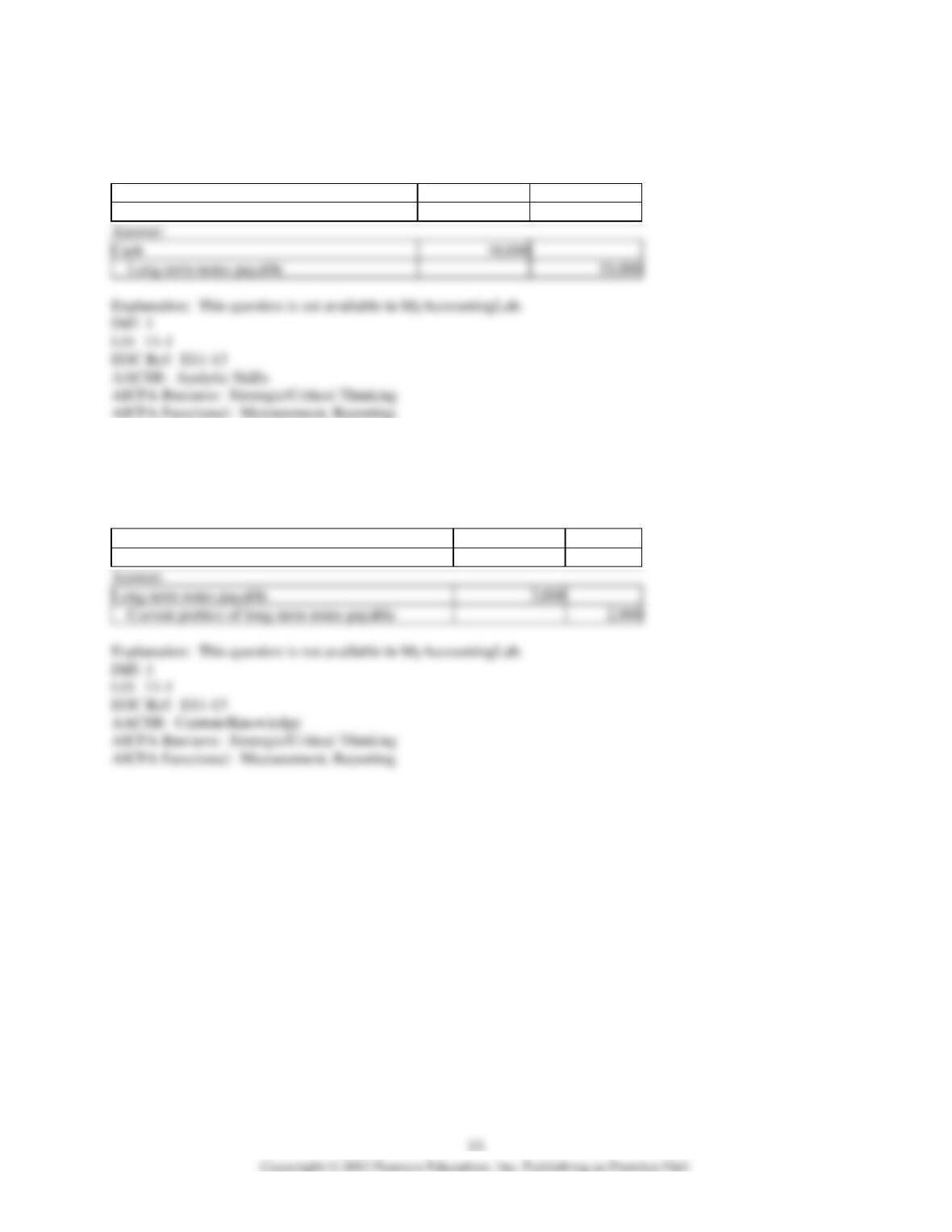
30) On July 1, 2013, Avery Services issued a long-term note payable for $10,000. It is payable over a 5-year term in
$2,000 installments on July 1 of each succeeding year. Please provide the initial journal entry for the issuance of the
note.
Cash
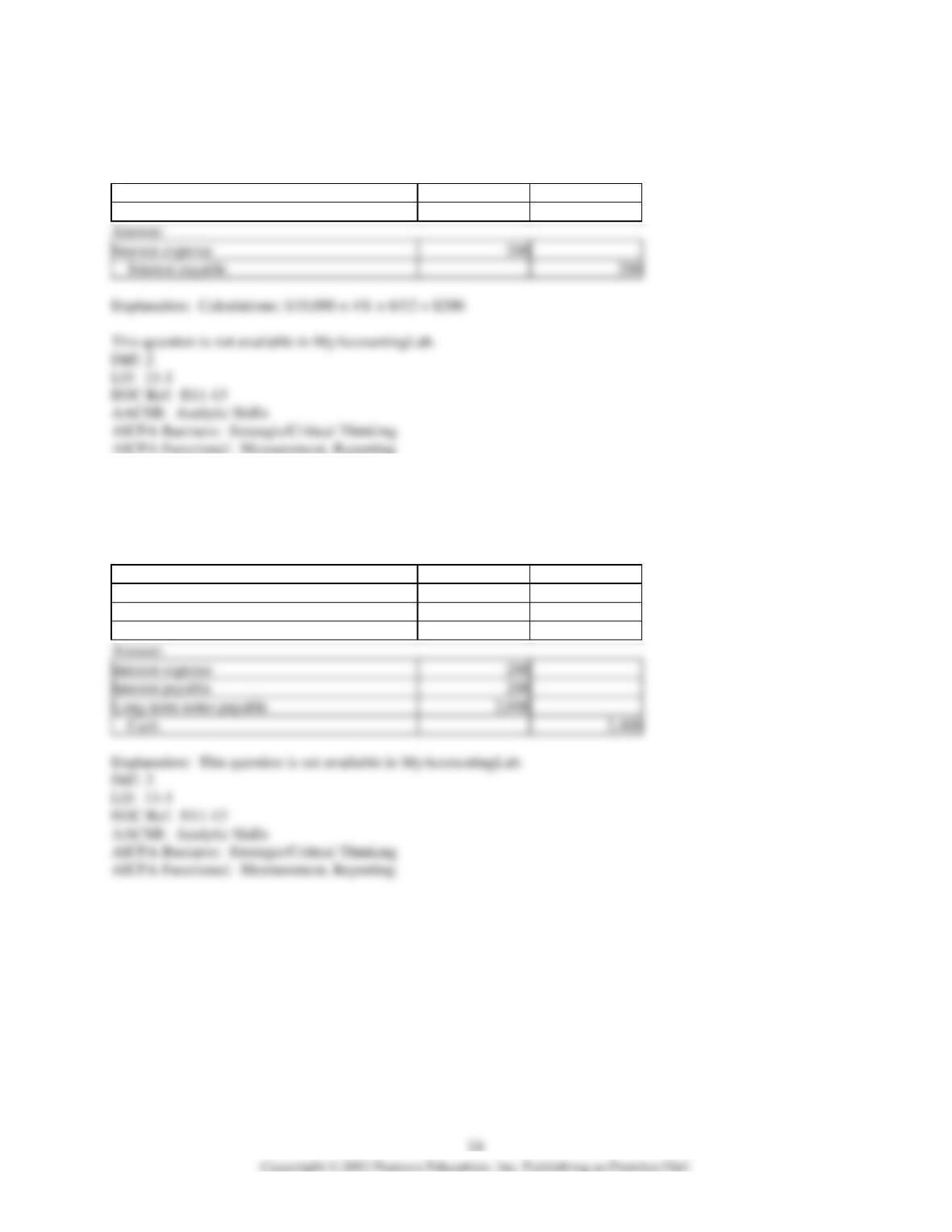
31) On July 1, 2013, Avery Services issued a long-term note payable for $10,000. It is payable over a 5-year term in
$2,000 installments on July 1 of each succeeding year. When the note was issued, the principal amount was initially
recorded in Long-term notes payable. In addition, a second entry was made to reclassify the current portion. Please
provide the journal entry needed for that reclassification.
Long-term notes payable
2,000
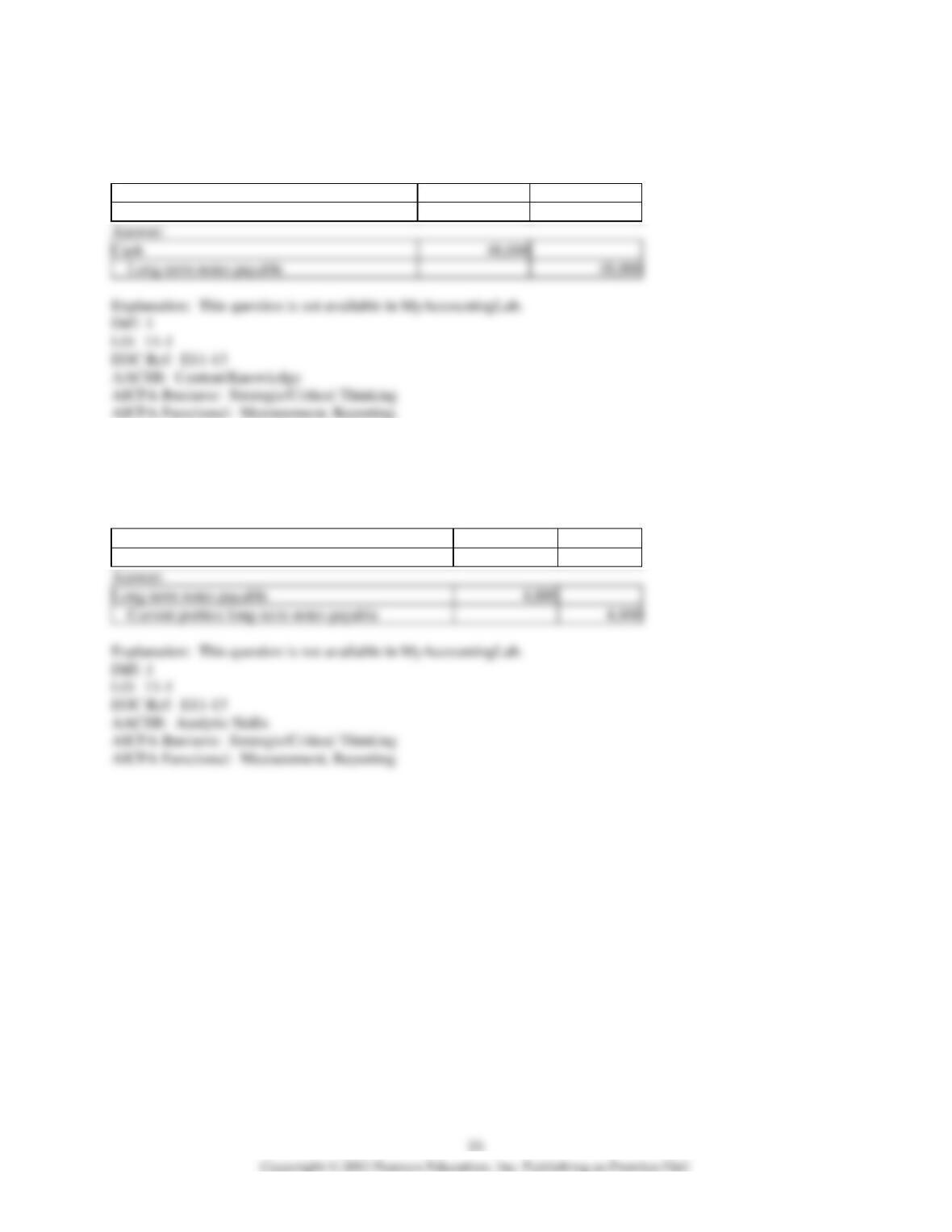
32) On July 1, 2013, Avery Services issued a 4% long-term note payable for $10,000. It is payable over a 5-year
term in $2,000 principal installments on July 1 of each year. Each yearly installment will include both principal
repayment of $2,000 and interest payment for the preceding one-year period. Please provide the journal entry
needed at year-end 2013 to accrue the interest expense from July 1 through the end of the year.
Interest expense
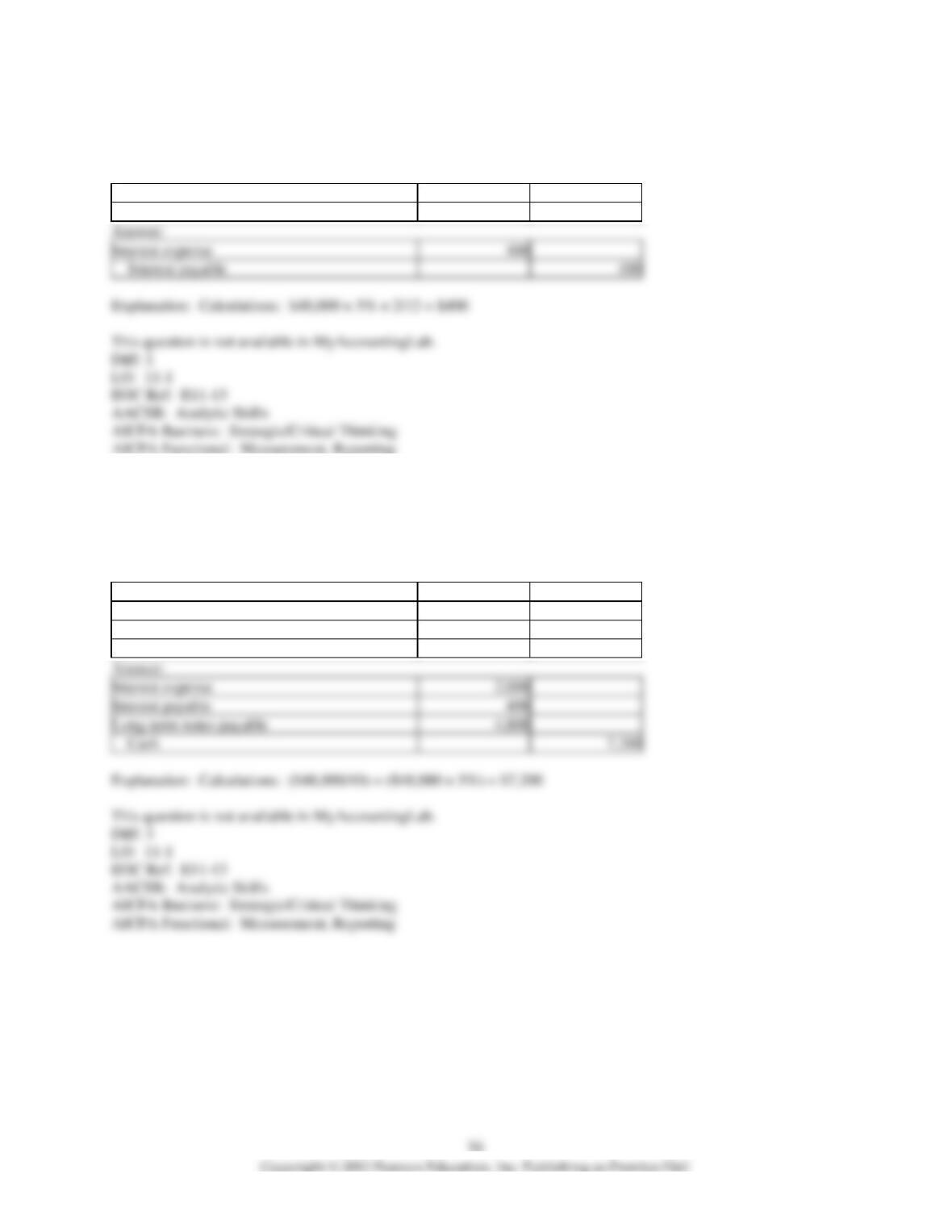
33) On July 1, 2013, Avery Services issued a 4% long–term note payable for $10,000. It is payable over a 5-year
term in $2,000 principal installments on July 1 of each year. Each yearly installment will include both principal
repayment of $2,000 and interest payment for the preceding one-year period. Please provide the journal entry
needed on July 1, 2014 when the first installment payment is made.
Interest expense
Interest payable
Long-term notes payable
34) On November 1, 2013, EZ Products borrowed $48,000 on a 5%, 10-year note with annual installment payments
of $4,800 plus interest due on November 1 of each succeeding year. Please provide the first journal entry for the
initial issuance of the note.
Cash
35) On November 1, 2013, EZ Products borrowed $48,000 on a 5%, 10-year note with annual installment payments
of $4,800 plus interest due on November 1 of each succeeding year. On November 1, the principal amount was
initially recorded as Long-term notes payable, and then a second entry was made to reclassify the current portion.
Please provide the proper reclassification entry.
Long-term notes payable
36) On November 1, 2014, EZ Products borrowed $48,000 on a 5%, 10-year note with annual installment payments
of $4,800 plus interest due on November 1 of each succeeding year. Please provide the journal entry to accrue
interest expense for the period of November 1 through the end of the year.
Interest expense
37) On November 1, 2014, EZ Products borrowed $48,000 on a 5%, 10-year note with annual installment payments
of $4,800 plus interest due on November 1 of each succeeding year. At the end of 2014, EZ Products accrued
interest expense. No further entries were made until November 1, 2015 when the first installment payment was
made. That payment included both principal and interest. Please provide the journal entry for the installment
payment made on November 1, 2015.
Interest expense
Interest payable
Long-term notes payable
38) Paris Company buys a building on a plot of land for $100,000, paying $20,000 cash and signing a 20-year
mortgage note for $80,000 at 6%. An appraisal shows the value of the building to be $70,000 and the value of the
land to be $30,000. Please provide the journal entry for the purchase.
Building
Land
39) Paris Company buys a building on a plot of land for $100,000, paying $20,000 cash and signing a 20-year
mortgage note for $80,000 at 6%. Monthly payments are $570. The first monthly payment was made in January,
2013. Please provide the journal entry for the first monthly payment.
Interest expense
Mortgage payable
40) On January 1, 2013, Thames Company purchases property and signs a 6-year mortgage note for $60,000 at 4%.
Please see the partial amortization schedule below.
AMORTIZATION SCHEDULE
Principal
$60,000.00
(partial)
Rate
4.00%
Payment
$980.00
Payment
Number
Date
Payment
Interest
Expense
Principal
Balance
1/1/2013
60,000.00
1
1/31/2013
980.00
200.00
780.00
59,220.00
2
2/28/2013
980.00
197.40
782.60
58,437.40
3
3/31/2013
980.00
194.79
785.21
57,652.19
4
4/30/2013
980.00
192.17
787.83
56,864.37
5
5/31/2013
980.00
189.55
790.45
56,073.91
6
6/30/2013
980.00
186.91
793.09
55,280.83
7
7/31/2013
980.00
184.27
795.73
54,485.10
8
8/31/2013
980.00
181.62
798.38
53,686.71
9
9/30/2013
980.00
178.96
801.04
52,885.67
10
10/31/2013
980.00
176.29
803.71
52,081.95
11
11/30/2013
980.00
173.61
806.39
51,275.56
12
12/31/2013
980.00
170.92
809.08
50,466.48
2013 totals
11,760.00
2,226.48
9,533.52
13
1/31/2014
980.00
168.22
811.78
49,654.70
14
2/29/2014
980.00
165.52
814.48
48,840.22
15
3/31/2014
980.00
162.80
817.20
48,023.02
16
4/30/2014
980.00
160.08
819.92
47,203.09
17
5/31/2014
980.00
157.34
822.66
46,380.44
18
6/302014
980.00
154.60
825.40
45,555.04
19
7/31/2014
980.00
151.85
828.15
44,726.89
20
8/31/2014
980.00
149.09
830.91
43,895.98
21
9/30/2014
980.00
146.32
833.68
43,062.30
22
10/31/2014
980.00
143.54
836.46
42,225.84
23
11/30/2014
980.00
140.75
839.25
41,386.59
24
12/31/2014
980.00
137.96
842.04
40,544.55
2014 totals
11,760.00
1,838.07
9,921.93
On January 1, 2013, Thames recorded the entire principal amount of $60,000 as mortgage payable. They would
then record a second entry to reclassify the current portion. Please provide that entry.
Mortgage payable
Current portion of mortgage payable
19
41) On January 1, 2013, Thames Company purchases property and signs a 6-year mortgage note for $60,000 at 4%.
Please see the partial amortization schedule below.
AMORTIZATION SCHEDULE
Principal
$60,000.00
(partial)
Rate
4.00%
Payment
$980.00
Payment
Number
Date
Payment
Interest
Expense
Principal
Balance
1/1/2013
60,000.00
1
1/31/2013
980.00
200.00
780.00
59,220.00
2
2/28/2013
980.00
197.40
782.60
58,437.40
3
3/31/2013
980.00
194.79
785.21
57,652.19
4
4/30/2013
980.00
192.17
787.83
56,864.37
5
5/31/2013
980.00
189.55
790.45
56,073.91
6
6/30/2013
980.00
186.91
793.09
55,280.83
7
7/31/2013
980.00
184.27
795.73
54,485.10
8
8/31/2013
980.00
181.62
798.38
53,686.71
9
9/30/2013
980.00
178.96
801.04
52,885.67
10
10/31/2013
980.00
176.29
803.71
52,081.95
11
11/30/2013
980.00
173.61
806.39
51,275.56
12
12/31/2013
980.00
170.92
809.08
50,466.48
2013 totals
11,760.00
2,226.48
9,533.52
13
1/31/2014
980.00
168.22
811.78
49,654.70
14
2/29/2014
980.00
165.52
814.48
48,840.22
15
3/31/2014
980.00
162.80
817.20
48,023.02
16
4/30/2014
980.00
160.08
819.92
47,203.09
17
5/31/2014
980.00
157.34
822.66
46,380.44
18
6/302014
980.00
154.60
825.40
45,555.04
19
7/31/2014
980.00
151.85
828.15
44,726.89
20
8/31/2014
980.00
149.09
830.91
43,895.98
21
9/30/2014
980.00
146.32
833.68
43,062.30
22
10/31/2014
980.00
143.54
836.46
42,225.84
23
11/30/2014
980.00
140.75
839.25
41,386.59
24
12/31/2014
980.00
137.96
842.04
40,544.55
2014 totals
11,760.00
1,838.07
9,921.93
At December 31, 2013, after the December payment has been made, a new reclassification entry must be made to
update the balance in the current portion of mortgage payable. Please provide that journal entry.
Mortgage payable
Learning Objective 11-2
1) Bonds are long-term liabilities issued to multiple lenders, usually in increments of $1,000.
2) The company will repay the principal amount of the bond on the maturity date.
3) If a bond is issued at a discount, it will sell for more than face value.