
Chapter 11—The Billing/Accounts Receivable/Cash Receipts
(B/AR/CR) Process Key
1. The B/AR/CR process completes the order to cash process by accomplishing the activities of billing
customers, managing customer accounts, and securing payment for goods and services rendered.
2. Recording B/AR/CR event data is generally the responsibility of the treasury department, which typically
reports to the controller function.
3. Although both the treasurer and controller functions report to the VP of Finance, for good internal control,
these functions should be segregated.
4. The credit department uses accounts receivable master data to complete several of their activities.
5. The goal for treasurers, who are responsible for managing an organization’s cash resources, is to make funds
available so that they can be used to acquire revenue-generating assets, be invested to earn interest, or be used
to reduce debt, thus saving interest charges.
6. Float, when applied to cash receipts, is the time between payment by customer and the availability of funds
on deposit and available for use.
7. Funds on deposit and available for use are known as good funds.

8. The AR master file address is a postal address, maintained by the firm’s bank, which is used solely for the
purpose of collecting checks.
9. Database systems are Internet based systems for sending bills/invoices to customers and receiving the
customer payment electronically.
10. An invoice is a business document¾either paper or electronic transmission¾used to notify the customer of
an obligation to pay the seller for merchandise which was ordered and shipped.
11. A purchasing statement is a business document designed to inform the payee of the invoices or other items
being paid.
12. The accounts receivable master data is a repository of all unpaid invoices issued by an organization and
awaiting final disposition.
13. The sales event data store contains invoice records.
14. Electronic bill presentment and payment (EBPP) systems are B2B systems that use a Web site to post
customers’ bills and to receive their electronic payments.
15. The three types of accounts receivable systems discussed in the text are the lockbox, balance-forward, and
open-item systems.

16. In a balance-forward accounts receivable system, customer statements display previous balance, payments,
and balance forward to which are added any new charges to derive the total balance due.
17. In an open-item accounts receivable system, customer statements display invoices (new or settled in the
current period), along with payment details.
18. In a pre-billing system, invoices are prepared after the goods have been shipped and the sales order
notification has been matched to the shipping’s billing notification.
19. In a post-billing system, invoices are prepared upon acceptance of the customer order.
20. The acronym EFT stands for electronic funds transfer.
21. The acronym ACH stands for automated clearing house.
22. A credit card system is better at reducing float time for the collector than a debit card system.
23. In an open-item system, accounts receivable records consist of a customer’s current balance due, past-due
balance, and the finance charges and payments related to the account.
24. The B/AR/CR system supports the repetitive work routines of the credit department, the cashier, and the
accounts receivable department.

25. A debit card is a method of payment whereby a third party, for a fee, removes from the collector the risk of
non-collection of the account receivable.
26. A credit card is a form of payment authorizing the collector to transfer funds electronically from the payer’s
bank account to the collector’s bank account.
27. Forced vacations is the only control procedure that can be used to help prevent or detect lapping.
28. The ACH network electronically transfers funds by crediting the collector’s bank account and debiting the
payer’s bank account for the amount of a payment.
29. The payment event data contains the details of each payment received.
30. The stub attached to the customer statement is also known as a turnaround document.
31. The accounts receivable master data is created as sales returns, bad debt write-offs, estimated doubtful
accounts, or similar adjustments are processed.
32. A lockbox is a postal address maintained by a third party¾typically a bank¾which is used solely for the
purpose of collecting checks.
33. EFT includes wire transfers, credit and debit card processing, as well as payments made via the ACH
Network.
34. An electronic bill presentment and payment (EBPP) system is a B2C system that uses a Web site to post
customer bills and to receive electronic payments.
35. With the biller direct method of an electronic bill presentment and payment (EBPP) system, a company
posts its bills/invoices to its own Web site (or to a Web site hosted by a third party) and sends an e-mail
notification to its customers telling them that their bill has been posted.
36. With the consolidation/aggregation method of an electronic bill presentment and payment (EBPP) system, a
company’s bills are posted, along with bills from other companies, to a Web site hosted by a third party.
Customers then go to that site to pay bills from a number of companies.
37. As discussed in the text, the functions of the B/AR/CR process:
38. According to the concept of segregation of duties, which of the following managers should report to the
controller rather than to the treasurer?
39. In an organization in which the OE/S and B/AR/CR processes are separate processes, the B/AR/CR process
usually accomplishes all of the following activities except:
40. Which of the following pairs of functions would you expect might report directly to the vice president of
finance?
A. credit department and controller
41. Which of the following statements regarding Check 21 is false?
A. It allows banks to exchange checks electronically.
42. Which of the following process bubbles (i.e., activities) would you not expect to see in the logical DFD for a
B/AR/CR process?
43. Which of the following normally would trigger the billing process in a B/AR/CR process?
44. Which of the following normally would trigger the B/AR/CR process to record a customer payment?
45. The principal master data that you would expect to see in a B/AR/CR process is the:
A. sales order
46. In a B/AR/CR process, which of the following data stores is least likely to interact with a process called
“perform billing”?
47. In a logical DFD for a B/AR/CR process, which of the following data stores would you expect to interact
with a process called “manage customer accounts”?
48. In a logical DFD for a B/AR/CR process, you would expect that a credit memo would be sent by the
B/AR/CR process to the customer from which of the following processes?
49. Inputs to the B/AR/CR process normally could include all of the following except:
50. In general, adjustments to customer balances in the accounts receivable master data will be necessary for all
of the following except:
A. sales returns and allowances
51. An invoice record usually contains all of the following elements except:
52. In an entity-relationship (E-R) diagram for the B/AR/CR process, you would expect that the word trigger
would appear between the boxes for?
53. A company using a centralized database approach might not maintain a relational table for ACCOUNTS
RECEIVABLE. Rather, accounts receivable balances at any point in time could be computed as the difference
between the relations for which of the following continuous events?
54. One type of accounts receivable system is balance-forward, the other is:
A. debit card system
55. In a pre-billing system, invoices are prepared:
56. In a fraud scheme known as ____, the perpetrator attempts to cover the theft of cash received from customer
A by applying cash collected from customer B to A’s account, then applying a receipt from C to B’s account,
and so forth.
57. Deposit slips are usually generated by the B/AR/CR process:
A. at the time invoices are prepared
58. Typically, the operations process goals of the B/AR/CR:
59. Which of the following control plans is most likely to appear in the input validity and input accuracy
columns, but not in the input completeness column of a control matrix for the billing process?
A. independent billing authorization
60. For the cash receipts process, the control plan turnaround documents helps to achieve which of the
following pairs of control goals?
61. In the cash receipts process, the control plan of immediately endorsing incoming checks is designed to
achieve the control goal of:
62. In the billing process, the control plan of review shipped not billed sales orders (tickler file) helps to ensure:
63. The B/AR/CR process comprises three different but related processes¾namely, billing, accounts receivable,
and cash receipts. Which of the following would not be an operations process goal for these three processes?
64. A remittance advice generally would be recorded in which of the following pairs of data stores?
A. customer master data and accounts receivable master data
65. Digital images:
A. help reduce paper in the B/AR/CR system
66. Which of the following statements is false?
A. The typical B/AR/CR system assists in preparing internal and external reports.
67. Which of the following statements is true?
A. In a pre-billing system, invoices are prepared after the goods have been shipped and the sales order
notification has been matched to the shipping’s billing notification.
68. Which of the following statements is false?
A. The check and remittance advice trigger the receive payment process.
69. The B/AR/CR process completes the:
70. Which of the following is not part of the horizontal information flows of the B/AR/CR process?
71. Which of the following is most commonly associated with the treasury function?
72. Which of the following segregation of duties is not required for the B/AR/CR business process controls to
be effective?
A. price authorization and billing
73. Placing a customer’s bills on a company’s own Web site and sending an e-mail telling the customer that his
or her bill is there is called:
74. The accounts receivable system in which all the accounts receivable master data contains individual open
invoices, against which payments and other adjustments are applied:
75. The accounts receivable system typically used by utilities is the:
76. Quantities of items shipped to a customer would typically be found in the relational table for:
77. The billing system in which the invoice is prepared after goods have been shipped and the sales order
notification has been matched to shipping’s billing notification is called a(n):
78. A billing system that can be used when there is little or no delay between the receipt of the customer order
and the shipment of the goods is a:
A. post-billing system
79. The technology that allows information on documents to be converted into machine-readable data through a
scanner is called a(n):
80. An overall management objective is to:
81. The cash receipts process can be accelerated by using the ACH network because it is:
A. an immediate process
82. A form of fraud in which the payments made by one customer are systematically applied to the account of
another is called:
83. In the billing function described in the text, the control plan that contributes to effective operations is:
A. edit the shipping notification for accuracy
84. Which control is most effective in contributing to the goal of ensure input accuracy in the billing function?
85. Which control plan for the cash receipts function has as its primary control goal to ensure security of
resources?
A. reconcile bank account regularly.
86. The control independent billing authorization ensures that bills:
A. are accurate
87. A customer is instructed to send his remittance advice and check to a bank’s postal address. This method for
collecting customer cash receipts is called:
A. electronic funds transfer
88. To reduce the cost of collecting its accounts receivable, a company sells its accounts receivable to a
financial organization. The service is called:
A. collection agency advance
89. The B/AR/CR process completes the order to cash process by accomplishing the activities of:
______________________________, managing customer accounts, and securing payment for goods or services
rendered.
90. Recording B/AR/CR event data is generally the responsibility of the accounts receivable department, which
for good internal control typically reports to the ______________________________ function.
91. In the organization structure shown in the text, although both report to the VP of Finance, the
______________________________ and ______________________________ functions should be
segregated.

92. Organizations should monitor ______________________________ to ensure that cash is received in a
timely manner.
93. There are two types of electronic bill presentment and payment (EBPP) systems the
______________________________ method and the consolidation/aggregation method.
94. ______________________________, when applied to cash receipts, is the time between the payment by a
customer and the availability of funds on deposit and available for use.
95. Funds on deposit and available for use are known as ______________________________ funds.
96. A(n) ______________________________ is a postal address, maintained by a third party¾typically a
bank¾which is used solely for the purpose of collecting checks.
97. ______________________________ systems are B2C systems that use a Web site to post customers’ bills
and to receive their electronic payments.
98. A(n) ______________________________ is a business document used to notify the customer of an
obligation to pay the seller for merchandise which was ordered and shipped.

99. A(n) ______________________________ is a business document used by the payer to notify the payee of
the items being paid.
100. The ______________________________ data is a repository of all unpaid invoices issued by an
organization and awaiting final disposition.
101. The ______________________________ data store contains invoice records.
102. Organizations should reconcile their ______________________________ on a regular basis to ensure that
valid deposits are recorded correctly.
103. The two types of accounts receivable systems discussed in the text are the balance-forward and
______________________________ systems.
104. In a(n) ______________________________ accounts receivable system, accounts receivable records
consist of a customer’s balance, categorized as current and past due, and current account activity, including such
items as current charges, finance charges for past-due balances, and payments.
105. In a(n) ______________________________ accounts receivable system, the customer statement displays
invoices (new or settled in the current period), along with payment details.
106. In a(n) ______________________________ billing system, invoices are prepared after the goods have
been shipped and the sales order notification has been matched to the shipping’s billing notification.

107. In a(n) ______________________________ billing system, invoices are prepared upon acceptance of the
customer order.
108. The acronym ACH stands for ______________________________.
109. The acronym EFT stands for ______________________________.
110. When customers pay with a(n) ______________________________ card, float is eliminated.
111. The ______________________________ process supports the repetitive work routines of the credit
department, the cashier, and the accounts receivable department.
112. The Check Clearing for the 21st Century Act called ______________________________ allows banks to
exchange check images electronically.
113. The ______________________________ type of accounts receivable systems is appropriate in situations
where invoices are prepared and sent for each sale (i.e., each shipment), and the customer typically makes
payments for specific invoices when those invoices are due.
114. A(n) ______________________________ is a form of payment authorizing the collector to transfer funds
electronically from the payer’s bank account to the collector’s bank account.
115. ______________________________ is a fraud resulting from the improper segregation of duties between
the functions of handling cash and recording cash receipt events.
116. The ______________________________ data is created as sales returns, bad debt write-offs, estimated
doubtful accounts, or similar adjustments are processed.
117. The ______________________________ network is one of the earliest and most prominent methods for
EFT in which the collector’s bank account is credited and the payer’s bank account is debited for the amount of
a payment.
118. The ______________________________ data store contains the details of each payment as reflected on
the remittance advice (RA) accompanying a payment.
119. Often times a stub is attached to the customer statement. This stub is also known as a(n)
______________________________ document.
120. Electric and gas utility companies typically use the ______________________________ type of accounts
receivable system.
121. The control plan ______________________________ establishes for the billing personnel that the
shipment is supported by an actual sales order.

122. The control plan ______________________________ ensures that invoices, accounts receivable, and
revenue reflect prices, terms, freight, and discounts authorized by management.
123. The control plan ______________________________ assumes that there is a segregation of duties
between those who approve prices and those involved in the selling function.
124. The control plan ______________________________ controls the billing and cash receipts functions by
asking the customer to review open invoices to determine that they are valid and accurate.
125. To help prevent incoming cash receipts from being fraudulently misappropriated, an organization should
______________________________.
126. An organization can accelerate cash deposits and prevent lapping by
______________________________.
127.
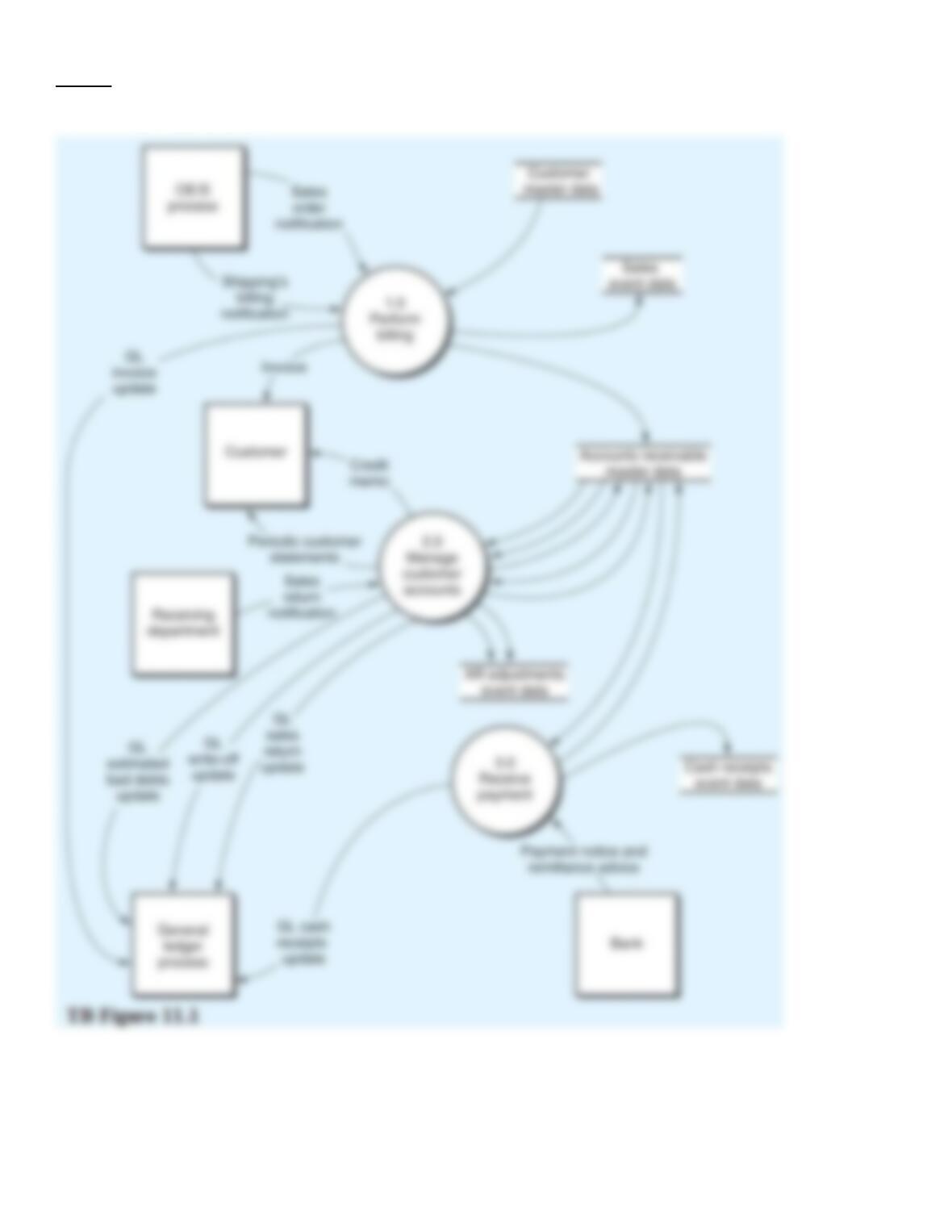
Below is the narrative of the “Perform billing” portion (i.e., bubble 1.0) of the B/AR/CR process.
Narrative Description
When the OE/S process produces a sales order, it notifies the B/AR/CR process to that effect. This is the flow
“Sales order notification.” When triggered by the data flow, “Shipping’s billing notification” (i.e., the shipping
notice), process 1.1 validates the sale by comparing the details on the sales order
notification to those shown on shipping’s billing notification. If discrepancies are noted, the shipping notice is
rejected, i.e. a reject stub. Rejected notices are later processed through a separate exception routine.
If the data flows match, process 1.1 sends a validated shipping notification to process 1.2. Process 1.2 then
performs the following actions:
·
Obtains from the customer master data certain standing data which is needed to produce the invoice.
·
Creates the invoice and sends it to the customer.
·
Updates the accounts receivable master data.
·
Adds an invoice to the sales event data (i.e., the sales journal).
·
Notifies the general ledger process that a sale has occurred (GL invoice update).
Required:
From the DFD in TB Figure 11.1 and the narrative description above, explode bubble 1.0 into a lower-level diagram showing the details of that
process.