Chapter 11 – Flexible Budgeting and Analysis of Overhead Costs
11-1
Chapter 11
Flexible Budgeting and Analysis of Overhead Costs
Answer Key
True / False Questions
1. Flexible budgets reflect a company’s anticipated costs based on variations in activity
levels.
2. The units of output are meaningful measures in multiproduct firms.
Chapter 11 – Flexible Budgeting and Analysis of Overhead Costs
11-2
3. A flexible budget for 15,000 hours revealed variable manufacturing overhead of $90,000
and fixed manufacturing overhead of $120,000. The budget for 25,000 hours would reveal
total overhead costs of $210,000.
4. The formula flexible budget is more general than the columnar flexible budget, because the
formula allows managers to compute budgeted overhead costs at any activity level.
5. The manufacturing overhead applied to Work-in-Process Inventory by a company that uses
standard costing would be computed as actual hours times a predetermined (standard)
overhead rate.
Chapter 11 – Flexible Budgeting and Analysis of Overhead Costs
11-3
6. Both normal- and standard-costing systems use a predetermined overhead rate.
7. From a traditional perspective, dollars of raw material have been a popular activity measure
in manufacturing firms.
8. The advantage of dollar measures as a basis for flexible overhead budgeting is that they are
relatively stable over time.
Chapter 11 – Flexible Budgeting and Analysis of Overhead Costs
11-4
9. Efficient or inefficient use of a specific component of variable overhead (e.g., electricity)
will cause the firm to have a variable-overhead efficiency variance.
10. The budget variance arises from a comparison of actual variable overhead expenditures
with budgeted variable overhead costs.
11. The overhead cost performance report presents itemized variances along with actual and
budgeted costs for each overhead item.
Chapter 11 – Flexible Budgeting and Analysis of Overhead Costs
11-5
12. The overhead cost performance report includes spending and efficiency variances for both
variable and fixed items.
13. The activity-based flexible budget provides a more accurate benchmark against which to
compare actual costs than does a conventional flexible budget.
14. In an activity-based flexible budget, each overhead item has the same cost driver,
identified by flexible overhead budget for that cost item.
Chapter 11 – Flexible Budgeting and Analysis of Overhead Costs
11-6
15. In a standard-costing system, the standard costs are used for product costing as well as for
cost control.
16. The right (credit) side of the production-overhead account accumulates actual overhead
costs incurred.
17. The sales-price variance is the difference between the actual and budgeted sales prices
multiplied by the actual sales volume.
18. The sales-volume variance measures the effect on sales revenue of sales price deviations.
Chapter 11 – Flexible Budgeting and Analysis of Overhead Costs
11-7
Multiple Choice Questions
19. A static budget:
20. Flexible budgets reflect a company’s anticipated costs based on variations in:
Chapter 11 – Flexible Budgeting and Analysis of Overhead Costs
11-8
21. A flexible budget:
22. Barrington Industries anticipated selling 29,000 units of a major product and paying sales
commissions of $6 per unit. Actual sales and sales commissions totaled 31,500 units and
$182,700, respectively. If the company used a static budget for performance evaluations,
Barrington would report a cost variance of:
Chapter 11 – Flexible Budgeting and Analysis of Overhead Costs
11-9
23. Strongheart Enterprises anticipated selling 27,000 units of a major product and paying
sales commissions of $6 per unit. Actual sales and sales commissions totaled 27,500 units and
$171,400, respectively. If the company used a flexible budget for performance evaluations,
24. Chong Corporation recently prepared a manufacturing cost budget for an output of 50,000
units, as follows:
Direct materials $100,000
Direct labor 50,000
Variable overhead 75,000
Fixed overhead 100,000
Actual units produced amounted to 60,000. Actual costs incurred were: direct materials,
$110,000; direct labor, $60,000; variable overhead, $100,000; and fixed overhead, $97,000. If
Chong evaluated performance by the use of a flexible budget, a performance report would
reveal a total variance of:
Chapter 11 – Flexible Budgeting and Analysis of Overhead Costs
11–10
25. Zhou, Inc. is planning its cash needs for an upcoming period when 85,000 machine hours
are expected to be worked. Activity may drop as low as 78,000 hours if some overdue
equipment maintenance procedures are performed; on the other hand, activity could jump to
94,000 hours if one of Zhou’s major competitors likely goes bankrupt. A flexible cash budget
to determine cash needs would best be based on:
Chapter 11 – Flexible Budgeting and Analysis of Overhead Costs
11–11
Use the following information to answer Questions 26 and 27.
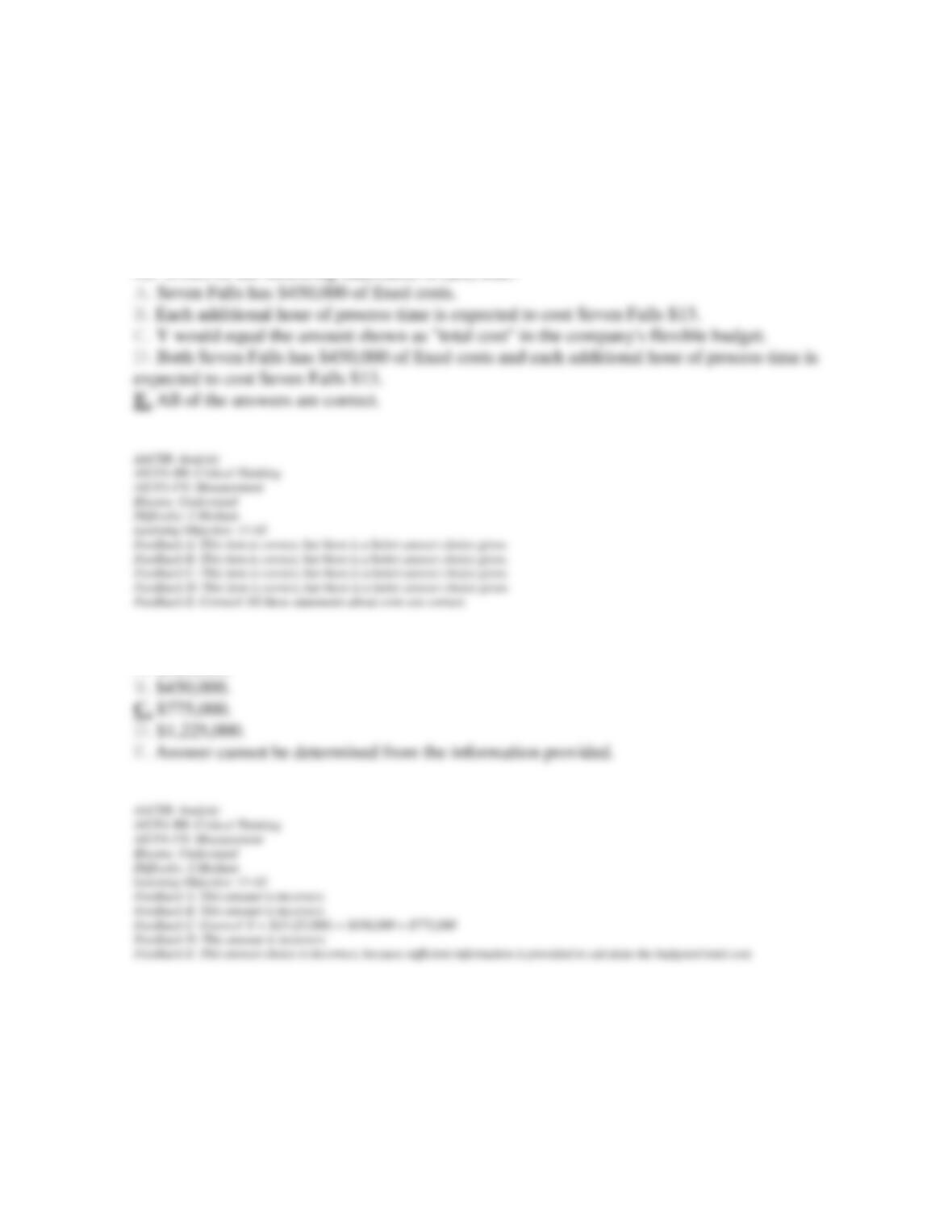
Commerce Corporation has a high probability of operating at 40,000 activity hours during the
upcoming period, and lower probabilities of operating at 30,000 hours and 50,000 hours. The
company’s flexible budget revealed the following:
30,000 Hours
40,000 Hours
50,000 Hours
Variable costs
$135,000
$180,000
$225,000
Fixed costs
720,000
720,000
720,000
26. Commerce’s flexible-budget formula, where Y is defined as total cost and AH represents
activity hours, is:
27. If Commerce operated at 35,000 hours, its total budgeted cost would be:
Chapter 11 – Flexible Budgeting and Analysis of Overhead Costs
11–12
Use the following information to answer Questions 28 and 29.
Seven Falls Cuisines has the following flexible-budget formula:
Y = $13PH + $450,000 where PH is defined as process hours.
28. Which of the following statements is (are) true?
29. What is Seven Falls’ budgeted total cost if its process hours equal 25,000?
A. $325,000.
Chapter 11 – Flexible Budgeting and Analysis of Overhead Costs
11–13
30. Dealer Enterprises (DE) anticipated that 84,000 process hours would be worked during an
upcoming accounting period when, in fact, 92,000 hours were actually worked. One of the
company’s cost functions is expressed as follows:
Y = $16PH + $640,000 where PH is defined as process hours
What budgeted dollar amount would appear in DE’s static budget and flexible budget for the
preceding cost function?
Static Flexible
A. $1,984,000 $1,984,000
31. Nerve Pain Innovations anticipated that 84,000 process hours would be worked during an
upcoming accounting period when, in fact, 90,000 hours were actually worked. One of the
company’s cost functions is expressed as follows:
Y = $16PH + $640,000 where PH is defined as process hours
What is Nerve Pain’s flexible budget (Y) for the preceding cost function?
A. $1,280,000
Chapter 11 – Flexible Budgeting and Analysis of Overhead Costs
11–14
32. Which of the following mathematical expressions is found in a typical flexible-budget
formula for overhead?
A. Total activity units + budgeted fixed overhead cost per unit.
33. A flexible budget for 15,000 hours revealed variable manufacturing overhead of $90,000
and fixed manufacturing overhead of $120,000. The budget for 25,000 hours would reveal
total overhead costs of:
A. $210,000.
Chapter 11 – Flexible Budgeting and Analysis of Overhead Costs
11–15
34. A flexible budget for 15,000 hours revealed variable manufacturing overhead of $90,000
and fixed manufacturing overhead of $120,000. The budget for 20,000 hours would reveal
total overhead costs of:
35. A flexible budget is appropriate for a (n):
Chapter 11 – Flexible Budgeting and Analysis of Overhead Costs
11–16
36. A flexible budget is appropriate for a:
37. The manufacturing overhead applied to Work-in-Process Inventory by a company that
uses standard costing would be computed as:
A. actual hours times a predetermined (standard) overhead rate.
Chapter 11 – Flexible Budgeting and Analysis of Overhead Costs
11–17
38. With respect to overhead, what is the difference between normal costing and standard
costing?
A. Use of a predetermined overhead rate.
39. Which of the following statements is/are correct concerning the application of overhead in
a standard costing system driven by process hours?
A. A predetermined overhead rate is allowed only for fixed overhead.
Chapter 11 – Flexible Budgeting and Analysis of Overhead Costs
11–18
40. The activity measure selected for use in a variable- and fixed-overhead flexible budget:
A. should be stated in sales dollars.
B. should be approved by the company’s president.
41. Which of the following should have the strongest cause and effect relationship with
overhead costs?
A. Cost followers.
Chapter 11 – Flexible Budgeting and Analysis of Overhead Costs
11–19
42. Which of the following is not an overhead variance?
A. Variable-overhead spending variance.
43. Which of the following is not an overhead variance?
A. Variable-overhead spending variance.
Chapter 11 – Flexible Budgeting and Analysis of Overhead Costs
11–20
44. Which of the following is used in the computation of the variable-overhead spending
variance?
45. Which of the following elements is (are) needed in a straightforward calculation of the
variable-overhead spending variance?
A. Variable overhead incurred during the period.