Chapter 11 – Reporting and Interpreting Owners’ Equity
1. Outstanding shares of stock are those shares which a corporation has the ability to issue as
documented in its charter in the state where incorporated.
2. There would be 100,000 shares of common stock outstanding when the number of shares
authorized was 150,000, issued shares totaled 120,000, and 20,000 shares were being held in
the treasury.
3. Earnings per share are calculated by dividing net income by the number of outstanding
shares of common stock at year-end.
Chapter 11 – Reporting and Interpreting Owners’ Equity
4. Treasury stock is a corporation’s own stock that was issued and then repurchased, and is
still held by the corporation.
5. Earnings per share increases when a company purchases treasury stock.
6. The issue of $5 par value common stock for $10 per share results in a $10 credit to the
common stock account for each share issued.
Chapter 11 – Reporting and Interpreting Owners’ Equity
7. The issue of $1 par value common stock for $10 per share results in a $9 credit to the
capital in excess of par value account for each share issued.
8. Stockholders’ equity decreases when a company purchases treasury stock.
9. Net income increases when treasury stock is sold for an amount in excess of its cost.
Chapter 11 – Reporting and Interpreting Owners’ Equity
10. Total stockholders’ equity increases when treasury stock is sold for an amount less than its
cost.
11. Net income decreases when treasury stock is sold for an amount less than its cost.
12. Total stockholders’ equity of Grasse Company is not affected when a stockholder sells
shares of Grasse Company stock to another stockholder.
Chapter 11 – Reporting and Interpreting Owners’ Equity
13. Total assets remain the same when a company uses cash to purchase treasury stock.
14. Common stockholders have voting rights and can declare cash dividends.
15. Shares of stock held as treasury stock do not have voting rights or the right to receive
dividends.
Chapter 11 – Reporting and Interpreting Owners’ Equity
16. Most investors that are retired prefer to receive their return on investment in the form of
stock price appreciation rather in dividends.
17. The dividend yield ratio is dividends per share divided by the number of shares
outstanding.
18. The dividend yield ratio increases when the market price per share increases.
Chapter 11 – Reporting and Interpreting Owners’ Equity
19. The dividend yield ratio increases when a cash dividend is paid.
20. A company’s assets and stockholders’ equity decrease when a cash dividend is declared by
its board of directors.
21. A company’s assets and liabilities decrease when they pay a previously declared cash
dividend.
Chapter 11 – Reporting and Interpreting Owners’ Equity
22. The declaration of a common stock dividend by a corporation’s board of directors creates
a liability on the declaration date.
23. The declaration and distribution of a common stock dividend results in a reduction of the
issuing corporation’s total stockholders’ equity.
24. The declaration and distribution of a 2-for-1 stock split results in a reduction of retained
earnings.
Chapter 11 – Reporting and Interpreting Owners’ Equity
25. A stock split results in the reduction of the par or stated value per share and a
proportionate increase in the number of shares outstanding.
26. Preferred stock often has a preference in the distribution of assets over common stock in
the event of dissolution of the corporation.
27. Preferred stockholders don’t have voting rights but do have a preference with respect to
dividend payments.
Chapter 11 – Reporting and Interpreting Owners’ Equity
28. When a company reissues treasury stock, it creates a cash inflow from an investing
activity because treasury stock is an investment asset on the balance sheet.
29. When a company issues common stock in exchange for cash, a cash inflow from a
financing activity is reported.
30. When a company pays its previously declared cash dividend, an investing cash outflow is
reported.
Chapter 11 – Reporting and Interpreting Owners’ Equity
31. Which of the following statements is false?
32. RKJ Company has provided the following:
• 100,000 shares of $5 par value common stock are authorized;
• 70,000 shares have been issued;
• 65,000 shares are outstanding.
Which of the following statements is correct?
Chapter 11 – Reporting and Interpreting Owners’ Equity
33. RKJ Company has provided the following:
• 100,000 shares of $5 par value common stock are authorized;
• 70,000 shares were issued for $9 per share;
• 65,000 shares are outstanding.
Which of the following statements is correct based only on the above facts?
34. Which of the following represents the maximum number of shares of stock issuable to the
public?
Chapter 11 – Reporting and Interpreting Owners’ Equity
35. Which of the following statements regarding earnings per share (EPS) is correct?
36. Which of the following statements regarding earnings per share (EPS) is false?
Chapter 11 – Reporting and Interpreting Owners’ Equity
37. Which of the following statements regarding earnings per share (EPS) is correct?
38. Which of the following represents the number of shares currently in the hands of
investors?
Chapter 11 – Reporting and Interpreting Owners’ Equity
39. Rye Company has provided the following information:
• Number of issued common shares, 225,000;
• Net income, $500,000;
• Number of authorized common shares, 400,000;
• Number of treasury shares, 25,000.
What is Rye’s earnings per share?
40. Kirova Company has provided the following information:
• Number of issued common shares, 900,000;
• Net income, $1,000,000;
• Number of authorized common shares, 1,000,000;
• Number of outstanding common shares, 800,000
• Number of treasury shares, 100,000.
What is Kirova’s earnings per share?
Chapter 11 – Reporting and Interpreting Owners’ Equity
41. Which of the following statements about earnings per share is correct?
42. CGJ Company has provided the following:
• 200,000 shares of $5 par value common stock are authorized;
• 140,000 shares of common stock were issued for $11 per share;
• 130,000 shares are outstanding.
Chapter 11 – Reporting and Interpreting Owners’ Equity
11–17
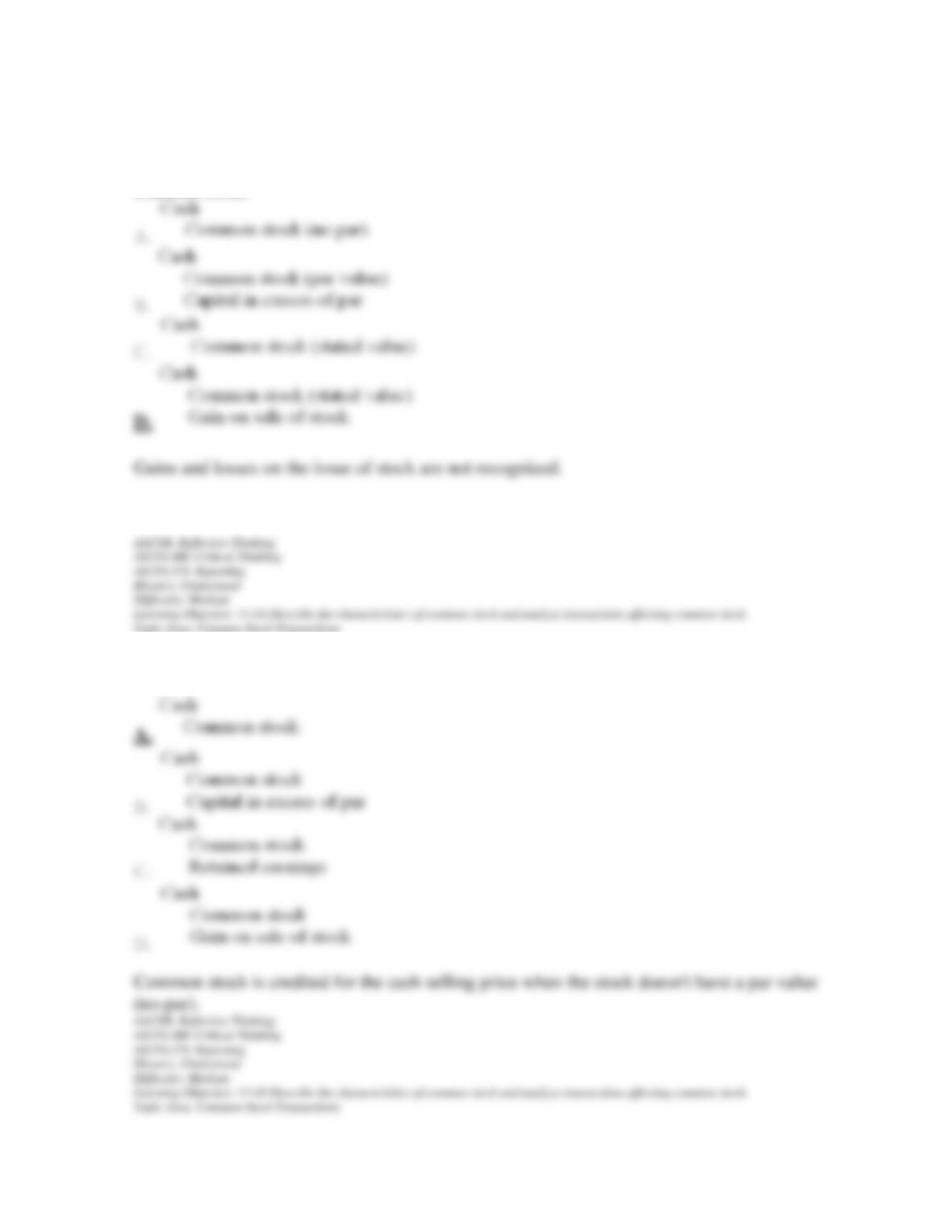
43. Which of the following journal entries doesn’t reflect the initial cash sale of shares of
common stock?
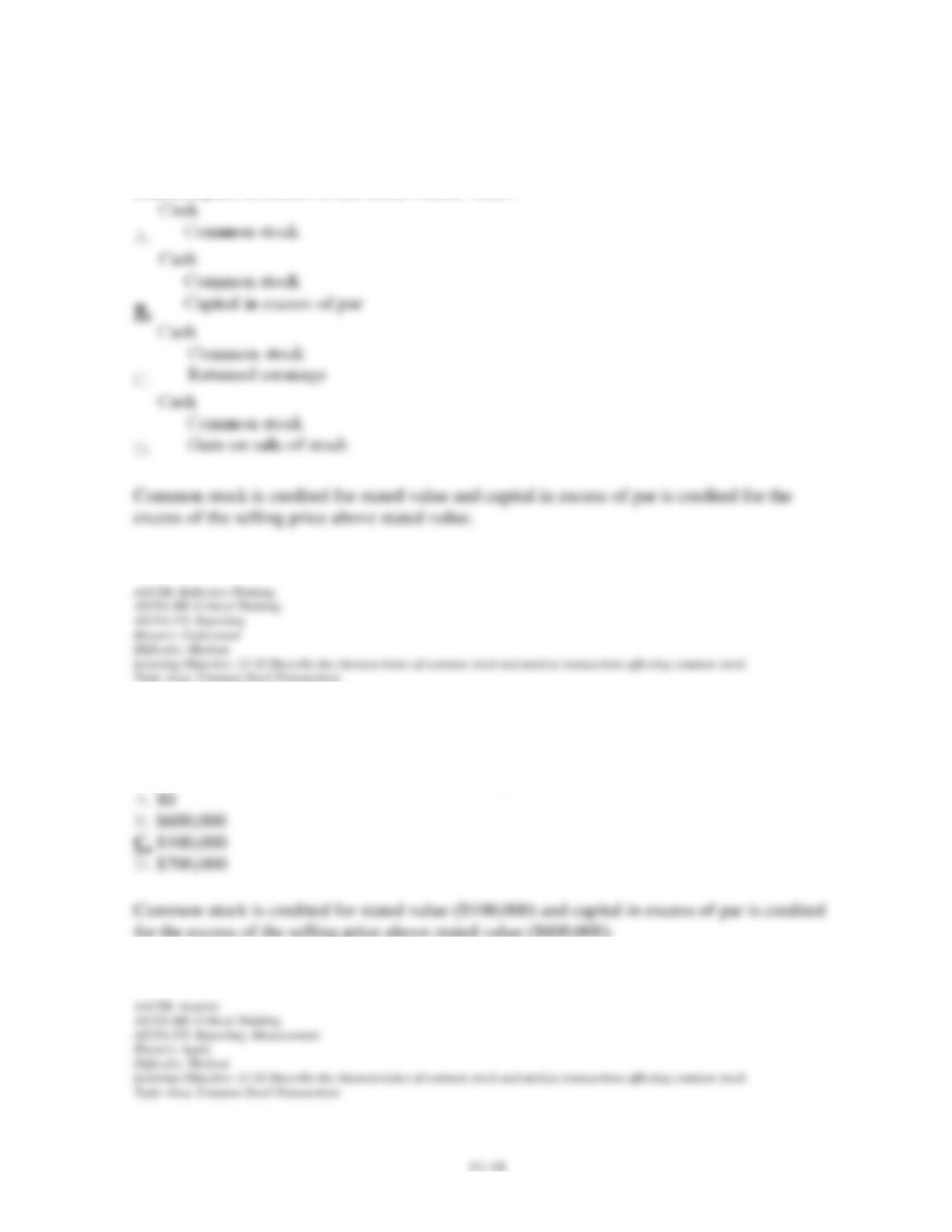
44. Which of the following journal entries is correct when no-par common stock is initially
issued for cash?
Chapter 11 – Reporting and Interpreting Owners’ Equity
45. Which of the following journal entries is correct when common stock is initially issued for
cash at a price in excess of the stock’s stated value?
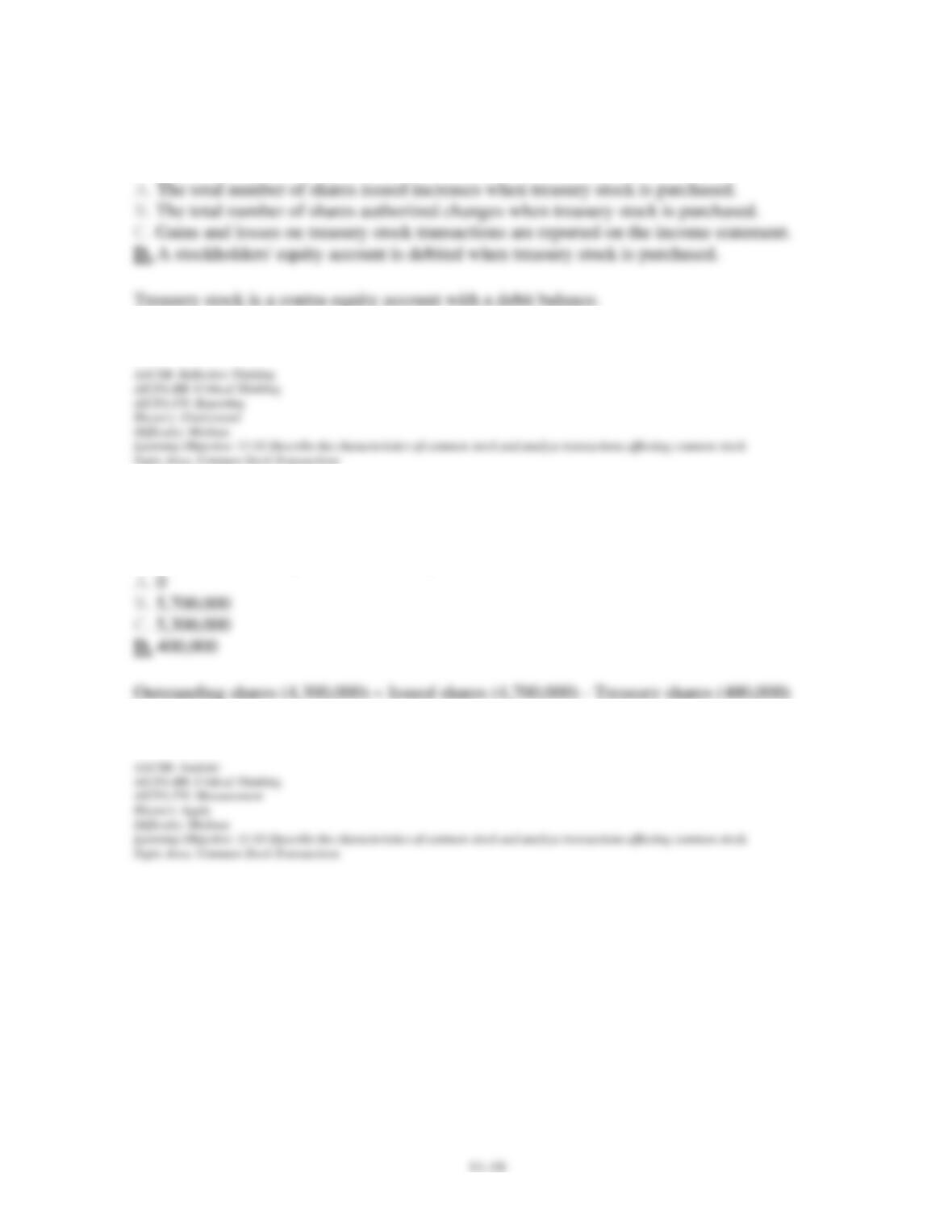
46. Irish Corporation issued (sold) 10,000 shares of its no par common stock for $70 per
share. The bylaws established a stated value of $10 per share. The transaction would increase
the common stock account on the balance sheet by how much?
Chapter 11 – Reporting and Interpreting Owners’ Equity
47. Which of the following statements about treasury stock transactions is correct?
48. Watson Company has provided the following data about its common stock: par value per
share, $1; authorized shares, 10,000,000; outstanding shares, 4,300,000; and issued shares
4,700,000. How many shares of treasury stock are there?
Chapter 11 – Reporting and Interpreting Owners’ Equity
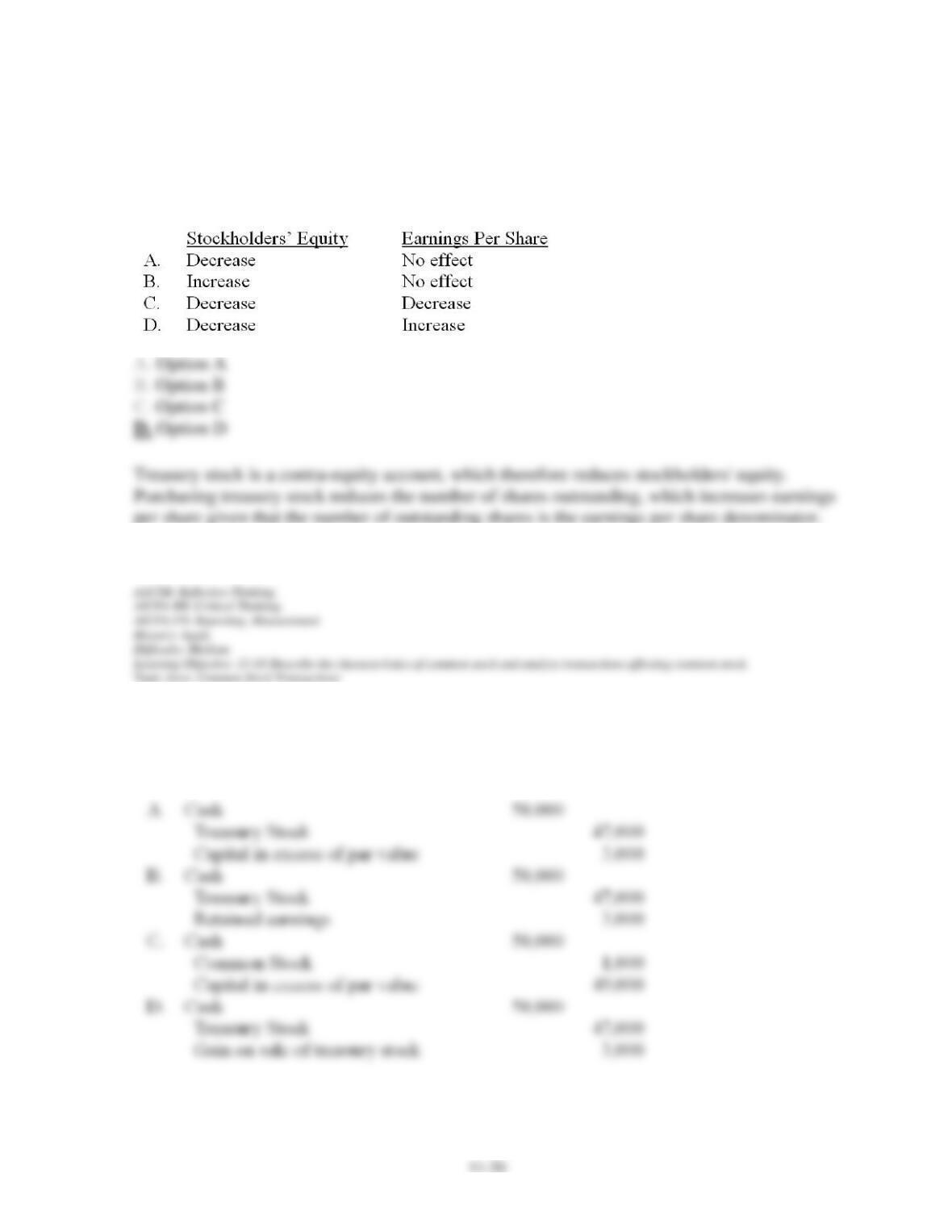
49. During 2010, Thomas Corporation repurchased some shares of its own common stock.
What effect did this transaction have on 2010 stockholders’ equity and earnings per share,
respectively?
50. Which of the following entries would be recorded when a company reissues 1,000 shares
of treasury stock for $50 per share when they were repurchased at a cost of $47 per share and
have a $1 par value?