
162
127) Segers Corporation manufactures one product. It does not maintain any beginning or ending
Work in Process inventories. The company uses a standard cost system in which inventories are
recorded at their standard costs and any variances are closed directly to Cost of Goods Sold. There
is no variable manufacturing overhead. The company’s balance sheet at the beginning of the year
was as follows:
Segers Corporation
Balance Sheet
January 1
Assets
Cash
$1,160,000
Raw materials inventory
46,550
Finished goods inventory
74,970
Property, plant, and equipment (net)
704,600
Total assets
$1,986,120
Liabilities and Equity
Retained earnings
$1,986,120
Total liabilities and equity
$1,986,120
The standard cost card for the company’s only product is as follows:
Inputs
Standard Quantity
or Hours
Standard Price
or Rate
Standard
Cost
Direct materials
1.4
liters
$9.50
per liter
$13.30
Direct labor
0.80
hours
$19.50
per hour
15.60
Fixed manufacturing overhead
0.80
hours
$8.50
per hour
6.80
Total standard cost per unit
$35.70
The standard fixed manufacturing overhead rate was based on budgeted fixed manufacturing
overhead of $238,000 and budgeted activity of 28,000 hours.

163
During the year, the company completed the following transactions:
a. Purchased 51,000 liters of raw material at a price of $9.20 per liter.
b. Used 46,100 liters of the raw material to produce 33,000 units of work in process.
c. Assigned direct labor costs to work in process. The direct labor workers (who were paid in cash)
worked 26,200 hours at an average cost of $19.90 per hour.
d. Applied fixed overhead to the 33,000 units in work in process inventory using the predetermined
overhead rate multiplied by the number of direct labor-hours allowed. Actual fixed overhead costs
for the year were $251,800. Of this total, $165,800 related to items such as insurance, utilities, and
indirect labor salaries that were all paid in cash and $86,000 related to depreciation of
manufacturing equipment.
e. Transferred 33,000 units from work in process to finished goods.
f. Sold for cash 34,800 units to customers at a price of $44.00 per unit.
g. Completed and transferred the standard cost associated with the 34,800 units sold from finished
goods to cost of goods sold.
h. Paid $156,000 of selling and administrative expenses.
i. Closed all standard cost variances to cost of goods sold.
164
Required:
1. Compute all direct materials, direct labor, and fixed overhead variances for the year.
2. Enter the beginning balances and record the above transactions in the worksheet that appears
below. Because of the width of the worksheet, it is in two parts. In your text, these two parts would
be joined side-by-side to make one very wide worksheet.
Cash
Raw Materials
Work in
Process
Finished
Goods
PP&E (net)
=
1/1
=
a.
=
b.
=
c.
=
d.
=
e.
=
f.
=
g.
=
h.
=
i.
=
12/31
=
=
Materials
Price
Variance
Materials
Quantity
Variance
Labor Rate
Variance
Labor
Efficiency
Variance
FOH Budget
Variance
FOH
Volume
Variance
Retained
Earnings
1/1
a.
b.
c.
d.
e.
f.
g.
h.
i.
12/31
3. Determine the ending balance (e.g., 12/31 balance) in each account.
165
166
168
128) Pioli Corporation manufactures one product. It does not maintain any beginning or ending
Work in Process inventories. The company uses a standard cost system in which inventories are
recorded at their standard costs and any variances are closed directly to Cost of Goods Sold. There
is no variable manufacturing overhead. The standard cost card for the company’s only product is as
follows:
Inputs
Standard
Quantity
or Hours
Standard Price or
Rate
Standard
Cost
Direct materials
2.2
kilos
$
8.00
per kilo
$
17.60
Direct labor
0.80
hours
$
19.00
per hour
15.20
Fixed manufacturing overhead
0.80
hours
$
11.00
per hour
8.80
Total standard cost per unit
$
41.60
The standard fixed manufacturing overhead rate was based on budgeted fixed manufacturing
overhead of $132,000 and budgeted activity of 12,000 hours.
During the year, the company completed the following transactions:
a. Purchased 22,300 kilos of raw material at a price of $7.40 per kilo.
b. Used 20,800 kilos of the raw material to produce 9,500 units of work in process.
c. Assigned direct labor costs to work in process. The direct labor workers (who were paid in
cash) worked 6,900 hours at an average cost of $19.80 per hour.
d. Applied fixed overhead to the 9,500 units in work in process inventory using the
predetermined overhead rate multiplied by the number of direct labor-hours allowed. Actual fixed
overhead costs for the year were $143,000. Of this total, $60,000 related to items such as
insurance, utilities, and indirect labor salaries that were all paid in cash and $83,000 related to
depreciation of manufacturing equipment.
e. Transferred 9,500 units from work in process to finished goods.
f. Sold for cash 10,100 units to customers at a price of $54.30 per unit.
g. Completed and transferred the standard cost associated with the 10,100 units sold from
finished goods to cost of goods sold.
h. Paid $43,000 of selling and administrative expenses.
i. Closed all standard cost variances to cost of goods sold.
169
Required:
1. Compute all direct materials, direct labor, and fixed overhead variances for the year.
2. Record the above transactions in the worksheet that appears below. Because of the width of the
worksheet, it is in two parts. In your text, these two parts would be joined side-by-side to make one
very wide worksheet. The beginning balances have been provided for each of the accounts,
including the Property, Plant, and Equipment (net) account which is abbreviated as PP&E (net).
Cash
Raw
Materials
Work in
Process
Finished
Goods
PP&E (net)
=
1/1
$1,050,000
$45,760
$0
$54,080
$726,400
=
a.
=
b.
=
c.
=
d.
=
e.
=
f.
=
g.
=
h.
=
i.
=
12/31
=
=
Material
Price
Variance
Material
Quantity
Variance
Labor
Rate
Variance
Labor
Effici.
Variance
FOH
Budget
Variance
FOH
Volume
Variance
Retained
Earnings
1/1
$0
$0
$0
$0
$0
$0
$1,876,240
a.
b.
c.
d.
e.
f.
g.
h.
i.
12/31
3. Determine the ending balance (e.g., 12/31 balance) in each account.
4. Prepare an income statement for the year.
Answer:
170
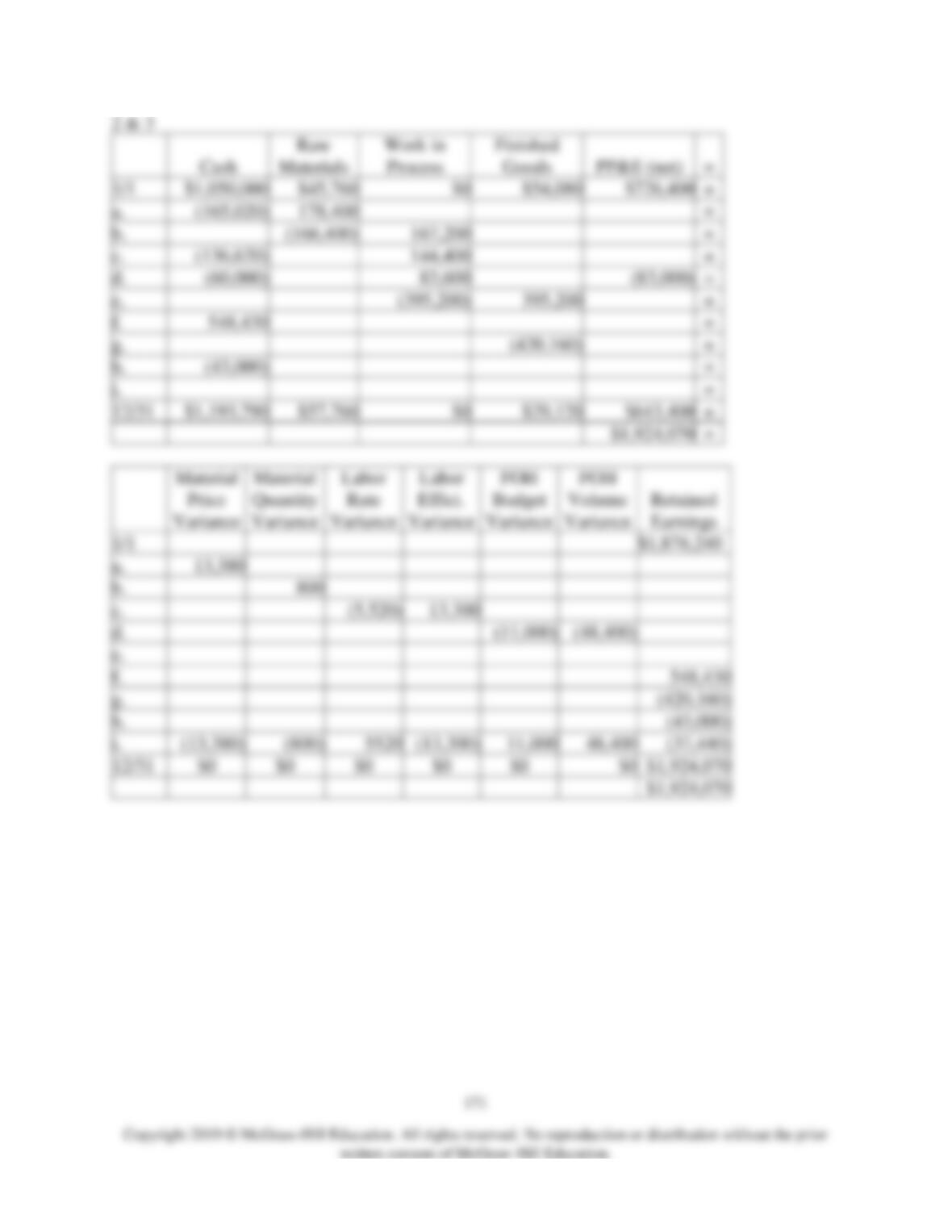
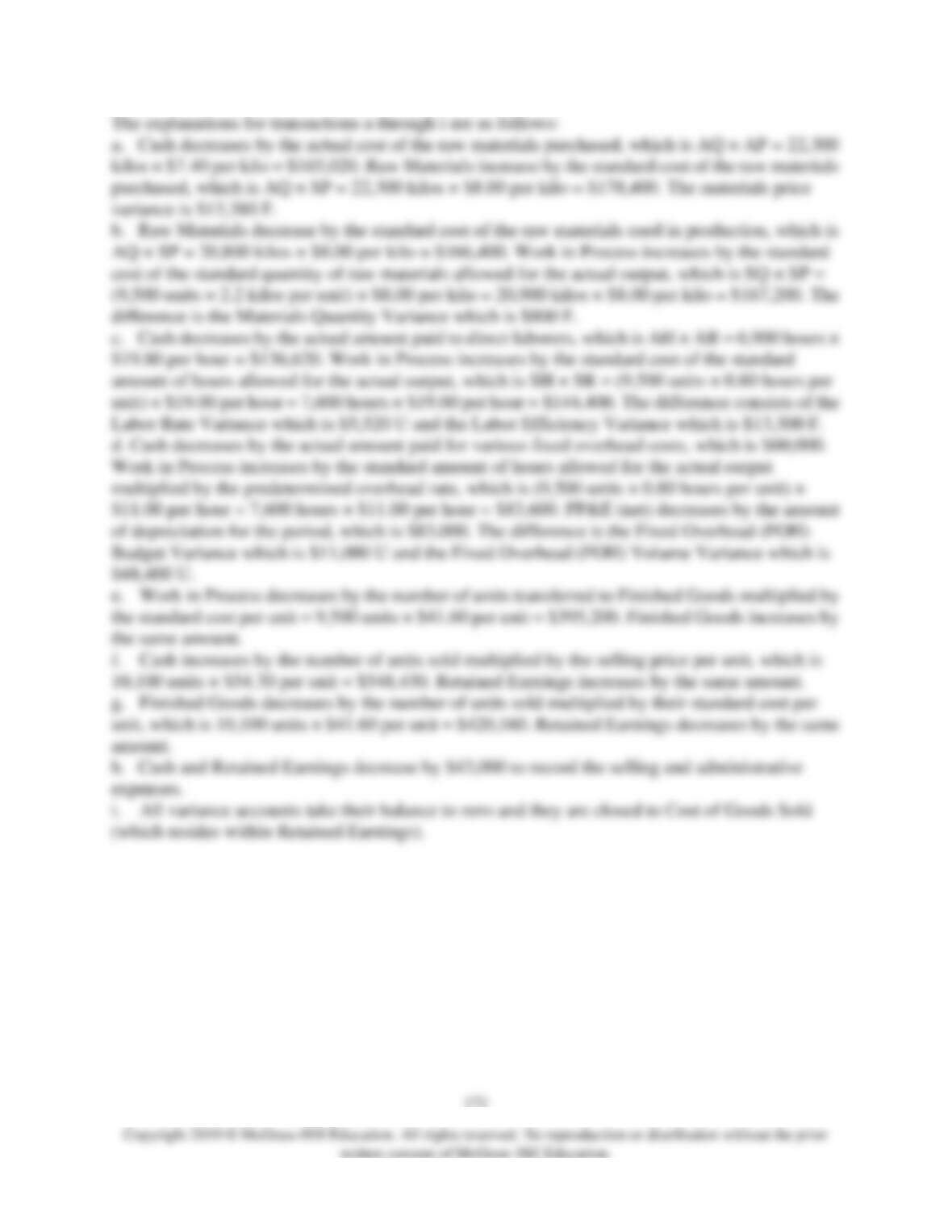
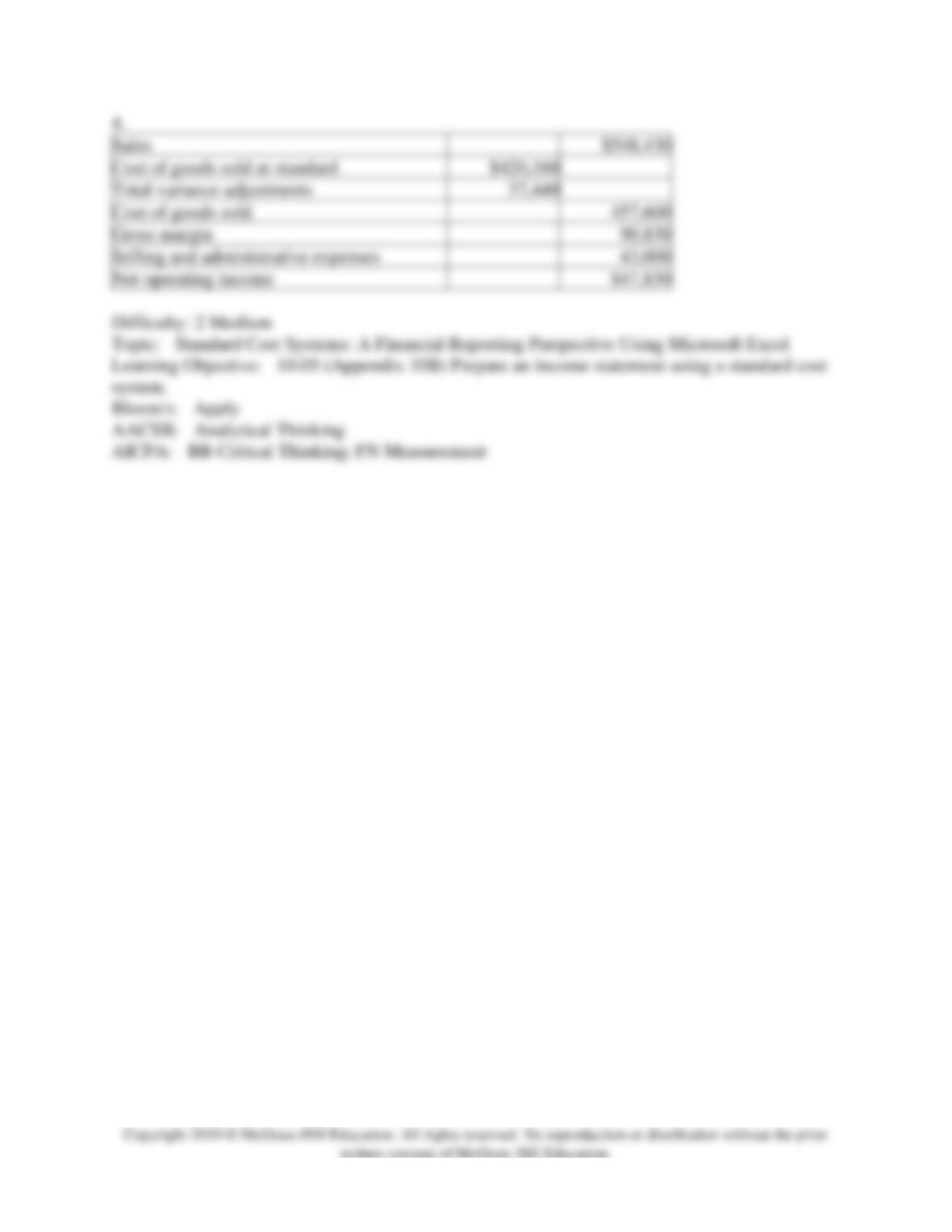
173

174
129) Yordy Corporation manufactures one product. It does not maintain any beginning or ending
Work in Process inventories. The company uses a standard cost system in which inventories are
recorded at their standard costs and any variances are closed directly to Cost of Goods Sold. There
is no variable manufacturing overhead. The company’s balance sheet at the beginning of the year
was as follows:
Yordy Corporation
Balance Sheet
January 1
Assets
Cash
$1,060,000
Raw materials inventory
40,460
Finished goods inventory
64,350
Property, plant, and equipment (net)
722,000
Total assets
$1,886,810
Liabilities and Equity
Retained earnings
$1,886,810
Total liabilities and equity
$1,886,810
The standard cost card for the company’s only product is as follows:
Inputs
Standard Quantity
or Hours
Standard Price
or Rate
Standard
Cost
Direct materials
1.4
kilos
$8.50
per kilo
$11.90
Direct labor
0.90
hours
$19.50
per hour
17.55
Fixed manufacturing overhead
0.90
hours
$7.00
per hour
6.30
Total standard cost per unit
$35.75
The company calculated the following variances for the year:
Materials price variance
$38,960
U
Materials quantity variance
$850
F
Labor rate variance
$20,174
U
Labor efficiency variance
$21,450
U
Fixed manufacturing overhead budget variance
$11,900
F
Fixed manufacturing overhead volume variance
$26,460
U
The standard fixed manufacturing overhead rate was based on budgeted fixed manufacturing
overhead of $220,500 and budgeted activity of 31,500 hours.

175
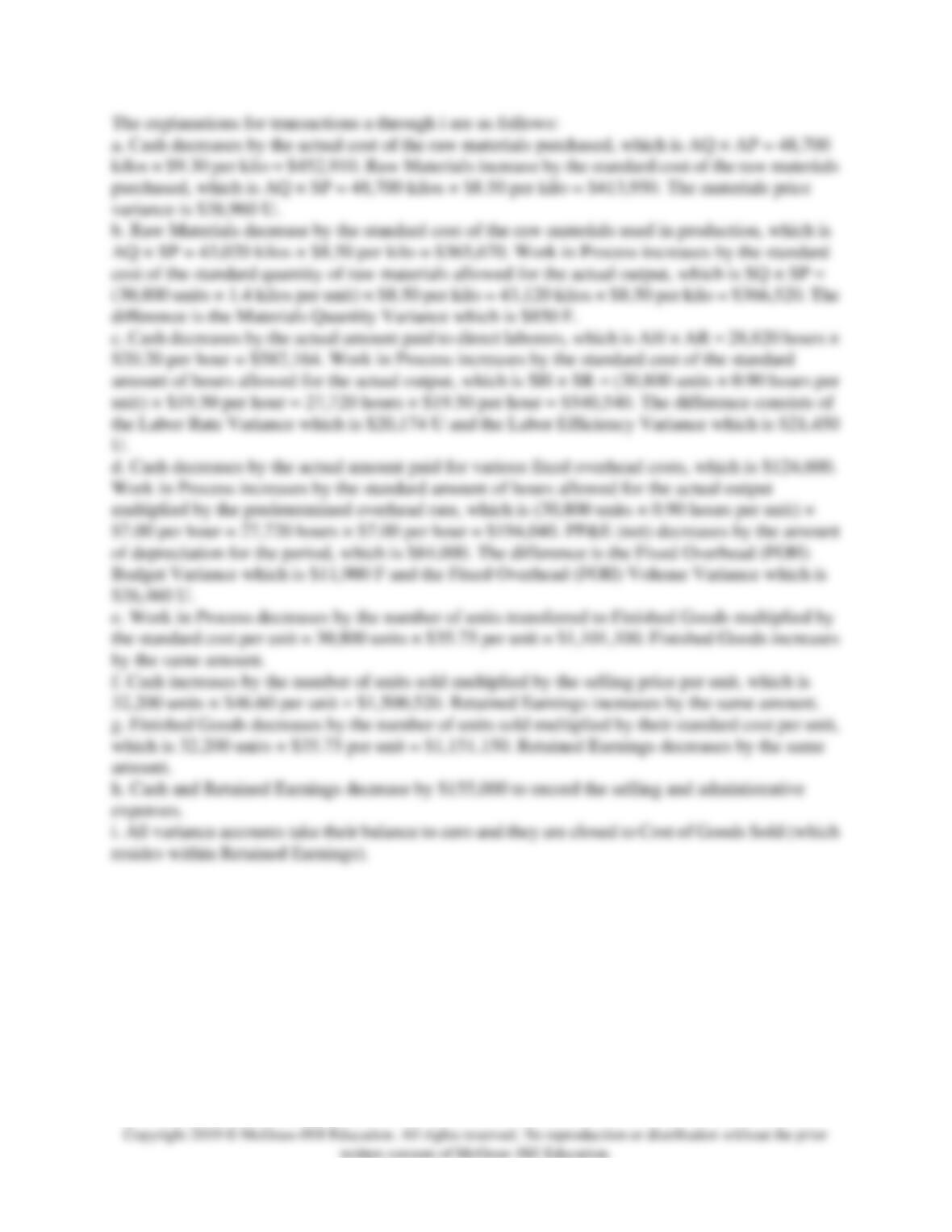
During the year, the company completed the following transactions:
a. Purchased 48,700 kilos of raw material at a price of $9.30 per kilo.
b. Used 43,020 kilos of the raw material to produce 30,800 units of work in process.
c. Assigned direct labor costs to work in process. The direct labor workers (who were paid in cash)
worked 28,820 hours at an average cost of $20.20 per hour.
d. Applied fixed overhead to the 30,800 units in work in process inventory using the predetermined
overhead rate multiplied by the number of direct labor-hours allowed. Actual fixed overhead costs
for the year were $208,600. Of this total, $124,600 related to items such as insurance, utilities, and
indirect labor salaries that were all paid in cash and $84,000 related to depreciation of
manufacturing equipment.
e. Transferred 30,800 units from work in process to finished goods.
f. Sold for cash 32,200 units to customers at a price of $46.60 per unit.
g. Completed and transferred the standard cost associated with the 32,200 units sold from finished
goods to cost of goods sold.
h. Paid $155,000 of selling and administrative expenses.
i. Closed all standard cost variances to cost of goods sold.
176
Required:
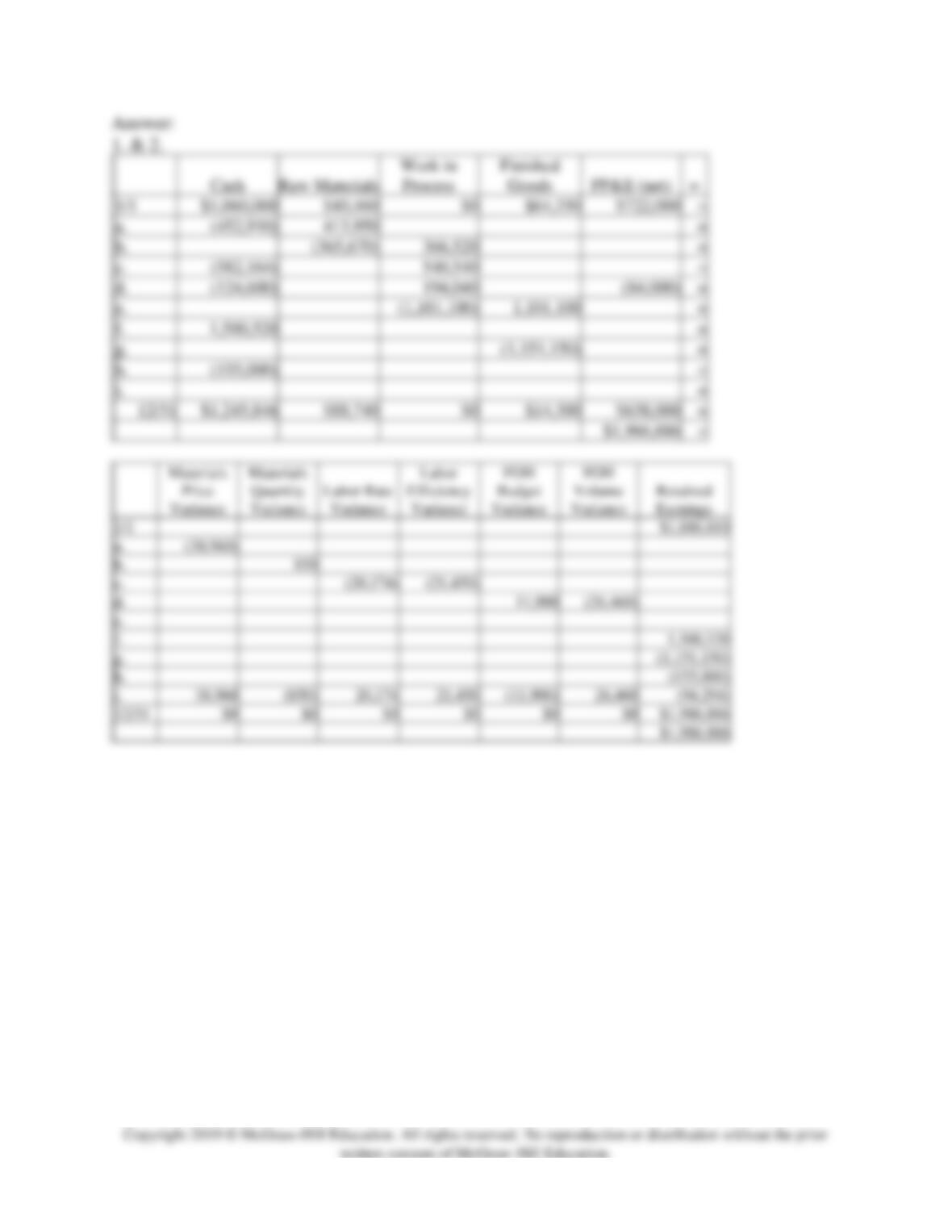
1. Enter the beginning balances and record the above transactions in the worksheet that appears
below. Because of the width of the worksheet, it is in two parts. In your text, these two parts would
be joined side-by-side to make one very wide worksheet.
Cash
Raw Materials
Work in
Process
Finished
Goods
PP&E (net)
=
1/1
=
a.
=
b.
=
c.
=
d.
=
e.
=
f.
=
g.
=
h.
=
i.
=
12/31
=
=
Materials
Price
Variance
Materials
Quantity
Variance
Labor Rate
Variance
Labor
Efficiency
Variance
FOH Budget
Variance
FOH
Volume
Variance
Retained
Earnings
1/1
a.
b.
c.
d.
e.
f.
g.
h.
i.
12/31
2. Determine the ending balance (e.g., 12/31 balance) in each account.
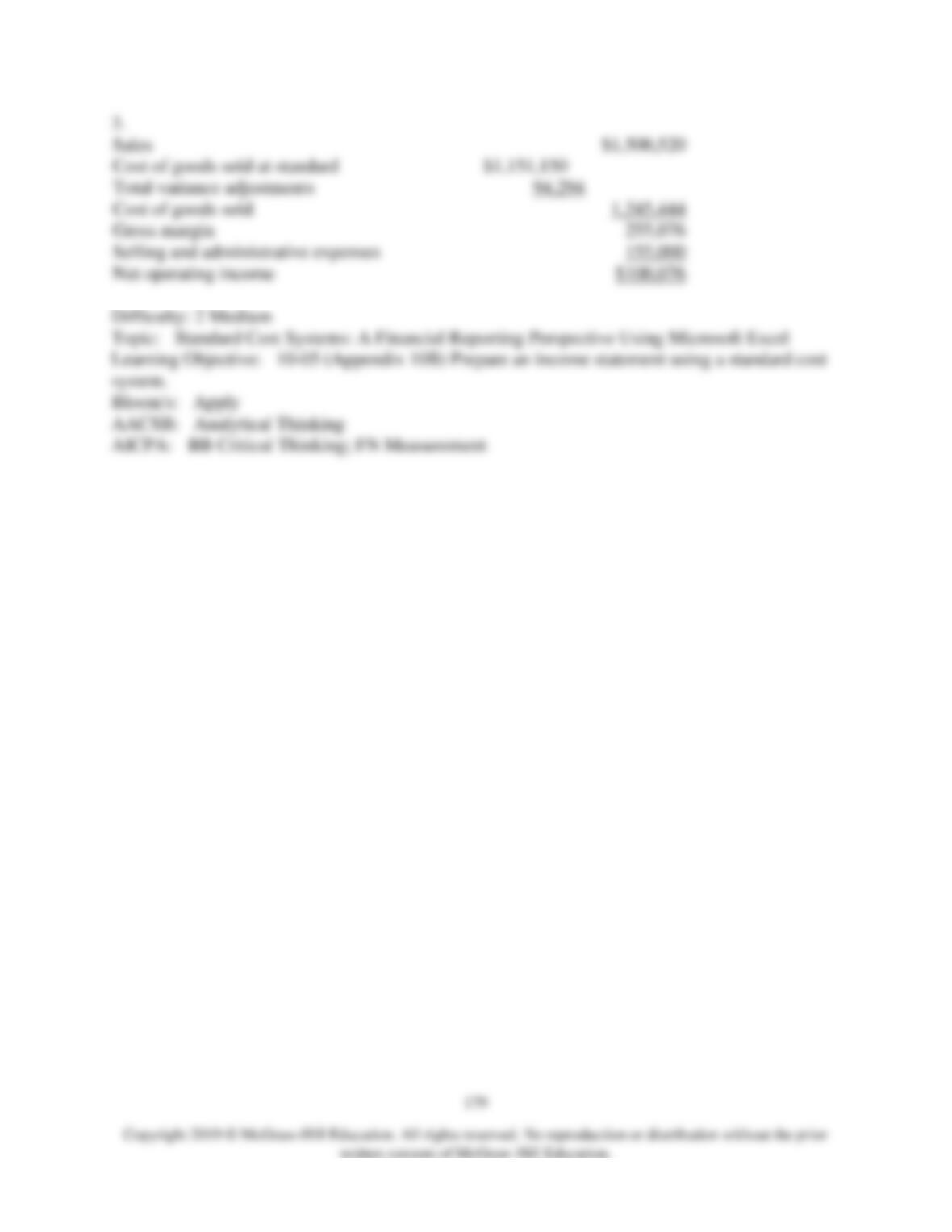
3. Prepare an income statement for the year.
177
178

180
130) Zaino Corporation manufactures one product. It does not maintain any beginning or ending
Work in Process inventories. The company uses a standard cost system in which inventories are
recorded at their standard costs and any variances are closed directly to Cost of Goods Sold. There
is no variable manufacturing overhead. The standard cost card for the company’s only product is as
follows:
Inputs
Standard Quantity
or Hours
Standard Price
or Rate
Standard
Cost
Direct materials
1.7
gallons
$5.50
per gallon
$9.35
Direct labor
0.50
hours
$21.50
per hour
10.75
Fixed manufacturing overhead
0.50
hours
$6.50
per hour
3.25
Total standard cost per unit
$23.35
The company calculated the following variances for the year:
Materials price variance
$27,360
F
Materials quantity variance
$550
U
Labor rate variance
$2,480
U
Labor efficiency variance
$12,900
U
Fixed manufacturing overhead budget variance
$14,700
F
Fixed manufacturing overhead volume variance
$27,950
F
The standard fixed manufacturing overhead rate was based on budgeted fixed manufacturing
overhead of $48,750 and budgeted activity of 7,500 hours.
During the year, the company completed the following transactions:
a. Purchased 45,600 gallons of raw material at a price of $4.90 per gallon.
b. Used 40,220 gallons of the raw material to produce 23,600 units of work in process.
c. Assigned direct labor costs to work in process. The direct labor workers (who were paid in cash)
worked 12,400 hours at an average cost of $21.70 per hour.
d. Applied fixed overhead to the 23,600 units in work in process inventory using the predetermined
overhead rate multiplied by the number of direct labor-hours allowed. Actual fixed overhead costs
for the year were $34,050. Of this total, -$23,950 related to items such as insurance, utilities, and
indirect labor salaries that were all paid in cash and $58,000 related to depreciation of
manufacturing equipment.
e. Transferred 23,600 units from work in process to finished goods.
f. Sold for cash 23,700 units to customers at a price of $27.20 per unit.
g. Completed and transferred the standard cost associated with the 23,700 units sold from finished
goods to cost of goods sold.
h. Paid $69,000 of selling and administrative expenses.
i. Closed all standard cost variances to cost of goods sold.