Managerial Accounting, 16e (Garrison)
Ch 10B: Standard Cost Systems: A Financial Reporting Perspective Using Microsoft Excel
1) When Raw Materials, Work in Process, and Finished Goods are recorded and carried at their
standard cost, the fixed overhead applied to work in process is calculated by multiplying the
predetermined overhead rate by the actual direct labor-hours worked.
2) In the Excel spreadsheet approach in Appendix 10B in the text, each variance has its own
clearing account that appears on the right-hand side of the “=” sign. This enables us to record all
favorable variances as increases to their respective clearing accounts and all unfavorable variances
as decreases to their accounts.
3) When Raw Materials, Work in Process, and Finished Goods are recorded and carried at their
standard cost, the actual prices paid for inputs and the actual quantities of inputs that are used in
production affect the costs recorded in the inventory accounts.
2
4) As defined it the text, the ending balance in retained earnings equals the beginning balance in
retained earnings plus net operating income minus dividends.
5) Juliano Corporation uses a standard cost system in which inventories are recorded at their
standard costs and any variances are closed directly to Cost of Goods Sold. The standard cost card
for the company’s only product is as follows:
Inputs
Standard
Quantity
or Hours
Standard Price or
Rate
Standard
Cost
Direct materials
1.5
pounds
$
6.00
per pound
$
9.00
Direct labor
0.80
hours
$
22.00
per hour
17.60
Fixed manufacturing overhead
0.80
hours
$
5.50
per hour
4.40
Total standard cost per unit
$
31.00
During the year, the company purchased 29,700 pounds of raw material at a price of $5.20 per
pound and used 25,700 pounds of the raw material to produce 17,200 units of work in process.
Assume that all transactions are recorded on a worksheet as shown in the text. On the left-hand
side of the equals sign in the worksheet are columns for Cash, Raw Materials, Work in Process,
Finished Goods, and PP&E (net). All of the variance columns are on the right-hand-side of the
equals sign along with the column for Retained Earnings.
When the raw materials used in production are recorded, which of the following entries will be
made?
A) $600 in the Materials Price Variance column
B) $600 in the Materials Quantity Variance column
C) ($600) in the Materials Price Variance column
D) ($600) in the Materials Quantity Variance column

4
6) Ferrero Corporation manufactures one product. It does not maintain any beginning or ending
Work in Process inventories. The company uses a standard cost system in which inventories are
recorded at their standard costs and any variances are closed directly to Cost of Goods Sold. The
company has provided the following information:
Actual sales
35,800
units
Actual selling price
$
40.40
per unit
Standard cost
$
33.30
per unit
Actual selling and administrative expenses
$
121,000
The company does not have any variable manufacturing overhead costs and it recorded the
following variances during the year:
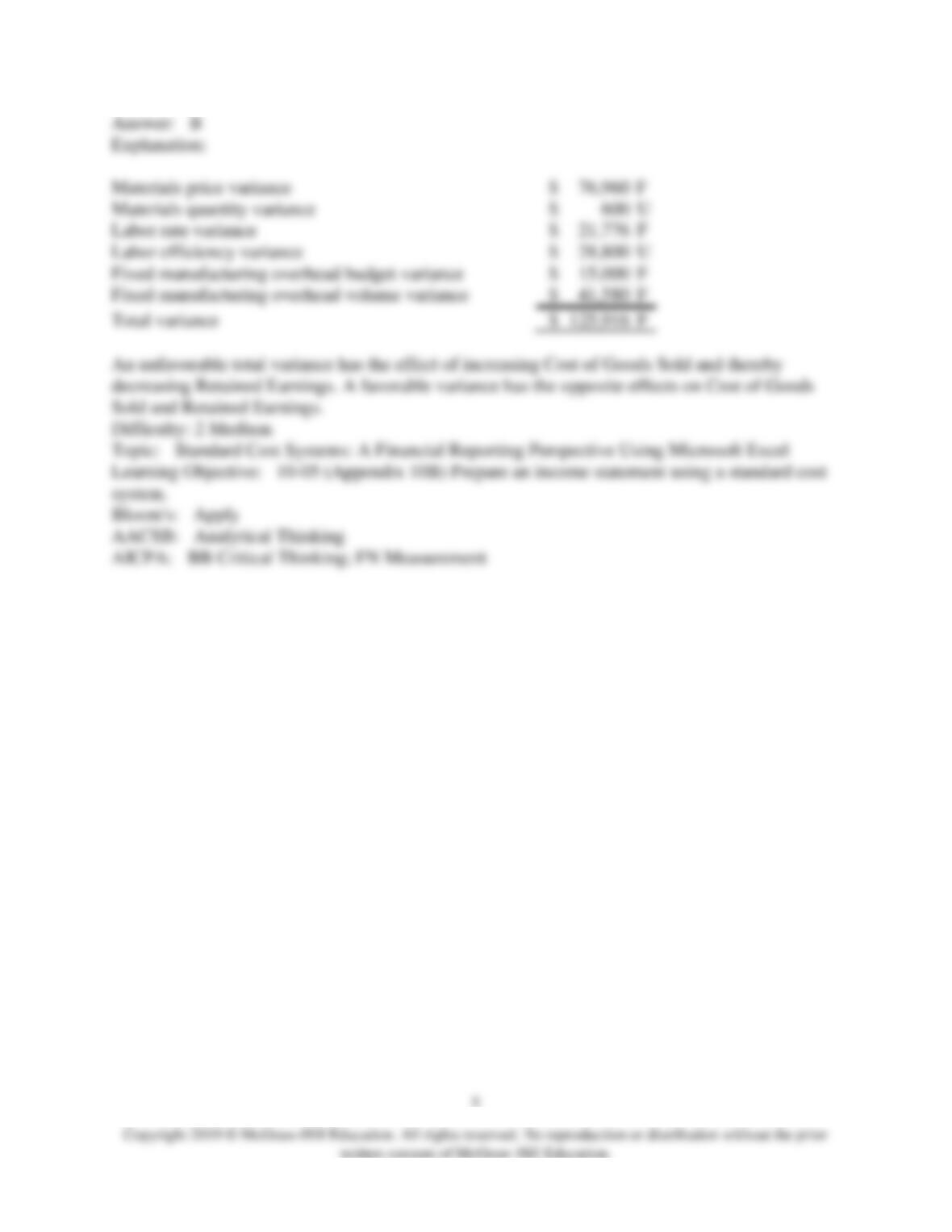
Materials price variance
$
76,960
F
Materials quantity variance
$
600
U
Labor rate variance
$
21,776
F
Labor efficiency variance
$
28,800
U
Fixed manufacturing overhead budget variance
$
15,000
F
Fixed manufacturing overhead volume variance
$
41,580
F
When the company closes its standard cost variances, the Cost of Goods Sold will increase
(decrease) by:
A) $56,580
B) ($125,916)
C) ($56,580)
D) $125,916
7) Bialas Corporation uses a standard cost system in which inventories are recorded at their
standard costs and any variances are closed directly to Cost of Goods Sold. The standards for
direct materials for the company’s only product specify 1.6 liters per unit at $7.00 per liter or
$11.20 per unit. During the year, the company purchased 36,400 liters of raw material at a price of
$7.40 per liter and used 32,060 liters of the raw material to produce 20,100 units of work in
process.
Assume that all transactions are recorded on a worksheet as shown in the text. On the left-hand
side of the equals sign in the worksheet are columns for Cash, Raw Materials, Work in Process,
Finished Goods, and PP&E (net). All of the variance columns are on the right-hand-side of the
equals sign along with the column for Retained Earnings.
When the purchase of raw materials is recorded, which of the following entries will be made?
A) ($14,560) in the Materials Quantity Variance column
B) ($14,560) in the Materials Price Variance column
C) $14,560 in the Materials Price Variance column
D) $14,560 in the Materials Quantity Variance column
8) Sousa Corporation uses a standard cost system in which inventories are recorded at their
standard costs and any variances are closed directly to Cost of Goods Sold. The standards for
direct materials for the company’s only product specify 2.8 kilos per unit at $7.50 per kilo or
$21.00 per unit. During the year, the company purchased 82,100 kilos of raw material at a price of
$7.40 per kilo and used 78,020 kilos of the raw material to produce 27,900 units of work in
process.
Assume that all transactions are recorded on a worksheet as shown in the text. On the left-hand
side of the equals sign in the worksheet are columns for Cash, Raw Materials, Work in Process,
Finished Goods, and PP&E (net). All of the variance columns are on the right-hand-side of the
equals sign along with the column for Retained Earnings.
When the raw materials used in production are recorded, which of the following entries will be
made?
A) $750 in the Materials Quantity Variance column
B) $750 in the Materials Price Variance column
C) ($750) in the Materials Quantity Variance column
D) ($750) in the Materials Price Variance column
9) Isenberg Corporation manufactures one product. It does not maintain any beginning or ending
Work in Process inventories. The company uses a standard cost system in which inventories are
recorded at their standard costs and any variances are closed directly to Cost of Goods Sold. The
company does not have any variable manufacturing overhead costs. It recorded the following
variances during the year:
Materials price variance
$
90,320
U
Materials quantity variance
$
500
F
Labor rate variance
$
4,365
F
Labor efficiency variance
$
16,000
U
Fixed manufacturing overhead budget variance
$
10,500
U
Fixed manufacturing overhead volume variance
$
15,000
F
When the company closes its standard cost variances, the Cost of Goods Sold will increase
(decrease) by:
A) ($4,500)
B) $4,500
C) $96,955
D) ($96,955)
Materials price variance
$
90,320
U
Materials quantity variance
$
500
F
Labor rate variance
$
4,365
F
Labor efficiency variance
$
16,000
U
Fixed manufacturing overhead budget variance
$
10,500
U
Fixed manufacturing overhead volume variance
$
15,000
F
Total variance
$
96,955
F
9
10) Dalgleish Corporation manufactures one product. It does not maintain any beginning or ending
Work in Process inventories. The company uses a standard cost system in which inventories are
recorded at their standard costs and any variances are closed directly to Cost of Goods Sold. There
is no variable manufacturing overhead. The standard cost card for the company’s only product is as
follows:
Inputs
Standard
Quantity
or Hours
Standard Price or
Rate
Standard
Cost
Direct materials
3.6
pounds
$
9.50
per pound
$
34.20
Direct labor
0.70
hours
$
20.00
per hour
14.00
Fixed manufacturing overhead
0.70
hours
$
20.50
per hour
14.35
Total standard cost per unit
$
62.55
The standard fixed manufacturing overhead rate was based on budgeted fixed
manufacturing overhead of $358,750 and budgeted activity of 17,500 hours. During
the year, 32,900 units were started and completed. Actual fixed overhead costs for the
year were $347,350.
Assume that all transactions are recorded on a worksheet as shown in the text. On the
left-hand side of the equals sign in the worksheet are columns for Cash, Raw Materials,
Work in Process, Finished Goods, and PP&E (net). All of the variance columns are on
the right-hand-side of the equals sign along with the column for Retained Earnings.
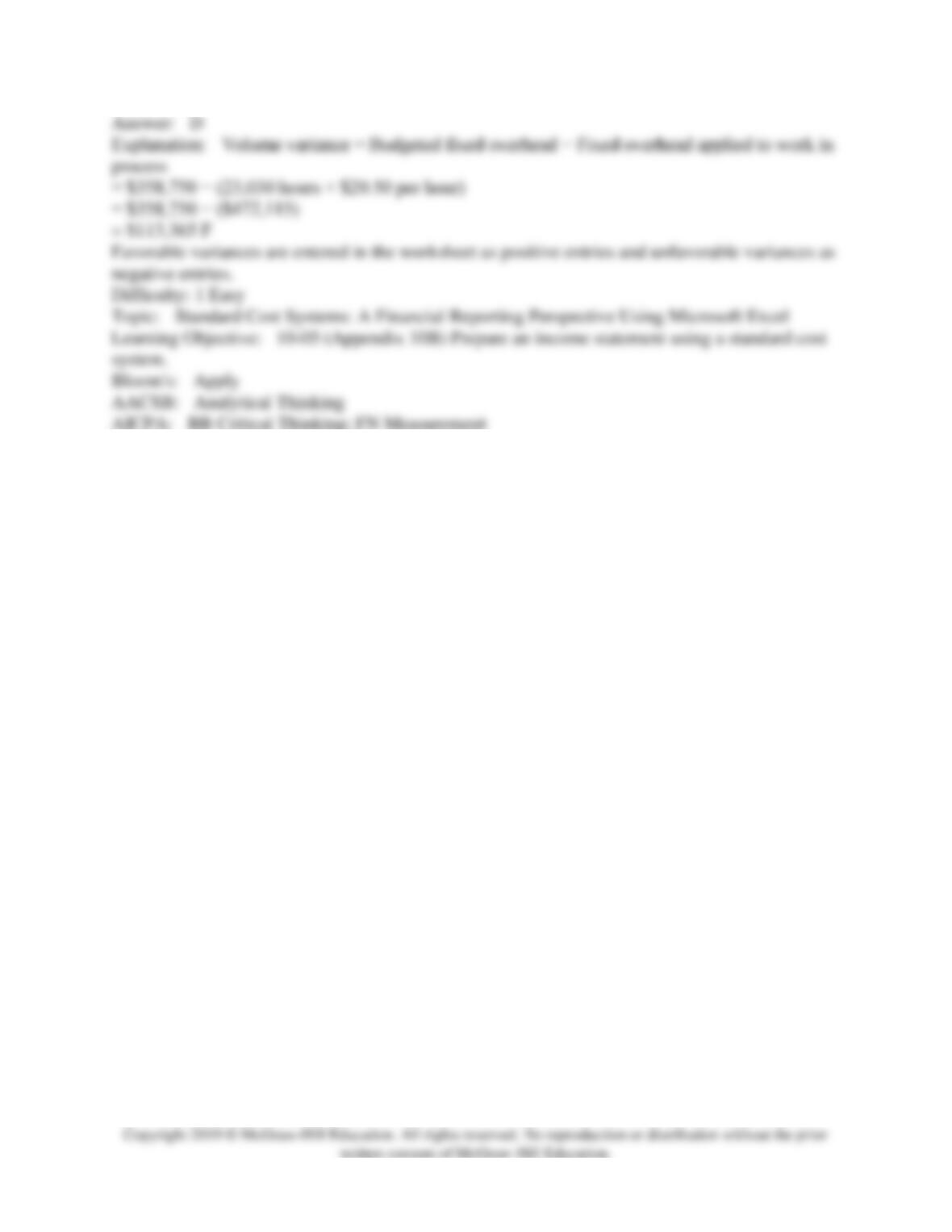
When the fixed manufacturing overhead cost is recorded, which of the following entries will be
made?
A) ($113,365) in the FOH Budget Variance column
B) ($113,365) in the FOH Volume Variance column
C) $113,365 in the FOH Budget Variance column
D) $113,365 in the FOH Volume Variance column
10
11) Dews Corporation manufactures one product. It does not maintain any beginning or ending
Work in Process inventories. The company uses a standard cost system in which inventories are
recorded at their standard costs and any variances are closed directly to Cost of Goods Sold. There
is no variable manufacturing overhead. The fixed manufacturing overhead standards for the
company’s only product specify 0.90 hours per unit at $20.50 per hour. The standard fixed
manufacturing overhead rate was based on budgeted fixed manufacturing overhead of $369,000
and budgeted activity of 18,000 hours. During the year, 14,100 units were started and completed.
Actual fixed overhead costs for the year were $386,200.
Assume that all transactions are recorded on a worksheet as shown in the text. On the left-hand
side of the equals sign in the worksheet are columns for Cash, Raw Materials, Work in Process,
Finished Goods, and PP&E (net). All of the variance columns are on the right-hand-side of the
equals sign along with the column for Retained Earnings.
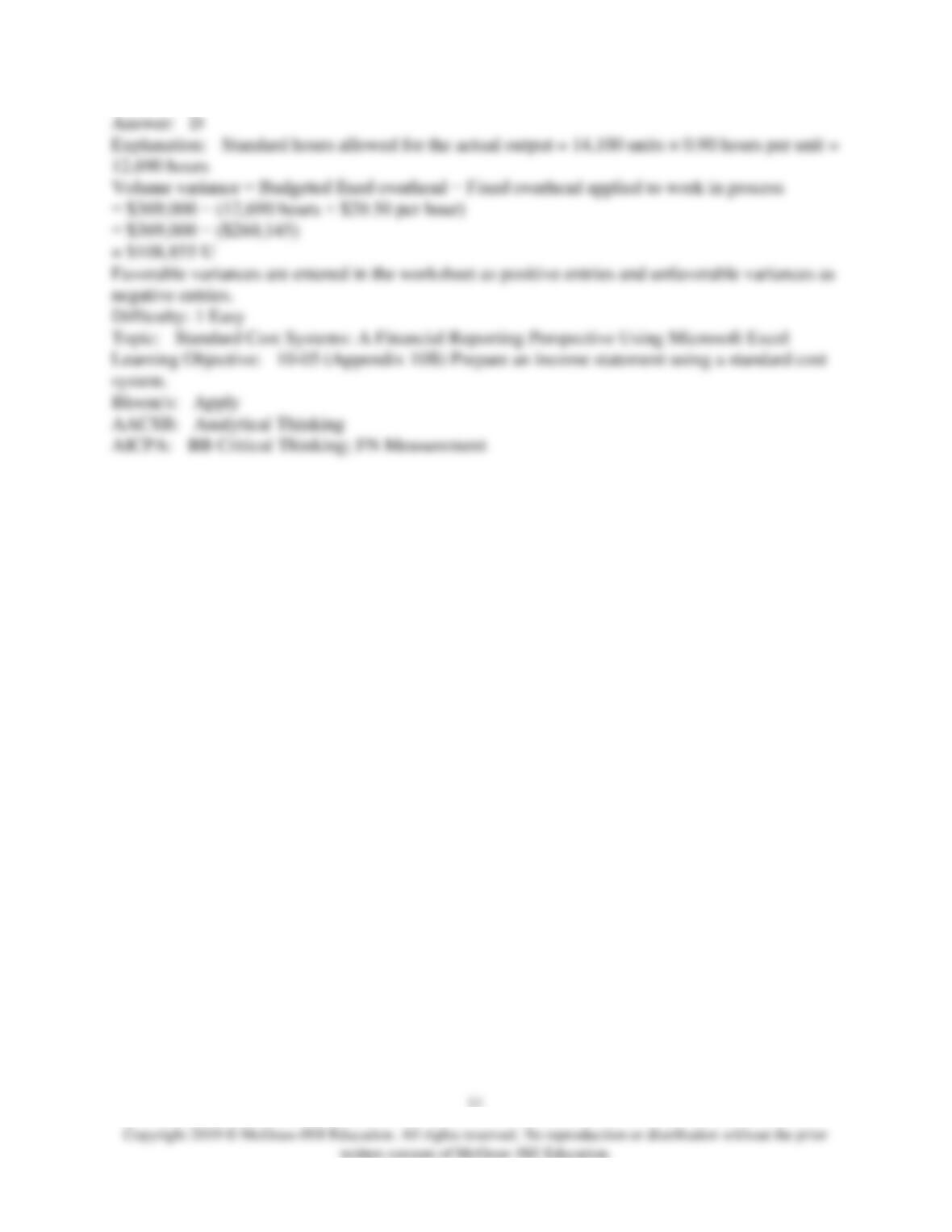
When the fixed manufacturing overhead cost is recorded, which of the following entries will be
made?
A) $108,855 in the FOH Volume Variance column
B) ($108,855) in the FOH Budget Variance column
C) $108,855 in the FOH Budget Variance column
D) ($108,855) in the FOH Volume Variance column
12) Platko Corporation manufactures one product. It does not maintain any beginning or ending
Work in Process inventories. The company uses a standard cost system in which inventories are
recorded at their standard costs and any variances are closed directly to Cost of Goods Sold. There
is no variable manufacturing overhead. The standard cost card for the company’s only product is as
follows:
Inputs
Standard
Quantity
or Hours
Standard Price or
Rate
Standard
Cost
Direct materials
3.6
gallon
$
7.00
per gallon
$
25.20
Direct labor
0.80
hours
$
22.00
per hour
17.60
Fixed manufacturing overhead
0.80
hours
$
14.50
per hour
11.60
Total standard cost per unit
$
54.40
The standard fixed manufacturing overhead rate was based on budgeted fixed manufacturing
overhead of $348,000 and budgeted activity of 24,000 hours. During the year, 38,900 units were
started and completed. Actual fixed overhead costs for the year were $335,900.
Assume that all transactions are recorded on a worksheet as shown in the text. On the left-hand
side of the equals sign in the worksheet are columns for Cash, Raw Materials, Work in Process,
Finished Goods, and PP&E (net). All of the variance columns are on the right-hand-side of the
equals sign along with the column for Retained Earnings.
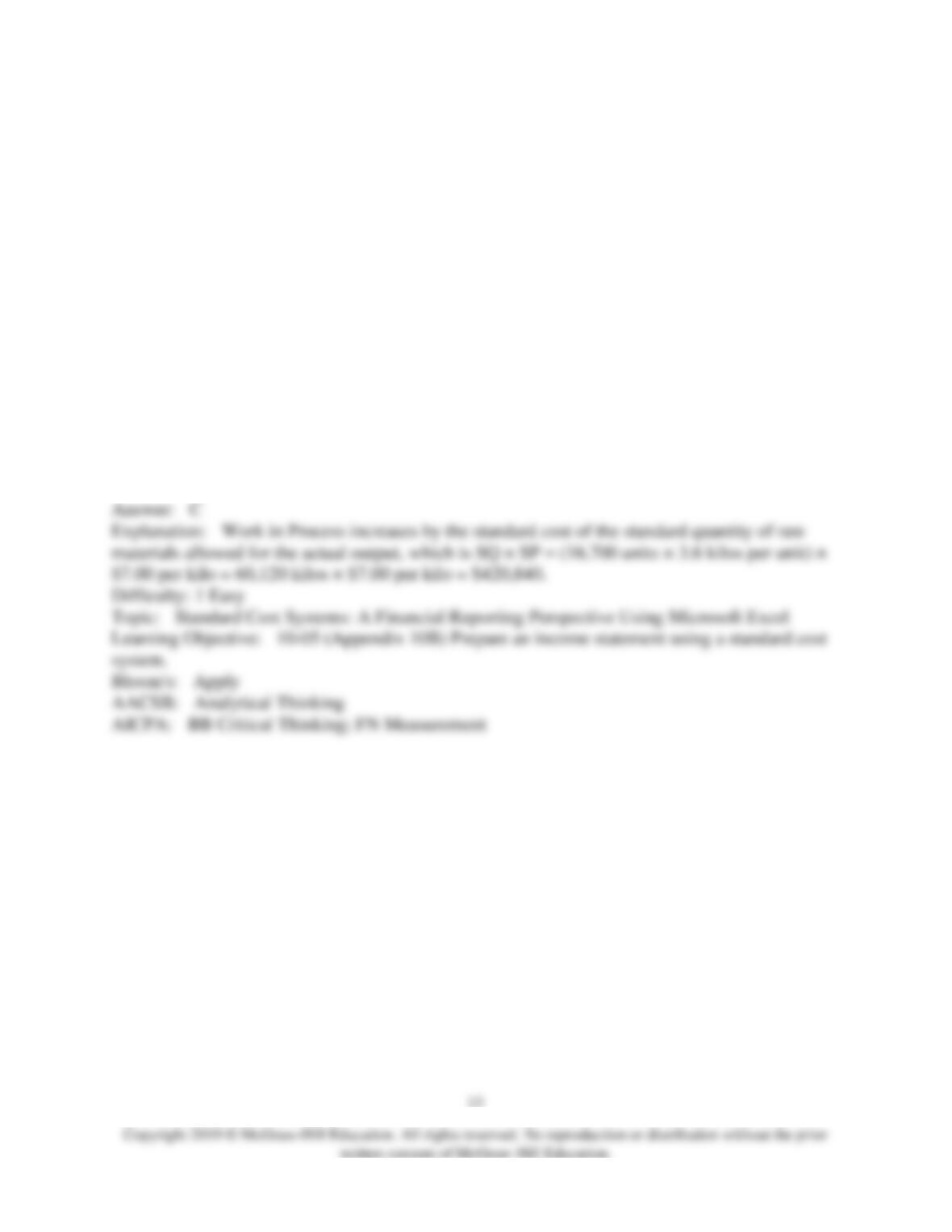
When the fixed manufacturing overhead cost is recorded, which of the following entries will be
made?
A) $12,100 in the FOH Volume Variance column
B) ($12,100) in the FOH Volume Variance column
C) $12,100 in the FOH Budget Variance column
D) ($12,100) in the FOH Budget Variance column
13) Ladue Corporation uses a standard cost system in which inventories are recorded at their
standard costs and any variances are closed directly to Cost of Goods Sold. The standards for
direct materials for the company’s only product specify 3.6 kilos per unit at $7.00 per kilo. During
the year, the company purchased 67,600 kilos of raw material at a price of $6.40 per kilo and used
60,220 kilos of the raw material to produce 16,700 units of work in process.
Assume that all transactions are recorded on a worksheet as shown in the text. On the left-hand
side of the equals sign in the worksheet are columns for Cash, Raw Materials, Work in Process,
Finished Goods, and PP&E (net). All of the variance columns are on the right-hand-side of the
equals sign along with the column for Retained Earnings.
When recording the raw materials used in production, the Work in Process inventory account will
increase (decrease) by:
A) $421,540
B) ($421,540)
C) $420,840
D) ($420,840)
14) Loos Corporation uses a standard cost system in which inventories are recorded at their
standard costs and any variances are closed directly to Cost of Goods Sold. The direct labor
standards for the company’s only product specify 0.90 hours per unit at $21.50 per hour. During
the year, the company started and completed 26,800 units. Direct labor employees worked 25,220
hours at an average cost of $22.50 per hour.
Assume that all transactions are recorded on a worksheet as shown in the text. On the left-hand
side of the equals sign in the worksheet are columns for Cash, Raw Materials, Work in Process,
Finished Goods, and PP&E (net). All of the variance columns are on the right-hand-side of the
equals sign along with the column for Retained Earnings.
When the direct labor cost is recorded, which of the following entries will be made?
A) ($25,220) in the Labor Rate Variance column
B) $25,220 in the Labor Rate Variance column
C) $25,220 in the Labor Efficiency Variance column
D) ($25,220) in the Labor Efficiency Variance column
15) Newbery Corporation manufactures one product. It does not maintain any beginning or ending
Work in Process inventories. The company uses a standard cost system in which inventories are
recorded at their standard costs and any variances are closed directly to Cost of Goods Sold. There
is no variable manufacturing overhead. The fixed manufacturing overhead standards for the
company’s only product specify 0.60 hours per unit at $9.50 per hour. The standard fixed
manufacturing overhead rate was based on budgeted fixed manufacturing overhead of $199,500
and budgeted activity of 21,000 hours. During the year, 44,000 units were started and completed.
Actual fixed overhead costs for the year were $216,200.
Assume that all transactions are recorded on a worksheet as shown in the text. On the left-hand
side of the equals sign in the worksheet are columns for Cash, Raw Materials, Work in Process,
Finished Goods, and PP&E (net). All of the variance columns are on the right-hand-side of the
equals sign along with the column for Retained Earnings.
When the fixed manufacturing overhead cost is recorded, which of the following entries will be
made?
A) ($16,700) in the FOH Budget Variance column
B) ($16,700) in the FOH Volume Variance column
C) $16,700 in the FOH Volume Variance column
D) $16,700 in the FOH Budget Variance column
16) Johanson Corporation uses a standard cost system in which inventories are recorded at their
standard costs and any variances are closed directly to Cost of Goods Sold. The standard cost card
for the company’s only product is as follows:
Inputs
Standard
Quantity
or Hours
Standard Price or
Rate
Standard
Cost
Direct materials
3.4
pounds
$
8.00
per pound
$
27.20
Direct labor
0.70
hours
$
21.00
per hour
14.70
Fixed manufacturing overhead
0.70
hours
$
13.50
per hour
9.45
Total standard cost per unit
$
51.35
During the year, the company purchased 89,600 pounds of raw material at a price of $7.80 per
pound and used 79,120 pounds of the raw material to produce 23,300 units of work in process.
Assume that all transactions are recorded on a worksheet as shown in the text. On the left-hand
side of the equals sign in the worksheet are columns for Cash, Raw Materials, Work in Process,
Finished Goods, and PP&E (net). All of the variance columns are on the right-hand-side of the
equals sign along with the column for Retained Earnings.
When recording the raw materials purchases, the Raw Materials inventory account will increase
(decrease) by:
A) $698,880
B) ($716,800)
C) ($698,880)
D) $716,800
17) Karim Corporation uses a standard cost system in which inventories are recorded at their
standard costs and any variances are closed directly to Cost of Goods Sold. The standard cost card
for the company’s only product is as follows:
Inputs
Standard
Quantity
or Hours
Standard Price or
Rate
Standard
Cost
Direct materials
1.5
pounds
$
9.00
per pound
$
13.50
Direct labor
0.70
hours
$
21.50
per hour
15.05
Fixed manufacturing overhead
0.70
hours
$
9.00
per hour
6.30
Total standard cost per unit
$
34.85
During the year, the company started and completed 31,500 units. Direct labor
employees worked 23,650 hours at an average cost of $19.50 per hour.
Assume that all transactions are recorded on a worksheet as shown in the text. On the
left-hand side of the equals sign in the worksheet are columns for Cash, Raw Materials,
Work in Process, Finished Goods, and PP&E (net). All of the variance columns are on
the right-hand-side of the equals sign along with the column for Retained Earnings.
When recording the direct labor costs, the Work in Process inventory account will increase
(decrease) by:
A) $474,075
B) ($474,075)
C) ($461,175)
D) $461,175

18
18) Ciresi Corporation manufactures one product. It does not maintain any beginning or ending
Work in Process inventories. The company uses a standard cost system in which inventories are
recorded at their standard costs and any variances are closed directly to Cost of Goods Sold. The
company has provided the following information:
Actual sales
19,900
units
Standard cost
$
36.70
per unit
The company does not have any variable manufacturing overhead costs and it recorded the
following variances during the year:
Materials price variance
$
32,820
F
Materials quantity variance
$
500
F
Labor rate variance
$
25,872
F
Labor efficiency variance
$
33,000
F
Fixed manufacturing overhead budget variance
$
16,500
F
Fixed manufacturing overhead volume variance
$
38,880
F
The adjusted Cost of Goods Sold after closing all of the variances to Cost of Goods Sold will be
closest to:
A) $1,066,952
B) $877,902
C) $730,330
D) $582,758
19) Shankland Corporation manufactures one product. It does not maintain any beginning or
ending Work in Process inventories. The company uses a standard cost system in which
inventories are recorded at their standard costs and any variances are closed directly to Cost of
Goods Sold. There is no variable manufacturing overhead. The standard cost card for the
company’s only product is as follows:
Inputs
Standard
Quantity
or Hours
Standard Price or
Rate
Standard
Cost
Direct materials
1.5
pounds
$
8.50
per pound
$
12.75
Direct labor
0.50
hours
$
18.00
per hour
9.00
Fixed manufacturing overhead
0.50
hours
$
9.00
per hour
4.50
Total standard cost per unit
$
26.25
The standard fixed manufacturing overhead rate was based on budgeted fixed manufacturing
overhead of $67,500 and budgeted activity of 7,500 hours. During the year, 24,600 units were
started and completed. Actual fixed overhead costs for the year were $84,800.
Assume that all transactions are recorded on a worksheet as shown in the text. On the left-hand
side of the equals sign in the worksheet are columns for Cash, Raw Materials, Work in Process,
Finished Goods, and PP&E (net). All of the variance columns are on the right-hand-side of the
equals sign along with the column for Retained Earnings.
When applying fixed manufacturing overhead to production, the Work in Process inventory
account will increase (decrease) by:
A) $110,700
B) ($6,800)
C) ($110,700)
D) $6,800