43) Braxwell Corporation acquired the following assets associated with a manufacturing facility
for a lump-sum price of $9,000,000. According to independent appraisals, the fair values were
$4,000,000, $2,000,000, $3,000,000, and $1,000,000 for the building, patent, land, and
equipment, respectively. The initial value of the patent would be:
A) $2,000,000.
B) $2,250,000.
C) $1,800,000.
D) $0.
44) Assets acquired under multi-year deferred payment contracts are:
A) Valued at their fair value on the date of the final payment.
B) Valued at the present value of the payments required by the contract.
C) Valued at the sum of the payments required by the contract.
D) None of these answer choices are correct.
45) An asset acquired using a long-term note payable always will be recorded at the face amount
of the note under which scenario?
A) The note payable explicitly requires the payment of interest at a realistic interest rate.
B) The note is a noninterest-bearing note.
C) The company expects to use the asset for its entire physical life.
D) Interest on the note is not payable until the note is due.
46) On January 1, 2018, Laramie Inc. acquired land for $6.2 million. Laramie paid $1.2 in cash
and signed a 6% note requiring the company to pay the remaining $5 million plus interest on
December 31, 2019. An interest rate of 6% properly reflects the time value of money for this
type of loan agreement. For what amount should Laramie record the purchase of land?
A) $6.8 million.
B) $5.0 million.
C) $5.6 million.
D) $6.2 million.
47) On July 1, 2018, Markwell Company acquired equipment. Markwell paid $160,000 in cash
on July 1, 2018, and signed a $640,000 noninterest-bearing note for the remaining balance which
is due on July 1, 2019. An interest rate of 5% reflects the time value of money for this type of
loan agreement.
For what amount will Markwell record the purchase of equipment?
A) $761,905.
B) $769,523.
C) $609,523.
D) $800,000.
48) On July 1, 2018, Markwell Company acquired equipment. Markwell paid $160,000 in cash
on July 1, 2018, and signed a $640,000 noninterest-bearing note for the remaining balance which
is due on July 1, 2019. An interest rate of 5% reflects the time value of money for this type of
loan agreement.
Which of the following should be included in the journal entry on July 1, 2018?
A) Credit: Notes payable, $609,523.
B) Debit: Equipment, $800,000.
C) Debit: Discount on notes payable, $30,477.
D) Credit: Notes payable, $609,523 and Debit: Discount on notes payable, $30,477.
49) On September 30, 2018, Corso Steel acquired a patent from Thermo Steel. The agreement
specified that Corso will pay Thermo $1,000,000 immediately and then another $1,000,000 on
September 30, 2020. An interest rate of 8% reflects the time value of money for this type of loan
agreement.
Corso should record the acquisition of the patent on September 30, 2018, for what amount?
A) $2,000,000.
B) $1,912,385.
C) $1,857,340.
D) $1,714,678.
50) On September 30, 2018, Corso Steel acquired a patent from Thermo Steel. The agreement
specified that Corso will pay Thermo $1,000,000 immediately and then another $1,000,000 on
September 30, 2020. An interest rate of 8% reflects the time value of money for this type of loan
agreement.
What amount of interest expense, if any, would Corso record on December 31, 2018, the
company’s fiscal year end?
A) $17,147.
B) $20,000.
C) $68,687.
D) $80,000.
51) On September 30, 2018, Corso Steel acquired a patent from Thermo Steel. The agreement
specified that Corso will pay Thermo $1,000,000 immediately and then another $1,000,000 on
September 30, 2020. An interest rate of 8% reflects the time value of money for this type of loan
agreement.
What amount of interest expense, if any, would Corso record on December 31, 2019, the
company’s fiscal year end?
A) $68,687.
B) $60,000.
C) $80,000.
D) $69,959.
52) Assets acquired by the issuance of equity securities are valued based on:
A) Their fair values.
B) The fair value of the equity securities.
C) The fair value of the assets acquired or the fair value of the equity securities, whichever is
more reasonably determinable.
D) The fair value of the assets acquired or the fair value of the equity securities, whichever is
smaller.
53) On June 17, the Lattern Company issued 120,000 shares of its $0.10 par value common stock
in exchange for land. On the date of the transaction, the fair value of the common stock,
evidenced by its market price, was $10 per share. The journal entry to record this transaction
includes:
A) Debt: Land, $1,200,000.
B) Credit: Cash, $1,200,000.
C) Debit: Land, $12,000.
D) No entry for this exchange.
54) Maltese is a privately-owned company. On September 3, Maltese exchanged 2,000 shares of
its private common stock for equipment. There is no readily available estimate of the stock’s fair
value. The equipment currently is selling for $80,000. The journal entry to record this transaction
includes:
A) Credit: Stock revenue, $80,000.
B) Credit: Cash, $80,000.
C) Debit: Equipment, $80,000.
D) No entry is recorded for this exchange.
55) Donated assets are recorded at:
A) Zero (memo entry only).
B) The donor’s book value.
C) The donee’s stated value.
D) Fair value.
56) A company receiving a donated asset will record:
A) An increase in revenue.
B) An increase in liabilities.
C) A decrease in liabilities.
D) An increase in revenue and A decrease in liabilities.
57) Savings Mart is a national retail chain. To entice the company to open a mega store in its
jurisdiction, the city of Populationville donated a 20-acre tract of land to be used for
construction. The land was originally purchased by the city for $250,000 three years ago. The
appraisal value at the time of the donation was $300,000. For what amount should Savings Mart
record the donated land?
A) $250,000.
B) $275,000.
C) $300,000.
D) $0; Donated assets are not recorded.
58) The fixed-asset turnover ratio provides:
A) The rate of decline in asset lives.
B) The rate of replacement of fixed assets.
C) The amount of sales generated per dollar of fixed assets.
D) The decline in book value of fixed assets compared to capital expenditures.
59) The balance sheets of Davidson Corporation reported net fixed assets of $320,000 at the end
of 2018. The fixed-asset turnover ratio for 2018 was 4.0, and sales for the year totaled
$1,480,000. Net fixed assets at the end of 2017 were:
A) $470,000.
B) $370,000.
C) $420,000.
D) None of these answer choices are correct.
60) The basic principle used to value an asset acquired in a nonmonetary exchange is to value it
at:
A) Fair value of the asset(s) given up.
B) The book value of the asset given plus any cash or other monetary consideration received.
C) Fair value or book value, whichever is smaller.
D) Book value of the asset given.
61) In a nonmonetary exchange of equipment, if the exchange has commercial substance, a gain
is recognized if:
A) The fair value of the equipment received exceeds the book value of the equipment received.
B) The book value of the equipment received exceeds the fair value of the equipment given up.
C) The fair value of the equipment surrendered exceeds the book value of the equipment given
up.
D) None of these answer choices are correct.
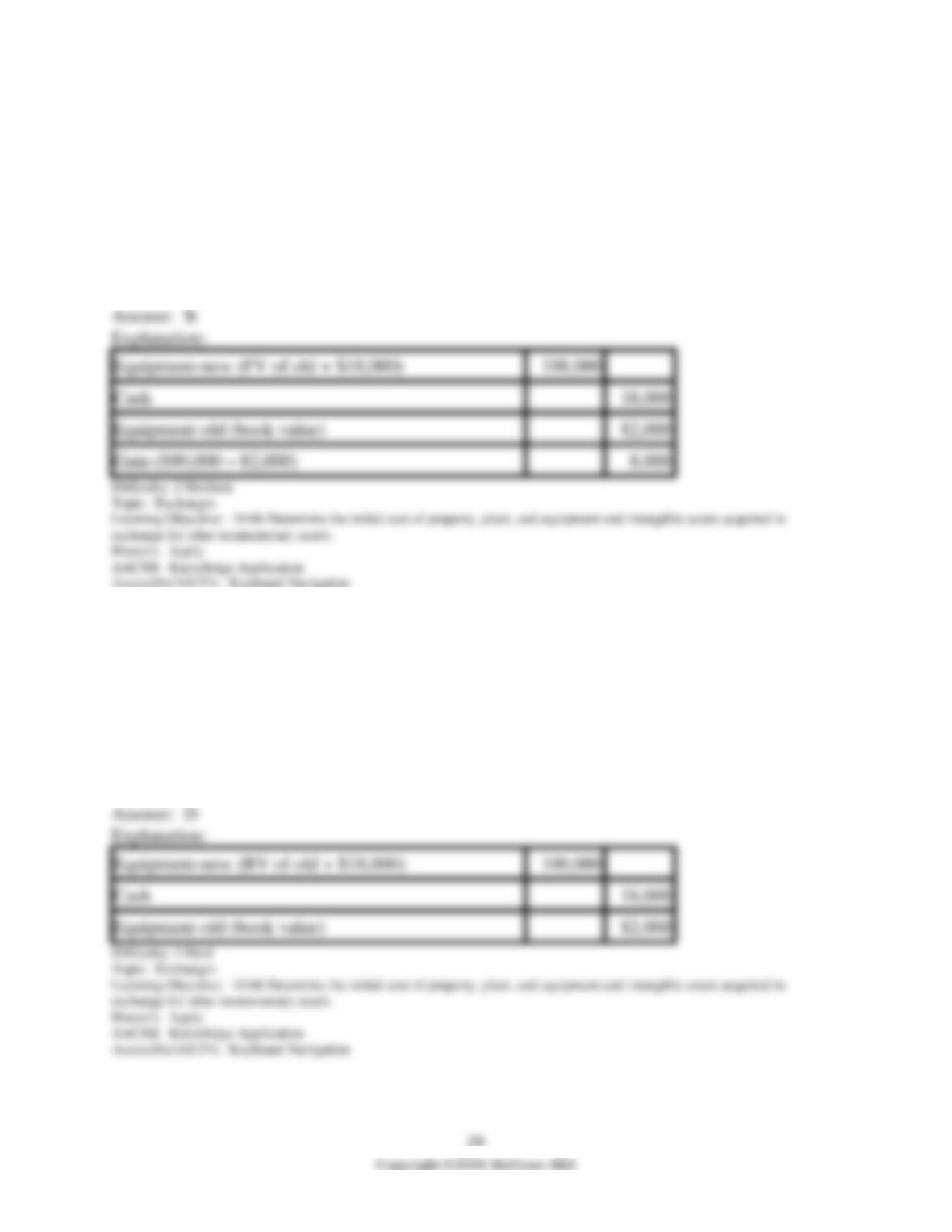
62) Alamos Co. exchanged equipment and $18,000 cash for similar equipment. The book value
and the fair value of the old equipment were $82,000 and $90,000, respectively.
Assuming that the exchange has commercial substance, Alamos would record a gain/(loss) of:
A) $26,000.
B) $8,000.
C) ($8,000).
D) $0.
63) Alamos Co. exchanged equipment and $18,000 cash for similar equipment. The book value
and the fair value of the old equipment were $82,000 and $90,000, respectively.
Assuming that the exchange lacks commercial substance, Alamos would record a gain/(loss) of:
A) $26,000.
B) $8,000.
C) ($8,000).
D) $0.
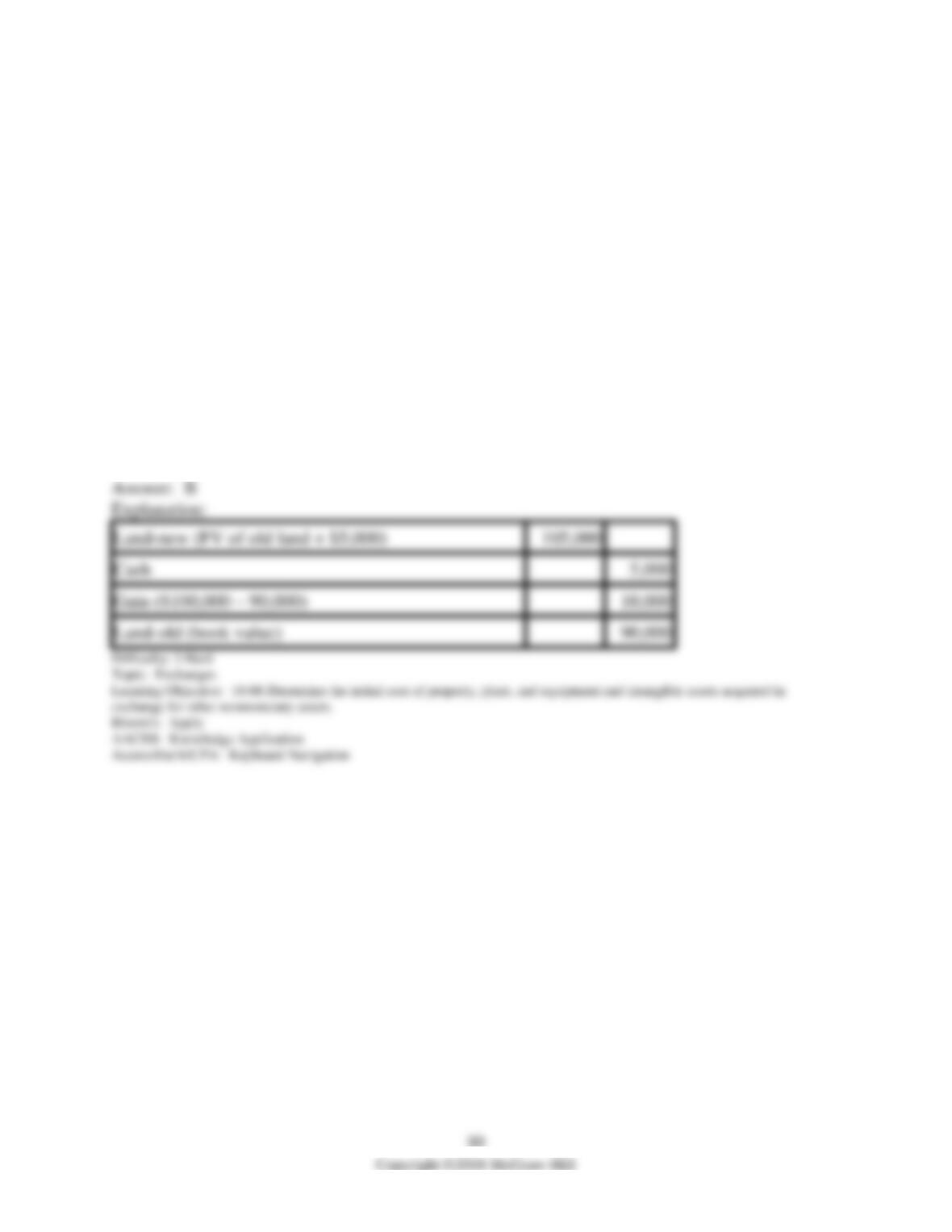
64) Horton Stores exchanged land and cash of $5,000 for similar land. The book value and the
fair value of the land were $90,000 and $100,000, respectively.
Assuming that the exchange has commercial substance, Horton would record land-new and a
gain/(loss) of:
Land
Gain/(loss)
a.
$
105,000
$
0
b.
$
105,000
$
10,000
c.
$
95,000
$
0
d.
$
95,000
$
10,000
A) Option A
B) Option B
C) Option C
D) Option D
Land-new (FV of old land + $5,000)
Cash
Gain ($100,000 – 90,000)
Land-old (book value)
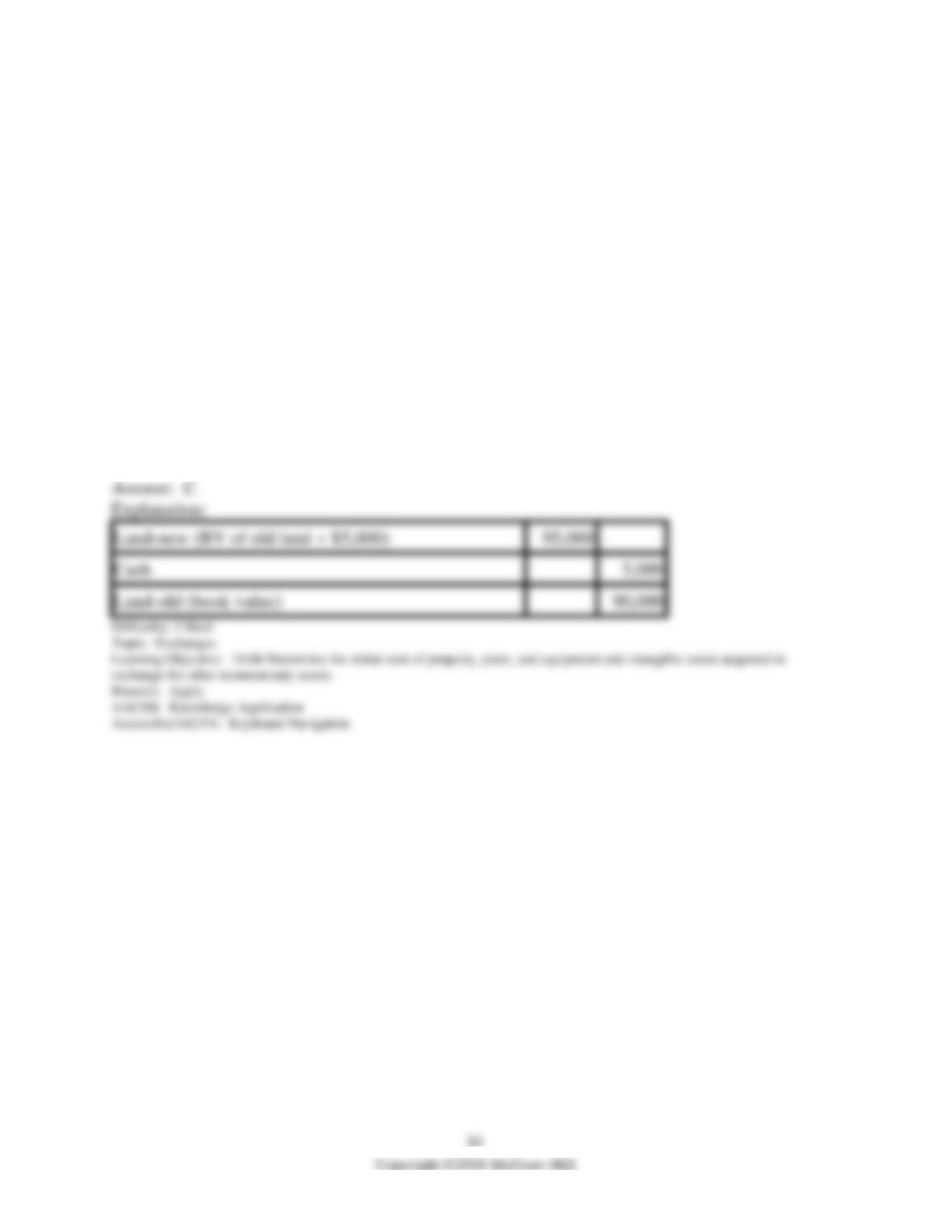
65) Horton Stores exchanged land and cash of $5,000 for similar land. The book value and the
fair value of the land were $90,000 and $100,000, respectively.
Assuming that the exchange lacks commercial substance, Horton would record land-new and a
gain/(loss) of:
Land
Gain/(loss)
a.
$
105,000
$
0
b.
$
105,000
$
10,000
c.
$
95,000
$
0
d.
$
95,000
$
10,000
A) Option A
B) Option B
C) Option C
D) Option D
Land-new (BV of old land + $5,000)
Cash
Land-old (book value)
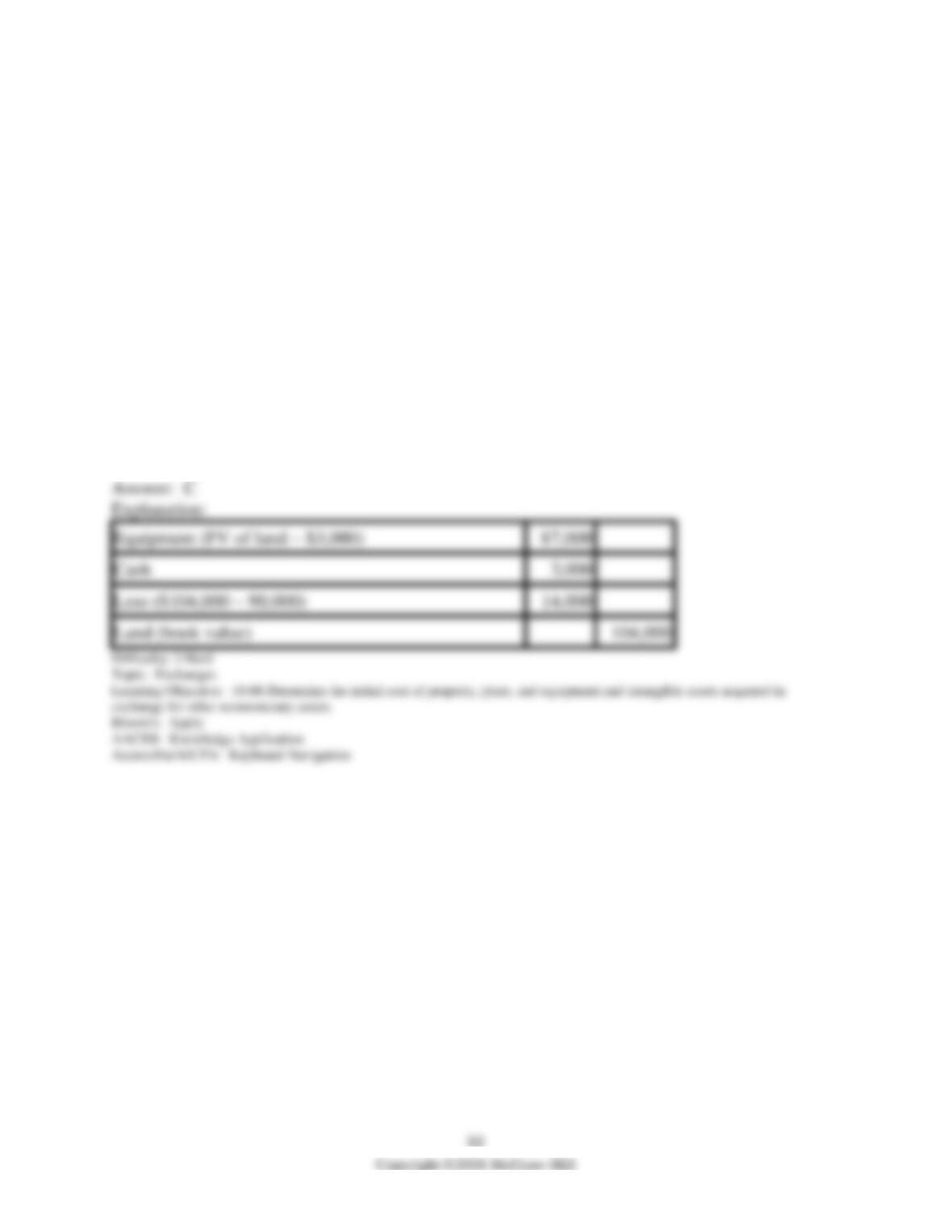
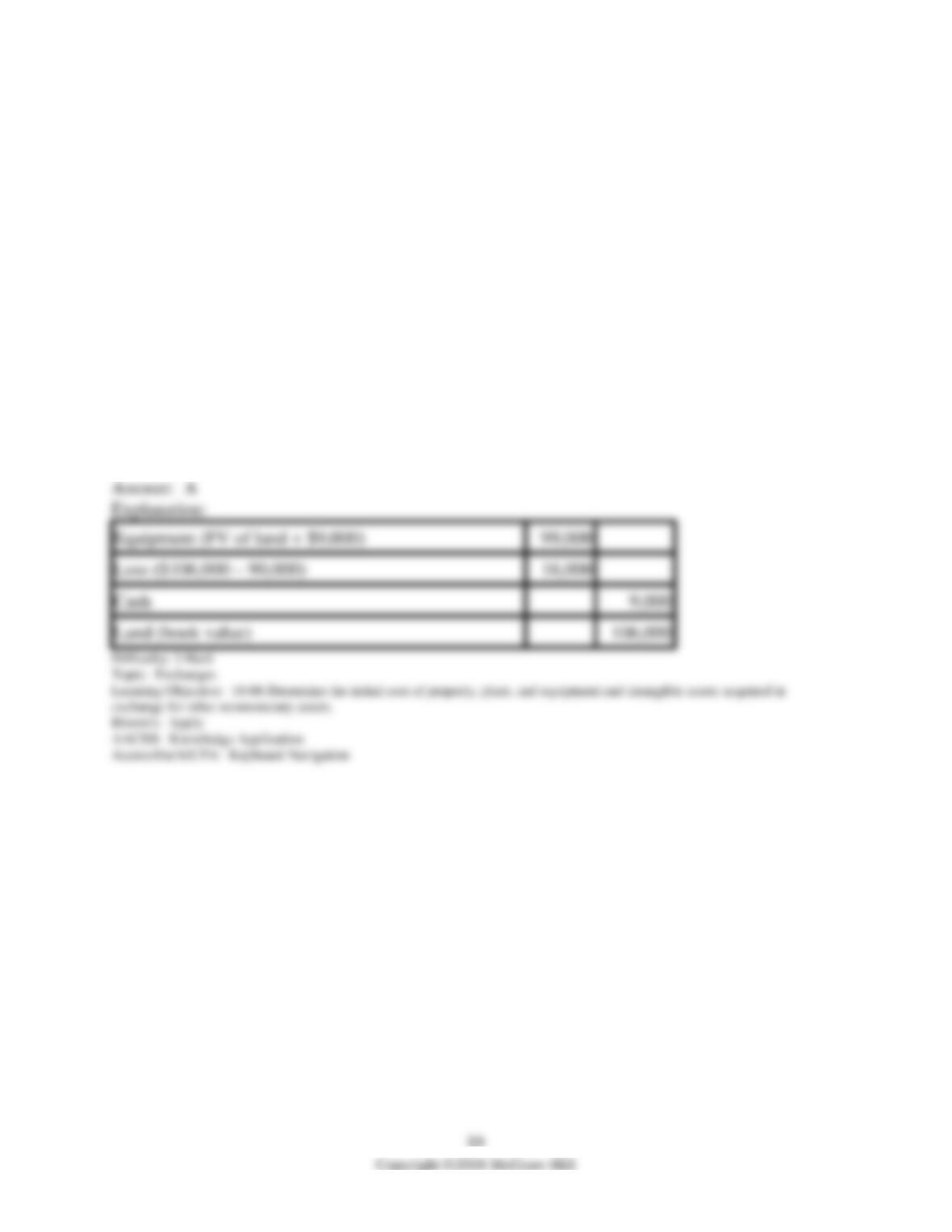
66) Bloomington Inc. exchanged land for equipment and $3,000 in cash. The book value and the
fair value of the land were $104,000 and $90,000, respectively.
Assuming that the exchange has commercial substance, Bloomington would record equipment
and a gain/(loss) of:
Equipment
Gain/(loss)
a.
$
87,000
$
3,000
b.
$
104,000
$
(5,000
)
c.
$
87,000
$
(14,000
)
d.
None of these answer choices are correct.
A) Option A
B) Option B
C) Option C
D) Option D
Equipment (FV of land – $3,000)
Cash
Loss ($104,000 – 90,000)
Land (book value)
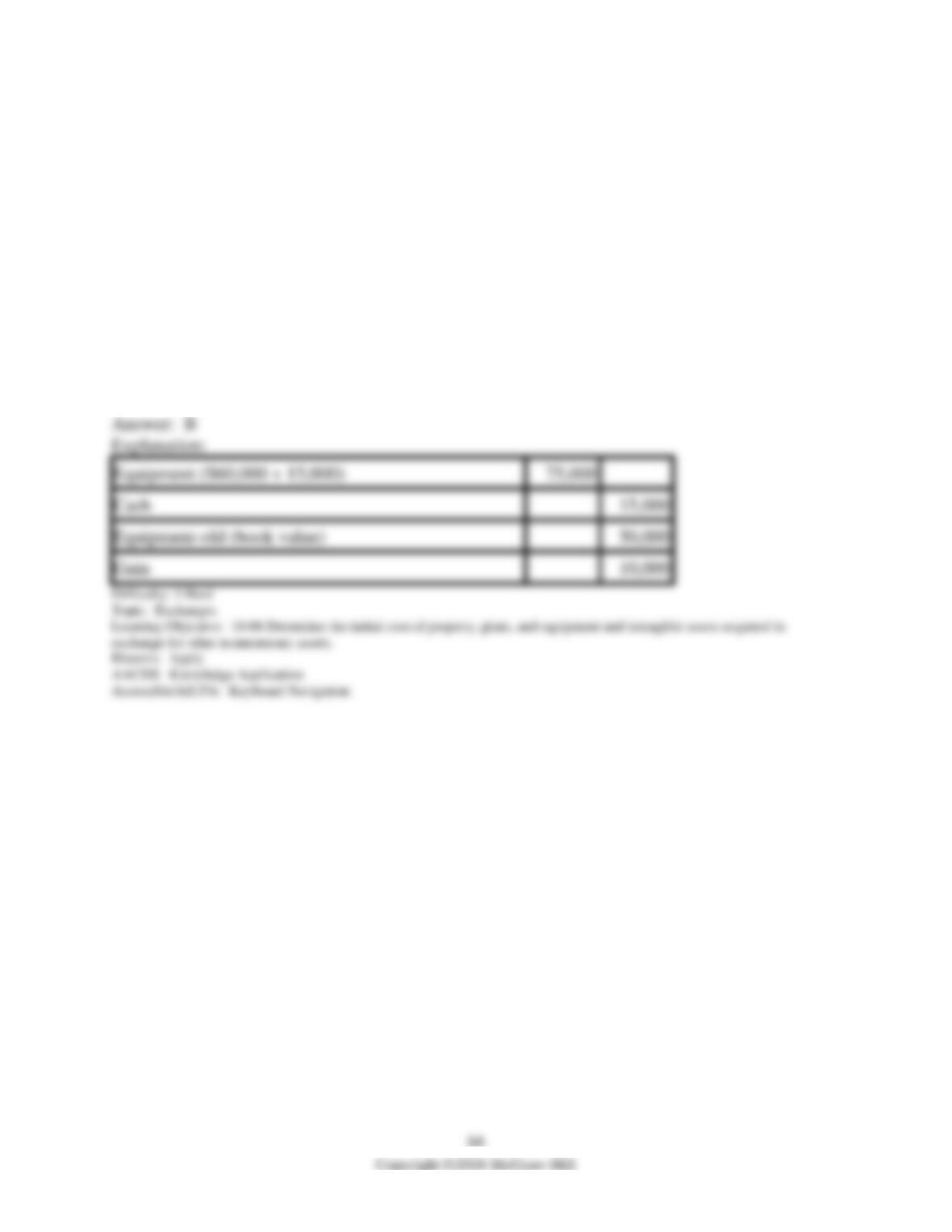
67) P. Chang & Co. exchanged land and $9,000 cash for equipment. The book value and the fair
value of the land were $106,000 and $90,000, respectively.
Assuming that the exchange has commercial substance, Chang would record equipment and a
gain/(loss) of:
Equipment
Gain/(loss)
a.
$
99,000
$
(16,000
)
b.
$
90,000
$
(25,000
)
c.
$
108,000
$
16,000
d.
$
106,000
$
(9,000
)
A) Option A
B) Option B
C) Option C
D) Option D
Equipment (FV of land + $9,000)
Loss ($106,000 – 90,000)
Cash
Land (book value)
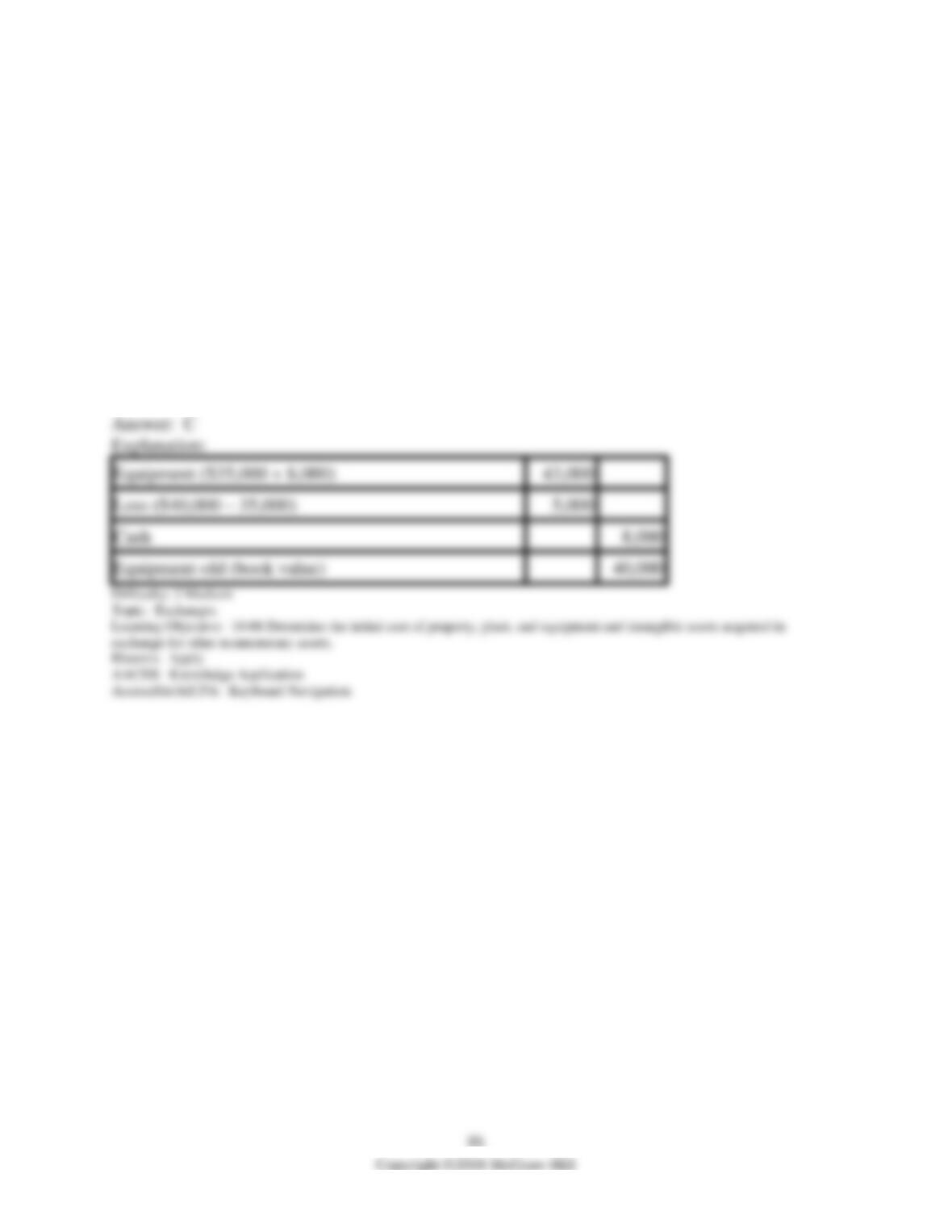
68) Below is information relative to an exchange of similar assets by Grand Forks Corp. Assume
the exchange has commercial substance.
Old Equipment
Cash
Book Value
Fair Value
Paid
Case A
$
50,000
$
60,000
$
15,000
Case B
$
40,000
$
35,000
$
8,000
In Case A, Grand Forks would record the new equipment at:
A) $65,000.
B) $75,000.
C) $50,000.
D) $60,000.
Equipment ($60,000 + 15,000)
75,000
Cash
Equipment-old (book value)
Gain
69) Below is information relative to an exchange of similar assets by Grand Forks Corp. Assume
the exchange has commercial substance.
Old Equipment
Cash
Book Value
Fair Value
Paid
Case A
$
50,000
$
60,000
$
15,000
Case B
$
40,000
$
35,000
$
8,000
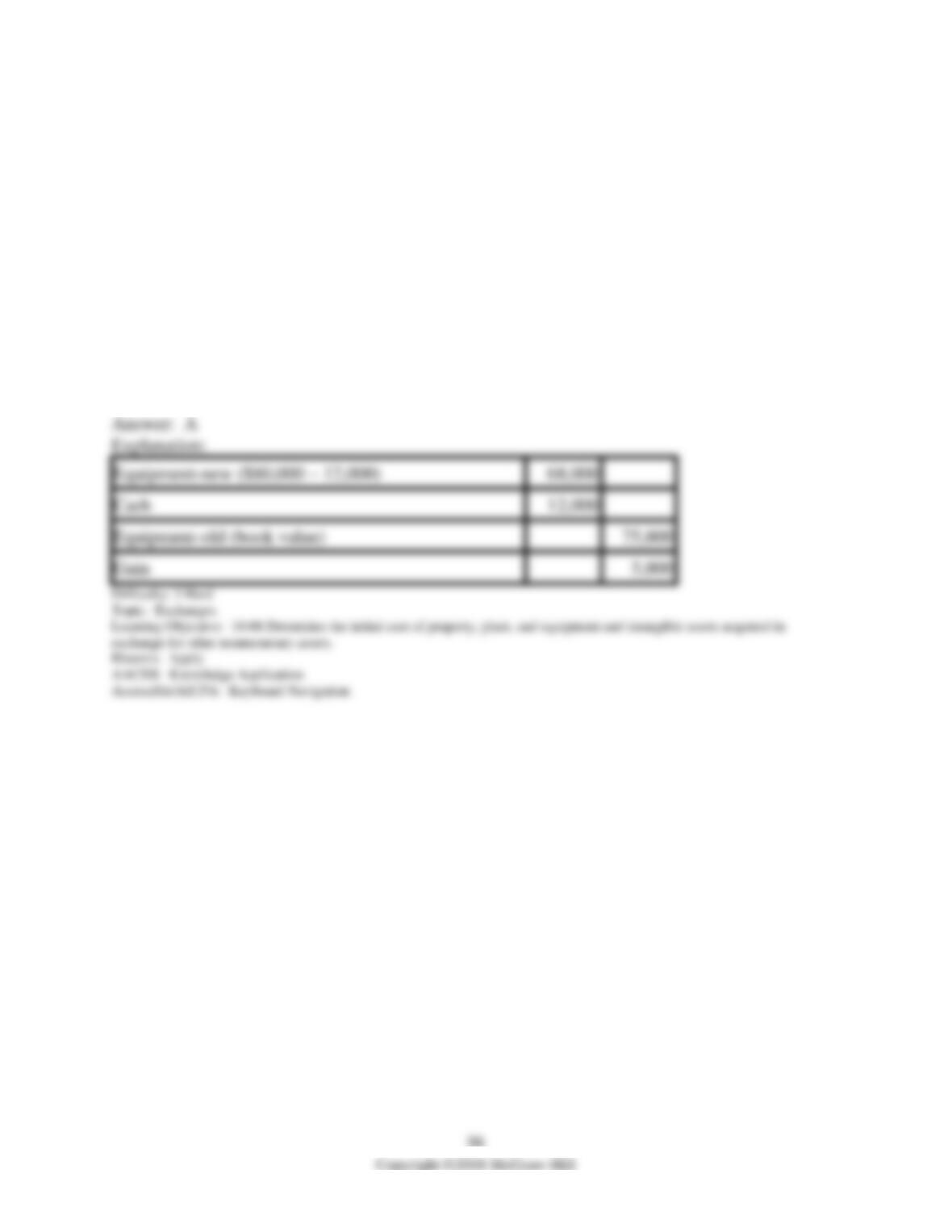
In Case B, Grand Forks would record a gain/(loss) of:
A) $5,000.
B) $3,000.
C) ($5,000).
D) ($3,000).
Equipment ($35,000 + 8,000)
Loss ($40,000 – 35,000)
Cash
Equipment-old (book value)
40,000
70) Pensacola Inc. exchanged old equipment for new equipment in two exchange transactions.
Each transaction has commercial substance.
Old Equipment
Cash
Book Value
Fair Value
Received
Equipment A
$
75,000
$
80,000
$
12,000
Equipment B
$
60,000
$
56,000
$
10,000
For Equipment A, Pensacola would record the new equipment at:
A) $68,000.
B) $63,750.
C) $67,250.
D) $80,000.
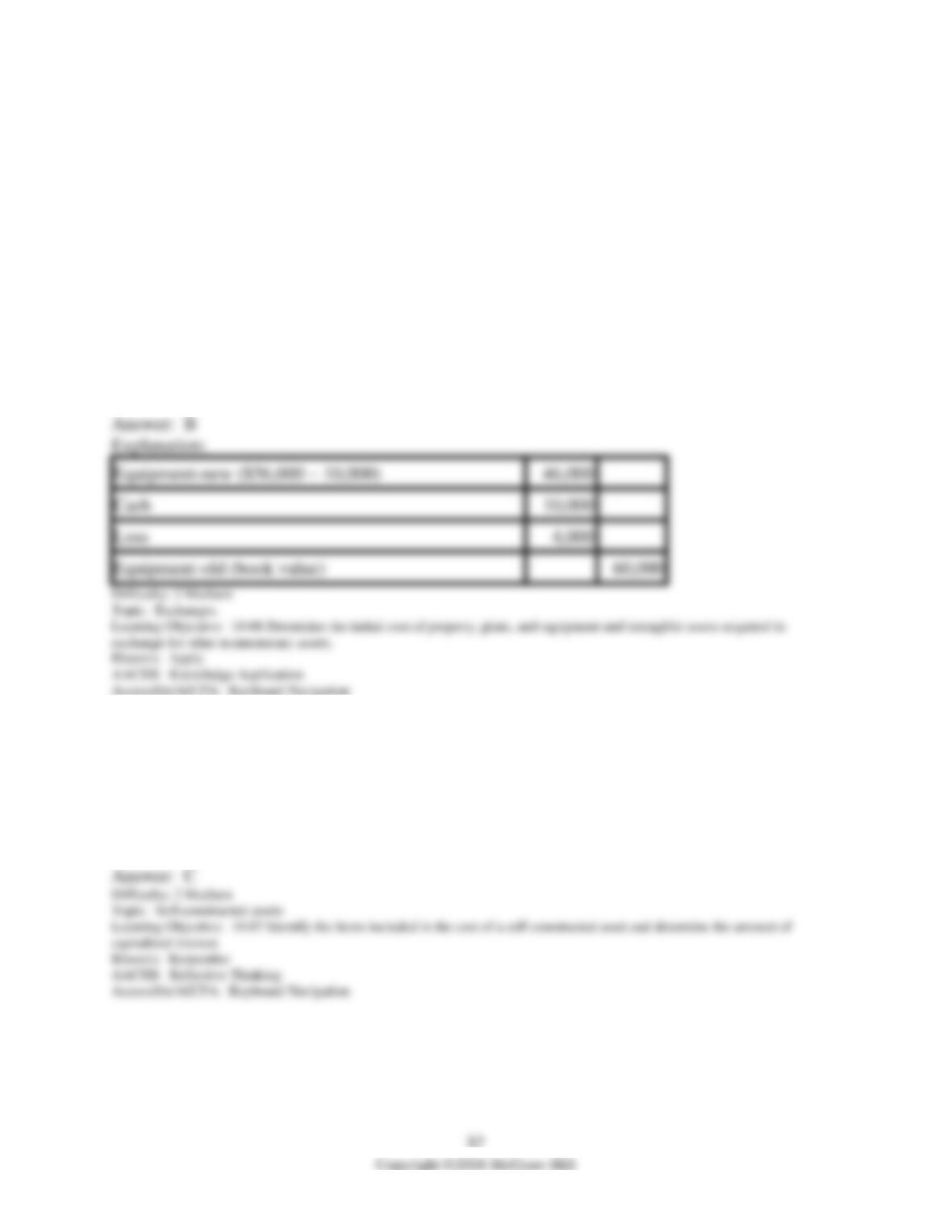
Equipment-new ($80,000 – 12,000)
Cash
Equipment-old (book value)
Gain
71) Pensacola Inc. exchanged old equipment for new equipment in two exchange transactions.
Each transaction has commercial substance.
Old Equipment
Cash
Book Value
Fair Value
Received
Equipment A
$
75,000
$
80,000
$
12,000
Equipment B
$
60,000
$
56,000
$
10,000
For Equipment B, Pensacola would record a gain/(loss) of:
A) $4,000.
B) ($4,000).
C) ($10,000).
D) None of these answer choices are correct.
Equipment-new ($56,000 – 10,000)
Cash
Loss
Equipment-old (book value)
60,000
72) Interest may be capitalized:
A) On routinely manufactured goods as well as self-constructed assets.
B) On self-constructed assets from the date an entity formally adopts a plan to build a discrete
project.
C) Whether or not there is specific borrowing for the construction.
D) Whether or not there are actual interest costs incurred.
73) Interest is eligible to be capitalized as part of an asset’s cost, rather than being expensed
immediately, when:
A) The interest is incurred during the construction period of the asset.
B) The asset is a discrete construction project for sale or lease.
C) The asset is self-constructed, rather than acquired.
D) All of these answer choices are correct.
74) In computing capitalized interest, average accumulated expenditures:
A) Is the arithmetic mean of all construction expenditures.
B) Is determined by time-weighting individual expenditures made during the asset construction
period.
C) Is multiplied by the company’s most recent financing rates.
D) All of these answer choices are correct.
75) Interest is not capitalized for:
A) Assets that are constructed as discrete projects for sale or lease.
B) Assets constructed for a company’s own use.
C) Inventories routinely and repetitively produced in large quantities.
D) Interest is capitalized for all of these items.
76) Average accumulated expenditures:
A) Is an approximation of the average debt a firm would have outstanding if it financed all
construction through debt.
B) Is computed as a simple average if all construction expenditures are made at the end of the
period.
C) Are irrelevant if the company’s total outstanding debt is less than total costs of construction.
D) All of these answer choices are true statements.
77) The cost of self-constructed fixed assets should:
A) Include allocated indirect costs just as they are for production of products.
B) Include only incremental indirect costs.
C) Include only specifically identifiable indirect costs.
D) Not include indirect costs.
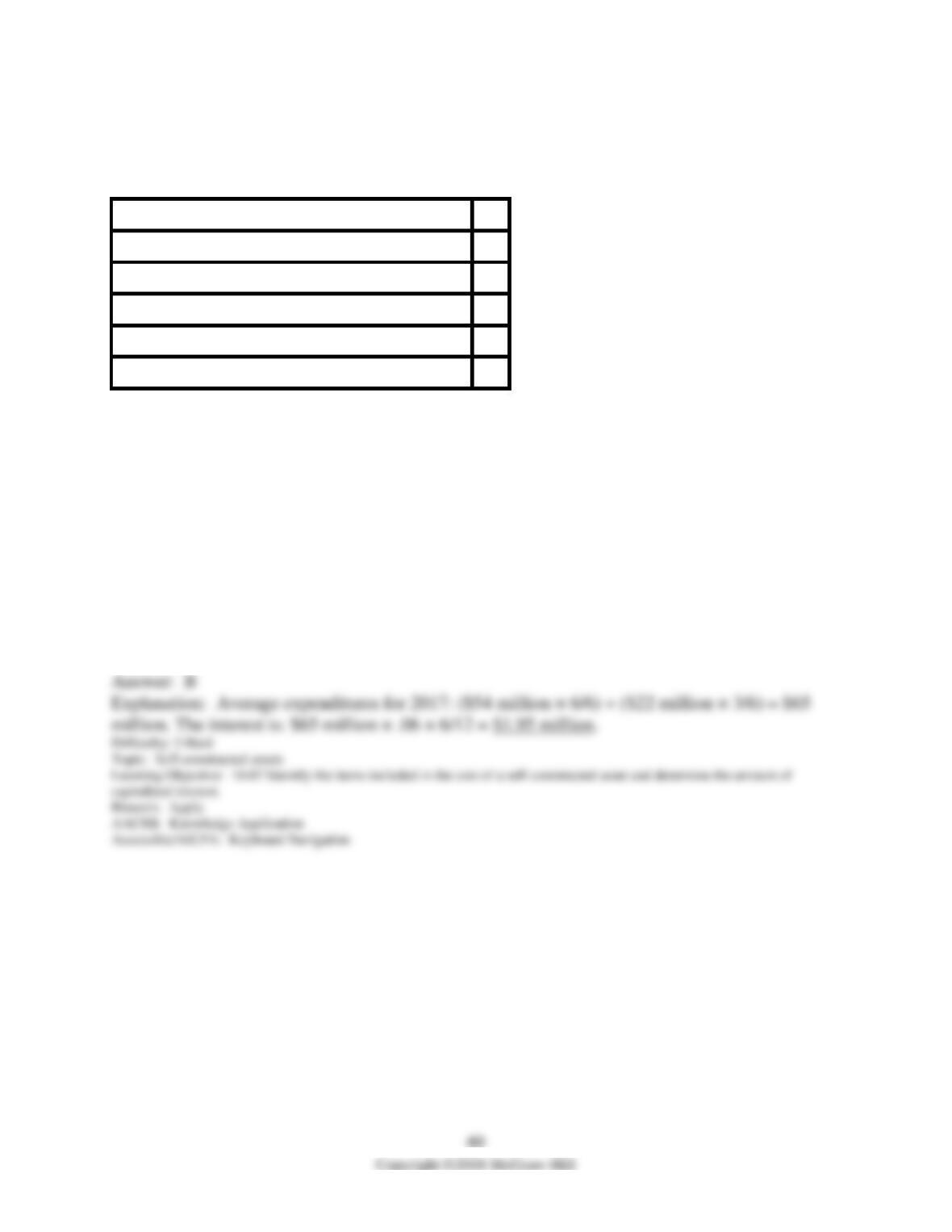
78) On June 1, 2017, the Crocus Company began construction of a new manufacturing plant. The
plant was completed on October 31, 2018. Expenditures on the project were as follows ($ in
millions):
July 1, 2017
54
October 1, 2017
22
February 1, 2018
30
April 1, 2018
21
September 1, 2018
20
October 1, 2018
6
On July 1, 2017, Crocus obtained a $70 million construction loan with a 6% interest rate. The
loan was outstanding through the end of October, 2018. The company’s only other interest-
bearing debt was a long-term note for $100 million with an interest rate of 8%. This note was
outstanding during all of 2017 and 2018. The company’s fiscal year-end is December 31.
What is the amount of interest that Crocus should capitalize in 2017, using the specific interest
method?
A) $1.90 million.
B) $1.95 million.
C) $2.96 million.
D) None of these answer choices are correct.