Acquisition and Disposition of Property, Plant, and Equipment
10 – 53
Solution 10-137
PROBLEMS
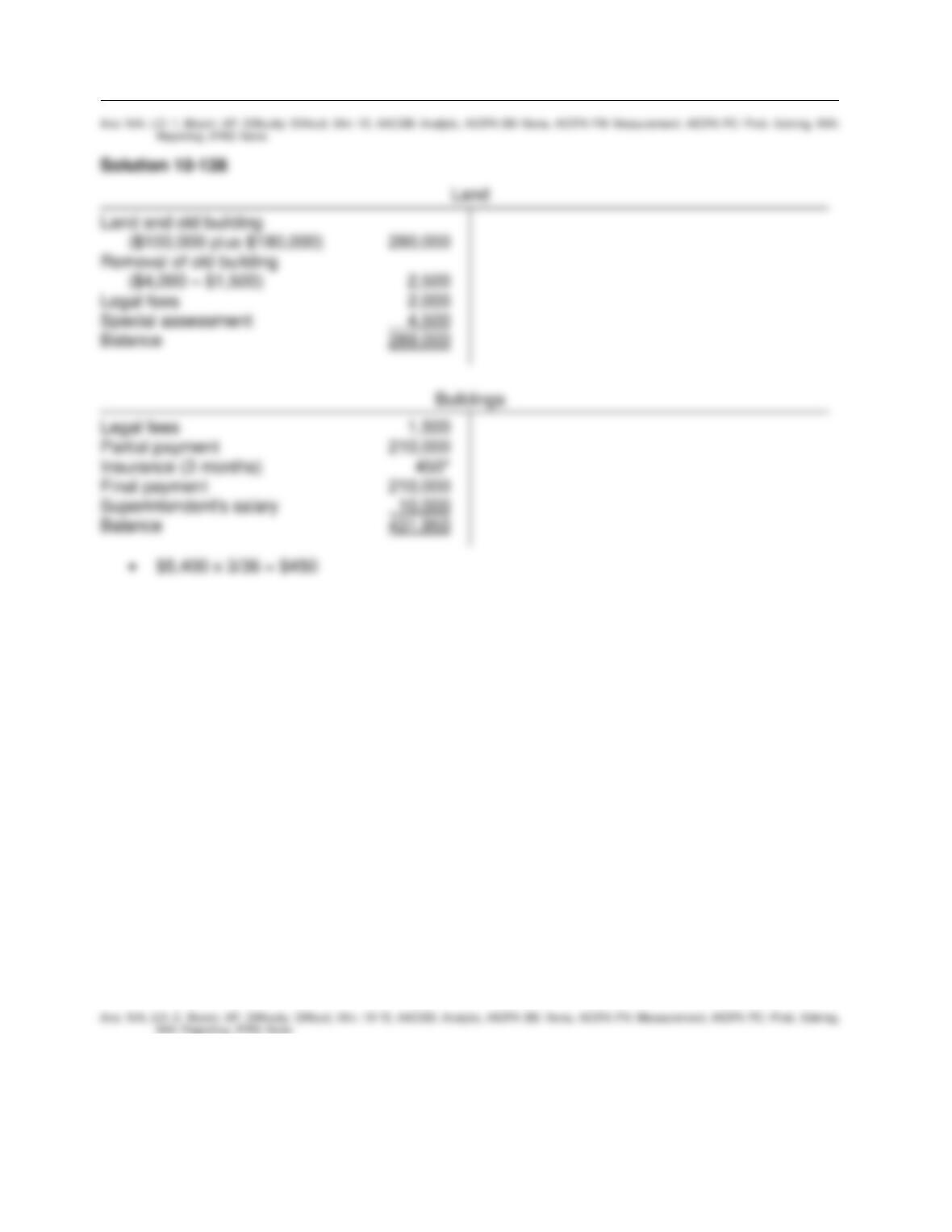
Pr. 10-138—Capitalizing acquisition costs.
Gibbs Manufacturing Co. was incorporated on 1/2/20 but was unable to begin manufacturing
activities until 8/1/20 because new factory facilities were not completed until that date. The Land
and Buildings account at 12/31/20 per the books was as follows:
Date Item Amount
1/31/20 Land and dilapidated building $200,000
2/28/20 Cost of removing building 4,000
4/1/20 Legal fees 6,000
5/1/20 Fire insurance premium payment 5,400
5/1/20 Special tax assessment for streets 4,500
5/1/20 Partial payment of new building construction 210,000
8/1/20 Final payment on building construction 210,000
8/1/20 General expenses 30,000
12/31/20 Asset write-up 75,000
$744,900
Additional information:
1. To acquire the land and building on 1/31/20, the company paid $100,000 cash and 1,000
shares of its common stock (par value = $100/share) which is very actively traded and had a
fair value per share of $180.
2. When the old building was removed, Gibbs paid Kwik Demolition Co. $4,000, but also
received $1,500 from the sale of salvaged material.
3. Legal fees covered the following:
Cost of organization $2,500
Examination of title covering purchase of land 2,000
Legal work in connection with the building construction 1,500
$6,000
4. The fire insurance premium covered premiums for a three-year term beginning May 1, 2020.
5. General expenses covered the following for the period 1/2/20 to 8/1/20.
President’s salary $20,000
Plant superintendent covering supervision of new building 10,000
$30,000
6. Because of the rising land costs, the president was sure that the land was worth at least
$75,000 more than what it cost the company.
Instructions
Determine the proper balances as of 12/31/20 for a separate land account and a separate
buildings account. Use separate T-accounts (one for land and one for buildings) labeling all the
relevant amounts and disclosing all computations.
Test Bank for Intermediate Accounting, Seventeenth Edition
10 – 54
Pr. 10-139—Capitalization of interest.
During 2020, Barden Building Company constructed various assets at a total cost of $14,700,000.
The weighted average accumulated expenditures on assets qualifying for capitalization of interest
during 2020 were $9,800,000. The company had the following debt outstanding at December 31,
2020:
1. 10%, 5-year note to finance construction of various assets,
dated January 1, 2020, with interest payable annually on January 1 $6,300,000
2. 12%, ten-year bonds issued at par on December 31, 2014, with interest
payable annually on December 31 7,000,000
3. 9%, 3-year note payable, dated January 1, 2019, with interest payable
annually on January 1 3,500,000
Instructions
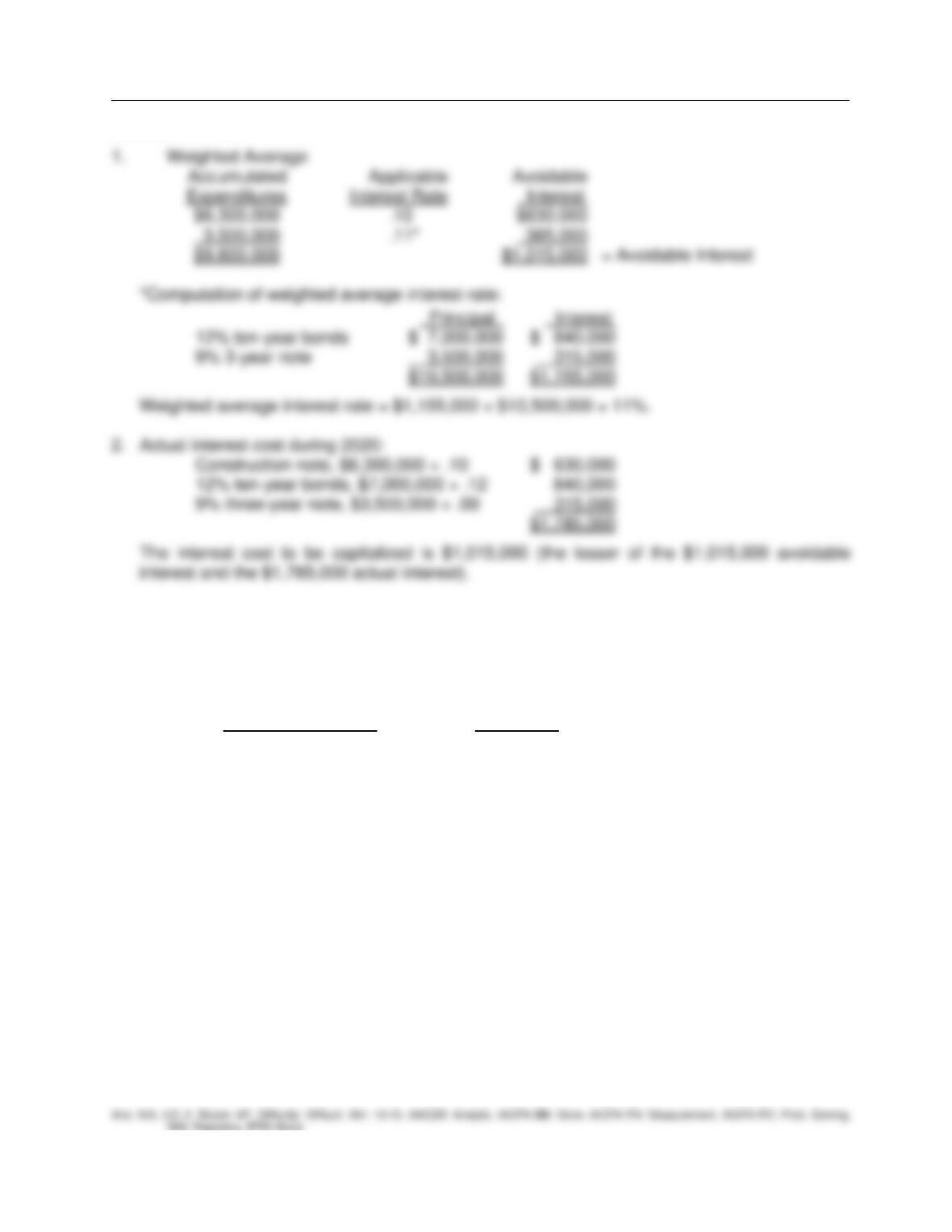
Compute the amounts of each of the following (show computations).
1. Avoidable interest.
2. Total interest to be capitalized during 2020.
Acquisition and Disposition of Property, Plant, and Equipment
10 – 55
Solution 10-139
Pr. 10-140—Capitalization of interest.
Early in 2020, Dobbs Corporation engaged Kiner, Inc. to design and construct a complete
modernization of Dobbs’s manufacturing facility. Construction was begun on June 1, 2020 and
was completed on December 31, 2020. Dobbs made the following payments to Kiner, Inc. during
2020:
Date Payment
June 1, 2020 $2,000,000
August 31, 2020 3,000,000
December 31, 2020 2,500,000
In order to help finance the construction, Dobbs issued the following during 2020:
1. $1,700,000 of 10-year, 9% bonds payable, issued at par on May 31, 2020, with interest
payable annually on May 31.
2. 300,000 shares of no-par common stock, issued at $10 per share on October 1, 2020.
In addition to the 9% bonds payable, the only debt outstanding during 2017 was a $425,000, 12%
note payable dated January 1, 2016 and due January 1, 2023, with interest payable annually on
January 1.
Instructions
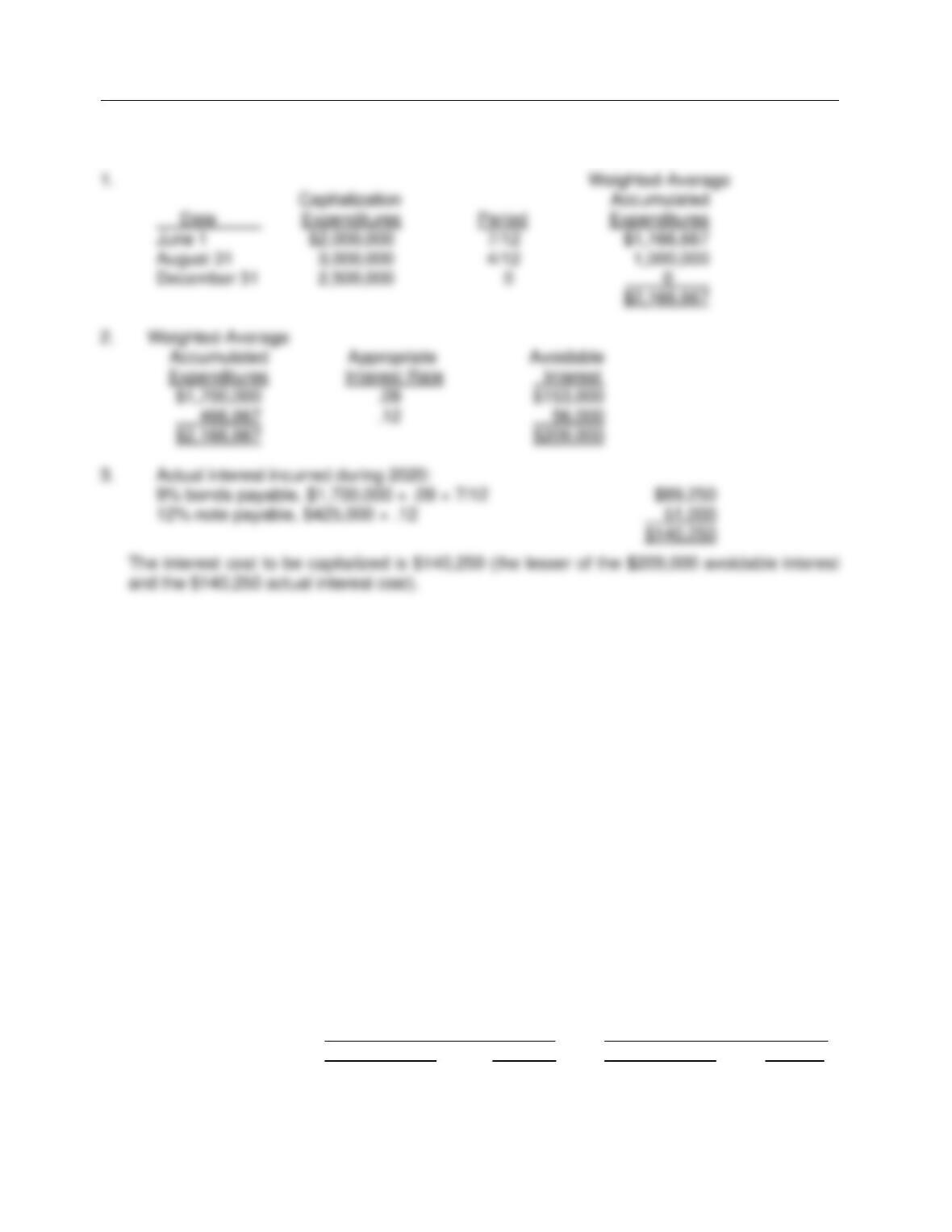
Compute the amounts of each of the following (show computations):
1. Weighted-average accumulated expenditures qualifying for capitalization of interest cost.
2. Avoidable interest incurred during 2020.
3. Total amount of interest cost to be capitalized during 2020.
Test Bank for Intermediate Accounting, Seventeenth Edition
10 – 56
Solution 10-140
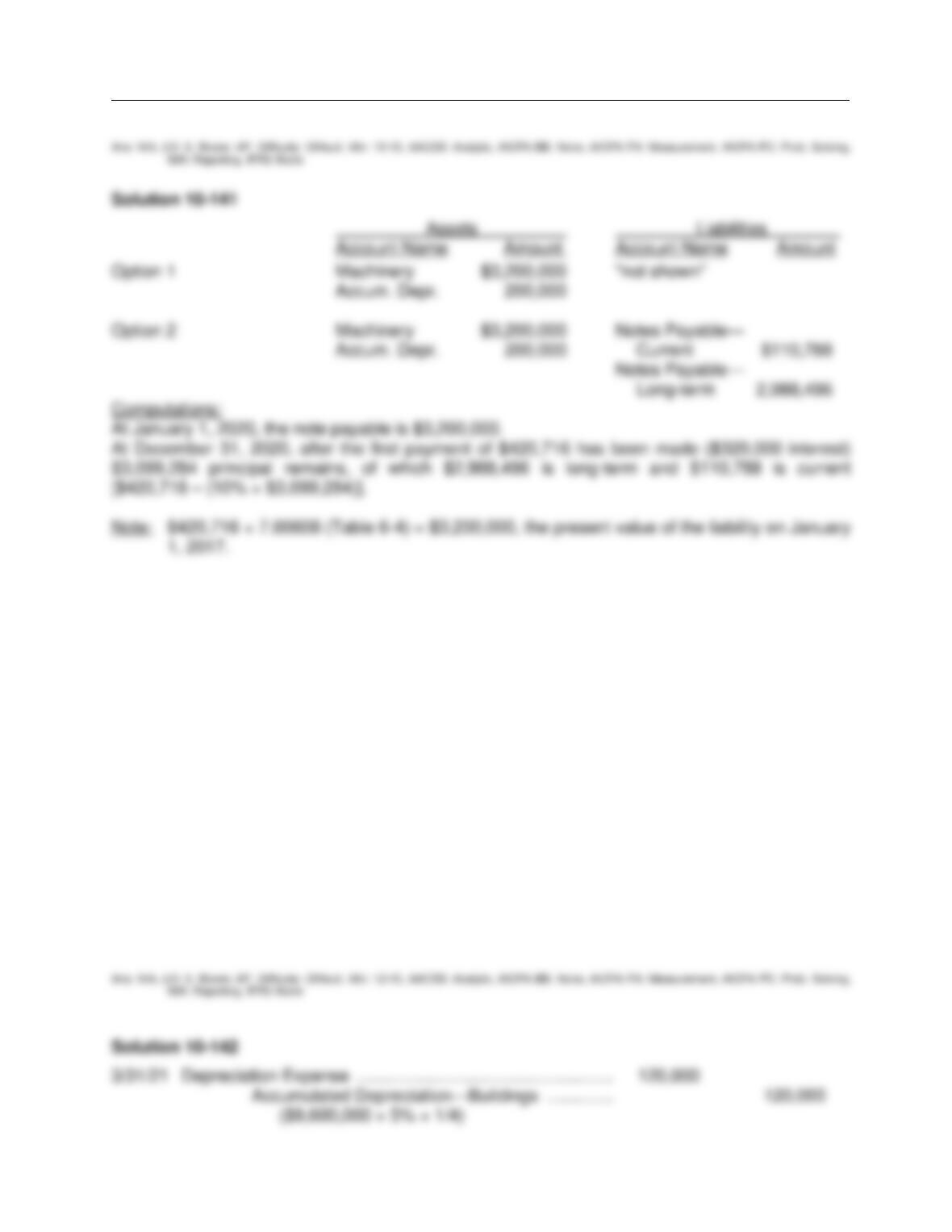
Pr. 10-141—Asset acquisition.
Ford Inc. plans to acquire an additional machine on January 1, 2020 to meet the growing demand
for its product. Stever Company offers to provide the machine to Ford using either of the options
listed below (each option gives Ford exactly the same machine and gives Stever Company
approximately the same net present value cash equivalent at 10%).
Option 1 — Cash purchase $3,200,000.
Option 2 — Installment purchase requiring 15 annual payments of $420,716 due
December 31 each year.
The expected economic life of this machine to Ford is 15 years. Salvage value at that time is
estimated to be $200,000. Straight-line depreciation is used. Interest expense under Option 2 is
computed using the effective interest method.
Instructions
Based upon current generally accepted accounting principles, state how, if at all, the book value
of the machine and the liability should appear on the December 31, 2020 balance sheet of Ford
Inc., for each option. Present your answer on an answer sheet in the following format. If an item
should not appear in the balance sheet, write “not shown” opposite the option.
Assets Liabilities
Account Name Amount Account Name Amount
Option 1
Option 2
Acquisition and Disposition of Property, Plant, and Equipment
10 – 57
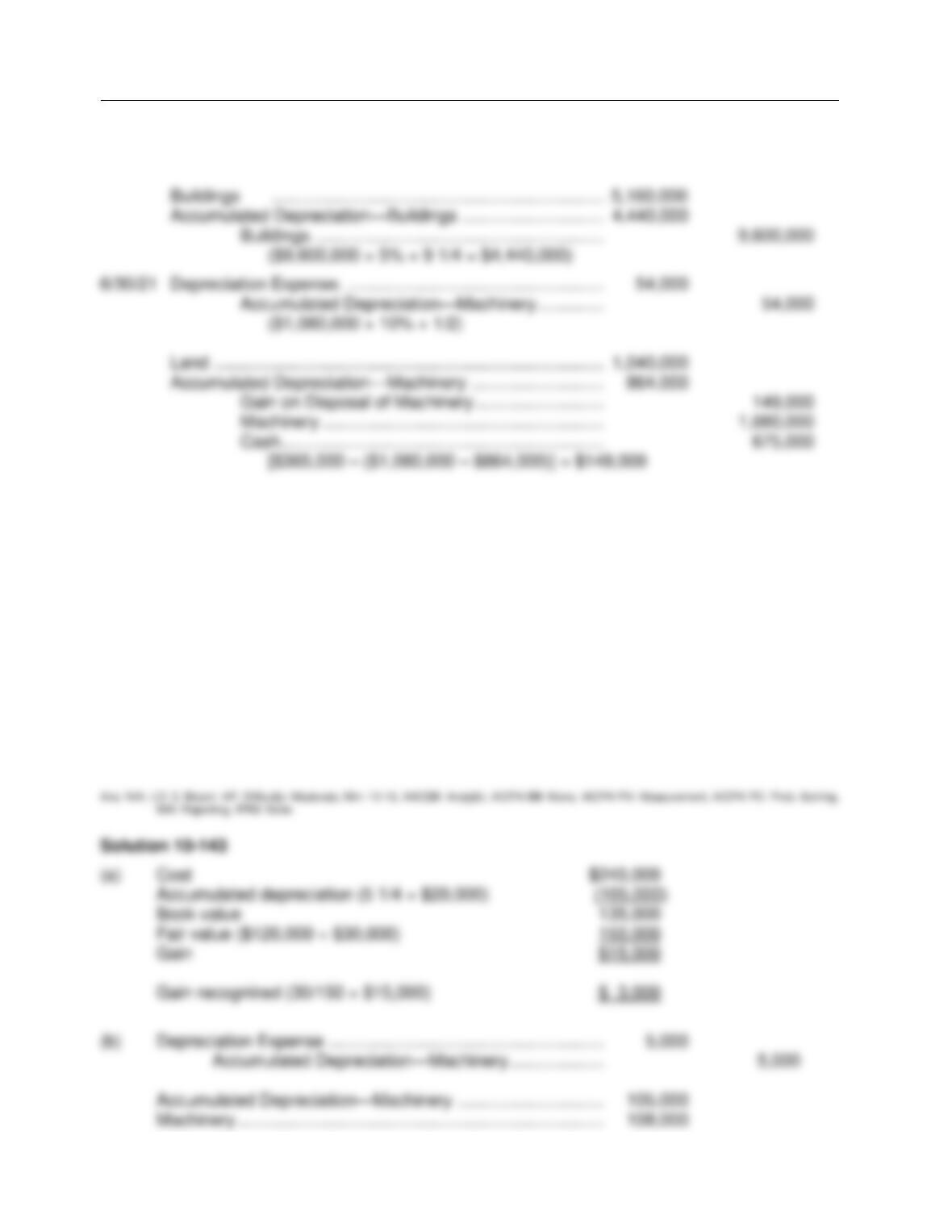
Pr. 10-142—Nonmonetary exchanges.
Moore Corporation follows a policy of a 10% depreciation charge per year on all machinery and a
5% depreciation charge per year on buildings. The following transactions occurred in 2021:
March 31, 2021— Negotiations which began in 2020 were completed and a building purchased
1/1/12 (depreciation has been properly charged through December 31, 2020)
at a cost of $9,600,000 with a fair value of $6,000,000 was exchanged for a
second building which also had a fair value of $6,000,000. The exchange had
no commercial substance. Both parcels of land on which the buildings were
located were equal in value, and had a fair value equal to book value.
June 30, 2021— Machinery with a cost of $1,080,000 and accumulated depreciation through
January 1 of $810,000 was exchanged with $675,000 cash for a parcel of land
with a fair value of $1,040,000. The exchange had commercial substance.
Instructions
Prepare all appropriate journal entries for Moore Corporation for the above dates.
Test Bank for Intermediate Accounting, Seventeenth Edition
10 – 58
Solution 10–142 (cont.)
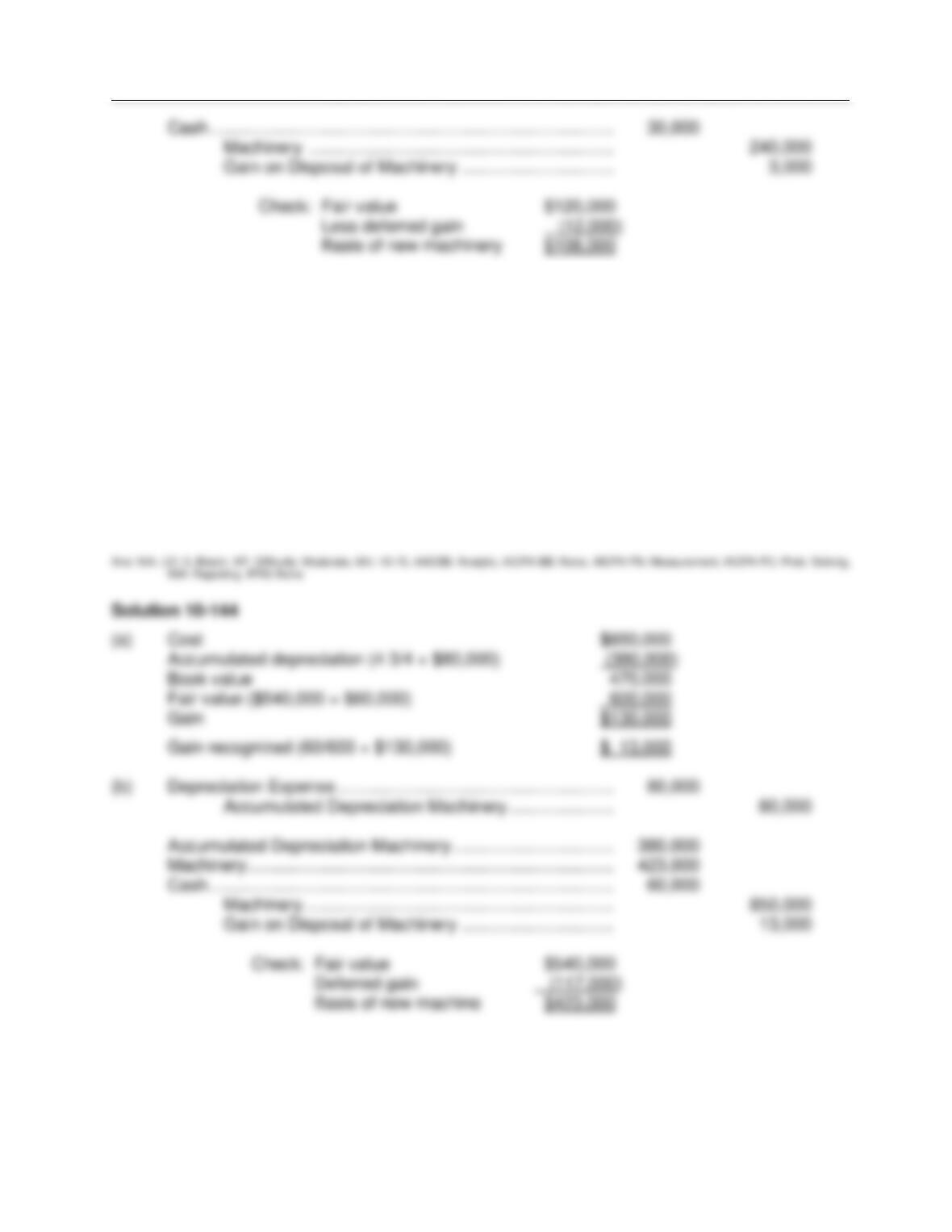
Pr. 10-143—Nonmonetary exchange.
Rogers Co. had a sheet metal cutter that cost $240,000 on January 5, 2016. This old cutter had
an estimated life of ten years and a salvage value of $40,000. On April 3, 2021, the old cutter is
exchanged for a new cutter with a fair value of $120,000. The exchange lacked commercial
substance. Rogers also received $30,000 cash. Assume that the last fiscal period ended on
December 31, 2020, and that straight-line depreciation is used.
Instructions
(a) Show the calculation of the amount of the gain or loss to be recognized by Rogers Co.
(b) Prepare all entries that are necessary on April 3, 2021. Show a check of the amount
recorded for the new cutter.
Acquisition and Disposition of Property, Plant, and Equipment
10 – 59
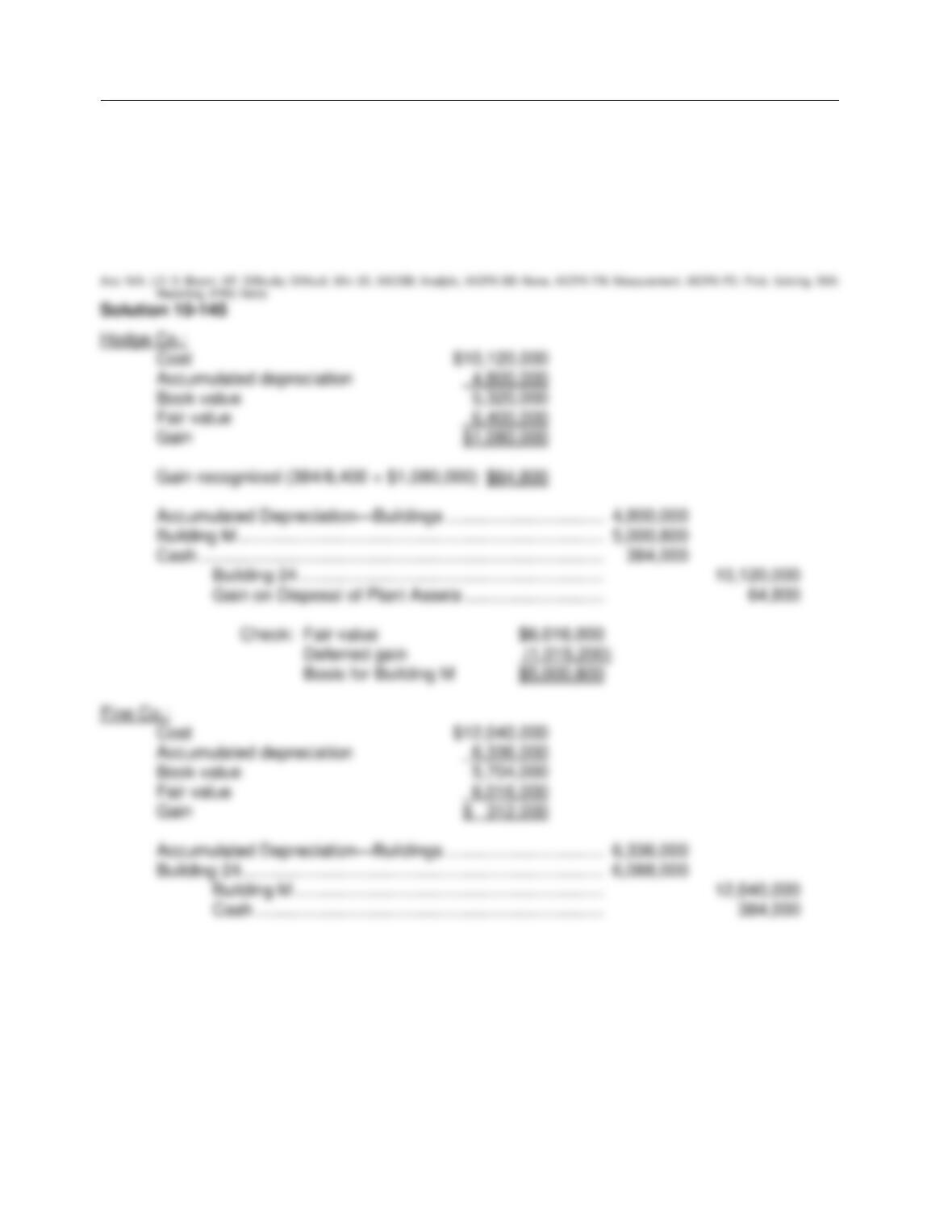
Pr. 10-144—Nonmonetary exchange.
Layne Co. has a machine that cost $850,000 on March 20, 2017. This old machine had an
estimated life of ten years and a salvage value of $50,000. On December 23, 2021, the old
machine is exchanged for a new machine with a fair value of $540,000. The exchange lacked
commercial substance. Layne also received $60,000 cash. Assume that the last fiscal period
ended on December 31, 2020, and that straight-line depreciation is used.
Instructions
(a) Show the calculation of the amount of gain or loss to be recognized by Layne Co. from the
exchange.
(b) Prepare all entries that are necessary on December 23, 2021. Show a check of the amount
recorded for the new machine.
Pr. 10-145—Nonmonetary exchange.
Hodge Co. exchanged Building 24 which has an appraised value of $6,400,000, a cost of
$10,120,000, and accumulated depreciation of $4,800,000 for Building M belonging to Fine Co.
Building M has an appraised value of $6,016,000, a cost of $12,040,000, and accumulated
Test Bank for Intermediate Accounting, Seventeenth Edition
10 – 60
depreciation of $6,336,000. The correct amount of cash was also paid. Assume depreciation has
already been updated.
Instructions
Prepare the entries on both companies’ books assuming the exchange had no commercial
substance. Show a check of the amount recorded for Building M on Hodge’s books. (Round to
the nearest dollar.)
Pr. 10-146—Nonmonetary exchange.
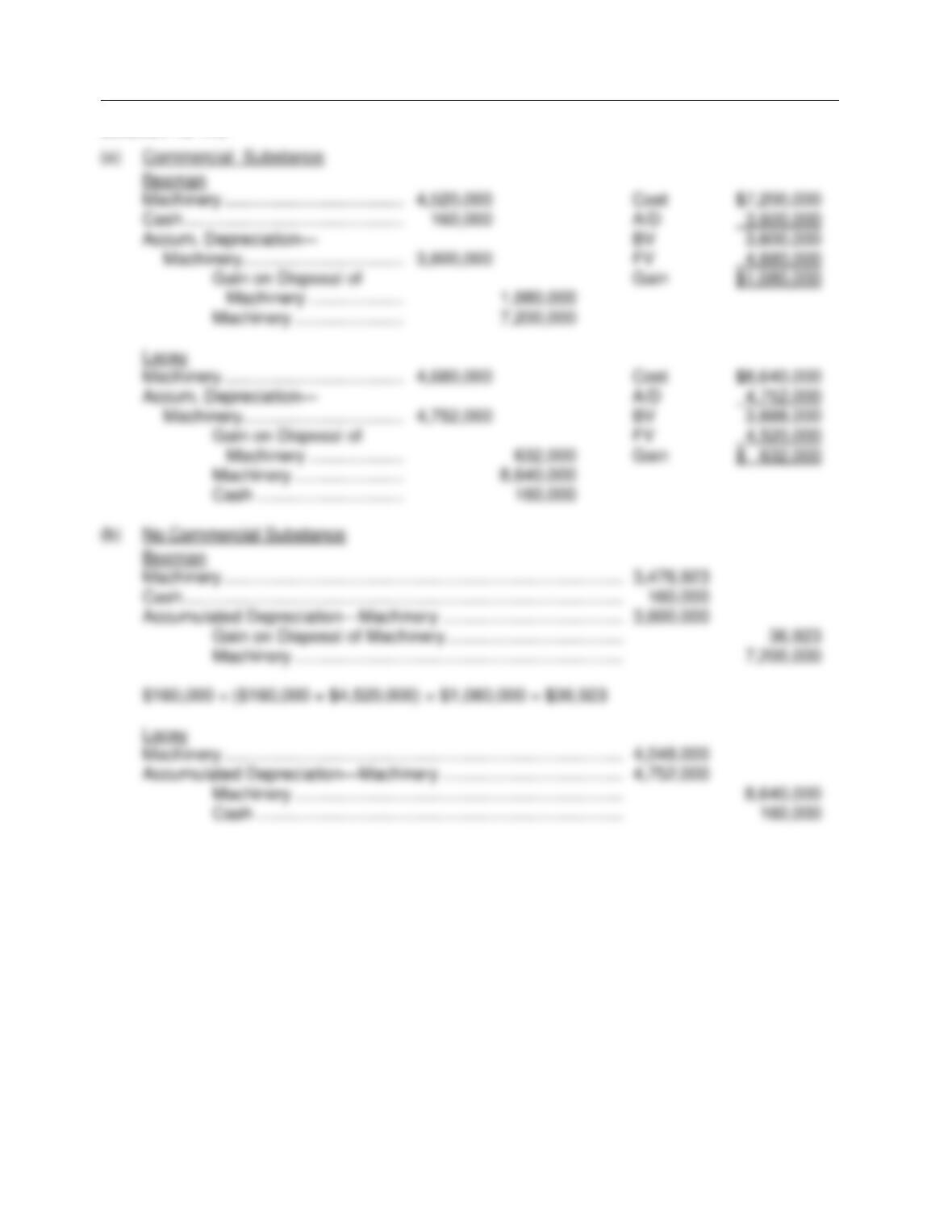
Beeman Company exchanged machinery with an appraised value of $4,680,000, a recorded cost
of $7,200,000 and accumulated depreciation of $3,600,000 with Lacey Corporation for machinery
Lacey owns. The machinery has an appraised value of $4,520,000, a recorded cost of
$8,640,000, and accumulated depreciation of $4,752,000. Lacey also gave Beeman $160,000 in
the exchange. Assume depreciation has already been updated.
Acquisition and Disposition of Property, Plant, and Equipment
10 – 61
Instructions
(a) Prepare the entries on both companies’ books assuming that the exchange had commercial
substance. (Round all computations to the nearest dollar.)
(b) Prepare the entries on both companies’ books assuming that the exchange lacked
commercial substance. (Round all computations to the nearest dollar.)
Test Bank for Intermediate Accounting, Seventeenth Edition
10 – 62
Solution 10-146
Acquisition and Disposition of Property, Plant, and Equipment
10 – 63
Short Answer:
1. What are the major characteristics of plant assets?
2. What interest rates should be used in determining the amount of interest to be capitalized?
How should the amount of interest to be capitalized be determined?