d.
Interest expense remains constant in amount for each interest period.
49. When the effective interest method of amortization is used for a bond premium, the amount of interest
expense for an interest period is calculated by multiplying the
a.
carrying value of the bonds at the beginning of the period by the face interest rate.
b.
face value of the bonds at the beginning of the period by the effective interest rate.
c.
carrying value of the bonds at the beginning of the period by the effective interest rate.
d.
face value of the bonds at the beginning of the period by the face interest rate.
50. The amortization of a bond premium will result in reporting an amount of interest expense for an
interest period that
a.
exceeds the amount of cash to be paid for interest for the period.
b.
is less than the amount of cash to be paid for interest for the period.
c.
has no predictable relationship with the amount of cash to be paid for interest for the
period.
d.
equals the amount of cash to be paid for interest for the period.
51. When the straight-line method of amortization is used for a bond discount, the amount of interest
expense for an interest period is calculated by
a.
adding the amount of discount amortization for the period to the amount of cash paid for
interest during the period.
b.
deducting the amount of discount amortization for the period from the amount of cash paid
for interest during the period.
c.
multiplying the carrying value of the bonds by the effective interest rate.
d.
multiplying the face value of the bonds by the face interest rate.
52. If bonds payable were issued initially at a discount, the carrying value of the bonds at a balance sheet
date will be calculated by
a.
deducting the amount of discount amortized between the issuance date and the balance
sheet date from the carrying value at the previous balance sheet date.
b.
deducting the balance of unamortized bond discount from the current carrying value.
c.
adding the balance of unamortized bond discount to the face value.
d.
adding the amount of discount amortized between the issuance date and the balance sheet
date to the face value.
53. When bonds have been issued at a premium, the periodic amortization of the premium will
a.
increase the carrying value of the bonds.
b.
have no effect on the carrying value of the bonds.
c.
decrease the carrying value of the bonds.
d.
cause the carrying value always to equal the face value of the bonds.
54. The total interest cost on seventy-eight, ten-year, 6 percent, $1,000 bonds that are issued at 98 is
a.
$48,360.
b.
$45,240.
c.
$47,580.
d.
$46,800.
55. Trigg Corporation issued $200,000 of 20-year, 6 percent bonds at 98 on one of its semi-annual interest
dates. The straight-line method of amortization is to be used. The entry to record the bond interest
expense on the next interest payment date is:
a.
Bond Interest Expense 6,100
Unamortized Bond Discount 100
Cash 6,000
b.
Bond Interest Expense 12,200
Unamortized Bond Discount 200
Cash 12,000
c.
Cash 6,100
Unamortized Bond Discount 6,100
d.
Bond Interest Expense 6,000
Cash 6,000
56. Suffolk Corporation issued $100,000 of 20-year, 6 percent bonds at 98 on one of its semi-annual
interest dates. The straight-line method of amortization is to be used. After seven years, what is the
carrying value of the bonds?
a.
$98,350
b.
$98,700
c.
$99,300
d.
$99,650
57. Suffolk Corporation issued $100,000 of 20-year, 6 percent bonds at 98 on one of its semi-annual
interest dates. The straight-line method of amortization is to be used. What is the total interest cost of
the bonds?
a.
$120,000
b.
$122,000
c.
$118,000
d.
$117,500
58. Kenton Corporation issued $556,000 of 30-year, 8 percent bonds at 106 on one of its semi-annual
interest dates. The straight-line method of amortization is to be used. The entry to record the bond
interest expense on the next interest payment date is:
a.
Bond Interest Expense 22,240
Cash 22,240
b.
Bond Interest Expense 43,368
Unamortized Bond Premium 1,112
Cash 44,480
c.
Bond Interest Expense 21,040
Cash 21,040
d.
Bond Interest Expense 21,684
Unamortized Bond Premium 556
Cash 22,240
59. Kenton Corporation issued $600,000 of 30-year, 8 percent bonds at 106 on one of its semi-annual
interest dates. The straight-line method of amortization is to be used. What is the total interest cost of
the bonds?
a.
$1,439,000
b.
$1,404,000
c.
$1,440,000
d.
$1,476,000
60. Kenton Corporation issued $562,000 of 30-year, 8 percent bonds at 106 on one of its semi-annual
interest dates. The straight-line method of amortization is to be used. After 11 years, what is the
carrying value of the bonds?
a.
$578,860
b.
$579,984
c.
$576,050
d.
$583,356
61. A company issued $300,000 of 20-year, 8 percent bonds at 96. If interest is paid semi-annually, the
entry to record the amount of bond interest expense (assuming the straight-line method of
amortization) on any interest date is
a.
Bond Interest Expense 12,000
Cash 12,000
b.
Bond Interest Expense 24,300
Unamortized Bond Discount 300
Cash 24,000
c.
Bond Interest Expense 23,700
Cash 23,700
d.
Bond Interest Expense 12,300
Unamortized Bond Discount 300
Cash 12,000
62. A ten-year bond has a face value of $10,000, a face interest rate of 11 percent, an unamortized bond
premium of $400, and an effective interest rate of 10 percent. The bonds were issued on one of the
semi-annual interest payment dates. The entry to record the bond interest expense on the first
semi-annual interest payment date is: (assuming the effective interest method of amortization),
a.
Bond Interest Expense 520
Unamortized Bond Premium 30
Cash 550
b.
Bond Interest Expense 520
Cash 520
c.
Bond Interest Expense 550
Cash 550
d.
Unamortized Bond Premium 520
Cash 520
63. Rowan Corporation issued ten-year term bonds on January 1, 2013, with a face value of $400,000. The
face interest rate is 6 percent and interest is payable semi-annually on June 30 and December 31. The
bonds were issued for $345,480 to yield an effective annual rate of 8 percent. The effective interest
method of amortization is to be used. The entry to record the bond interest expense on the first interest
payment date is: (Round answer to the nearest dollar.)
a.
Bond Interest Expense 12,000
Cash 12,000
b.
Bond Interest Expense 10,364
Unamortized Bond Discount 1,636
Cash 16,000
c.
Bond Interest Expense 13,819
Cash 13,819
d.
Bond Interest Expense 13,819
Unamortized Bond Discount 1,819
Cash 12,000
64. Rowan Corporation issued ten-year term bonds on January 1, 2013, with a face value of $400,000. The
face interest rate is 8 percent and interest is payable semi-annually on June 30 and December 31. The
bonds were issued for $345,480 to yield an effective annual rate of 10 percent. The effective interest
method of amortization is to be used. The entry on June 30, 2013, to record the payment of interest and
amortization of discount will be:
a.
Bond Interest Expense 16,000
Cash 16,000
b.
Bond Interest Expense 17,274
Unamortized Bond Discount 1,274
Cash 16,000
c.
Bond Interest Expense 17,274
Cash 17,274
d.
Bond Interest Expense 20,000
Unamortized Bond Discount 6,181
Cash 13,819
65. Rowan Corporation issued ten-year term bonds on January 1, 2013, with a face value of $400,000. The
face interest rate is 6 percent and interest is payable semiannually on June 30 and December 31. The
bonds were issued for $345,480 to yield an effective annual rate of 8 percent. The effective interest
method of amortization is to be used. How much bond interest expense (rounded to the nearest dollar)
should be reported on the income statement for the year ended December 31, 2013?
a.
$24,000
b.
$27,711
c.
$27,566
d.
$27,638
66. Rowan Corporation issued ten-year term bonds on January 1, 2013, with a face value of $400,000. The
face interest rate is 6 percent and interest is payable semi-annually on June 30 and December 31. The
bonds were issued for $345,480 to yield an effective annual rate of 8 percent. The effective interest
method of amortization is to be used. The entry to be recorded on December 31, 2013, for the payment
of interest (rounded to the nearest dollar) and the amortization of discount is:
a.
Bond Interest Expense 13,819
Unamortized Bond Discount 1,819
Cash 12,000
b.
Bond Interest Expense 13,892
Unamortized Bond Discount 1,892
Cash 12,000
c.
Bond Interest Expense 13,892
Cash 13,892
d.
Bond Interest Expense 12,000
Unamortized Bond Discount 12,000
67. Rowan Corporation issued ten-year term bonds on January 1, 2013, with a face value of $400,000. The
face interest rate is 6 percent and interest is payable semi-annually on June 30 and December 31. The
bonds were issued for $345,480 to yield an effective annual rate of 8 percent. The effective interest
method of amortization is to be used. The carrying value of the bonds payable on the December 31,
2013, balance sheet date should be (rounded to the nearest dollar)
a.
$348,206.
b.
$349,118.
c.
$349,191.
d.
$345,480.
68. Lenz Corporation issued ten-year, 8 percent bonds payable in 2012 at a premium. During 2012, the
company’s accountant failed to amortize any of the bond premium. The omission of the premium
amortization will
a.
cause net income for 2012 to be overstated.
b.
not affect net income reported for 2012.
c.
cause net income for 2012 to be understated.
d.
cause retained earnings at the end of 2012 to be overstated.
69. Bonds that contain a provision that allows the issuing corporation to buy back the bonds prior to the
maturity date are called
a.
unsecured bonds
b.
callable bonds.
c.
convertible bonds.
d.
coupon bonds
70. Bonds that contain a provision that allows the holders to exchange the bonds for other securities of the
issuing corporation are called
a.
registered bonds
b.
unsecured bonds
c.
callable bonds.
d.
convertible bonds.
71. When bonds are converted to common stock, which of the following could be part of the entry?
a.
Credit to Gain on Conversion of Bonds
b.
Credit to Unamortized Bond Premium
c.
Credit to Unamortized Bond Discount
d.
Debit to Common Stock
72. When bonds payable are converted into stock, the carrying value of the bonds should be
a.
credited to Retained Earnings.
b.
credited to contributed capital accounts.
c.
debited to Retained Earnings.
d.
debited to Loss on Conversion of Bonds.
73. A company has $1,634,000 in bonds payable with an unamortized premium of $40,000. If one-fourth
of the bonds are converted to common stock, the entry that would record the conversion is:
a.
Bonds Payable 408,500
Common Stock 408,500
b.
Bonds Payable 448,500
Common Stock 448,500
c.
Common Stock 398,500
Bonds Payable 398,500
d.
Bonds Payable 408,500
Unamortized Bond Premium 10,000
Common Stock 418,500
74. A $300,000 bond issue with a carrying value of $311,000 is called at 103 and retired. The entry to
record the retirement of bonds would be:
a.
Bonds Payable 309,000
Cash 309,000
b.
Bonds Payable 311,000
Cash 311,000
c.
Cash 300,000
Bonds Payable 300,000
d.
Bonds Payable 300,000
Unamortized Bond Premium 11,000
Cash 309,000
Gain on Retirement of Bonds 2,000
75. A $100,000 bond issue with a carrying value of $94,000 is called at 102 and retired. The entry to
record the retirement of bonds would be:
a.
Bonds Payable 100,000
Loss on Retirement of Bonds 8,000
Unamortized Bond Discount 6,000
Cash 102,000
b.
Bonds Payable 94,000
Cash 94,000
c.
Bonds Payable 100,000
Gain on Retirement of Bonds 6,000
Cash 94,000
d.
Bonds Payable 100,000
Loss on Retirement of Bonds 2,000
Cash 102,000
76. A company has $1,800,000 in bonds payable with an unamortized discount of $42,000. If two-thirds of
the bonds are converted to common stock, the carrying value of the bonds payable will decrease by
a.
$586,000.
b.
$1,172,000.
c.
$1,228,000.
d.
$1,256,000.
77. A $200,000 bond issue with a carrying value of $194,000 is called at 101 and retired. The entry to
record the retirement of bonds would be:
a.
Bonds Payable 200,000
Gain on Retirement of Bonds 6,000
Cash 194,000
b.
Bonds Payable 200,000
Cash 200,000
c.
Bonds Payable 200,000
Loss on Retirement of Bonds 8,000
Unamortized Bond Discount 6,000
Cash 202,000
d.
Bonds Payable 194,000
Loss on Retirement of Bonds 8,000
Cash 202,000
78. A $200,000 bond issue with a carrying value of $206,000 is called at 101 and retired. The entry to
record the retirement of bonds would be:
a.
Bonds Payable 202,000
Loss on Retirement of Bonds 4,000
Cash 206,000
b.
Bonds Payable 200,000
Unamortized Bond Premium 6,000
Cash 202,000
Gain on Retirement of Bonds 4,000
c.
Bonds Payable 200,000
Loss on Retirement of Bonds 6,000
Cash 206,000
d.
Bonds Payable 206,000
Cash 206,000
79. A bond issue of $50,000 with a carrying value of $49,000 is converted into $10 par value common
stock at the rate of fifty shares for each $1,000 bond. The entry to record the conversion of bonds
would be:
a.
Bonds Payable 50,000
Loss on Retirement of Bonds 1,000
Unamortized Bond Discount 1,000
Common Stock 50,000
b.
Bonds Payable 50,000
Common Stock 25,000
Additional Paid-In Capital 25,000
c.
Bonds Payable 50,000
Common Stock 25,000
Additional Paid-In Capital 24,000
Unamortized Bond Discount 1,000
d.
Bonds Payable 49,000
Unamortized Bond Discount 1,000
Common Stock 25,000
Additional Paid-In Capital 25,000
80. Hooper Corporation has bonds outstanding with a face value of $100,000 and a carrying value of
$103,000 on December 31, 2013. If the company calls in and retires these bonds on December 31,
2013, for $105,000, the entry to record the retirement would be:
a.
Bonds Payable 103,000
Cash 103,000
b.
Bonds Payable 105,000
Cash 105,000
c.
Bonds Payable 100,000
Loss on Retirement of Bonds 3,000
Cash 103,000
d.
Bonds Payable 100,000
Loss on Retirement of Bonds 2,000
Unamortized Bond Premium 3,000
Cash 105,000
SHORT ANSWER
1. When fixed mortgage payments are made, in what way does the interest portion change each month,
and why?
2. Bracken Corporation had income before income taxes of $8,000,000 and interest expense of $900,000.
Calculate Bracken’s interest coverage ratio, rounded to one decimal place.
3. When a bond sells at a premium, what is probably true about the market interest rate versus the face
interest rate? Discuss.
4. When a bond sells at a discount, what is probably true about the market interest rate versus the face
interest rate? Discuss.
5. When determining the value of a bond using present value, what are the two components used in the
calculation?
6. Montgomery Corporation has a 7 percent, $300,000 bond issue that originally was issued five years
ago. There are now ten years remaining on the bond issue, and the market interest rate is 12 percent.
Interest is paid semi-annually. Calculate the current market value of the bond issue, using present
value tables.
7. Flint Corporation issues $1,000,000 of 30-year, 8 percent bonds at 106. Interest is paid semi-annually,
and the effective interest method is used for amortization. Assume that the market interest rate for
similar investments is 7 percent and that the bonds are issued on an interest date.
a. What amount was received for the bonds?
b. How much interest is paid each interest period?
c. How much bond interest expense is recorded on the first interest date (after the issue date)?
d. What is the carrying value of the bonds after the first interest date (after the issue date)?
8. West Valley Corporation issues $800,000 of 20-year, 9 percent bonds at 95. Interest is paid
semi-annually, and the effective interest method is used for amortization. Assume that the market
interest rate for similar investments is 10 percent and that the bonds are issued on an interest date.
a. What amount was received for the bonds?
b. How much interest is paid each interest period?
c. How much bond interest expense is recorded on the first interest date (after the issue date)?
d. What is the carrying value of the bonds after the first interest date (after the issue date)?
9. Technically, what is meant by the amortization of a bond discount, and why is it necessary?
10. On January 1, 2013, Woolfe Corporation issued five-year term bonds with a face value of $1,400,000.
Interest is payable annually on December 31. The bonds were issued for $1,454,600. The effective
interest method of amortization is used. Woolfe reported Bond Interest Expense of $130,914 on its
income statement for the year ended December 31, 2013. Calculate the effective interest rate for these
bonds.
11. Comment on the change in both the carrying value and the balance of the Unamortized Bond Discount
account over the life of a bond issue.
12. Comment on the change in both the carrying value and the balance of the Unamortized Bond Premium
account over the life of a bond issue.
13. When bonds are converted to common stock, what is the basis for recording (valuing) the stock
issued?
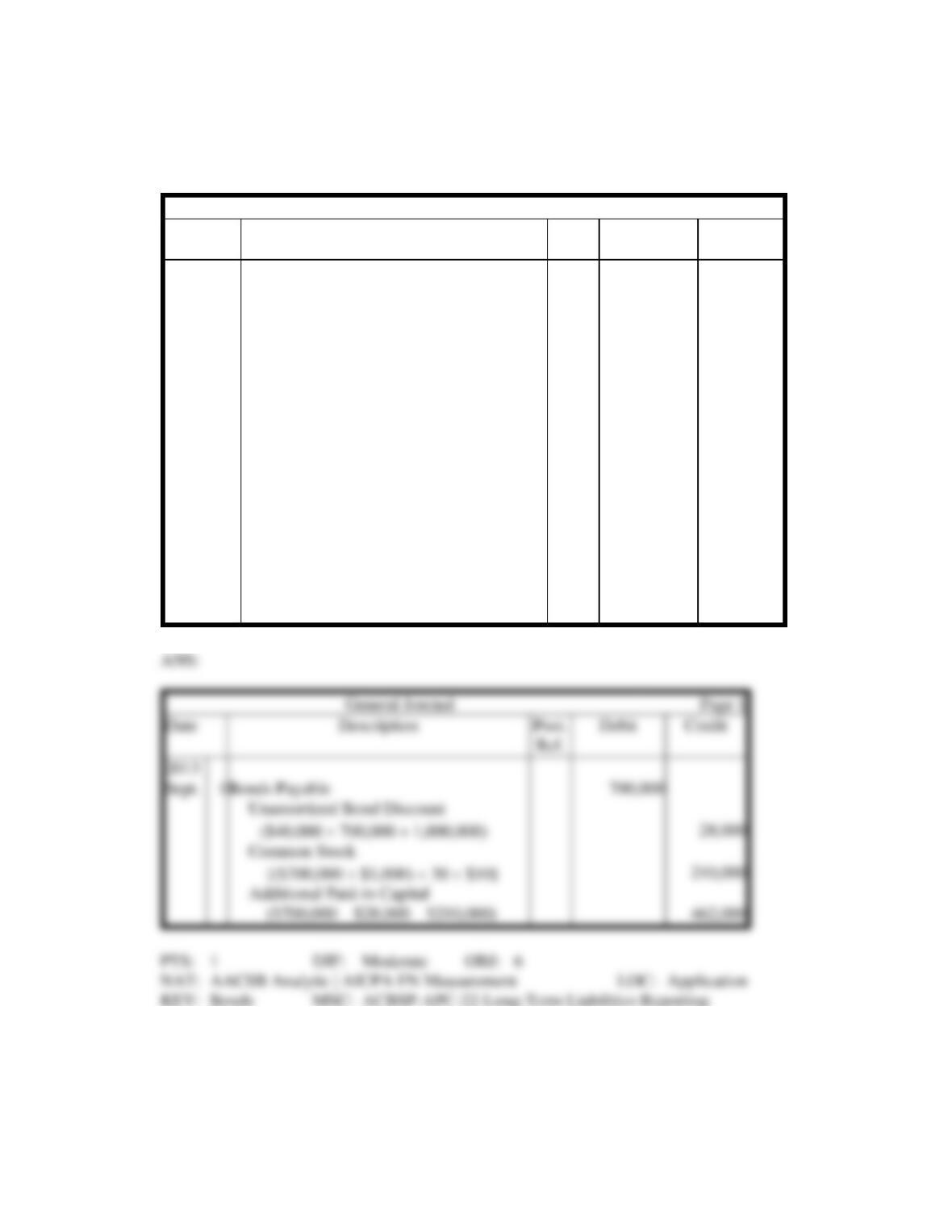
14. Trimble Corporation has $1,000,000 worth of 7 percent convertible bonds outstanding. On September
1, 2013, there is $40,000 of unamortized discount associated with these bonds. The bonds are
convertible at the rate of 30 shares of $10 par value common stock for each $1,000 bond. On
September 1, 2013, an interest payment date, bondholders presented $700,000 of the bonds for
conversion. Prepare an entry in journal form without explanation to record the conversion of the
bonds.
General Journal
Page 1
Date
Description
Post.
Ref.
Debit
Credit
15. Valdez Corporation has outstanding $1,500,000 of 10 percent bonds callable at 103. On July 1, a
semi-annual interest payment date, the unamortized bond premium equaled $60,000. On that date,
$900,000 of the bonds were called and retired. Prepare an entry in journal form without explanation to
record the retirement of the bonds on July 1.
($40,000 700,000 ÷ 1,000,000)
[($700,000 ÷ $1,000) 30 $10]
General Journal
Page 1
Date
Description
Post.
Ref.
Debit
Credit
16. On December 31, 2012, the balance sheet of the Gable Corporation reported 1,000 bonds outstanding
with a face value of $1,000,000 and a related unamortized discount of $70,000. The bonds are
convertible at the rate of 25 shares of common stock for each $1,000 bond. On January 1, 2013, the
bondholders presented $800,000 of the bonds for conversion. The entry to record this conversion
contained a credit to Additional Paid-in Capital for $344,000. Calculate the par value per share of the
common stock.
MATCHING
Match each definition with the correct term below.
a.
A security that represents money that a corporation borrows from the investing public.
Unamortized Bond Premium
Gain on Retirement of Bonds