Test Bank to accompany Jiambalvo Managerial Accounting, 6th Edition
10–54
175. In the fourth quarter of 2017, Winston Wheels had the following net income:
Sales $400,000
Less cost of sales 150,000
Gross margin 250,000
Selling and administration costs 110,000
Income before taxes 140,000
Income taxes 42,000
Net income $ 98,000
Purchases in the fourth quarter of 2017 amounted to $170,000. Estimated data for 2018
follow:
First Second Third Fourth
Quarter Quarter Quarter Quarter
Sales $300,000 $350,000 $400,000 $450,000
Cost of sales 170,000 200,000 230,000 150,000
Purchases 200,000 230,000 250,000 280,000
Selling and admin. 110,000 110,000 110,000 110,000
• Taxes are 30% of pretax income and are paid in the month of accrual.
• All sales are on credit and 30% are collected in the quarter of sale and 70% are
collected in the next quarter.
• 40% of purchases are paid in the quarter of purchase and 60% in the next quarter.
• Selling and administrative expenses are paid in the quarter incurred.
• There is $11,000 of depreciation included in selling and administrative expense.
• A capital expenditure for $40,000 is planned for the fourth quarter of 2018.
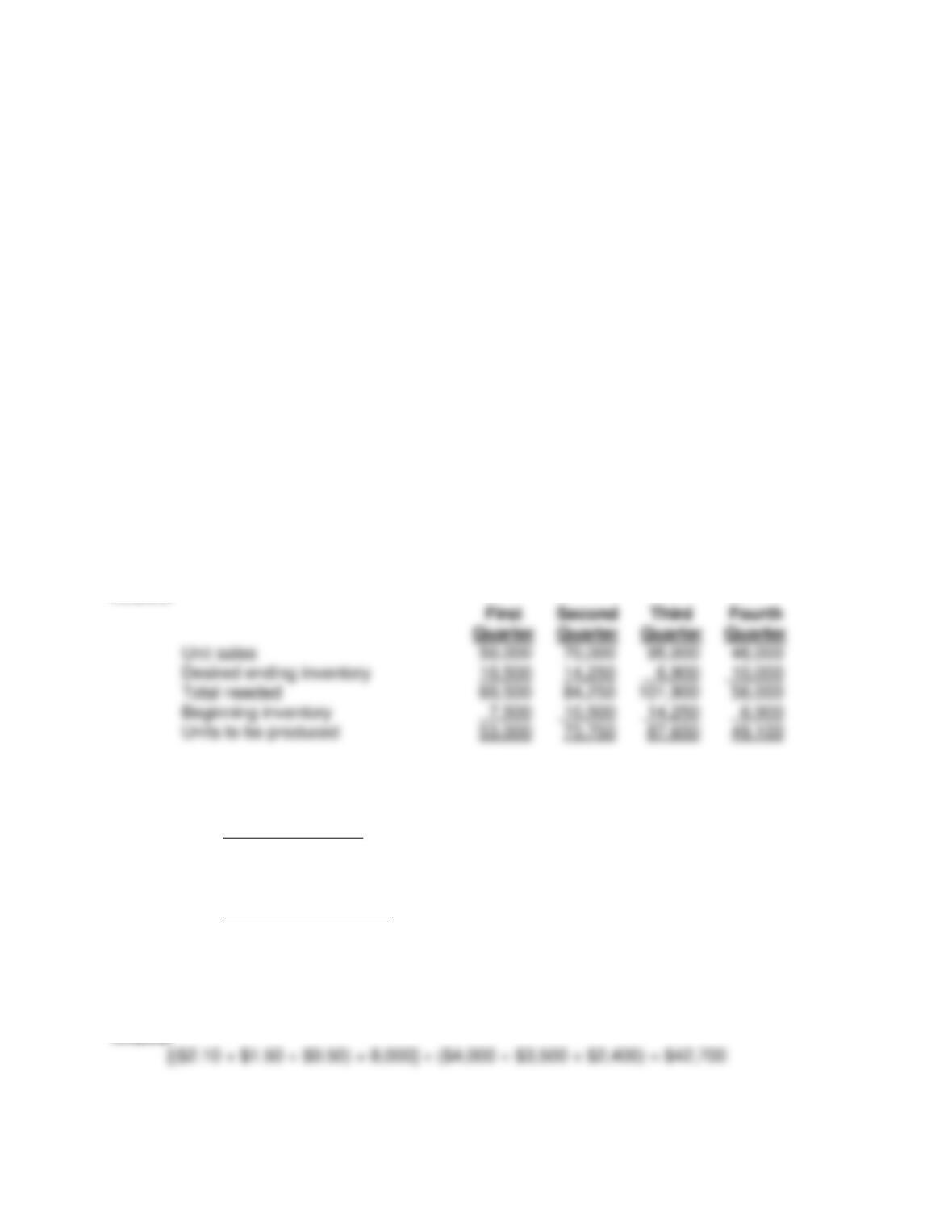
Prepare a cash disbursements budget for the second quarter of 2018.
Answer
Chapter 10 Budgetary Planning and Control
10–55
176. Green & Clean produces and sells organic concentrated detergent. Information about
the budget for 2017 is as follows:
1. The company expects to sell 50,000 bottles of detergent in the first quarter,
70,000 in the second quarter, 95,000 in the third quarter, and 46,000 in the fourth
quarter.
2. A bottle of detergent requires 5 ounces of Chemical A and 12 ounces of
Chemical B.
3. The desired ending inventory of finished goods is equal to 15% of next quarter’s
sales, whereas the desired ending inventory for material is 10% of next quarter’s
production requirements.
4. There are 7,500 bottles of detergent, 25,000 ounces of Chemical A, and 60,000
ounces of Chemical B on hand at the beginning of the first quarter.
5. At the end of the fourth quarter, the company must have 10,000 bottles of
detergent, 24,000 ounces of Chemical A, and 90,000 ounces of Chemical B to
meet its needs in the first quarter of 2018.
6. The cost of Chemical A is $0.12 per ounce, the cost of Chemical B is $0.08 per
ounce, and the selling price of the detergent is $11.50 per bottle.
7. The cost of direct labor is $0.80 per bottle, and the cost of variable overhead is
$1.20 per bottle. Fixed manufacturing overhead is $50,000 per quarter.
8. Variable selling and administrative expense is 5% of sales, and fixed selling and
administrative expenses are $60,000 per quarter.
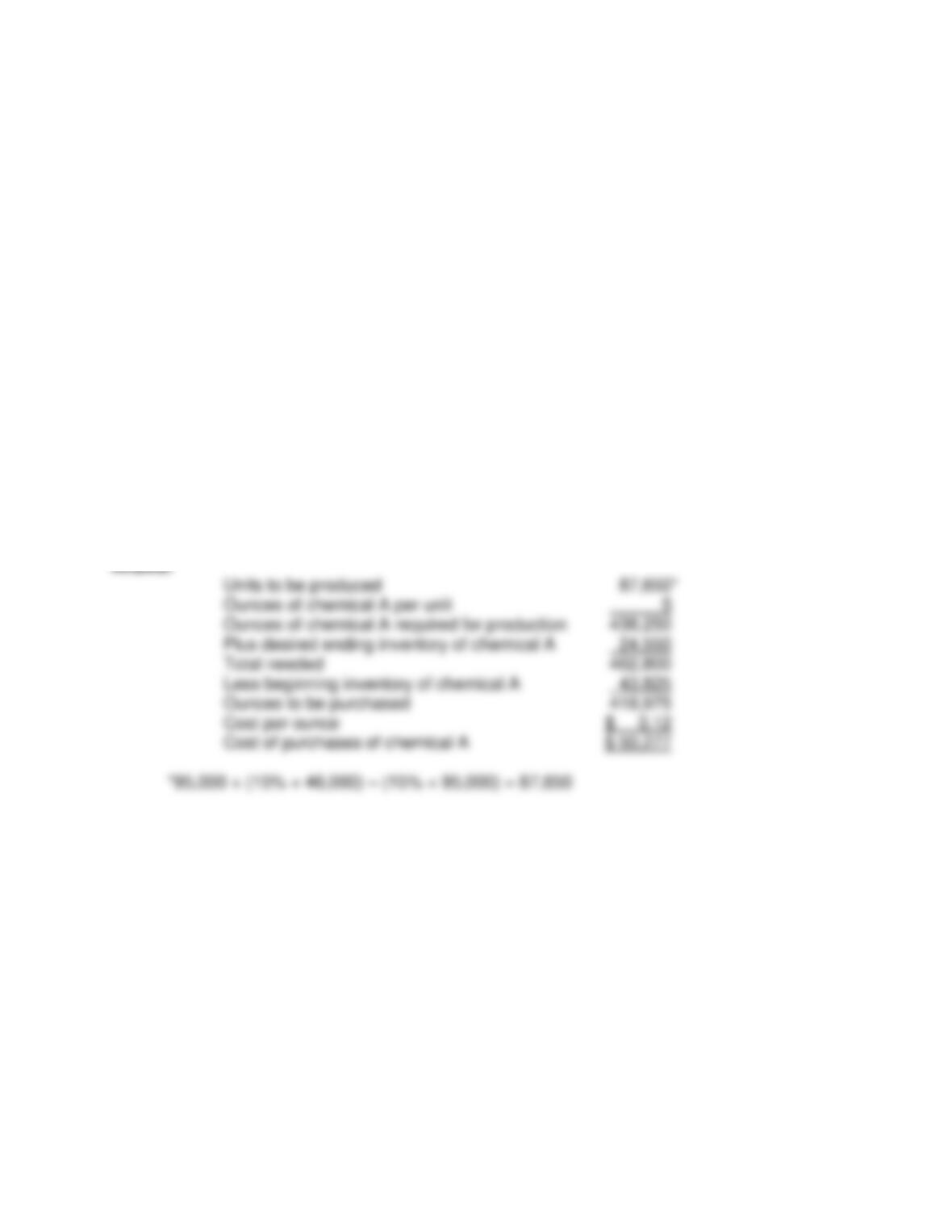
Prepare a production budget for each quarter of 2017.
Answer
177. Pappas Products manufactures a single product. Expected manufacturing costs are as
follows:
Variable unit costs
Direct materials $2.10 per unit
Direct labor $1.50 per unit
Manufacturing overhead $0.50 per unit
Fixed costs per month
Depreciation $4,000 per month
Supervisory salaries $3,500 per month
Other fixed costs $2,400 per month
How much are budgeted manufacturing costs for a production levels of 8,000 units?
Answer
Test Bank to accompany Jiambalvo Managerial Accounting, 6th Edition
10–56
178. Green & Clean produces and sells organic concentrated detergent. Information about
the budget for 2017 is as follows:
1. The company expects to sell 50,000 bottles of detergent in the first quarter, 70,000 in
the second quarter, 95,000 in the third quarter, and 46,000 in the fourth quarter.
2. A bottle of detergent requires 5 ounces of Chemical A and 12 ounces of Chemical B.
3. The desired ending inventory of finished goods is equal to 15% of next quarter’s
sales, whereas the desired ending inventory for material is 10% of next quarter’s
production requirements.
4. There are 7,500 bottles of detergent, 25,000 ounces of Chemical A, and 60,000
ounces of Chemical B on hand at the beginning of the first quarter.
5. At the end of the fourth quarter, the company must have 10,000 bottles of detergent,
24,000 ounces of Chemical A, and 90,000 ounces of Chemical B to meet its needs in
the first quarter of 2018.
6. The cost of Chemical A is $0.12 per ounce, the cost of Chemical B is $0.08 per
ounce, and the selling price of the detergent is $11.50 per bottle.
7. The cost of direct labor is $0.80 per bottle, and the cost of variable overhead is $1.20
per bottle. Fixed manufacturing overhead is $50,000 per quarter.
8. Variable selling and administrative expense is 5% of sales, and fixed selling and
administrative expenses are $60,000 per quarter.
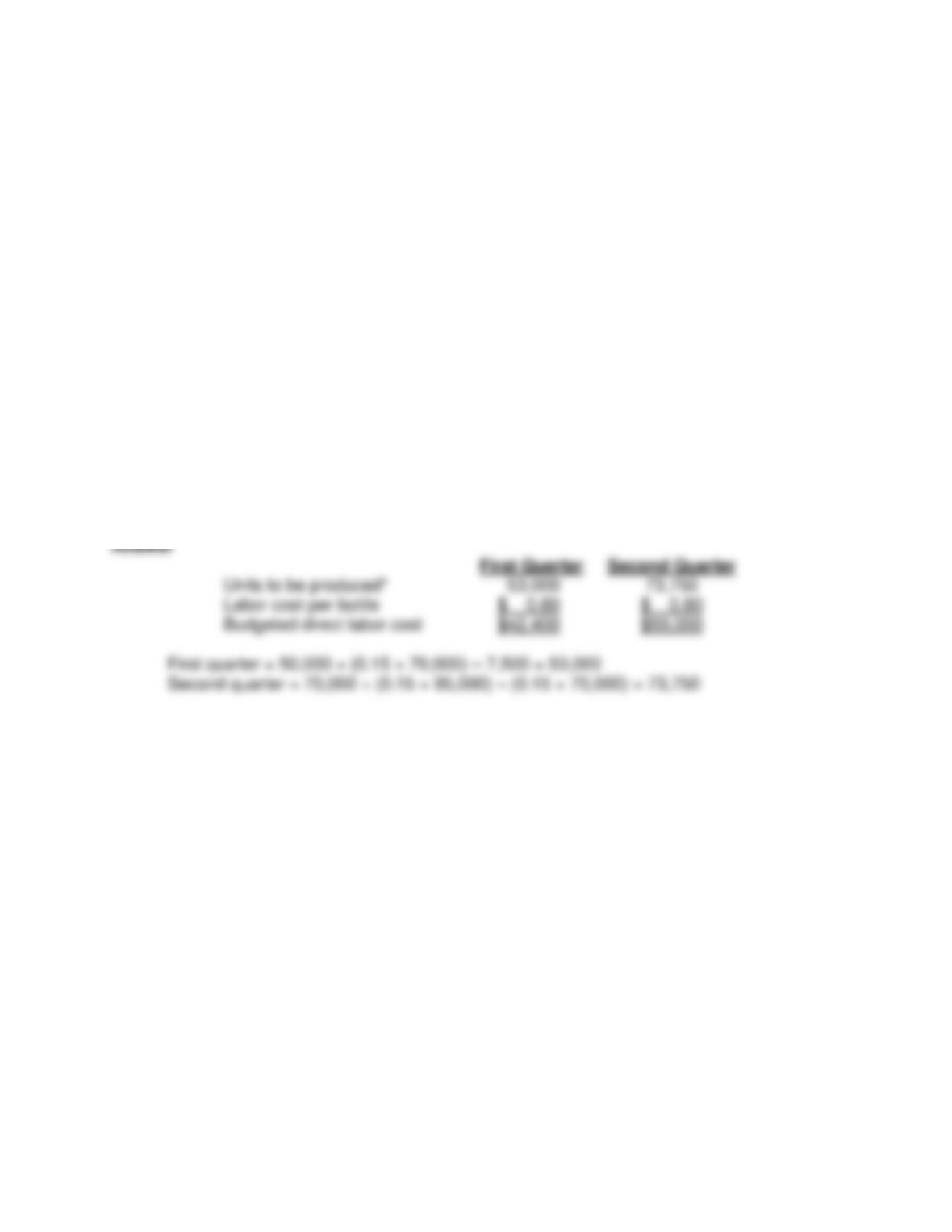
Prepare a material purchases budget for Chemical A for the third quarter of 2017.
Assume the production for the fourth quarter is 49,100 units.
Chapter 10 Budgetary Planning and Control
10–57
179. Green & Clean produces and sells organic concentrated detergent. Information about
the budget for 2017 is as follows:
1. The company expects to sell 50,000 bottles of detergent in the first quarter, 70,000 in
the second quarter, 95,000 in the third quarter, and 46,000 in the fourth quarter.
2. A bottle of detergent requires 5 ounces of Chemical A and 12 ounces of Chemical B.
3. The desired ending inventory of finished goods is equal to 15% of next quarter’s
sales, whereas the desired ending inventory for material is 10% of next quarter’s
production requirements.
4. There are 7,500 bottles of detergent, 25,000 ounces of Chemical A, and 60,000
ounces of Chemical B on hand at the beginning of the first quarter.
5. At the end of the fourth quarter, the company must have 10,000 bottles of detergent,
24,000 ounces of Chemical A, and 90,000 ounces of Chemical B to meet its needs in
the first quarter of 2018.
6. The cost of Chemical A is $0.12 per ounce, the cost of Chemical B is $0.08 per
ounce, and the selling price of the detergent is $11.50 per bottle.
7. The cost of direct labor is $0.80 per bottle, and the cost of variable overhead is $1.20
per bottle. Fixed manufacturing overhead is $50,000 per quarter.
8. Variable selling and administrative expense is 5% of sales, and fixed selling and
administrative expenses are $60,000 per quarter.
Prepare a direct labor budget for the first and second quarters of 2017.
Test Bank to accompany Jiambalvo Managerial Accounting, 6th Edition
10–58
180. Green & Clean produces and sells organic concentrated detergent. Information about
the budget for 2017 is as follows:
1. The company expects to sell 50,000 bottles of detergent in the first quarter, 70,000 in
the second quarter, 95,000 in the third quarter, and 46,000 in the fourth quarter.
2. A bottle of detergent requires 5 ounces of Chemical A and 12 ounces of Chemical B.
3. The desired ending inventory of finished goods is equal to 15% of next quarter’s
sales, whereas the desired ending inventory for material is 10% of next quarter’s
production requirements.
4. There are 7,500 bottles of detergent, 25,000 ounces of Chemical A, and 60,000
ounces of Chemical B on hand at the beginning of the first quarter.
5. At the end of the fourth quarter, the company must have 10,000 bottles of detergent,
24,000 ounces of Chemical A, and 90,000 ounces of Chemical B to meet its needs in
the first quarter of 2018.
6. The cost of Chemical A is $0.12 per ounce, the cost of Chemical B is $0.08 per
ounce, and the selling price of the detergent is $11.50 per bottle.
7. The cost of direct labor is $0.80 per bottle, and the cost of variable overhead is $1.20
per bottle. Fixed manufacturing overhead is $50,000 per quarter.
8. Variable selling and administrative expense is 5% of sales, and fixed selling and
administrative expenses are $60,000 per quarter.
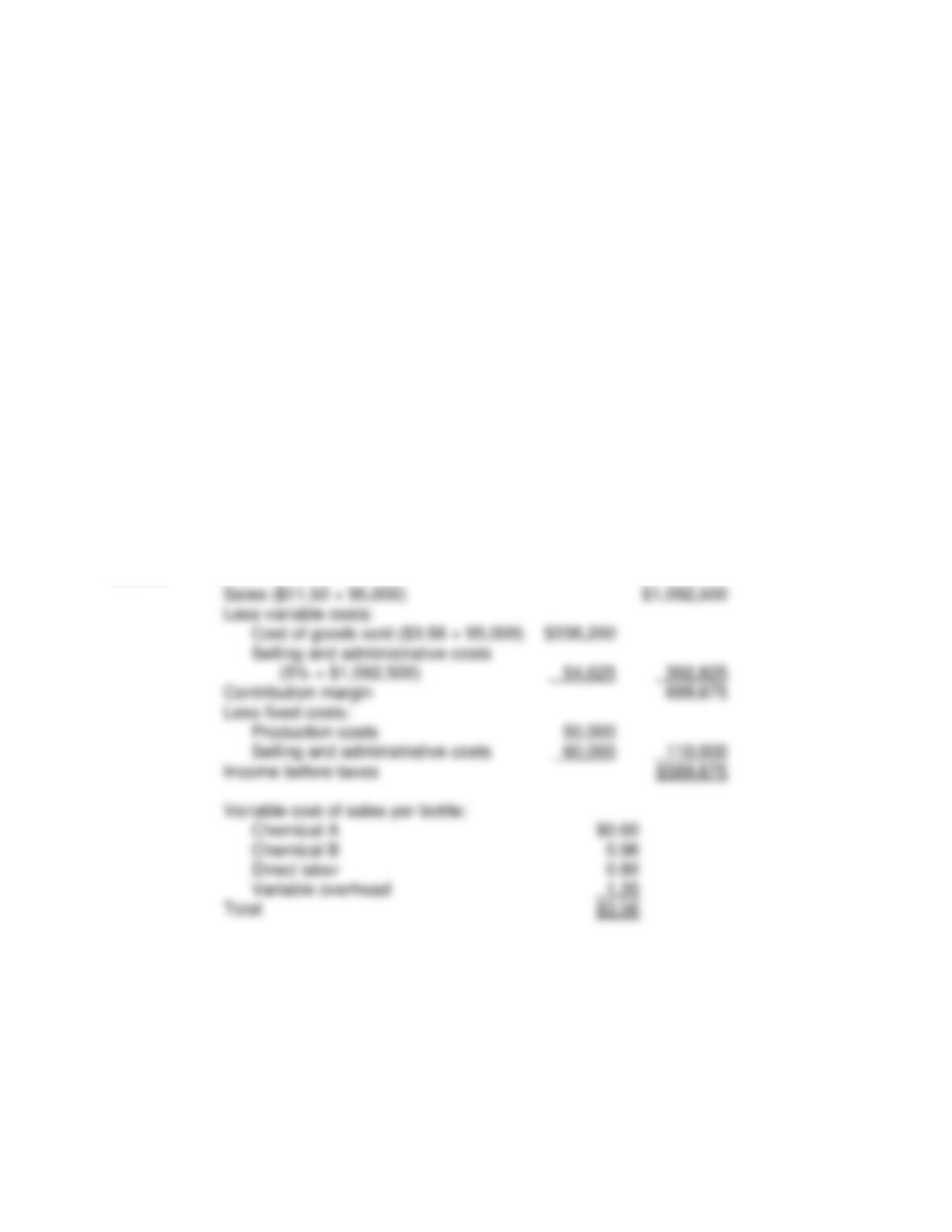
Prepare a budgeted income statement using the variable costing format for the third
quarter of 2017. (Ignore income taxes).
Answer
Chapter 10 Budgetary Planning and Control
10–59
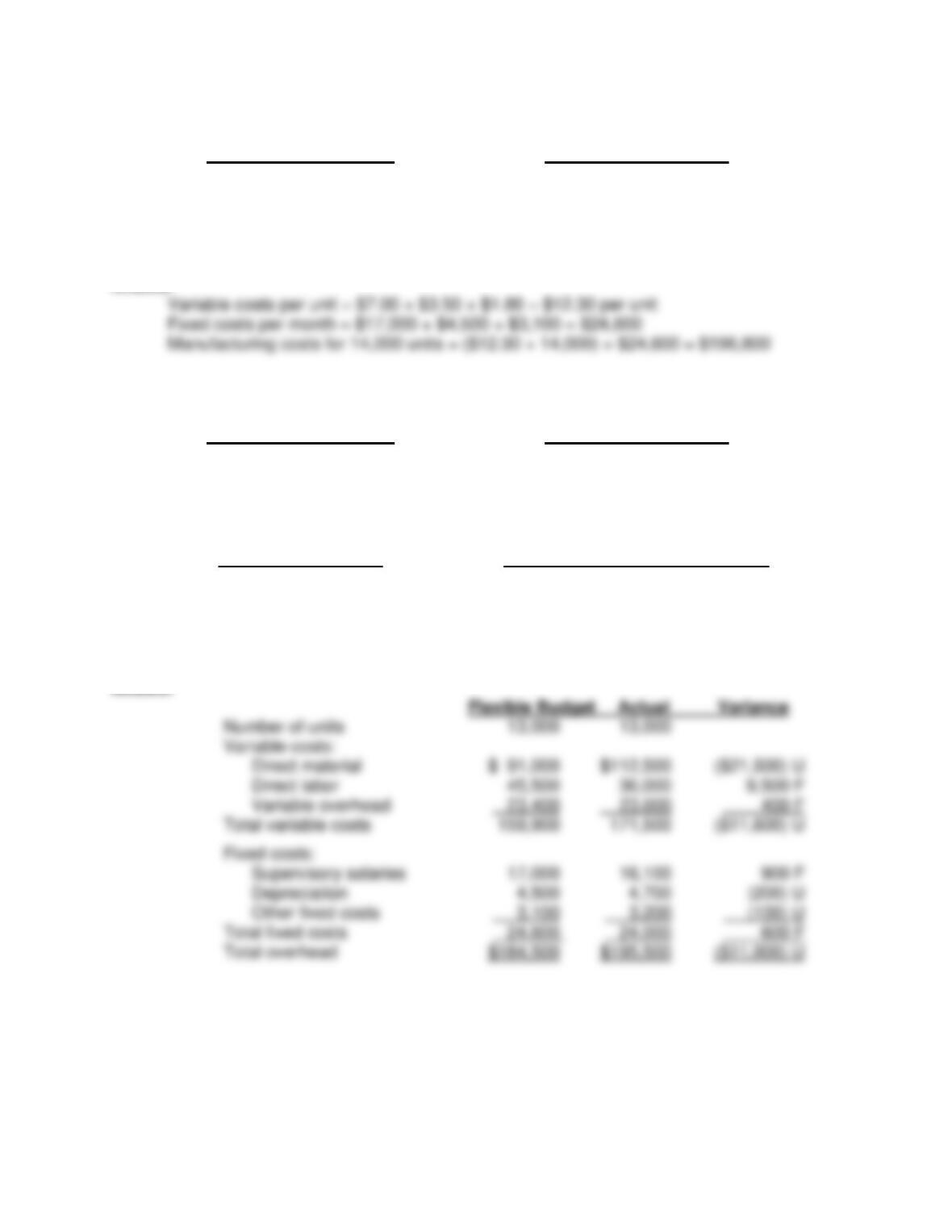
181. Expected manufacturing costs for Beaver Street Manufacturing are as follows:
Variable Costs per Unit Fixed Costs per Month
Direct material $7.00 Supervisory salaries $17,000
Direct labor 3.50 Factory depreciation 4,500
Variable overhead 1.80 Other factory costs 3,100
Determine the budgeted manufacturing costs for a production level of 14,000 units.
Answer
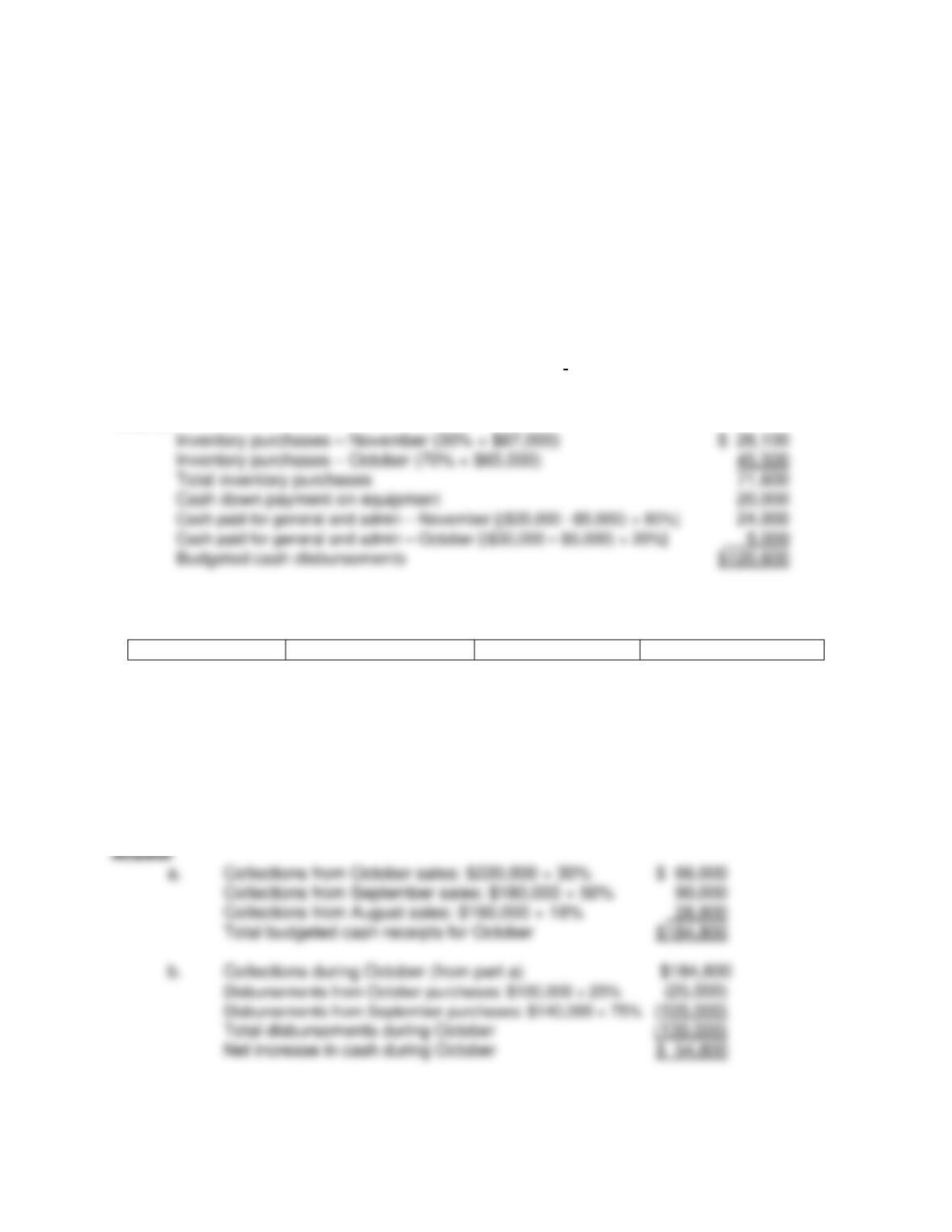
182. Expected manufacturing costs for Beaver Street Manufacturing for June are as follows:
Variable Costs per Unit Fixed Costs per Month
Direct material $7.00 Supervisory salaries $17,000
Direct labor 3.50 Factory depreciation 4,500
Variable overhead 1.80 Other factory costs 3,100
During June, the company produced 13,000 units and incurred the following costs:
Total Variable Costs Total Fixed Costs For The Month
Direct material $112,500 Supervisory salaries $16,100
Direct labor 36,000 Factory depreciation 4,700
Variable overhead 23,000 Other factory costs 3,200
Prepare a performance report for Beaver Street Manufacturing for June.
Answer
Test Bank to accompany Jiambalvo Managerial Accounting, 6th Edition
10–60
CHALLENGE EXERCISES
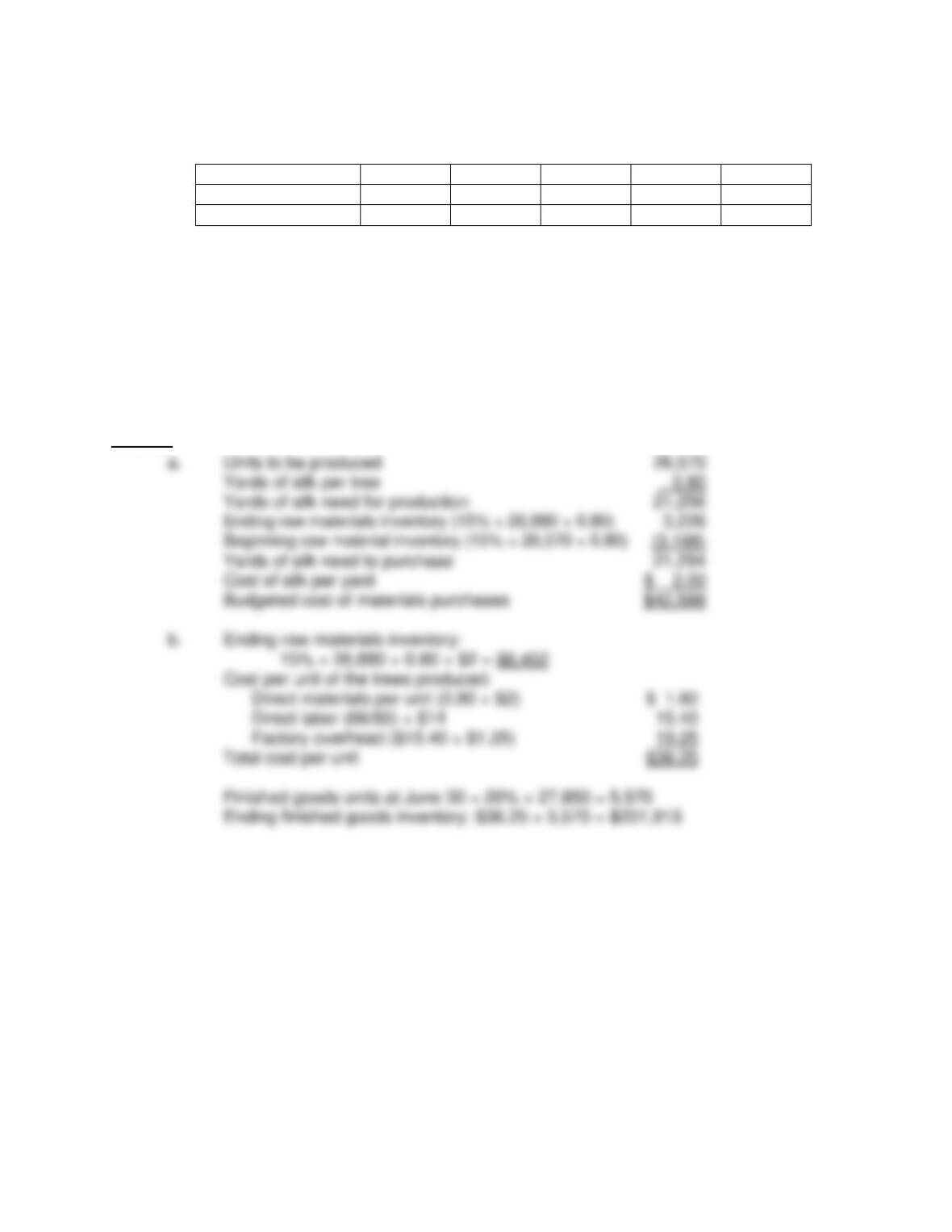
183. Werth’s Widgets pays for 30% of its inventory purchases in the month of the purchase
and the remainder in the following month. The company’s inventory purchases totaled
$65,000 in October, $87,000 in November, and $52,000 in December. During
November, Werth acquired new equipment costing $100,000 by signing a note for
$80,000 and paid the balance in cash. Werth made one payment for $5,000 toward the
note during December that included $600 of interest. Income taxes totaling $30,000
were paid in December. General and admin expenses totaled $30,000 during October,
$35,000 during November, and $40,000 during December, of which $5,000 per month is
for depreciation. Werth pays 80% of the general and administrative costs during the
month incurred and the balance the following month. Cash at the beginning of November
was $40,000. Prepare a cash disbursements budget for November for Werth’s Widgets.
Omit the budget heading.
Answer
184. Gessel Co.’s projected sales are as follows:
August
$160,000
September
$180,000
October
$220,000
November
$200,000
Gessel estimates that it will collect 30% of sales in the month of sale, 50% in the month
after the sale, and 18% in the second month following the sale. Two percent of all sales
are estimated to be bad debts. Gessel purchases inventories on account totaling
$130,000 during August, $140,000 during September, and $100,000 during October.
Gessel pays 25% of purchases in the month purchased and 75% in the following month.
a. How much is Gessel Co.’s budgeted cash receipts for October?
b. How much is the net increase or decrease in cash for Gessel for October?
Total inventory purchases
Cash down payment on equipment
Budgeted cash disbursements
Chapter 10 Budgetary Planning and Control
10–61
185. Tree Haven makes and sells silk palm trees. Each tree uses 0.80 yards of silk fabric.
Budgeted production of trees in units for the next five months is as follows:
April
May
June
July
August
Budgeted production
24,160
23,490
26,570
26,880
22,900
Budgeted sales
24,500
22,800
26,250
27,850
23,000
The company wants to maintain monthly ending inventories of fabric equal to 15% of the
following month’s budgeted production needs, and monthly inventories of trees equal to
20% of the number needed for next month’s sales. The cost of silk is $2.00 per yard.
Direct labor cost is $14.00 per hour and it takes 66 minutes to complete each tree.
Factory overhead is applied at the rate of $1.25 per direct labor dollar.
a. Prepare a direct materials purchases budget for June.
b. Calculate the amount of Raw Materials and Finished Goods Inventory to be
reported on Tree Haven’s June 30 balance sheet.
Answer
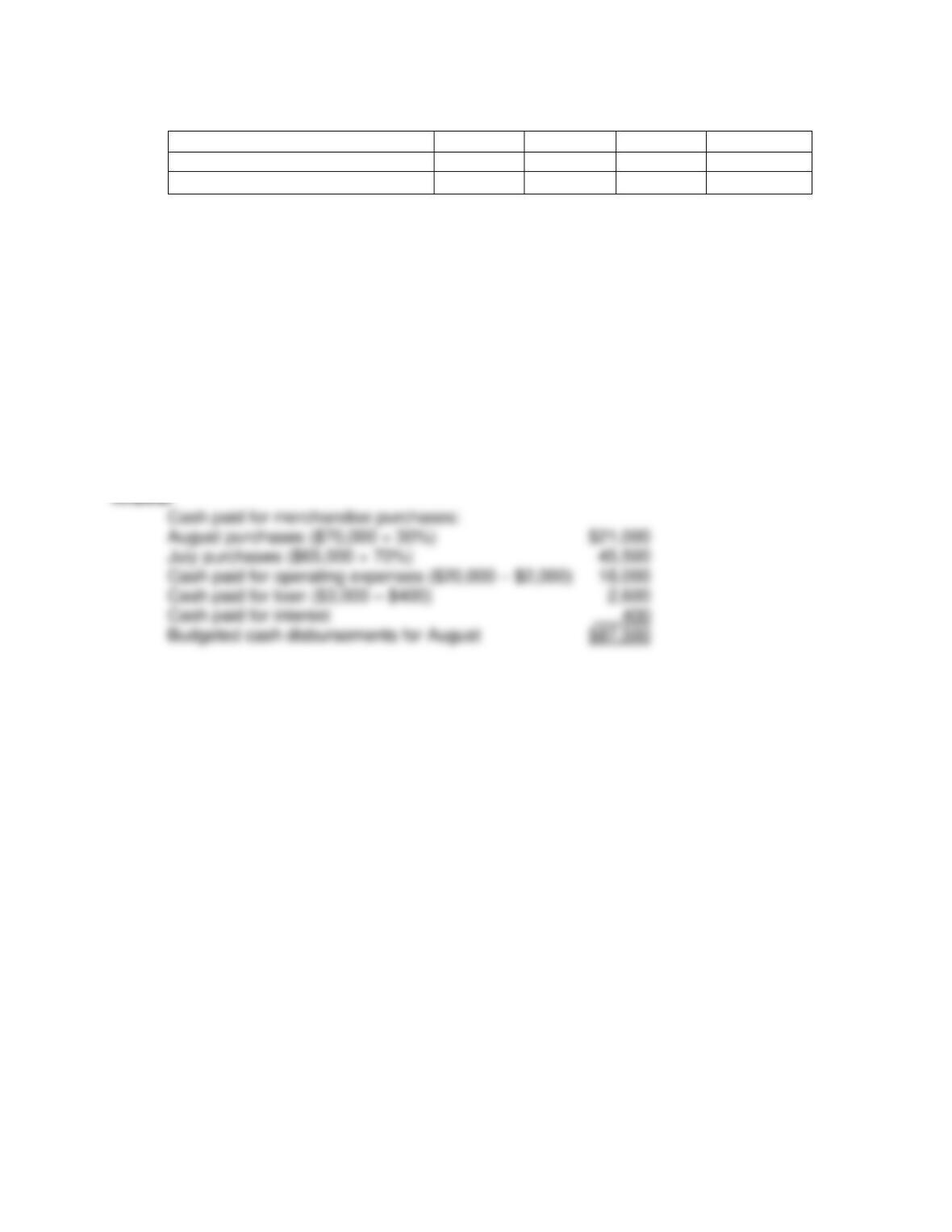
21,256
21,294
Test Bank to accompany Jiambalvo Managerial Accounting, 6th Edition
10–62
186. Trescot, Inc. provided the following information:
June
July
August
September
Projected sales
$120,000
$110,000
$130,000
$100,000
Projected merchandise purchases
$76,000
$65,000
$70,000
$58,000
• Trescot estimates that it will collect 40% of its sales in the month of sale, 35% in
the month after the sale, and 23% in the second month following the sale. Two
percent of all sales are estimated to be bad debts.
• The cash balance on June 1 is $6,000.
• Trescot pays 30% of merchandise purchases in the month purchased and 70%
in the following month.
• General operating expenses are budgeted to be $20,000 per month of which
depreciation is $2,000 of this amount. Trescot pays operating expenses in the
month incurred.
• Trescot make loan payments of $3,000 per month of which $400 is interest and
the remainder is principal.
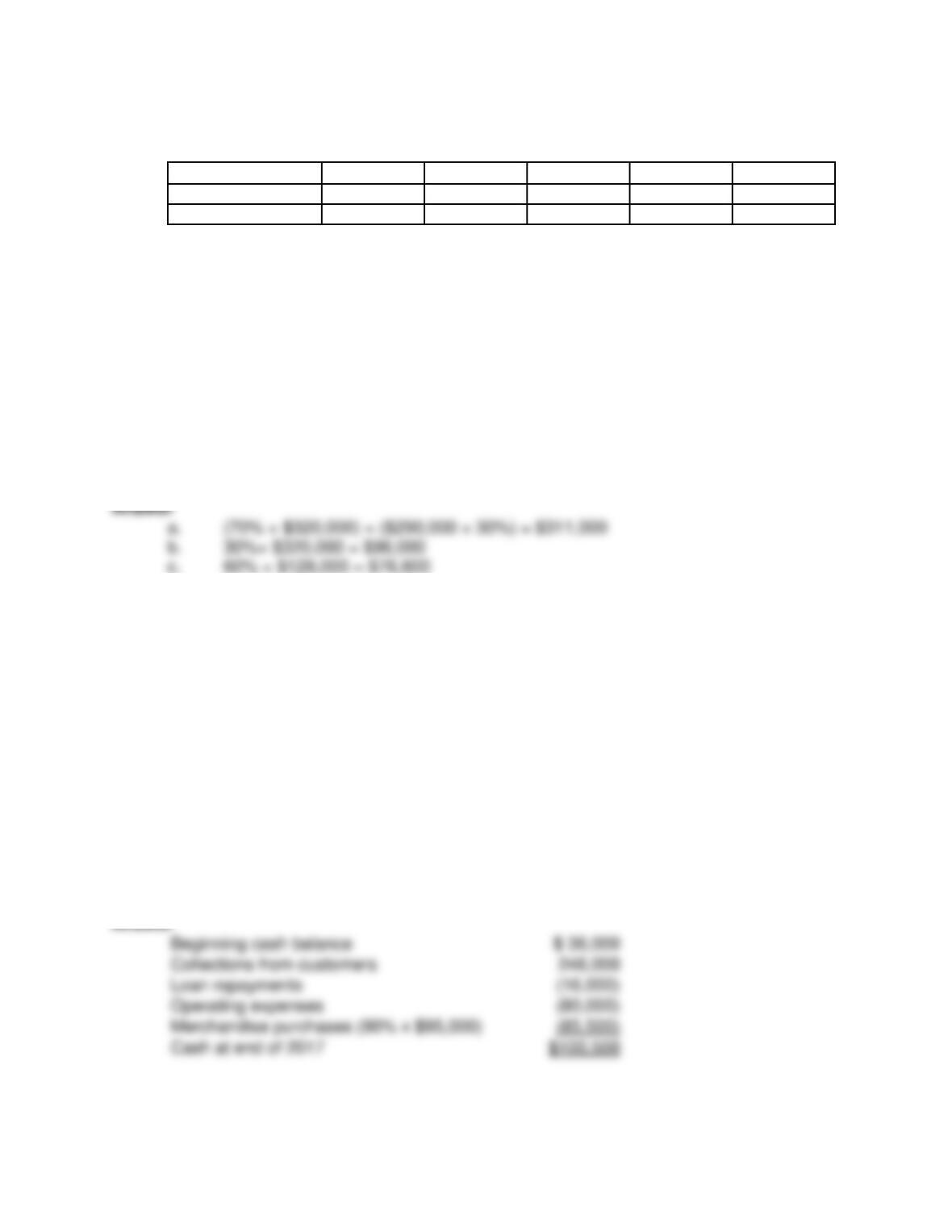
Calculate Trescot’s budgeted cash disbursements for August.
Chapter 10 Budgetary Planning and Control
10–63
187. Livanos, Inc. reports all its sales on credit, and pays operating costs in the month
incurred. Amounts for 2017 are:
March
April
May
June
July
Budgeted sales
$300,000
$290,000
$320,000
$280,000
$210,000
Budgeted purchases
$144,000
$120,000
$128,000
$132,000
$90,000
• Amounts due from customers are collected 70% in the month of sale and 30% in
the following month.
• Cost of goods sold is 60% of sales.
• Livanos purchases and pays for merchandise 40% in the month of acquisition
and 60% in the following month.
• Operating expenses are: Salaries, $50,000; Depreciation, $12,000; Rent,
$15,000; and Utilities, $14,000.
• Accounts payable is used only for inventory acquisitions.
a. How much cash will Livanos receive during May from customers?
b. How much is the May 30, 2017 budgeted Accounts Receivable?
c. How much is the budgeted balance for Accounts Payable at May 30, 2017?
188. Contron, Inc. projected the following for 2017:
Credit sales
$240,000
Collections from customers
246,000
Cost of goods sold
92,000
Loan repayments:
$1,000 is interest, $15,000 is principal
16,000
Current period cash operating expenses
80,000
Depreciation expense
20,000
Loss on disposal of plant asset
5,000
Merchandise purchases (90% to be paid in cash)
95,000
Accrued wages closing balance
12,000
Beginning cash balance
36,000
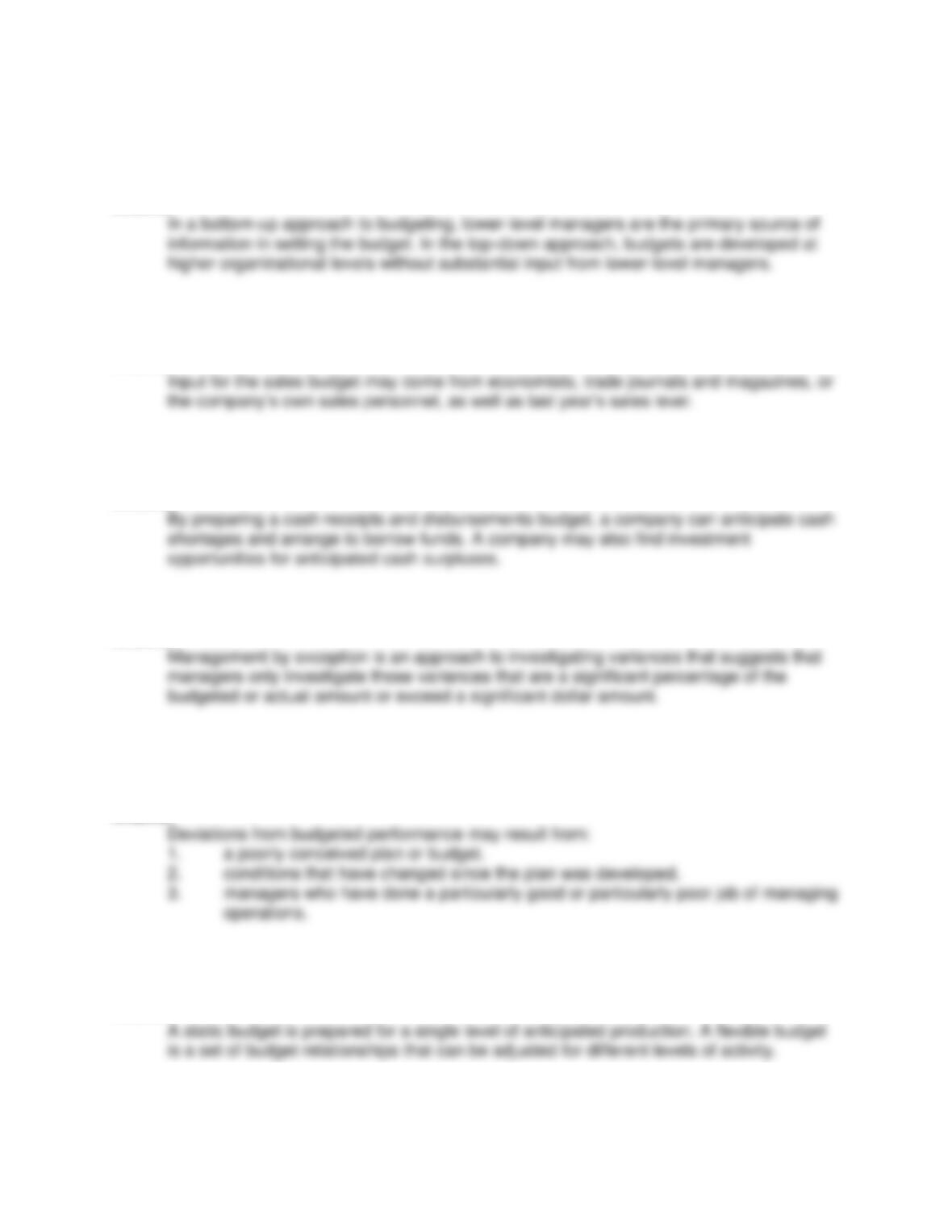
How much is cash to be reported on Con’s budgeted balance sheet at the end of 2017?
Test Bank to accompany Jiambalvo Managerial Accounting, 6th Edition
10–64
SHORT-ANSWER ESSAYS
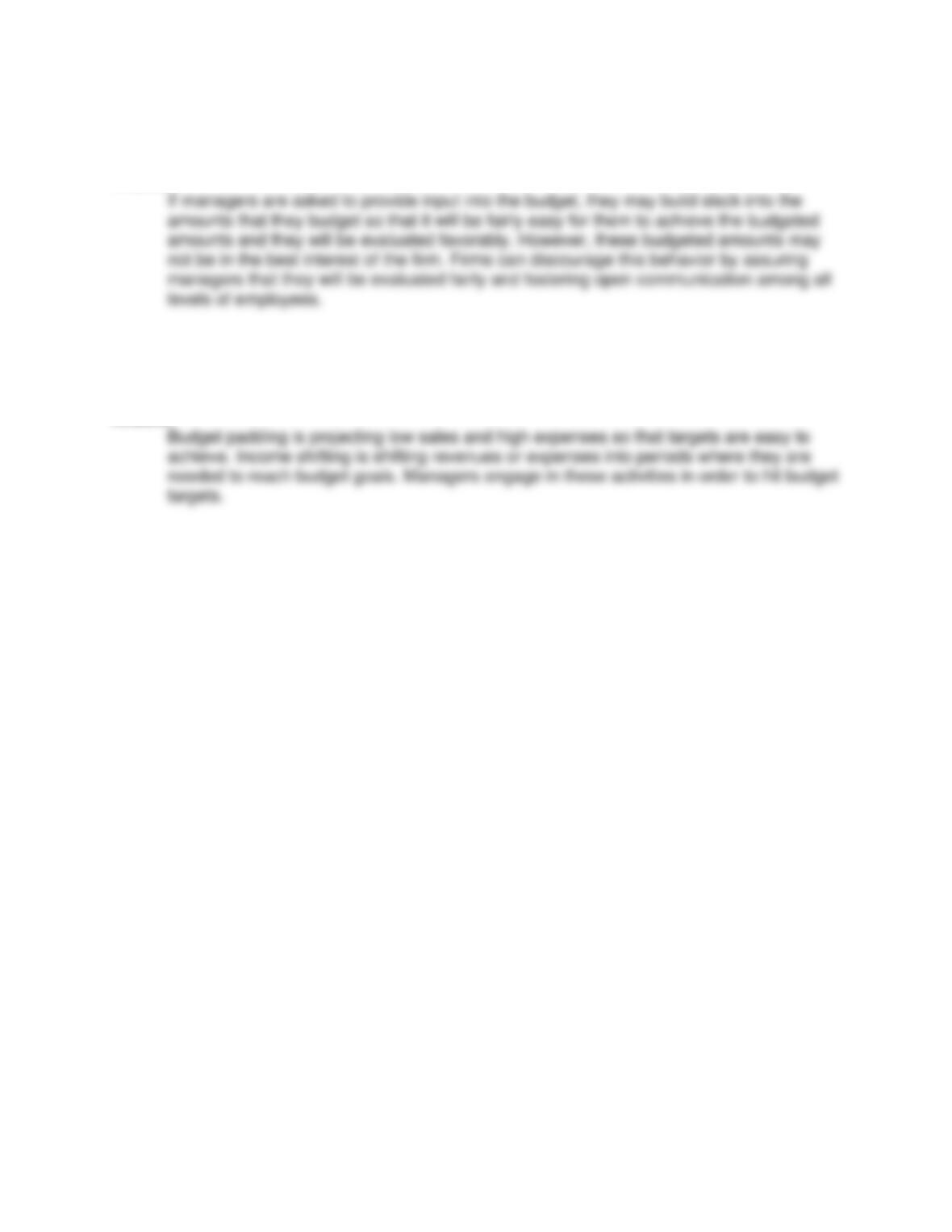
189. What is the difference between the bottom–up and top-down approach to budgeting?
Answer
190. Describe at least three sources of input for the sales budget.
Answer
191. What are the main purposes of preparing a cash receipts and disbursements budget?
Answer
192. What is meant by “management by exception?”
Answer
193. List and briefly explain three reasons that a company may have significant deviations
from budgeted performance.
Answer
194. What is the difference between a static budget and a flexible budget?
Answer
Chapter 10 Budgetary Planning and Control
10–65
195. “Managers may perceive a conflict between the planning and control uses of budgets.”
Explain what this statement means and what a company can do to minimize this conflict.
Answer
196. Explain what budget padding and income shifting are and why managers are tempted to
do them.
Answer