
Chapter 10: Accounting Systems for Manufacturing Businesses
78. The recording of the jobs completed would increase:
a. Factory Overhead.
b. Finished Goods.
c. Work-in-Process.
d. Cost of Goods Sold.
79. The recording of the jobs completed would decrease:
a. Factory Overhead.
b. Finished Goods.
c. Work-in-Process.
d. Cost of Goods Sold.
80. The recording of the jobs shipped and customers billed would increase:
a. Accounts Payable.
b. Cash.
c. Finished Goods.
d. Cost of Goods Sold.
81. The finished goods account is a controlling account for the subsidiary:
a. sales ledger.
b. materials ledger.
c. work-in-process ledger.
d. stock ledger.
82. The Anderson Company forecasts that total overhead for the current year will be $15,000,000
and total machine hours will be 200,000 hours. However, the actual overhead is $8,000,000
and the actual machine hours are 100,000 hours. If the company uses a predetermined
overhead rate based on machine hours for applying overhead, what is predetermined overhead
rate?
a. $80 per machine hour
b. $150 per machine hour
c. $75 per machine hour
d. $40 per machine hour

Chapter 10: Accounting Systems for Manufacturing Businesses
83. Mountain View Manufacturers Inc. has estimated total factory overhead costs of $90,000, and
15,000 direct labor hours for the current fiscal year. If job number 112 incurred 1,000 direct
labor hours, the work-in–process account will be increased and factory overhead will be
decreased by:
a. $15,000.
b. $0.
c. $6,000.
d. $1,000.
84. Upon completing a job, direct materials totaled $3,000; direct labor, $3,500; and factory
overhead, $1,500. Units produced totaled 1,000. What is the per unit cost?
a. $8,000
b. $6,500
c. $6.50
d. $8
85. During the year, Bright Corporation applied factory overhead costs of $330,000 to production.
At the end of the year, total overapplied factory overhead is $13,000. What was the amount of
actual factory overhead cost incurred during the year?
a. $343,000
b. $300,000
c. $330,000
d. $317,000
86. Elite, Inc. has estimated total factory overhead costs of $900,000, and 25,000 direct labor
hours for the current fiscal year. If the direct labor hours for Job N41 is 2,000, calculate the
total factory overhead applied to this job.
a. $40,000
b. $25,000
c. $4,000
d. $72,000

Chapter 10: Accounting Systems for Manufacturing Businesses
87. Hudson, Inc. has estimated total factory overhead costs of $400,000 and 20,000 direct labor
hours for the current fiscal year. If direct labor hours for the year totals 18,000 and actual
factory overhead totals $350,000, what is the amount of overapplied or underapplied overhead
for the year?
a. $10,000 overapplied
b. $10,000 underapplied
c. $50,000 underapplied
d. $50,000 overapplied
88. The sale of a finished good on account would:
a. decrease Cost of Goods Sold and increase Finished Goods.
b. increase Cost of Goods Sold and decrease Finished Goods; increase Accounts Receivable
and increase Sales.
c. increase Sales Expense and decrease Finished Goods; decrease Cash and decrease Accounts
Receivable.
d. increase Work-in–Process and decrease Finished Goods; increase Accounts Receivable and
increase Sales.
89. Which of the following is a product cost?
a. CEO salary
b. Depreciation on factory equipment
c. Commission to sales
d. Office lightings
90. Which of the following is most likely be a period cost?
a. Depreciation on factory lunchroom furniture
b. Salary of telephone receptionist in the sales office
c. Salary of a security guard for the factory parking lot
d. Computer chips used by a computer manufacturer
91. Which of the following is a period cost?
a. Power
b. Depreciation on factory equipment
c. Sales commissions
d. Wages of an assembly worker

Chapter 10: Accounting Systems for Manufacturing Businesses
92. Which of the following would be a period costs for a textbooks printing company?
a. Wages of a press operator
b. Utility costs of the factory
c. Advertising expenses
d. Paper costs
93. Direct materials, work-in–process, and finished goods inventory are most likely to be reported
on the balance sheet of a(n):
a. financial consultant.
b. apparel boutique.
c. automobile company.
d. insurance company.
94. Until products are sold, product costs are treated as:
a. liabilities.
b. assets.
c. expenses.
d. income.
95. The Harold Company forecasts that total overhead for the current year will be $12,000,000
and total machine hours will be 200,000 hours. However, the actual overhead is $4,000,000
and the actual machine hours are 100,000 hours. If the company uses a predetermined
overhead rate based on machine hours for applying overhead, the overhead will be:
a. overapplied by $2,000,000.
b. underapplied by $2,000,000.
c. overapplied by $4,000,000.
d. underapplied by $4,000,000.
96. For Peterson Company, total overhead applied was $35,000,000 at the end of the year. Actual
overhead was $35,800,000. Closing over/under applied overhead into cost of goods sold
would cause net income to:
a. increase by $800,000.
b. decrease by $800,000.
c. stay the same.
d. decrease by $200,000.
Chapter 10: Accounting Systems for Manufacturing Businesses
97. Which of the following is most likely to be a product cost?
a. Salary of the vice president of sales
b. Advertising for a particular product
c. Drill bits for a drill press used in the plant assembly area
d. Salary of the company receptionist
98. For a manufacturing business, work-in-process inventories consist of inventories which have .
a. not yet entered the manufacturing process
b. entered the manufacturing process but not been completed
c. entered and completed manufacturing process but have not been sold
d. entered and completed manufacturing process and have been sold
The following information is available for the first month of operations for Bluemoon, Inc.:
Sales
$850,000
Gross profit
330,000
Indirect labor
35,000
Indirect materials
14,000
Other factory overhead
9,000
Materials purchased
360,000
Total manufacturing costs
670,000
Materials inventory, end of period
20,000
99. Refer to the information provided for Bluemoon, Inc. What is the cost of goods sold?
a. $670,000
b. $418,000
c. $520,000
d. $650,000
100. Refer to the information provided for Bluemoon, Inc. Calculate direct materials cost used in
production.
a. $326,000
b. $340,000
c. $360,000
d. $346,000

Chapter 10: Accounting Systems for Manufacturing Businesses
The following information is available for the first month of operations for Brandt, Inc.:
Sales
$570,000
Gross profit
210,000
Indirect labor
20,000
Indirect materials
5,000
Other factory overhead
37,000
Direct materials cost
390,000
Total manufacturing costs
658,000
101. Calculate direct labor cost for Brandt, Inc.
a. $226,000
b. $206,000
c. $231,000
d. $218,000
102. Which of the following information is provided by job cost sheets?
a. Cost of depreciation on office computers
b. Managerial salary
c. Cost of utilities
d. Cost impact of materials changes
103. A difference in quantity of materials used on two comparable jobs may be caused by:
a. inadequately trained employees.
b. poor quality materials.
c. employee carelessness.
d. all of these.
104. Which of the following would probably not be found in the accounting system of a service
provider?
a. Cost ledger
b. Finished goods ledger
c. Cost of services account
d. Job cost sheets

Chapter 10: Accounting Systems for Manufacturing Businesses
105. In job order cost accounting system used by a service business, which of the following items
would normally not be included as part of overhead?
a. Materials
b. Direct labor
c. Rent
d. Supplies
106. The direct labor and overhead costs of providing services to clients are accumulated in:
a. finished services expense.
b. work in process.
c. administrative salaries expense.
d. overhead.
107. One of the ways in which just-in-time processing is accomplished in manufacturing and
nonmanufacturing processes is by:
a. moving a product from process to process as each function is completed.
b. combining processing functions into work centers and cross-training workers to perform
more than one function.
c. having production supervisors attempt to enter enough materials into manufacturing to keep
all manufacturing departments operating.
d. having workers typically perform one function on a continuous basis.
108. Which of the following is a characteristic of the just-in–time philosophy?
a. Increases inventory to protect against process problems
b. Tolerates defects
c. Emphasizes push manufacturing
d. Emphasizes product-oriented layout
109. Which of the following statements is true of lead time?
a. Total lead time can be divided into acceptable and non-acceptable lead time.
b. Lead time is a measure of time that elapses between the sale of a product and delivery to the
customer.
c. Reducing nonvalue-added lead time reduces costs and improves the speed of production.
d. Reducing nonacceptable lead time improves the speed of production, but will not affect
product cost.

Chapter 10: Accounting Systems for Manufacturing Businesses
110. Which of the following techniques is used by just-in-time manufacturing?
a. It provides specialized training so that employees only do one task and work individually to
improve efficiencies in the department.
b. It organizes the plant in such a way as to reduce product movement from station to station.
c. It encourages management to make all operating decisions regarding the manufacturing
process rather than the line employees in order to streamline the process.
d. It emphasizes push manufacturing.
111. Pull manufacturing is driven by:
a. customer demand.
b. forecasting customers’ requirements.
c. a production schedule rather than line status.
d. pushing inventory ahead to the next station.
112. Just-in-time manufacturing practices include all of the following except:
a. eliminating defective or poor-quality products.
b. partnering with suppliers to provide high-quality, low-cost, and on-time materials.
c. emphasizing push manufacturing to ensure inventory levels that will provide a buffer
against production problems.
d. employee involvement using teams organized in product cells.
113. An activity-based costing system allocates factory overhead rates to products or services
using:
a. a single plantwide overhead rate.
b. the cost of activities based on an activity rate times the number of activity-based usage
quantities.
c. an allocation of budgeted revenues produced by a product or service.
d. an end-of-year allocation of costs to products or services.
114. Heedy Winery accumulates the costs incurred in the labeling process in an activity cost pool.
Costs for the labeling process are estimated to be $320,000, and the winery expects to generate
640,000 labels for the coming year. Production for its top-selling wine is estimated at 160,000
bottles. How much overhead from the labeling process will be allocated to this particular
variety of wine?
a. $40,000
b. $80,000
c. $160,000
d. $320,000
Chapter 10: Accounting Systems for Manufacturing Businesses
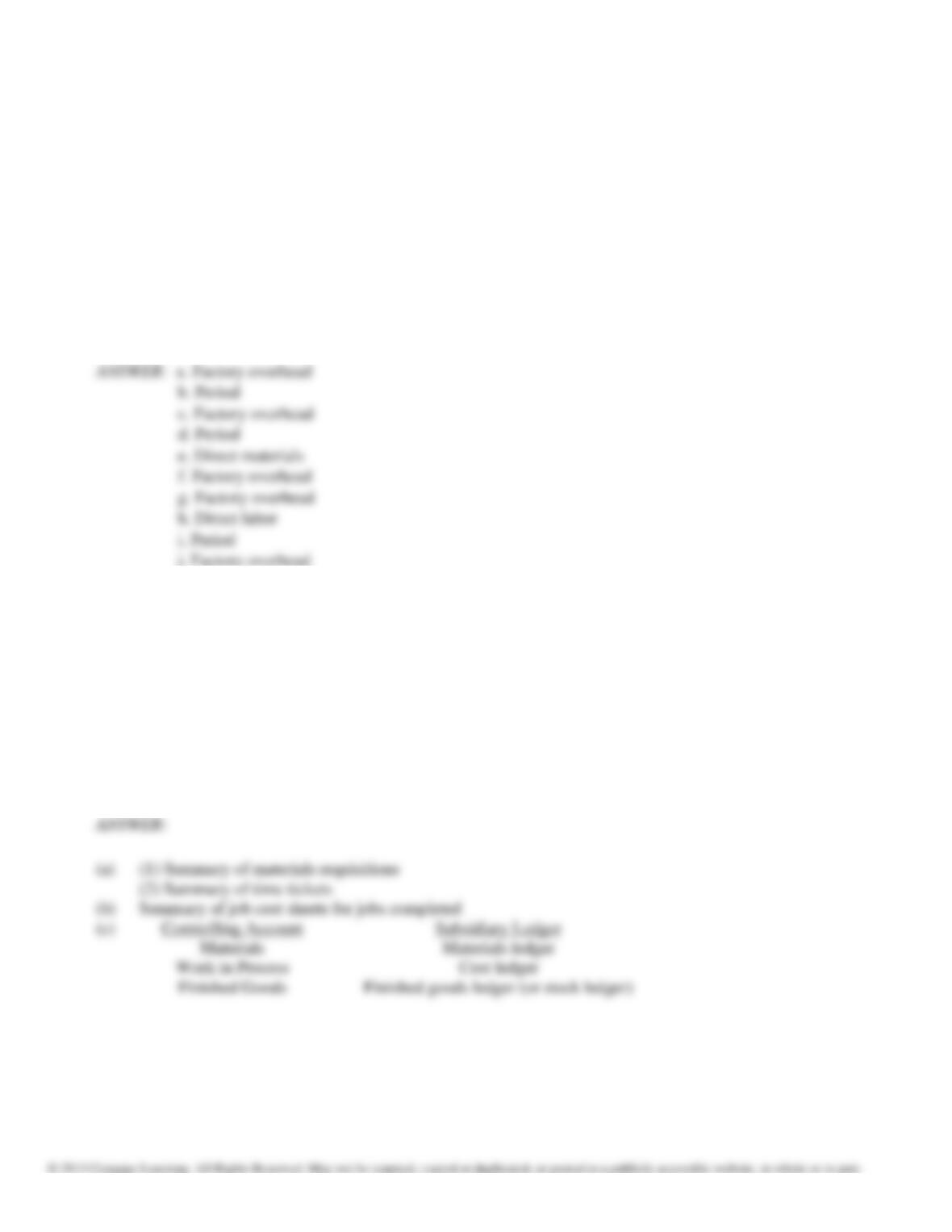
115. Indicate whether each of the following costs of a cabinet manufacturer would be classified as
direct materials cost, direct labor cost, factory overhead cost, or period cost.
a. Plant manager’s salary
b. Office administrative assistant’s salary
c. Depreciation on factory equipment
d. Rent on office building
e. Varieties of wood
f. Varnish for coating cabinets
g. Utilities cost on the factory
h. Cabinet assembly worker’s salary
i. Advertising costs
j. Screws and glue used in assembly process
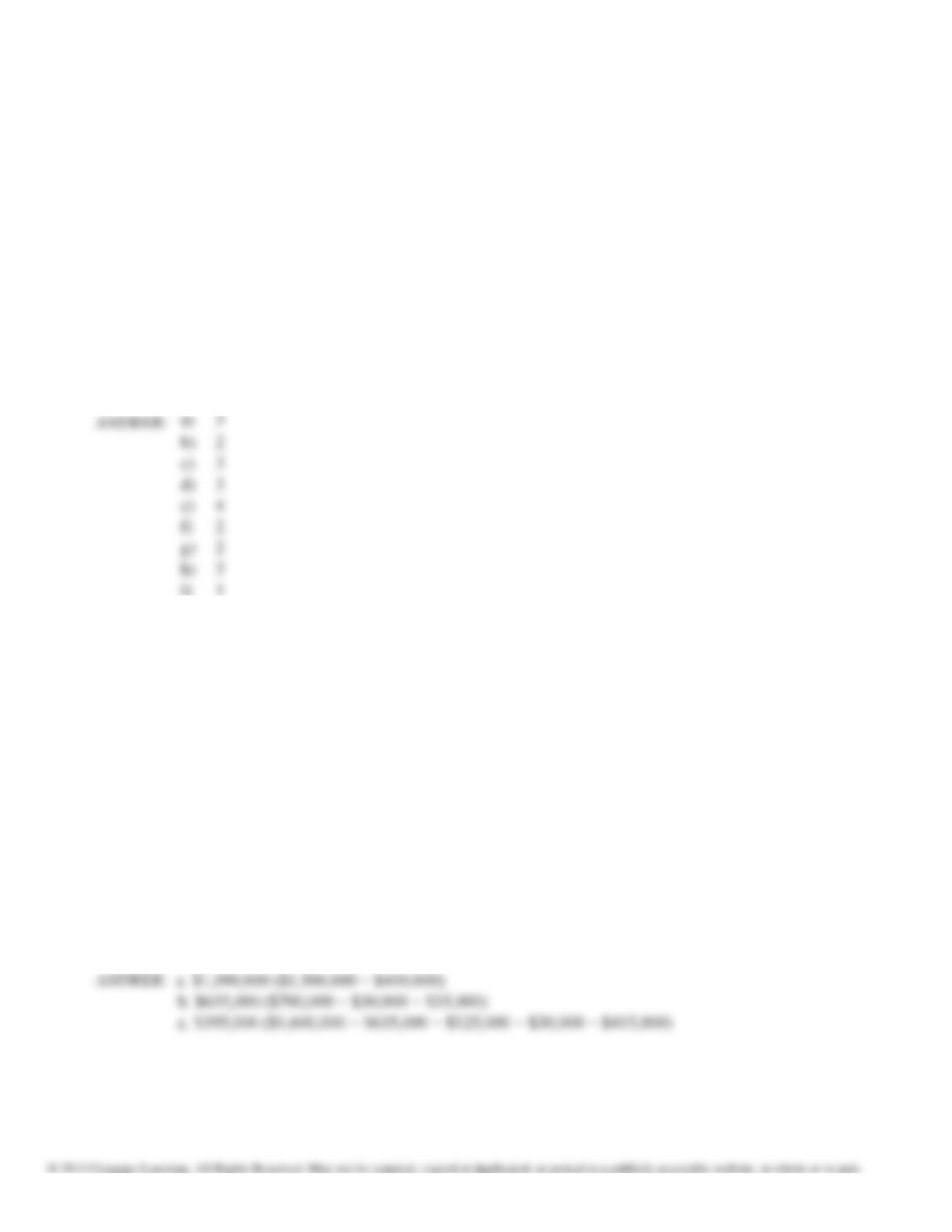
116. KCT Printing Company uses a job order cost system.
(a)
Indicate the source of the data for increasing Work in Process for each of the
following:
(1)
Direct materials requisitioned
(2)
Direct labor used
(b)
Indicate the source of the data for decreasing Work in Process for jobs
completed.
(c)
Present a list of the three controlling accounts used in the general ledger to
record the inventories and, in each case, indicate the related subsidiary ledger.
(a)
Summary of job cost sheets for jobs completed
(b)
(c)
Chapter 10: Accounting Systems for Manufacturing Businesses
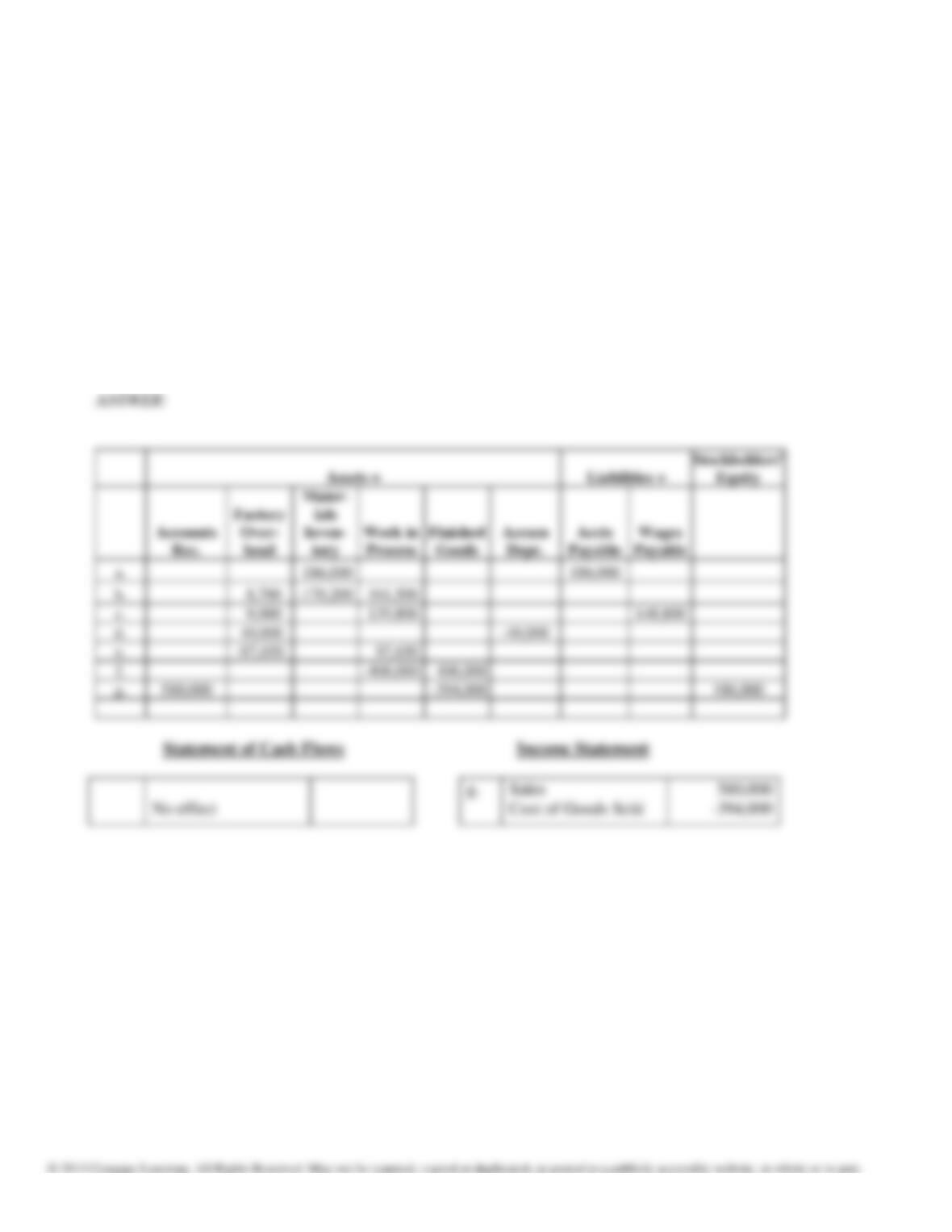
117. Use the correct number to designate each item below:
1) direct materials
2) selling and administrative expenses
3) factory overhead
4) direct labor
a) rent expense on factory building
b) sales supplies used
c) factory supplies used
d) indirect materials used
e) wages of assembly line personnel
f) depreciation on office equipment
g) rent on office facilities
h) insurance expired on factory equipment
i) cost of primary material used to assemble product
118. The following information is available for the first month of operations of Deer Inc., a
manufacturer of sports apparel:
Sales
$1,500,000
Gross profit
410,000
Indirect labor
125,000
Indirect materials
30,000
Other factory overhead
415,000
Materials purchased
700,000
Total manufacturing costs for the period
1,600,000
Materials inventory, end of period
35,000
Using the given information, determine the following:
a. Cost of goods sold
b. Direct materials cost
c. Direct labor cost
Chapter 10: Accounting Systems for Manufacturing Businesses
119. Illustrate the effects on the accounts and financial statements of each of the following
transactions for a company using a job order cost system:
(a)
Materials purchased on account
$186,000
(b)
Materials requisitioned:
For production orders
161,500
For general factory use
8,700
(c)
Factory labor used:
On production orders
139,800
For general factory purposes
9,000
(d)
Depreciation on factory equipment
40,000
(e)
Factory overhead applied, based on machine hours
97,650
(f)
Jobs finished
406,000
(g)
Jobs shipped to customers: cost, $394,000; selling price
580,000
Chapter 10: Accounting Systems for Manufacturing Businesses
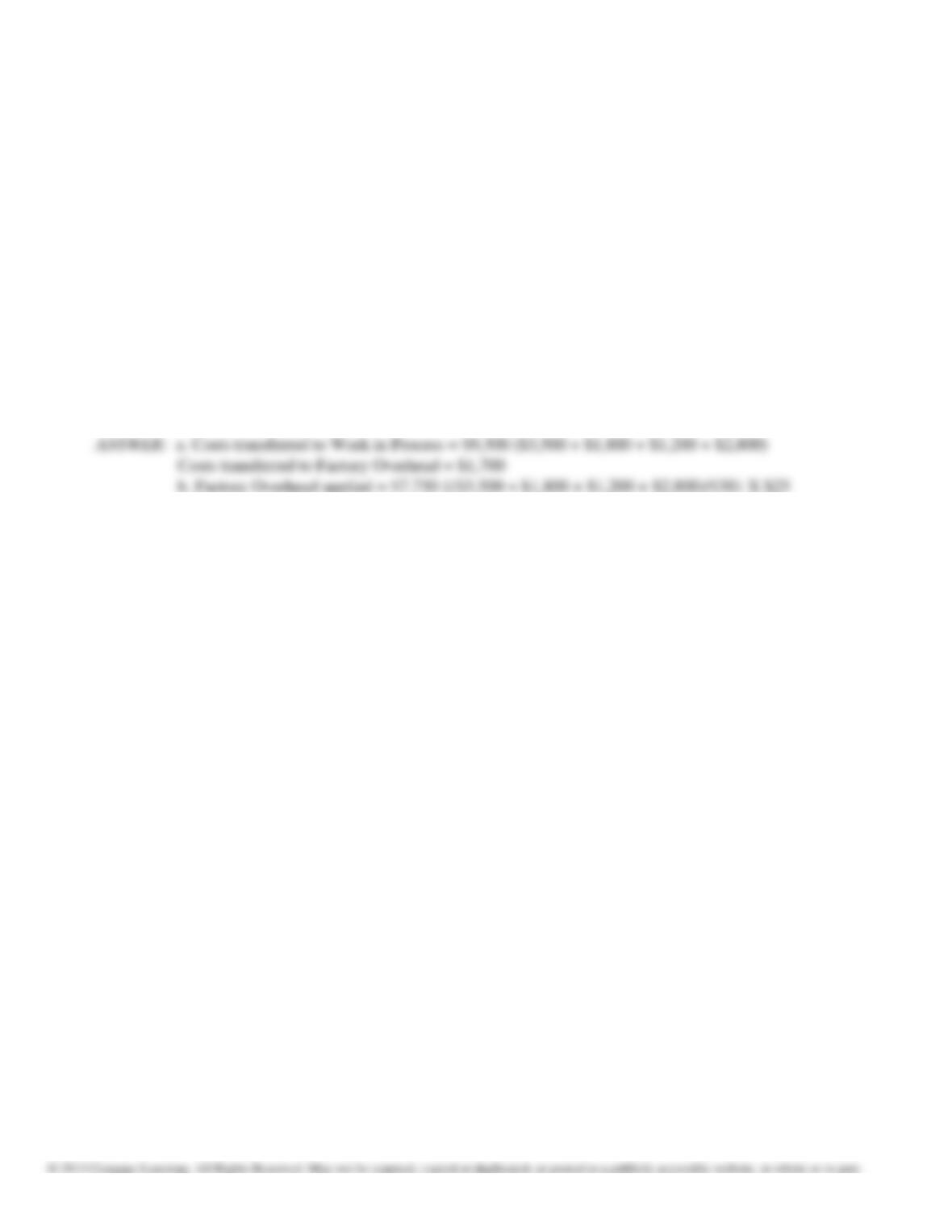
120. Matt, Inc., a toy manufacturing company uses job order cost system. The time tickets from
September jobs are summarized below.
Job 100
$3,500
Job 101
1,800
Job 102
1,200
Job 103
2,800
Factory supervision
1,700
Factory overhead is applied to jobs on the basis of a predetermined overhead rate of $25 per
direct labor hour. The direct labor rate is $30 per hour.
a. Determine the total factory labor costs transferred to Work in Process and Factory Overhead
for September.
b. Determine the amount of factory overhead applied to production for September.