Figure 10-2.
Highland Company’s standard cost is $250,000. The allowable deviation is 10%. Its actual costs for
six months are
January
$235,000
February
220,000
March
245,000
April
265,000
May
270,000
June
280,000
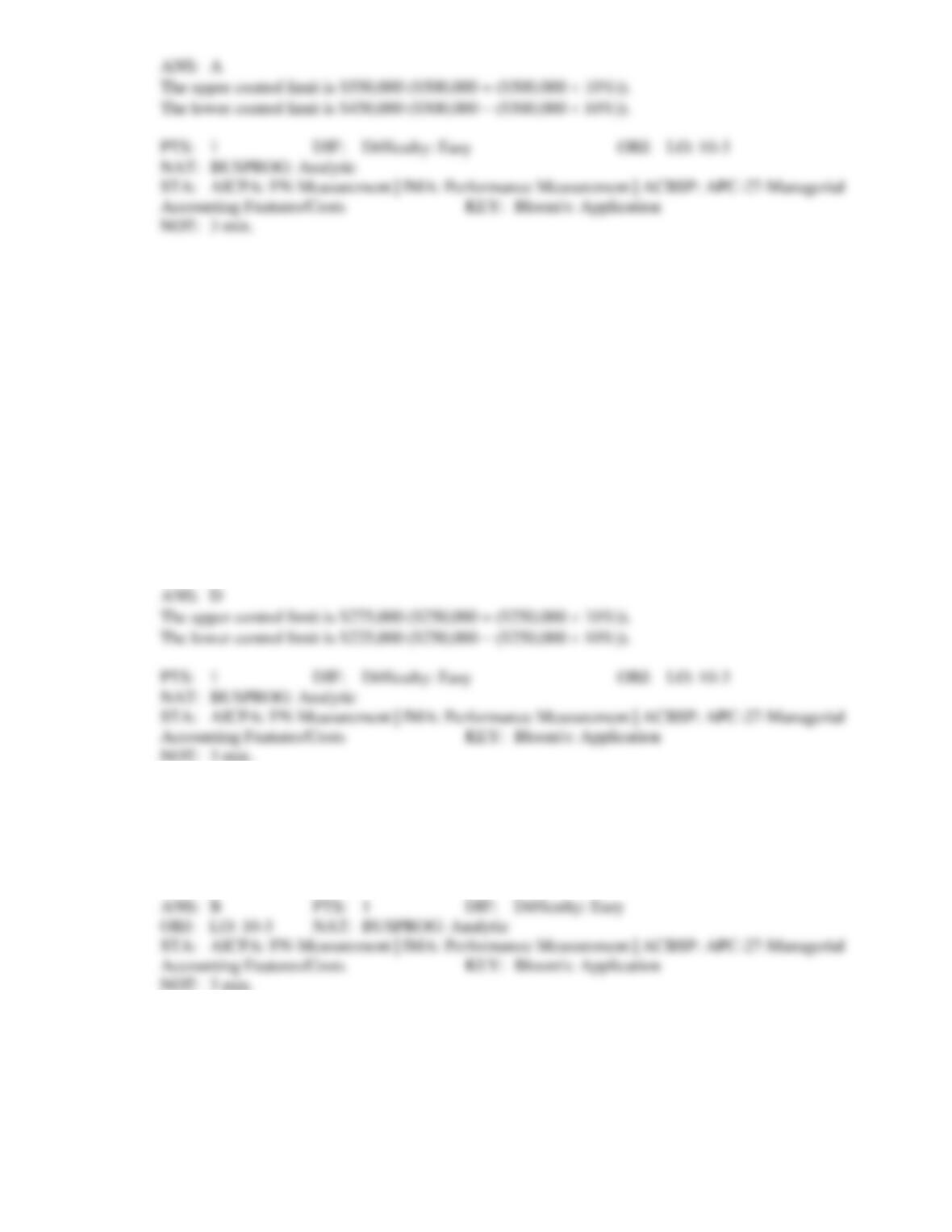
30. Refer to Figure 10-2. The upper and lower control limits are, respectively,
a.
$250,000 and $225,000
b.
$305,000 and $195,000
c.
$275,000 and $250,000
d.
$275,000 and $225,000
31. Refer to Figure 10-2. The variance that is higher than the upper control limit is
a.
$220,000
b.
$280,000
c.
$265,000
d.
$235,000
32. Refer to Figure 10-2. The variance that is lower than the lower control limit is
a.
$220,000
b.
$280,000
c.
$265,000
d.
$235,000
33. Which of the following is not true concerning direct materials variances?
a.
The sum of the price and usage variances will add up to the total materials variance only if
the materials purchased is equal to the materials used.
b.
The materials price variance uses the actual quantity of materials purchased rather than the
actual quantity of materials used.
c.
The materials price variance always uses the actual quantity of materials used rather than
the actual quantity of materials purchased.
d.
The materials usage variance uses the actual quantity of materials used.
e.
Separate materials variances can be computed for each type of material used.
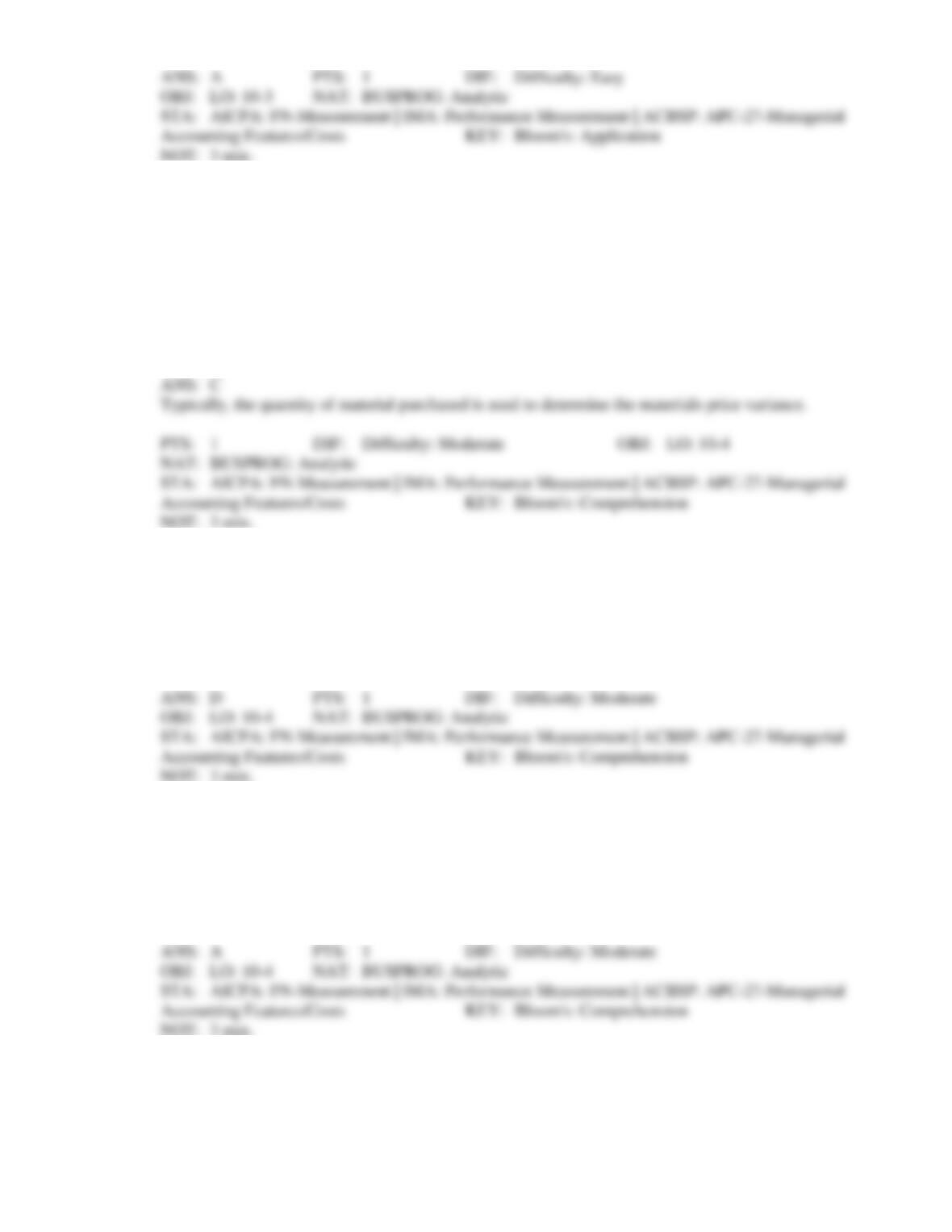
34. The materials price variance is computed using the equation
a.
(Actual Price Actual Quantity) − (Standard Price Standard Quantity).
b.
(Standard Price Actual Quantity) − (Actual Price Actual Quantity).
c.
(Standard Price Standard Quantity) − (Actual Price Actual Quantity).
d.
(Actual Price Actual Quantity) − (Standard Price Actual Quantity).
e.
None of these.
35. The materials usage variance is calculated by the equation
a.
(Standard Price Actual Quantity) − (Standard Price Standard Quantity).
b.
(Standard Price Standard Quantity) + (Standard Price Actual Quantity).
c.
(Actual Price Actual Quantity) − (Standard Price Actual Quantity).
d.
(Actual Price Standard Quantity) + (Actual Quantity Standard Price).
e.
None of these.
36. Which of the following is not true regarding the use of materials variance information?
a.
The purchasing agent has the responsibility for controlling the materials price variance.
b.
The production manager is generally responsible for materials usage.
c.
The production manager is concerned with minimizing scrap, waste, and rework.
d.
The purchasing department is responsible for acquiring quality materials.
e.
All of these are true.
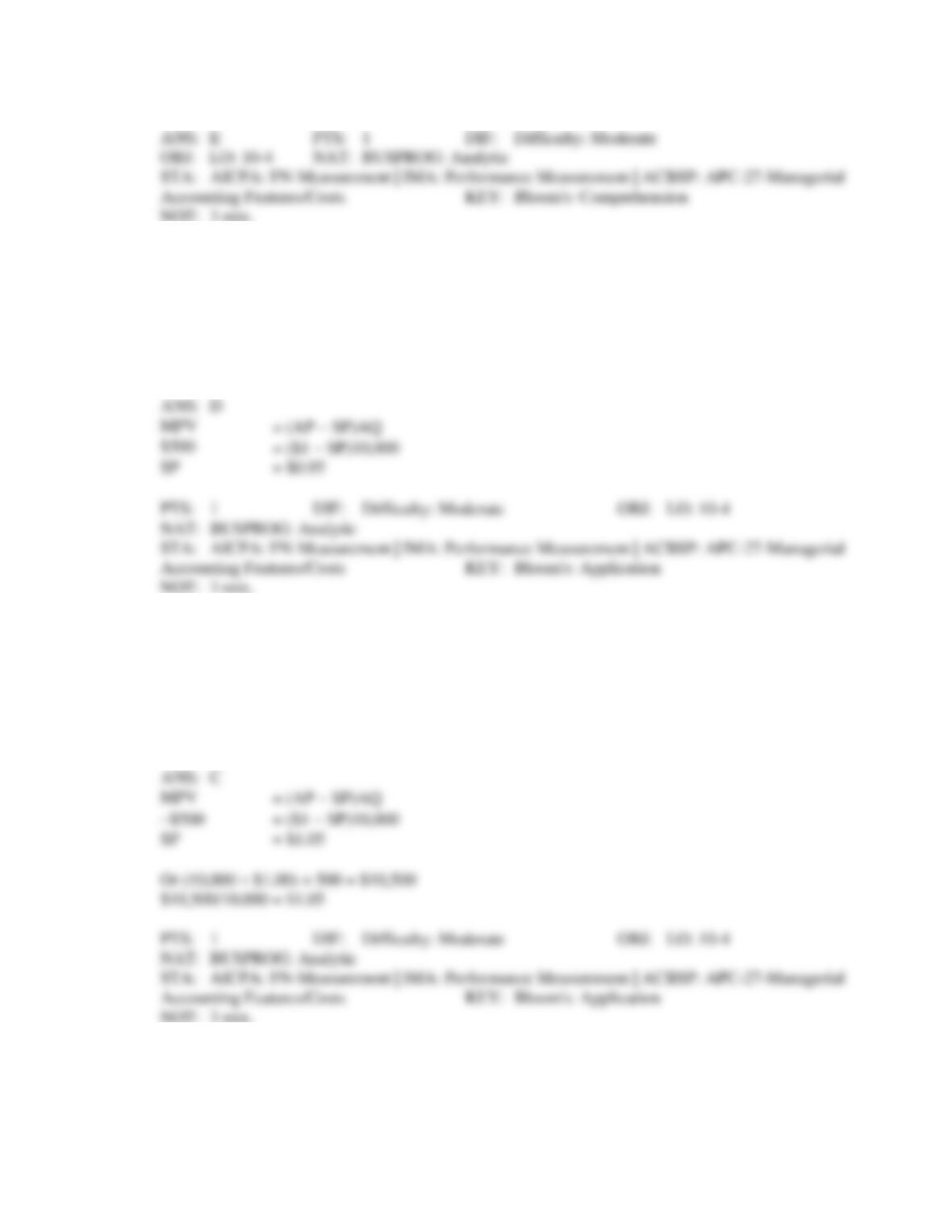
37. During the month of March, Baker’s Express purchased 10,000 pounds of flour at $1 per pound. At the
end of March, Baker’s Express found that it had an unfavorable materials price variance of $500. The
standard cost per pound must be
a.
$1.95
b.
$1.00
c.
$1.05
d.
$0.95
38. During the month of March, Baker’s Express purchased 10,000 pounds of flour at $1 per pound. At the
end of March, Baker’s Express found that it had a favorable materials price variance of $500. The
standard cost per pound must be
a.
$0.95
b.
$1.00
c.
$1.05
d.
$1.95
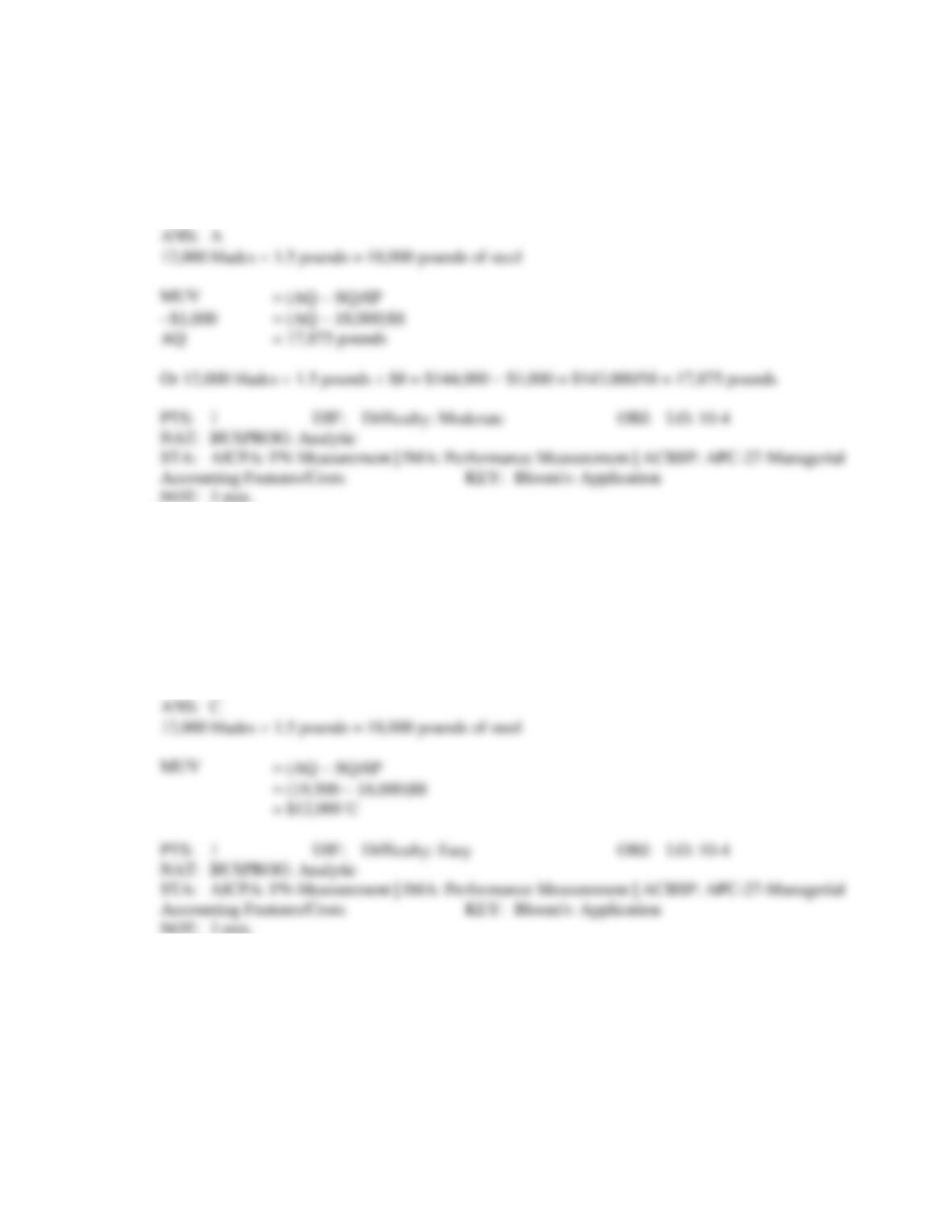
39. During June, Cisco Company produced 12,000 chainsaw blades. The standard quantity of material
allowed per unit was 1.5 pounds of steel per blade at a standard cost of $8 per pound. Cisco
determined that it had a favorable materials usage variance of $1,000 for June. Calculate the actual
quantity of materials Cisco used.
a.
17,875 pounds
b.
12,125 pounds
c.
11,875 pounds
d.
18,125 pounds
40. During June, Cisco Company produced 12,000 chainsaw blades. The standard quantity of material
allowed per unit was 1.5 pounds of steel per blade at a standard cost of $8 per pound. The actual cost
was $7 per pound. The actual pounds of steel that Cisco purchased were 19,500 pounds. All materials
purchased were used. Calculate Cisco’s materials usage variance.
a.
$10,500 U
b.
$12,000 F
c.
$12,000 U
d.
$10,500 F
41. Perfect Builders makes all sorts of moldings. Its standard quantity of material allowed is 1 foot of
wood per 1 foot of molding at a standard price of $2.00 per foot. During August, it purchased 500,000
feet of wood at a cost of $1.90 per foot, which produced only 499,000 feet of molding. Calculate the
materials price variance and the materials usage variance, respectively.
a.
$50,000 F and $2,000 U
b.
$49,900 U and $2,000 F
c.
$50,000 F and $1,900 U
d.
$49,900 F and $1,900 U
42. Mover Company has developed the following standards for one of its products:
Direct materials:
7.5 pounds $8 per pound
Direct labor:
2 hours $12 per hour
The following activity occurred during March:
Materials purchased:
5,000 pounds costing $42,500
Materials used:
3,600 pounds
Units produced:
500 units
Direct labor:
1,150 hours at $11.80/hour
The company records materials price variances at the time of purchase. The variable standard cost per
unit for materials and labor is
a.
$98.
b.
$84.
c.
$74.
d.
$38.
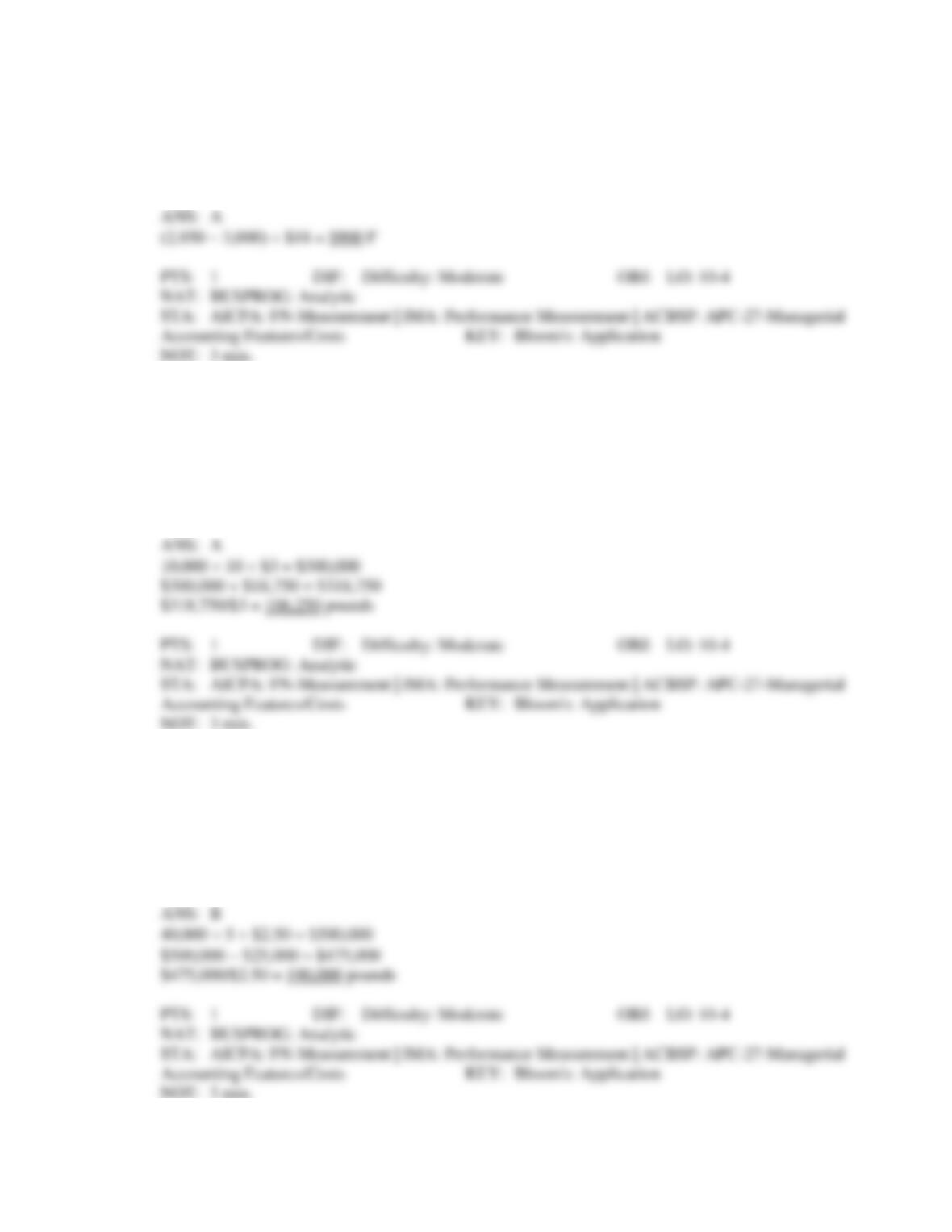
Direct materials (7.5 pounds $8)
Direct labor (2 hours $12)
43. Roberts Company uses a standard costing system. The following information pertains to direct
materials for the July:
Standard price per lb.
$18.00
Actual purchase price per lb.
$16.50
Quantity purchased
3,100 lbs.
Quantity used
2,950 lbs.
Standard quantity allowed for actual output
3,000 lbs.
Actual output
1,000 units
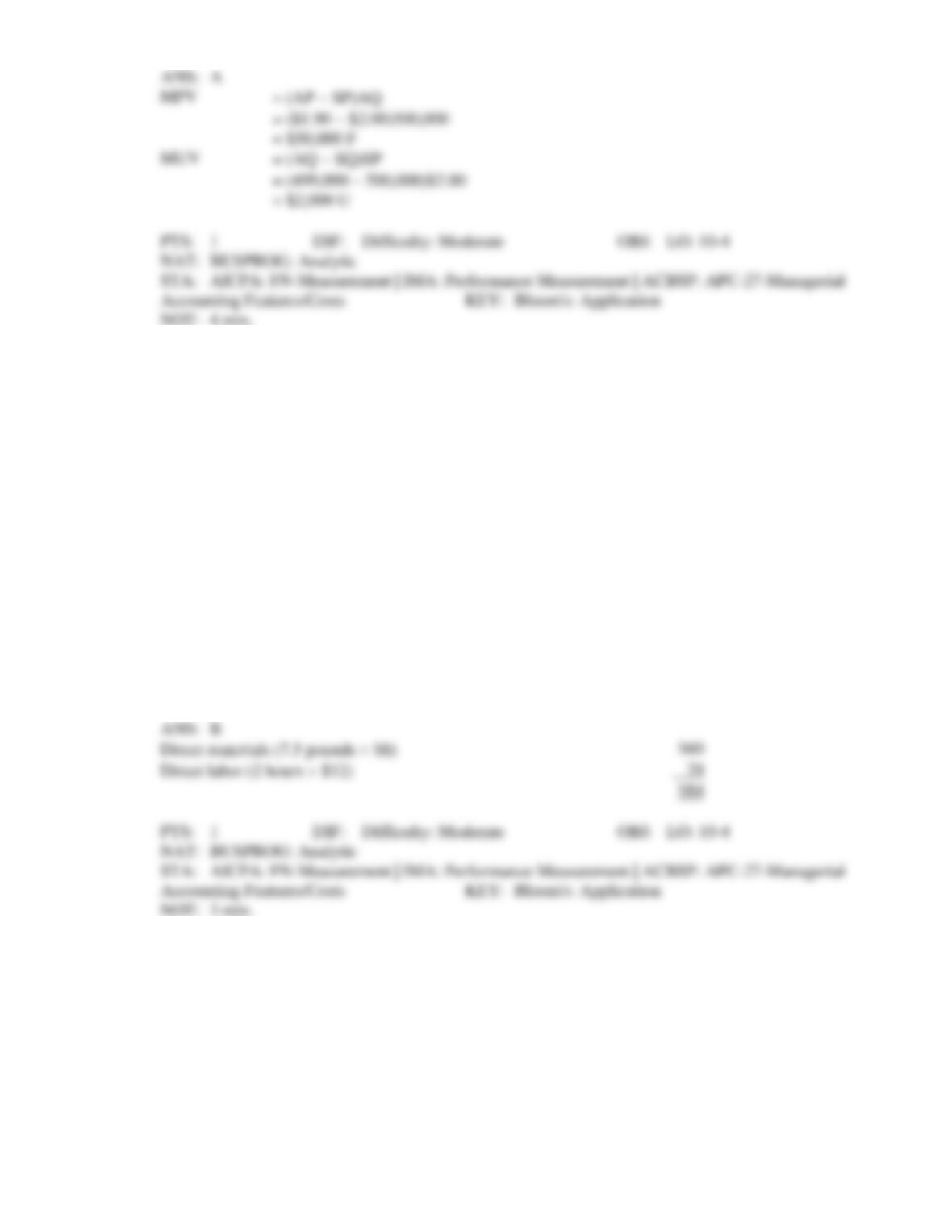
= (AP − SP)AQ
= ($1.90 − $2.00)500,000
= $50,000 F
= (AQ − SQ)SP
= (499,000 − 500,000)$2.00
= $2,000 U
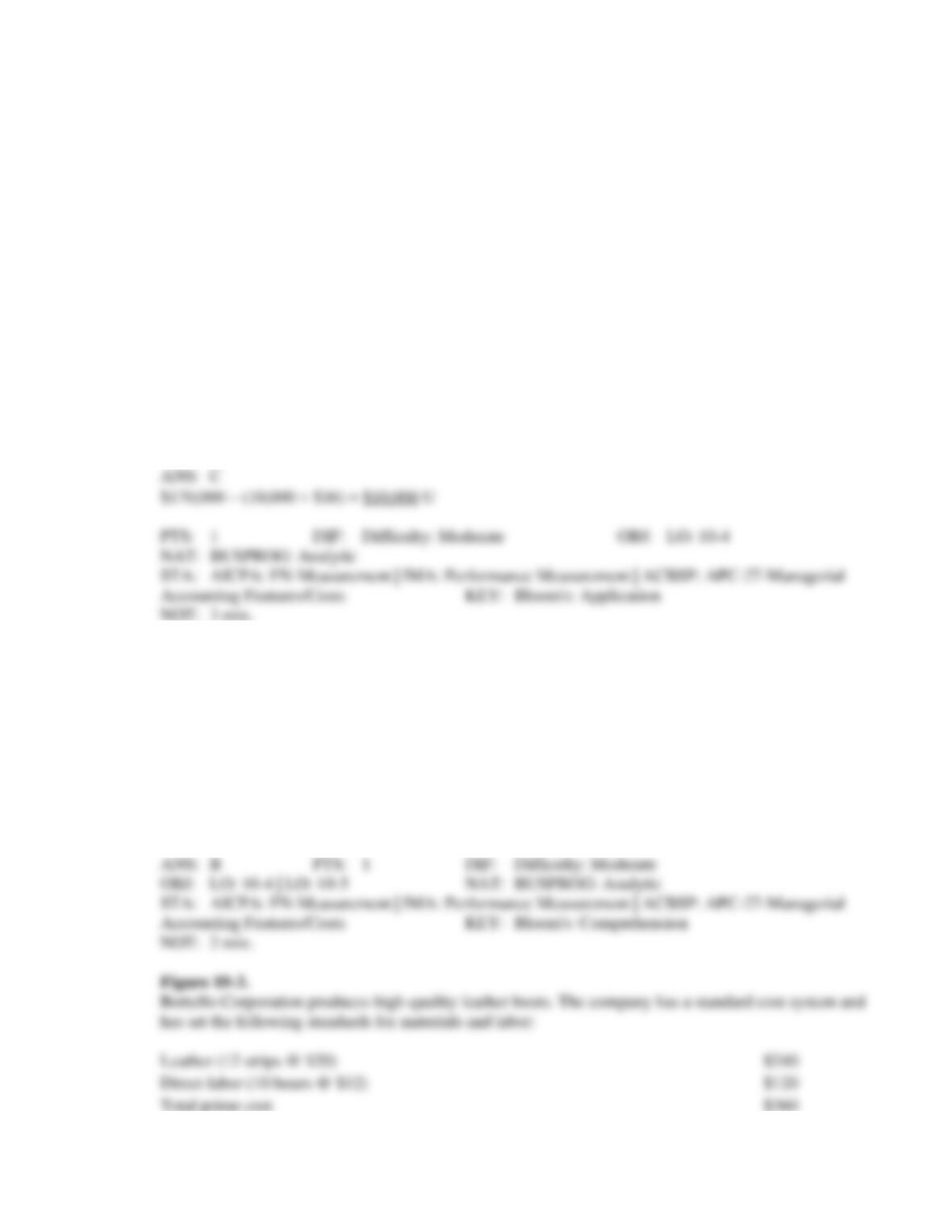
Roberts Company reports its material price variances at the time of purchase. What is the material
usage variance for Roberts Company?
a.
$900 F
b.
$1,950 F
c.
$2,850 F
d.
$900 U
44. During August, 10,000 units were produced. The standard quantity of material allowed per unit was 10
pounds at a standard cost of $3 per pound. If there was an unfavorable usage variance of $18,750 for
August, the actual quantity of materials used must be
a.
106,250 pounds.
b.
93,750 pounds.
c.
31,875 pounds.
d.
23,438 pounds.
45. During September, 40,000 units were produced. The standard quantity of material allowed per unit
was 5 pounds at a standard cost of $2.50 per pound. If there was a favorable usage variance of $25,000
for September, the actual quantity of materials used must have been
a.
210,000 pounds.
b.
190,000 pounds.
c.
105,000 pounds.
d.
95,000 pounds.
46. Max Company has developed the following standards for one of its products.
Direct materials:
15 pounds $16 per pound
Direct labor:
4 hours $24 per hour
Variable overhead:
4 hours $14 per hour
The following activity occurred during the month of October:
Materials purchased:
10,000 pounds costing $170,000
Materials used:
7,200 pounds
Units produced:
500 units
Direct labor:
2,300 hours at $23.60/hour
The company records materials price variances at the time of purchase. The direct materials price
variance is
a.
$50,000 F.
b.
$50,000 U.
c.
$10,000 U.
d.
$10,000 F.
47. All of the following are true except
a.
A favorable labor efficiency variance could result from using higher quality materials that
result in fewer inspections.
b.
A favorable labor rate variance could result from lower wage workers quitting.
c.
A favorable materials price variance could result from purchasing identical materials from
another supplier at a lower price.
d.
An unfavorable materials usage variance could result from not efficiently utilizing raw
materials, thus causing waste.
e.
An unfavorable labor efficiency variance can be caused by machine downtime, and poor
quality materials.
48. Refer to Figure 10-3. Compute the materials price variance and the materials usage variance,
respectively.
a.
$9,000 F and $1,200 U
b.
$9,300 U and $1,500 F
c.
$6,800 F and $4,000 U
d.
$6,800 U and $4,000 F
49. Refer to Figure 10-3. Calculate the labor rate variance and the labor efficiency variance, respectively.
a.
$4,500 U and $3,000 U
b.
$4,500 F and $3,000 F
c.
$4,500 U and $3,000 F
d.
$4,500 F and $3,000 U
50. Refer to Figure 10-3. Compute the total budget variances for materials and labor, respectively.
a.
$2,800 F and $7,500 F
b.
$2,800 F and $7,500 U
c.
$2,800 U and $7,500 U
d.
$2,800 U and $7,500 F
51. Refer to Figure 10-3. Compute the costs of leather and direct labor that should have been incurred for
the production of 125 boots.
a.
$36,000 and $36,000
b.
$46,500 and $37,500
c.
$37,200 and $20,000
d.
$30,000 and $15,000
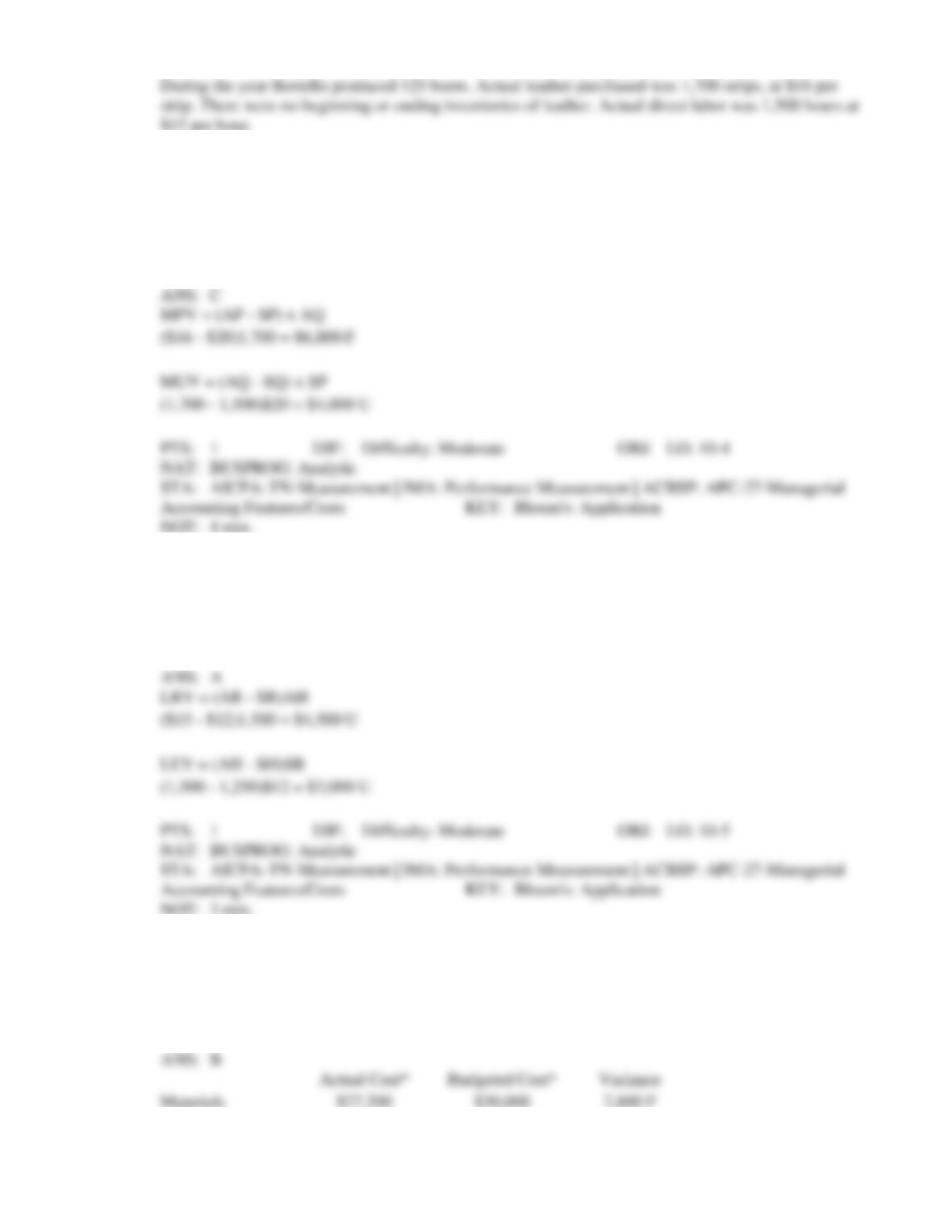
Materials: (SQ x SR) x AQ = $240 x 125 = $30,000
Labor: (SH x SR) x AQ = $120 x 125 = $15,000
Figure 10-5.
Seaside Company produces picture frames. During the year 190,000 picture
frames were produced. Materials and labor standards for producing the picture
frames are as follows:
Direct materials (2 pieces of wood @ $2.25)
$4.50
Direct labor (2 hours @ $10)
$20.00
Seaside purchased and used 400,000 pieces of wood at $2.00 each and its actual
labor hours were 360,000 hours at a wage rate of $10.50.
52. Refer to Figure 10-5. What is the materials price variance?
a.
$100,000 F
b.
$112,500 U
c.
$135,000 F
d.
$170,000 U
MPV= (AP-SP)AQ
Labor
^Budgeted Materials: (SQ x SR) x AQ = $240 x 125 = $30,000
^Budgeted Labor: (SH x SR) x AQ = $120 x 125 = $15,000
53. Refer to Figure 10-5. What is the materials usage variance?
a.
$112,500 F
b.
$112,500 U
c.
$45,000 F
d.
$45,000 U
54. Refer to Figure 10-5. What is Seaside’s labor rate variance?
a.
$180,000 F
b.
$180,000 U
c.
$225,000 U
d.
$217,500 F
55. Refer to Figure 10-5. What is Seaside’s total labor variance?
a.
$20,000 F
b.
$20,000 U
c.
$112,500 F
d.
$120,000 U
56. Which of the following is true regarding direct labor variances?
a.
The labor efficiency variance measures the difference between what was paid to direct
laborers and what should have been paid.
b.
The labor rate and labor efficiency variances will always add up to the total labor variance.
c.
The labor rate variance measures the difference between the labor hours that were actually
used and the labor hours that should have been used.
d.
The labor rate variance measures the difference between the labor hours that were
originally budgeted and the labor hours that should have been used.
e.
The labor rate variance measures the difference between the labor hours that were actually
used and the labor hours that were originally budgeted.
57. The labor rate variance is computed by
a.
(Actual Rate Actual Hours) − (Standard Rate Standard Hours).
b.
(Standard Rate Actual Rate) − (Actual Rate Actual Hours).
c.
(Actual Rate Standard Hours) − (Standard Rate Actual Hours).
d.
(Actual Rate Actual Hours) − (Standard Rate Actual Hours).
e.
None of these.
58. The labor efficiency variance is calculated by the equation
a.
(Standard Hours Actual Hours) − (Actual Hours Standard Rate).
b.
(Actual Rate Actual Hours) − (Standard Rate Actual Hours).
c.
(Actual Hours Standard Rate) − (Standard Hours Standard Rate).
d.
(Standard Hours Actual Rate) − (Actual Hours Actual Rate).
e.
None of these.
59. Which of the following is not true regarding the use of labor variance information?
a.
The actual wage rate is almost always different from the standard rate.
b.
Unexpected overtime can cause variation in the labor rate.
c.
An average wage rate is chosen as the labor rate standard.
d.
The production manager controls the use of labor.
e.
The actual wage rate is used in determining the labor rate variance.
60. Kaizen costing involves
a.
changing the standards frequently.
b.
changing management.
c.
outsourcing processes.
d.
major ad campaigns.
61. Which of the following is not true about Kaizen Standards?
a.
Kaizen standards are the standards used for continuous improvement.
b.
Kaizen standards are a currently attainable standard that reflects planned improvement.
c.
Kaizen standards are constantly changing.
d.
Kaizen standards are the standards used in traditional costing systems.
62. Claire Company uses a standard costing system. The following information pertains to direct labor
costs for February:
Standard direct labor rate per hour
$15.00
Actual direct labor rate per hour
$13.50
Labor rate variance
$18,000 F
Actual output
1,000 units
Standard hours allowed for actual production
10,000 hours
What is the total labor budget variance for Claire Company?
a.
$18,000 F
b.
$12,000 F
c.
$18,000 U
d.
$12,000 U
63. Claire Company uses a standard costing system. The following information pertains to direct labor
costs for February:
Standard direct labor rate per hour
$15.00
Actual direct labor rate per hour
$13.50
Labor rate variance
$18,000 F
Actual output
1,000 units
Standard hours allowed for actual production
10,000 hours
How many actual labor hours were worked during February for Claire Company?
a.
10,000 hours
b.
2,000 hours
c.
1,200 hours
d.
12,000 hours
64. If the actual labor rate exceeds the standard labor rate and the actual labor hours exceed the number of
hours allowed, the labor rate variance and labor efficiency variance will be
Labor Rate Labor Efficiency
Variance Variance
a.
Favorable Favorable
b.
Favorable Unfavorable
c.
Unfavorable Favorable
d.
Unfavorable Unfavorable
65. During January, 7,000 direct labor hours were worked at a standard cost of $20 per hour. If the direct
labor rate variance for January was $17,500 favorable, the actual cost per direct labor hour must be
a.
$17.50.
b.
$20.00.
c.
$22.50.
d.
$25.00.
66. During October, 10,000 direct labor hours were worked at a standard cost of $10 per hour. If the direct
labor rate variance for October was $4,000 unfavorable, the actual cost per direct labor hour must be
a.
$10.40.
b.
$10.00.
c.
$9.60.
d.
$9.20.
67. Bender Corporation produced 100 units of Product AA. The total standard and actual costs for
materials and direct labor for the 100 units of Product AA are as follows:
Materials:
Standard
Actual
Standard:
200 pounds at $3.00 per pound
$600
Actual:
220 pounds at $2.85 per pound
$627
Direct labor:
Standard:
400 hours at $15.00 per hour
6,000
Actual:
368 hours at $16.50 per hour
6,072
What is the labor efficiency variance for Bender Corporation?
a.
$480 U
b.
$552 F
c.
$552 U
d.
$480 F
68. Refer to Figure 10-4. What was High Fliers’ actual cost per labor hour?
a.
$12.75
b.
$11.50
c.
$10.50
d.
$10.25
69. Refer to Figure 10-4. What was High Fliers’ total labor variance?
a.
$61,500 F
b.
$76,500 F
c.
$76,500 U
d.
$61,500 U
Figure 10-6.
Extreme Builders constructs houses. The standard labor rate is $25 per hour and the standard number
of hours is 15,000 hours per home. During the year, it constructed 12 homes using 18,000 labor hours
per home and a rate of $28 per hour.
70. Refer to Figure 10-6. Calculate the Extreme Builders’ labor rate variance.
a.
$540,000 U
b.
$540,000 F
c.
$648,000 U
d.
$648,000 F
71. Refer to Figure 10-6. Calculate the labor efficiency variance.
a.
$1,008,000 F
b.
$900,000 U
c.
$1,008,000 U
d.
$900,000 F
72. Assume that SQ = Standard Quantity, SP = Standard Price, AQ = Actual Quantity, and AP = Actual
Price. The correct entry along with the equation to record the issuance and usage of materials,
assuming a favorable materials usage variance, is as follows
a.
Work in Process SQ SP
Materials Usage Variance (AQ − SQ)SP
Materials AQ SP
b.
Work in Process SQ SP
Materials Usage Variance (AQ − SQ)SP
Materials AQ SP
c.
Work in Process AQ AP
Materials Usage Variance (AQ − SQ)SP
Materials AQ SP
d.
Work in Process AQ AP
Materials Usage Variance (AQ − SQ)SP
Materials AQ SP
e.
None of these.
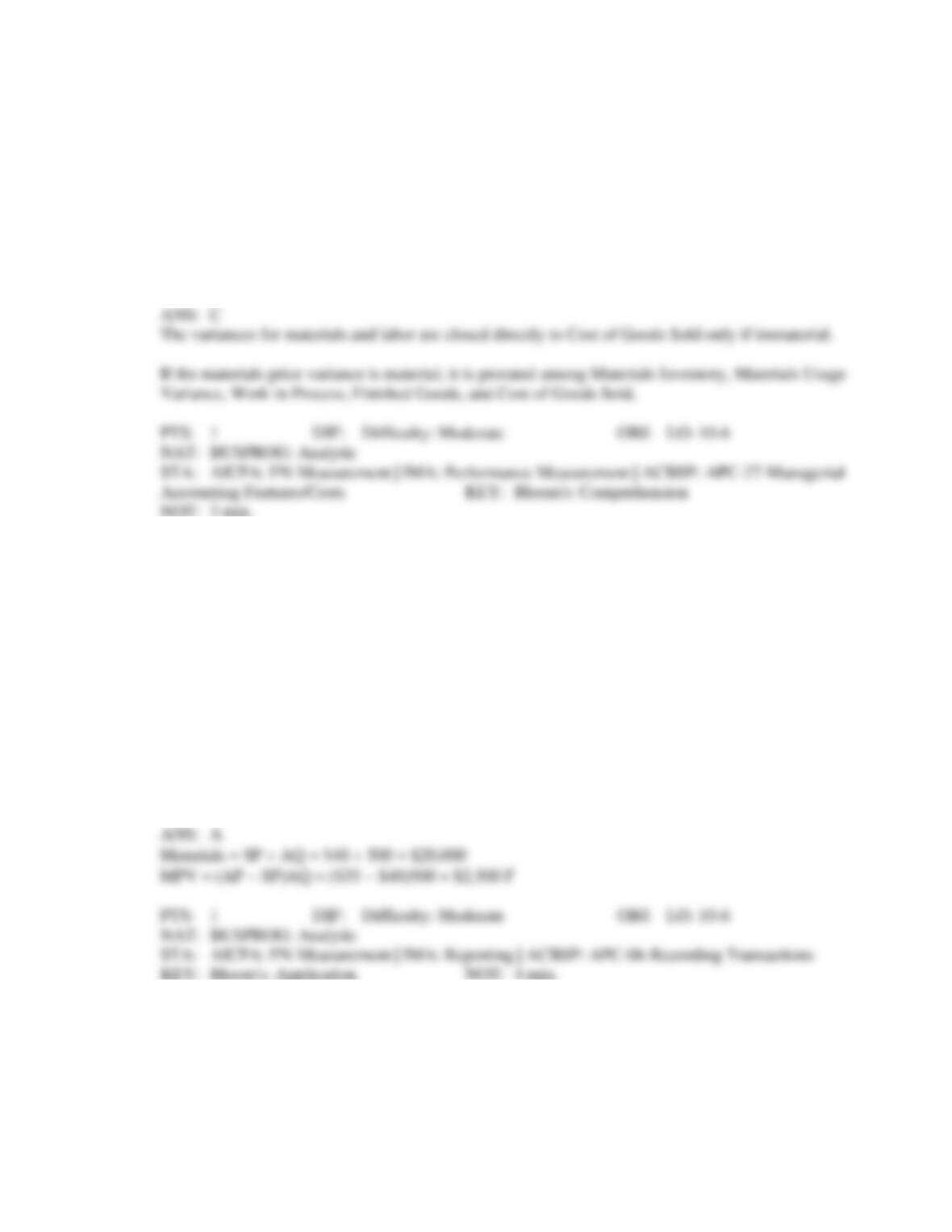
73. Which of the following is true regarding the disposition of materials and labor variances?
a.
The variances for materials and labor are closed directly to Cost of Goods Sold regardless
of materiality.
b.
If the materials price variance is material, it is prorated among Materials Inventory,
Materials Usage Variance, Work in Process, and Finished Goods.
c.
The materials usage variance and the labor variances, if material, are prorated among
Work in Process, Finished Goods, and Cost of Goods Sold.
d.
The materials usage variance and the labor variances are always prorated among Work in
Process, Finished Goods, and Cost of Goods Sold.
e.
The materials usage variance and the labor variances are always closed to Cost of Goods
Sold.
74. During September, a small roofing company purchased 500 bundles of a certain type of shingle at a
price of $35 per bundle, $5 less than the standard price. Its standard quantity of this type of shingle is
550 bundles. What is the journal entry to record the purchase of materials?
a.
Materials 20,000
Materials Price Variance 2,500
Accounts Payable 17,500
b.
Materials 20,000
Materials Price Variance 2,500
Accounts Payable 22,500
c.
Materials 17,500
Materials Price Variance 2,500
Accounts Payable 15,000
d.
Materials 20,000
Materials Price Variance 2,750
Accounts Payable 17,250
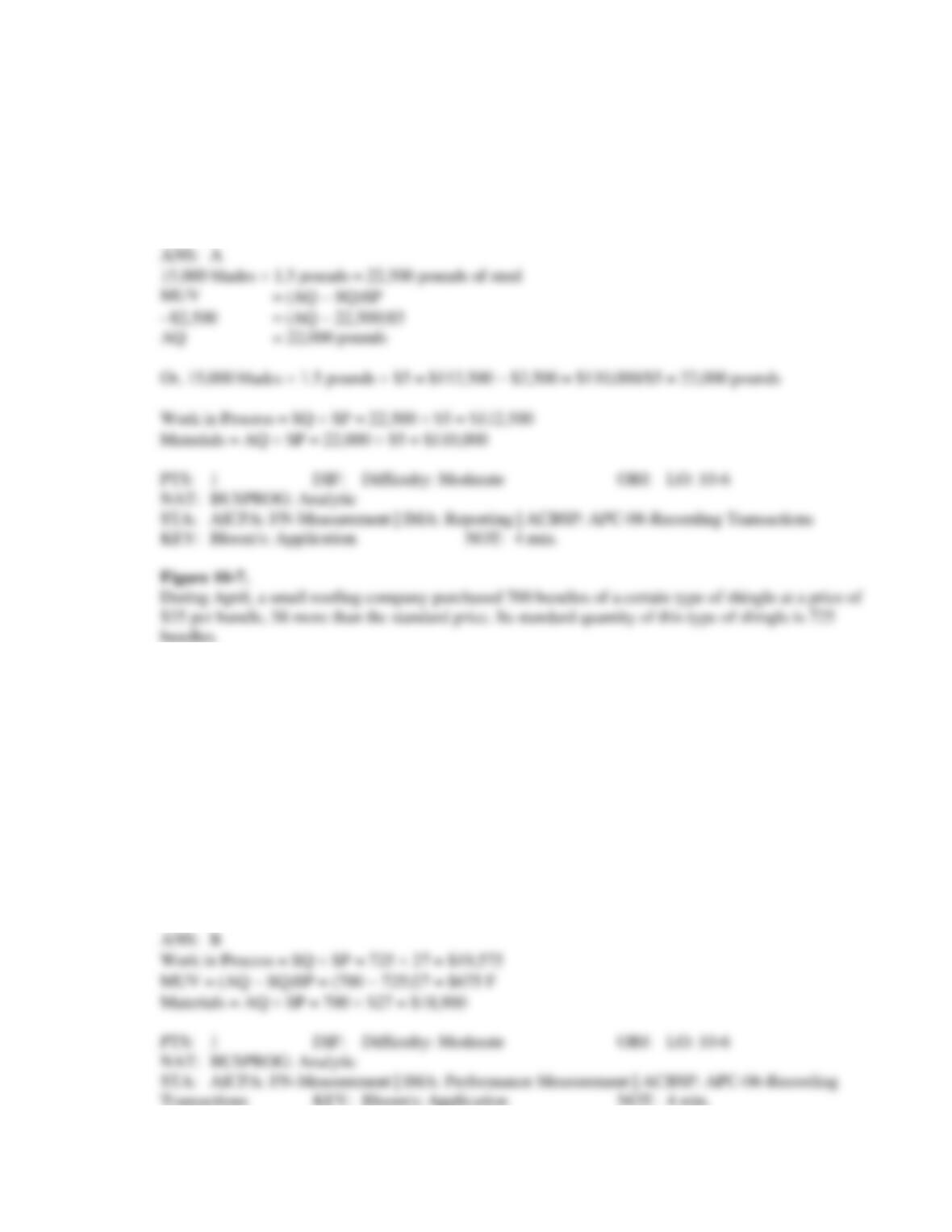
75. During June, Cisco Company produced 15,000 chainsaw blades. The standard quantity of material
allowed per unit was 1.5 pounds of steel per blade at a standard cost of $5 per pound. The actual
purchase price was $6.25 per pound. Cisco determined that it had a favorable materials usage variance
of $2,500 for June. What is the journal entry to record the issuance and usage of materials?
a.
Work in Process 112,500
Materials Usage Variance 2,500
Materials 110,000
b.
Work in Process 110,000
Materials Usage Variance 2,500
Materials 112,000
c.
Work in Process 112,500
Materials Usage Variance 2,500
Materials 115,000
d.
Work in Process 140,625
Materials Usage Variance 2,500
Materials 138,125
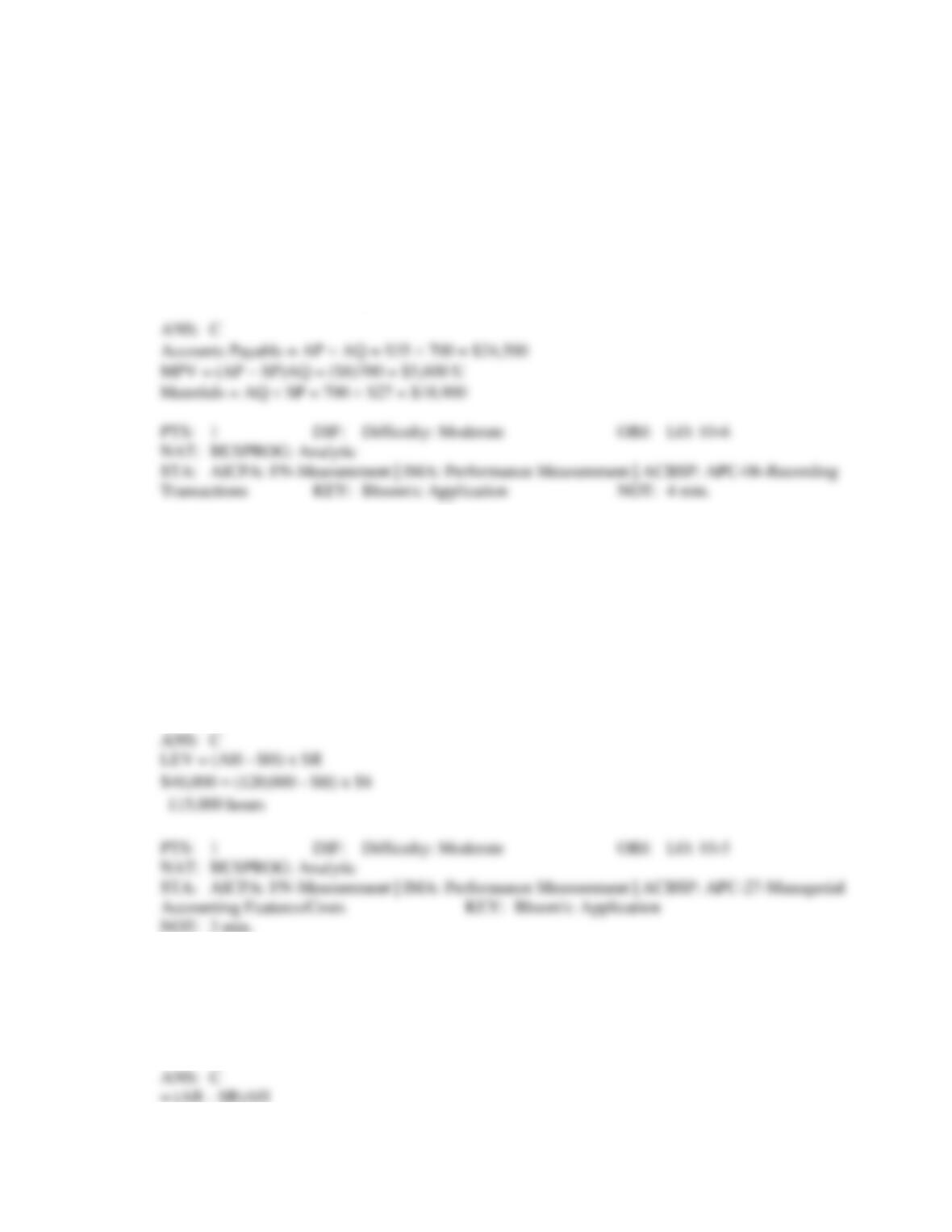
76. Refer to Figure 10-7. What is the journal entry to record the issuance and usage of materials assuming
that the roofing company purchased and used 700 bundles?
a.
Work in Process 18,900
Materials Usage Variance 675
Materials 19,575
b.
Work in Process 19,575
Materials Usage Variance 675
Materials 18,900
c.
Work in Process 24,500
Materials Usage Variance 875
Materials 25,375
d.
Work in Process 25,375
Materials Usage Variance 875
Materials 24,500
77. Refer to Figure 10-7. What is the journal entry to record the purchase of materials?
a.
Materials 19,575
Materials Price Variance 5,800
Accounts Payable 25,375
b.
Materials 24,500
Materials Price Variance 5,600
Accounts Payable 18,900
c.
Materials 18,900
Materials Price Variance 5,600
Accounts Payable 24,500
d.
Materials 25,375
Materials Price Variance 5,800
Accounts Payable 19,575
Figure 10-8.
The Perfect Tool Company (South America Division) produced 80,000 saw blades during the year. It
took 1.5 hours of labor per blade at a rate of $8.50 per hour. However, its standard labor rate is $8.00.
Its labor efficiency variance was an unfavorable $40,000.
78. Refer to Figure 10-8. What is Perfect’s standard hours allowed for a volume of 80,000 blades?
a.
210,000 hours
b.
189,000 hours
c.
115,000 hours
d.
125,000 hours
79. Refer to Figure 10-8. What is Perfect’s labor rate variance?
a.
$57,500 U
b.
$57,500 F
c.
$60,000 U
d.
$60,000 F
80. Refer to Figure 10-8. What is the journal entry to record both labor variances?
a.
Work In Process 920,000
Labor Rate Variance 60,000
Labor Efficiency Variance 40.000
Accrued Payroll 1,020,000
b.
Work In Process 960,000
Labor Rate Variance 57,500
Labor Efficiency Variance 40,000
Accrued Payroll 1,057,500
c.
Work In Process 920,000
Labor Rate Variance 60,000
Labor Efficiency Variance 40,000
Accrued Payroll 940,000
d.
Work In Process 960,000
Labor Rate Variance 57,500
Labor Efficiency Variance 40,000
Accrued Payroll 977,500
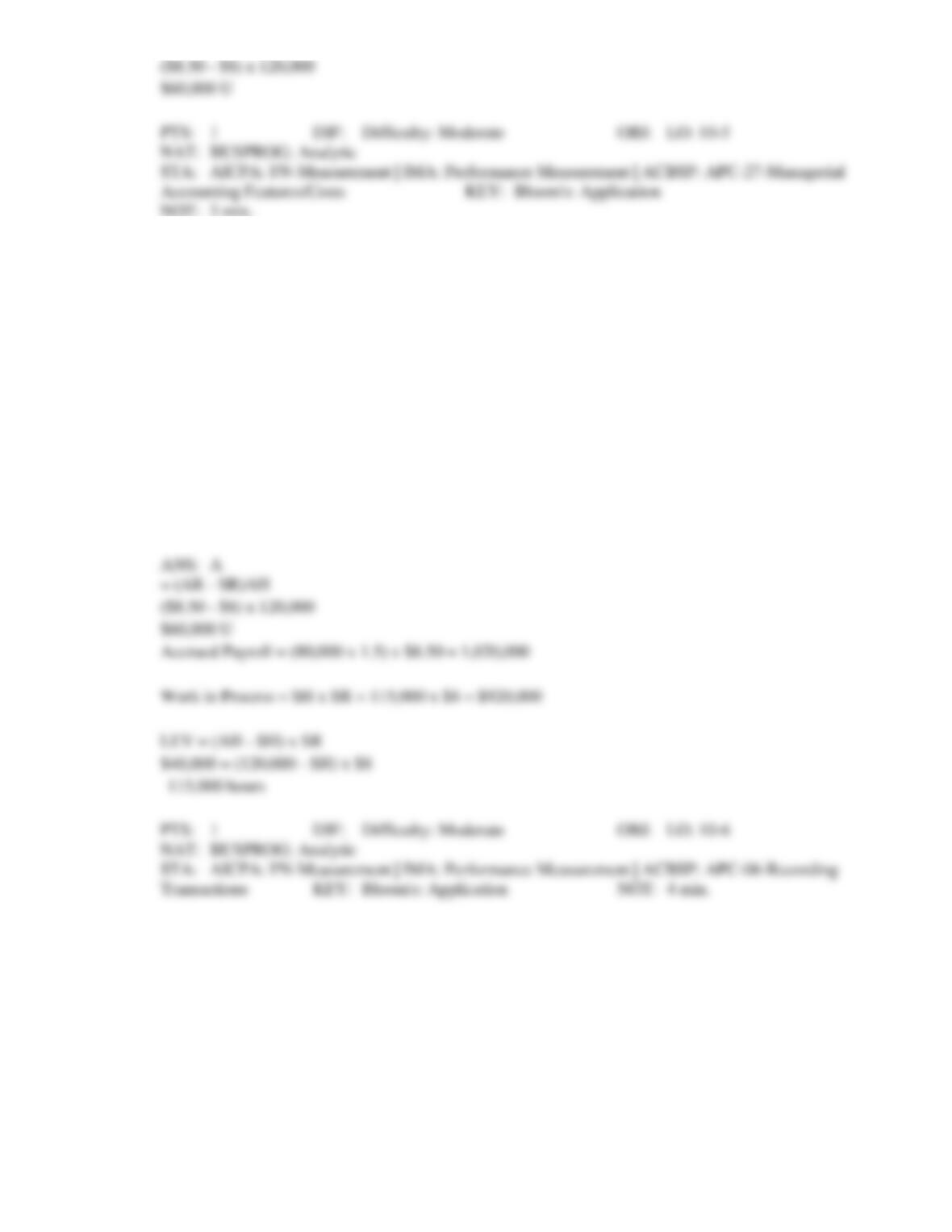
= (AR – SR)AH
($8.50 – $8) x 120,000
$60,000 U
Accrued Payroll = (80,000 x 1.5) x $8.50 = 1,020,000
Work in Process = SH x SR = 115,000 x $8 = $920,000
LEV = (AH – SH) x SR
$40,000 = (120,000 – SH) x $8
115,000 hours
Figure 10-9.
James Company manufactures t-shirts. During the year, it manufactured 250,000 t-shirts, using 2 hours
of direct labor at a rate of $8.50 per hour. The materials and labor standards for manufacturing the
t-shirts are:
Direct materials (6 yards of fabric @ $3 per yard)
$18
Direct labor (2.4 hours @ $8.00 per hour)
17
It took James 1,400,000 yards at $2.50 per yard to make the 250,000 t-shirts.
($8.50 – $8) x 120,000
$60,000 U