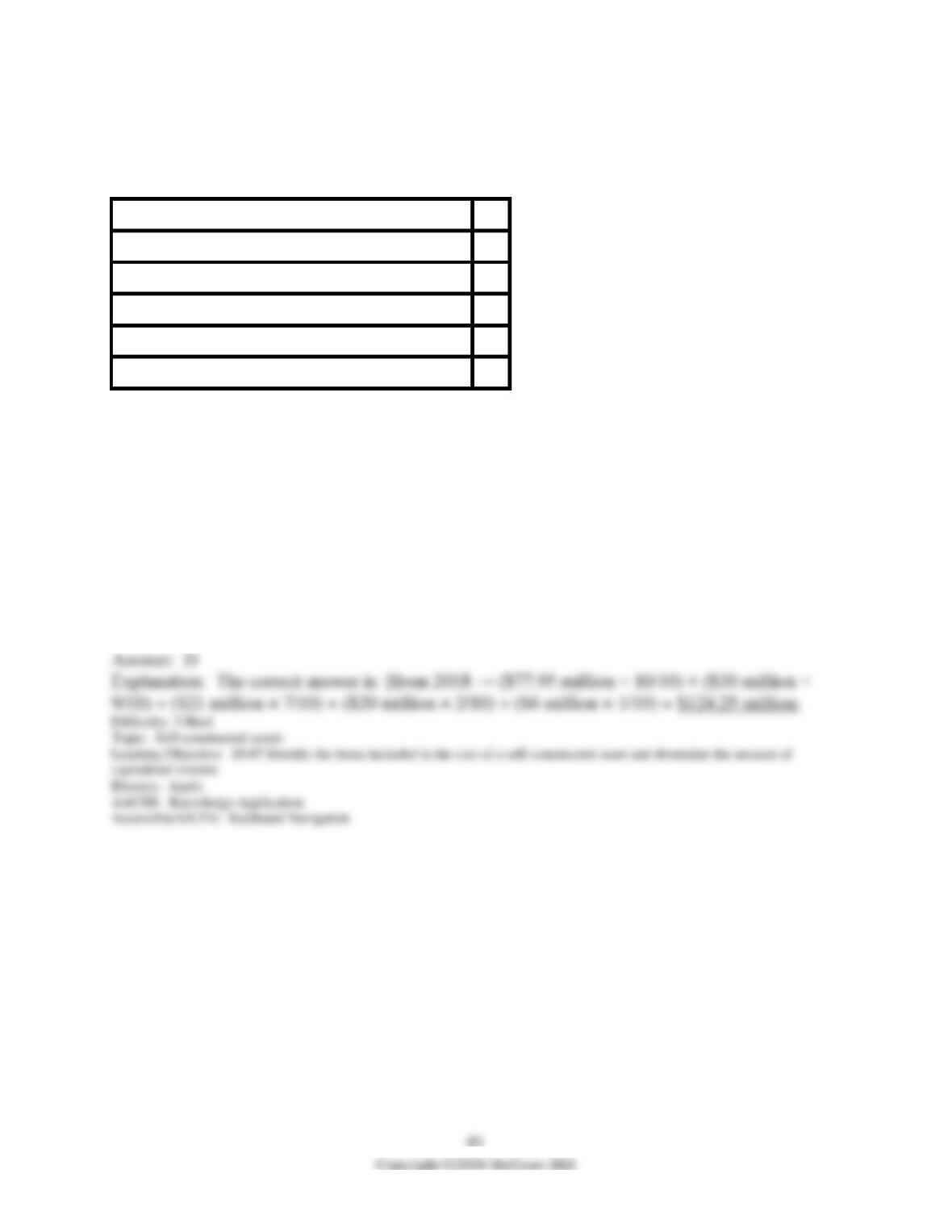
79) On June 1, 2017, the Crocus Company began construction of a new manufacturing plant. The
plant was completed on October 31, 2018. Expenditures on the project were as follows ($ in
millions):
July 1, 2017
54
October 1, 2017
22
February 1, 2018
30
April 1, 2018
21
September 1, 2018
20
October 1, 2018
6
On July 1, 2017, Crocus obtained a $70 million construction loan with a 6% interest rate. The
loan was outstanding through the end of October, 2018. The company’s only other interest-
bearing debt was a long-term note for $100 million with an interest rate of 8%. This note was
outstanding during all of 2017 and 2018. The company’s fiscal year-end is December 31.
In computing the capitalized interest for 2018, Crocus’ average accumulated expenditures are:
A) $46.30 million.
B) $103.54 million.
C) $122.30 million.
D) $124.25 million.
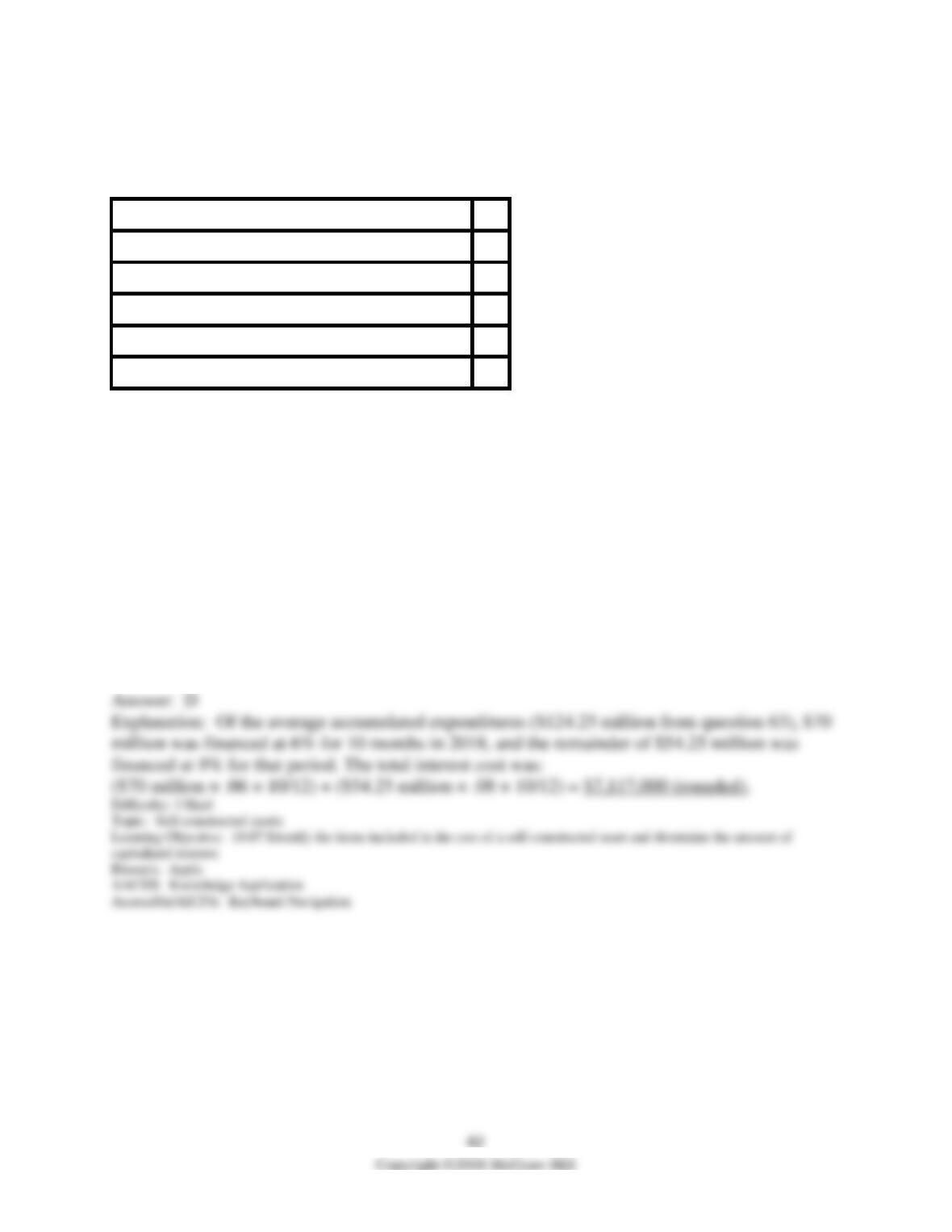
80) On June 1, 2017, the Crocus Company began construction of a new manufacturing plant. The
plant was completed on October 31, 2018. Expenditures on the project were as follows ($ in
millions):
July 1, 2017
54
October 1, 2017
22
February 1, 2018
30
April 1, 2018
21
September 1, 2018
20
October 1, 2018
6
On July 1, 2017, Crocus obtained a $70 million construction loan with a 6% interest rate. The
loan was outstanding through the end of October, 2018. The company’s only other interest-
bearing debt was a long-term note for $100 million with an interest rate of 8%. This note was
outstanding during all of 2017 and 2018. The company’s fiscal year-end is December 31.
What is the amount of interest that Crocus should capitalize in 2018, using the specific interest
method (rounded to the nearest thousand dollars)?
A) $7,248,000 (rounded).
B) $7,283,000 (rounded).
C) $8,740,000 (rounded).
D) None of these answer choices are correct.
81) On January 1, 2018, Kendall Inc. began construction of an automated cattle feeder system.
The system was finished and ready for use on September 30, 2019. Expenditures on the project
were as follows:
January 1, 2018
$
200,000
September 1, 2018
$
300,000
December 31, 2018
$
300,000
March 31, 2019
$
300,000
September 30, 2019
$
200,000
Kendall borrowed $750,000 on a construction loan at 12% interest on January 1, 2018. This loan
was outstanding throughout the construction period. The company had $4,500,000 in 9% bonds
payable outstanding in 2018 and 2019.
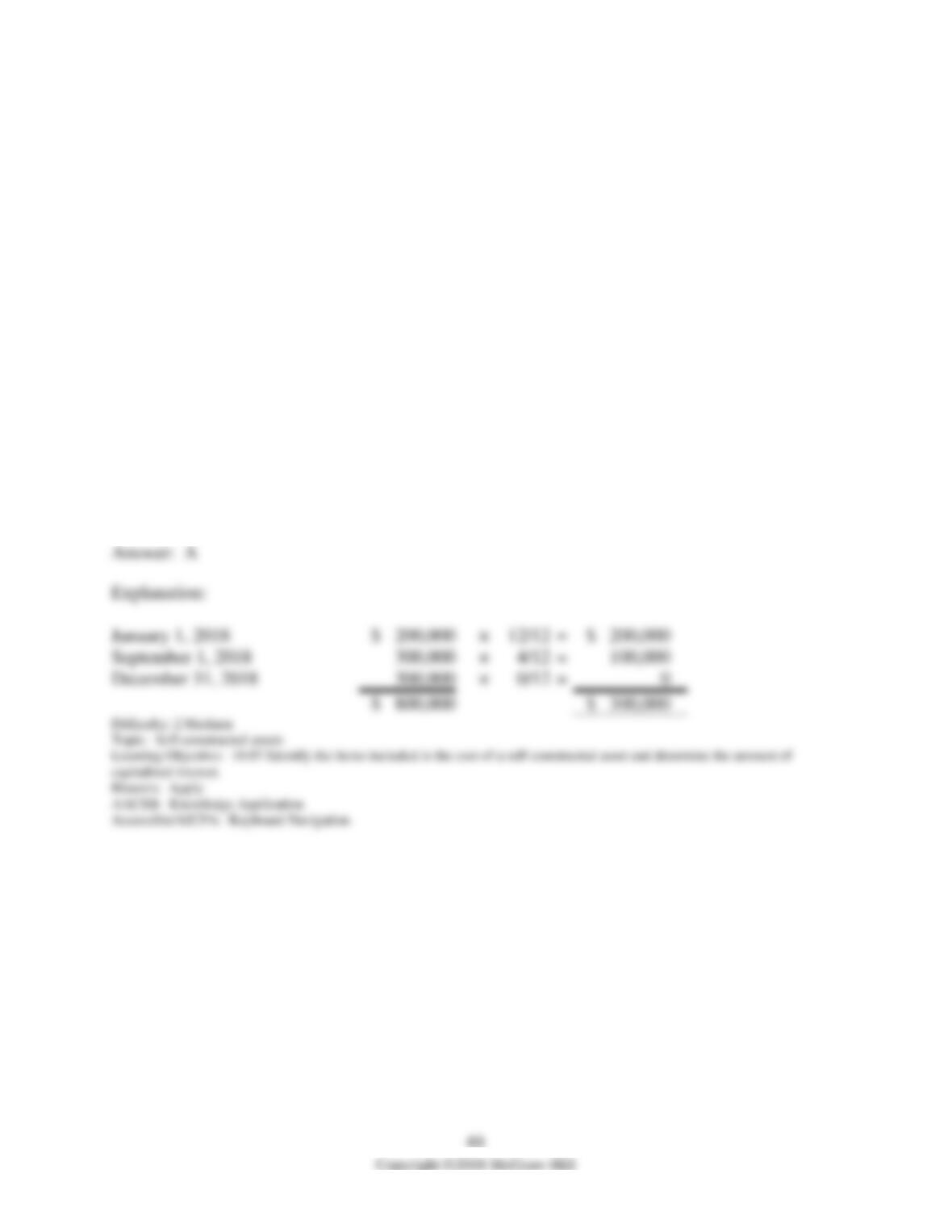
Average accumulated expenditures for 2018 was:
A) $300,000.
B) $350,000.
C) $500,000.
D) $400,000.
January 1, 2018
$
200,000
12/12
$
200,000
September 1, 2018
300,000
100,000
December 31, 2018
300,000
$
800,000
$
300,000
82) On January 1, 2018, Kendall Inc. began construction of an automated cattle feeder system.
The system was finished and ready for use on September 30, 2019. Expenditures on the project
were as follows:
January 1, 2018
$
200,000
September 1, 2018
$
300,000
December 31, 2018
$
300,000
March 31, 2019
$
300,000
September 30, 2019
$
200,000
Kendall borrowed $750,000 on a construction loan at 12% interest on January 1, 2018. This loan
was outstanding throughout the construction period. The company had $4,500,000 in 9% bonds
payable outstanding in 2018 and 2019.
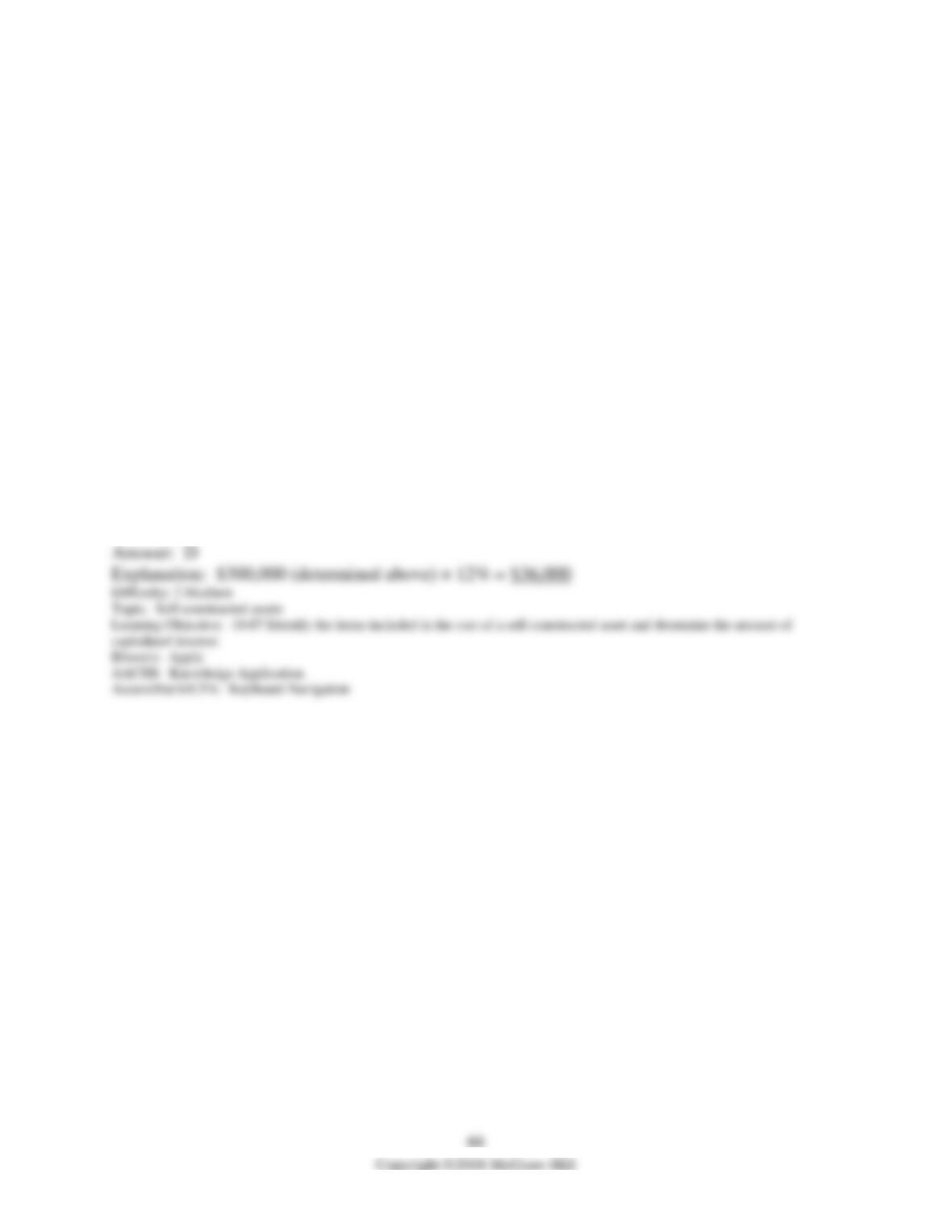
Interest capitalized for 2018 was:
A) $48,000.
B) $42,000.
C) $60,000.
D) $36,000.
83) On January 1, 2018, Kendall Inc. began construction of an automated cattle feeder system.
The system was finished and ready for use on September 30, 2019. Expenditures on the project
were as follows:
January 1, 2018
$
200,000
September 1, 2018
$
300,000
December 31, 2018
$
300,000
March 31, 2019
$
300,000
September 30, 2019
$
200,000
Kendall borrowed $750,000 on a construction loan at 12% interest on January 1, 2018. This loan
was outstanding throughout the construction period. The company had $4,500,000 in 9% bonds
payable outstanding in 2018 and 2019.
Average accumulated expenditures for 2019 was:
A) $536,000.
B) $1,236,000.
C) $1,200,000.
D) $1,036,000.
$
9/9
$
March 31, 2019
6/9
September 30, 2019
0/9
$
1,336,000
$
1,036,000
84) On January 1, 2018, Kendall Inc. began construction of an automated cattle feeder system.
The system was finished and ready for use on September 30, 2019. Expenditures on the project
were as follows:
January 1, 2018
$
200,000
September 1, 2018
$
300,000
December 31, 2018
$
300,000
March 31, 2019
$
300,000
September 30, 2019
$
200,000
Kendall borrowed $750,000 on a construction loan at 12% interest on January 1, 2018. This loan
was outstanding throughout the construction period. The company had $4,500,000 in 9% bonds
payable outstanding in 2018 and 2019.
Interest capitalized for 2019 was:
A) $104,625.
B) $86,805.
C) $87,875.
D) $67,500.
Total
$
1,036,000
Specific borrowing
12
%
9/12
$
67,500
Excess
%
9/12
19,305
Capitalized interest
$
86,805
85) On January 1, 2018, Dreamworld Co. began construction of a new warehouse. The building
was finished and ready for use on September 30, 2019. Expenditures on the project were as
follows:
January 1, 2018
$
300,000
September 1, 2018
$
450,000
December 31, 2018
$
450,000
March 31, 2019
$
450,000
September 30, 2019
$
300,000
Dreamworld had $5,000,000 in 12% bonds outstanding through both years.
Dreamworld’s average accumulated expenditures for 2018 was:
A) $300,000.
B) $450,000.
C) $525,000.
D) $600,000.
January 1, 2018
$
12/12
$
300,000
September 1, 2018
150,000
December 31, 2018
86) On January 1, 2018, Dreamworld Co. began construction of a new warehouse. The building
was finished and ready for use on September 30, 2019. Expenditures on the project were as
follows:
January 1, 2018
$
300,000
September 1, 2018
$
450,000
December 31, 2018
$
450,000
March 31, 2019
$
450,000
September 30, 2019
$
300,000
Dreamworld had $5,000,000 in 12% bonds outstanding through both years.
Dreamworld’s capitalized interest in 2018 was:
A) $72,000.
B) $63,000.
C) $54,000.
D) $36,000.
January 1, 2018
$
12/12
$
300,000
September 1, 2018
150,000
December 31, 2018
87) On January 1, 2018, Dreamworld Co. began construction of a new warehouse. The building
was finished and ready for use on September 30, 2019. Expenditures on the project were as
follows:
January 1, 2018
$
300,000
September 1, 2018
$
450,000
December 31, 2018
$
450,000
March 31, 2019
$
450,000
September 30, 2019
$
300,000
Dreamworld had $5,000,000 in 12% bonds outstanding through both years.
The average accumulated expenditures for 2019 by the end of the construction period was:
A) $1,950,000.
B) $1,554,000.
C) $1,254,000.
D) $975,000.
January 1, 2018
$
12/12
$
300,000
September 1, 2018
150,000
December 31, 2018
$
1,200,000
$
450,000
(determined above)
$
1,254,000
9/9
$
1,254,000
March 31, 2019
6/9
September 30, 2019
0/9
$
2,004,000
$
1,554,000
88) On January 1, 2018, Dreamworld Co. began construction of a new warehouse. The building
was finished and ready for use on September 30, 2019. Expenditures on the project were as
follows:
January 1, 2018
$
300,000
September 1, 2018
$
450,000
December 31, 2018
$
450,000
March 31, 2019
$
450,000
September 30, 2019
$
300,000
Dreamworld had $5,000,000 in 12% bonds outstanding through both years.
What was the final cost of Dreamworld’s warehouse?
A) $2,154,480.
B) $2,143,860.
C) $1,950,000.
D) $1,254,000.
January 1, 2018
$
12/12
$
300,000
September 1, 2018
150,000
December 31, 2018
$
1,200,000
$
450,000
12/31/2018
$
1,254,000
9/9
$
1,254,000
March 31, 2019
6/9
September 30, 2019
0/9
$
2,004,000
$
1,554,000
before 2019 interest
$
2,004,000
2019 interest capitalized $1,554,000 x 12% x 9/12
Total capitalized cost
$
2,143,860
89) Liddy Corp. began constructing a new warehouse for its operations during the current year.
In the year Liddy incurred interest of $30,000 on a working capital loan, and interest on a
construction loan for the warehouse of $60,000. Interest computed on the average accumulated
expenditures for the warehouse construction was $50,000. What amount of interest should Liddy
expense for the year?
A) $30,000.
B) $40,000.
C) $90,000.
D) $140,000.
90) Research and development costs for projects other than software development should be:
A) Expensed in the period incurred.
B) Expensed in the period they are determined to be unsuccessful.
C) Deferred pending determination of success.
D) Expensed if unsuccessful, capitalized if successful.
91) Software development costs are capitalized if they are incurred:
A) Prior to the point at which technological feasibility has been established.
B) After commercial production has begun.
C) After technological feasibility has been established but prior to the product availability date.
D) None of these answer choices are correct.
92) Research and development (R&D) costs:
A) Generally pertain to activities that occur prior to the start of production.
B) May be expensed or capitalized, at the option of the reporting entity.
C) Must be capitalized and amortized.
D) None of these answer choices are correct.
93) Research and development expense for a given period includes:
A) The full cost of newly acquired equipment that has an alternative future use.
B) Depreciation on a research and development facility.
C) Research and development conducted on a contract basis for another entity.
D) Patent filing and legal costs.
94) A company incurred the following costs related to research and development for the current
year:
R&D salaries
$
120,000
R&D supplies consumed
240,000
Equipment used in R&D projects
600,000
Payment for services to others for R&D projects
160,000
Purchase of in-process R&D in a business acquisition
80,000
The equipment will be used in other projects. Depreciation in the current year is $70,000. For
what amount should the company report research and development expense?
A) $430,000.
B) $670,000.
C) $1,200,000.
D) $590,000.
95) A company incurred the follow costs related to research and development for the current
year:
Technology development (salaries and supplies)
$
320,000
Engineering work performed by another company
150,000
Purchase of equipment
750,000
Testing new models
60,000
Legal fees for patent application
30,000
The equipment will be used in other projects. Depreciation in the current year is $90,000. For
what amount should the company report research and development expense?
A) $500,000.
B) $620,000.
C) $650,000.
D) $470,000.
96) Which of the costs related to research and development would be capitalized?
A) Development costs for software that has reached the point of technological feasibility.
B) R&D performed by the company for sale to others.
C) R&D purchased in a business acquisition.
D) All of the other answers are costs to be capitalized.
97) Amortization of capitalized computer software costs is:
A) Either the percentage-of-revenue method or the straight-line method at the company’s option.
B) The greater of the percentage-of-revenue method or the straight-line method.
C) The lesser of the percentage-of-revenue method or the straight-line method.
D) Based on neither the percentage-of-revenue nor the straight-line method.
98) Axcel Software began a new development project in 2017. The project reached technological
feasibility on June 30, 2018, and was available for release to customers at the beginning of 2019.
Development costs incurred prior to June 30, 2018, were $3,200,000 and costs incurred from
June 30 to the product release date were $1,400,000. The 2019 revenues from the sale of the new
software were $4,000,000, and the company anticipates additional revenues of $6,000,000. The
economic life of the software is estimated at four years. Amortization of the software
development costs for the year 2019 would be:
A) $0.
B) $350,000.
C) $1,840,000.
D) $560,000.
99) Micropolois Technology began a new development project in 2017. The project reached
technological feasibility on September 1, 2018, and was available for release to customers at the
beginning of 2019. Development costs incurred prior to September 1, 2018, were $4,200,000 and
costs incurred from June 30 to the product release date were $1,800,000. The 2019 revenues
from the sale of the new software were $3,000,000, and the company anticipates additional
revenues of $12,000,000. The economic life of the software is estimated at three years.
Amortization of the software development costs for the year 2019 would be:
A) $1,400,000.
B) $360,000.
C) $600,000.
D) $2,000,000.
100) Cebrex Software began a new development project in 2017. The project reached
technological feasibility on June 30, 2018, and was available for release to customers at the
beginning of 2019. Development costs incurred prior to June 30, 2018, were $3,200,000 and
costs incurred from June 30 to the product release date were $1,400,000. The economic life of
the software is estimated at four years. For what amount will software be capitalized in 2018?
A) $0.
B) $5,600,000.
C) $1,400,000.
D) $3,200,000.
101) The costs of research and development performed by the company for sale to others (but
not yet sold) would be included in which of the following accounts?
A) Research and development expense.
B) Sales revenue.
C) Inventory.
D) Cost of goods sold.
102) When one company acquires another company, any acquired “developed technology” is
recorded as:
A) Finite-life intangible asset.
B) Property, plant, and equipment.
C) Research and development expense.
D) Indefinite-life intangible asset.
103) When one company acquires another company, any acquired “in-process research and
development” is recorded as:
A) Finite-life intangible asset.
B) Property, plant, and equipment.
C) Research and development expense.
D) Indefinite-life intangible asset.
104) Consider the following scenarios:
Scenario
1:
In the current year, a kitchen appliance manufacturer spends $450,000 on
R&D costs to develop internally a new heating element for conventional
ovens. By the end of the year, the design for the new heating element has
been patented. Legal and filing fees associated with the patent are
$50,000. The patent has a fair value $600,000 and an estimated useful
life of 10 years.
Scenario
2:
In the current year, a kitchen appliance manufacturer purchases a patent
for heating elements used in conventional ovens from a third-party for
$600,000. The patent has an estimated useful life of 10 years.
Under which scenario would the company report greater research and development expense in
the current year?
A) Scenario 1.
B) Scenario 2.
C) The expense would be the same under each scenario.
D) An expense is not recorded under either scenario.
105) Under International Financial Reporting Standards, research expenditures are:
A) Expensed in the period incurred.
B) Expensed in the period they are determined to be unsuccessful.
C) Capitalized if certain criteria are met.
D) Expensed if unsuccessful, capitalized if successful.
106) Under International Financial Reporting Standards (IFRS), development expenditures are:
A) Expensed in the period incurred.
B) Expensed in the period they are determined to be unsuccessful.
C) Capitalized if certain criteria are met.
D) None of these answer choices are correct.
107) Cromartie Ltd. prepares its financial statements according to International Financial
Reporting Standards. During 2018 the company incurred $1,245,000 in research expenditures to
develop a new product. An additional $756,000 in development expenditures were incurred after
technological and commercial feasibility was established and after the future economic benefits
were deemed probable. The project was successfully completed and the new product was
patented before the end of the 2018 fiscal year. Sale of the product began in 2017. What amount
of the above expenditures would Cromartie expense in its 2018 income statement?
A) $2,001,000.
B) $756,000.
C) $1,245,000.
D) $0.
108) In accounting for oil and gas exploration costs, companies:
A) May not use the full-cost method.
B) May use the successful efforts method.
C) May use the slippery slope method.
D) All of these answer choices are correct.
109) During 2018, the Longhorn Oil Company incurred $5,000,000 in exploration costs for each
of 20 oil wells drilled in 2018 in west Texas. Of the 20 wells drilled, 14 were dry holes.
Longhorn uses the successful efforts method of accounting. Assuming that none of the oil found
is depleted in 2018, what oil exploration expense would Longhorn charge for this activity in its
2018 income statement?
A) $0.
B) $30 million.
C) $70 million.
D) $100 million.
110) During 2018, Prospect Oil Corporation incurred $4,000,000 in exploration costs for each of
15 oil wells drilled in 2018. Of the 15 wells drilled, 10 were dry holes. Prospect uses the
successful efforts method of accounting. Assuming that Prospect depletes 30% of the oil
discovered in 2018, what amount of these exploration costs would remain in its 12/31/2018
balance sheet?
A) $6 million.
B) $14 million.
C) $20 million.
D) $42 million.