Managerial Accounting, 16e (Garrison)
Chapter 10: Standard Costs and Variances
1) Waste on the production line will result in an unfavorable materials price variance.
2) When the materials price variance is recorded at the time of purchase, raw materials are
recorded as inventory at standard cost.
3) Material price variances are often isolated at the time materials are purchased, rather than when
they are placed into production, to facilitate earlier recognition of variances.
4) The materials price variance is computed based on the amount of materials purchased during the
period.
5) The standard price per unit for direct materials should reflect the final, delivered cost of the
materials.
6) In general, the production manager is responsible for the materials price variance.
7) An unfavorable materials quantity variance occurs when the actual quantity used in production
is less than the standard quantity allowed for the actual output of the period.
8) The labor rate variance measures the difference between the actual hourly rate and the standard
hourly rate, multiplied by the standard hours allowed for the actual output.
9) If the actual hourly rate is greater than the standard hourly rate, the labor rate variance is labeled
unfavorable (U).
10) The labor efficiency variance is labeled favorable (F) if the actual hours used is less than the
standard hours allowed for the actual output.
11) If skilled workers with high hourly rates of pay are given duties that require little skill and call
for lower hourly rates of pay, this will result in a favorable labor rate variance.
12) The standard labor rate per hour should not include any employment taxes.
13) When more hours of labor time are necessary to complete a job than the standard allows, the
labor efficiency variance is unfavorable.
14) If demand is insufficient to keep everyone busy and workers are not laid off, a favorable (F)
labor efficiency variance often will be a result.
15) The variable overhead efficiency variance does not actually measure how efficiently variable
manufacturing overhead resources were used.
16) The variable overhead efficiency variance measures the difference between the actual level of
activity and the standard activity allowed for the actual output, multiplied by the variable part of
the predetermined overhead rate.
17) If variable manufacturing overhead is applied based on direct labor-hours, it is impossible to
have a favorable labor rate variance and unfavorable variable overhead rate variance for the same
period.
18) The variable overhead efficiency variance measures the difference between the actual level of
activity and the standard activity allowed for the actual output, multiplied by the fixed part of the
predetermined overhead rate.
19) If demand is insufficient to keep everyone busy and workers are not laid off, an unfavorable
(U) variable overhead efficiency variance often will be a result unless managers build excessive
inventories.
20) A quantity standard indicates how much of an input should be used to make a unit of product or
provide a unit of service.
21) The standard quantity or standard hours allowed refers to the amount of the input that should
have been used to produce the actual output of the period.
22) The production department should generally be responsible for materials price variances that
resulted from:
A) purchases made in uneconomical lot-sizes.
B) rush orders arising from poor scheduling.
C) purchase of the wrong grade of materials.
D) changes in the market prices of raw materials.
23) An unfavorable materials quantity variance indicates that:
A) actual usage of material exceeds the standard material allowed for output.
B) standard material allowed for output exceeds the actual usage of material.
C) actual material price exceeds standard price.
D) standard material price exceeds actual price.
9
24) The general model for calculating a quantity variance is:
A) Actual quantity of inputs used × (Actual price − Standard price).
B) Standard price × (Actual quantity of inputs used − Standard quantity allowed for output).
C) (Actual quantity of inputs used × Actual price) − (Standard quantity allowed for output ×
Standard price).
D) Actual price × (Actual quantity of inputs used − Standard quantity allowed for output).
25) Poorly trained workers could have an unfavorable effect on which of the following variances?
Labor Rate Variance
Materials Quantity Variance
A)
Yes
Yes
B)
Yes
No
C)
No
Yes
D)
No
No
A) Choice A
B) Choice B
C) Choice C
D) Choice D
26) A favorable labor rate variance indicates that
A) actual hours exceed standard hours.
B) standard hours exceed actual hours.
C) the actual rate exceeds the standard rate.
D) the standard rate exceeds the actual rate.
27) Variable manufacturing overhead is applied to products on the basis of standard direct
labor-hours. If the labor efficiency variance is favorable, the variable overhead efficiency variance
will be:
A) favorable.
B) unfavorable.
C) zero.
D) either favorable or unfavorable.
28) If variable manufacturing overhead is applied on the basis of direct labor-hours and the
variable overhead rate variance is favorable, then:
A) the actual variable overhead rate exceeded the standard rate.
B) the standard variable overhead rate exceeded the actual rate.
C) the actual direct labor-hours exceeded the standard direct labor-hours allowed for the actual
output.
D) the standard direct labor-hours allowed for the actual output exceeded the actual hours.
29) Magno Cereal Corporation uses a standard cost system for its “crunchy pickle” cereal. The
materials standard for each batch of cereal produced is 1.4 pounds of pickles at a standard cost of
$3.00 per pound. During the month of August, Magno purchased 78,000 pounds of pickles at a
total cost of $253,500. Magno used all of these pickles to produce 60,000 batches of cereal. What
is Magno’s materials quantity variance for August?
A) $1,500 Unfavorable
B) $18,000 Favorable
C) $19,500 Unfavorable
D) $54,000 Unfavorable
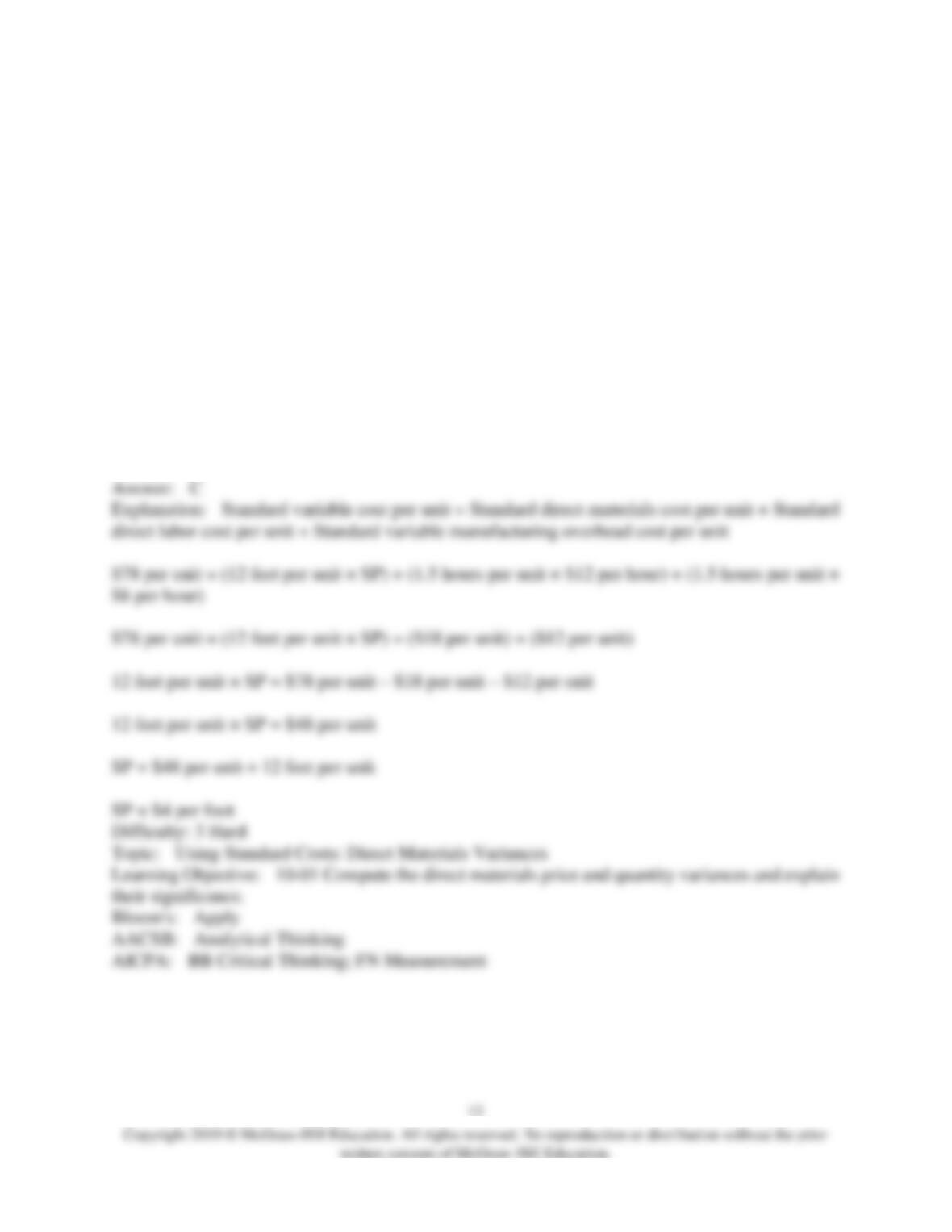
30) The standard cost card for one unit of a finished product shows the following:
Standard Quantity or
Hours
Standard Price or Rate
Direct materials
12
feet
$
?
per foot
Direct labor
1.5
hours
$
12
per hour
Variable manufacturing overhead
1.5
hours
$
8
per hour
–
If the total standard variable cost for one unit of finished product is $78, then the standard price per
foot for direct materials is:
A) $2
B) $3
C) $4
D) $5
31) The following materials standards have been established for a particular product:
Standard quantity per unit of output
4.6
grams
Standard price
$
15.05
per gram
–
The following data pertain to operations concerning the product for the last month:
Actual materials purchased
3,100
grams
Actual cost of materials purchased
$
44,020
Actual materials used in production
2,400
grams
Actual output
300
units
What is the materials quantity variance for the month?
A) $9,940 U
B) $15,351 U
C) $14,484 U
D) $10,535 U
32) Suver Corporation has a standard costing system. The following data are available for June:
Actual quantity of direct materials purchased
24,000
pounds
Standard price of direct materials
$
6.00
per pound
Material price variance
$
6,000
Unfavorable
Material quantity variance
$
2,400
Favorable
The actual price per pound of direct materials purchased in June was:
A) $6.10 per pound
B) $5.90 per pound
C) $6.25 per pound
D) $6.30 per pound
33) Bailey Corporation manufactures orange safety suits for road workers. The following
information relates to the corporation’s purchases and use of material for April:
Material purchased
12,000
yards
Material used in production
10,000
yards
Standard material allowed for suits produced
10,800
yards
The company’s materials price variance for April was $3,000 Favorable. Its materials quantity
variance for April was $5,000 Favorable. What does the company use as a standard price per yard
of material for its safety suits?
A) $5.75 per yard
B) $6.50 per yard
C) $6.25 per yard
D) $6.00 per yard
34) The following materials standards have been established for a particular product:
Standard quantity per unit of output
5.3
meters
Standard price
$
17.20
per meter
The following data pertain to operations concerning the product for the last month:
Actual materials purchased
8,100
meters
Actual cost of materials purchased
$
141,345
Actual materials used in production
7,600
meters
Actual output
1,400
units
What is the materials price variance for the month?
A) $3,141 U
B) $2,025 U
C) $8,600 U
D) $8,725 U
35) A total of 6,850 kilograms of a raw material was purchased at a total cost of $21,920. The
materials price variance was $1,370 favorable. The standard price per kilogram for the raw
material must be:
A) $0.20
B) $3.00
C) $3.20
D) $3.40
36) The following labor standards have been established for a particular product:
Standard labor-hours per unit of output
8.7
hours
Standard labor rate
$
18.10
per hour
The following data pertain to operations concerning the product for the last month:
Actual hours worked
3,800
hours
Actual total labor cost
$
67,640
Actual output
500
units
What is the labor efficiency variance for the month?
A) $9,790 F
B) $11,095 U
C) $9,955 F
D) $11,095 F
37) Zanny Electronics Corporation uses a standard cost system for the production of its water ski
radios. The direct labor standard for each radio is 0.9 hours. The standard direct labor cost per hour
is $7.20. During the month of August, Zanny’s water ski radio production used 6,600 direct
labor-hours at a total direct labor cost of $48,708. This resulted in production of 6,900 water ski
radios for August. What is Zanny’s labor rate variance for August?
A) $972 Favorable
B) $1,188 Unfavorable
C) $2,160 Favorable
D) $2,808 Unfavorable
38) The Fime Corporation uses a standard costing system. The following data have been
assembled for December:
Actual direct labor-hours worked
6,200
hours
Standard direct labor rate
$
7
per hour
Labor efficiency variance
$
2,100
Unfavorable
The standard hours allowed for December’s production is:
A) 5,900 hours
B) 6,500 hours
C) 6,200 hours
D) 6,000 hours