52.
The carrying (book) value of a bond payable is the par value of the bonds plus any
discount or minus any premium.
53.
On January 1, a company issued a $500,000, 10%, 8-year bond payable, and received
proceeds of $473,845. Interest is payable each June 30 and December 31. The total
interest expense on the bond over its eight-year life is $400,000.
54.
On January 1, a company issued a $500,000, 10%, 8-year bond payable, and received
proceeds of $473,845. Interest is payable each June 30 and December 31. The company
uses the straight-line method to amortize the discount. The amount of discount amortized
each period is $1,634.69.
55.
On January 1, a company issued a $500,000, 10%, 8-year bond payable, and received
proceeds of $473,845. Interest is payable each June 30 and December 31. The company
uses the straight-line method to amortize the discount. The amount of interest expense to
be recorded on June 30 is $25,000.
56.
On January 1, a company issued a $500,000, 10%, 8-year bond payable, and received
proceeds of $473,845. Interest is payable each June 30 and December 31. The company
uses the straight-line method to amortize the discount. The amount of the interest
payment on June 30 is $25,000.
57.
A premium on bonds occurs when bonds carry a contract rate greater than the market rate
at issuance.
58.
A premium reduces the interest expense of a bond over its life.
59.
A discount reduces the interest expense of a bond over its life.
60.
The market value (issue price) of a bond is equal to the present value of all future cash
payments provided by the bond.
61.
Premium on Bonds Payable is an adjunct liability account.
62.
If a bond’s interest period does not coincide with the issuing company’s accounting period,
an adjusting entry is necessary to recognize bond interest expense accrued since the most
recent interest payment.
63.
The issue price of bonds is found by computing the future value of the bond’s cash
payments, discounted at the market rate of interest.
64.
The effective interest method assigns a bond interest expense amount that increases over
the life of a premium bond.
65.
Two common ways of retiring bonds before maturity are to (1) exercise a call option or (2)
purchase them on the open market.
66.
When convertible bonds are converted to a company’s stock, the carrying value of the
bonds is transferred to equity accounts and no gain or loss is recorded.
67.
Payments on installment notes normally include accrued interest plus a portion of the
principal amount borrowed.
68.
The equal total payments pattern for installment notes consists of changing amounts of
interest but constant amounts of principal over the life of the note.
Multiple Choice Questions
69.
Sinking fund bonds:
70.
Bonds that have an option exercisable by the issuer to retire them at a stated dollar
amount prior to maturity are known as:
71.
A bond traded at 102½ means that:
72.
Secured bonds:
73.
Bonds that have interest coupons attached to their certificates, which the bondholders
present to a bank or broker for collection, are called:
74.
Bonds owned by investors whose names and addresses are recorded by the issuing
company, and for which interest payments are made with checks or cash transfers to the
bondholders, are called:
75.
The contract between the bond issuer and the bondholders identifying the rights and
obligations of the parties, is called a(n):
76.
Bonds that mature at more than one date with the result that the principal amount is
repaid over a number of periods are known as:
77.
A contract pledging title to assets as security for a note or bond is known as a(an):
78.
Promissory notes that require the issuer to make a series of payments consisting of both
interest and principal are:
79.
The carrying value of a long-term note payable is computed as:
80.
The carrying value of bonds at maturity always equals:
81.
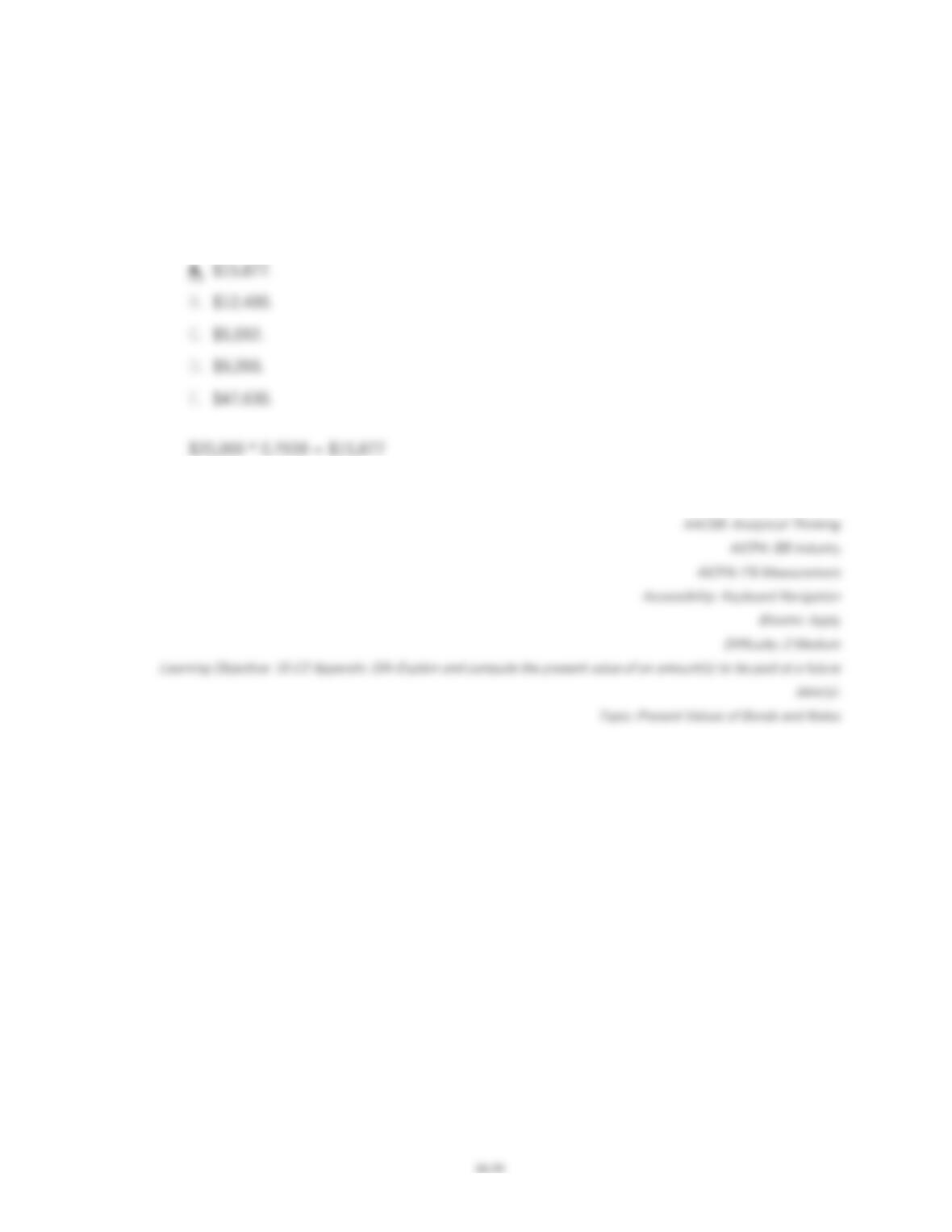
A company must repay the bank a single payment of $20,000 cash in 3 years for a loan it
entered into. The loan is at 8% interest compounded annually. The present value factor for
3 years at 8% is 0.7938. The present value of the loan (rounded) is:
82.
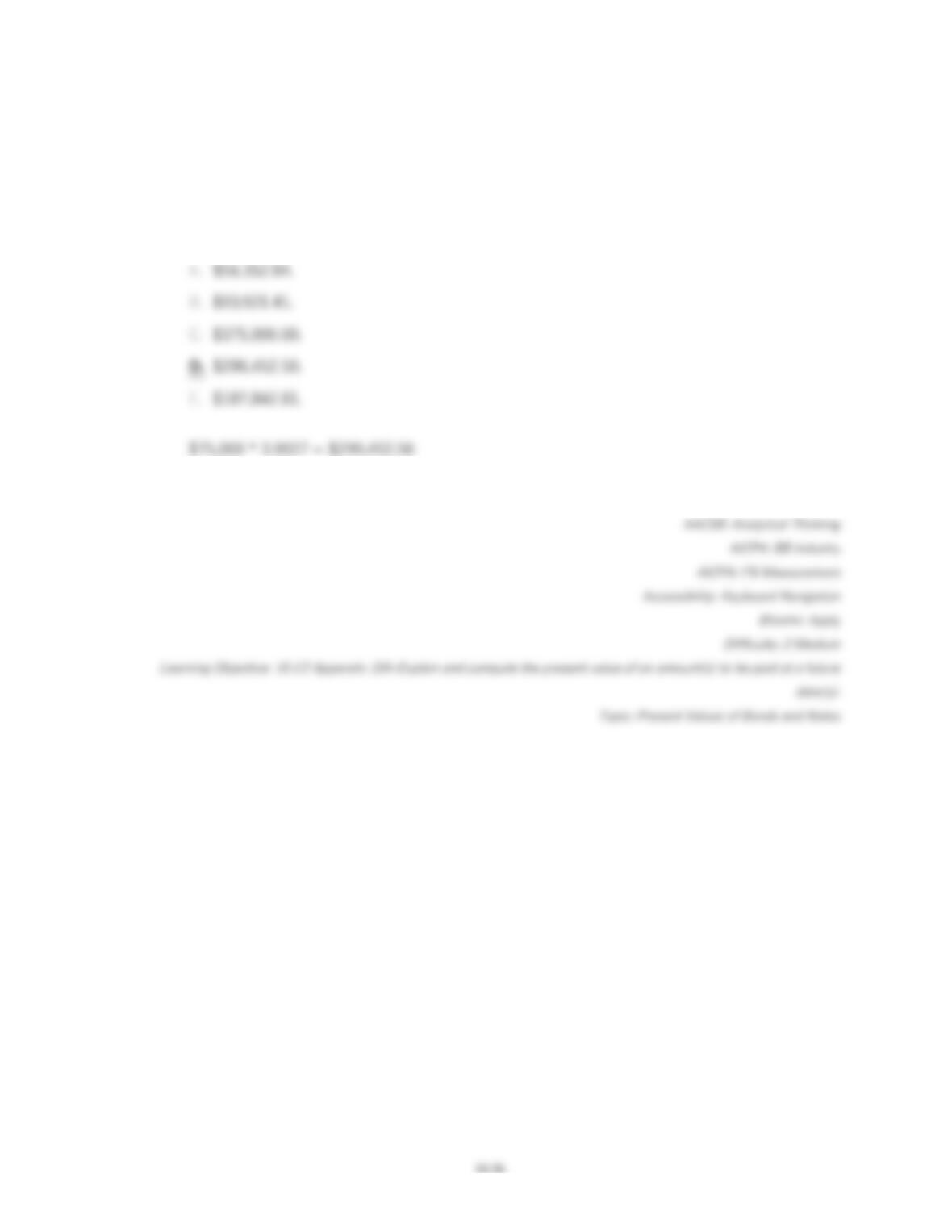
A company borrowed cash from the bank by signing a 5-year, 8% installment note. The
present value of an annuity factor at 8% for 5 years is 3.9927. Each annual payment equals
$75,000. The present value of the note is:
83.
A company borrowed $40,000 cash from the bank and signed a 6-year note at 7% annual
interest. The present value of an annuity factor for 6 years at 7% is 4.7665. The annual
annuity payments equal:
84.
A company purchased equipment and signed a 7-year installment loan at 9% annual
interest. The annual payments equal $9,000. The present value of an annuity factor for 7
years at 9% is 5.0330. The present value of the equipment and loan is:
85.
A pension plan:
86.
All of the following statements regarding leases are true
except
:
87.
A disadvantage of bond financing is:
88.
An advantage of bonds is: