Intermediate Accounting, 9e (Spiceland)
Chapter 10 Property, Plant, and Equipment and Intangible Assets: Acquisition
1) Property, plant, and equipment and intangible assets are long-term, revenue producing assets.
2) Sales tax paid on equipment acquired for use in the business is not capitalized.
3) Demolition costs to remove an old building from land purchased as a site for a new building
are considered part of the cost of the new building.
4) The initial cost of property, plant, and equipment includes all the identifiable expenditures
necessary to bring the asset to its desired condition and location for use.
5) A distinguishing characteristic of intangible assets is that the extent and timing of their future
benefits typically are highly uncertain.
6) Costs incurred after discovery of a natural resource but before production begins are reported
as expenses of the period in which the expenditures are made.
7) The relative fair values are used to determine the valuation of individual assets acquired in a
lump-sum purchase.
8) The fair value of the asset, debt, or equity securities given in a noncash acquisition should
determine the value of the consideration received.
9) Under current GAAP, fair value is used to measure the components of all nonmonetary
exchanges.
10) The interest capitalization period for a self-constructed asset ends either when the asset is
substantially complete and ready for use or when interest costs no longer are being incurred.
11) The FASB’s required accounting treatment for research and development costs often
understates both net income and assets.
12) According to International Financial Reporting Standards (IFRS), all research and
development expenditures are expensed in the period incurred.
13) A company that prepares its financial statements according to International Financial
Reporting Standards (IFRS) must calculate amortization of capitalized software development
costs in the same way as under U.S. GAAP.
14) A company that prepares its financial statements according to International Financial
Reporting Standards (IFRS) accounts for a government grant by recognizing revenue for the
amount of the grant.
15) The successful efforts method of accounting for oil and gas exploration costs allows costs
incurred in searching for oil and gas within a large geographical area to be capitalized.
16) Property, plant, and equipment and intangible assets are:
A) Created by the normal operation of the business and include accounts receivable.
B) All assets except cash and cash equivalents.
C) Current and long-term assets used in the production of either goods or services.
D) Long-term revenue-producing assets.
17) The acquisition costs of property, plant, and equipment do not include:
A) The ordinary and necessary costs to bring the asset to its desired condition and location for
use.
B) The net invoice price.
C) Legal fees, delivery charges, installation, and any applicable sales tax.
D) Maintenance costs during the first 30 days of use.
18) Goodwill is:
A) Amortized over the greater of its estimated life or 40 years.
B) Only recorded by the seller of a business.
C) The excess of the fair value of a business over the fair value of all net identifiable assets.
D) None of these answer choices are correct.
19) Productive assets that are physically consumed in operations are:
A) Equipment.
B) Land.
C) Land improvements.
D) Natural resources.
6
Copyright ©2018 McGraw-Hill
20) An exclusive 20-year right to manufacture a product or use a process is a:
A) Patent.
B) Copyright.
C) Trademark.
D) Franchise.
21) A contractual arrangement under which one party grants another party the exclusive right to
use a trademark or tradename is a:
A) Patent.
B) Copyright.
C) Trademark.
D) Franchise.
22) The exclusive right to benefit from a creative work, such as a film, is a:
A) Patent.
B) Copyright.
C) Trademark.
D) Franchise.
23) The exclusive right to display a symbol of product identification is a:
A) Patent.
B) Copyright.
C) Trademark.
D) Franchise.
24) The capitalized cost of equipment excludes:
A) Maintenance.
B) Sales tax.
C) Shipping.
D) Installation.
25) The capitalized cost of land excludes:
A) The purchase price of the land.
B) Title insurance paid at the time of purchase.
C) Real estate commissions associated with the sale.
D) Property taxes for the first year owned.
26) The cost of constructing a new parking lot at the company’s office building would be
recorded as:
A) Land.
B) Land improvement.
C) Building.
D) Equipment.
27) Asset retirement obligations:
A) Increase the balance in the related asset account.
B) Are measured at fair value in the balance sheet.
C) Are liabilities associated with the restoration of a long-term asset.
D) All of these answer choices are correct.
28) If a company incurs legal obligations associated with the retirement of a tangible long-lived
asset as a result of acquiring the asset:
A) The company recognizes the obligation at fair value when the asset is acquired.
B) The company recognizes the obligation at fair value when the asset is retired.
C) The company records the difference between the fair value of the asset and the obligation
when the asset is acquired.
D) None of these answer choices are correct.
29) Which of the following does not pertain to accounting for asset retirement obligations?
A) They accrete (increase over time) at the company’s credit-adjusted risk-free rate.
B) They must be recognized according to GAAP.
C) Statement of Financial Accounting Concepts No. 7 is applied when adjusting cash flow
obligations for uncertainty.
D) All of these answer choices pertain to accounting for asset retirement obligations.
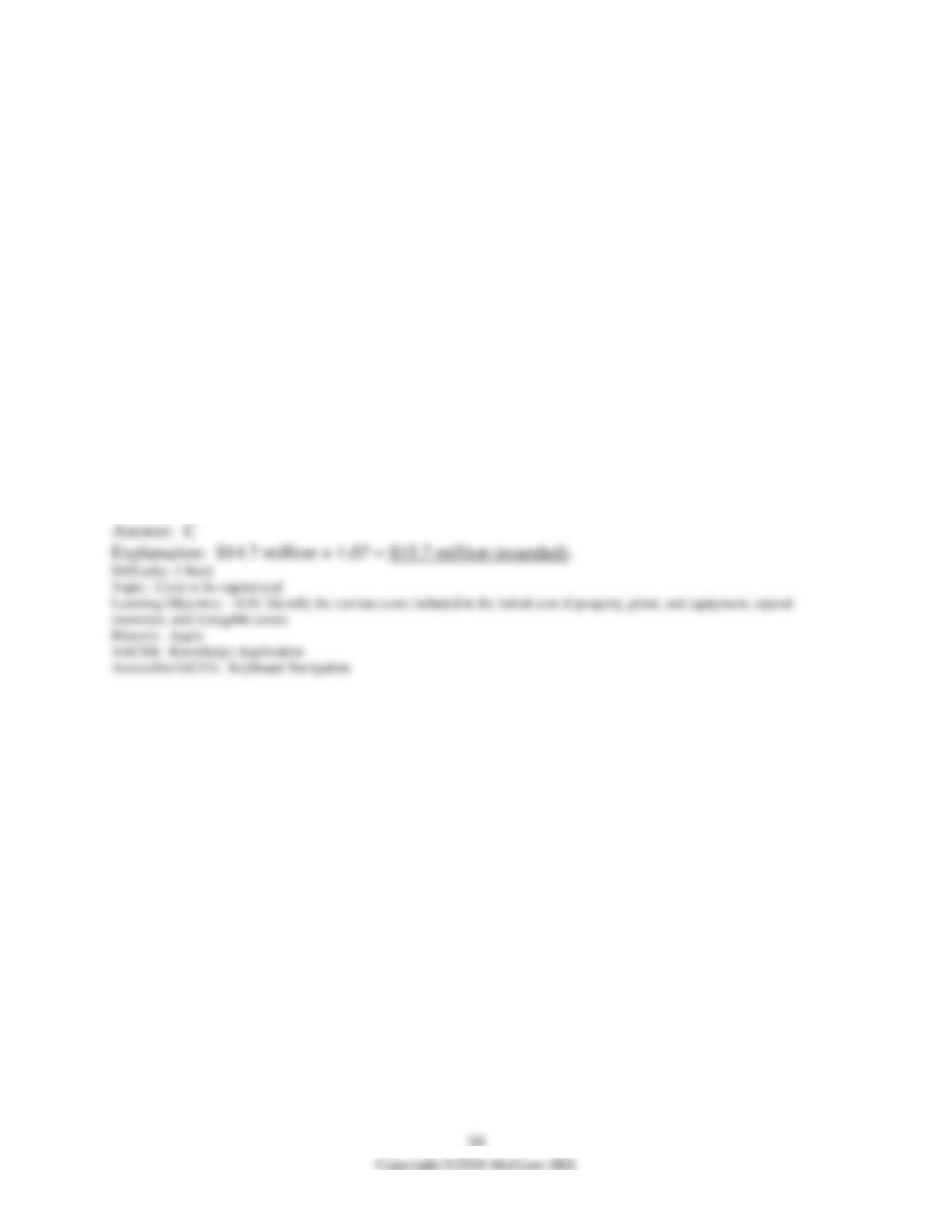
30) Montana Mining Co. (MMC) paid $200 million for the right to explore and extract rare
metals from land owned by the state of Montana. To obtain the rights, MMC agreed to restore
the land to a suitable condition for other uses after its exploration and extraction activities. MMC
incurred exploration and development costs of $60 million on the project.
MMC has a credit-adjusted risk free interest rate is 7%. It estimates the possible cash flows for
restoring the land, three years after its extraction activities begin, as follows:
Cash Outflow
Probability
$
10
million
60
%
$
30
million
40
%
The asset retirement obligation (rounded) that should be recognized by MMC at the beginning of
the extraction activities is:
A) $8.2 million.
B) $14.7 million.
C) $18 million.
D) $30 million.
31) Montana Mining Co. (MMC) paid $200 million for the right to explore and extract rare
metals from land owned by the state of Montana. To obtain the rights, MMC agreed to restore
the land to a suitable condition for other uses after its exploration and extraction activities. MMC
incurred exploration and development costs of $60 million on the project.
MMC has a credit-adjusted risk free interest rate is 7%. It estimates the possible cash flows for
restoring the land, three years after its extraction activities begin, as follows:
Cash Outflow
Probability
$
10
million
60
%
$
30
million
40
%
The asset retirement obligation (rounded) that should be reported on MMC’s balance sheet one
year after the extraction activities begin is:
A) $0.
B) $14.7 million.
C) $15.7 million.
D) $19.3 million.
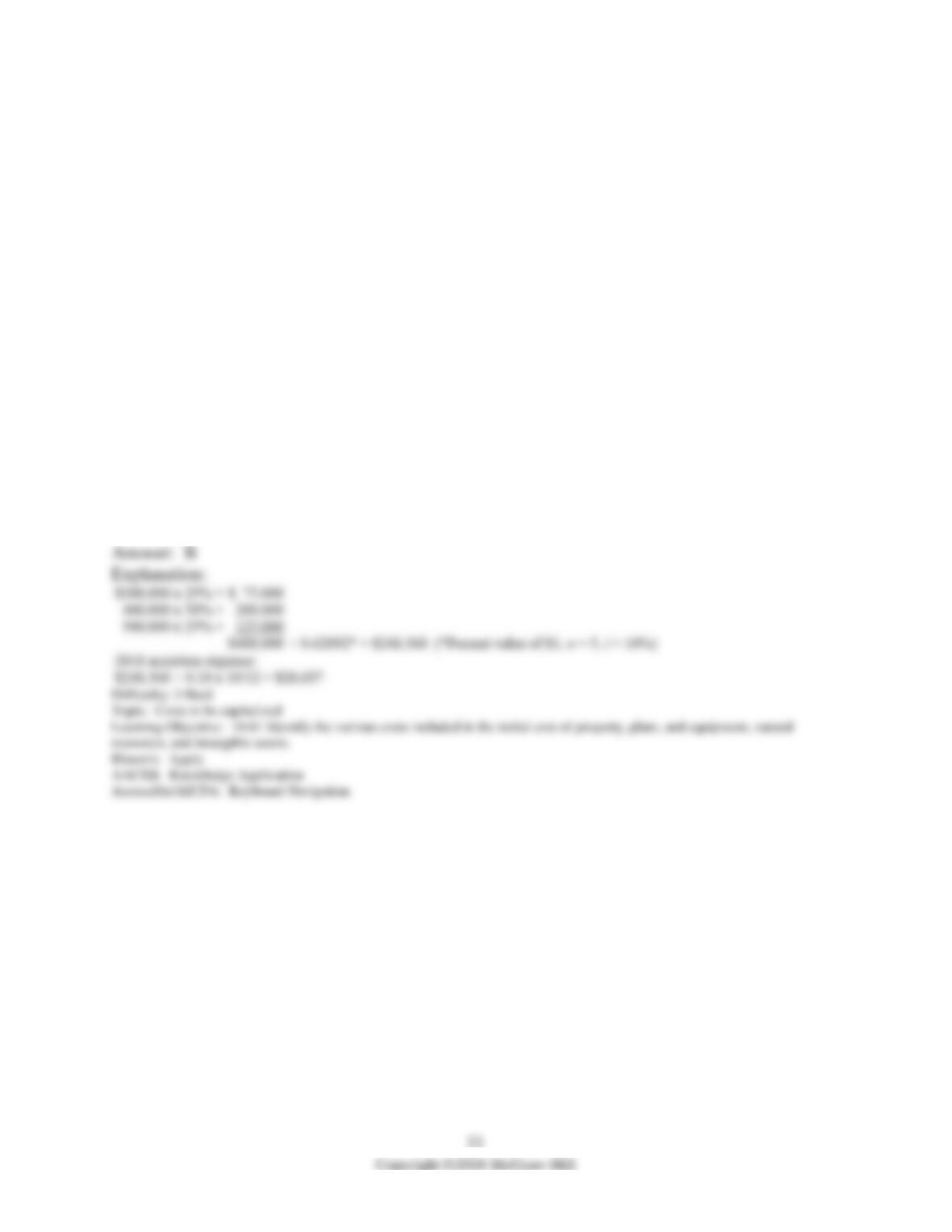
32) On March 1, 2018, Shipley Resources entered into an agreement with the state of Alaska to
obtain the rights to operate a mineral mine for $6 million. The mine is expected to produce
100,000 tons of mineral. As part of the agreement, Shipley agrees to restore the land to its
original condition after mining operations are completed in approximately five years.
Management has provided the following possible outflows for the restoration costs that will
occur five years from now:
Cash Outflow
Probability
$
300,000
25
%
400,000
50
%
500,000
25
%
Shipley’s credit-adjusted risk-free interest rate is 10%. During 2018, Shipley extracted 18,000
tons of ore from the mine. How much accretion expense will the company record in its income
statement for the 2018 fiscal year?
A) $30,326.
B) $20,697.
C) $24,837.
D) $27,294.
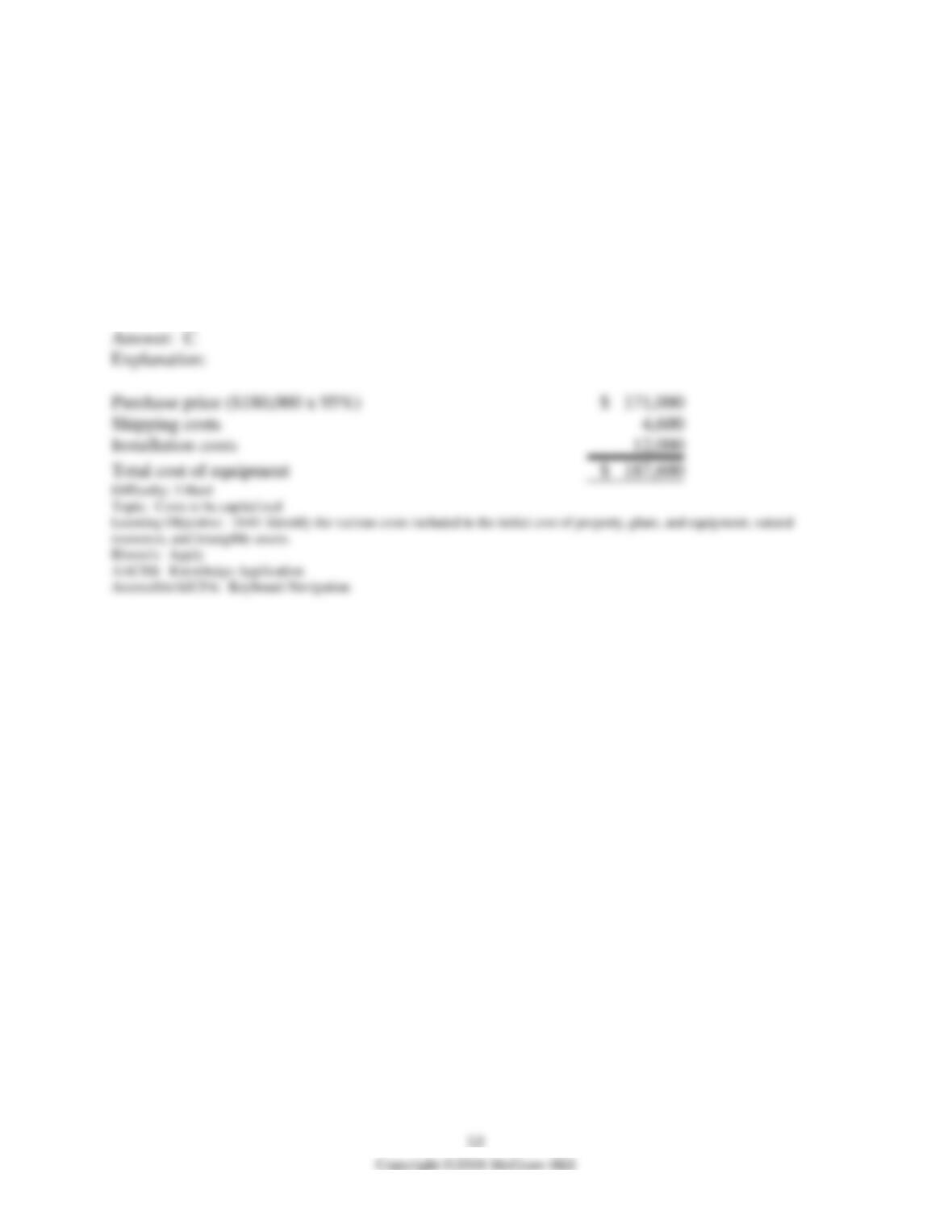
33) Grab Manufacturing Co. purchased a 10-ton draw press at a cost of $180,000 with terms of
5/15, n/45. Payment was made within the discount period. Shipping costs were $4,600, which
included $200 for insurance in transit. Installation costs totaled $12,000, which included $4,000
for taking out a section of a wall and rebuilding it because the press was too large for the
doorway. The capitalized cost of the 10-ton draw press is:
A) $171,000.
B) $183,600.
C) $187,600.
D) $185,760.
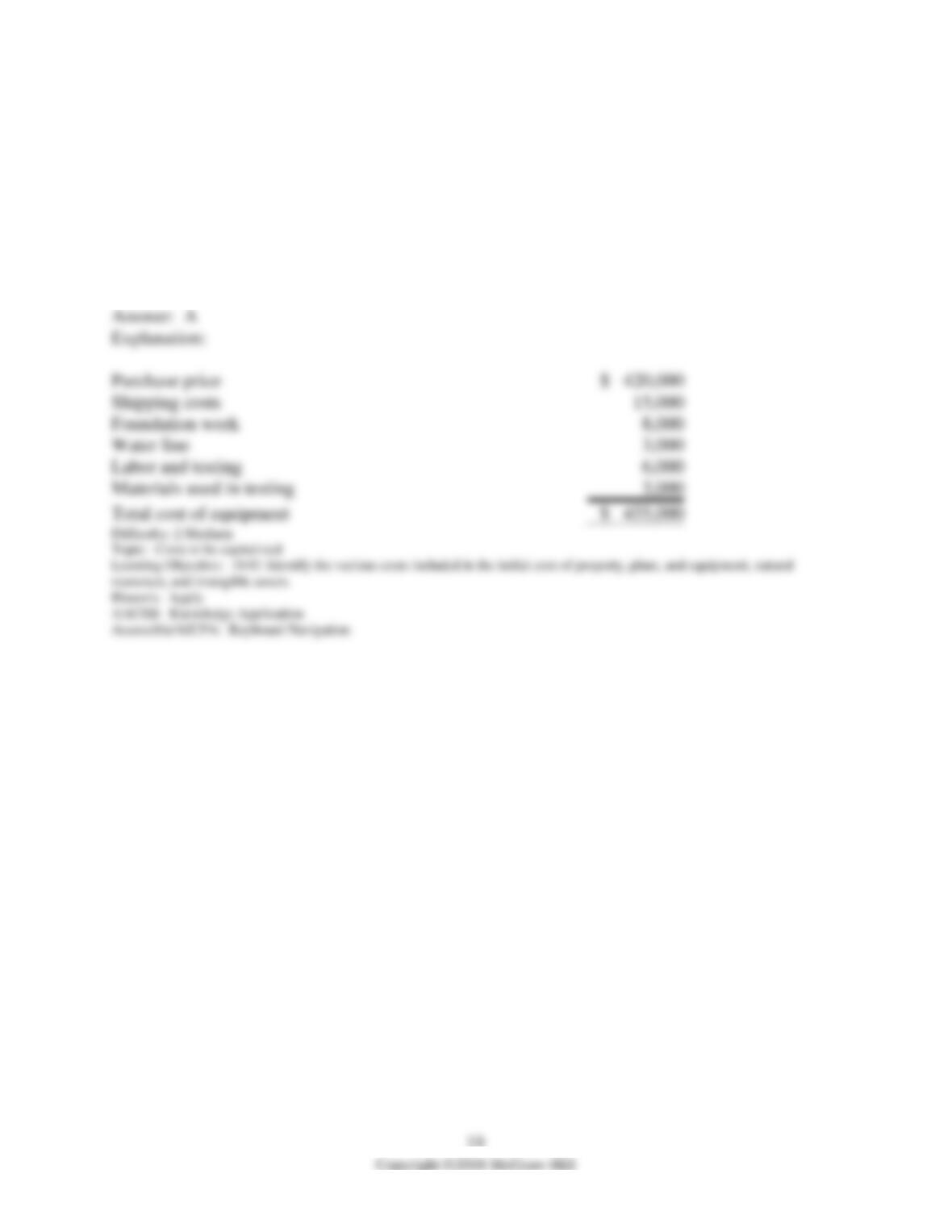
34) Holiday Laboratories purchased a high-speed industrial centrifuge at a cost of $420,000.
Shipping costs totaled $15,000. Foundation work to house the centrifuge cost $8,000. An
additional water line had to be run to the equipment at a cost of $3,000. Labor and testing costs
totaled $6,000. Materials used up in testing cost $3,000. The capitalized cost is:
A) $455,000.
B) $446,000.
C) $437,000.
D) $435,000.
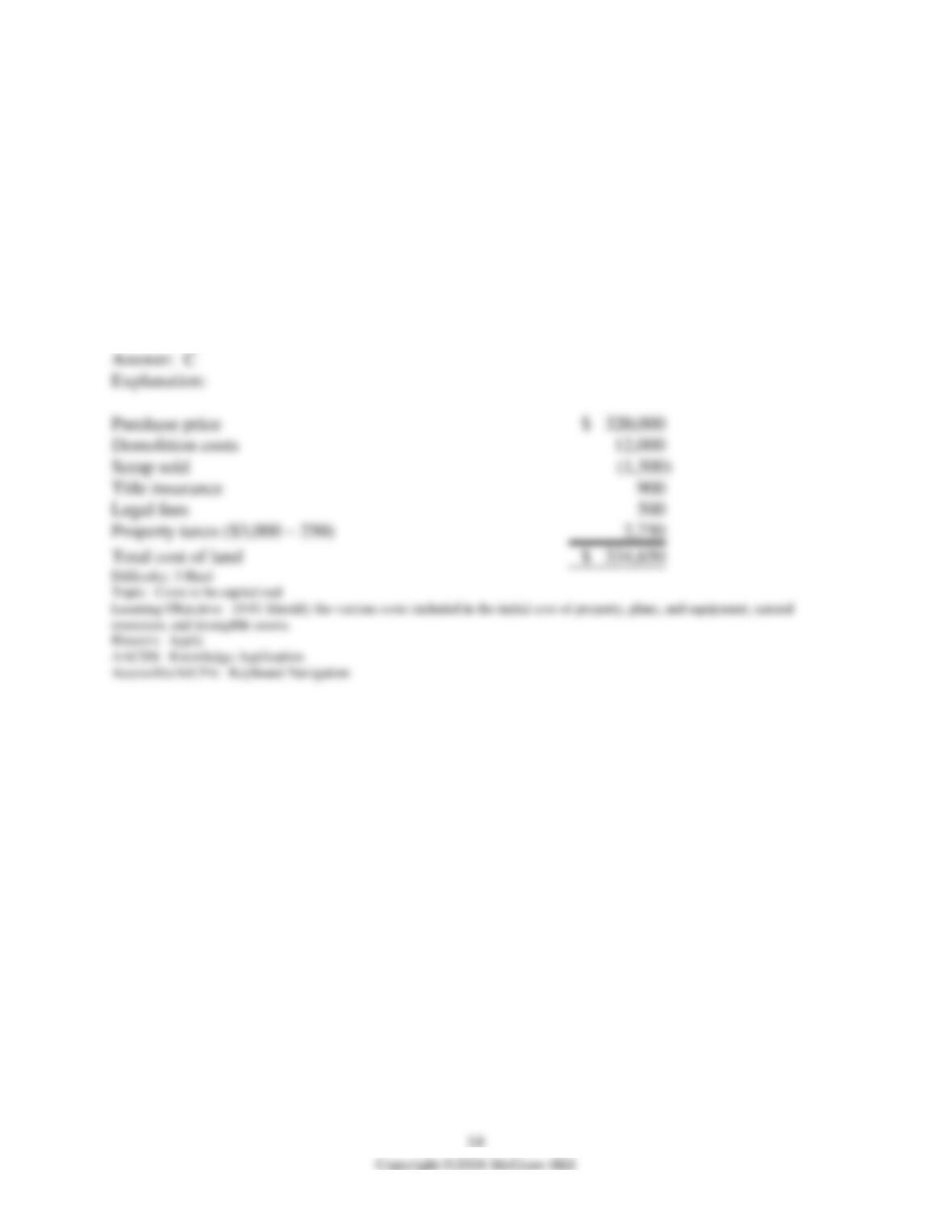
35) Vijay Inc. purchased a three-acre tract of land for a building site for $320,000. On the land
was a building with an appraised value of $120,000. The company demolished the old building
at a cost of $12,000, but was able to sell scrap from the building for $1,500. The cost of title
insurance was $900 and attorney fees for reviewing the contract were $500. Property taxes paid
were $3,000, of which $250 covered the period subsequent to the purchase date. The capitalized
cost of the land is:
A) $336,400.
B) $336,150.
C) $334,650.
D) $201,150.
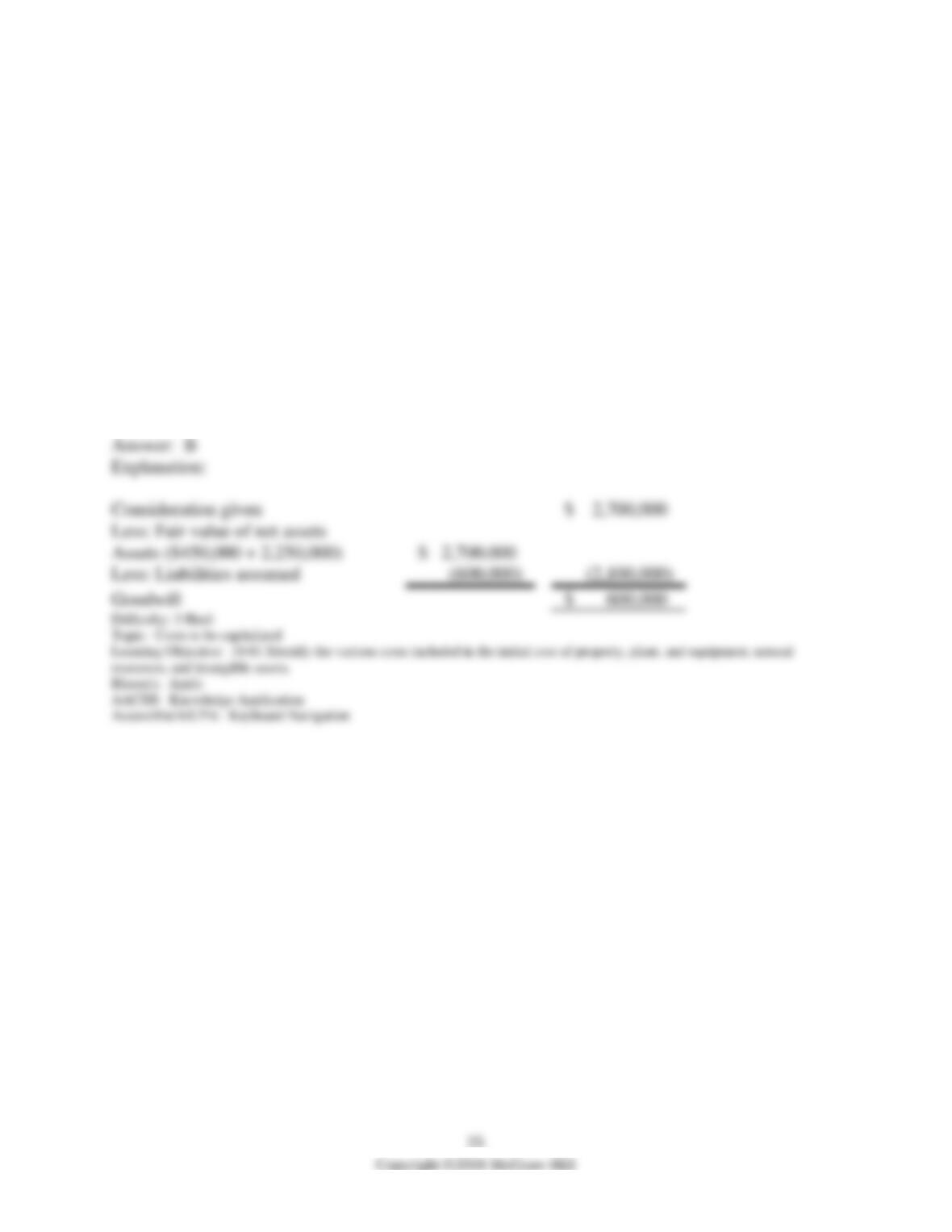
36) Juliana Corporation purchased all of the outstanding stock of Caldwell Inc., paying
$2,700,000 cash. Juliana assumed all of the liabilities of Caldwell. Book values and fair values of
acquired assets and liabilities were:
Book Value
Fair Value
Current assets (net)
$
420,000
$
450,000
Property, plant, & equip. (net)
1,600,000
2,250,000
Liabilities
500,000
600,000
Juliana would record goodwill of:
A) $1,180,000.
B) $600,000.
C) $880,000.
D) $100,000.
Consideration given
$
2,700,000
Less: Fair value of net assets
Assets ($450,000 + 2,250,000)
$
2,700,000
Less: Liabilities assumed
)
(2,100,000
)
Goodwill
$
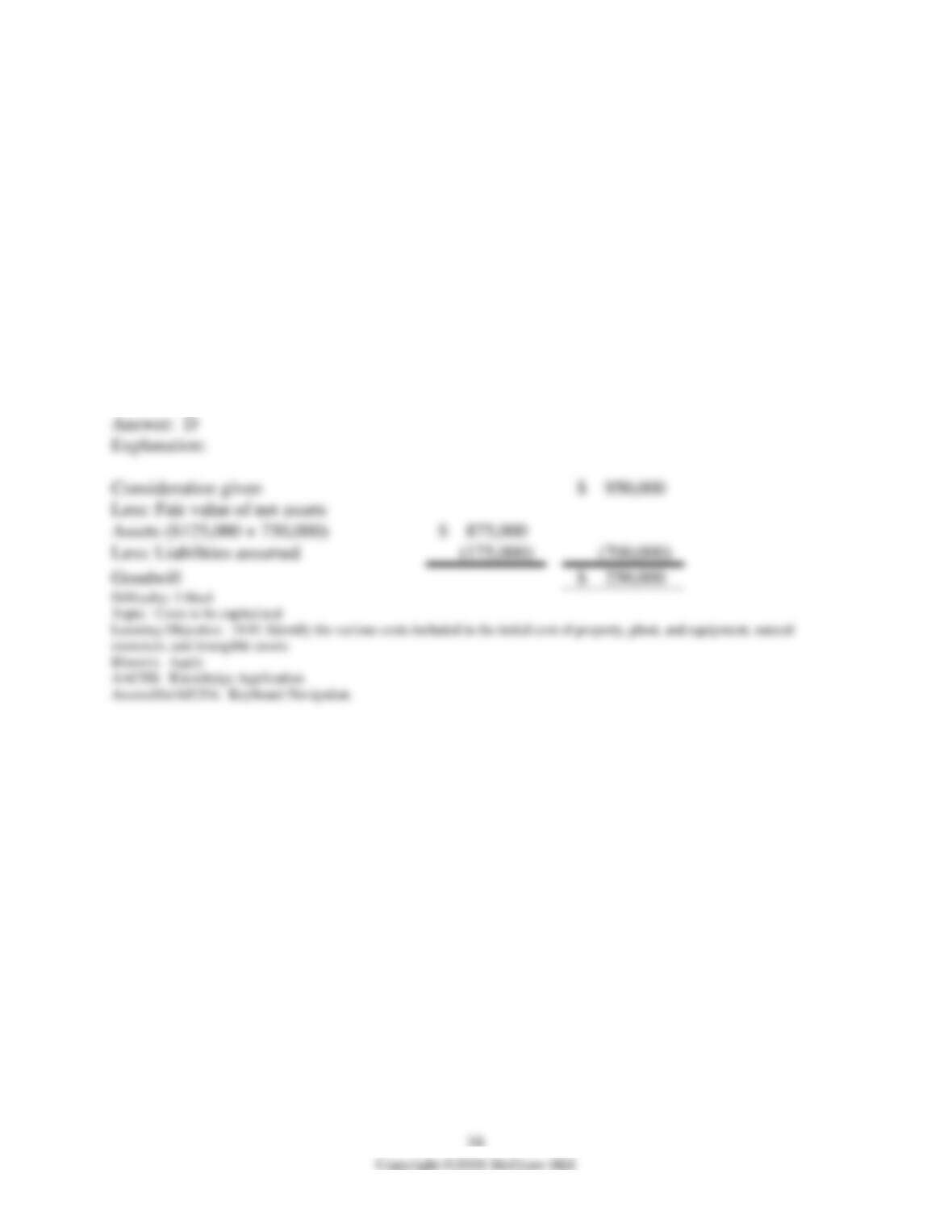
37) Lake Incorporated purchased all of the outstanding stock of Huron Company paying
$950,000 cash. Lake assumed all of the liabilities of Huron. Book values and fair values of
acquired assets and liabilities were:
Book Value
Fair Value
Current assets (net)
$
130,000
$
125,000
Property, plant, equip. (net)
600,000
750,000
Liabilities
150,000
175,000
Lake would record goodwill of:
A) $0.
B) $75,000.
C) $445,000.
D) $250,000.
Consideration given
$
950,000
Less: Fair value of net assets
Assets ($125,000 + 750,000)
$
875,000
Less: Liabilities assumed
(175,000
)
(700,000
)
Goodwill
$
250,000
38) A company has the following expenditures during the year.
Advertising
$
100,000
Employee training
80,000
Customer outreach and consultation
50,000
The company believes that these efforts have increased the fair value of the entire company by
$325,000. How much goodwill can the company recognize at the end of the year associated with
these expenditures?
A) $0.
B) $80,000.
C) $230,000.
D) $325,000.
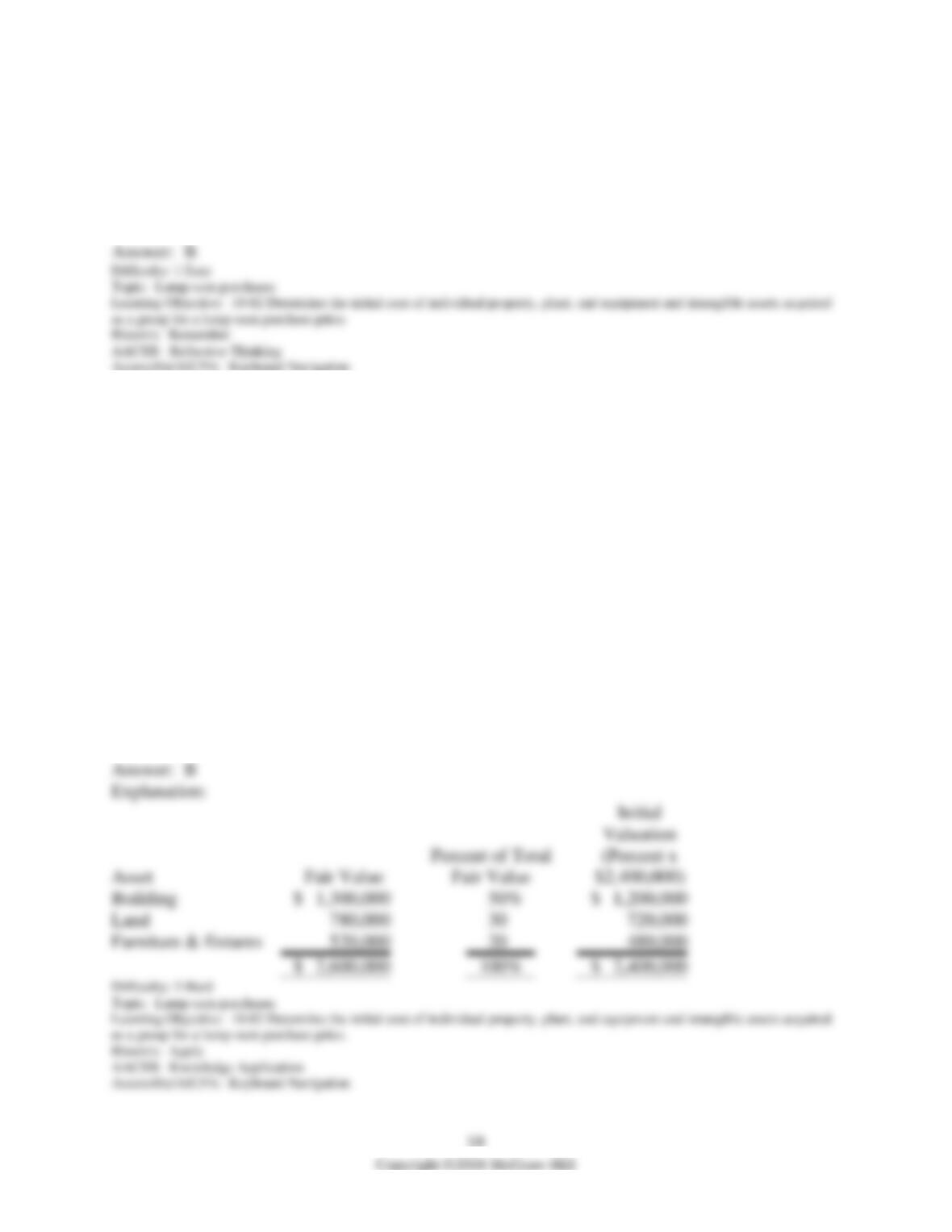
39) On July 1, 2018, Larkin Co. purchased a $400,000 tract of land that is intended to be the site
of a new office complex. Larkin incurred additional costs and realized salvage proceeds during
2018 as follows:
Demolition of existing building on site
$
75,000
Legal and other fees to close escrow
12,000
Proceeds from sale of demolition scrap
10,000
What would be the balance in the land account as of December 31, 2018?
A) $400,000.
B) $475,000.
C) $477,000.
D) $487,000.
Purchase price
$
400,000
Demolition costs
Legal fees
Sale of scrap
)
Total cost of land
$
477,000
40) Assets acquired in a lump-sum purchase are valued based on:
A) Their assessed valuation.
B) Their relative fair values.
C) The present value of their future cash flows.
D) Their cost plus the difference between their cost and fair values.
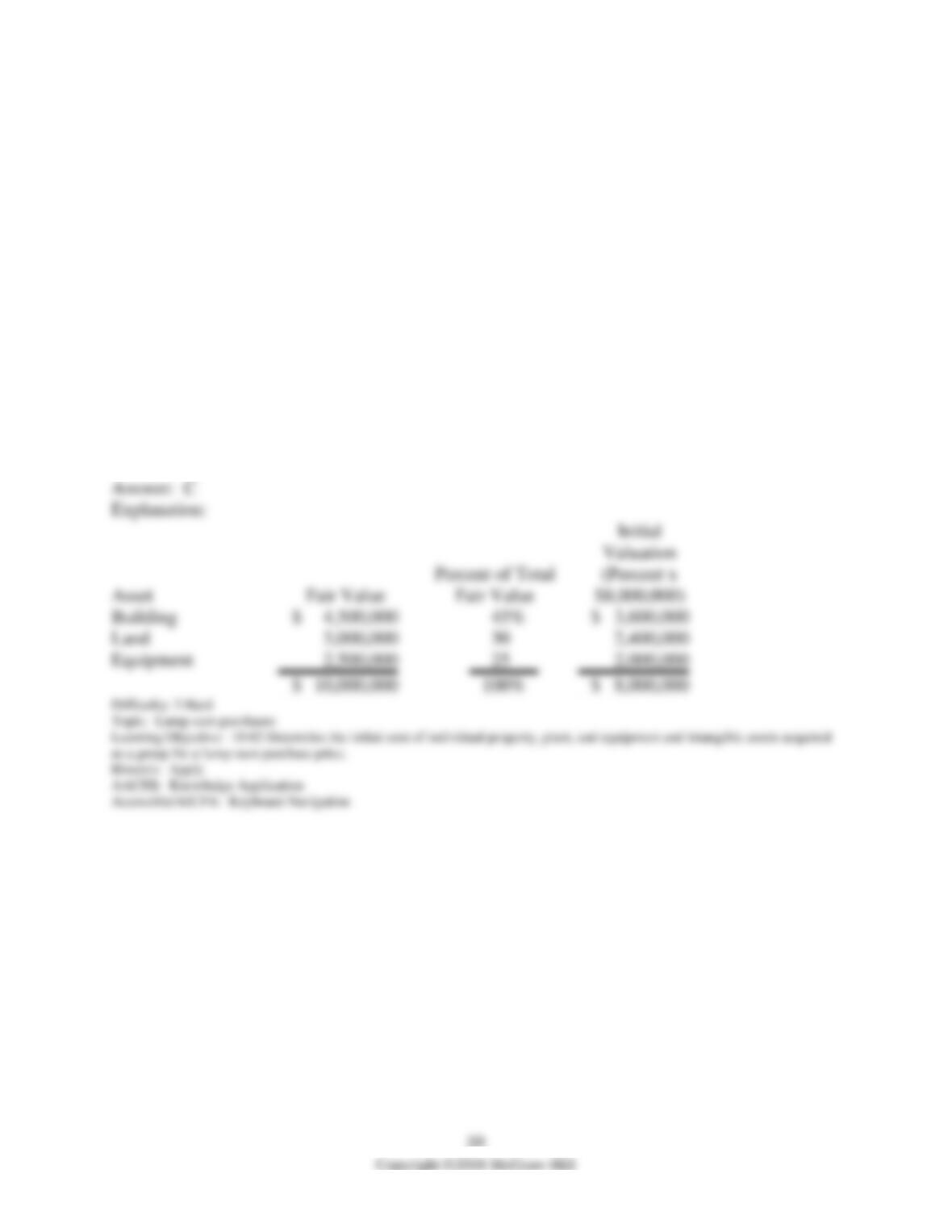
41) Simpson and Homer Corporation acquired an office building on three acres of land for a
lump-sum price of $2,400,000. The building was completely furnished. According to
independent appraisals, the fair values were $1,300,000, $780,000, and $520,000 for the
building, land, and furniture and fixtures, respectively. The initial values of the building, land,
and furniture and fixtures would be:
Building
Land
Fixtures
a.
$
1,300,000
$
780,000
$
520,000
b.
$
1,200,000
$
720,000
$
480,000
c.
$
720,000
$
1,200,000
$
480,000
d.
None of these answer choices are correct.
A) Option A
B) Option B
C) Option C
D) Option D
Asset
Building
$
1,300,000
%
$
1,200,000
Land
720,000
Furniture & fixtures
480,000
$
2,600,000
100
%
$
2,400,000
42) Cantor Corporation acquired a manufacturing facility on four acres of land for a lump-sum
price of $8,000,000. The building included used but functional equipment. According to
independent appraisals, the fair values were $4,500,000, $3,000,000, and $2,500,000 for the
building, land, and equipment, respectively. The initial values of the building, land, and
equipment would be:
Building
Land
Equipment
a.
$
4,500,000
$
3,000,000
$
2,500,000
b.
$
4,500,000
$
3,000,000
$
500,000
c.
$
3,600,000
$
2,400,000
$
2,000,000
d.
None of these answer choices are correct.
A) Option A
B) Option B
C) Option C
D) Option D
Asset
Fair Value
Building
%
$
Land
Equipment
10,000,000
100
%
$