32. If a government uses the “modified approach” in accounting for its infrastructure
assets, which of the following items properly will not appear in its government-
wide statement of activities?
a. depreciation expense for any capital assets
b. interest expense for bonds issued to finance any capital assets
c. depreciation expense for infrastructure capital assets
d. interest expense for bonds issued to finance infrastructure capital assets
33. Westenhover City is a municipality that has governmental activities, business-
type activities, a discrete component unit, and a blended component unit. Which
of the following would not properly appear as a specific line item in Westenhover
City’s government-wide statement of net position?
a. revenues of the blended component unit
b. revenues of the discrete component unit
c. revenues of the governmental activities
d. revenues of the business-type activities
34. The unrestricted net position balance for a local government
a. cannot be negative
b. normally is the largest component of the total net position balance
c. can be negative
d. equals the sum of the unrestricted fund balances of the major governmental funds
35. On the government-wide statement of net position, assets and liabilities may be
reported:
a. in a classified format
b. in order of relative liquidity
c. in either order of relative liquidity or a classified format
d. in separate columns

36. Tinsel Town has only two funds, the General Fund (GF), and a Capital Projects
Fund (CPF). Summarized operating statements for each of the funds for fiscal
2013 are as follows:
GF CPF Total
Revenues $100 $ — $100
Expenditures 89 62 151
Bond proceeds — 70 70
Increase in fund balance 11 8 19
Beginning fund balance 52 0 52
Ending fund balance 63 8 71
The total net position balance for Tinsel Town’s governmental activities at the end
of fiscal 2013 is
a. 63
b. 43
c. 68
d. 75
37. In 2013, Monks Town received a State grant of $300,000 that can only be used to
hire additional police officers. How should this revenue be reported in the Town’s
government-wide statement of activities?
a. as a general revenue
b. as a program-specific capital grant
c. as a charge for services
d. as a program-specific operating grant
38. The City of Bogue provides other postemployment benefits (OPEB) to its full-
time employees. The City uses an actuary to measure its obligation. Which of the
following should the City report as a liability in its government-wide statement of
net position?
a. the contribution it made to the OPEB plan during the year
b. the unpaid portion of medical benefits it expects to pay retirees for events
that happened during the year.
c. the cumulative difference between the annual accrual basis OPEB
expense, as determined by the actuary, less payments to retirees and
contributions to the OPEB plan
d. nothing. The liability should only be reported in the governmental fund
balance sheet.

Problems
39. (Reporting Internal Service Fund activity in government-wide financial statements)
Regina County has an Internal Service Fund (ISF) that operates a motor pool for
various county agencies, all of which receive appropriations from the General
Fund. The amounts billed by the ISF during 2012 were: General government
programs – $60,000; Public safety programs – $10,000; and Social services
programs – $30,000. These amounts are included in the total expenditures reported
in the fund financial statements for each program.
Following is a condensed ISF operating statement:
Charges for services $120,000
Operating expenses 80,000
Operating income 40,000
Nonoperating expenses 10,000
Change in net position 30,000
Net position, beginning of period 180,000
Net position, end of period $210,000
Required:
a. Calculate how much Regina County should report as motor pool
transportation expenses for each of its programs in its 2012 government-
wide statement of activities.
b. Assume the ISF assets are: Cash of $20,000; and Capital assets, net of
depreciation, of $180,000. Describe how the ISF assets are brought into
the government-wide financial statements.

40. (Preparation of government-wide financial statements – capital asset elements)
The following information is extracted from the City of Lucas’ government-wide
statement of net position at December 31, 2012:
Capital assets $2,000,000
Accumulated depreciation, capital assets $1,600,000
Annual depreciation rate on capital assets 10 %
Bonds payable -0-
The following information is extracted from the city’s governmental funds
statement of revenues, expenditures, and changes in fund balances for the year
ended December 31, 2013.
Expenditures – capital outlay (General Fund) $ 40,000
Expenditures – capital outlay (Capital Projects Fund) $600,000
Expenditures – bond principal (Debt Service Fund) $ 60,000
Expenditures – bond interest (Debt Service Fund $ 15,000
Proceeds of debt (Capital Projects Fund) $600,000
According to the notes to the financial statements, the city sold $600,000 of 5-
year serial bonds on April 1, 2013, to finance the acquisition of capital assets.
Principal is payable every six months, starting October 1, 2013. Interest of 5
percent per annum on the unpaid principal is also payable every six months,
starting October 1, 2013.
Required:
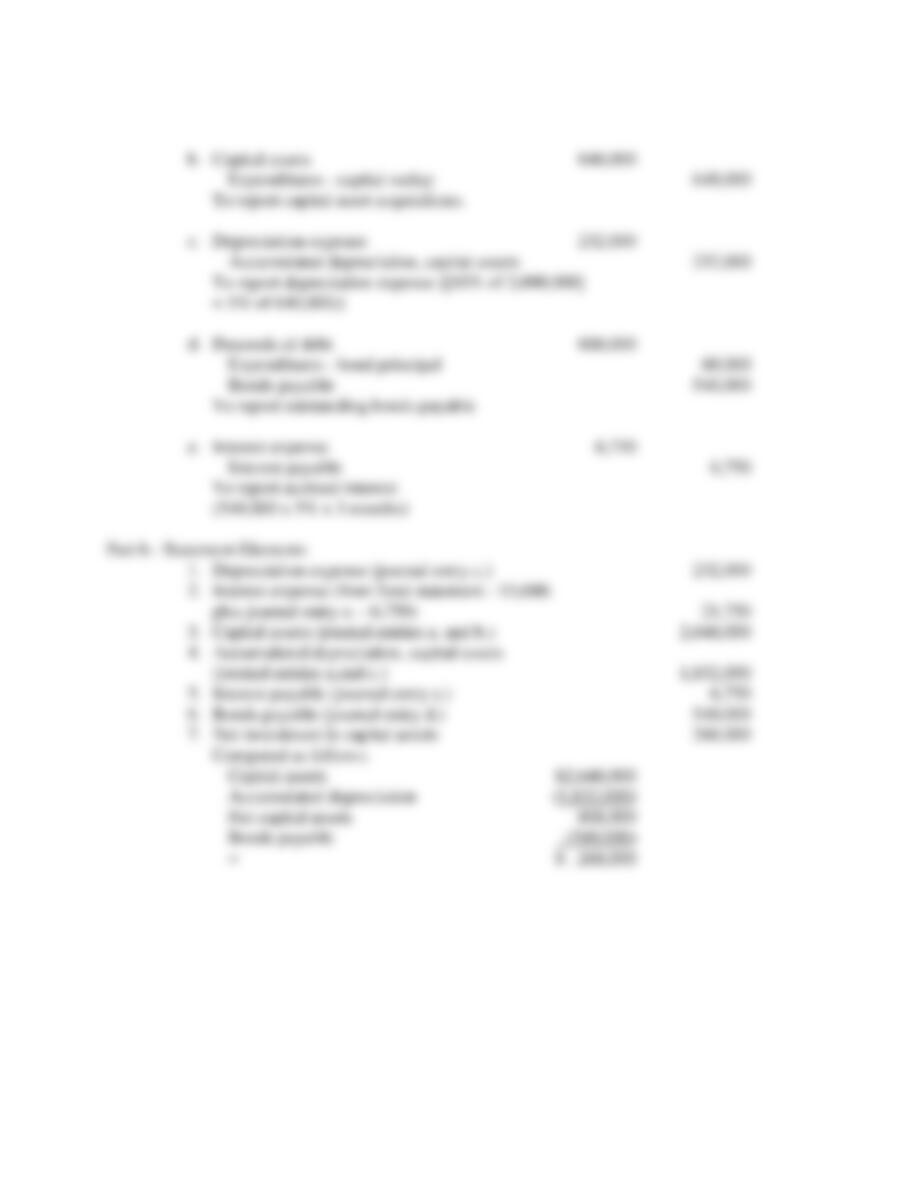
a. Prepare journal entries so the foregoing information can be used in a work
sheet to prepare government-wide financial statements for the year ended
December 31, 2013.
b. Compute the amounts for the following statement elements as they will
appear in the government-wide financial statements for the year ended
December 31, 2013:
1. Depreciation expense (assume all assets acquired in 2013 were
acquired July 1 and all have a 10-year life)
2. Interest expense
3. Capital assets
4. Accumulated depreciation, capital assets
5. Interest payable
6. Bonds payable
7. Net investment in capital assets
41.(Entries to prepare government-wide financial statements – revenue and expense accruals)
For the following situations, make adjusting entries necessary to prepare
government-wide financial statements. Where appropriate, take account of the
amounts reported in the fund-level financial statements.
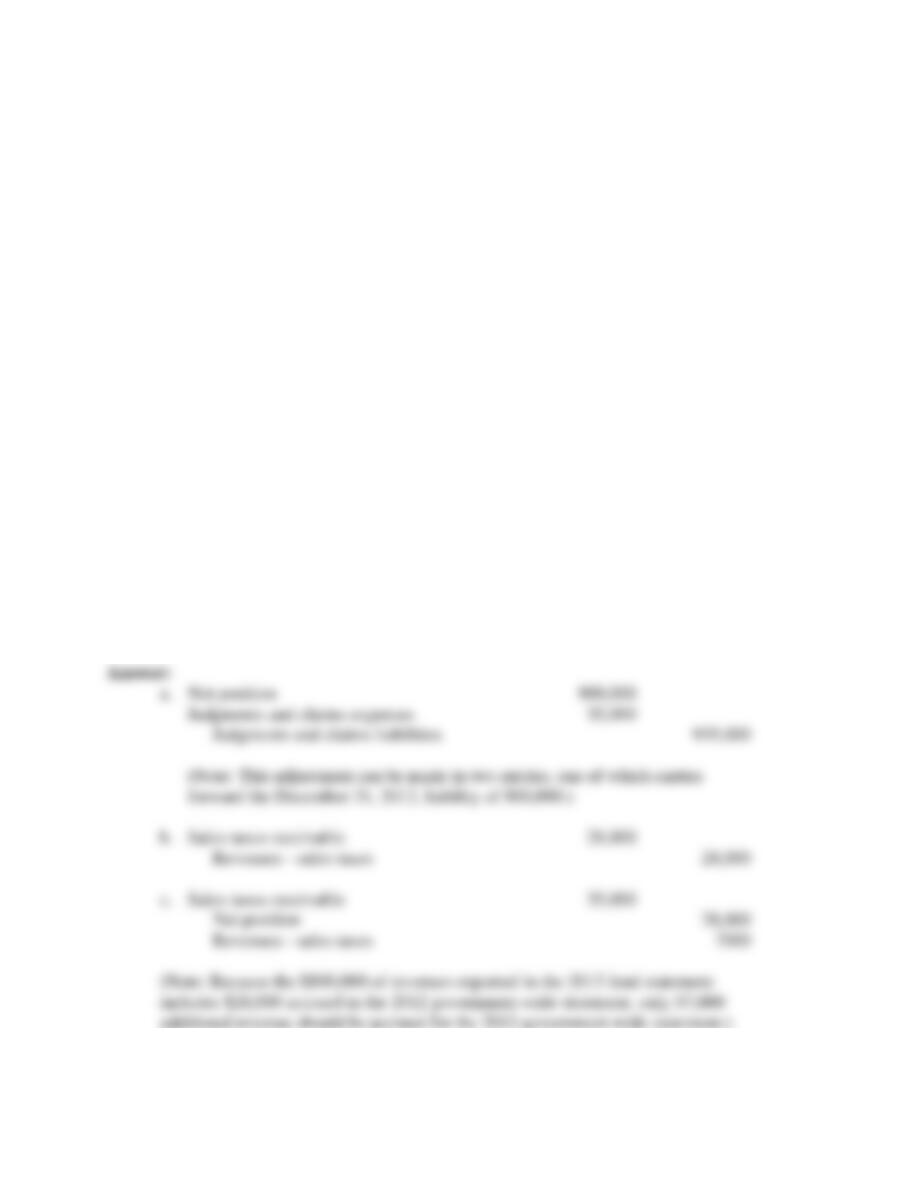
a. To prepare its government-wide financial statements for the year ended
December 31,2012, the city reported a $900,000 long-term liability for
estimated judgments and claims. At December 31, 2013, the city
estimated that the long-term liability would be $935,000. (Hint: Carry
forward the starting liability and adjust for the increase.)
b. A city instituted a new sales tax starting January 1, 2012. It collected
$600,000 of sales taxes during 2012. When the city prepared its fund-level
statements, it accrued an additional $200,000 for sales taxes remitted by
larger businesses in January, 2013, for taxes collected in the fourth quarter
of 2012. However, smaller businesses are not required to remit fourth
quarter collections until April, 2013. No accrual was made for those taxes,
which were estimated to be $28,000.
c. See facts in situation b. For the calendar year 2013, the city reported sales
taxes of $800,000 in its fund-level financial statements. This amount
includes all taxes collected in 2013 (applicable to 2013 and 2012), as well
as the accrual for larger merchant remittances in January, 2014. The
accrual does not include estimated remittances of $35,000 from smaller
merchants in April, 2014.
42. (Entries to prepare government-wide statements – property tax revenue deferral)
When it prepared its financial statements for calendar year 2012, Watson Town
assumed that it would collect all unpaid property taxes during the first 60 days of
2013. As a result, no deferred revenues were reported. The following facts
pertain to the property tax revenues for calendar years 2013 and 2014. Make
adjusting entries needed to prepare both the fund-level and the government-wide
financial statements for 2013 and 2014. Watson Town does not record deferred
revenues until it makes end of the year adjustments.
2013 2014
Tax levy $700,000 $730,000
Taxes collected in cash from the year’s levy $670,000 $690,000
Taxes expected to be collected in first
60 days of the following year $ 22,000 $ 29,000
Taxes expected to be collected later in
the following year $ 8,000 $ 11,000
Assume that all taxes expected to be collected in the following year were actually
collected when expected. Also assume that all journal entries to record the tax
levy, tax collections and so on were made, as appropriate.
43. (Preparation of Government-Wide Financial Statements)
On the following page is the government-wide adjusted trial balance for the Town
of Catlettville as of June 30, 2013, the end of the fiscal year. The adjustments
needed to convert accounting information from the current financial resources
measurement focus and modified accrual basis of accounting to the economic
resources measurement focus and accrual basis of accounting have been made.
The Town government performs three functions, general government, public
safety and roads and bridges. The Town has no business-type activities nor any
component units. Program revenues include charges for services (related to the
general government and public safety functions), operating grants (for public
safety) and capital grants (for roads and bridges). General revenue sources are
property taxes, other taxes, investment revenues, and miscellaneous revenues.
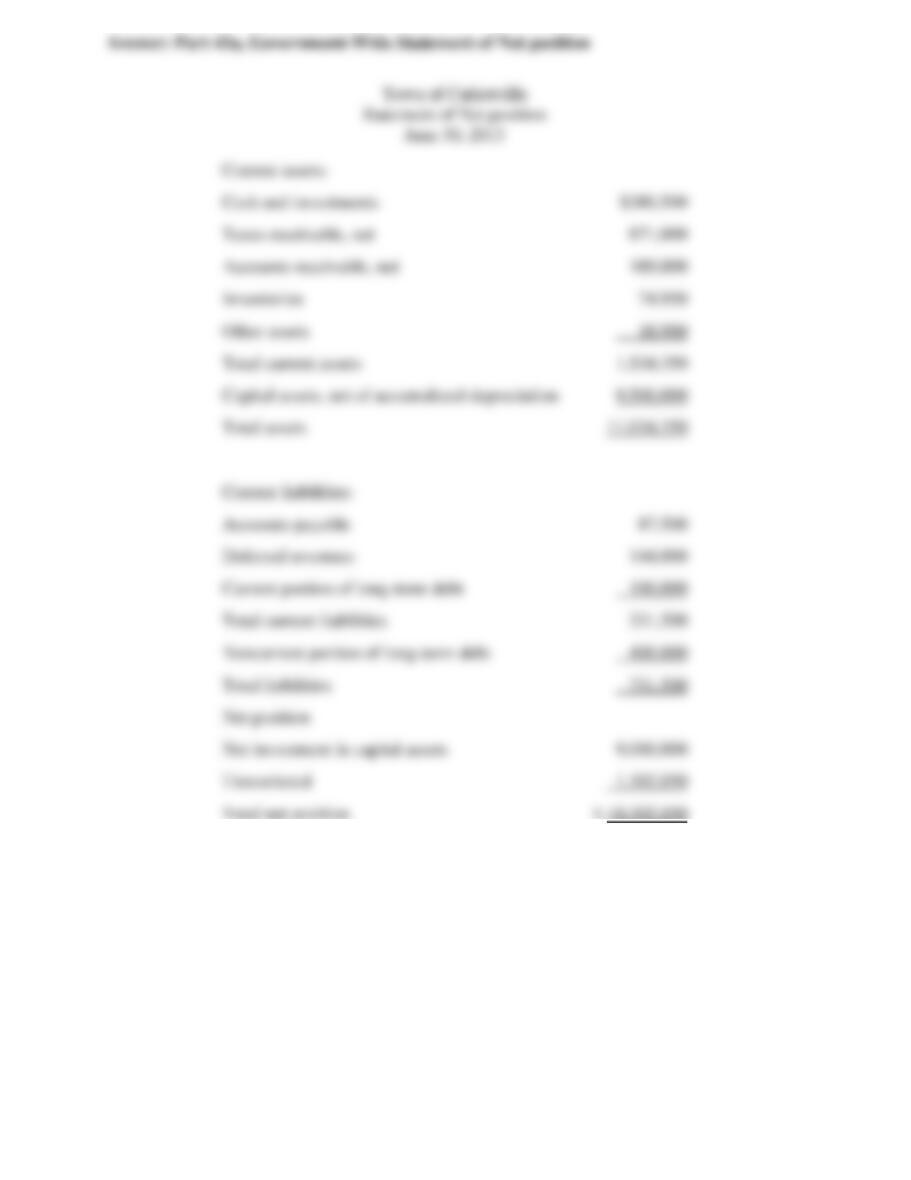
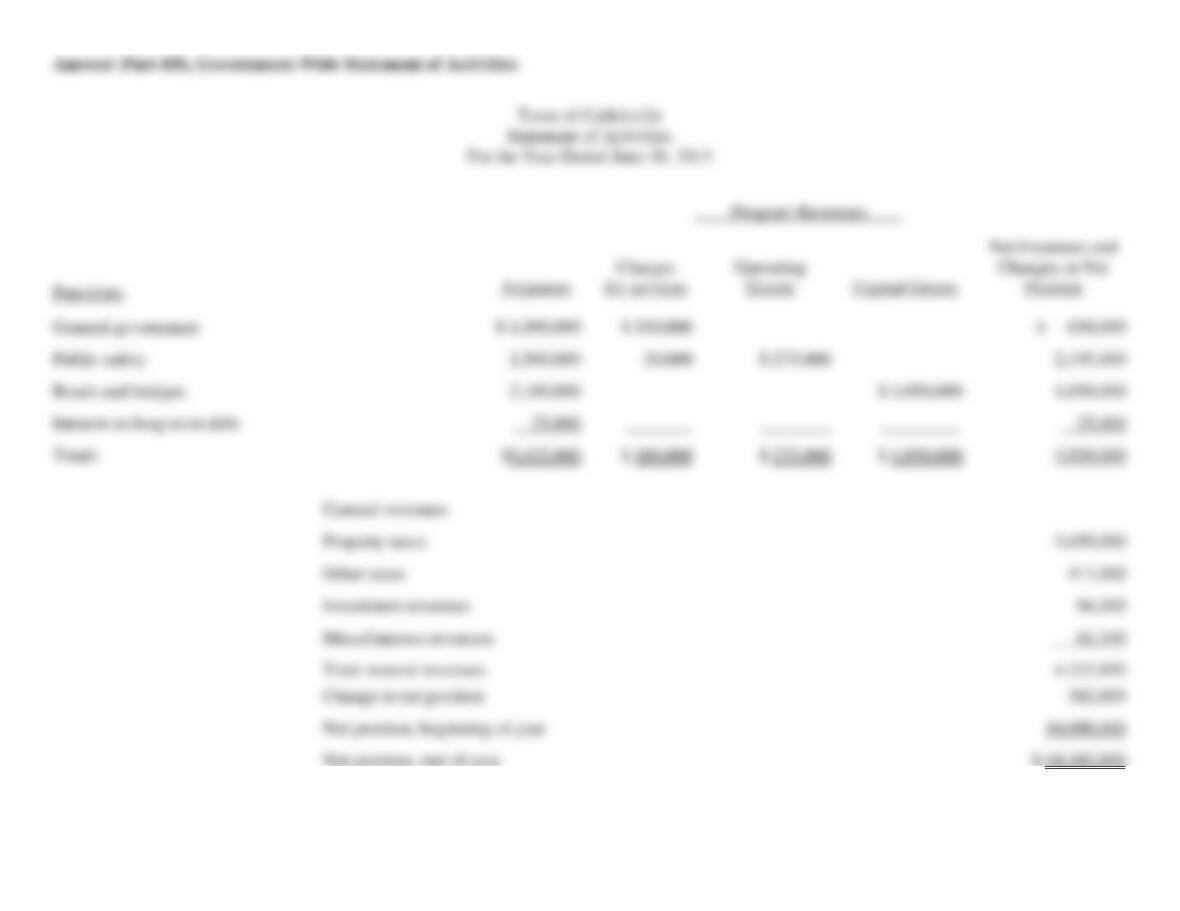
Using this information, prepare in good form (a) the government-wide statement
of net position (using a classified format), and (b) the government-wide statement
of activities as of, and for the year ended, June 30, 2013. There are no restricted
assets or liabilities; the long-term debt (both portions) is the only debt related to
the Town’s capital assets.

Town of Catlettville
Government-Wide Adjusted Trial Balance
June 30, 2013
Cash and investments
$380,500
Taxes receivable, net
871,000
Accounts receivable, net
189,000
Inventories
74,950
Other assets
18,900
Capital assets
20,000,000
Accumulated depreciation, capital assets
$10,500,000
Accounts payable
87,500
Deferred revenues
144,000
Current portion of long-term debt
100,000
Noncurrent portion of long-term debt
400,000
Net position
10,000,000
Revenues—property taxes
3,650,000
Revenues—other taxes
417,000
Investment revenues
94,500
Miscellaneous revenues
61,350
Program revenues—charges for services—general
350,000
Program revenues—charges for services—public safety
30,000
Program revenues—public safety—operating grants
275,000
Program revenues—roads and bridges—capital grants
1,050,000
General government expenses
1,000,000
Public safety expenses
2,500,000
Roads and bridges expenses
2,100,000
Interest expense on long-term debt
25,000
Totals
$27,159,350
$27,159,350