180) Zhang Company has a loan agreement that provides it with cash today, and the company
must pay $25,000 4 years from today. Zhang agrees to a 6% interest rate. The present value of 1
(single sum) for 4 periods at 6% is 0.7921. What is the amount of cash that Zhang Company
receives today?
181) Wasp Corporation has a loan agreement that provides it with cash today, and the company
must pay $25,000 one year from today, $15,000 two years from today, and $5,000 three years
from today. Wasp agrees to pay 10% interest. The following are factors from a present value
table:
Interest rate
Periods
10%
1
0.9091
2
0.8264
3
0.7513
What is the amount of cash that Wasp receives today?
1
$25,000
2
3
Total cash received
$38,880.00
182) A company enters into an agreement to make 5 annual year-end payments of $3,000 each,
starting one year from now. The annual interest rate is 6%. The present value of an annuity
(series of payments) for 5 periods at 6% is 4.2124. What is the present value of these five
payments?
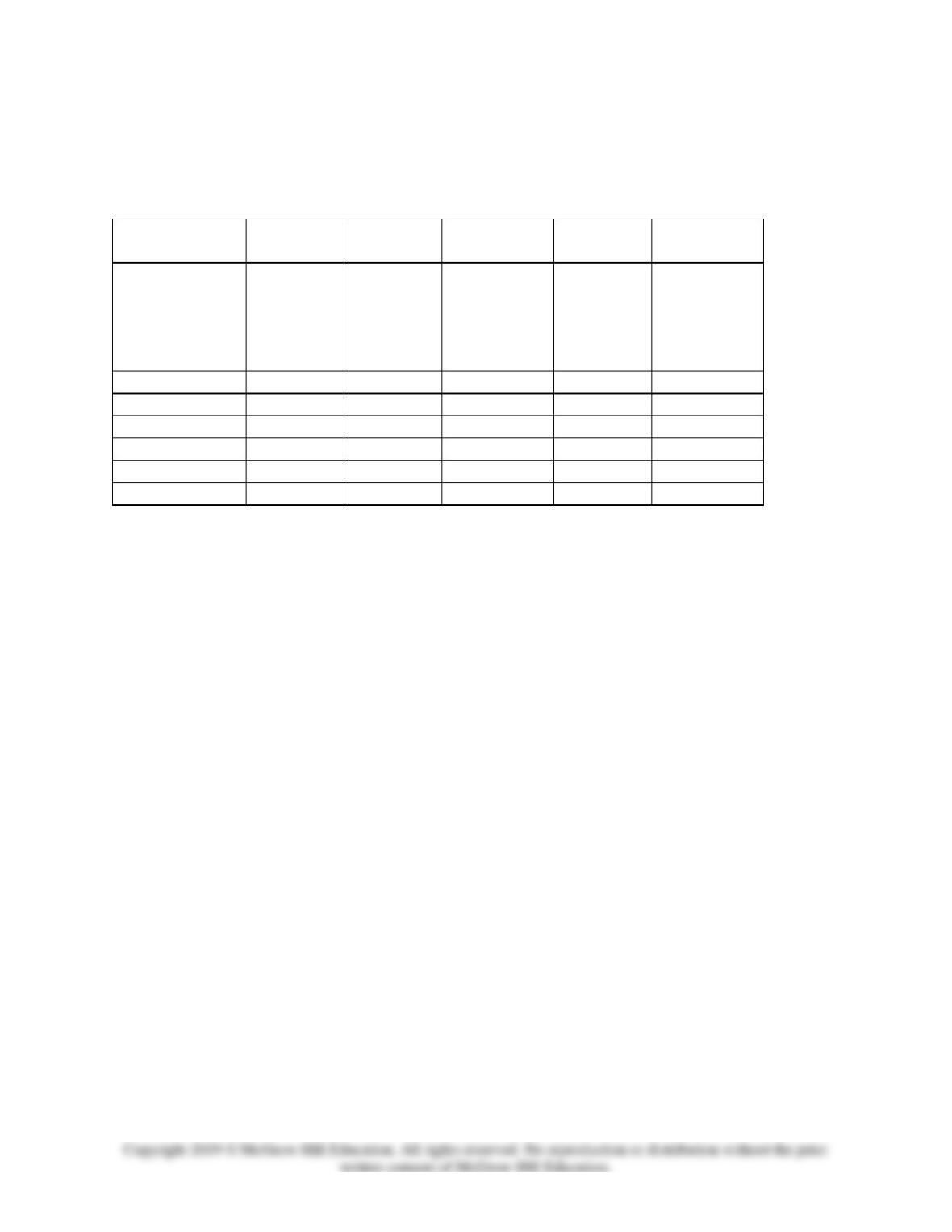
183) On January 1, the Rodrigues Corporation leased some equipment on a 2-month lease,
paying $1,500 per month. The lease is considered to be a short-term lease. Prepare the general
journal entry to record the second lease payment on February 1.
83
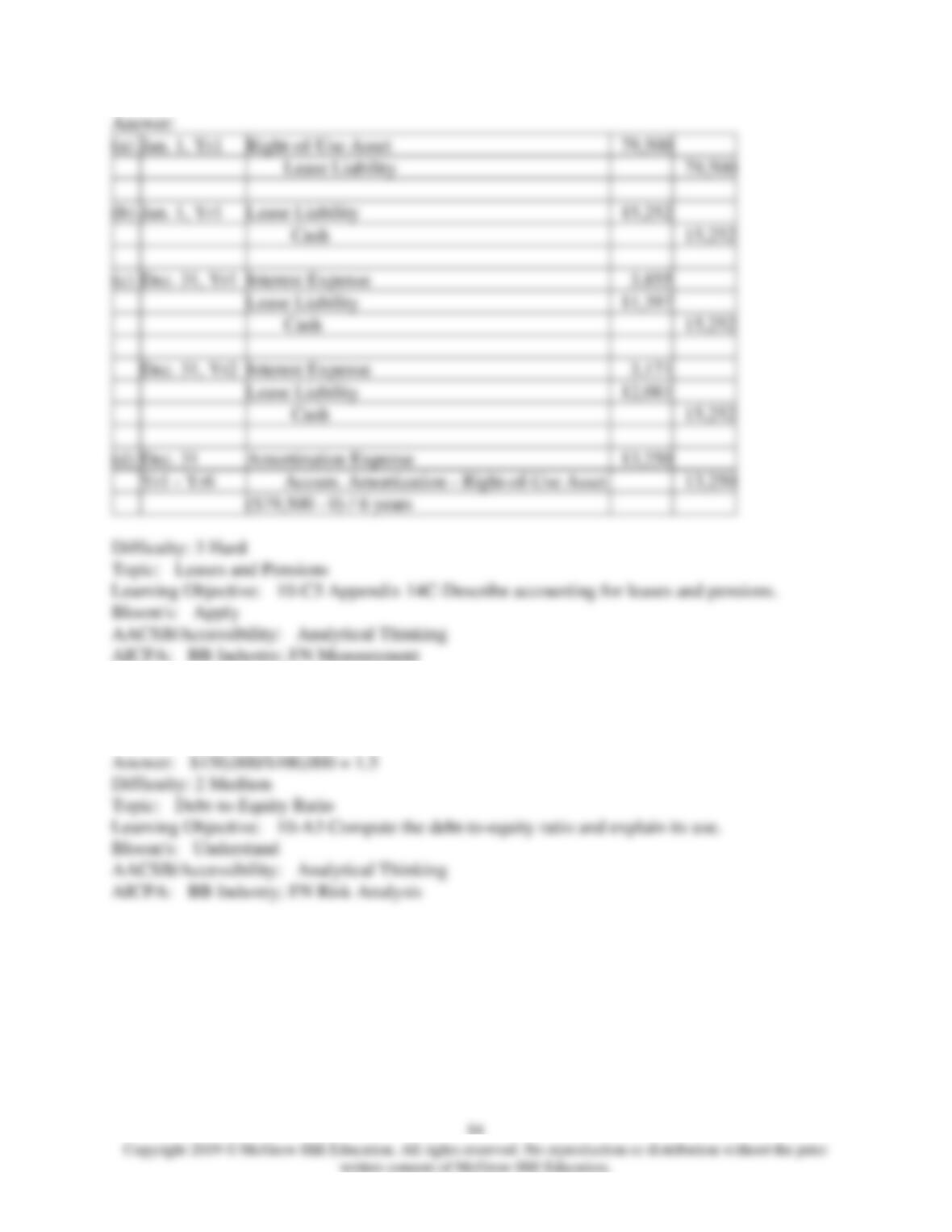
184) On January 1, Haymark Corporation signs a six-year lease for a truck that is accounted for
as a finance lease. The lease requires six $15,252 lease payments (the first at the beginning of
the lease and the rest at December 31 of years 1 through 5). The present value of the six annual
lease payments, at 6% interest, is $79,500. The lease payment schedule follows.
(A)
(B)
Debit
(C)
Debit
(D)
Credit
(E)
Date
Beginning
Balance of
Lease
Liability
Interest on
Lease
Liability
6% * (A)
+ Lease
Liability
(D) – (B)
= Cash
Lease
Payment
Ending
Balance of
Lease
Liability
(A) – (C)
Jan 1., Year 1
$79,500
$15,252
$15,252
$64,247
Dec. 31, Year 1
$64,247
$3,855
$11,397
$15,252
$52,850
Dec. 31, Year 2
$52,850
$3,171
$12,081
$15,252
$40,769
Dec. 31, Year 3
$40,769
$2,446
$12,806
$15,252
$27,963
Dec. 31, Year 4
$27,963
$1,678
$13,574
$15,252
$14.389
Dec. 31, Year 5
$14,389
$863
$14,389
$15,252
$0
(a) Prepare the January 1 journal entry at the start of the lease to record any asset or liability.
(b) Prepare the January 1 journal entry to record the first $15,252 cash lease payment.
(b) Prepare the journal entry to record the cash lease payment at the end of Year 1 and the end of
Year 2.
(c) Prepare the journal entry made at the end of each year to record straight-line amortization,
assuming zero salvage value at the end of the six-year lease term.
185) Sharma Company’s balance sheet reflects total assets of $250,000 and total liabilities of
$150,000. Calculate the company’s debt-to-equity ratio.
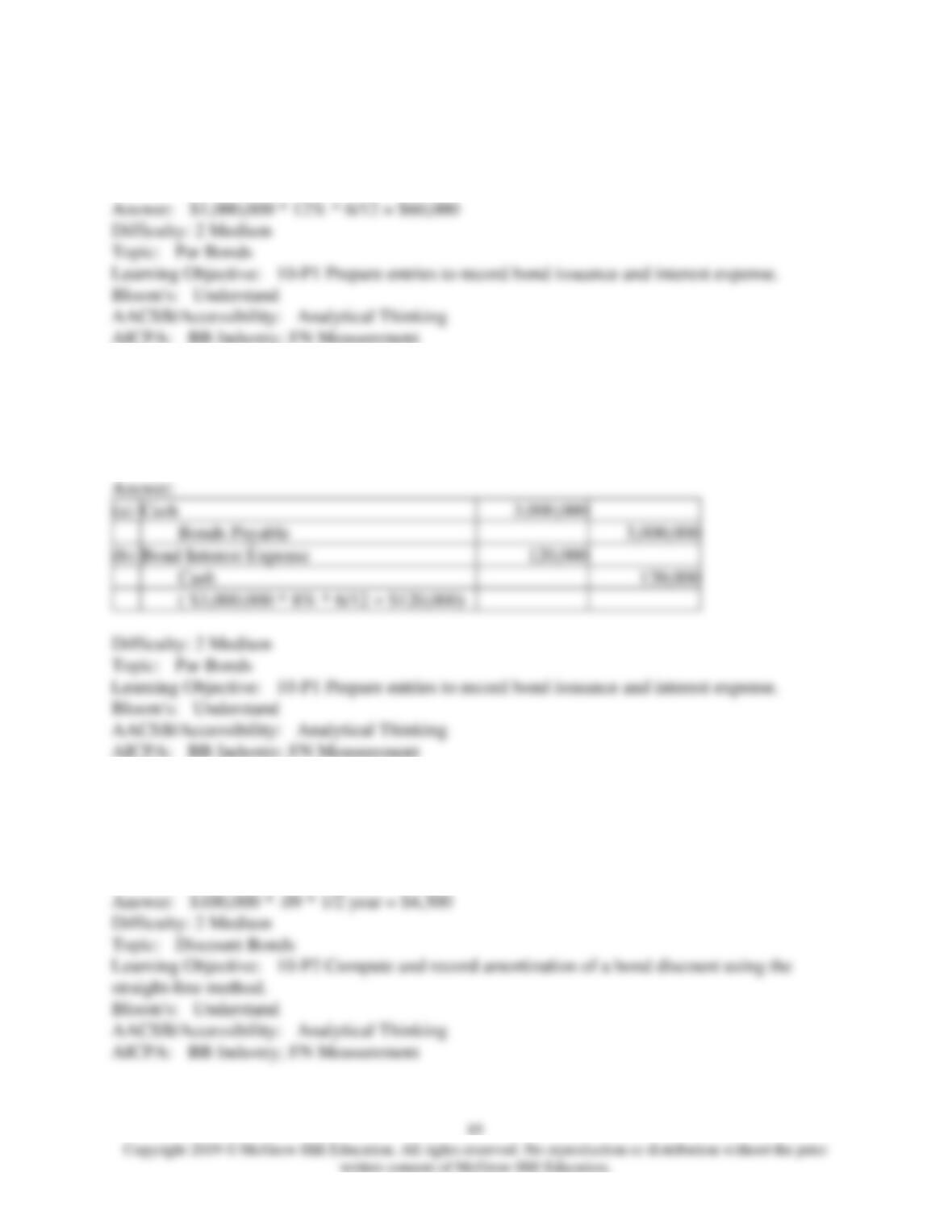
186) On July 1 of the current year a corporation issued (sold) $1,000,000 of its 12% bonds at par.
The bonds pay interest June 30 and December 31. What amount of bond interest expense should
the company report on its current year income statement?
187) Johanna Corporation issued $3,000,000 of 8%, 20-year bonds payable at par value on
January 1. Interest is payable each June 30 and December 31.
(a) Prepare the general journal entry to record the issuance of the bonds on January 1.
(b) Prepare the general journal entry to record the first interest payment on June 30.
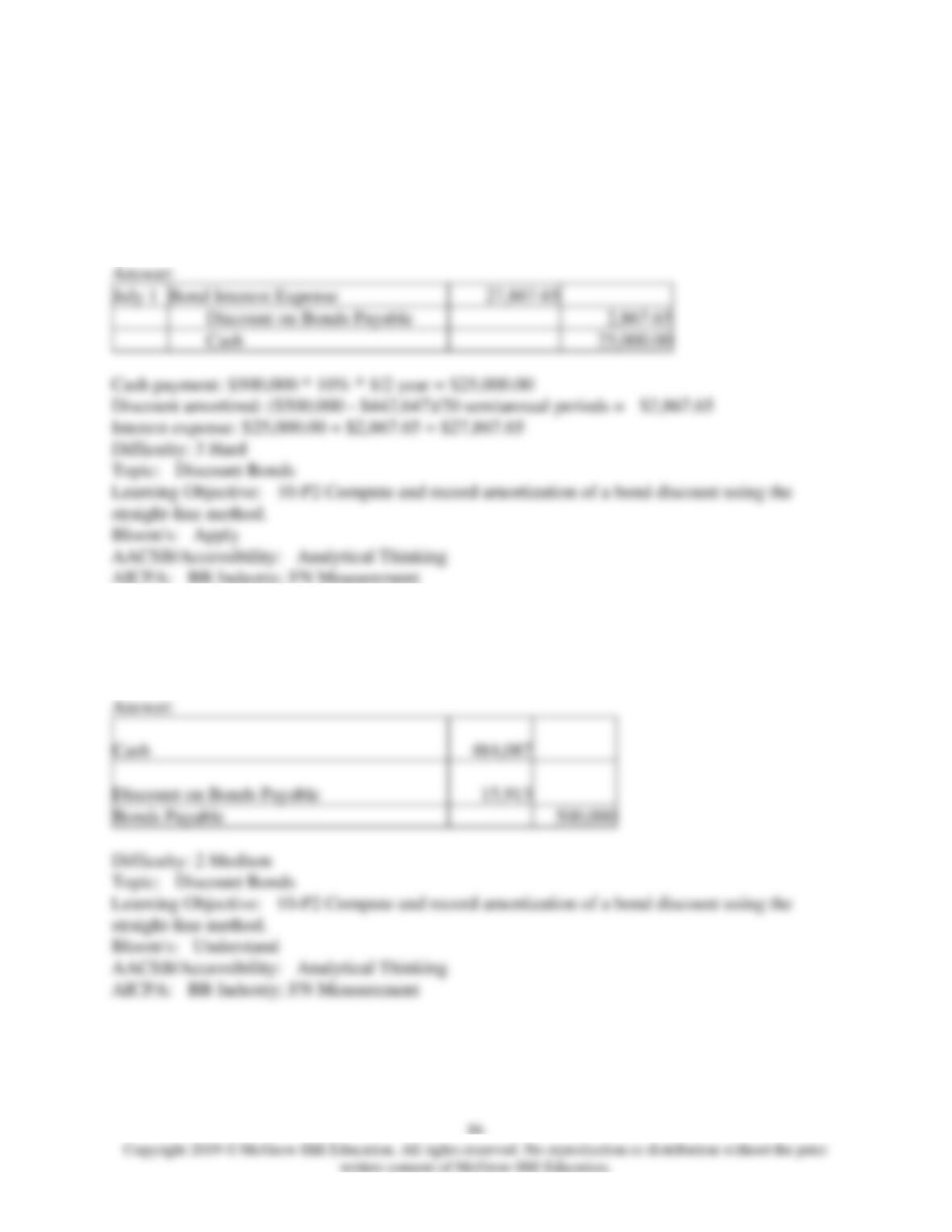
188) A company issued 9%, 10-year bonds with a par value of $100,000. Interest is paid
semiannually. The market interest rate on the issue date was 10%, and the issuer received
$95,016 cash for the bonds. On the first semiannual interest date, what amount of cash should be
paid to the holders of these bonds for interest?
189) On January 1, a company issued 10-year, 10% bonds payable with a par value of $500,000,
and received $442,647 in cash proceeds. The market rate of interest at the date of issuance was
12%. The bonds pay interest semiannually on July 1 and January 1. The issuer uses the straight-
line method for amortization. Prepare the issuer’s journal entry to record the first semiannual
interest payment on July 1.
190) A company issued 10-year, 9% bonds, with a par value of $500,000 when the market rate
was 9.5%. The issuer received $484,087 in cash proceeds. Prepare the issuer’s journal entry to
record the bond issuance.
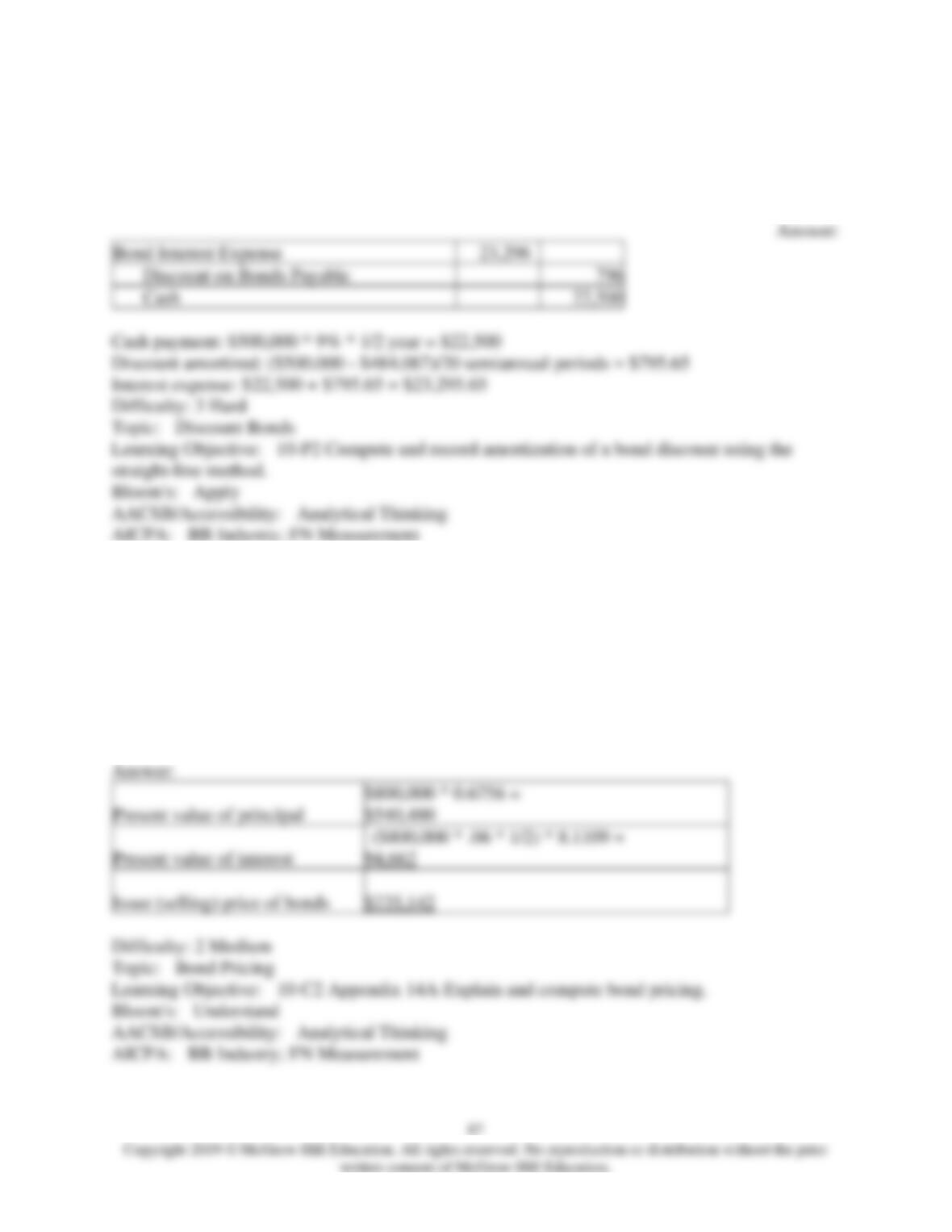
191) A company issued 10-year, 9% bonds with a par value of $500,000 when the market rate
was 9.5%. The company received $484,087 in cash proceeds. Using the straight-line method,
prepare the issuer’s journal entry to record the first semiannual interest payment and the
amortization of any bond discount or premium.(Round amounts to the nearest whole dollar)
192) A company issues 6%, 5 year bonds with a par value of $800,000 and semiannual interest
payments. On the issue date, the annual market rate of interest is 8%. Compute the issue (selling)
price of the bonds. The following information is taken from present value tables:
Present value of an annuity (series of payments) for 10 periods at 3% 8.5302
Present value of an annuity (series of payments) for 10 periods at 4% 8.1109
Present value of 1 (single sum) due in 10 periods at 3% 0.7441
Present value of 1 (single sum) due in 10 periods at 4% 0.6756
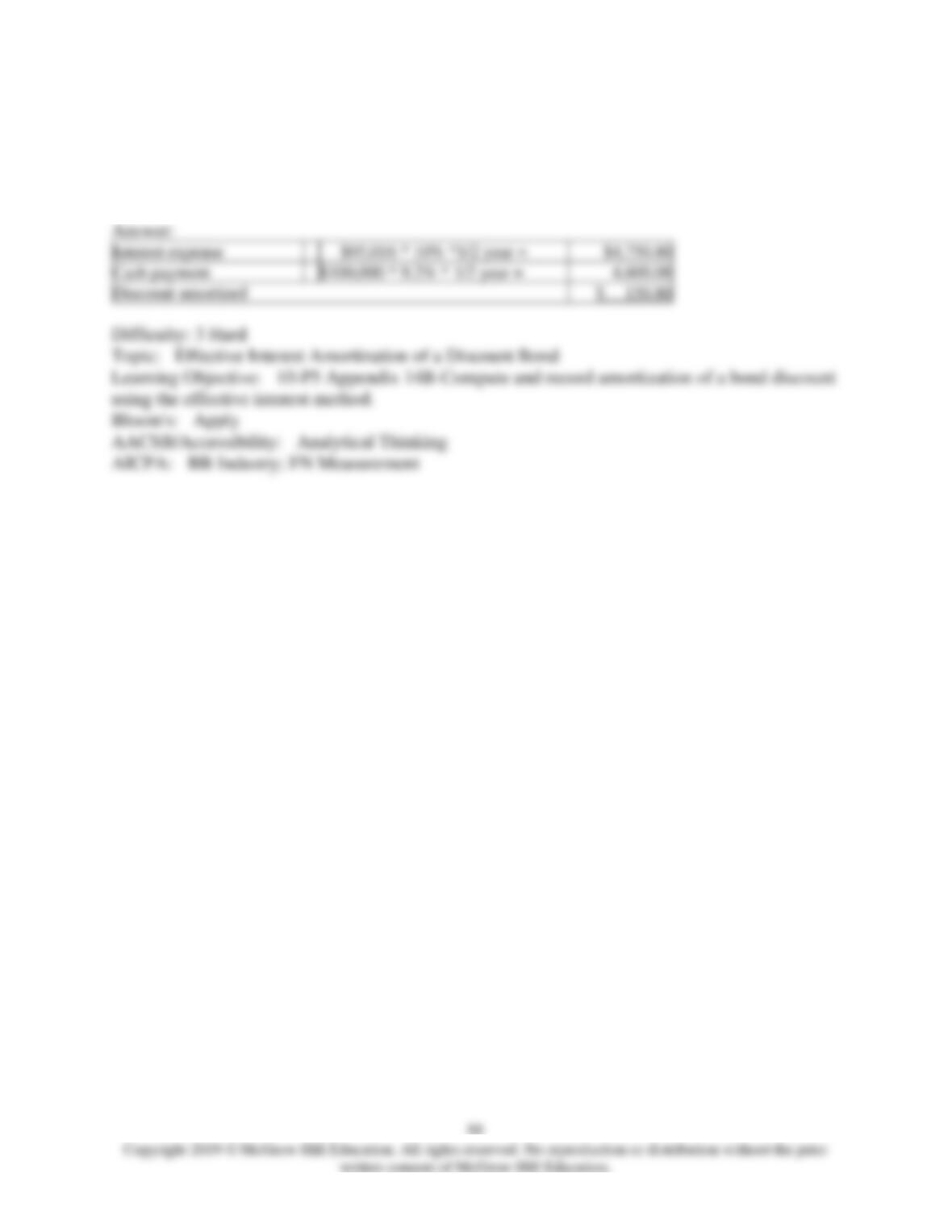
193) A company issued 9.2%, 10-year bonds with a par value of $100,000. Interest is paid
semiannually. The annual market interest rate on the issue date was 10%, and the issuer received
$95,016 cash for the bonds. The issuer uses the effective interest method for amortization. On the
first semiannual interest date, what amount of discount should the issuer amortize?
89
194) A company issued 10%, 10-year bonds with a par value of $1,000,000 on January 1, at a
selling price of $885,295 when the annual market interest rate was 12%. The company uses the
effective interest amortization method. Interest is paid semiannually each June 30 and December
31.
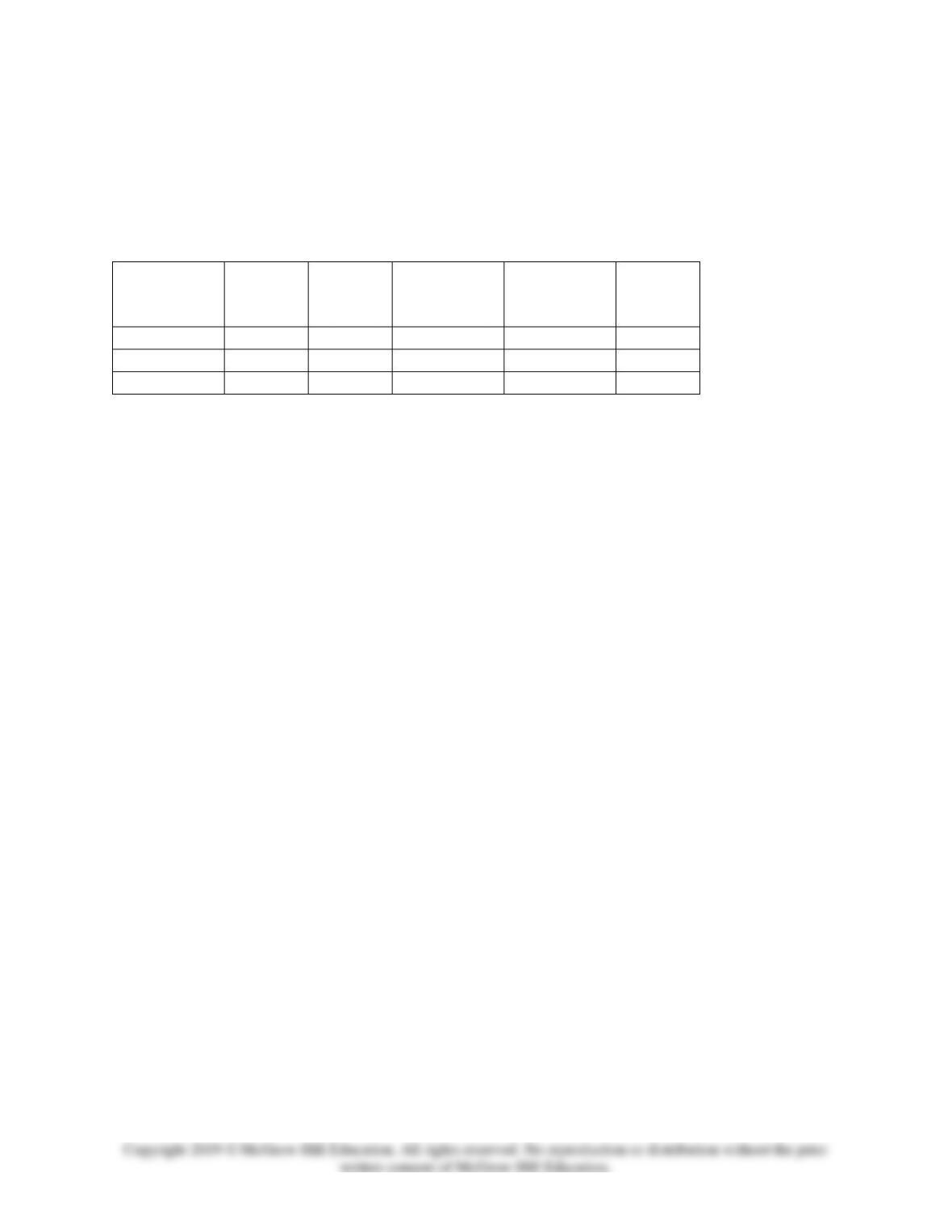
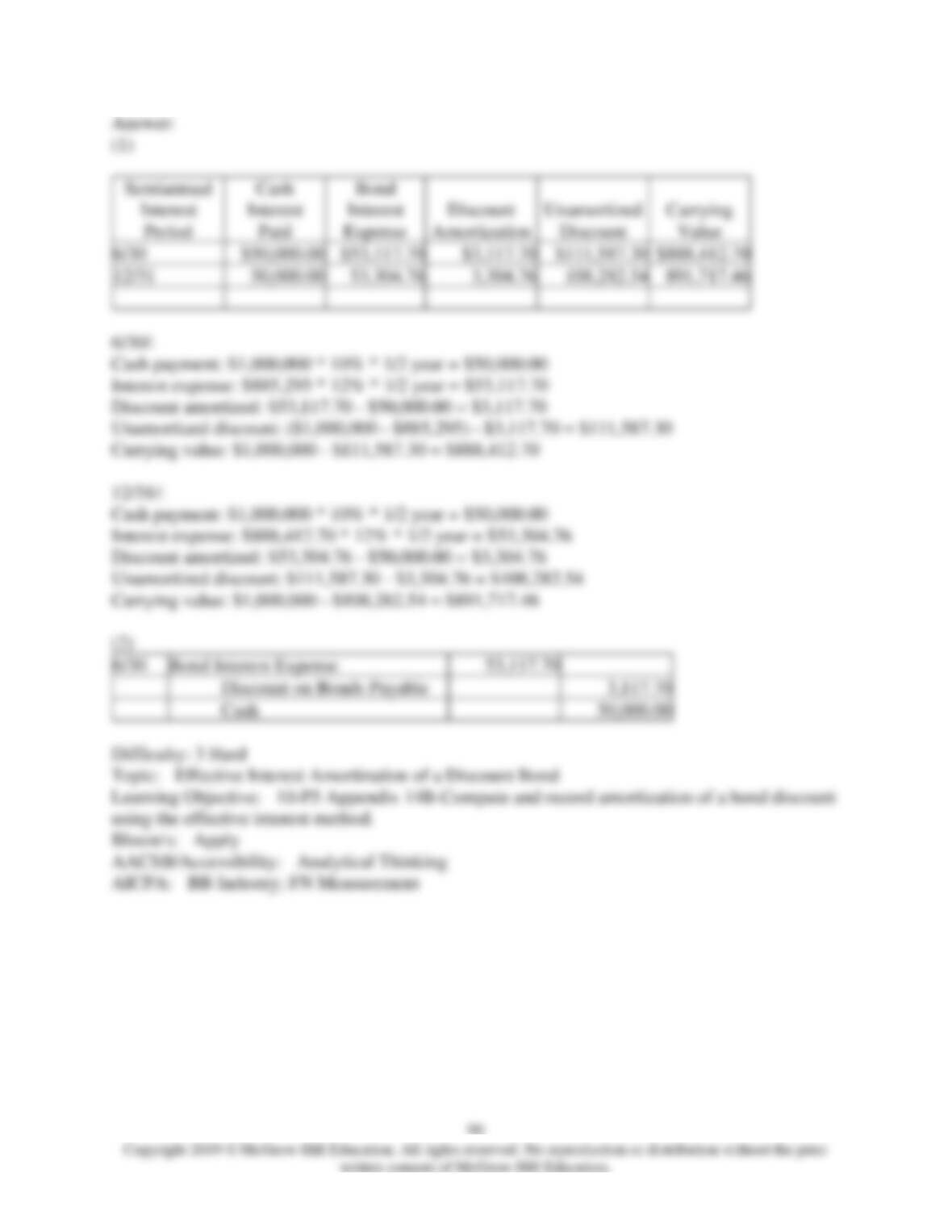
(1) Prepare an amortization table for the first two payment periods using the format shown
below:
Semiannual
Interest
Period
Cash
Interest
Paid
Bond
Interest
Expense
Discount
Amortization
Unamortized
Discount
CarryingV
alue
(2) Prepare the journal entry to record the first semiannual interest payment.
195) A company issued 10-year, 9% bonds with a par value of $500,000 when the market rate
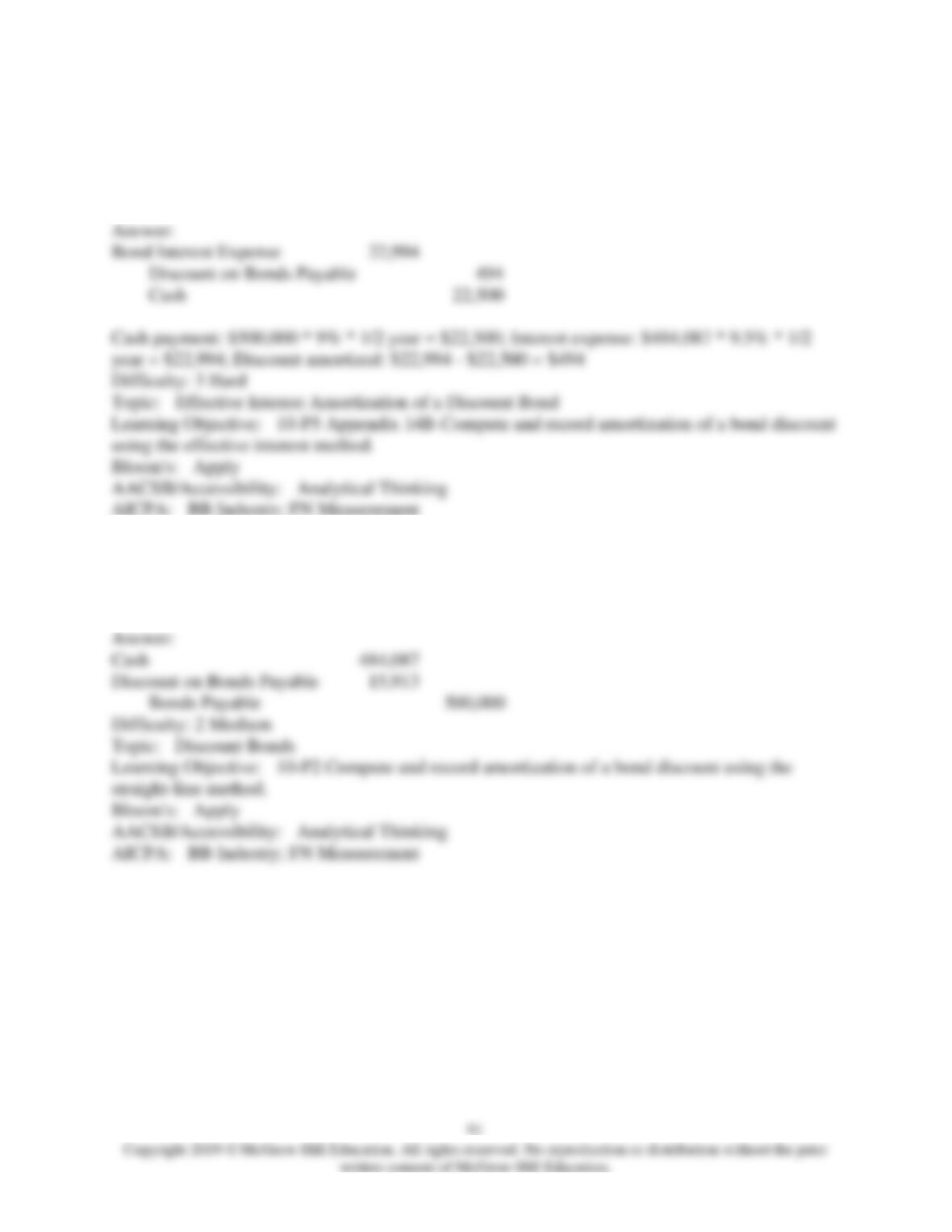
was 9.5%. The company received $484,087 in cash proceeds. Using the effective interest
method, prepare the issuer’s journal entry to record the first semiannual interest payment and the
amortization of any bond discount or premium.
196) A company issued 10-year, 9% bonds with a par value of $500,000 when the market rate
was 9.5%. The company received $484,087 in cash proceeds. Prepare the issuer’s journal entry to
record the issuance of the bond.
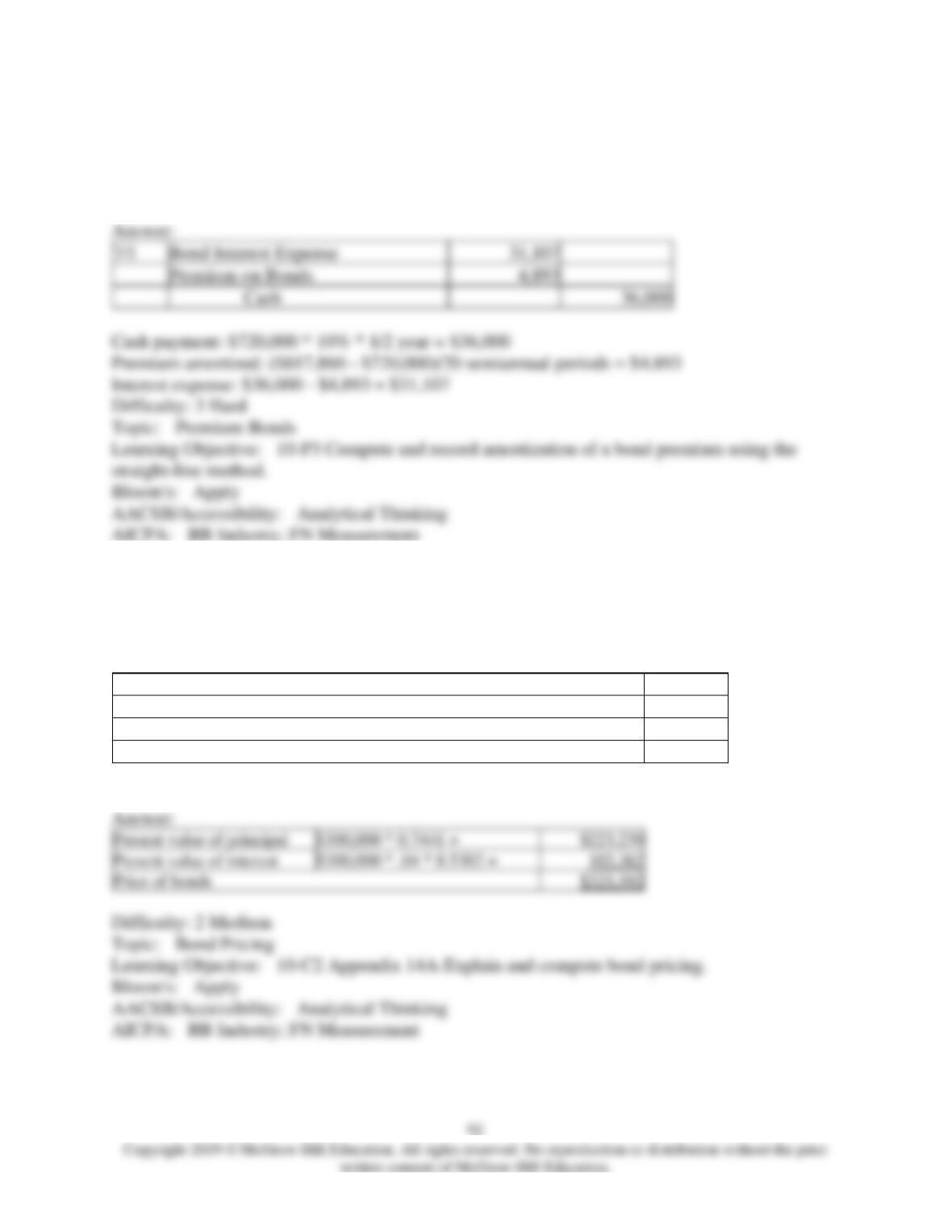
197) On January 1, a company issued 10%, 10-year bonds payable with a par value of $720,000.
The bonds pay interest on July 1 and January 1. The bonds were issued for $817,860 cash, which
provided the holders an annual yield of 8%. Prepare the journal entry to record the first
semiannual interest payment, assuming it uses the straight-line method of amortization.
7/1
Bond Interest Expense
Premium on Bonds
198) On January 1, a company issues 8%, 5-year, $300,000 bonds that pay interest semiannually
each June 30 and December 31. On the issue date, the annual market rate of interest is 6%.
Compute the price of the bonds on their issue date. The following information is taken from
present value tables:
Present value of an annuity (series of payments) for 10 periods at 3%
8.5302
Present value of an annuity (series of payments) for 10 periods at 4%
8.1109
Present value of 1 (single sum) due in 10 periods at 3%.
0.7441
Present value of 1 (single sum) due in 10 periods at 4%
0.6756
199) On January 1, a company issues 8%, 5-year, $300,000 bonds that pay interest semiannually
each June 30 and December 31. On the issue date, the annual market rate of interest for the
bonds is 10%. Compute the price of the bonds on their issue date. The following information is
taken from present value tables:
Present value of an annuity (series of payments) for 10 periods at 4%
8.1109
Present value of an annuity (series of payments) for 10 periods at 5%
7.7217
Present value of 1 (single sum) for 10 periods at 4%
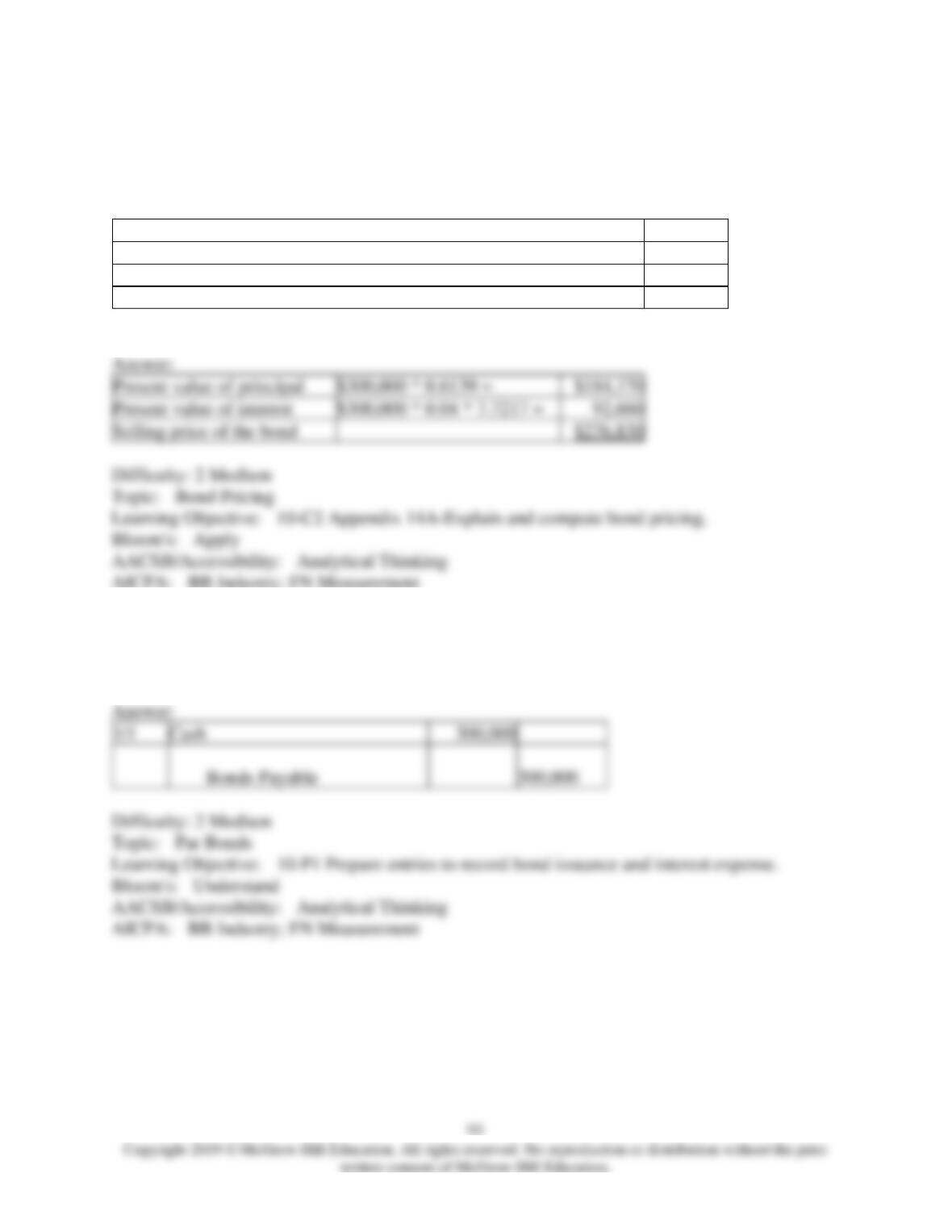
0.6756
Present value of 1 (single sum) for 10 periods at 5%
0.6139
Present value of principal
$300,000 * 0.6139 =
Present value of interest
$300,000 * 0.04 * 7.7217 =
Selling price of the bond
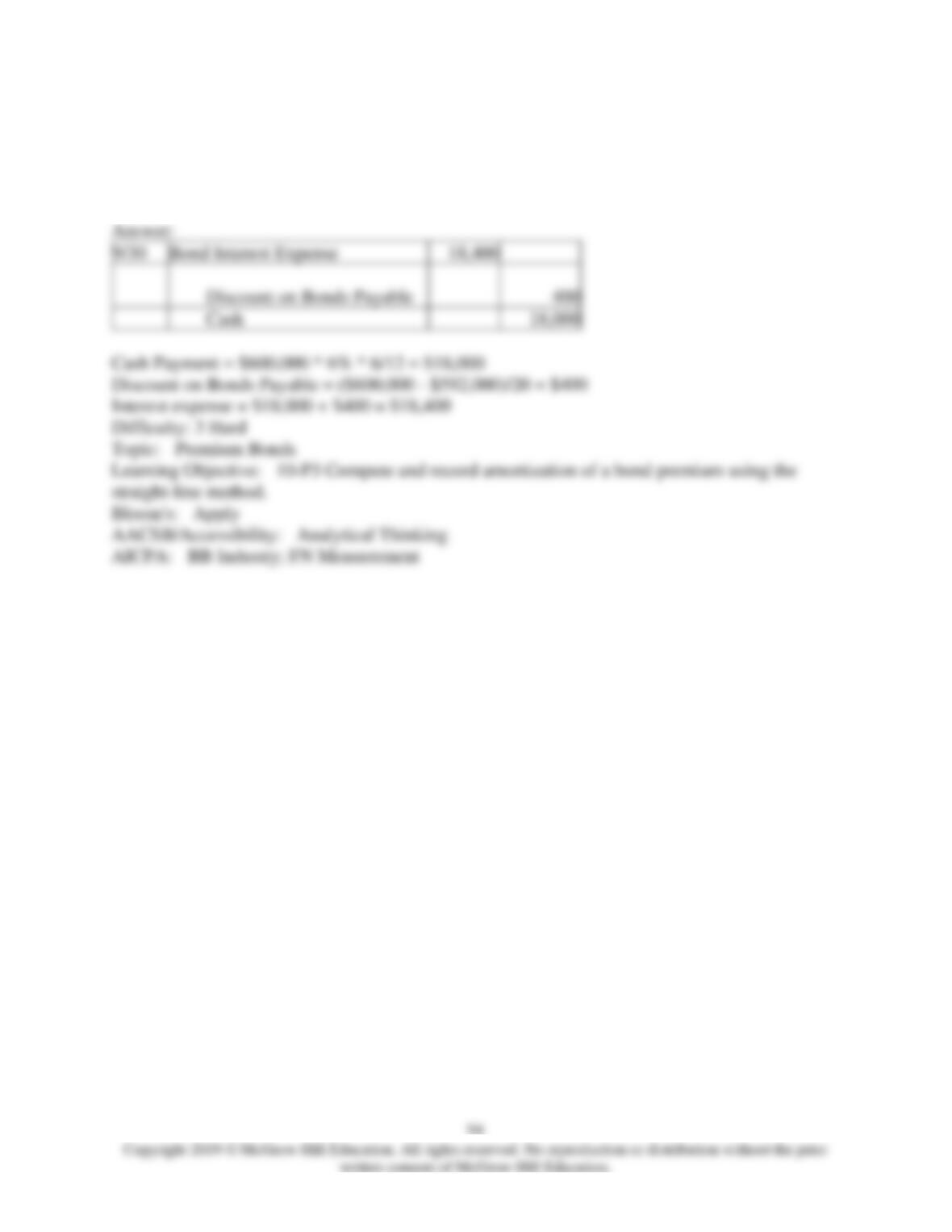
200) On January 1, a company issues 6%, 10 year $300,000 par value bonds that pay semiannual
interest each June 30 and December 31. The bonds sell at par value. Prepare the general journal
entry to record the issuance of the bonds on January 1.
1/1
Cash
300,000
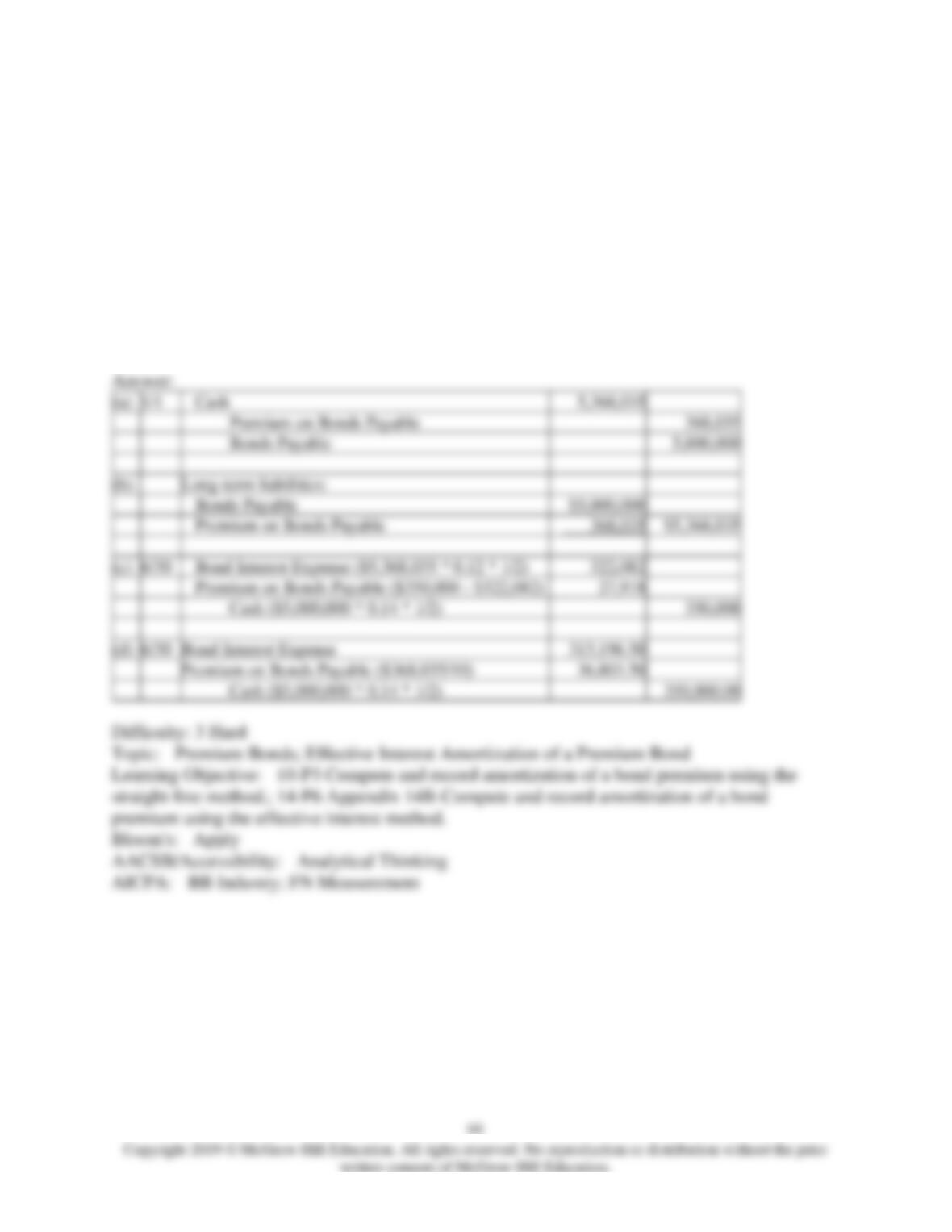
201) On April 1, a company issues 6%, 10-year, $600,000 par value bonds that pay interest
semiannually each March 31 and September 30. The bonds sold at $592,000. The company uses
the straight-line method of amortizing bond discounts. Prepare the general journal entry to record
the first interest payment on September 30.
202) Strider Corporation issued 14%, 5-year bonds with a par value of $5,000,000 on January 1,
Year 1. Interest is to be paid semiannually on each June 30 and December 31. The bonds are
issued at $5,368,035 cash when the market rate for this bond is 12%.
(a) Prepare the general journal entry to record the issuance of the bonds on January 1, year 1.
(b) Show how the bonds would be reported on Strider’s balance sheet at January 1, Year 1.
(c) Assume that Strider uses the effective interest method of amortization of any discount or
premium on bonds. Prepare the general journal entry to record the first semiannual interest
payment on June 30, Year 1.
(d) Assume instead that Strider uses the straight-line method of amortization of any discount or
premium on bonds. Prepare the general journal entry to record the first semiannual interest
payment on June 30, Year 1.
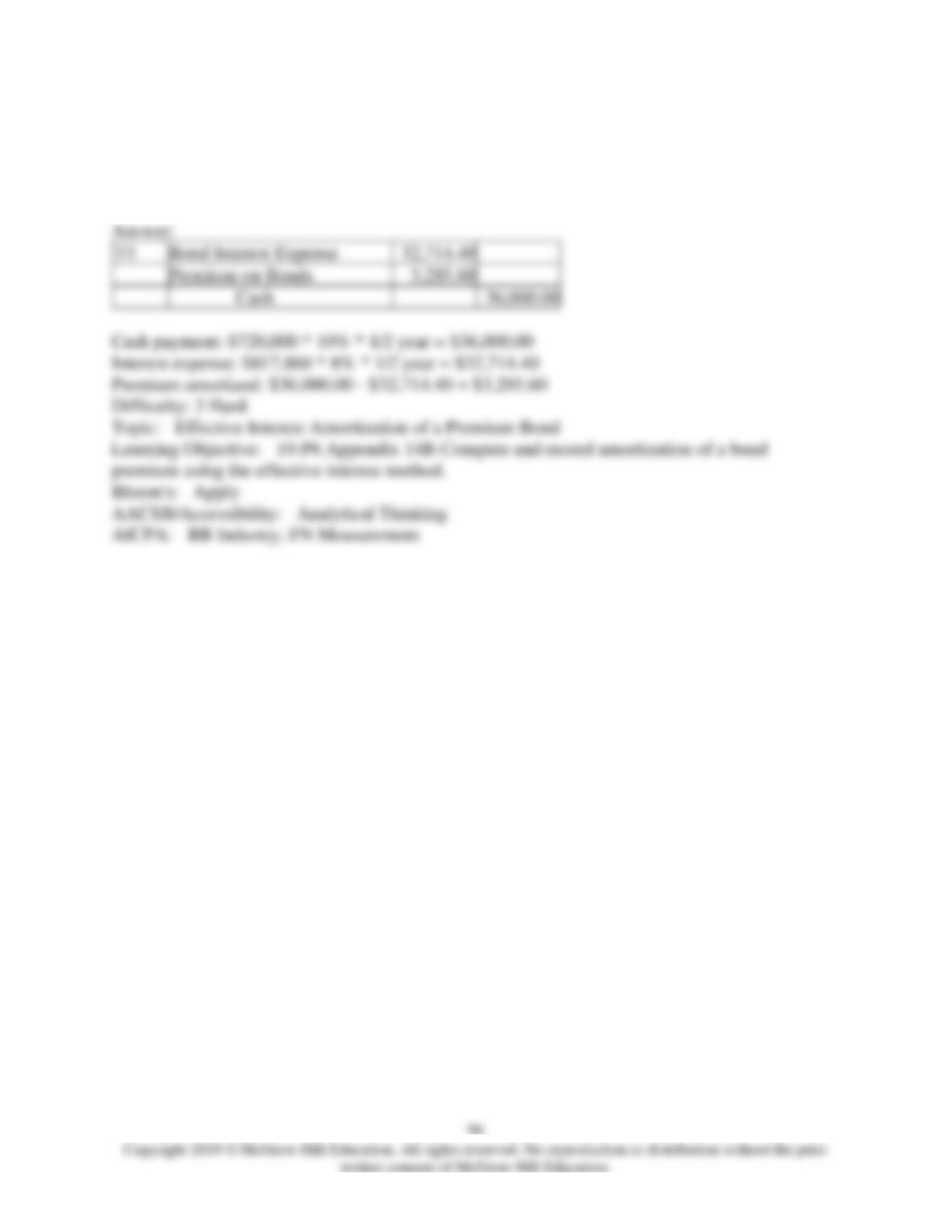
203) On January 1, a company issued 10%, 10-year bonds with a par value of $720,000. The
bonds pay interest each July 1 and January 1. The bonds were sold for $817,860 cash, based on
an annual market rate of 8%. Prepare the issuer’s journal entry to record the first semiannual
interest payment assuming the effective interest method is used.