80) On January 1, 2019, a company issued $400,000 of 10-year, 12% bonds. The interest is
payable semiannually on June 30 and December 31. The issue price was $413,153 based on a
10% market interest rate. The effective-interest method of amortization is used.
Which of the following statements is incorrect?
A) The market rate of interest on the sale date was less than the coupon rate of interest.
B) The book value of the bond will decrease as the bond reaches maturity.
C) The interest expense will decrease as the bond reaches maturity.
D) The amortization of the premium on bonds payable will decrease as the bond matures.
81) On January 1, 2019, a company issued $400,000 of 10-year, 12% bonds. The interest is
payable semiannually on June 30 and December 31. The issue price was $413,153 based on a
10% market interest rate. The effective-interest method of amortization is used.
The interest expense for the six-month period ending December 31, 2019 is closest to:
A) $24,000.
B) $20,491.
C) $20,000.
D) $20,825.
82) On January 1, 2019, a company issued $400,000 of 10-year, 12% bonds. The interest is
payable semiannually on June 30 and December 31. The issue price was $449,849 based on a
10% market interest rate. The effective-interest method of amortization is used.
The book value of the bond liability at the end of December 31, 2019 is closest to:
A) $400,000.
B) $448,341.
C) $446,758
D) $449,849.
83) Which of the following statements regarding the effective-interest method of amortization is
incorrect?
A) The amount of interest expense is different each period.
B) The amount of discount or premium, on which amortization is calculated, increases each
period.
C) The effective-interest method is one of the options allowed by generally accepted accounting
principles for all bond issues.
D) The total interest expense over the life of a bond is the same as that reported under the
straight-line method of amortization.
84) Straight-line amortization of a premium related to a bond issuance would result in which of
the following?
A) Interest expense would be calculated by multiplying the market interest rate times the book
value of the bonds.
B) Higher premium amortization would exist in the early years and lower interest expense would
result over the life of the bonds.
C) The constant amount of premium to be amortized would be calculated and then subtracted
from cash interest to calculate interest expense.
D) Lower premium amortization would exist in the early years and higher interest expense would
result over the life of the bonds.
85) Which of the following statements regarding the debt-to-equity ratio is correct?
A) A high ratio means that the company is primarily financed through stockholder investments.
B) A higher ratio is preferred.
C) The debt-to-equity ratio is a measure of a company’s ability to pay its debt.
D) The debt-to-equity ratio is a measure of investor and creditor risk.
86) A company prepared the following journal entry:
Interest expense
xxx
Discount on bonds payable
xxx
Cash
Which of the following statements correctly describes the effect of this journal entry on the
financial statements?
A) The bonds payable book value increases by the amount of the credit to discount on bonds
payable.
B) The bonds payable book value decreases by the amount of the credit to cash.
C) Stockholders’ equity decreases by the amount of the credit to cash.
D) The cash payment is reported as a cash flow from financing activities.
87) A company prepared the following journal entry:
Interest expense
xxx
Premium on bonds payable
xxx
Cash
xxx
Which of the following statements incorrectly describes the effect of this journal entry on the
financial statements?
A) The bonds payable book value decreases by the amount of the debit to premium on bonds
payable.
B) Assets decrease by the amount of the credit to cash.
C) Stockholders’ equity decreases by the amount of the debit to interest expense.
D) The cash payment is reported as a cash flow from financing activities.
88) A company prepared the following journal entry:
Cash
xxx
Discount on bonds payable
xxx
Bonds payable
xxx
Which of the following statements incorrectly describes the effect of this journal entry on the
financial statements?
A) Total liabilities increase by only the amount of the credit to bonds payable.
B) Discount on bonds payable is reported on the balance sheet as a contra-liability account.
C) Assets increase by the amount of the debit to cash.
D) The cash inflow (debit) is reported as a cash flow from financing activities.
89) A company prepared the following journal entry:
Cash
xxx
Premium on bonds payable
xxx
Bonds payable
xxx
Which of the following statements correctly describes the effect of this journal entry on the
financial statements?
A) Total liabilities increase by the amount of the debit to cash.
B) Premium on bonds payable is reported on the balance sheet as a contra-liability account.
C) Stockholders’ equity increases by the amount of the credit to premium on bonds payable.
D) The credit to bonds payable is the amount reported as a cash flow from financing activities.
90) When a bond payable is issued at a discount, which of the following would not occur as the
bond is amortized each year?
A) Interest expense would increase.
B) The book value of the bonds would increase.
C) When the effective-interest method is used, the discount amortization for each year the bond
approaches maturity would increase.
D) The amount of amortization would be subtracted from net income to arrive at cash flows from
operating activities.
91) Which of the following is correct when using the effective-interest method of amortizing the
discount on bonds payable?
A) Interest expense is computed by adding the portion of amortized discount to the cash interest
paid.
B) The amount of interest expense recognized each period increases over time.
C) The amount of discount amortized each period decreases over time.
D) The book value of the bonds payable liability decreases.
92) When a bond payable is issued at a premium, subsequent amortization of the premium does
which of the following?
A) Increases interest expense.
B) Decreases the book value of the bonds.
C) When the effective-interest method is used, the amount of amortization would decrease for
each year the bond approaches maturity.
D) The amount of amortization would be added to net income to arrive at cash flows from
operating activities.
93) If a bond is issued at 101, the coupon rate was:
A) higher than the market rate of interest.
B) lower than the market rate of interest.
C) equal to the market rate of interest.
D) not related to the market rate of interest.
94) If a bond is issued at 98, the coupon rate was:
A) higher than the market rate of interest.
B) lower than the market rate of interest.
C) equal to the market rate of interest.
D) not related to the market rate of interest.
95) When recording bond issuance costs for underwriter fees:
A) Debit bond issuance costs and credit cash.
B) Credit bond issuance costs and debit bond discount.
C) Debit bond premium and credit cash.
D) Credit cash and debit bond fee expense.
96) When recording bond issuance costs for fees paid to underwriters:
A) The fee is recorded in a bond issuance costs account regardless of whether the bonds were
issued at a discount or at a premium.
B) The fee is recorded as a reduction in the bond discount account if the bonds were issued at a
discount.
C) The fee is recorded as a reduction in the bond premium account if the bonds were issued at a
premium.
D) The fee is recorded as a bond issuance expense regardless of whether the bonds were issued
at a discount or at a premium.
97) On July 1, 2019, immediately after recording interest payments, Salsa, Inc. retired one fifth
of its $500,000 of bonds payable for $97,500. The bonds were originally issued at par value in
2014. Which of the following statements is correct?
A) Stockholders’ equity is not affected by the bond retirement.
B) A gain of $2,500 will be reported on the income statement.
C) A loss of $2,500 will be reported on the income statement.
D) A gain of $402,500 will be reported on the income statement.
98) A company prepared the following journal entry:
Bonds payable
xxx
Premium on bonds payable
xxx
Loss on bond retirement
xxx
Cash
xxx
Which of the following statements is correct?
A) The book value of the bonds was greater than the cash payment.
B) The increase in stockholders’ equity equals the loss on the bond retirement.
C) The decrease in assets is greater than the decrease in liabilities and, as a result, stockholders’
equity decreases.
D) The net cash flow from financing activities decreases by the book value of the bonds payable.
99) A company prepared the following journal entry:
Bonds payable
xxx
Premium on bonds payable
xxx
Gain on bond retirement
xxx
Cash
xxx
Which of the following statements is incorrect?
A) The book value of the bonds was less than the cash payment.
B) The increase in stockholders’ equity equals the gain on the bond retirement.
C) The decrease in assets is less than the decrease in liabilities.
D) The net cash flow from financing activities decreases by the cash payment.
100) On March 31, 2019, Bundy Company retired $10,000,000 of bonds, which have an
unamortized premium of $500,000, by paying bondholders $9,850,000. What is the amount of
the gain or loss on the retirement of the bonds?
A) $150,000 loss.
B) $150,000 gain.
C) $650,000 gain.
D) $350,000 loss.
101) A company retired $500,000 of bonds, which have an unamortized discount of $10,000, by
repurchasing them for $500,000. What is the amount of the gain or loss on the retirement of the
bonds?
A) There was no gain or loss.
B) There was a $10,000 loss.
C) There was a $10,000 gain.
D) There was a $500,000 loss.
102) A company retired $900,000 of bonds which have an unamortized discount of $30,000, by
paying bondholders $920,000. What is the amount of the gain or loss on the retirement of the
bonds?
A) There was a $50,000 loss.
B) There was a $10,000 loss.
C) There was a $10,000 gain.
D) There was a $20,000 loss.
103) A company retired $200,000 of bonds, which have an unamortized premium of $8,000, by
purchasing them on the open market for $210,000. What is the amount of the gain or loss on the
retirement of the bonds?
A) There was a $10,000 loss.
B) There was a $2,000 loss.
C) There was a $10,000 gain.
D) There was an $18,000 loss.
104) Which of the following statements is correct?
A) An outflow of cash for interest payments is reported as a cash flow from financing activities.
B) The conversion of bonds to stock is reported as a cash flow from financing activities.
C) An outflow of cash when callable bonds are recalled by the issuer is reported as a cash flow
from financing activities.
D) Amortization of discounts and premiums on bonds payable are reported as a cash flow from
financing activities.
105) Which of the following statements is incorrect?
A) It is common for companies to retire bonds and also issue new bonds in the same year as a
way to replace higher interest rate debt with lower interest rate issuances.
B) The cash payment of interest is reported as a cash flow from operating activities.
C) Retiring bonds by paying cash creates a cash flow from investing activities when the issuing
company buys the bonds back from investors.
D) The cash payment to call an outstanding bond issue is reported as a cash flow from financing
activities.
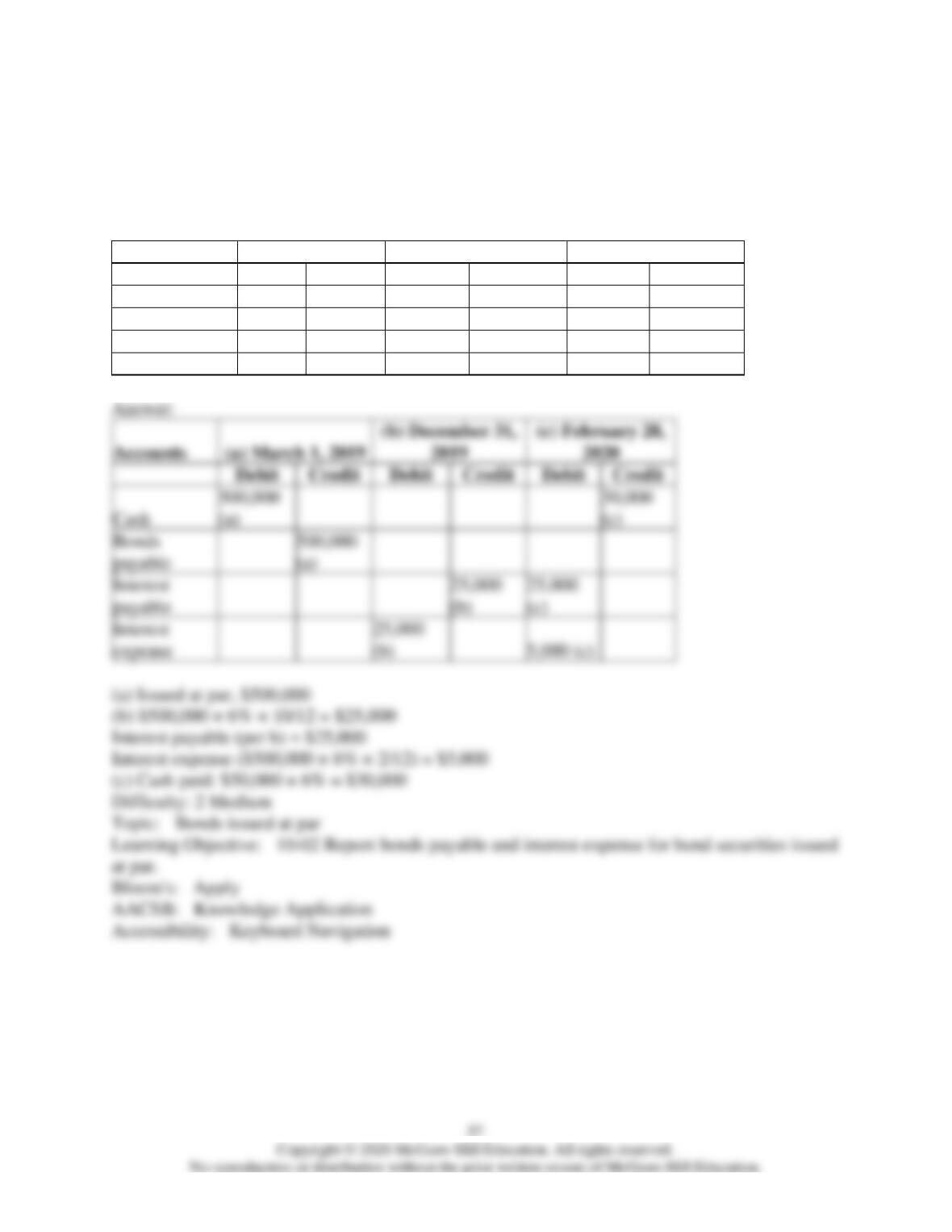
106) On March 1, 2019, Halbur Company, issued $500,000 of 6%, five-year bonds at par. The
bonds were dated March 1, 2019, and the first annual interest payment will be on February 28,
2020. The accounting period ends December 31. Assume no adjusting entries have been made
during the year.
Complete the journal entry grid for each of the following dates:
Accounts
(a) March 1, 2019
(b) December 31, 2019
(c) February 28, 2020
Debit
Credit
Debit
Credit
Debit
Credit
Cash
Bonds payable
Interest payable
Interest expense
Accounts
Credit
Credit
Cash
(a)
(c)
payable
(a)
payable
(b)
(c)
expense
(b)
5,000 (c)
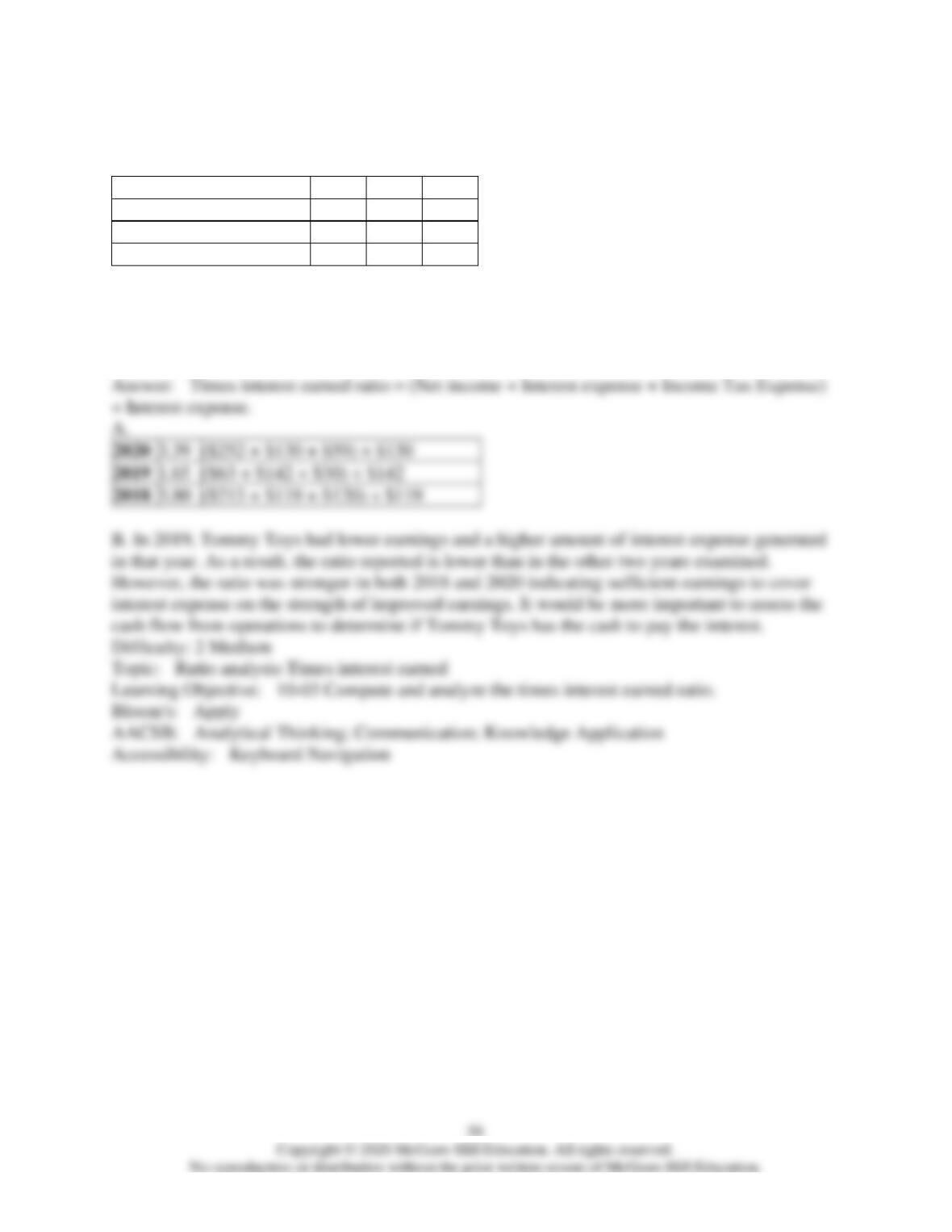
107) The following information was taken from the income statement of Tommy Toys for the
years 2018 through 2020 (in millions):
2020
2019
2018
Interest expense
$130
$142
$119
Income tax expense
$59
$30
$120
Net income (loss)
$252
$63
$213
A. Compute Tommy Toys times interest earned ratio for all three years. Round your answers to
two decimal places.
B. Briefly interpret the times interest earned ratio for the three years.
3.39
($252 + $130 + $59) ÷ $130
1.65
($63 + $142 + $30) ÷ $142
3.80
($213 + $119 + $120) ÷ $119
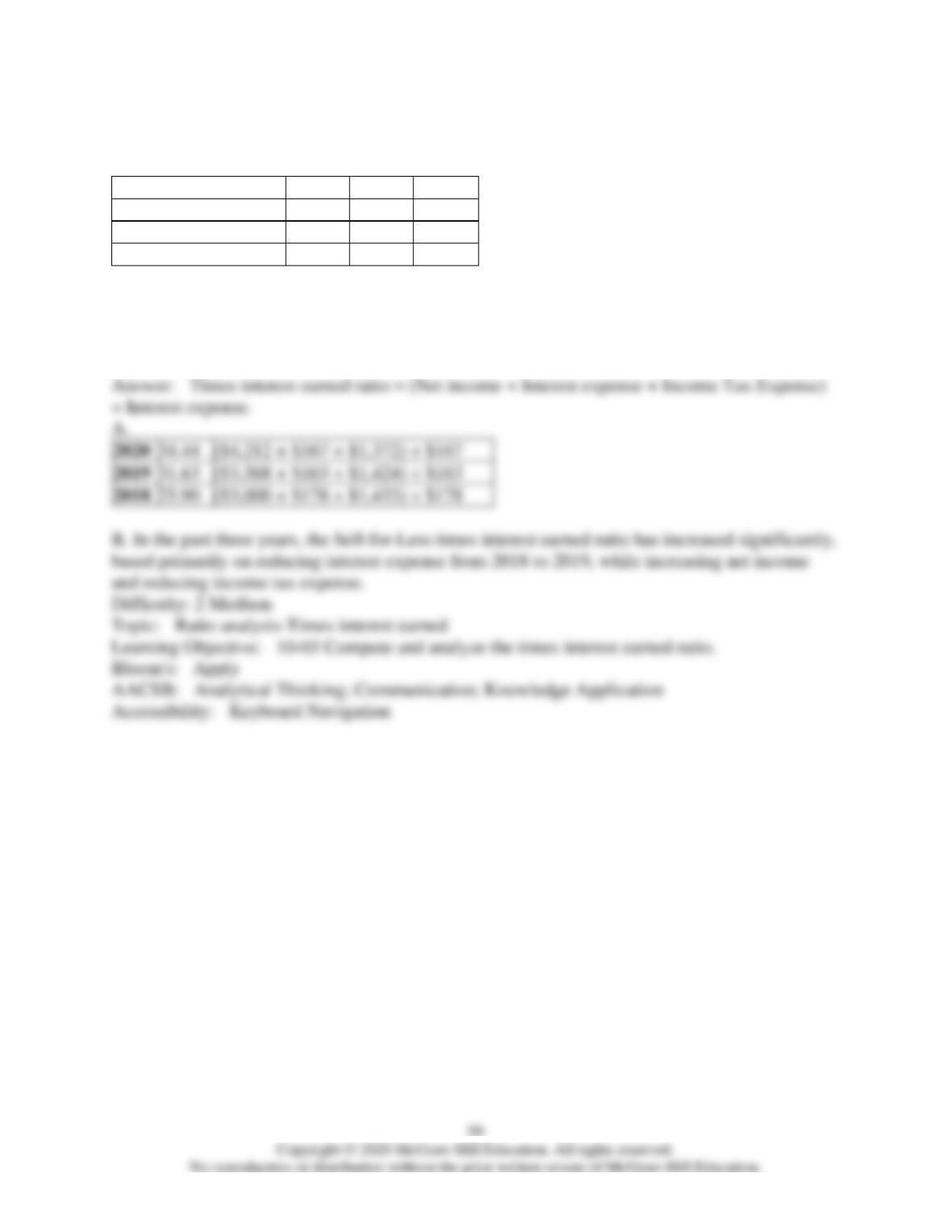
108) The following information is available for Sell-for-Less for the years 2018 through 2020 (in
millions):
2020
2019
2018
Interest expense
$167
$163
$178
Income tax expense
$1,372
$1,424
$1,433
Net income (loss)
$4,212
$3,568
$3,000
A. Compute the Sell-for-Less times interest earned ratio for 2020, 2019, and 2018. Round your
answers to two decimal places.
B. Briefly interpret the times interest earned ratio for the three years.
34.44
($4,212 + $167 + $1,372) ÷ $167
31.63
($3,568 + $163 + $1,424) ÷ $163
25.90
($3,000 + $178 + $1,433) ÷ $178
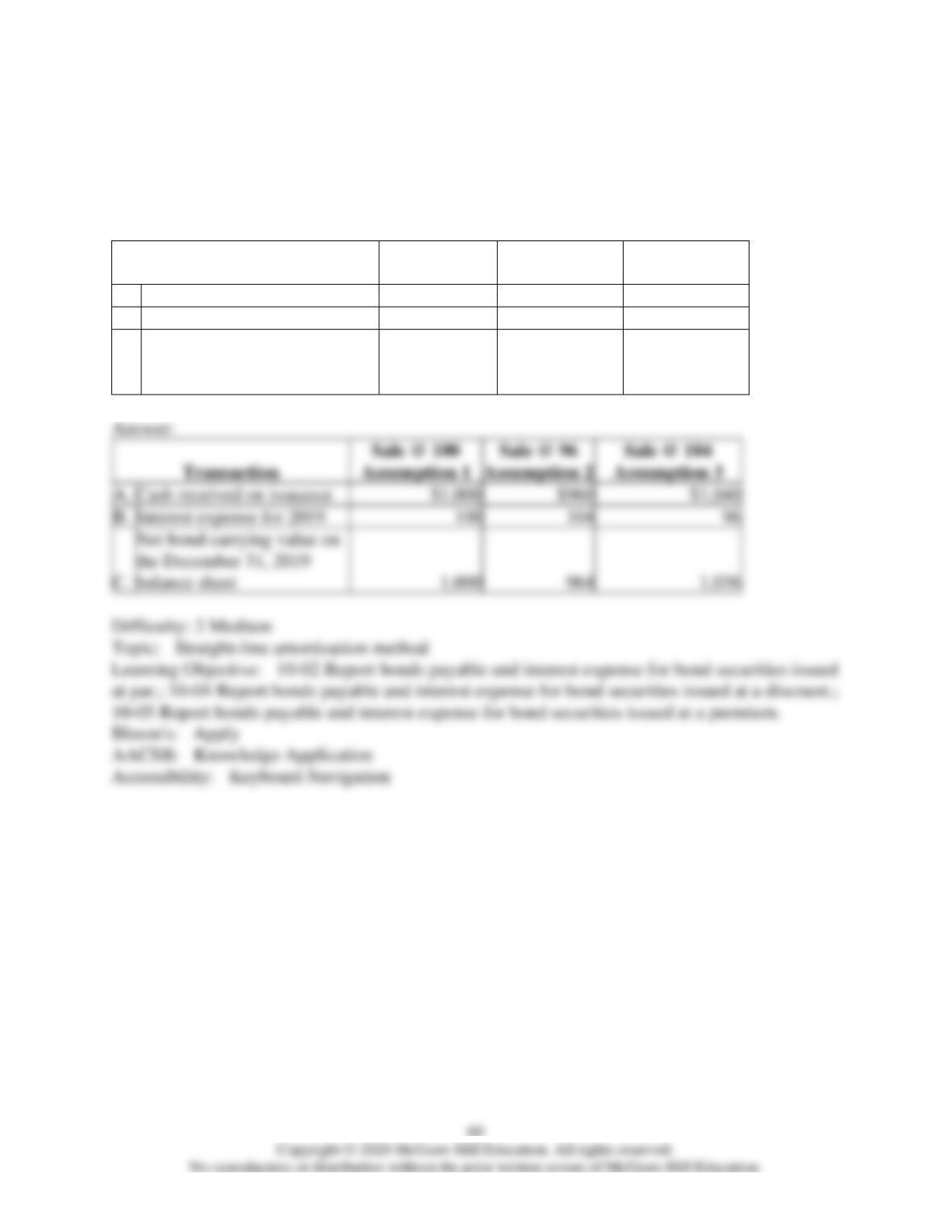
109) On January 1, 2019, Clintwood Company issued a $1,000, ten-year, 10% bond payable
(interest payable each December 31).
For the three assumptions below, complete the following schedule if the fiscal year end is
December 31, and straight-line amortization is used:
Transaction
Sale @ 100
Assumption 1
Sale @ 96
Assumption 2
Sale @ 104
Assumption 3
A.
Cash received on issuance
B.
Interest expense for 2019
C.
Net bond carrying value on the
December 31, 2019 balance
sheet
Sale @ 100
A.
Cash received on issuance
B.
Interest expense for 2019
C.
Net bond carrying value on
the December 31, 2019
balance sheet