163.
What is a lease? Explain the difference between an operating lease and a capital lease.
10-102
164.
Identify the advantages and disadvantages of bond financing.
165.
A corporation plans to invest $1 million in oil exploration. The corporation is considering
two plans to raise the money. Under Plan #1, bonds with a contract rate of interest of 6%
would be issued. Under Plan #2, 50,000 additional shares of common stock would be
issued at $20 per share. The corporation currently has 300,000 shares of stock
outstanding, and it expects to earn $700,000 per year before bond interest and income
taxes. The net income and return on investment for both plans is shown below:
Plan #1
Plan #2
Earnings before bond
interest and taxes
$700,000
$700,000
Bond interest expense
(60,000)
Income before taxes
$640,000
$700,000
Income taxes
(224,000)
(245,000)
Net income
$416,000
$455,000
Equity
$8,000,000
$9,000,000
Return on Equity
5.2%
5.06%
Comment on the relative effects of each alternative, including when one form of financing
is preferred to another.
166.
Describe the journal entries required to record the issuance of bonds at par and the
payment of bond interest.
167.
Describe the journal entries required to record the issuance of bonds at a premium and
the payment of bond interest, including any applicable amortization.
168.
Describe the journal entries required to record the issuance of bonds at a discount and the
payment of bond interest, including any applicable amortization.
169.
Explain the amortization of a bond discount. Identify and describe the two amortization
methods available.
170.
Explain how to record the issuance and sale of a bond between interest payment dates.
171.
Explain the accounting procedures when a bond’s interest period does not coincide with
the issuer’s accounting period.
172.
How are bond issue prices determined?
173.
Explain the amortization of a bond premium. Identify and describe the two amortization
methods available.
174.
What are methods that a company may use to retire its bonds?
175.
Describe the recording procedures for the issuance, retirement, and paying of interest for
installment notes.
176.
Zhang Company has a loan agreement that provides it with cash today, and the company
must pay $25,000 4 years from today. Zhang agrees to a 6% interest rate. The present
value factor for 4 periods at 6% is 0.7921. What is the amount of cash that Zhang
Company receives today?
177.
Wasp Corporation has a loan agreement that provides it with cash today, and the company
must pay $25,000 one year from today, $15,000 two years from today, and $5,000 three
years from today. Wasp agrees to pay 10% interest. The following are factors from a
present value table:
Periods
Interest rate 10%
1
0.9091
2
0.8264
3
0.7513
Periods
Payments
1
2
3
What is the amount of cash that Wasp receives today?
178.
A company enters into an agreement to make 5 annual year-end payments of $3,000 each,
starting one year from now. The annual interest rate is 6%. The present value of an
annuity factor for 5 periods at 6% is 4.2124. What is the present value of these five future
payments?
179.
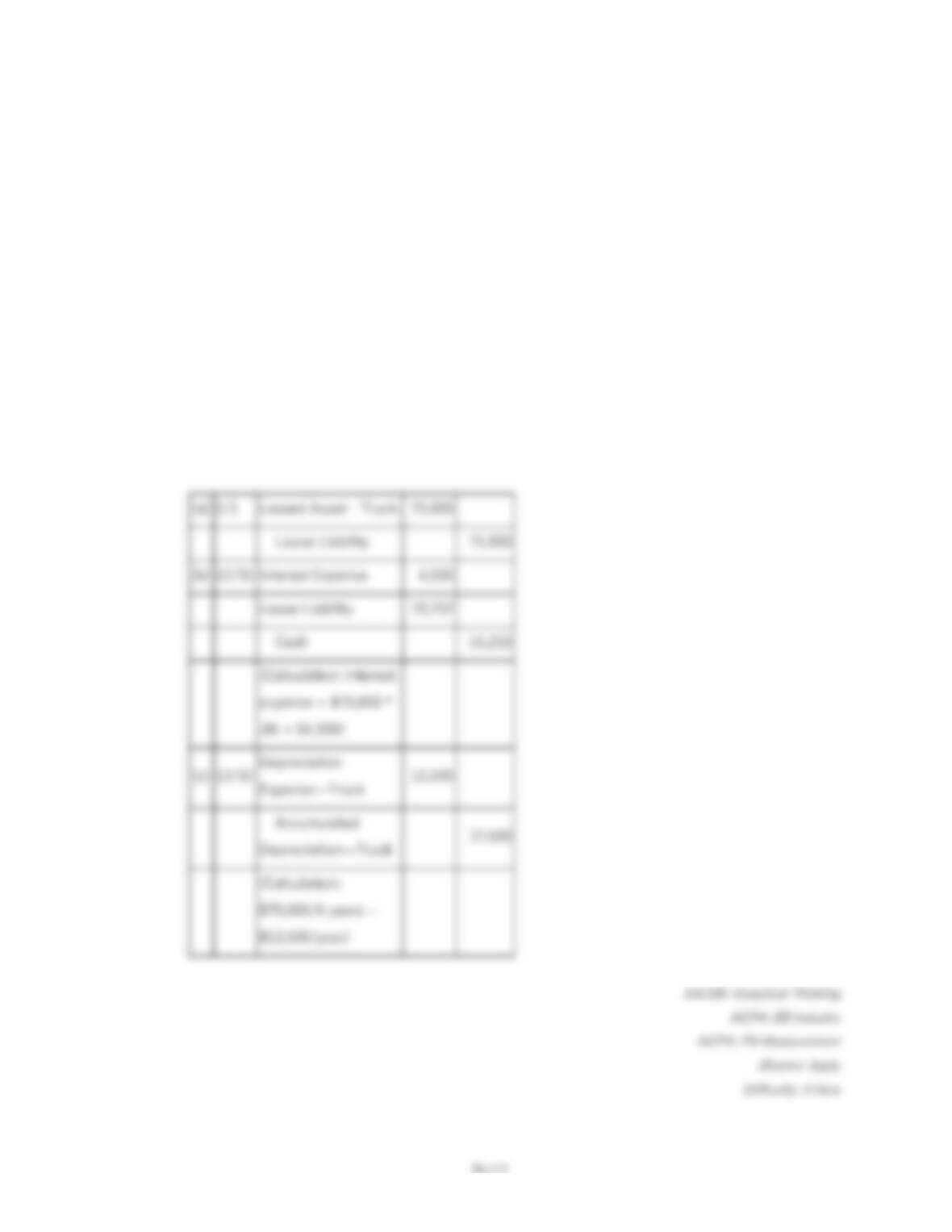
On January 1, the Rodrigues Corporation leased some equipment on a 2-year lease, paying
$15,000 per year each December 31. The lease is considered to be an operating lease.
Prepare the general journal entry to record the first lease payment on December 31.
180.
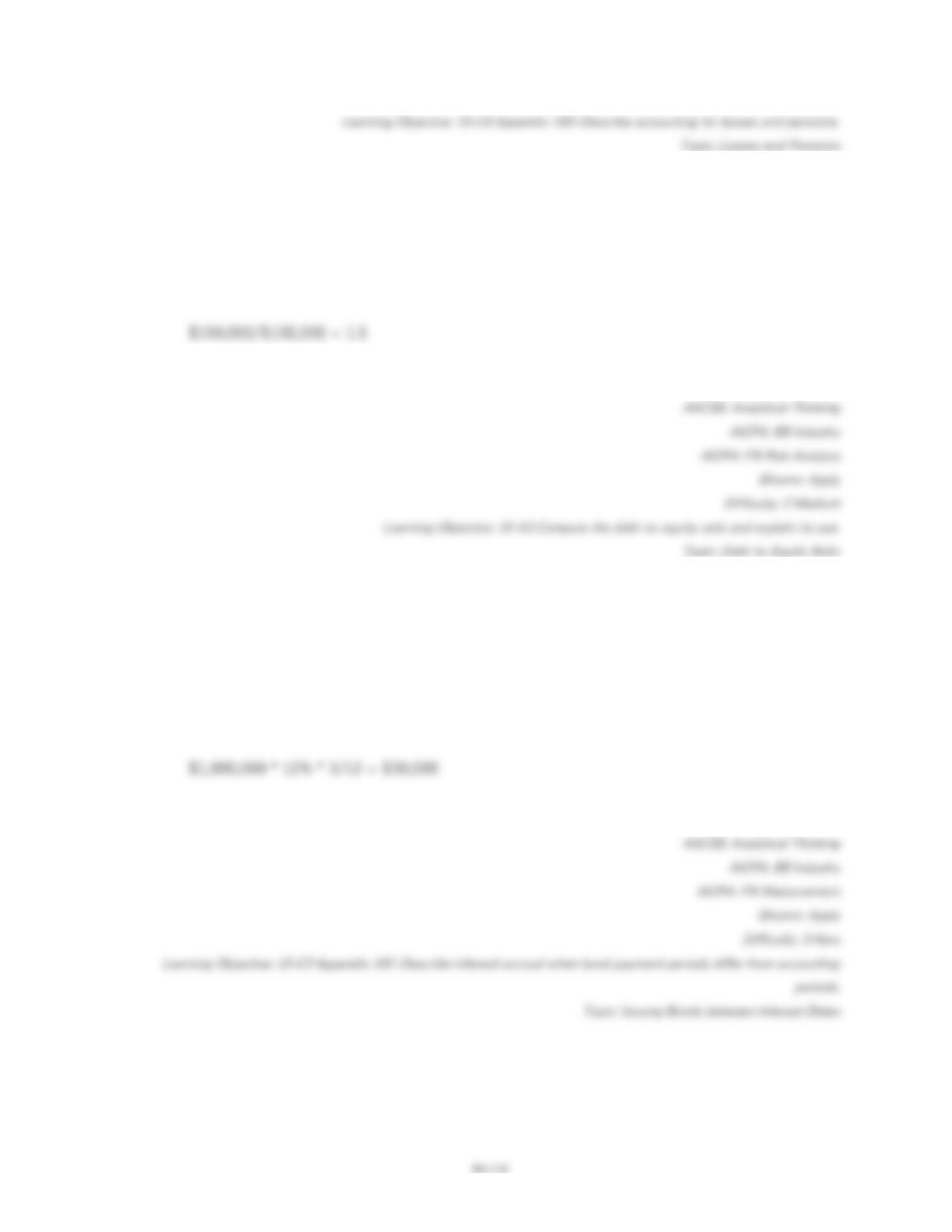
On January 1, Haymark Corporation leased a truck, agreeing to pay $15,252 every
December 31 for the six-year life of the lease. The present value of the lease payments, at
6% interest, is $75,000. The lease is considered a capital lease.
(a) Prepare the general journal entry to record the acquisition of the truck with the capital
lease.
(b) Prepare the general journal entry to record the first lease payment on December 31.
(c) Record straight-line depreciation on the truck on December 31, assuming a 6-year life
and no salvage value.
181.
Sharma Company’s balance sheet reflects total assets of $250,000 and total liabilities of
$150,000. Calculate the company’s debt–to-equity ratio.
182.
On October 1 of the current year a corporation issued (sold) $1,000,000 of its 12% bonds
at par plus accrued interest. The bonds were dated July 1 of this year. What amount of
bond interest expense should the company report on its current year income statement?
183.
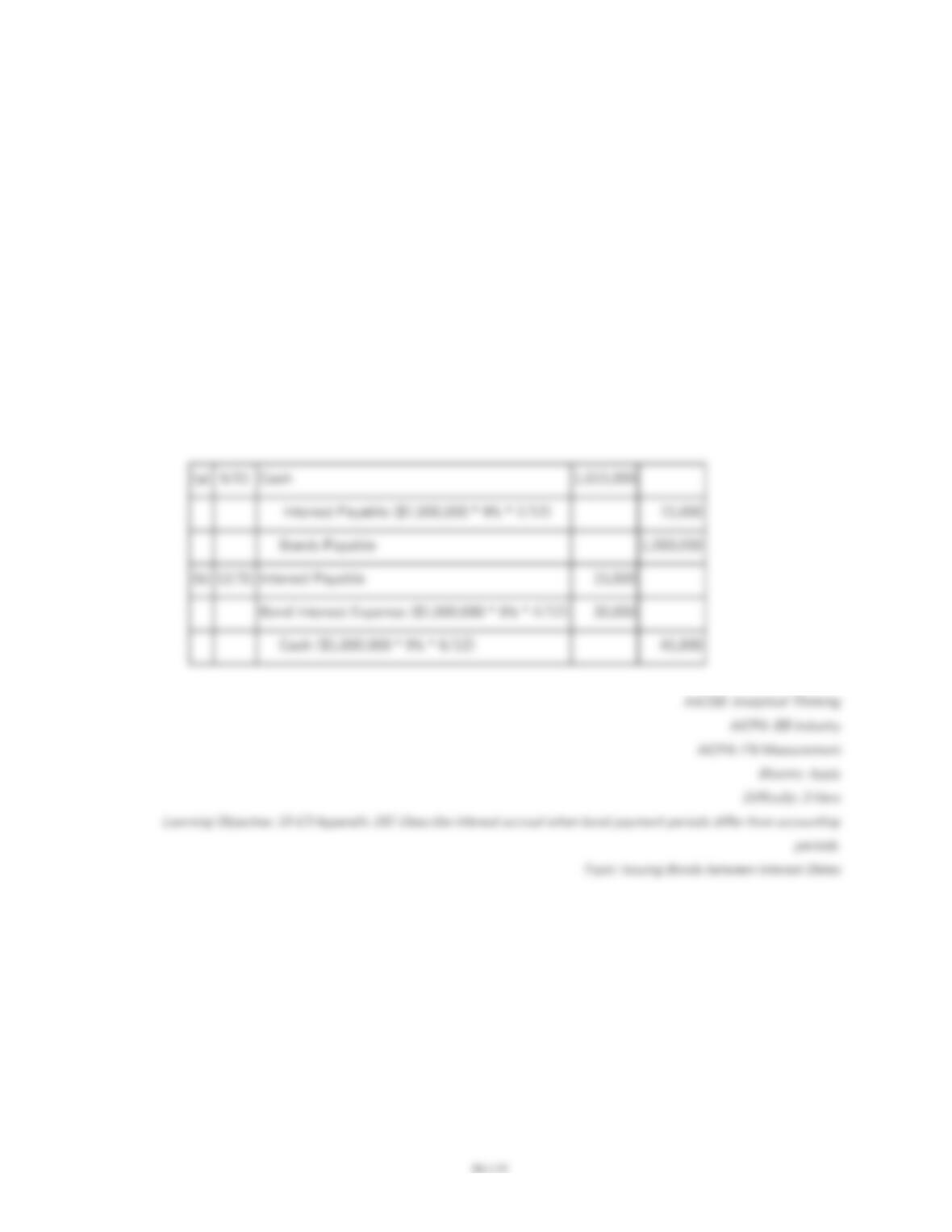
A company issued 9%, 10-year bonds with a par value of $1,000,000 on September 1, Year
1 when the market rate was 9%. The bonds were dated June 30, Year 1. The bond issue
price included accrued interest. Interest is paid semiannually on December 31 and June
30.
(a) Prepare the issuer’s journal entry to record the issuance of the bonds on September 1.
(b) Prepare the issuer’s journal entry to record the semiannual interest payment on
December 31, Year 1.
184.
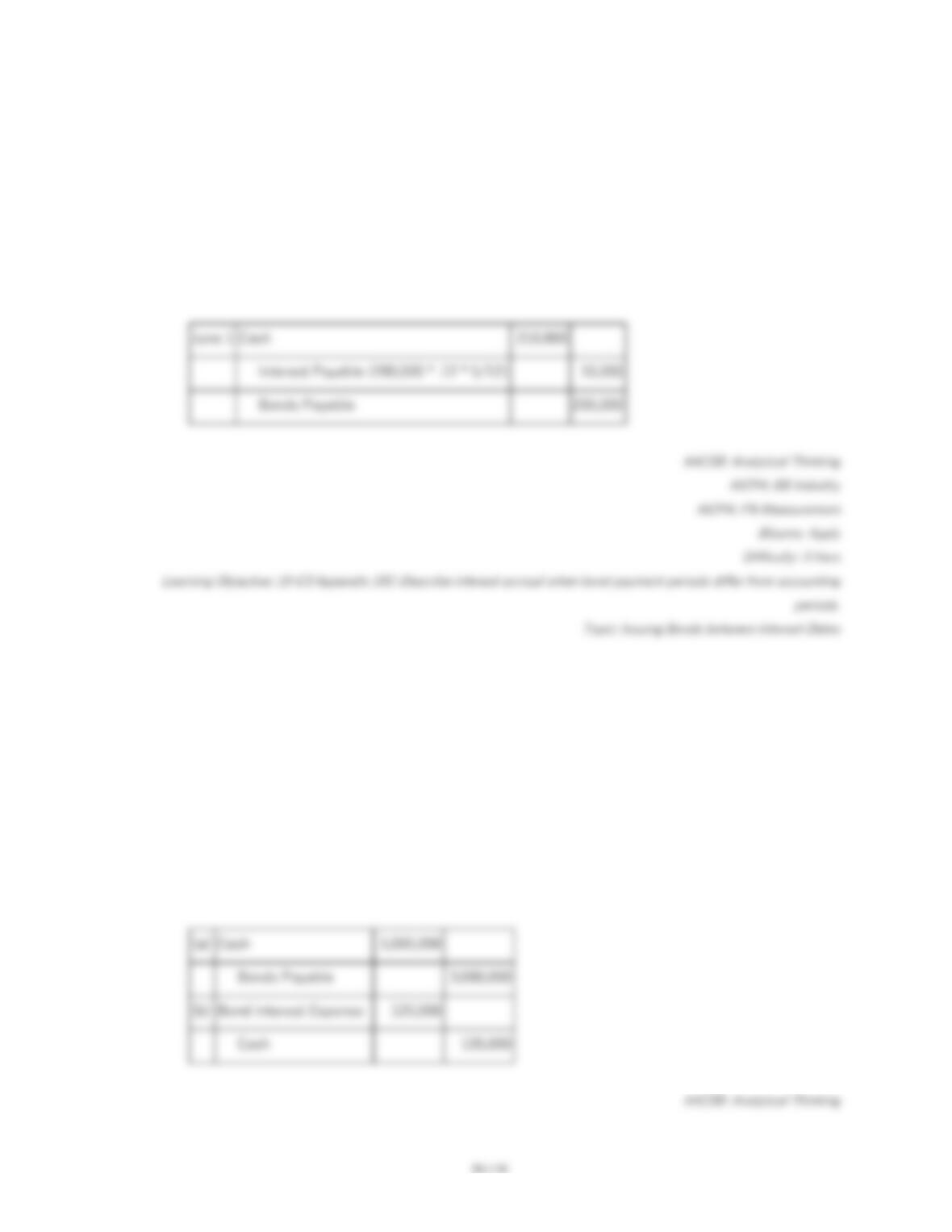
On June 1, a company issued $200,000 of 12% bonds at their par value plus accrued
interest. The interest on these bonds is payable semiannually on January 1 and July 1.
Prepare the issuer’s journal entry to record the bond issuance of June 1.
185.
Johanna Corporation issued $3,000,000 of 8%, 20-year bonds payable at par value on
January 1. Interest is payable each June 30 and December 31.
(a) Prepare the general journal entry to record the issuance of the bonds on January 1.
(b) Prepare the general journal entry to record the first interest payment on June 30.
186.
A company issued 9%, 10-year bonds with a par value of $100,000. Interest is paid
semiannually. The market interest rate on the issue date was 10%, and the issuer received
$95,016 cash for the bonds. On the first semiannual interest date, what amount of cash
should be paid to the holders of these bonds for interest?
187.
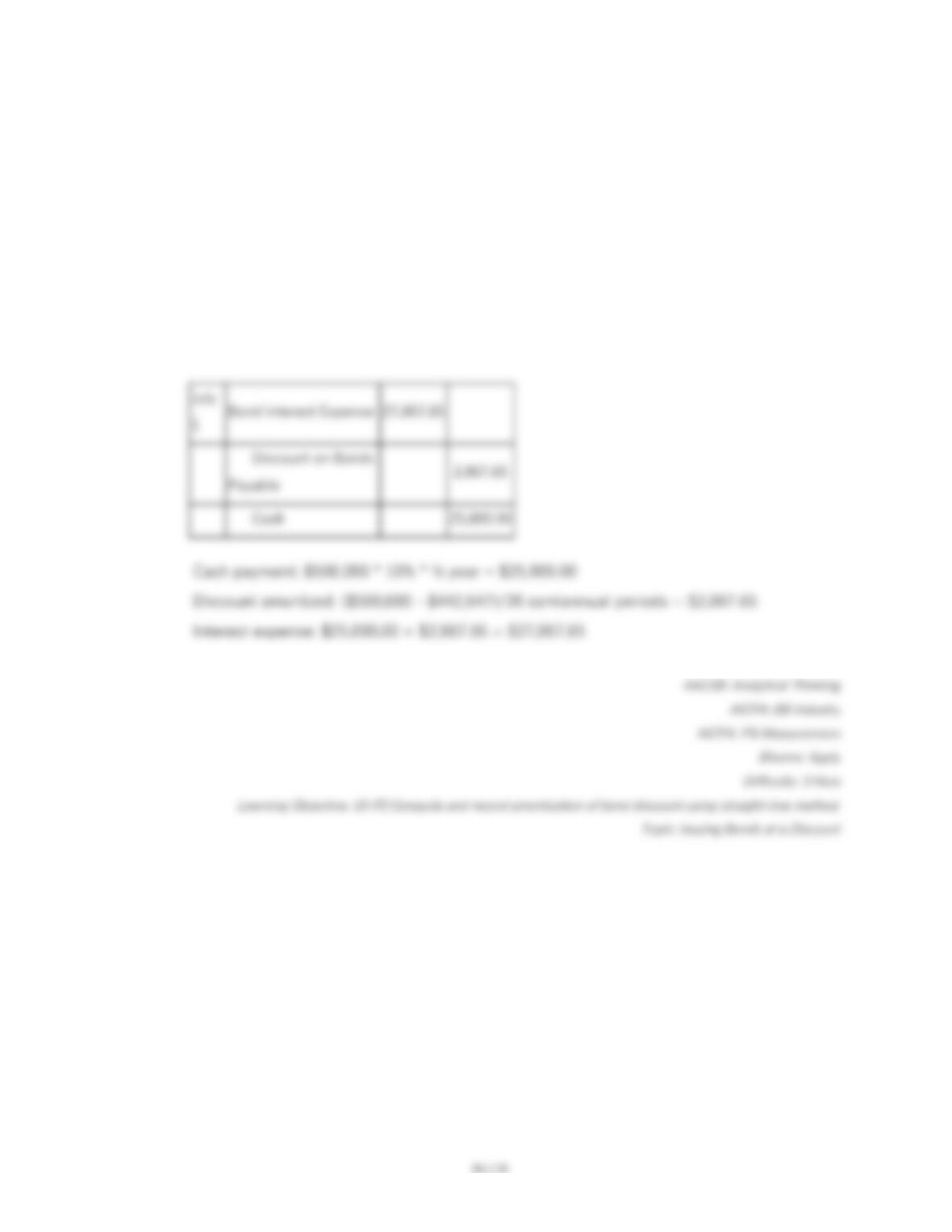
On January 1, a company issued 10-year, 10% bonds payable with a par value of $500,000,
and received $442,647 in cash proceeds. The market rate of interest at the date of
issuance was 12%. The bonds pay interest semiannually on July 1 and January 1. The
issuer uses the straight-line method for amortization. Prepare the issuer’s journal entry to
record the first semiannual interest payment on July 1.
188.
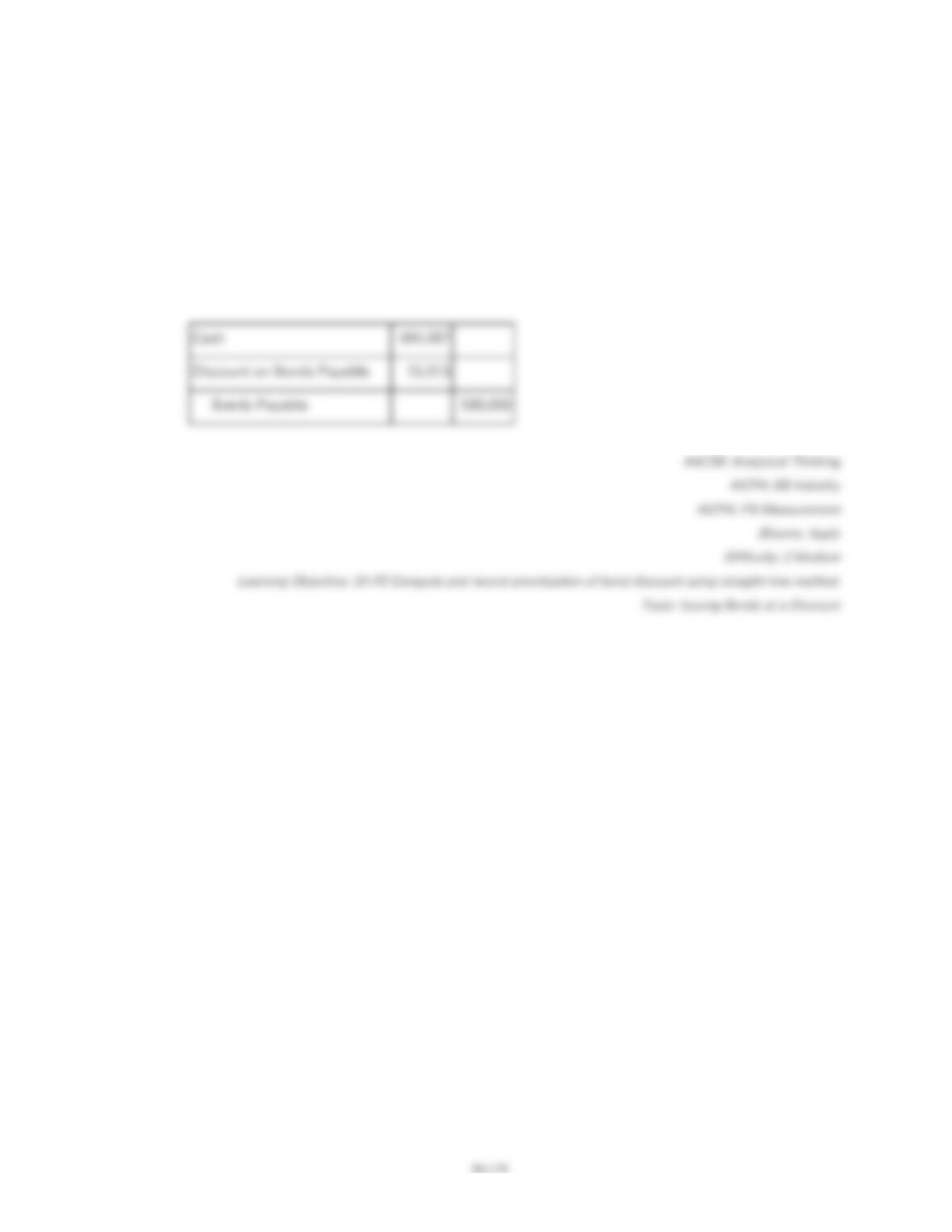
A company issued 10-year, 9% bonds, with a par value of $500,000 when the market rate
was 9.5%. The issuer received $484,087 in cash proceeds. Prepare the issuer’s journal
entry to record the bond issuance.
189.
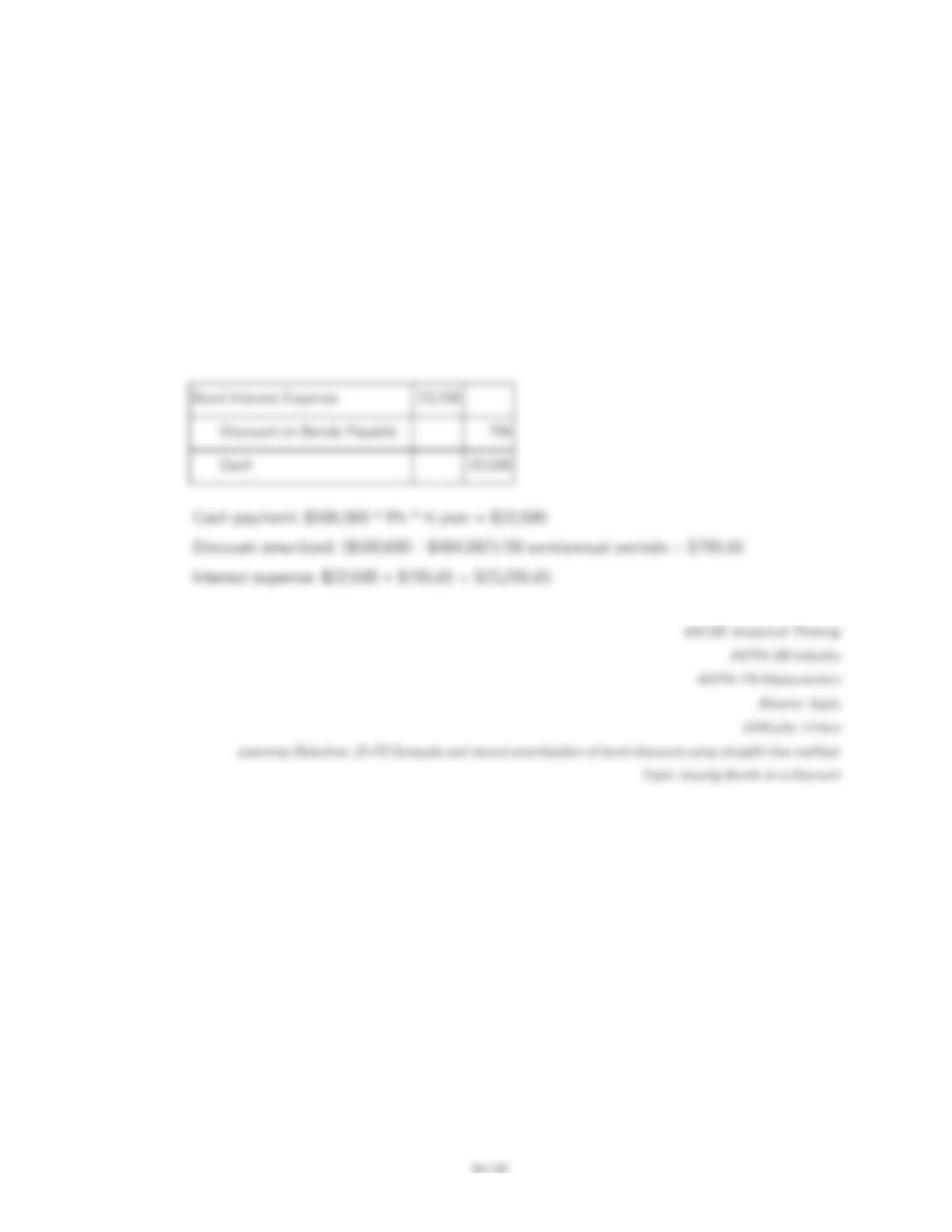
A company issued 10-year, 9% bonds with a par value of $500,000 when the market rate
was 9.5%. The company received $484,087 in cash proceeds. Using the straight-line
method, prepare the issuer’s journal entry to record the first semiannual interest payment
and the amortization of any bond discount or premium. (Round amounts to the nearest
whole dollar)