89.
Which of the following statements is true?
90.
A bondholder that owns a $1,000, 10%, 10-year bond has:
91.
Collateral agreements for a note or bond can:
92.
The party that has the right to exercise a call option on callable bonds is:
93.
Which of the following accurately describes a debenture?
94.
A company’s total liabilities divided by its total stockholders’ equity is called the:
95.
The debt-to–equity ratio:
96.
Charger Company’s most recent balance sheet reports total assets of $27,000,000, total
liabilities of $15,000,000 and total equity of $12,000,000. The debt to equity ratio for the
period is (rounded to two decimals):
97.
Seedly Corporation’s most recent balance sheet reports total assets of $35,000,000 and
total liabilities of $17,500,000. Management is considering issuing $5,000,000 of par value
bonds (at par) with a maturity date of ten years and a contract rate of 7%. What effect, if
any, would issuing the bonds have on the company’s debt–to–equity ratio?
98.
Saffron Industries most recent balance sheet reports total assets of $42,000,000, total
liabilities of $16,000,000 and stockholders’ equity of $26,000,000. Management is
considering using $3,000,000 of excess cash to prepay $3,000,000 of outstanding bonds.
What effect, if any, would prepaying the bonds have on the company’s debt–to–equity
ratio?
99.
A bond is issued at par value when:
100.
When a bond sells at a premium:
101.
A bond sells at a discount when the:
102.
Morgan Company issues 9%, 20-year bonds with a par value of $750,000 that pay interest
semi-annually. The current market rate is 8%. The amount of interest owed to the
bondholders for each semiannual interest payment is:
103.
A company issued 8%, 15-year bonds with a par value of $550,000 that pay interest semi–
annually. The current market rate is 8%. The journal entry to record each semiannual
interest payment is:
104.
On January 1 of 2015, Parson Freight Company issues 7%, 10-year bonds with a par value
of $2,000,000. The bonds pay interest semi-annually. The market rate of interest is 8% and
the bond selling price was $1,864,097. The bond issuance should be recorded as:
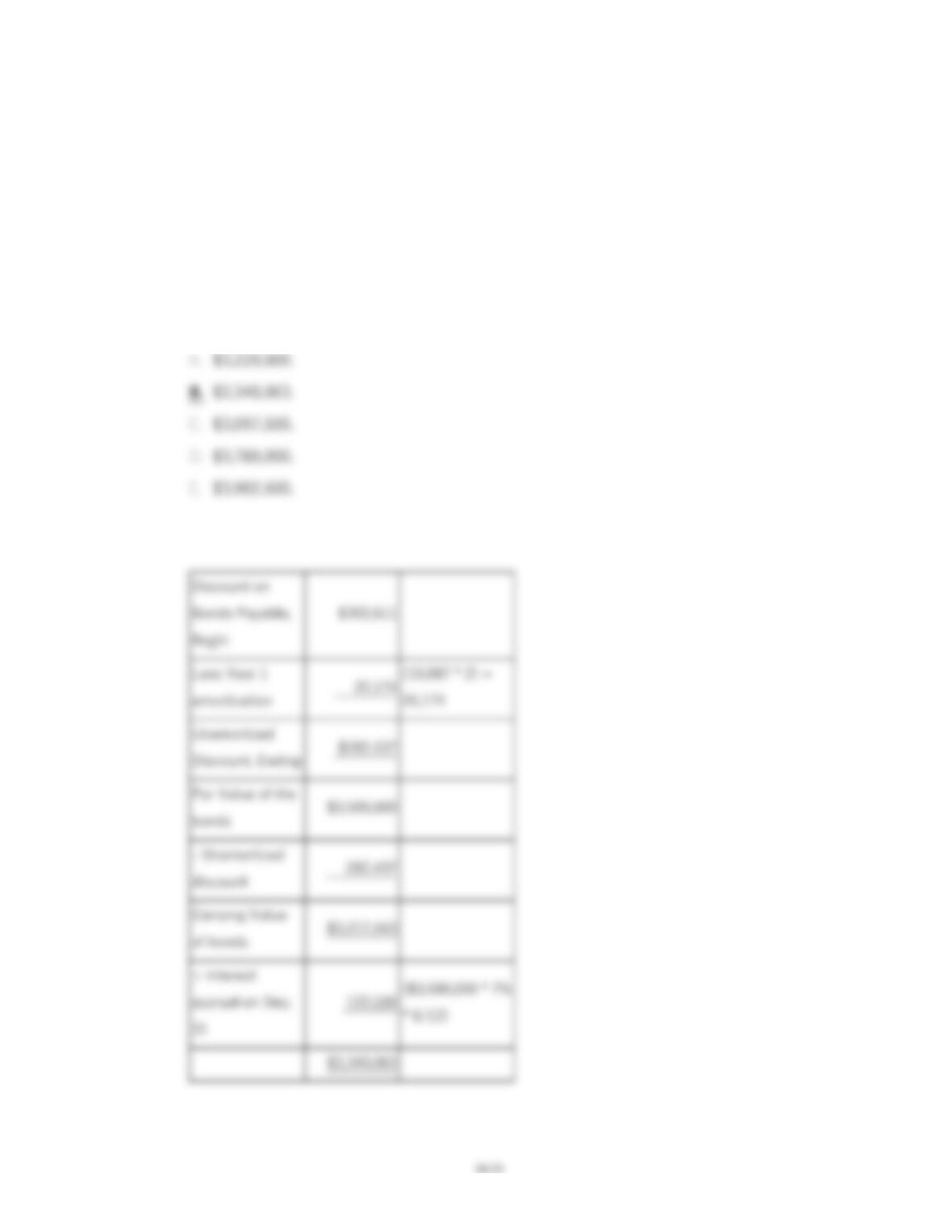
105.
On January 1 of Year 1, Congo Express Airways issued $3,500,000 of 7% bonds that pay
interest semiannually on January 1 and July 1. The bond issue price is $3,197,389 and the
market rate of interest for similar bonds is 8%. The bond premium or discount is being
amortized at a rate of $10,087 every six months. The company’s December 31, Year 1
balance sheet should reflect total liabilities associated with the bond issue in the amount
of:
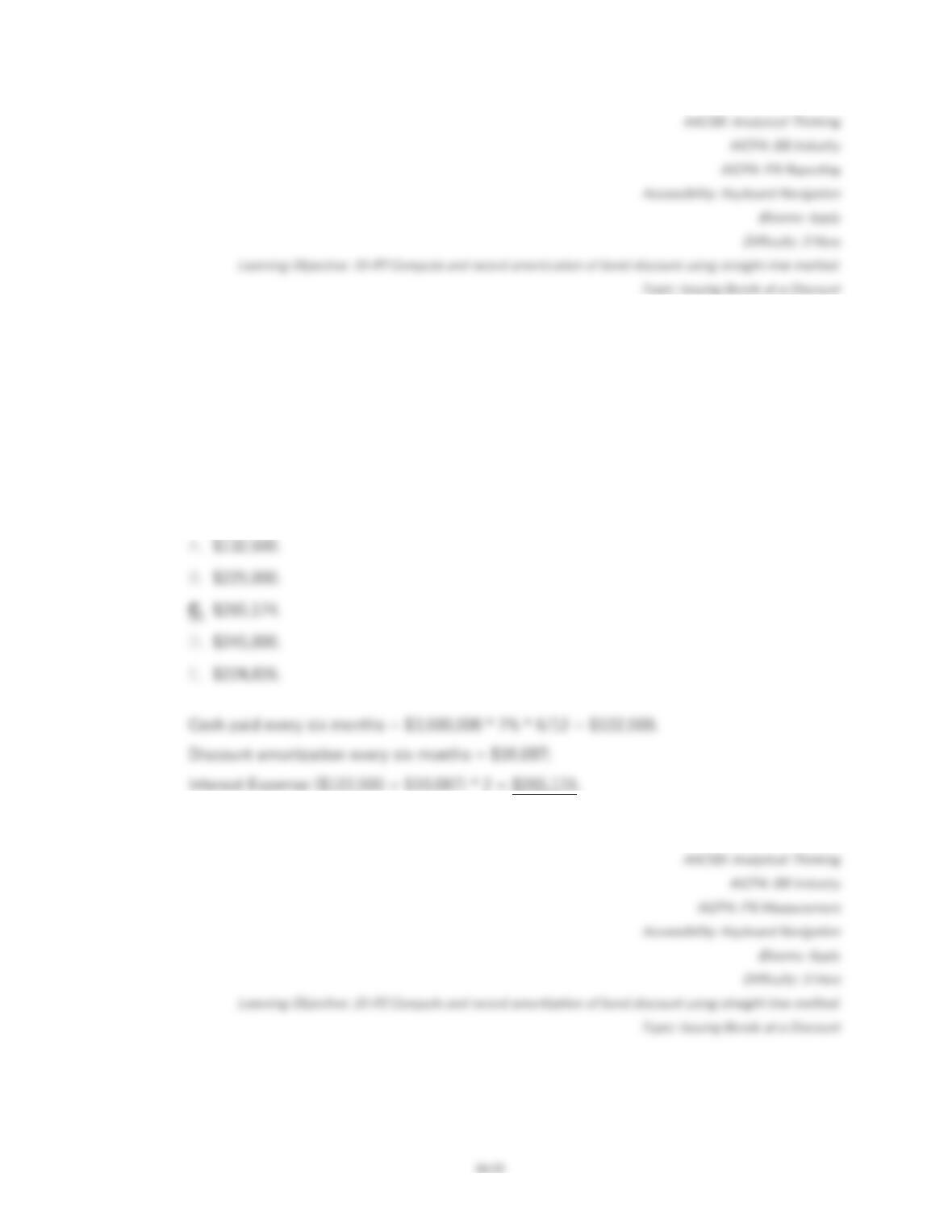
106.
On January 1 of Year 1, Congo Express Airways issued $3,500,000 of 7% bonds that pay
interest semiannually on January 1 and July 1. The bond issue price is $3,197,389 and the
market rate of interest for similar bonds is 8%. The bond premium or discount is being
amortized at a rate of $10,087 every six months. The amount of interest expense
recognized by Congo Express Airways on the bond issue in Year 1 would be:
107.
On January 1 of Year 1, Congo Express Airways issued $3,500,000 of 7%, bonds that pay
interest semiannually on January 1 and July 1. The bond issue price is $3,197,389 and the
market rate of interest for similar bonds is 8%. The bond premium or discount is being
amortized using the straight-line method at a rate of $10,087 every six months. The life of
these bonds is:
108.
Amortizing a bond discount:
109.
The Discount on Bonds Payable account is a(n):
110.
A discount on bonds payable:
111.
On January 1, a company issued and sold a $400,000, 7%, 10-year bond payable, and
received proceeds of $396,000. Interest is payable each June 30 and December 31. The
company uses the straight-line method to amortize the discount. The journal entry to
record the first interest payment is:
112.
A company issued 10-year, 7% bonds with a par value of $100,000. The company received
$96,526 for the bonds. Using the straight-line method, the amount of interest expense for
the first semiannual interest period is:
113.
The effective interest amortization method:
114.
A company issued 7%, 5-year bonds with a par value of $100,000. The market rate when
the bonds were issued was 7.5%. The company received $97,947 cash for the bonds.
Using the effective interest method, the amount of interest expense for the first
semiannual interest period is:
115.
The issue price of a bond is equal to:
116.
The Premium on Bonds Payable account is a(n):
117.
Adonis Corporation issued 10-year, 8% bonds with a par value of $200,000. Interest is paid
semiannually. The market rate on the issue date was 7.5%. Adonis received $206,948 in
cash proceeds. Which of the following statements is true?
118.
A company received cash proceeds of $206,948 on a bond issue with a par value of
$200,000. The difference of $6,948 between par value and issue price for this bond is
recorded as a: