
Name:
Class:
Date:
chapter 10
Indicate whether the statement is true or false.
1. Capital expenditures are costs that are charged to stockholders’ equity accounts.
a.
True
b.
False
2. The difference between the balance in a fixed asset account and its related accumulated depreciation account is the
asset’s book value.
a.
True
b.
False
3. Functional depreciation occurs when a fixed asset is no longer able to provide services at the level for which it was
intended.
a.
True
b.
False
4. The double-declining-balance depreciation method computes depreciation each year by taking twice the straight-line
rate times the book value of the asset at the beginning of each year.
a.
True
b.
False
5. The double-declining-balance method of depreciation uses a declining percentage rate in determining the depreciation
amount.
a.
True
b.
False
6. The cost of replacing an engine in a truck is an example of ordinary maintenance.
a.
True
b.
False
7. Land acquired as a speculation is reported under Investments on the balance sheet.
a.
True
b.
False
8. Residual value is not incorporated in the initial computations for double-declining-balance depreciation.
a.
True
b.
False
9. Regardless of the depreciation method, the amount that will be depreciated during the life of the asset will be the same.
a.
True
b.
False
10. When depreciation estimates are revised, all years of the asset’s life are affected.
a.
True
b.
False

Name:
Class:
Date:
chapter 10
11. An exchange of similar assets is said to have commercial substance if future cash flows change as a result of the
exchange.
a.
True
b.
False
12. The book value of a fixed asset reported on the balance sheet represents its market value on that date.
a.
True
b.
False
13. An asset leased under an operating lease will appear on the balance sheet as a long-term asset.
a.
True
b.
False
14. An estimate of the amount for which an asset can be sold at the end of its useful life is called residual value.
a.
True
b.
False
15. The normal balance of the accumulated depreciation account is a debit.
a.
True
b.
False
16. When exchanging equipment, if the trade-in allowance is greater than the book value, a loss results.
a.
True
b.
False
17. Patents are exclusive rights to produce and sell goods with one or more unique features.
a.
True
b.
False
18. When a company establishes an outstanding reputation and has a competitive advantage because of it, the company
should record goodwill on its financial statements.
a.
True
b.
False
19. Standby equipment held for use in the event of a breakdown of regular equipment is reported as property, plant, and
equipment on the balance sheet.
a.
True
b.
False
20. The acquisition costs of property, plant, and equipment should include all normal, reasonable and necessary costs to
get the asset in place and ready for use.
a.
True
b.
False
21. It is necessary for a company to use the same depreciation method for all of its depreciable assets.
a.
True

Name:
Class:
Date:
chapter 10
b.
False
22. Long-lived assets held for sale are classified as fixed assets.
a.
True
b.
False
23. Expenditures that increase operating efficiency or capacity for the remaining useful life of a fixed asset are called
capital expenditures.
a.
True
b.
False
24. Both the initial cost of the asset and the accumulated depreciation will be taken off the books with the disposal of the
asset.
a.
True
b.
False
25. During construction of a building, the cost of interest on a construction loan should be charged to an expense account.
a.
True
b.
False
26. The cost of new equipment is called a revenue expenditure because it will help generate revenues in the future.
a.
True
b.
False
27. The cost of computer equipment does not include the consultant’s fee to supervise installation of the equipment.
a.
True
b.
False
28. Capital expenditures are costs that improve a fixed asset or extend its useful life.
a.
True
b.
False
29. Once the useful life of a depreciable asset has been estimated and the amount to be depreciated each year has been
determined, the amounts cannot be changed.
a.
True
b.
False
30. When land is purchased to construct a new building, the cost of removing any structures on the land should be charged
to the building account.
a.
True
b.
False
31. The amount of depreciation expense for a fixed asset costing $95,000, with an estimated residual value of $5,000 and
a useful life of 5 years or 20,000 operating hours, is $21,375 by the units-of-activity method during a period when the
asset was used for 4,500 hours.
a.
True

Name:
Class:
Date:
chapter 10
b.
False
32. Minerals removed from the earth are classified as intangible assets.
a.
True
b.
False
33. The cost of repairing damage to a machine during installation is debited to a fixed asset account.
a.
True
b.
False
34. When a plant asset is traded for another similar asset, losses on the asset traded are not recognized.
a.
True
b.
False
35. If a fixed asset with a book value of $10,000 is traded for a similar fixed asset, a trade-in allowance of $15,000 is
granted by the seller, and the transaction is deemed to have commercial substance, the buyer would report a gain on
exchange of fixed assets of $5,000.
a.
True
b.
False
36. It is not necessary for a company to use the same depreciation method for all of its fixed assets.
a.
True
b.
False
37. The amount of the depreciation expense for the second full year of use of a fixed asset costing $100,000, with an
estimated residual value of $5,000 and a useful life of 4 years, is $25,000 by the double-declining-balance method.
a.
True
b.
False
38. Losses on the discarding of fixed assets are reported on the income statement.
a.
True
b.
False
39. Revising depreciation estimates affects the amounts of depreciation expense recorded in past periods.
a.
True
b.
False
40. The transfer to expense of the cost of intangible assets attributed to the passage of time or decline in usefulness is
called amortization.
a.
True
b.
False
41. The double-declining-balance method is an accelerated depreciation method.
a.
True
b.
False

Name:
Class:
Date:
chapter 10
42. When a seller allows a buyer an amount for old equipment that is traded in for new equipment of similar use, this
amount is known as boot.
a.
True
b.
False
43. The depreciable cost of a building is the same as its acquisition cost.
a.
True
b.
False
44. The cost of a patent with a remaining legal life of 10 years and an estimated useful life of 7 years is amortized over 10
years.
a.
True
b.
False
45. A tangible asset is one that lacks physical existence.
a.
True
b.
False
46. The journal entry for the disposal of fixed assets will include a credit to Accumulated Depreciation.
a.
True
b.
False
47. All property, plant, and equipment assets are depreciated over time.
a.
True
b.
False
48. Though a piece of equipment is still being used, the equipment should be removed from the accounts if it has been
fully depreciated.
a.
True
b.
False
49. The method used to compute the depletion of a natural resource is the straight-line method.
a.
True
b.
False
50. Costs associated with normal research and development activities should be treated as intangible assets.
a.
True
b.
False
51. A gain can be realized when a fixed asset is discarded.
a.
True
b.
False
52. When selling a piece of equipment for cash, a loss will result when the proceeds of the sale are less than the book
value of the asset.
a.
True

Name:
Class:
Date:
chapter 10
b.
False
53. As a company records depreciation expense for a period of time, cash is accumulated to replace fixed assets as they
wear out.
a.
True
b.
False
54. The units-of-activity depreciation method provides a good match of expenses against revenue.
a.
True
b.
False
55. Intangible assets differ from property, plant, and equipment assets in that they lack physical substance.
a.
True
b.
False
56. Long-lived assets that are intangible in nature, used in the operations of the business, and not held for sale in the
ordinary course of business are called fixed assets.
a.
True
b.
False
57. When old equipment is traded in for new equipment, the difference between the list price and the trade-in allowance is
called boot.
a.
True
b.
False
58. The amount of depreciation expense for the first full year of use of a fixed asset costing $95,000, with an estimated
residual value of $5,000 and a useful life of 5 years, is $19,000 by the straight-line method.
a.
True
b.
False
59. An exchange is said to have commercial substance if future cash flows remain the same as a result of the exchange.
a.
True
b.
False
Indicate the answer choice that best completes the statement or answers the question.
60. An asset was purchased for $120,000 on January 1, Year 1 and originally estimated to have a useful life of 10 years
with a residual value of $10,000. At the beginning of the third year, it was determined that the remaining useful life of the
asset was only 4 years with a residual value of $2,000. Compute the third-year depreciation expense using the revised
amounts and straight-line method.
a.
$25,000
b.
$11,000
c.
$24,000
d.
$24,500
61. The term applied to the amount of cost to transfer to expense resulting from a decline in the utility of intangible assets

Name:
Class:
Date:
chapter 10
a.
amortization
b.
depletion
c.
depreciation
d.
allocation
62. A machine with a cost of $75,000 has an estimated residual value of $5,000 and an estimated life of 4 years or 18,000
hours. What is the amount of depreciation for the second full year, using the double-declining-balance method?
a.
$17,500
b.
$37,500
c.
$18,750
d.
$16,667
63. The name, term, or symbol used to identify a business and its products is called
a.
goodwill
b.
a patent
c.
a trademark
d.
a copyright
64. Sands Company purchased mining rights for $500,000. It expects to harvest 1 million tons of ore over the next 5
years. During the current year, Sands mined 350,000 tons of ore. The journal entry for the depletion would include a
a.
debit to Depletion Expense for $175,000
b.
credit to Depletion Expense for $350,000
c.
debit to Accumulated Depletion for $175,000
d.
credit to Accumulated Depletion for $350,000
65. Bacon Company acquired new machinery with a price of $15,200 by trading in similar old machinery and paying
$12,700. The old machinery originally cost $9,000 and had accumulated depreciation of $5,000. In recording this
transaction, Bacon Company should record
a.
the new machinery at $16,700
b.
the new machinery at $12,700
c.
a gain of $1,500
d.
a loss of $1,500
66. A fixed asset with a cost of $41,000 and accumulated depreciation of $36,000 is traded for a similar asset priced at
$50,000 (fair market value) in a transaction with commercial substance. Assuming a trade-in allowance of $4,000, at what
cost will the new equipment be recorded in the books?
a.
$54,000
b.
$45,000
c.
$51,000
d.
$50,000
67. Fixed assets are ordinarily presented on the balance sheet
a.
at current market values
b.
at replacement costs
c.
at cost less accumulated depreciation

Name:
Class:
Date:
chapter 10
d.
in a separate section along with intangible assets
68. Which intangible assets are amortized over their useful life?
a.
trademarks
b.
goodwill
c.
patents
d.
All of these choices
69. A capital expenditure results in a debit to a(n)
a.
expense account
b.
capital account
c.
liability account
d.
asset account
70. Expected useful life is
a.
computed when the asset is sold
b.
estimated at the time that the asset is placed in service
c.
determined each year that the depreciation computation is made
d.
of no bearing on the depreciation computation
71. The formula for annual depreciation using the units-of-activity method is
a.
(Initial Cost ÷ Estimated Output) × Actual Yearly Output
b.
(Depreciable Cost ÷ Yearly Output) × Estimated Output
c.
Depreciable Cost ÷ Yearly Output
d.
(Depreciable Cost ÷ Estimated Output) × Actual Yearly Output
72. When a company discards machinery that is fully depreciated, this transaction would be journalized as a
a.
debit to Accumulated Depreciation and a credit to Machinery
b.
debit to Machinery and a credit to Accumulated Depreciation
c.
debit to Cash and a credit to Accumulated Depreciation
d.
debit to Depreciation Expense and a credit Accumulated Depreciation
73. All of the following are needed for the computation of straight-line depreciation except
a.
cost
b.
residual value
c.
estimated life
d.
units produced
74. Which of the following is included in the cost of constructing a building?
a.
insurance costs during construction
b.
cost of paving the parking lot
c.
cost of repairing vandalism damage during construction
d.
cost of removing the demolished building existing on the land when it was purchased

Name:
Class:
Date:
chapter 10
75. The process of transferring the cost of metal ores and other minerals removed from the earth to an expense account is
called
a.
depletion
b.
deferral
c.
amortization
d.
depreciation
76. A fixed asset with a cost of $52,000 and accumulated depreciation of $47,500 is traded for a similar asset priced at
$60,000 (fair market value) in a transaction with commercial substance. Assuming a trade-in allowance of $5,000, at what
cost will the new equipment be recorded in the books?
a.
$54,000
b.
$59,500
c.
$60,000
d.
$60,500
77. The method of determining depreciation that yields successive reductions in the periodic depreciation charge over the
estimated life of the asset is the
a.
units-of-production method
b.
double-declining-balance method
c.
straight-line method
d.
time-valuation method
78. On December 31, Strike Company sold one of its batting cages for $20,000. The equipment had an initial cost of
$310,000 and has accumulated depreciation of $260,000. Depreciation has been recorded up to the end of the year. What
is the amount of the gain or loss on this transaction?
a.
gain of $20,000
b.
gain of $30,000
c.
loss of $20,000
d.
loss of $30,000
79. The formula for depreciable cost is
a.
Initial Cost + Residual Value
b.
Initial Cost – Residual Value
c.
Initial Cost – Accumulated Depreciation
d.
Depreciable Cost = Initial Cost
80. A fixed asset’s estimated value at the time it is to be retired from service is called
a.
book value
b.
residual value
c.
market value
d.
carrying value
81. A building with an appraisal value of $154,000 is made available at an offer price of $172,000. The purchaser acquires
the property for $40,000 in cash, a 90-day note payable for $45,000, and a mortgage amounting to $75,000. The cost of
the building to be reported on the balance sheet is

Name:
Class:
Date:
chapter 10
a.
$154,000
b.
$172,000
c.
$160,000
d.
$120,000
82. A fixed asset with a cost of $41,000 and accumulated depreciation of $36,500 is traded for a similar asset priced at
$60,000. Assuming a trade–in allowance of $3,000, the recognized loss on the trade is
a.
$3,000
b.
$4,500
c.
$500
d.
$1,500
83. Newport Company has sales of $2,025,000 for the current year. The book value of its fixed assets at the beginning of
the year was $550,000 and at the end of the year was $800,000. The fixed asset turnover ratio for Newport is
a.
3.0
b.
3.6
c.
3.7
d.
2.5
84. On December 31, Strike Company traded in one of its batting cages for another one that has a cost of $500,000. Strike
receives a trade-in allowance of $11,000. The old equipment had an initial cost of $215,000 and has accumulated
depreciation of $185,000. Depreciation has been recorded up to the end of the year. The difference will be paid in cash.
What is the amount of the gain or loss on this transaction?
a.
loss of $11,000
b.
gain of $11,000
c.
loss of $19,000
d.
no loss or gain
85. Equipment with a cost of $220,000 has an estimated residual value of $30,000 and an estimated life of 10 years or
19,000 hours. It is to be depreciated by the straight-line method. What is the amount of depreciation for the first full year,
during which the equipment was used 2,100 hours?
a.
$19,000
b.
$21,000
c.
$22,000
d.
$30,000
86. A fixed asset with a cost of $30,000 and accumulated depreciation of $28,500 is sold for $3,500. What is the amount
of the gain or loss on the sale of the fixed asset?
a.
$2,000 loss
b.
$1,500 loss
c.
$3,500 gain
d.
$2,000 gain
87. On June 1, Aaron Company purchased equipment at a cost of $120,000 that has a depreciable cost of $90,000 and an
estimated useful life of 3 years and 30,000 hours, which ends on December 31.

Name:
Class:
Date:
chapter 10
Using straight-line depreciation, compute depreciation expense for the final (partial) year of service.
a.
$17,500
b.
$30,000
c.
$12,500
d.
$40,000
88. Which of the following should be included in the acquisition cost of a piece of equipment?
a.
transportation costs
b.
installation costs
c.
testing costs prior to placing the equipment into production
d.
All of these choices
89. Factors contributing to a decline in the usefulness of a fixed asset may be divided into which of the following two
categories?
a.
salvage and functional
b.
physical and functional
c.
residual and salvage
d.
functional and residual
90. Residual value is also known as all of the following except
a.
scrap value
b.
trade-in value
c.
salvage value
d.
net book value
91. Land acquired so it can be resold in the future is listed on the balance sheet as a(n)
a.
fixed asset
b.
current asset
c.
investment
d.
intangible asset
92. On December 31, Strike Company sold one of its batting cages for $50,000. The equipment had an original cost of
$310,000 and has accumulated depreciation of $260,000. Depreciation has been recorded up to the end of the year. What
is the amount of the gain or loss on this transaction?
a.
gain of $50,000
b.
loss of $50,000
c.
no gain or loss
d.
cannot be determined with information given
93. The journal entry for recording payment for the short-term lease of a fixed asset would
a.
be a memo entry only
b.
debit the fixed asset and credit Cash
c.
debit Rent Expense and credit Cash
d.
debit a liability and credit Cash

Name:
Class:
Date:
chapter 10
94. Which of the following statements is true?
a.
If using the double-declining-balance method, the total amount of depreciation expense during the life of the
asset will be the highest.
b.
If using the units-of-activity method, it is possible to depreciate more than the depreciable cost.
c.
If using the straight-line method, the amount of depreciation expense during the first year is higher than that of
the double-declining-balance method.
d.
Regardless of the depreciation method, the amount of total depreciation expense during the life of the asset
will be the same.
95. On December 31, Strike Company sold one of its batting cages for $55,000. The equipment had an initial cost of
$310,000 and has accumulated depreciation of $260,000. Depreciation has been recorded up to the end of the year. What
is the amount of the gain or loss on this transaction?
a.
loss of $55,000
b.
loss of $5,000
c.
gain of $5,000
d.
gain of $55,000
96. The ratio measuring the number of sales dollars earned per dollar of fixed assets is the
a.
fixed asset turnover ratio
b.
days’ in assets ratio
c.
current asset turnover ratio
d.
intangible asset ratio
97. The accumulated depletion account is
a.
an expense account
b.
an intangible asset account
c.
reported on the income statement as other expense
d.
a contra asset account
98. A characteristic of a fixed asset is that it is
a.
intangible
b.
used in the operations of a business
c.
held for sale in the ordinary course of business
d.
a short-term investment
99. The accumulated depletion of a natural resource is reported on the
a.
balance sheet as depreciation from the cost of the resource
b.
income statement as an increase in revenue
c.
balance sheet as a deduction from the cost of the natural resource
d.
income statement as a deduction from revenues
100. If a fixed asset, such as a computer, were purchased on January 1 for $3,750 with an estimated life of 3 years and a
salvage or residual value of $150, the journal entry for monthly expense under straight-line depreciation is
a.
Depreciation Expense 100
Accumulated Depreciation 100

Name:
Class:
Date:
chapter 10
b.
Depreciation Expense 1,200
Accumulated Depreciation 1,200
c.
Accumulated Depreciation 1,200
Depreciation Expense 1,200
d.
Accumulated Depreciation 100
Depreciation Expense 100
101. Expenditures that add to the utility of fixed assets for more than one accounting period are
a.
committed expenditures
b.
revenue expenditures
c.
utility expenditures
d.
capital expenditures
102. Which of the following is an example of a capital expenditure?
a.
cleaning the carpet in the front room
b.
tuning-up a company truck
c.
replacing an engine in a company car
d.
replacing all burned-out light bulbs in the factory
103. Computer equipment was acquired at the beginning of the year at a cost of $57,000 that has an estimated residual
value of $9,000 and an estimated useful life of 5 years. Determine the second-year depreciation using the straight-line
method.
a.
$13,200
b.
$19,200
c.
$9,600
d.
$9,000
104. Which of the following is included in the cost of land?
a.
cost of paving a parking lot
b.
brokerage commission
c.
outdoor parking lot lighting attached to the land
d.
fences on the land
105. When a company exchanges machinery and receives a trade-in allowance less than the book value, this transaction
would be journalized with which of the following entries?
a.
debit Machinery and Accumulated Depreciation; credit Machinery and Cash
b.
debit Cash and Machinery; credit Accumulated Depreciation
c.
debit Cash and Machinery; credit Accumulated Depreciation and Machinery
d.
debit Machinery, Accumulated Depreciation, and Loss on Exchange of Machinery; credit Machinery and Cash
106. On June 1, Michael Company purchased equipment at a cost of $120,000 that has a depreciable cost of $90,000 and
an estimated useful life of 3 years or 30,000 hours.
Using straight-line depreciation, compute depreciation expense for the second year.
a.
$17,500
b.
$30,000

Name:
Class:
Date:
chapter 10
d.
MACRS
c.
$12,500
d.
$40,000
107. In a lease contract, the party who legally owns the asset is the
a.
lessee
b.
lessor
c.
operator
d.
banker
108. Equipment with a cost of $160,000, an estimated residual value of $40,000, and an estimated life of 15 years was
depreciated by the straight-line method for 4 years. Due to obsolescence, it was determined that the remaining useful life
should be shortened by 3 years and the residual value changed to zero. The depreciation expense for the current and future
years is
a.
$11,636
b.
$16,000
c.
$11,000
d.
$8,000
109. The formula for annual depreciation using the straight-line depreciation method is
a.
Initial Cost ÷ Estimated Useful Life
b.
Depreciable Cost ÷ Estimated Useful Life
c.
Depreciable Cost × Estimated Useful Life
d.
Initial Cost × Estimated Useful Life
110. The acquisition of a new machine with a purchase price of $109,000, transportation costs of $12,000, installation
costs of $5,000, and special acquisition fees of $6,000, would be journalized with a debit to the asset account for
a.
$114,000
b.
$126,000
c.
$121,000
d.
$132,000
111. On June 1, Scotter Company purchased equipment at a cost of $120,000 that has a depreciable cost of $90,000 and
an estimated useful life of 3 years or 30,000 hours.
Using straight-line depreciation, compute depreciation expense for the first year, which ends on December 31.
a.
$17,500
b.
$30,000
c.
$12,500
d.
$40,000
112. When the amount of use of a fixed asset varies from year to year, the method of determining depreciation expense
that best matches allocation of cost with revenue is
a.
the double-declining-balance method
b.
the straight-line method
c.
the units-of-activity method

Name:
Class:
Date:
chapter 10
113. The higher the fixed asset turnover ratio, the
a.
less efficiently a company is using its fixed assets in generating sales
b.
more efficiently a company is using its fixed assets in generating sales
c.
more efficiently a company is using its current assets in generating sales
d.
more efficiently a company is using its intangible assets in generating sales
114. Machinery was purchased on January 1 for $51,000. The machinery has an estimated life of 7 years and an estimated
salvage value of $9,000. Double-declining-balance depreciation for the second year (rounded to the nearest dollar) would
be
a.
$10,929
b.
$6,000
c.
$10,500
d.
$10,408
115. Which of the following statements is true?
a.
A larger fixed asset turnover ratio is associated with firms that are more labor intensive and require smaller
fixed asset investments.
b.
The fixed asset turnover ratio cannot be compared across time for an individual company.
c.
A smaller fixed asset turnover ratio is associated with firms that are more labor intensive and require smaller
fixed asset investments.
d.
The fixed asset turnover ratio is not useful for comparing different companies.
116. When a company sells machinery at a price equal to its book value, this transaction would be journalized as a
a.
debit to Cash and Accumulated Depreciation and a credit to Machinery
b.
debit to Machinery and a credit to Cash and Accumulated Depreciation
c.
debit to Cash and Machinery and a credit to Accumulated Depreciation
d.
debit to Cash and Depreciation Expense and a credit to Accumulated Depreciation
117. Xtra Company purchased a business from Argus for $96,000 above the fair value of its net assets. Argus had
developed the goodwill over 12 years. How much would Xtra amortize the goodwill for its first year?
a.
$7,000
b.
$8,000
c.
$0 (goodwill is not amortized)
d.
cannot be determined with information given
118. Accumulated Depreciation
a.
is used to show the amount of cost expiration of intangibles
b.
is the same as Depreciation Expense
c.
is a contra asset account
d.
is used to show the amount of cost expiration of natural resources
119. When a company exchanges machinery and receives a trade-in allowance greater than the book value, this
transaction would be journalized with which of the following entries (assuming the exchange was considered to have
commercial substance)?

Name:
Class:
Date:
chapter 10
a.
debit Machinery and Accumulated Depreciation; credit Machinery, Cash, and Gain on Exchange of Machinery
b.
debit Machinery and Accumulated Depreciation; credit Machinery and Cash
c.
debit Cash and Machinery; credit Accumulated Depreciation
d.
debit Cash and Machinery; credit Accumulated Depreciation and Machinery
120. Expenditures for research and development are generally recorded as
a.
current operating expenses
b.
assets and amortized over their estimated useful life
c.
assets and amortized over 40 years
d.
current assets
121. The process of transferring the cost of an asset to an expense account is called all of the following except
a.
depletion
b.
allocation
c.
amortization
d.
depreciation
122. The proper journal entry for the purchase of a computer costing $975 on account to be utilized within the business
would be
a.
Office Supplies 975
Accounts Payable 975
b.
Office Equipment 975
Accounts Payable 975
c.
Office Supplies 975
Accounts Receivable 975
d.
Office Equipment 975
Accounts Receivable 975
123. The natural resources of some companies include
a.
timber, metal ores, and minerals
b.
timber, equipment, and patents
c.
minerals, trademarks, and land
d.
metal ores, copyrights, and supplies
124. The acquisition of a used machine with a purchase price of $77,000, requiring an overhaul costing $8,000,
installation costs of $5,000, and special acquisition fees of $3,000 would be journalized with a debit to the asset account
for
a.
$93,000
b.
$90,000
c.
$82,000
d.
$85,000
125. On December 31, Strike Company has decided to discard one of its batting cages. The equipment had an initial cost
of $310,000 and has accumulated depreciation of $260,000. Depreciation has been recorded up to the end of the
year. Which of the following will be included in the journal entry for the disposal?

Name:
Class:
Date:
chapter 10
a.
Accumulated Depreciation, debit, $310,000
b.
Loss on Disposal of Asset, debit, $260,000
c.
Equipment, credit, $310,000
d.
Gain on Disposal of Asset, credit, $50,000
126. Weber Company purchased a mining site for $1,750,000 on July 1. The company expects to mine ore for the next 10
years and anticipates that a total of 400,000 tons will be recovered. The estimated residual value of the property is
$150,000. During the first year, the company extracted 6,500 tons of ore. The depletion expense is
a.
$17,500
b.
$16,000
c.
$26,000
d.
$15,000
127. A machine with a cost of $120,000 has an estimated residual value of $15,000 and an estimated life of 5 years or
15,000 hours. It is to be depreciated by the units-of-activity method. What is the amount of depreciation for the second
full year, during which the machine was used 5,000 hours?
a.
$5,000
b.
$35,000
c.
$21,000
d.
$45,000
128. The depreciation method that does not use residual value in computing the first year’s depreciation expense is
a.
straight-line
b.
units-of-activity
c.
double-declining-balance
d.
sum-of-the-years-digits
129. Which of the following are criteria for determining whether to record an asset as a fixed asset?
a.
must be an investment and long-lived
b.
must be long-lived and used by the company in its normal operations
c.
must be short-lived and tangible
d.
must be tangible and an investment
Match each of the following costs associated with long-lived assets to the account (a–e) to which the cost would ultimately
be debited. Each account may be used more than once, and some accounts may not be used.
a.
Land Improvements
b.
Buildings
c.
Land
d.
Machinery and Equipment
e.
Other Expense
130. Fences around land at new business location
131. Paved parking areas at new business location

Name:
Class:
Date:
chapter 10
132. Outdoor lighting at new business location
133. Walkways to surround new business location
134. Modifying a building purchased for new business location
135. Supplies (materials) used to test new equipment
136. Cost of installing new equipment
137. Cost of grading and leveling land to be used for a new business site
138. Cost of removing an existing building to ready land for use as a new business site
139. Cost assessed by city for paving a public street that borders land on which a new business location will be
constructed
140. Fee paid for installation of equipment
141. Insurance on new equipment while in transit
142. Cost incurred in repairing damage resulting from installation of new equipment
143. Special assessment paid to city for extension of water main to property
144. Delinquent real estate taxes assumed by purchaser on property acquired for a building site
145. Architect’s fee for building plans and supervision of construction
Match each of the following account names to the financial statement section (a–i) in which it would appear. Sections
may be used more than once or may not be used at all.
a.
Current Assets
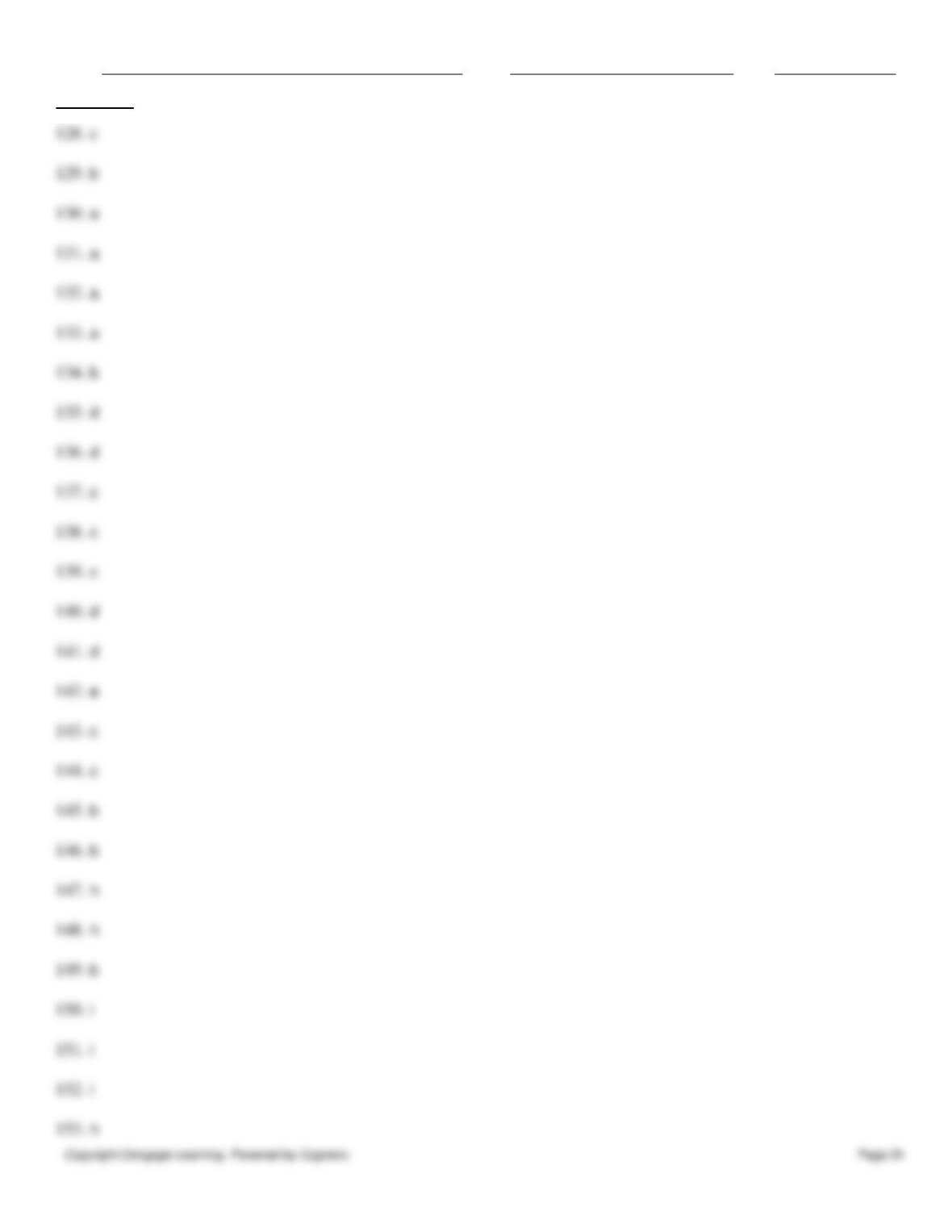
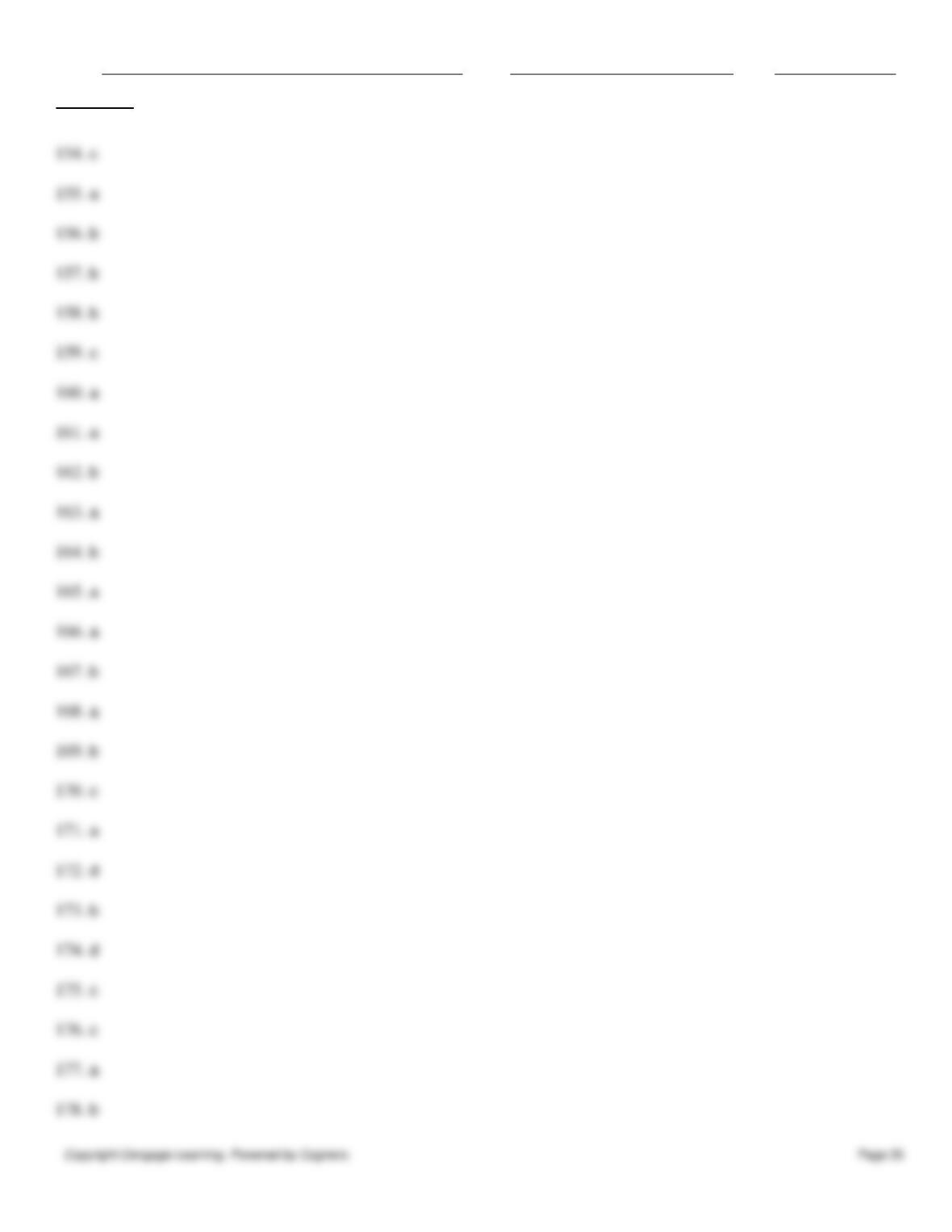
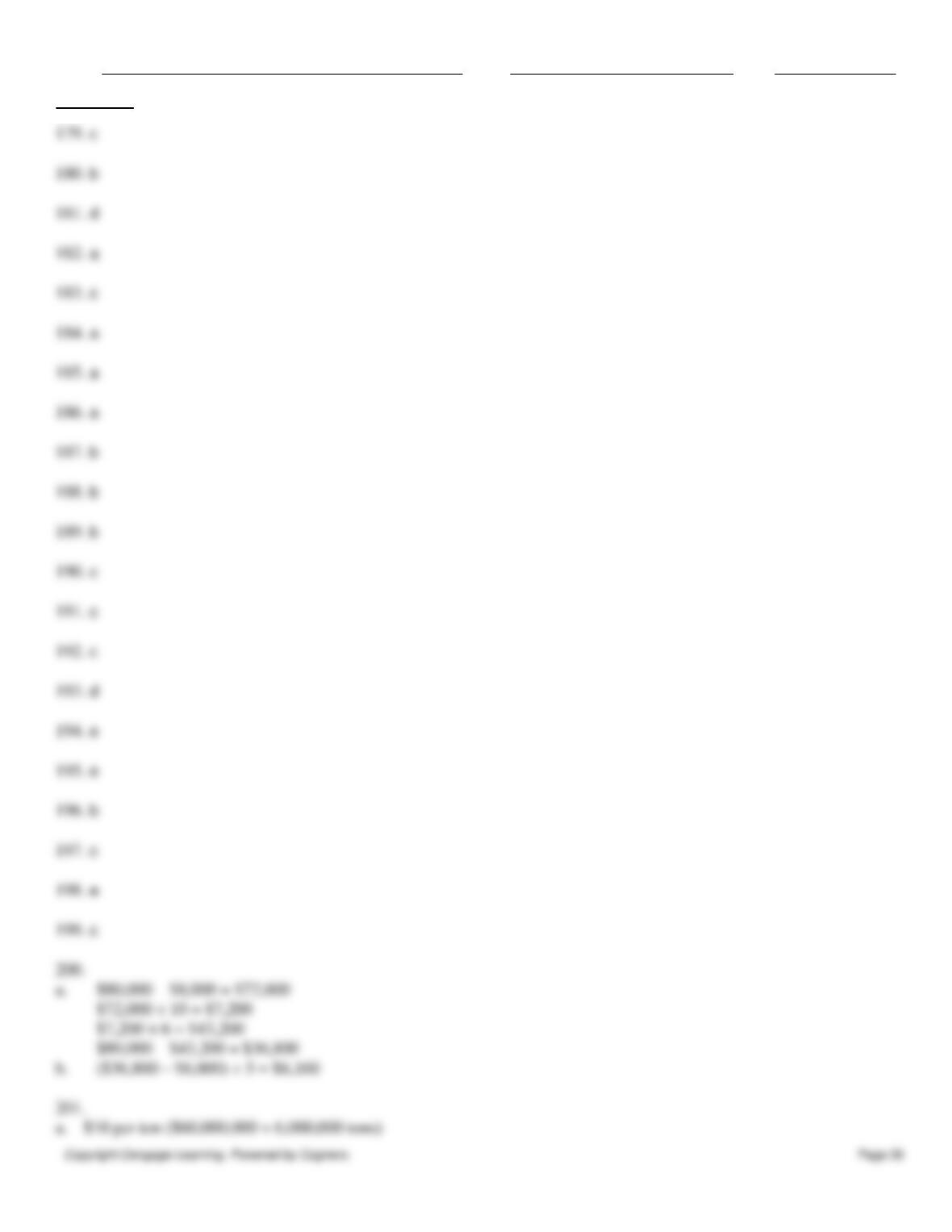
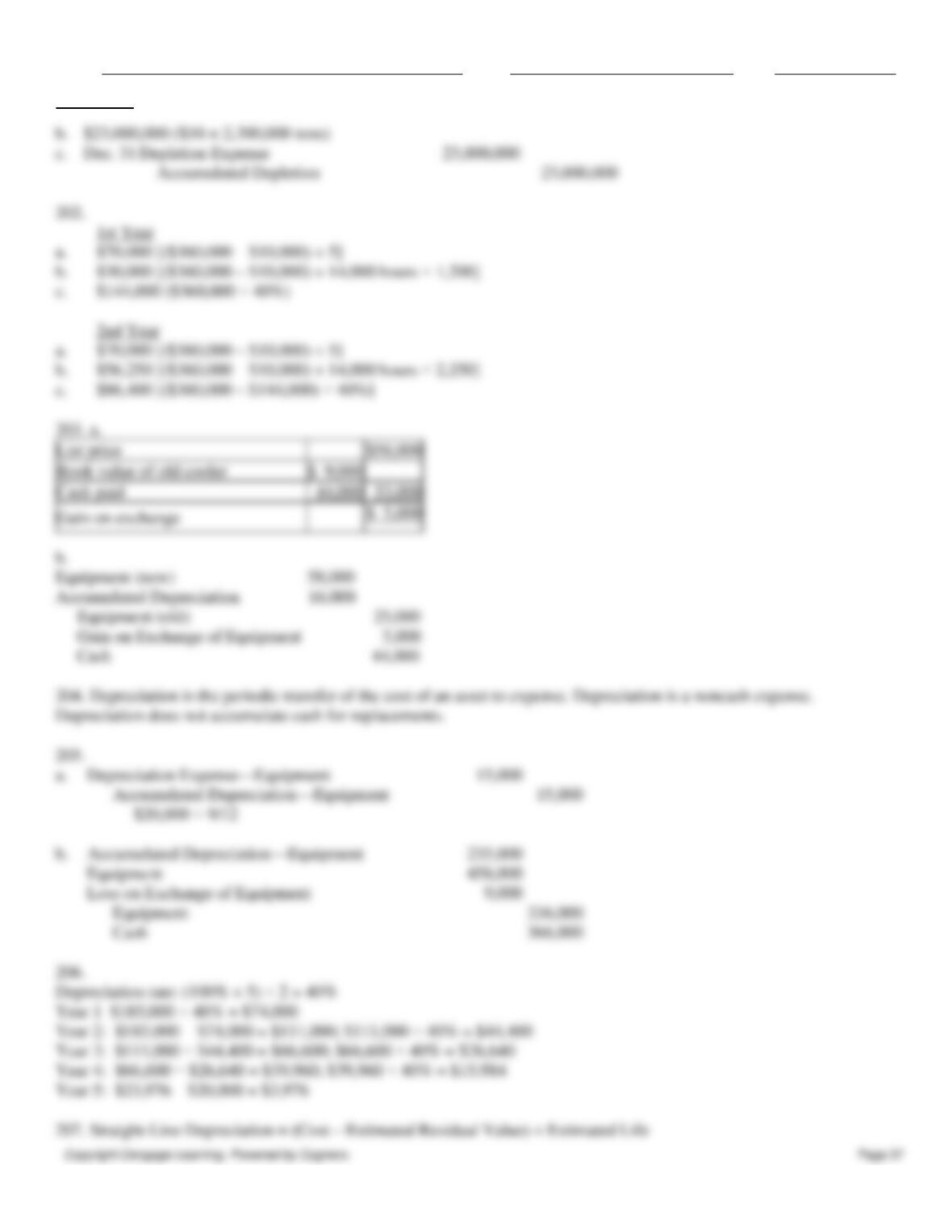
b.
Fixed Assets
c.
Intangible Assets
d.
Current Liabilities
e.
Long-Term Liabilities
f.
Owner’s Equity
g.
Revenues
h.
Operating Expenses
i.
Other Revenue and Expense
146. Accumulated Depreciation—Building
147. Depreciation Expense
148. Amortization Expense
149. Land Improvements

Name:
Class:
Date:
chapter 10
150. Gain on Sale of Equipment
151. Loss on Disposal of Asset
152. Loss from Impaired Goodwill
153. Research and Development Costs
Match each of the following costs with its classification and treatment (a–c) as a revenue or capital expenditure. Each
term may be used more than once.
a.
Ordinary maintenance and repairs to be treated as a revenue expenditure, increasing an expense account
b.
Asset improvements to be treated as a capital expenditure, decreasing an accumulated depreciation account
c.
Extraordinary repairs to be treated as a capital expenditure, increasing an asset account
154. Overhauling an engine in a large truck
155. Exterior and interior painting
156. Paving a new parking lot
157. New landscaping
158. Installing a new air conditioning system in an old building
159. Resurfacing a pool in an apartment building
160. Adding refrigerant to an air conditioning system
161. Fixing damage due to a car accident
Match each of the following costs related to XYZ Co.’s office building to its proper classification (a or b).
a.
Capital expenditure
b.
Revenue expenditure
162. Replaced a broken window
163. Replaced the roof that had been on the building for 23 years
164. Serviced all the air conditioners before summer started
165. Replaced the air conditioners in the customer service areas
166. Added a warehouse to the back of the building
167. Repainted the interior walls
168. Installed window shutters on all windows
Match each of the following items to the type of intangible asset (a–d) it represents.

Name:
Class:
Date:
chapter 10
a.
Patent
b.
Copyright
c.
Trademark
d.
Goodwill
169. Rights to sell a book and make a profit
170. McDonald’s golden arches
171. A new kitchen gadget that can be produced by only one company
172. Location of a company
173. iTunes music
174. Reputation of a company
175. Nike swoosh
176. Mickey Mouse
Match each of the following assets to its proper classification (a–d). Each classification may be used more than once.
a.
Fixed asset
b.
Intangible asset
c.
Natural resource
d.
None of these
177. Computer
178. Patent
179. Oil reserve
180. Goodwill
181. U.S. Treasury note
182. Land used for employee parking
183. Gold mine
Match each of the following costs associated with long-lived assets to the account (a–e) to which the cost would ultimately
be debited. Each account may be used more than once, and some accounts may not be used.
a.
Buildings
b.
Machinery and Equipment
c.
Land
d.
Land Improvements
e.
Other Expense

Name:
Class:
Date:
chapter 10
184. Fees paid to architect to design new office building
185. Cost of insurance during the construction of new office building
186. Interest on money borrowed to finance construction of new office building
187. Sales taxes paid on new factory equipment
188. Freight costs paid on purchase of new equipment
189. Repairs made to used office equipment
190. Costs to survey a new piece of land for a new business location
191. Costs of government permits required to develop land for a new business location
192. Purchase price of land purchased for new business site
193. Landscaping at new business location
194. Cost of lubricating oil purchased for periodic oil changes for equipment
195. Cost of repainting the trim on a building
196. Cost of special foundation for new equipment acquired
197. Attorney’s fee for title search of land
198. Cost of repairing vandalism damage to equipment during installation
199. Cost of landfill for building site
200. Equipment costing $80,000 with a useful life of 10 years and a residual value of $8,000 has been depreciated for 6
years by the straight-line method. Assume a fiscal year ending December 31.
a.
What is the book value at the end of the sixth year of use?
b.
If early in the seventh year it is estimated that the remaining useful life is 5 years
(instead of 4) and the residual value is $6,000, what is the amount of depreciation for
the seventh year?
201. Solare Company acquired mineral rights for $60,000,000. The diamond deposit is estimated at 6,000,000
tons. During the current year, 2,300,000 tons were mined and sold.
a. Determine the depletion rate.
b. Determine the amount of depletion expense for the current year.
c. Journalize the adjusting entry to recognize the depletion expense.
202. Equipment purchased at the beginning of the fiscal year for $360,000 is expected to have a useful life of 5 years, or
14,000 operating hours, and a residual value of $10,000. Compute the depreciation for the first and second years of use by

Name:
Class:
Date:
chapter 10
each of the following methods:
a. Straight-line
b. Units-of-activity (1,200 hours first year; 2,250 hours second year)
c. Double-declining-balance
203. On the first day of the fiscal year, a new walk-in cooler with a list price of $58,000 was acquired in exchange for an
old cooler and $44,000 cash. The old cooler had a cost of $25,000 and accumulated depreciation of $16,000. Assume the
transaction has commercial substance.
a. Determine the gain to be recorded on the exchange.
b. Journalize the entry for the exchange.
204. Comment on the validity of the following statements. “As an asset loses its ability to provide services, cash needs to
be set aside to replace it. Depreciation accomplishes this goal.”
205. On October 1, Sebastian Company acquired new equipment with a fair market value of $458,000. Sebastian received
a trade-in allowance of $92,000 on the old equipment of a similar type and paid cash of $366,000. The following
information about the old equipment is obtained from the account in the equipment ledger: Cost, $336,000; accumulated
depreciation on December 31, the end of the preceding fiscal year, $220,000; annual depreciation, $20,000. Assuming the
exchange has commercial substance, journalize the entries for: (a) the current depreciation of the old equipment to the
date of trade-in and (b) the exchange transaction on October 1.
206. A machine costing $185,000 with a 5-year life and $20,000 residual value was purchased on January 2. Compute
depreciation for each of the 5 years, using the double-declining-balance method.
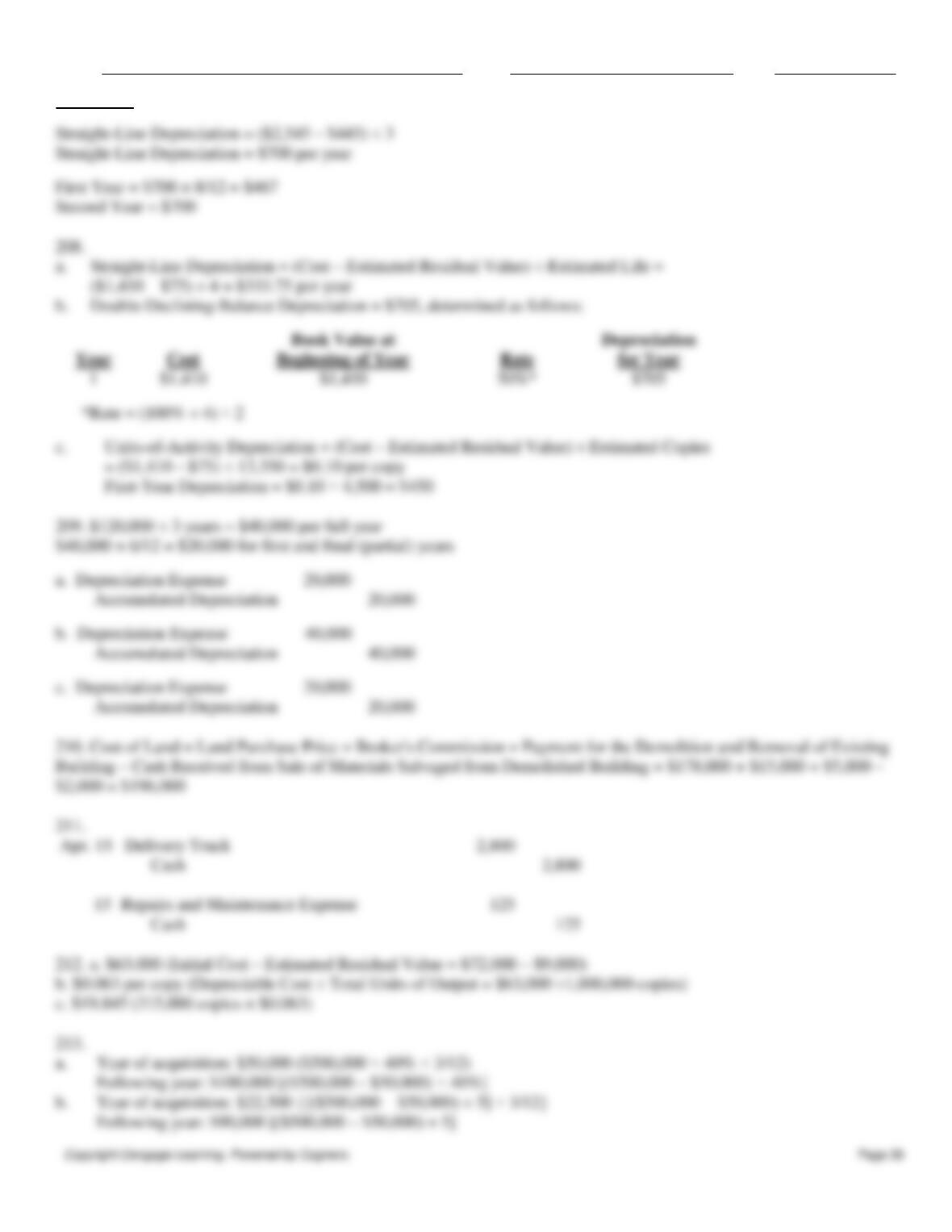
207. A copy machine acquired on May 1 with a cost of $2,545 has an estimated useful life of 3 years. Assuming that it
will have a residual value of $445, determine the depreciation for the first and second years by the straight-line method.
Round to the nearest whole dollar.
208. A copy machine acquired with a cost of $1,410 has an estimated useful life of 4 years. It is also expected to have a
useful operating life of 13,350 copies. Assuming that it will have a residual value of $75, determine the depreciation for
the first year by the following methods:
a. Straight-line
b. Double-declining-balance
c. Units-of-activity (4,500 copies were made the first year)
209. On July 1, Andrew Company purchased equipment at a cost of $150,000 that has a depreciable cost of $120,000 and
an estimated useful life of 3 years or 60,000 hours
Using straight-line depreciation, journalize the entry to record depreciation expense for (a) the first year, (b) the second
year, and (c) the last year.
210. Based on the following data, determine the cost of the land to be reported on the balance sheet.
Land purchase price
$178,000
Broker’s commission
15,000
Payment for demolition and removal of existing building
5,000
Cash received from sale of materials salvaged from demolished building
2,000
211. On April 15, Compton Co. paid $2,800 to upgrade a delivery truck and $125 for an oil change. Journalize the entries
for the upgrade to the delivery truck and oil change expenditures.

Name:
Class:
Date:
chapter 10
212. Copy equipment was acquired at the beginning of the year at a cost of $72,000 that has an estimated residual value of
$9,000 and an estimated useful life of 5 years. It is estimated that the machine will output an estimated 1,000,000
copies. This year, 315,000 copies were made. Determine the (a) depreciable cost, (b) depreciation rate, and (c) units–of–
activity depreciation for the year.
213. Determine the depreciation for the year of acquisition and for the following year of a fixed asset acquired on October
1 for $500,000 with an estimated life of 5 years, and residual value of $50,000, using (a) the double-declining-balance
method and (b) the straight-line method. Assume a fiscal year ending December 31.
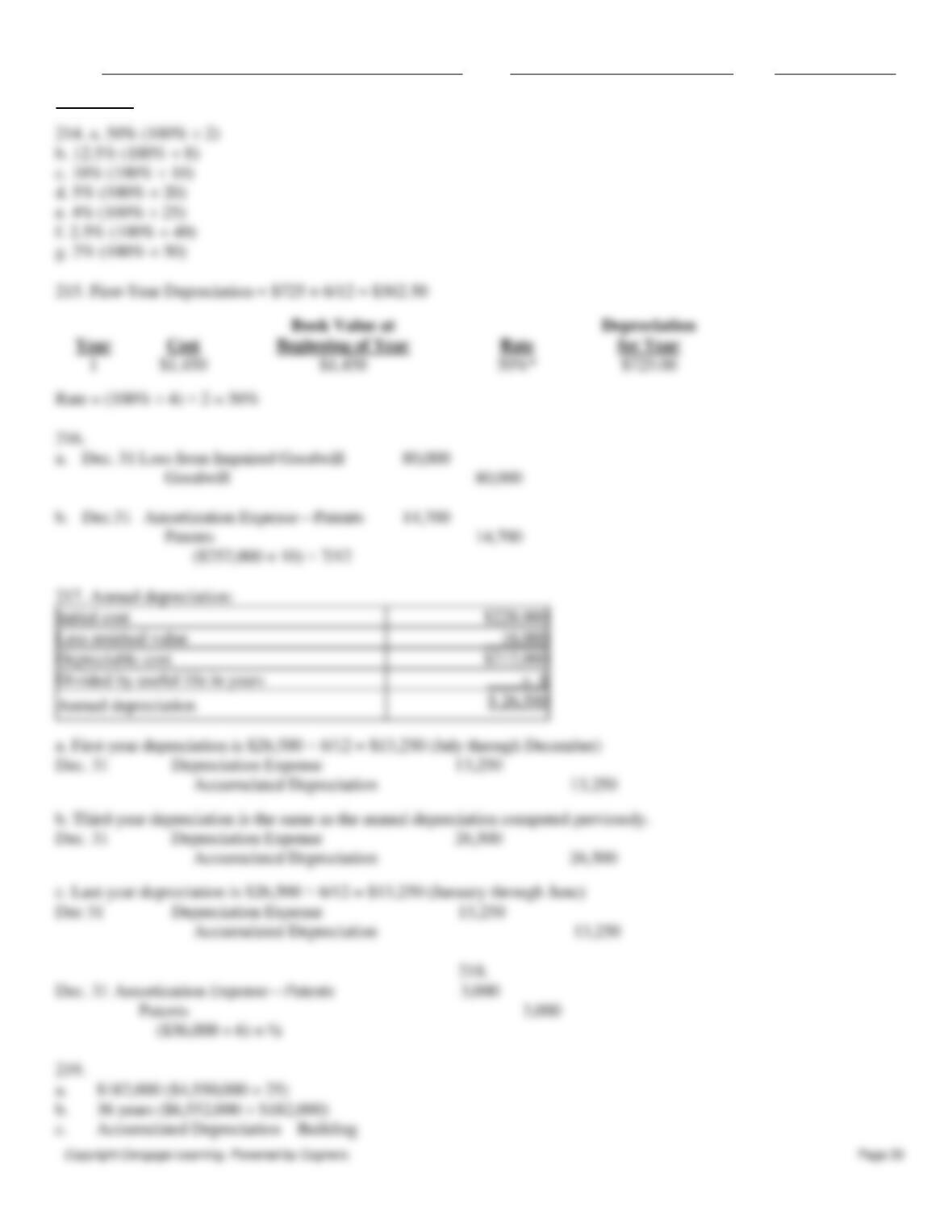
214. Convert each of the following estimates of useful life to a straight-line depreciation rate, stated as a percentage.
a. 2 years
b. 8 years
c. 10 years
d. 20 years
e. 25 years
f. 40 years
g. 50 years
215. A copy machine acquired on July 1 with a cost of $1,450 has an estimated useful life of 4 years. Assuming that it will
have a residual value of $250, determine the depreciation for the first year by the double-declining-balance method.
216. On December 31, Bowman Company estimated that goodwill of $80,000 was impaired. On June 1, a patent with an
estimated useful economic life of 10 years was acquired for $252,000.
a. Journalize the adjusting entry on December 31 for the impaired goodwill.
b. Journalize the adjusting entry on December 31 for the amortization of the patent rights.
217. On July 1, Harding Construction purchases a bulldozer for $228,000. The equipment has an 8-year life with a
residual value of $16,000. Harding uses straight-line depreciation.
a. Compute the depreciation expense, and journalize the depreciation entry for the first year ending December 31.
b. Compute the third year’s depreciation expense, and journalize the depreciation entry for the third year
ending December 31.
c. Compute the last year’s depreciation expense, and journalize the depreciation entry for the last year.
218. On July 1, Sterns Co. acquired patent rights for $36,000. The patent has a useful life of 6 years and a legal life of 15
years. Journalize the adjusting entry on December 31 to recognize the amortization.
219. A number of major structural repairs completed at the beginning of the current fiscal year at a cost of $1,000,000 are
expected to extend the life of a building 10 years beyond the original estimate. The original cost of the building was
$6,552,000, and it has been depreciated by the straight-line method for 25 years. Estimated residual value is negligible
and has been ignored. The related accumulated depreciation account after the depreciation adjustment at the end of the
preceding fiscal year is $4,550,000.
a.
What has the amount of annual depreciation been in past years?
b.
What was the original life estimate of the building?
c.
To what account should the $1,000,000 be debited?
d.
What is the book value of the building after the extraordinary repairs have been made?
e.
What is the expected remaining life of the building after the extraordinary repairs have been made?
f.
What is the amount of straight-line depreciation for the current year, assuming that the repairs were
Name:
Class:
Date:
chapter 10
completed at the very beginning of the current year? Round to the nearest dollar.
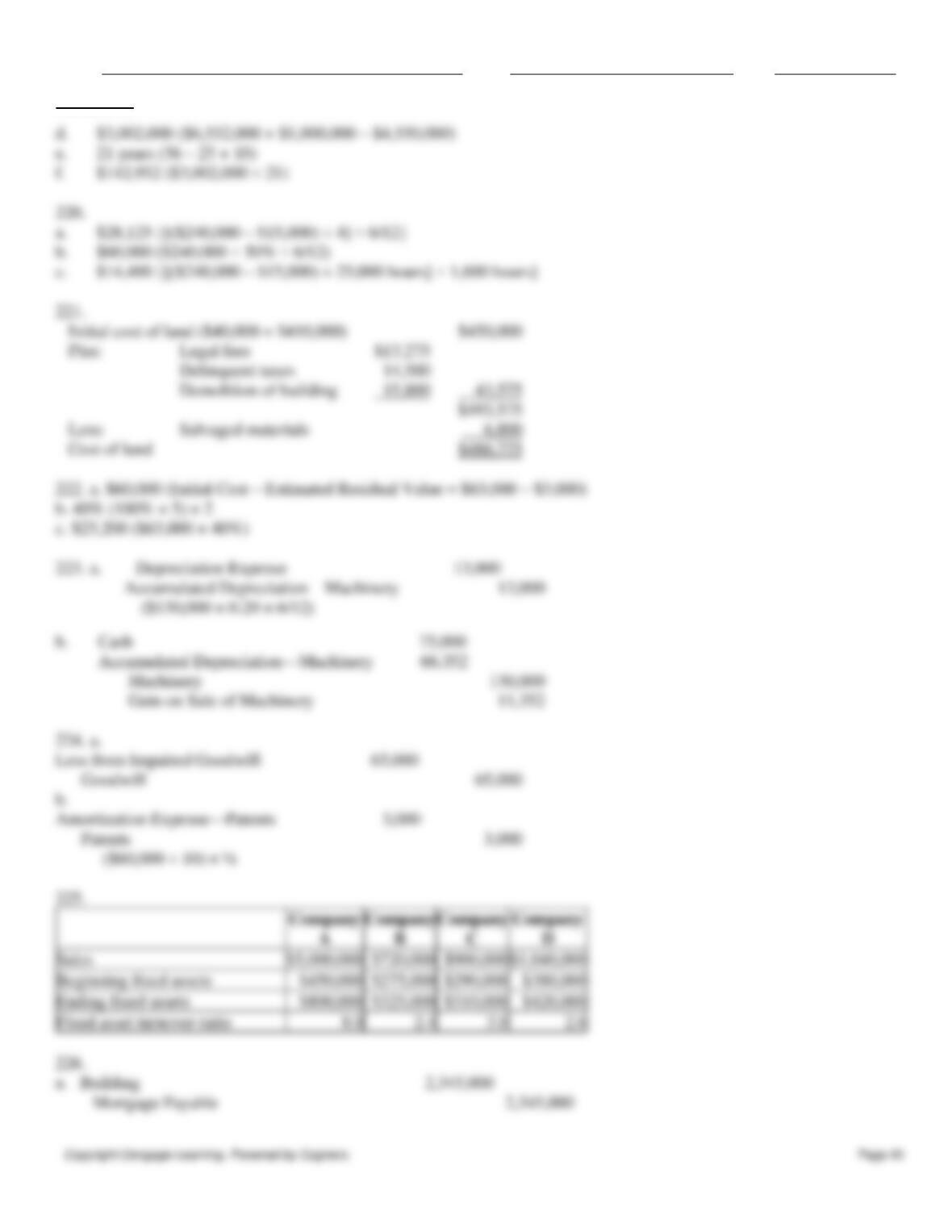
220. Machinery is purchased on July 1 of the current fiscal year for $240,000. It is expected to have a useful life of 4
years, or 25,000 operating hours, and a residual value of $15,000. Compute the depreciation for the last 6 months of the
current fiscal year ending December 31 by each of the following methods:
a. Straight-line
b. Double-declining-balance
c. Units-of-activity (used for 1,600 hours during the current year)
221. Falcon Company acquired an adjacent lot to construct a new warehouse, paying $40,000 and giving a short-term note
for $410,000. Legal fees paid were $13,275, delinquent taxes assessed were $14,500, and fees paid to remove an old
building from the land were $15,800. Materials salvaged from the demolition of the building were sold for $6,800. A
contractor was paid $890,000 to construct the new warehouse. Determine the cost of the land to be reported on the
balance sheet and show your work.
222. Computer equipment was acquired at the beginning of the year at a cost of $63,000 that has an estimated residual
value of $3,000 and an estimated useful life of 5 years. Determine the (a) depreciable cost, (b) double-declining-balance
rate, and (c) double-declining-balance depreciation for the first year.
223. Williams Company acquired machinery on July 1, Year 1, at a cost of $130,000. The estimated useful life of the
machinery was 10 years, and the estimated residual value was $10,000. Williams uses the double-declining-balance
method of depreciation. On October 1, Year 4, Williams sold the equipment for $75,000.
a. Journalize the entry for the depreciation on this machinery for Year 1.
b. Journalize the entry for the sale of the machinery.
224. On December 31, it was estimated that goodwill of $65,000 was impaired. On July 1, a patent with an estimated
useful economic life of 10 years was acquired for $60,000.
a. Journalize the adjusting entry on December 31 for the impaired goodwill.
b. Journalize the adjusting entry on December 31 for the amortization of the patent rights.
225. Fill in the missing numbers using the formula for the fixed asset turnover ratio:
Company A
Company B
Company C
Company D
Sales
$5,000,000
$720,000
$900,000
?
Beginning fixed assets
$450,000
$275,000
?
$380,000
Ending fixed assets
$800,000
?
$310,000
$420,000
Fixed asset turnover ratio
?
2.4
3.0
2.6
226. Journalize each of the following transactions:
a.
A wing costing $2,345,000 was added to the building. A new mortgage was issued for the cost.
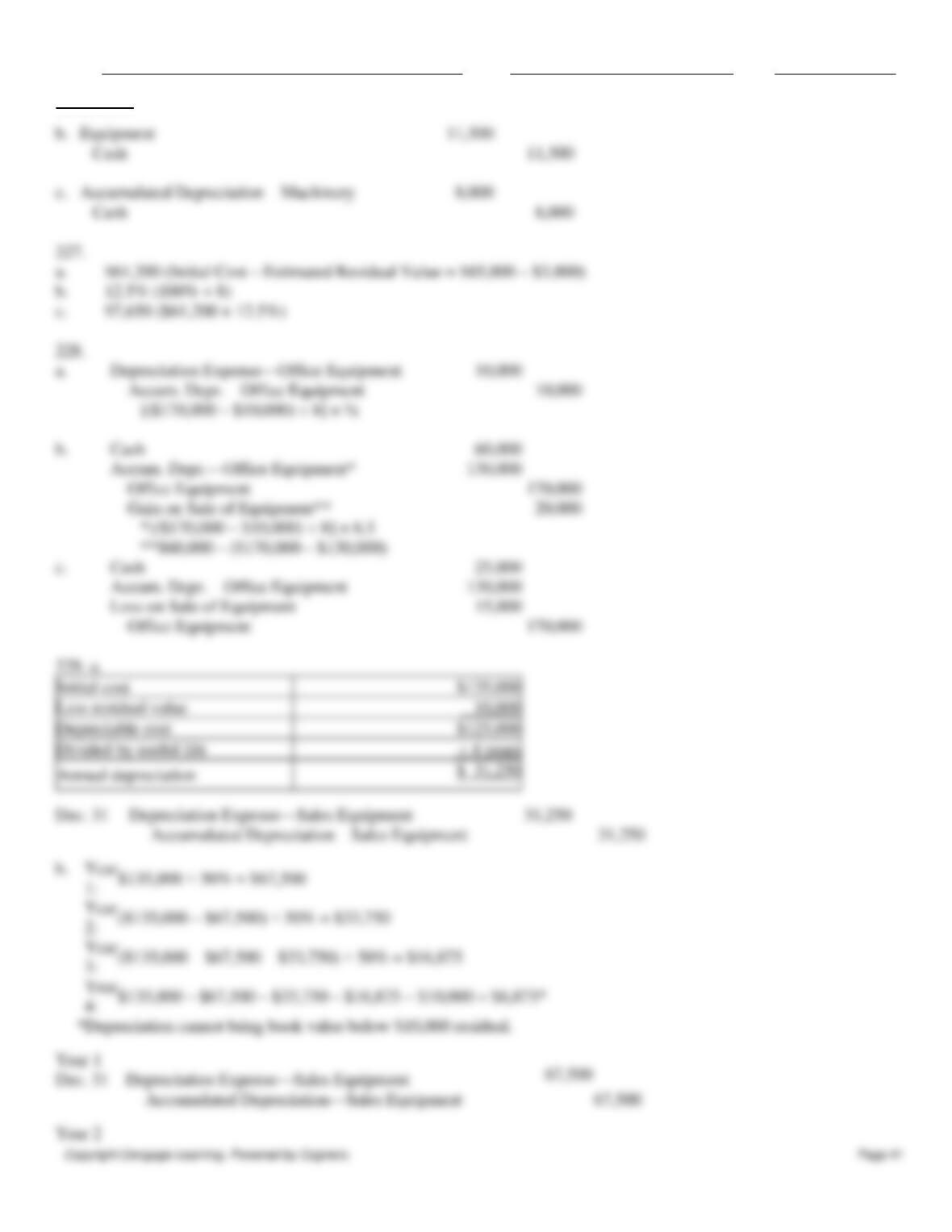
b.
Equipment was upgraded to increase its capacity to produce widgets. The upgrade cost of
$11,500 was paid in cash.
c.
A major overhaul costing $8,000 on a machine increased the useful life by 4 years. The payment
was made in cash.
227. Computer equipment was acquired at the beginning of the year at a cost of $65,000 that has an estimated residual
value of $3,800 and an estimated useful life of 8 years. Determine the (a) depreciable cost, (b) straight-line rate, and (c)
annual straight-line depreciation.
Name:
Class:
Date:
chapter 10
228. Computer equipment (office equipment) purchased 6½ years ago for $170,000, with an estimated life of 8 years and
a residual value of $10,000, is now sold. (Appropriate entries for depreciation had been made for the first 6 years of use.)
a. Journalize the depreciation for the one-half year prior to the sale, using the straight-line method.
b. Journalize the sale of the equipment, assuming it is sold for $60,000 cash.
c. Journalize the sale of the equipment, assuming it is sold for $25,000 cash.
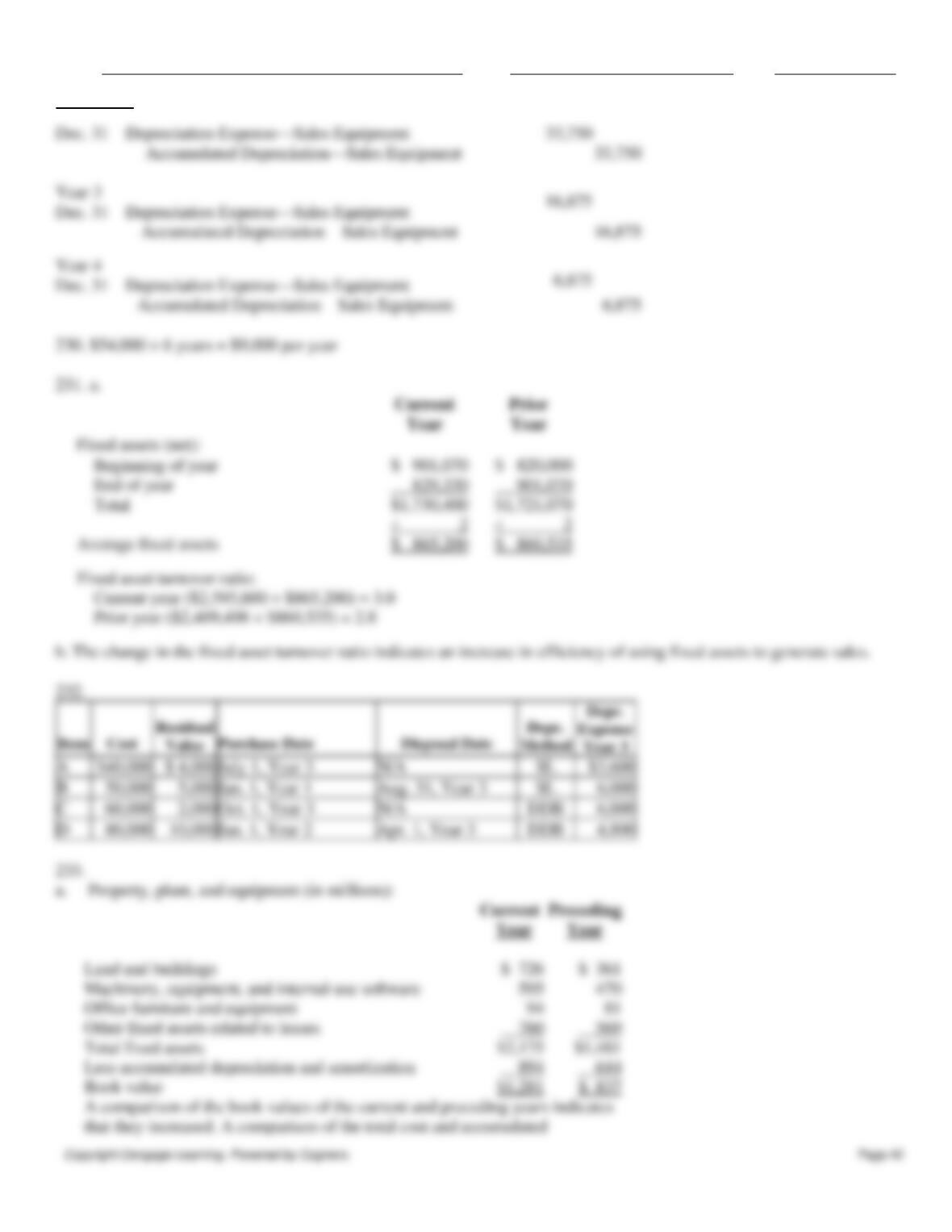
229. On January 1, Golden Sales bought $135,000 in fixed assets associated with sales equipment. The residual value of
these assets is estimated at $10,000 at the end of their 4-year service life. Golden Sales managers want to evaluate the
options of depreciation.
a. Compute the annual straight-line depreciation, and journalize the sample depreciation entry to be recorded at the end of
each of the 4 years.
b. Compute the double-declining-balance depreciation, and journalize the depreciation entries to be recorded at the end of
each of the 4 years.
230. A machine costing $57,000 with a 6-year life and $54,000 depreciable cost was purchased on January 1. Compute
the yearly depreciation expense using straight-line depreciation.
231. Financial statement data for the years ended December 31 for Parker Corporation are as follows:
Current Year
Prior Year
Sales
$2,595,600
$2,409,498
Fixed assets (net):
Beginning of year
901,070
820,000
End of year
829,330
901,070
a. Determine the fixed asset turnover ratio for the current and prior years.
b. Does the change in fixed asset turnover ratio from the prior year to the current year indicate a favorable or unfavorable
change?
232. For each of the following fixed assets, determine the depreciation expense for Year 3.
Disposal date is N/A if asset is still in use.
Method: SL = straight-line; DDB = double-declining-balance
Assume the estimated life is 5 years for each asset.
Item
Cost
Residual
Value
Purchase Date
Disposal Date
Depr. Method
Depr.
Expense Year 3
A
$40,000
$ 4,000
July 1, Year 3
N/A
SL
B
50,000
5,000
Jan. 1, Year 1
Aug. 31,Year 3
SL
C
60,000
2,000
Oct. 1, Year 3
N/A
DDB
D
80,000
10,000
Jan. 1, Year 2
Apr. 1, Year 3
DDB
233. The following information was taken from a recent annual report of Harrison Company (in millions):
Current Year
Preceding Year
Land and buildings
$726
$361
Machinery, equipment, and internal-use software
595
470
Office furniture and equipment
94
81
Other fixed assets related to leases
760
569
Accumulated depreciation and amortization
894
644
a.
Compute the book value of the fixed assets for the current year and the preceding year
and explain the differences, if any.

Name:
Class:
Date:
chapter 10
b.
Would you normally expect the book value of fixed assets to increase or decrease during
the year?
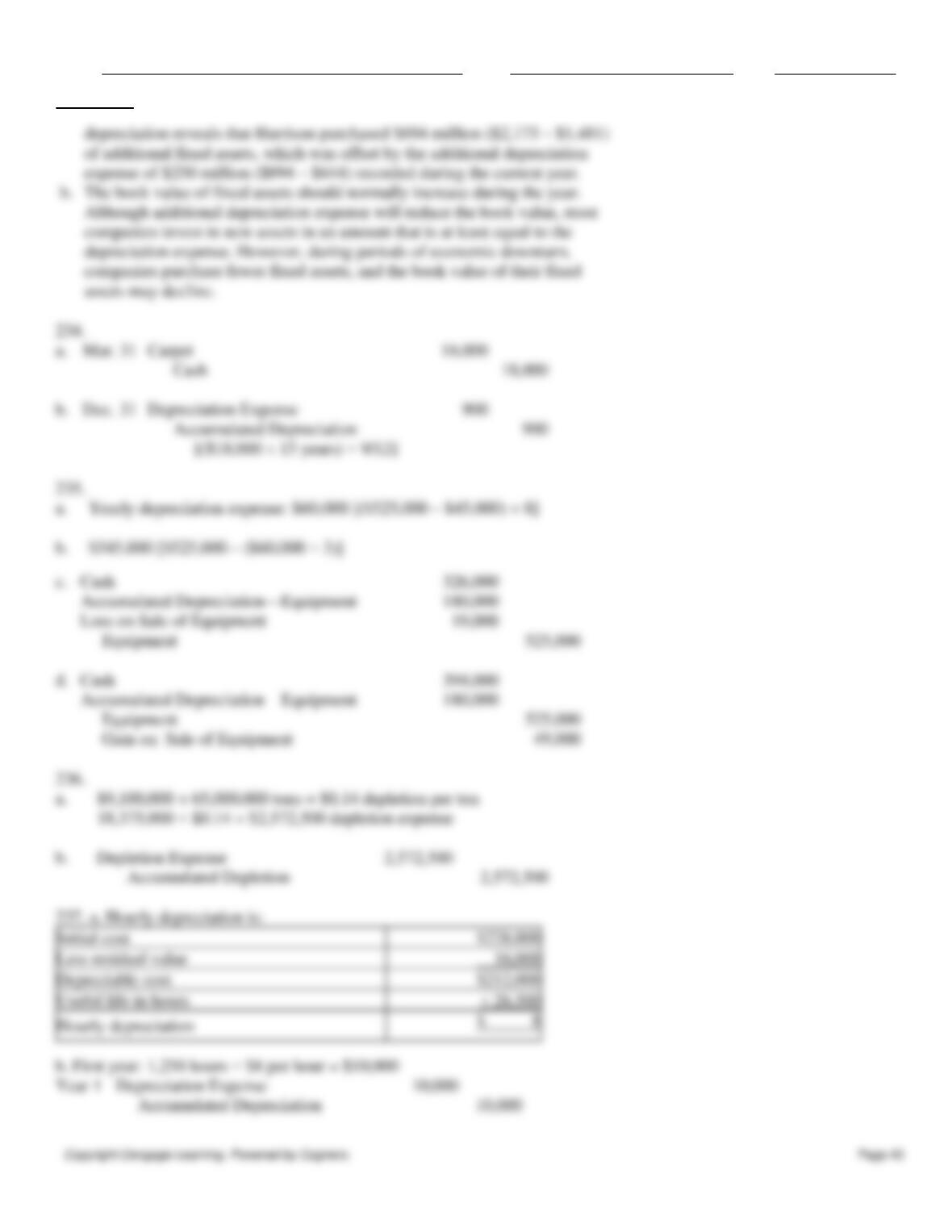
234. Champion Company purchased and installed carpet in its new general offices on March 31 for a total cost of
$18,000. The carpet is estimated to have a 15-year useful life and no residual value.
a.
Journalize the March 31 purchase of the new carpet.
b.
Journalize the December 31 adjusting entry for the partial-year depreciation of the
carpet, assuming that Champion Company uses the straight-line method.
235. Equipment acquired on January 2, Year 1, at a cost of $525,000 has an estimated useful life of 8 years and an
estimated residual value of $45,000.
a.
Compute the annual amount of depreciation for the first 3 years, assuming the straight-
line method of depreciation is used.
b.
Determine the book value of the equipment on January 1, Year 4.
c.
Assuming that the equipment is sold on January 2, Year 4, for $326,000, journalize the
entry for the sale.
d.
Assuming that the equipment is sold on January 2, Year 4, for $394,000, journalize the
entry for the sale.
236. Chasteen Company acquired mineral rights for $9,100,000. The mineral deposit is estimated at 65,000,000 tons.
During the current year, 18,375,000 tons were mined and sold.
a. Determine the amount of depletion expense for the current year.
b. Journalize the adjusting entry to recognize the depletion expense.
237. On July 1, Hartford Construction purchases a bulldozer for $228,000. The equipment has a 9-year life with a residual
value of $16,000. Hartford uses the units-of-activity method of depreciation, and the bulldozer is expected to yield 26,500
operating hours.
a. Compute the depreciation expense per hour of operation.
b. The bulldozer is operated 1,250 hours in the first year, 2,755 hours in the second year, and 1,225 hours in the third year
of operations. Journalize the depreciation expense for each year.
238. Machinery acquired at a cost of $80,000 and on which there is accumulated depreciation of $55,000 (including
depreciation for the current year to date) is exchanged for similar machinery. Assume that the transaction has commercial
substance. Journalize the entries for the exchange of the machinery under each of the following assumptions:
a. Price of new, $120,000; trade-in allowance on old, $4,000; balance paid in cash.
b. Price of new, $120,000; trade-in allowance on old, $34,000; balance paid in cash.
239. A double-declining-balance rate for computing depreciation expense is determined by doubling the straight-line rate.
Assuming that an asset has a useful life of 25 years, determine the rate to be used under the double-declining-balance
method.
240. An asset was purchased for $58,000 and originally estimated to have a useful life of 10 years with a residual value of
$3,000. After 2 years of straight-line depreciation, it was determined that the remaining useful life of the asset was only 2
years with a residual value of $2,000.
a. Determine the amount of the annual depreciation for the first 2 years.
b. Determine the book value at the end of Year 2.
Name:
Class:
Date:
chapter 10
c. Determine the depreciation expense for each of the remaining years after revision.
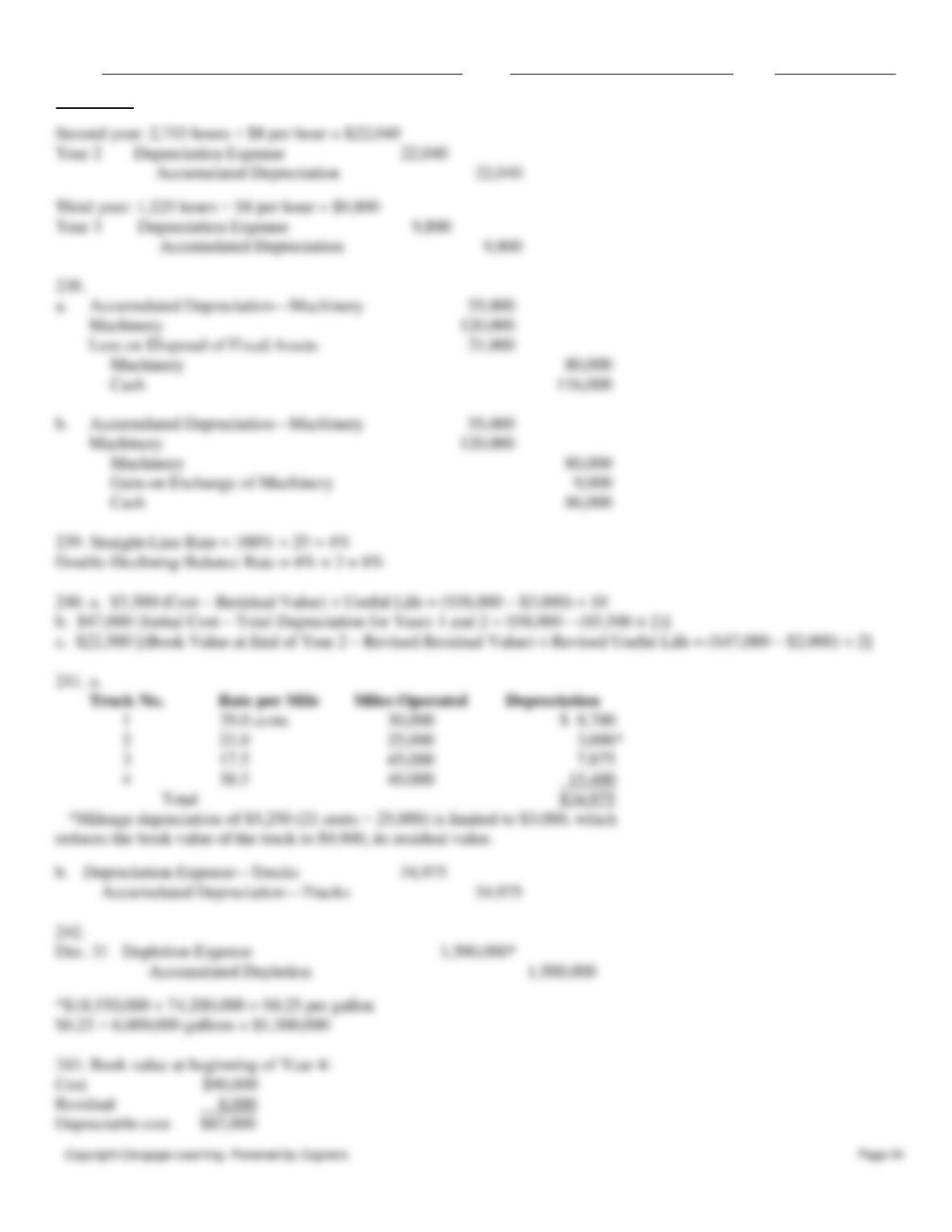
241. Prior to adjustment at the end of the year, the balance in Trucks is $300,900 and the balance in Accumulated
Depreciation—Trucks is $88,200. Details of the subsidiary ledger are as follows:
Truck
No.
Cost
Estimated
Residual Value
Estimated Useful
Life
Accumulated
Depreciation at
Beginning of Year
Miles Operated
During Year
1
$100,000
$13,000
300,000
—
30,000
2
72,900
9,900
300,000
$60,000
25,000
3
38,000
3,000
200,000
8,050
45,000
4
90,000
13,000
200,000
20,150
40,000
a.
Based on the units-of-activity method, determine the depreciation rates per mile and the
amount to be credited to the Accumulated Depreciation section of each of the
subsidiary accounts for the miles operated during the current year. Round rates to 1/10
of a cent.
b.
Journalize the adjusting entry to record depreciation for the year.
242. Carter Co. acquired drilling rights for $18,550,000. The oil deposit is estimated at 74,200,000 gallons. During the
current year, 6,000,000 gallons were drilled. Journalize the adjusting entry at December 31 to recognize the depletion
expense.
243. Equipment was purchased on January 5, Year 1, at a cost of $90,000. The equipment had an estimated useful life of 8
years and an estimated residual value of $8,000.
After using the equipment for 3 years, the useful life was revised to a total of 10 years and the residual value was reduced
to $2,004.
Determine the straight-line depreciation expense for Year 4 and the following years.
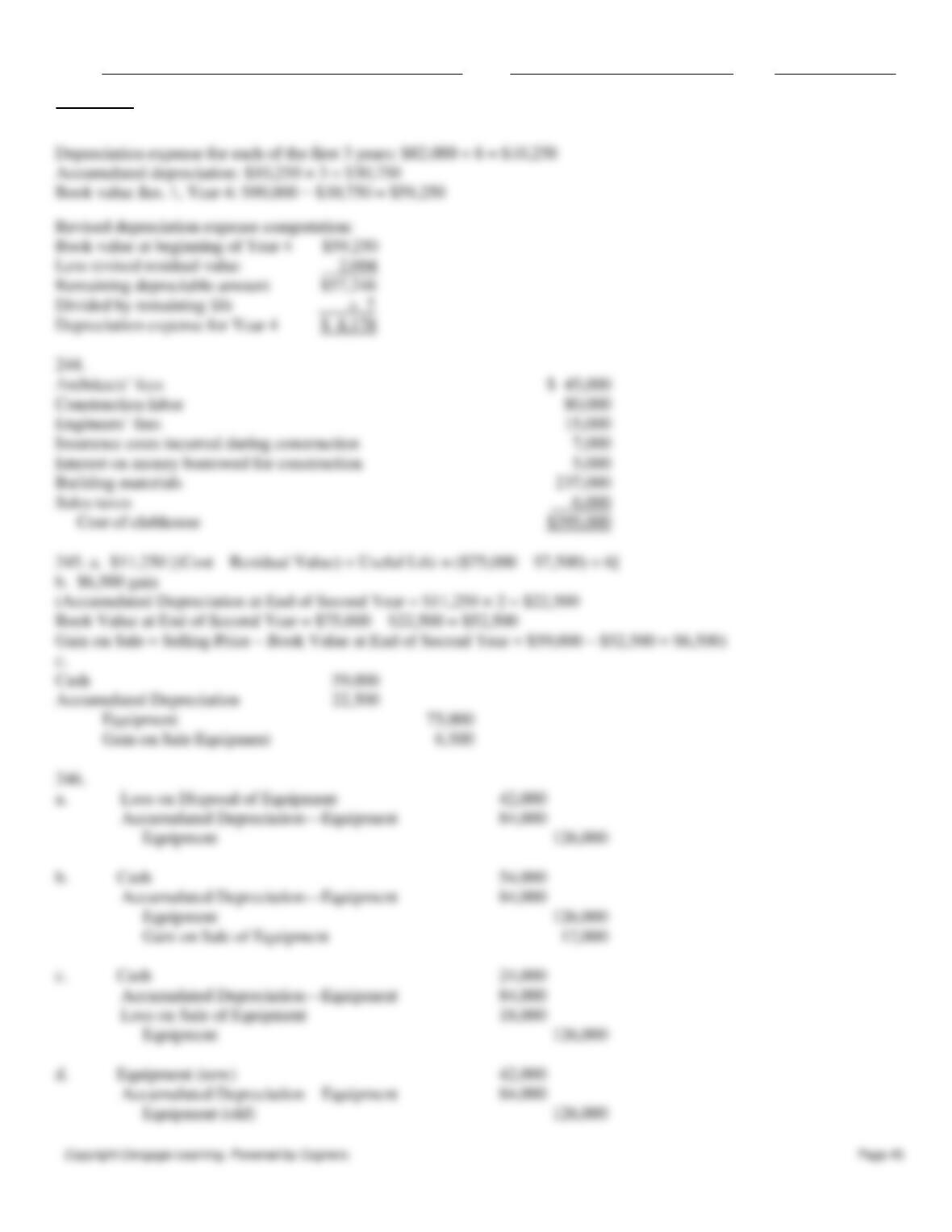
244. Eagle Country Club has acquired a lot to construct a clubhouse. Eagle had the following costs related to the
construction:
Architects’ fees
$ 45,000
Construction labor
80,000
Engineers’ fees
15,000
Fences around building
9,000
Grading and leveling
10,000
Insurance costs incurred during construction
7,000
Interest on money borrowed for construction
5,000
Land
73,000
Building materials
237,000
Sales taxes
6,000
Trees and shrubs
6,000
Determine the cost of the clubhouse to be reported on the balance sheet.
245. Equipment was acquired at the beginning of the year at a cost of $75,000. The equipment was depreciated using the
straight-line method based on an estimated useful life of 6 years and an estimated residual value of $7,500.
a.
Compute the depreciation expense for the first year.
b.
Assuming the equipment was sold at the end of the second year for $59,000, determine

Name:
Class:
Date:
chapter 10
the gain or loss on sale of the equipment.
c.
Journalize the entry for the sale.
246. Equipment acquired at a cost of $126,000 has a book value of $42,000. Journalize the disposal of the equipment
under the following independent assumptions:
a.
The equipment had no market value and was discarded.
b.
The equipment is sold for $54,000.
c.
The equipment is sold for $24,000.
d.
The equipment is traded in for a similar asset. The list price of the new equipment is
$63,000. The buyer gave no cash in the exchange. The transaction lacks commercial
substance.
Name:
Class:
Date:
chapter 10
Answer Key
Name:
Class:
Date:
chapter 10
Name:
Class:
Date:
chapter 10
Name:
Class:
Date:
chapter 10
Name:
Class:
Date:
chapter 10
Name:
Class:
Date:
chapter 10
Name:
Class:
Date:
chapter 10
Name:
Class:
Date:
chapter 10
Name:
Class:
Date:
chapter 10
Name:
Class:
Date:
chapter 10
Name:
Class:
Date:
chapter 10
Name:
Class:
Date:
chapter 10
Name:
Class:
Date:
chapter 10
Name:
Class:
Date:
chapter 10
Name:
Class:
Date:
chapter 10
Name:
Class:
Date:
chapter 10
Name:
Class:
Date:
chapter 10

Name:
Class:
Date:
chapter 10